Hubbry Logo
Dutch Baroque architectureDutch Baroque architectureMain
Open search
Dutch Baroque architecture
Community hub
Dutch Baroque architecture
logo
8 pages, 0 posts
0 subscribers
Be the first to start a discussion here.
Dutch Baroque architecture
from Wikipedia
Royal Palace of Amsterdam: Jacob van Campen, 1646.
Oostkerk, Middelburg: Arent van 's-Gravesande [nl], 1667.

Dutch Baroque architecture is a variety of Baroque architecture that flourished in the Dutch Republic and its colonies during the Dutch Golden Age of the 17th century. (Dutch painting during the period is covered by Dutch Golden Age painting).

Like contemporary developments in England, Dutch Palladianism is marked by sobriety and restraint. The architecture of the first republic in Northern Europe was meant to reflect democratic values by quoting extensively from classical antiquity. It found its impetus in the designs of Hendrick de Keyser, who was instrumental in establishing a Venetian-influenced style into early 17th-century architecture through new buildings like the Noorderkerk ("Northern church", 1620–1623) and Westerkerk ("Western church", 1620–1631) in Amsterdam. In general, architecture in the Low Countries, both in the Counter-Reformation-influenced south and Protestant-dominated north, remained strongly invested in northern Italian Renaissance and Mannerist forms that predated the Roman High Baroque style of Borromini and Bernini. Instead, the more austere form practiced in the Dutch Republic was well suited to major building patterns: palaces for the House of Orange and new civic buildings, uninfluenced by the Counter-Reformation style that made some headway in Antwerp.

The major exponents of the mid-17th century, Jacob van Campen and Pieter Post, adopted de Keyser's forms for such eclectic elements as giant order pilasters, gable roofs, central pediments, and vigorous steeples. Brought together in a coherent combination, these stylistic developments anticipated Christopher Wren's Classicism. The most ambitious constructions of the period included the seats of self-government in Amsterdam (1646) and Maastricht (1658), designed by Campen and Post, respectively. On the other hand, the residences of the House of Orange are closer to a typical burgher mansion than to a royal palace. Two of these, Huis ten Bosch and Mauritshuis, are symmetrical blocks with large windows, stripped of ostentatious Baroque flourishes. The same austerely geometrical effect is achieved without great cost or pretentious effects at the stadtholder's summer residence of Het Loo.

The Dutch Republic was one of the great powers of 17th-century Europe and its influence on European architecture was significant. Dutch architects were employed on important projects in Northern Germany, Scandinavia and Russia, disseminating their ideas in those countries. The Dutch Colonial architecture, once flourishing in the Hudson River Valley and associated primarily with red-brick gabled houses, may still be seen in Willemstad, Curaçao, although painted with more varied colors.

[edit]

References

[edit]
Revisions and contributorsEdit on WikipediaRead on Wikipedia
from Grokipedia
Dutch Baroque architecture refers to the that emerged in the during the , particularly amid the , blending classical elements with a restrained expression suited to the Protestant ethos and burgeoning mercantile wealth of the . This period, spanning roughly from 1600 to 1750, marked a shift from earlier Gothic and Mannerist influences toward , , and functional elegance, distinguishing it from the more exuberant Catholic styles in , , and . Fueled by economic prosperity from global trade and independence from Spanish rule following the , the style emphasized practicality and civic pride in public buildings, town halls, and merchant residences along Amsterdam's canal rings. Key characteristics include exteriors of red brick or stone with modest classical ornamentation, such as pilasters, pediments, and stepped gables, often arranged in symmetrical facades with central projections to convey balance and restraint rather than dramatic theatricality. , by contrast, could feature more opulent details like revetments, work, gilded accents, and coffered ceilings, reflecting the wealth of patrons while adhering to Protestant by avoiding overt religious . Buildings typically followed a tripartite layout with a , main , and upper level, incorporating large windows for and functional spaces like grand halls or . Prominent architects shaped this style, with Hendrick de Keyser pioneering the transition through works like the Westerkerk in Amsterdam (1620–1631), which exemplifies early Baroque with its tall tower and brick facade. Jacob van Campen, often credited with introducing Dutch Classicism—a refined Baroque variant—influenced by Italian Renaissance masters like Palladio, designed iconic structures such as the Royal Palace of Amsterdam (originally the Town Hall, 1648–1655) and collaborated on the Mauritshuis in The Hague (1633–1636), both showcasing symmetrical proportions and classical columns. Pieter Post, working alongside van Campen, contributed to the Mauritshuis and other projects, further emphasizing geometric precision. Notable examples also include the Nieuwe Kerk in (1645–1649) by van Campen, featuring Ionic columns, vaulted interiors, and a wooden central to Protestant worship, and the canal houses of , which adapted motifs to narrow urban plots for merchant elites. These structures not only served administrative and residential purposes but also symbolized the Republic's stability and cultural sophistication during a time of rapid and artistic flourishing.

Historical Context

The Dutch Golden Age

The 17th-century Dutch Republic, during its Golden Age, underwent a profound economic transformation fueled by maritime trade, shipping innovations, and colonial enterprises. The founding of the Dutch East India Company (VOC) in 1602 marked a cornerstone of this prosperity, as it received a monopoly on Dutch trade with Asia and rapidly expanded operations, dispatching numerous ships and establishing outposts that funneled spices, textiles, and other goods into European markets. This commercial dominance positioned the Republic as the epicenter of global trade, with Amsterdam serving as the primary entrepôt where merchants amassed fortunes through re-exportation and financial services, contributing to an overall economic surge that doubled fiscal revenues in key provinces like Holland between 1590 and 1609. This economic vitality spurred rapid and across the , particularly in port cities that became magnets for immigrants, laborers, and traders. exemplified this trend, growing from roughly 30,000 residents in 1580 to over 200,000 by 1660, driven by inflows from rural areas, religious refugees, and international merchants seeking opportunities in the burgeoning . By the mid-17th century, more than 60% of Holland's population resided in urban settings, with the province alone boasting around 540,000 city dwellers by 1675; this demographic pressure, coupled with wealth accumulation, created an urgent demand for expanded , including warehouses, halls, and to accommodate the swelling populace and support commercial activities. The socio-cultural landscape was profoundly shaped by the Calvinist Reformation, which permeated the Republic's predominantly Protestant society and instilled a preference for architectural restraint over the extravagant opulence characteristic of Catholic Baroque styles elsewhere in Europe. Calvinist doctrine, emphasizing simplicity, moral sobriety, and the primacy of the word over visual splendor, fostered a "restrained Baroque" or Dutch Classicism that prioritized functional elegance and subdued ornamentation in public and private buildings, reflecting a cultural aversion to perceived excess while still allowing for expressions of civic pride. Key milestones underscored this era's trajectory: the with in 1609 provided a vital respite from the , enabling economic stabilization, lower interest rates on public debt (dropping to 6.25% by 1608), and redirected resources toward trade expansion. Prosperity reached its zenith circa 1650–1672, a period bookended by the (1652–1654) and the Second Anglo-Dutch War (1665–1667), during which naval conflicts disrupted some routes but ultimately reinforced Dutch commercial resilience through innovations in finance and shipping, sustaining urban growth despite geopolitical tensions.

Foreign Influences and Adaptations

Dutch Baroque architecture drew significantly from Italian sources, particularly through the dissemination of classical treatises that emphasized proportion and order. Architects in the engaged with the works of , whose provided foundational principles of and mathematical , often accessed via earlier Italian commentaries and partial translations circulating in Europe by the early . Andrea Palladio's (1570) and Vincenzo Scamozzi's Idea della architettura universale (1615) were especially influential, serving as models for column orders, facade compositions, and proportional systems in Dutch designs from the 1630s onward; these texts promoted a rational, geometry-based approach inspired by , which Dutch builders adapted for urban and civic structures. French classicism, particularly under the patronage of , exerted an indirect but notable influence mediated through shared European networks, introducing elements of refined symmetry and decorative restraint. By the mid-17th century, Dutch architects incorporated French-inspired features such as steep, dormered roofs and balanced elevations, often blending them with local traditions to create more monumental yet practical forms. Flemish Baroque contributions from , including motifs like twisted columns and ornate detailing derived from Peter Paul Rubens's circle, further enriched this exchange, as proximity and trade facilitated the flow of ideas; Hans Vredeman de Vries's Architectura (1606), a Flemish-Dutch pattern book, played a key role in popularizing these hybrid styles through engravings that reached wider audiences in the Republic. The adaptation of these foreign trends in the Dutch context was markedly shaped by Protestant religious norms, resulting in a subdued interpretation that prioritized functionality over theatrical excess. Hendrick de Keyser, who served as Amsterdam's city mason from 1595 and city architect from 1610 until his death in 1621, was pivotal in this process around 1610–1620, integrating classical orders (Doric, Ionic, and Corinthian) and into public buildings while eschewing the sculptural exuberance of Catholic or Flemish ; his designs, such as those for gates and churches, reflected a "sober " aligned with Calvinist values of and utility. Travel to during the 1620s, including participation in societies like the Bentvueghels in , allowed Dutch professionals—such as Jacob van Campen and —to study prototypes firsthand, while printed books and engravings enabled broader dissemination without direct journeys. By mid-century, this evolved into a restrained "Dutch ," emphasizing clean lines and proportional harmony to suit the Republic's mercantile and Protestant ethos, distinct from the grandeur of southern European .

Architectural Characteristics

Exterior Design and Facades

Dutch Baroque architecture emphasized a restrained interpretation of the style, characterized by sober exteriors that integrated classical elements with practical urban needs, often using as the primary material accented by dressings for decorative details. Facades typically featured horizontal lines to convey stability and proportion, with ornamental gables serving as focal points at the roofline. These designs evolved from precedents, adapting Italian and French classical motifs to the Dutch context of narrow urban plots and mercantile prosperity. A defining feature was the evolution of gable types, transitioning from the stepped and spout s of the early to more ornate variants like neck and bell gables by the mid-century. Architects such as Philips Vingboons pioneered the neck gable, which narrowed the traditional stepped form into a slender, pediment-like shape to harmonize with classicist proportions while accommodating the steep roofs necessary for attic storage in canal houses. Amsterdam's building ordinances from the 1610s, including the 1614 regulation mandating construction "according to a set pattern," standardized facade types to ensure visual uniformity along the new rings. This approach reflected a subtle dynamism through undulating curves in gable outlines, contrasting with the more rigid verticality of earlier styles. Classical orders were incorporated modestly, often as strips or giant flanking windows and doors, creating rhythmic facades without the exuberance of Southern European . These elements, drawn from Vitruvian principles via influences like , emphasized entablatures and cornices to articulate horizontal divisions, with sandstone detailing on surfaces for durability in the damp climate. was rigorously applied, adhering to proportional systems such as 1:2 or 2:3 ratios in facade widths and heights, as seen in designs where central axes aligned windows and balconies for balanced compositions that underscored civic harmony. While dominated in , was used in for more prestigious buildings, highlighting regional material adaptations. Regional variations highlighted adaptations to local contexts: in , narrow canal houses featured elongated facades with prominent gables and ornate cornices to maximize light and views over water, constrained by plot sizes under 1616 ordinances that prohibited excessive subdivision to avoid asymmetry. In contrast, The Hague's broader facades, as in princely commissions around the , allowed for more expansive classical treatments, including symmetrical pediments and orders that evoked palatial grandeur while maintaining Dutch restraint.

Interior Spaces and Ornamentation

Interior spaces in Dutch Baroque architecture prioritized practicality and subtle elegance, reflecting the prosperity of the merchant class during the while adhering to Calvinist principles of restraint. Residential buildings commonly adopted double-pile plans from the 1620s, arranging rooms on both sides of a central corridor to optimize space within the narrow lots of cities like . In more grand settings such as palaces, layouts sometimes incorporated sequences of aligned rooms influenced by French models, promoting fluid movement while adapting to local needs of privacy and display. These layouts created open, interconnected environments that balanced privacy with social display. Ornamentation emphasized refined details over extravagance, with ceilings featuring molded motifs and chimneypieces serving as focal points in principal rooms. remained minimal due to Calvinist that frowned upon overt opulence. This approach extended to painted elements simulating depth in some interiors from the mid-, enhancing the perceived scale without excess. Large windows, a Dutch of the , allowed abundant natural light to permeate rooms, fostering airy, luminous atmospheres that highlighted the clean lines and modest proportions typical of burgher homes. Furniture integration reinforced this harmony through built-in cabinetry and wainscoting crafted from wood or , which provided storage and decoration while underscoring the owners' wealth in a restrained manner. These elements, often commissioned by affluent patrons, blended utility with aesthetic subtlety, distinguishing Dutch interiors from the more theatrical styles elsewhere in .

Key Architects and Patrons

Leading Architects

Jacob van Campen (1595–1657) is widely regarded as a pioneer of Dutch Classicism within , advocating for pure classical forms inspired by treatises such as those of Scamozzi during the 1620s. His innovations included the strategic use of rustication to emphasize structural elements and create a sense of solidity in facades, adapting international trends to suit the Protestant restraint of Dutch design. Van Campen often worked in collaborative workshops, influencing a generation of architects through shared designs and geometric precision derived from Vitruvian principles. Philips Vingboons (1607–1678), son of painter David Vinckboons, specialized in designing elegant townhouses for Amsterdam's affluent merchants, producing numerous attributed works that integrated French-inspired curved elements into classical facades. In 1648, he published Afbeelsels der voornaemste gebouwen, a collection of engravings showcasing his designs from the previous decade, which disseminated his approach to proportions and antique rules across Europe. Vingboons' innovations extended to garden facades that harmoniously blended with surrounding landscapes, particularly in suburban country houses, enhancing the emphasis on symmetry and environmental integration. Like van Campen, he operated within a workshop system, mentoring apprentices who carried forward his classicist vocabulary. Other key figures included Pieter Post (1608–1669), who collaborated closely with van Campen on major projects and contributed to the development of the Dutch Baroque through his expertise in palace design. Post's work emphasized balanced proportions and decorative restraint, shaping institutional and private commissions. Adriaan Dortsman (c. 1625–1682), a mathematician-turned-architect, advanced austere in the 1660s–1670s, notably designing the innovative domed Nieuwe Lutherse Kerk (1668–1671). These architects' collective efforts, often supported by princely and civic patrons, established collaborative practices that prioritized geometric harmony over ornate excess, defining the restrained elegance of Dutch Baroque.

Patrons and Institutional Support

Merchant patrons, particularly Amsterdam regents and directors of the (VOC), played a pivotal role in commissioning Dutch Baroque architecture during the , using their amassed wealth from global trade to construct private houses and civic halls that symbolized status and prosperity. These affluent individuals funded opulent canal houses along 's Grachtengordel, where the 1650s and 1660s saw a boom in commissions driven by VOC profits, resulting in structures like the Trippenhuis built for the wealthy Trip brothers, who were prominent merchants in the arms trade. This patronage not only reflected personal prestige but also contributed to the urban landscape's grandeur, with regents investing in facades that blended functionality with restrained ornamentation to showcase mercantile success. State and civic institutions provided essential support through regulatory frameworks that standardized and promoted Baroque architectural development. Amsterdam's city council enforced building ordinances from 1613 onward, mandating facade uniformity with standardized plot widths (4–16 meters), brick construction, and gabled designs such as stepped or neck gables to ensure aesthetic cohesion along canals like the Herengracht and Keizersgracht. These regulations, extended into the 1660s during the Fourth Extension, banned industrial uses and infill to preserve residential prestige, generating significant revenue (over 500,000 guilders from Herengracht sales) while integrating civic projects. At the national level, the States General oversaw expansions of the Binnenhof complex in The Hague toward the late 17th century, commissioning reception and conference halls like the Trêveszaal to accommodate diplomatic functions and reinforce the Republic's governance image post-Peace of Münster. Influential theorists like (1596–1687) bridged patronage and design by advising on architectural projects and advocating Italian models adapted to Dutch contexts. As a and , Huygens promoted classical influences through his correspondence and personal commissions, including the design of his own house in in the 1620s, which incorporated Italian-inspired elements like symmetrical facades and integrated gardens to elevate civic prestige. In a 1655 letter to city authorities, he emphasized that high-quality "adorns the city and magnifies its fame," influencing patrons to prioritize refined, status-displaying structures. The system among craftsmen further institutionalized support by regulating training and maintaining quality in Baroque construction from the early 1600s. Stonemasons' and carpenters' s in cities like and oversaw apprenticeships, registering trainees (e.g., an average of 132 mason apprentices per decade in from 1610–1662) and enforcing minimum terms to ensure skilled labor for facade detailing and structural work. These s issued certification upon completion (leerbrief) and limited apprentices per master (e.g., 1–2 for carpenters) to control workforce size and uphold standards, thereby standardizing building practices and enabling the precise execution of ornate yet restrained elements across commissioned projects.

Major Works

Civic and Public Buildings

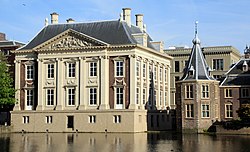
Civic and public buildings in Dutch Baroque architecture served as symbols of municipal authority and prosperity during the , functioning primarily as administrative hubs for , , and . These structures often featured grand interiors designed to impress visitors and reinforce civic pride, including expansive staircases leading to council chambers where officials deliberated on and legal matters. Unlike more ostentatious styles elsewhere in Europe, Dutch examples emphasized restraint and classical symmetry, reflecting the Republic's republican ethos and mercantile focus. The Amsterdam Town Hall, now known as the Royal Palace, stands as a quintessential example, constructed between 1648 and 1665 under the direction of architect Jacob van Campen. This massive edifice housed essential administrative functions, including the criminal court, magistrate's office, police headquarters, city bank, armory, prison, tax office, mayor's residence, and marketplace, serving as the political heart of the city until 1806. Its interior centerpiece, the 120-foot-long Citizens' Hall (Burgerzaal), features a barrel-vaulted and floors inlaid with maps of the and skies, surrounded by imported stone allegories of virtues, elements, planets, and bounties that evoke the ordered and Dutch triumphs in trade and . Sculptures by Artus Quellinus, such as those depicting Peace with Prudence and Justice on the eastern , further symbolize republican virtues like stability and moral governance, underscoring the building's role in celebrating Amsterdam's civic identity. In , the exemplifies a more compact civic prototype, built from 1636 to 1644 as a residence for Johan Maurits van Nassau-Siegen by architects Jacob van Campen and Pieter Post in the Dutch classicist style. The free-standing structure boasts symmetrical stone facades with classical pediments, columns, and cornices, creating an imposing yet balanced presence that highlights the era's preference for proportion over excess. Originally a private palace tied to administrative roles through its patron's governorship in , it transitioned in 1822 to a public museum housing the Royal Picture Gallery, renowned today for its collection of paintings, including Johannes Vermeer's Girl with a Pearl Earring. The building's design integrated functional spaces like offices and a grand staircase, reflecting the blend of personal and public utility common in Dutch civic architecture. Other notable examples include Leiden's Town Hall, which originated in the medieval period but received a facade in 1595 designed by Lieven de Key. These buildings collectively illustrate how Dutch Baroque civic structures prioritized practical grandeur, with opulent yet restrained interiors—such as council chambers adorned with symbolic reliefs— to project communal authority and economic vitality.

Religious and Private Structures

Dutch Baroque architecture in religious contexts adapted to the strictures of the Reformed Church, emphasizing simplicity and functionality following the iconoclastic Beeldenstorm of 1566, which led to the widespread destruction of Catholic imagery and a preference for minimal iconography in Protestant spaces. Churches typically featured whitewashed walls, prominent pulpits for sermons, and elaborate organ cases as the primary decorative elements, avoiding altarpieces or figurative art to align with Calvinist doctrines against idolatry. A prime example is the in , constructed between 1620 and 1631 under the design of city architect Hendrick de Keyser and completed by his son Pieter. This structure, planned as two connected Greek crosses, exemplifies early with its tall, 85-meter Westertoren crowned by an imperial eagle, serving as a landmark for Reformed worship. The interior remains whitewashed and austere, devoid of altarpieces, with focus on the central pulpit and the grand organ built by Christian Vater in 1727, its case adorned with paintings by depicting biblical scenes in a restrained manner. The Portuguese Synagogue (Esnoga) in , built from 1671 to 1675 for the Sephardic Jewish community, represents a fusion of grandeur and traditional Jewish . Designed by Elias Bouwman, the building features a vast arcaded hall inspired by descriptions of , with high brick walls, large windows for natural light, and an orientation toward , accommodating up to 1,200 worshippers. Its classical elements, such as symmetrical pilasters and cornices, blend with Jewish symbolism like the hechal (ark) and bimah (platform), creating a monumental yet spiritually focused space without overt . In private residences, Dutch Baroque manifested in elite homes commissioned by wealthy merchants, prioritizing comfort and subtle opulence over public display. Amsterdam's canal mansions, constructed during the , often included rear gardens for seclusion and featured lavish interiors with ornate ceilings and wall panels, as seen in preserved examples like those at Museum . These tall, narrow structures housed trading families, with ground floors for warehouses and upper levels for living quarters, reflecting economic prosperity through restrained Baroque detailing. Country houses like De Voorst, built around 1700 near for Arnold Joost van Keppel, a favorite of Stadholder William III, adopted a more lavish Baroque style inspired by palaces such as Het Loo, with expansive gardens and grand interiors that, though partially restored after a 1943 fire, originally included opulent decorative elements suited to aristocratic patrons. Funding for such private commissions often came from merchant wealth and courtly favor, underscoring the era's blend of commerce and nobility.

Legacy and Influence

Evolution in the Netherlands

The economic downturn that began with the of 1672, a year of multiple invasions and political instability marking the end of the , significantly curtailed the scale of architectural projects in the throughout the 18th century. This crisis, compounded by the (1780–1784), which exacerbated trade disruptions and financial strain, led to fewer grand commissions and a shift toward more modest, decorative adaptations of earlier styles. As prosperity waned, the robust of the 17th century gave way to lighter, more ornate expressions in decorative elements. Around the 1720s, influences appeared in Dutch interiors and ornamentation, softening the heavier forms with asymmetrical curves, shell motifs, and pastel palettes suited to bourgeois homes and civic spaces. By the mid-18th century, particularly from the 1750s onward, emerged, drawing on and Roman principles of and restraint, as seen in works by architects incorporating simplified facades and classical orders. This evolution reflected broader Enlightenment ideals and a desire for rational, less extravagant design amid ongoing economic constraints. Baroque elements persisted regionally into the early . A notable example is the City Hall in , whose front was built in 1693 and features restrained pilasters and pediments adapted to local brick traditions.

International Reach and Modern Views

Dutch Baroque architecture extended its influence through colonial expansion, particularly in the , where principles of the style were adapted to local tropical conditions. In Batavia (modern-day ), the Stadhuis, or city hall, constructed between 1707 and 1710, exemplifies this export with its Baroque Classicism facade featuring pediments, pilasters, and symmetrical massing, serving as the administrative center for the (VOC). Adaptations included deep overhanging eaves on gabled roofs for shade and rain protection, drawing from Javanese prototypes while using imported Dutch bricks, which facilitated natural ventilation in the humid climate but also led to stagnant canals contributing to health issues. Similarly, in (present-day New York), early Baroque elements arrived via Dutch settlers and were reinforced after 1689 through King William III and Queen Mary's introduction of these styles to , influencing North American buildings with high ceilings, large sash windows, and H-bent structural systems that persisted into the . The style's reach impacted neighboring regions, notably , where Dutch exiles following the 1688 facilitated a cross-pollination of architectural ideas. Post-1688, Dutch —characterized by sash windows, , and restrained ornamentation—influenced British designs during William and Mary's reign, contributing to the evolution of English Palladianism through shared craftsmanship and materials like imported Dutch bricks and tiles. Architects such as Jacob Roman incorporated Palladian-inspired elements, like central blocks with colonnades, into Dutch projects that in turn shaped British estates, blending the two traditions in works like . In the 19th and 20th centuries, Dutch Baroque principles saw revivals that echoed its volumetric massing and urban integration. The 1920s movement, active from 1910 to 1930, drew on historical Dutch massing—including Baroque layering of forms—for expressive brick facades and sculptural volumes in social housing projects, adapting these to modern socialist ideals while referencing the grandeur of 17th-century canal-side ensembles. This legacy gained international recognition through UNESCO's 2010 inscription of Amsterdam's Seventeenth-Century Canal Ring as a , honoring the area's Baroque-era bourgeois houses and as a model of planned urbanism that influenced global port cities. Contemporary scholarship has reevaluated historical buildings for their inherent , particularly through energy efficiency approaches and integration of passive strategies. These analyses position as a precursor to modern eco-design, with ongoing preservation efforts balancing authenticity and .

References

Add your contribution
Related Hubs
User Avatar
No comments yet.