Hubbry Logo
logo
Edison Studios
Community hub

Edison Studios

logo
0 subscribers
Read side by side
from Wikipedia

Edison Studios was an American film production organization, owned by companies controlled by inventor and entrepreneur, Thomas Edison. The studio made close to 1,200 films, as part of the Edison Manufacturing Company (1894–1911) and then Thomas A. Edison, Inc. (1911–1918), until the studio's closing in 1918. Of that number, 54 were feature length, and the remainder were shorts.[1] All of the company's films have fallen into the public domain because they were released before 1928.

Key Information

History

[edit]
Several films in production at Edison's Bronx studio, c. 1912. Seated in the foreground, with his legs crossed, is Charles Brabin; seated to the rear, with the card "26" under his arm, is Harold M. Shaw.

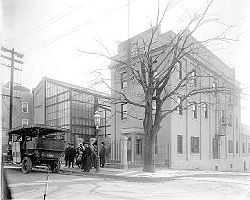
The first production facility was Edison's Black Maria studio, in West Orange, New Jersey, built in the winter of 1892–93. The second facility, a glass-enclosed rooftop studio built at 41 East 21st Street in Manhattan's entertainment district, opened in 1901. In 1907, Edison had new facilities built, on Decatur Avenue and Oliver Place, in the Bedford Park neighborhood of the Bronx.

William Kennedy Dickson, an early motion picture innovator, film production inventor, and assistant of Thomas A. Edison, eventually left to form the Biograph Company.
Horace G. Plimpton, an Edison Studios film producer 1909–1915

Thomas Edison himself played no direct part in the making of his studios' films, beyond being the owner and appointing William Gilmore as vice-president and general manager. Edison's assistant William Kennedy Dickson, who supervised the development of Edison's motion picture system, produced the first Edison films intended for public exhibition, 1893–95. After Dickson's departure for the American Mutoscope and Biograph Company in 1895, he was replaced as director of production by cameraman William Heise, then from 1896 to 1903, by James H. White. When White left to supervise Edison's European interests in 1903, he was replaced by William Markgraf (1903–1904), then Alex T. Moore (1904–1909), and Horace G. Plimpton (1909–1915).

The first commercially exhibited motion pictures in the United States were from Edison, and premiered at a Kinetoscope parlor in New York City on April 14, 1894. The program consisted of ten short films, each less than a minute long, of athletes, dancers, and other performers. After competitors began exhibiting films on screens, Edison introduced its own, Projecting Kinetoscope, in late 1896.

The earliest productions were brief "actualities", showing everything, from acrobats, to parades, to fire calls. But, competition from French and British story films, in the early 1900s, rapidly changed the market. By 1904, 85% of Edison's sales were from story films.

In December 1908, Edison led the formation of the Motion Picture Patents Company in an attempt to control the industry and shut out smaller producers.[2] The "Edison Trust", as it was nicknamed, was made up of Edison, Biograph, Essanay Studios, Kalem Company, George Kleine Productions, Lubin Studios, Georges Méliès, Pathé, Selig Studios, and Vitagraph Studios, and dominated distribution through the General Film Company. The Motion Picture Patents Co. and the General Film Co. were found guilty of antitrust violation in October 1915,[3] and were dissolved.[4]

The breakup of the Trust by federal courts, under monopoly laws, and the loss of European markets during World War I, hurt Edison financially. Edison sold its film business, including the Bronx studio, on 30 March 1918, to the Lincoln & Parker Film Company, of Massachusetts.

Notable productions

[edit]
Edison Studios produced the first motion picture adaptation of Mary Shelley's Frankenstein (1910).

Some of the studio's notable productions include The Kiss (1896); The Great Train Robbery (1903); Alice's Adventures in Wonderland (1910); Frankenstein (1910), the first film adaptation of the novel; The Battle of Trafalgar (1911); What Happened to Mary (1912), one of the earliest film serials; and The Land Beyond the Sunset (1912), which was directed by Harold M. Shaw and was later described by film historian William K. Everson as "'the screen's first genuinely lyrical film'".[5] The company also produced a number of short "Kinetophone" sound films in 1913–1914 using a sophisticated acoustical recording system capable of picking up sound from 30 feet away. They released a number of Raoul Barré cartoon films in 1915 and the first film version of the Robert Louis Stevenson historical novel Kidnapped.

Legacy

[edit]

Everson, calling Edison Studios "financially successful and artistically unambitious," wrote that other than directors Edwin S. Porter and John Hancock Collins,

[T]he Edison studios never turned out a notable director, or even one above average. Nor did the Edison films show the sense of dynamic progress, that one gets, from studying the Biograph films, on a year-by-year basis. On the contrary, there is a sense of stagnation.[6]

However, new restorations and screenings of Edison films in recent years contradict Everson's statement; indeed, Everson citing The Land Beyond the Sunset points out creativity at Edison beyond Porter and Collins, as it was directed by Harold M. Shaw (1877–1926), who later went on to a successful career directing in England, South Africa, and Lithuania before returning to the US in 1922. Other important directors who started at Edison included Oscar Apfel, Charles Brabin, Alan Crosland, J. Searle Dawley, and Edward H. Griffith.

Notable films

[edit]

See also

[edit]

References

[edit]
[edit]
Revisions and contributorsEdit on WikipediaRead on Wikipedia
from Grokipedia
Edison Studios was an American motion picture production company founded by inventor Thomas Edison in 1893, initially as the film production arm of his laboratory in West Orange, New Jersey, and later operating under the Edison Manufacturing Company (1894–1911) and Thomas A. Edison, Inc. (1911–1918).[1][2] It is credited with establishing the world's first dedicated film studio, known as the Black Maria, a rotatable wooden structure designed to capture optimal sunlight for early indoor filming.[2] The studio produced approximately 1,200 films over its 25-year span, encompassing short "actualities" depicting everyday scenes and events, scenic views, early animations, documentary-style works, comedies, dramas, and a limited number of feature-length pictures.[2][3] Under Edison's oversight, key employee William K.L. Dickson developed essential technologies such as the Kinetograph motion picture camera, patented in 1891, and the Kinetoscope peep-hole viewer, first demonstrated publicly in 1893, which propelled the commercial viability of short films for individual viewing before the advent of projection systems.[4] Edison Studios' defining characteristics included its aggressive patenting strategy, which culminated in the formation of the Motion Picture Patents Company in 1908—a trust aimed at controlling film production and distribution but ultimately undermined by antitrust rulings and independent filmmakers' evasion of East Coast enforcement, accelerating the industry's shift to California.[5] The company's reluctance to fully embrace longer narrative features and sound integration contributed to its decline amid rising competition, ceasing operations in 1918 after relocating studios from New Jersey to Manhattan and then the Bronx.[2][5]

Founding and Early Development

Establishment and the Black Maria Studio

Thomas Edison initiated systematic motion picture production through his laboratory in West Orange, New Jersey, where development of the Kinetograph motion picture camera began in 1889 under the direction of W. K. L. Dickson.[6] By 1891, experimental films were being shot outdoors or in makeshift indoor setups, but the need for a controlled environment prompted the construction of a dedicated studio.[6] This marked the establishment of what became known as Edison Studios, with its first purpose-built facility, the Black Maria, representing a pivotal advancement in film technology by enabling repeatable indoor filming under optimized conditions.[7] Construction of the Black Maria began in December 1892 on the grounds of Edison's West Orange laboratory complex and was completed in early 1893 at a cost reflecting the era's modest scale for experimental facilities.[6] The studio's innovative design included a 50-foot-square wooden frame covered in black tar paper for light control, a roof that could slide open to admit sunlight, and the entire structure mounted on a pivot atop a circular track, allowing it to rotate hourly to track the sun's movement and maximize natural illumination without artificial sources.[7] This swiveling mechanism, combined with its dark exterior, led to its nickname "Black Maria," derived from the era's horse-drawn police wagons that similarly swung on their axles and were painted black.[7] The facility's portability and efficiency addressed early challenges in film exposure, as the Kinetograph required bright, consistent lighting for its 35mm celluloid strips shot at 40 frames per second.[6] Under Dickson's supervision, with William Heise as a primary cameraman, the Black Maria produced the first copyrighted Edison motion pictures in August 1893, including short demonstrations like Carmencita and Annabelle's Butterfly Dance.[6] The inaugural film widely recognized as such, Edison Kinetoscopic Record of a Sneeze (featuring laboratory worker Fred Ott), was copyrighted on January 7, 1894, and exemplified the studio's focus on novelty shorts for the Kinetoscope peep-show viewer.[6] Productions emphasized vaudeville performers, strongmen like Eugene Sandow, and exotic acts such as boxing cats or Buffalo Bill's Wild West participants, yielding over 75 films in 1894 alone to supply the growing Kinetoscope parlor market.[6] These efforts laid the groundwork for commercial film distribution, though limited by the single-viewer format and short run times of under a minute.[7] The Black Maria operated until January 1901, when operations shifted to larger facilities amid demands for projected films.[6]

Key Technological Innovations

The Kinetograph, a pioneering motion picture camera, was developed by William Kennedy Laurie Dickson under Thomas Edison's supervision beginning in 1888, utilizing celluloid film strips perforated for intermittent motion to capture sequences of up to 20 seconds.[1] Edison received a patent for it on August 31, 1897, after years of refinement that addressed challenges in film transport and exposure timing.[8] This device formed the core technology for Edison Studios' early productions, enabling the recording of short actualities and staged scenes that demonstrated the feasibility of sequential photography for commercial viewing. The Kinetoscope, a compact peep-hole viewer, complemented the Kinetograph by allowing individual spectators to observe looped films through an eyepiece, with a prototype successfully demonstrated by the Edison Company in 1891.[1] Over 1,000 units were manufactured and deployed in parlors worldwide by 1894, generating revenue that funded further studio expansions, though its single-viewer limitation spurred the later shift to projection systems.[1] Central to operational innovations was the Black Maria, constructed in February 1893 at Edison's West Orange laboratory as the world's first purpose-built film studio, measuring 50 by 33 feet and covered in heat-absorbing black tar paper.[7] Its design incorporated a turntable base for hourly rotation to track sunlight, a counterweighted roof that swung open like a camera shutter, and collapsible walls for set reconfiguration, optimizing natural illumination essential for the Kinetograph's short exposure times without artificial lighting.[7] This adaptable structure facilitated over 1,200 films until its decommissioning in 1901, serving as a controlled environment for testing camera mechanisms and early narrative experiments. Edison's team also advanced sound-image synchronization within the studio, conducting trials in the Black Maria to pair Kinetograph footage with phonograph recordings, as in the 1894 experiments where performers spoke or played instruments in view of the camera while audio was captured separately.[6] These efforts, though challenged by mechanical desynchronization, represented an initial integration of Edison's phonograph technology with visuals, predating widespread "talkies" by decades and influencing subsequent devices like the Kinetophone.[7]

Initial Productions and Personnel

The development of Edison's initial motion pictures was primarily led by William Kennedy Laurie Dickson, a Scottish-born inventor and photographer who joined Thomas Edison's laboratory in 1883 and was assigned the task of creating a motion picture device in June 1889. Collaborating with mechanics such as Charles A. Brown and William Heise, Dickson refined the Kinetograph camera, incorporating Eastman Kodak's celluloid film strips and transitioning from horizontal to vertical feed mechanisms by 1892, which enabled the first public Kinetoscope demonstration on May 9, 1893.[4] Productions commenced in earnest with the completion of the Black Maria studio in late 1892 or early 1893 at Edison's West Orange, New Jersey laboratory, where the first films—short actualities and demonstrations—were shot indoors under controlled lighting. The earliest known motion pictures from this facility, including blacksmithing scenes and other occupational vignettes, were deposited for copyright by Dickson at the Library of Congress in August 1893. These single-shot films, typically lasting under a minute, captured everyday activities and served as proofs of concept for Kinetoscope exhibition.[6] In 1894, following the April 1 establishment of the Edison Manufacturing Company to commercialize Kinetoscopes and films, Dickson and Heise produced over 75 shorts, focusing on vaudeville performers and public spectacles to attract viewers. Key titles included Edison Kinetoscopic Record of a Sneeze (Fred Ott's Sneeze), copyrighted January 7, 1894, featuring laboratory assistant Fred Ott in a 17-frame sneeze sequence filmed by Dickson; strongman Eugene Sandow's muscle displays; dancer Carmencita's routines; Annabelle Whitford's Butterfly Dance; and excerpts from Buffalo Bill’s Wild West Show, such as Annie Oakley's sharpshooting. Heise increasingly handled directing duties alongside Dickson, emphasizing visually striking, non-narrative content optimized for the peephole viewer.[6] Dickson remained the central figure in these formative efforts until his resignation in 1895 to form the rival Biograph Company, after which Heise and later arrivals like James H. White assumed greater production responsibilities. Early personnel beyond the core technicians included performers drawn from nearby entertainment circuits and Edison's staff, with no formalized acting ensemble yet established. These productions prioritized technological validation over storytelling, producing content that demonstrated motion recording fidelity rather than dramatic arcs.[4]

Expansion and Production Peak

Studio Relocations and Infrastructure

Following the closure of the Black Maria studio in West Orange, New Jersey, in January 1901, Edison shifted film production to a new glass-enclosed rooftop facility at 41 East 21st Street in Manhattan's entertainment district.[6][2] This relocation addressed growing production demands, providing better access to performers and resources in New York City while relying on natural sunlight through its glass construction, as artificial lighting remained undeveloped for motion pictures.[9] The Manhattan studio operated from 1901 to 1906, supporting increased output of short films but proving insufficient for emerging longer narratives requiring expansive sets.[2] In 1907, Edison constructed a larger studio at Decatur Avenue and Oliver Place in the Bronx's Bedford Park neighborhood to accommodate multi-reel productions and elaborate staging.[10][11] The facility measured 60 by 100 feet, constructed from concrete, iron, and glass to maximize natural illumination, with a dedicated scenic area akin to a theater stage for set construction and filming.[11] This infrastructure enabled the studio's peak operations, producing nearly 1,200 films until its sale in March 1918.[2] The Bronx site's design emphasized functionality over aesthetics, prioritizing light capture and durability for daily production cycles without electric supplementation.[12]

Major Films and Creative Output

Edison Studios, operating under the Edison Manufacturing Company and later Thomas A. Edison, Inc., produced over 1,200 short films between 1894 and 1918, spanning genres such as actualities depicting real events and locations, reenactments of historical or news incidents, comedies, dramas, trick films with special effects, and early animations using puppets.[3] These outputs reflected a transition from simple, single-shot actualities to more complex narratives, incorporating edited sequences, cross-cutting, and portable filming techniques to capture everyday scenes or staged adventures.[3][1] Among the studio's most influential works was The Great Train Robbery (1903), directed by Edwin S. Porter, a 12-minute Western that employed groundbreaking cross-cutting between simultaneous actions, location shooting along railroads, and a climactic shootout, establishing narrative momentum through edited scenes rather than continuous action.[3] This film, shot in New Jersey and New York studios, grossed significantly and influenced global filmmaking by demonstrating the potential of multi-scene storytelling.[13] Edison's team also advanced horror with Frankenstein (1910), directed by J. Searle Dawley, the earliest known motion picture adaptation of Mary Shelley's novel, featuring innovative stop-motion and dissolve effects to conjure the creature from a boiling cauldron, emphasizing psychological torment over graphic violence.[14] Creative output extended to social dramas like The Ex-Convict (1904) and The Kleptomaniac (1905), which explored Progressive Era themes of redemption and class disparity through staged scenarios with intertitles for moral commentary.[3] Trick films showcased optical illusions, such as ghostly apparitions via double exposures, while humorous shorts parodied contemporary life or adapted comic strips, and late-period animations like R.F.D., 10,000 B.C. (1917) used stop-motion puppets for prehistoric comedies.[3] Reenactments, including war simulations with National Guard troops, provided spectacle amid actual conflicts like the Spanish-American War, blending education with entertainment.[3] Overall, these productions prioritized technical experimentation and commercial viability, laying groundwork for feature-length narratives despite the era's focus on shorts under 15 minutes.[1]

Role in Narrative Filmmaking Advancements

Edison Studios, operating under the Edison Manufacturing Company, contributed to narrative filmmaking by fostering the shift from single-shot actualities to multi-scene story films around 1901–1903, as filmmakers like Edwin S. Porter experimented with sequential editing to convey plot progression rather than isolated events. Porter, appointed chief camera operator and later studio head at the Bronx facility, produced early narratives such as Jack and the Beanstalk in 1902, which integrated multiple tableaux to adapt fairy tales into cinematic form, building on prior single-reel constraints but introducing rudimentary scene linkage.[15] A pivotal advancement came with Porter's The Great Train Robbery (1903), a 12-minute film comprising 14 shots that employed cross-cutting to interweave parallel actions—the robbery, a dancer interlude, and a posse's pursuit—creating suspense through temporal overlap absent in prior static staging. This technique, influenced by European precedents like the Brighton School but refined for American audiences, achieved continuity of action across locations, allowing viewers to follow cause-and-effect narratives without relying on live performance conventions. The film's commercial success, with over 800 prints distributed, demonstrated editing's potential to sustain audience engagement beyond spectacle.[16][13][17] Porter's subsequent works, including Uncle Tom's Cabin (1903), further developed inter-scene transitions and point-of-view shots, adapting literary sources into films that prioritized psychological depth over mere reenactment, though limited by one-reel formats to about 10–15 minutes. These efforts at Edison established precedents for montage and ellipsis, influencing rivals like Biograph and laying groundwork for longer-form storytelling, despite Edison's later lag in feature-length production. Primary production records from the era confirm over 1,200 Edison titles by 1918, with narrative films dominating output post-1903, underscoring the studio's role in cinema's causal progression from visual novelty to structured drama.[15][17]

Formation of the Motion Picture Patents Company

In the mid-1900s, rampant patent infringement by independent producers and importers of foreign films threatened Thomas Edison's dominance in motion picture technology, as his company held foundational patents for cameras, projectors, and film stock mechanisms developed since the 1890s.[18] Edison, viewing unauthorized duplication as theft of intellectual property, pursued legal enforcement but recognized the need for industry-wide coordination to curb "pirates" who duplicated films without compensation.[19] This led to protracted negotiations between Edison's manufacturing allies and the rival American Mutoscope and Biograph Company, which controlled competing patents for its own camera and projector systems.[18] The talks, spanning months, resolved in late December 1908 with the incorporation of the Motion Picture Patents Company (MPPC) on December 18, pooling the 16 most critical U.S. motion picture patents to create a unified licensing framework.[15] Edison's firm contributed its core inventions, including the Kinetograph camera and related mechanisms, while Biograph added its complementary technologies; additional participants encompassed Vitagraph Company of America, Essanay Film Manufacturing Company, Selig Polyscope Company, Lubin Manufacturing Company, Kalem Company, and Pathé Frères' U.S. operations under George Kleine.[20] Frank L. Dyer, Edison's patent attorney, served as MPPC president, with Edison exerting informal leadership through his patent leverage.[19] The MPPC's charter authorized it to grant licenses for film production equipment, raw stock, and finished prints, imposing royalties—typically $2 per positive print and equipment fees—to fund enforcement via detectives and lawsuits against non-licensed entities.[15] This structure aimed to stabilize the nascent industry by eliminating unlicensed competition, which Edison argued degraded quality and evaded rightful returns on invention costs exceeding millions in research.[18] Initial operations centralized in New York, with the trust quickly expanding to control over 70% of domestic film output through exclusive deals with Eastman Kodak for licensed stock.[20]

Monopoly Strategies and Industry Control

The Motion Picture Patents Company (MPPC), dominated by Edison interests, implemented control through restrictive licensing agreements that permitted only approved producers, distributors, and exhibitors to use patented motion picture equipment, such as cameras and projectors, while mandating exclusive exhibition of MPPC-sanctioned films.[21] These licenses, issued starting in 1909, effectively barred independent filmmakers from legal access to essential technology unless they submitted to the trust's terms, which included quality standards and output quotas designed to limit competition.[18] By pooling over 16 key patents from Edison and allies like Biograph and Vitagraph, the MPPC claimed comprehensive ownership of core filmmaking processes, enabling it to extract royalties—typically 10% of equipment sales and film rentals—from licensees.[22] A critical lever of control was the MPPC's exclusive arrangement with Eastman Kodak, the primary supplier of raw film stock in the United States, which agreed in 1909 to sell film only to licensed parties, thereby starving independents of necessary materials and forcing many to import European stock at higher costs.[23] This supply chain dominance complemented the trust's formation of the General Film Company in February 1910, a subsidiary that acquired or coerced independent film exchanges into compliance, centralizing distribution and imposing uniform rental fees while boycotting non-MPPC content.[19] By mid-1910, General Film controlled approximately 70% of U.S. film distribution channels, using aggressive tactics such as undercutting prices for trust films and threatening theaters with equipment denial or legal action if they screened unauthorized prints.[21] Legal enforcement formed the backbone of the monopoly, with the MPPC initiating at least 40 patent infringement lawsuits between 1909 and 1918 against independent producers and exhibitors, aiming to drain resources through protracted litigation rather than solely winning on merits.[23] Edison himself had filed early infringement suits as far back as December 1897 against emerging competitors, setting a precedent for using courts to consolidate power, though many cases hinged on disputed claims over film perforation and projection mechanisms.[22] The trust supplemented lawsuits with non-judicial pressure, including surveillance of suspected pirates and blacklisting of actors, directors, and technicians who collaborated with independents, thereby discouraging defection from licensed studios.[19] These combined measures temporarily suppressed independent output, reducing unlicensed films from dominating exchanges by 1911, but at the cost of fostering resentment and evasion among producers who relocated westward to evade enforcement.[18]

Antitrust Litigation and Dissolution of the Trust

The United States Department of Justice filed an antitrust lawsuit against the Motion Picture Patents Company (MPPC) and its affiliates, including the General Film Company, on August 15, 1912, under the Sherman Antitrust Act of 1890.[24] The complaint alleged that the MPPC's cross-licensing agreements among its ten member firms—such as Thomas A. Edison, Inc., Biograph, Vitagraph, and others—combined with exclusive licensing to approved producers and the General Film Company's monopolistic distribution practices, unlawfully restrained trade by excluding independent filmmakers, forcing exhibitors to source films solely from the trust, and inflating prices through controlled supply.[24] These practices, the government argued, extended beyond legitimate patent enforcement to create an illegal combination in restraint of commerce, affecting interstate distribution of films and equipment.[25] The case, United States v. Motion Picture Patents Co., proceeded to trial in the U.S. District Court for the Eastern District of Pennsylvania. On October 1, 1915, Judge Oliver B. Dickinson issued a ruling declaring the MPPC's patent pool and licensing system an illegal monopoly that violated Sections 1 and 2 of the Sherman Act.[22] The court found that the trust's agreements constituted a conspiracy to drive competitors from the market, as evidenced by blacklisting of unauthorized films, coercive contracts with exhibitors, and aggressive litigation against independents, which stifled innovation and competition despite the members' control of over 70% of U.S. film production by 1912.[25] Dickinson ordered the immediate cessation of restrictive licensing, divestiture of interlocking interests, and dissolution of the trust's monopolistic structure, emphasizing that patent rights did not extend to dictating unpatented aspects of film production or exhibition.[25] A follow-up decree on January 24, 1916, detailed enforcement measures, including the termination of exclusive dealing clauses and the opening of distribution to non-members, further eroding the MPPC's control.[24] The defendants appealed to the U.S. Supreme Court, but by 1917, ongoing patent expirations—such as key Edison motion picture patents lapsing between 1913 and 1917—and defiance from independents like Carl Laemmle's Universal had already fragmented the trust's market dominance.[26] The Supreme Court dismissed the appeal in 1918 via stipulation, as the lower court's decision rendered further review moot, leading to the MPPC's formal dissolution by federal court order in 1917.[26] This outcome dismantled the centralized control that Edison Studios had leveraged for licensing revenue, accelerating the shift toward decentralized production in regions like Hollywood, where independents evaded East Coast enforcement.[25]

Decline and Closure

Competitive Pressures and Technological Lag

Edison Studios encountered mounting competitive pressures in the early 1910s from independent producers who had migrated to Hollywood, California, to circumvent the Motion Picture Patents Company's licensing requirements and enforcement challenges posed by distance. These independents operated without patent royalties, enabling lower production costs and faster output that eroded Edison's market dominance.[5] By 1909, Edison's dramatic films had lost ground to rivals such as Biograph and Vitagraph, which delivered superior narrative depth and technical refinements that audiences favored. The company's output increasingly appeared formulaic and less innovative, failing to match competitors' advancements in storytelling and visual quality.[3] Technological lag exacerbated these issues, as Edison Studios clung to short-film formats while the industry pivoted toward multi-reel features to sustain viewer engagement and boost revenues. Edison initiated sporadic three-reel releases in mid-1914 but did not integrate features into regular weekly production until March 1, 1915, by which point competitors had established longer-form dominance.[27] In a bid to adapt, Edison formed a stock company of actors in 1910, emulating rivals' ensemble approaches to foster continuity and star appeal, yet this and similar initiatives proved insufficient against accelerating industry shifts. From 1912 onward, the studio could no longer sustain cutting-edge production, marking a sharp decline amid rivals' unencumbered innovation.[5]

Financial Struggles and World War I Impact

Beginning in 1912, Edison Studios experienced a sharp financial decline as it failed to maintain technological and creative leadership in the rapidly evolving motion picture industry. The company's reluctance to prioritize film production amid Thomas Edison's broader industrial interests limited investments in advanced narrative techniques and feature-length films, allowing West Coast competitors to dominate with innovative storytelling and larger-scale productions.[5] By the mid-1910s, sales had plummeted, with the studio distributing only about 22 prints per short subject through the General Film Company in fall 1915, rendering operations unprofitable.[27] The onset of World War I in 1914 intensified these pressures by severing access to lucrative European export markets, which had previously bolstered revenues through distributors such as Paramount and George Kleine. While the war disrupted European film production and boosted domestic U.S. demand—favoring agile Hollywood studios—Edison's East Coast operations, burdened by outdated infrastructure and legal fallout from the Motion Picture Patents Company's antitrust defeat in October 1915, could not capitalize on the shift.[5] Edison's personal diversion to wartime inventions, including naval technologies, further diverted managerial focus and resources from film recovery efforts.[28] Desperate cost-cutting measures, including halting motion picture equipment manufacturing in 1915 due to declining sales and experimenting with ventures like Conquest Pictures, proved ineffective in stemming losses.[5] Innovations such as the 1913 Kinetophone sound system and Super-Kinetoscope projector also faltered due to technical unreliability and market rejection.[5] Consequently, on March 30, 1918, Thomas A. Edison, Inc., sold the studio and facilities to the Lincoln & Parker Film Company for $150,000 in cash plus $200,000 in stock, marking the end of Edison's direct involvement in film production.[27][5]

Final Sale and Edison's Withdrawal

On March 30, 1918, Thomas A. Edison, Inc., sold its motion picture studio and production facilities in the Bronx, New York, to the Lincoln & Parker Film Company, a Massachusetts-based entity, marking the conclusion of Thomas Edison's direct participation in the film industry.[5] This transaction encompassed the physical plant, equipment, and remaining film assets, executed amid ongoing financial losses and the broader decline of Edison's film operations following World War I disruptions and competitive shifts toward Hollywood.[5] The sale represented a complete divestiture, with Edison shifting focus to other inventions such as phonographs and chemical research, effectively withdrawing from cinema after nearly three decades of involvement that began with the Kinetoscope in 1891.[1] Lincoln & Parker, seeking to capitalize on the facilities, continued limited production but faced similar market challenges, leading to the studio's eventual closure by 1920 without significant revival.[5] Edison's exit underscored the industry's migration westward, where independent producers had evaded his earlier patent enforcements, rendering East Coast operations like his unviable.[1]

Legacy and Historical Assessment

Pioneering Contributions to Cinema

Edison's laboratory pioneered key technologies for motion pictures, including the Kinetograph camera, developed by William K.L. Dickson between 1890 and 1891, which used celluloid film strips to capture sequential images via intermittent motion.[29] This device enabled the recording of actualities and short scenes, marking a shift from static photography to dynamic visual sequences. Complementing the Kinetograph, the Kinetoscope peephole viewer, refined by Dickson from Edison's 1888 concept, allowed individual viewing of looped films starting in 1893, with public exhibitions debuting that year in New York and Chicago.[29] These inventions established the foundational workflow for producing and displaying short motion pictures, influencing global adoption of film technology. In February 1893, Edison completed construction of the Black Maria in West Orange, New Jersey, recognized as the world's first dedicated motion picture production studio.[7] The tar-papered wooden structure, resembling a police wagon—hence its name—featured a rotating base on a circular track to follow sunlight and a retractable roof for optimal natural lighting, allowing controlled indoor filming regardless of weather.[30] This innovation addressed limitations of outdoor shooting, such as inconsistent light and mobility issues, and facilitated the production of over 1,000 short films in its initial years. The studio's design emphasized efficiency, with sets built for quick reconfiguration to capture diverse subjects like industrial processes and performances. Among the earliest productions, Blacksmith Scene (also known as Blacksmithing Scene), filmed in late April 1893 by Dickson, depicted three men hammering metal on an anvil, lasting about 48 seconds on 35mm film.[31] Publicly screened on May 9, 1893, at the Brooklyn Institute of Arts and Sciences via Kinetoscope, it represented one of the first multi-actor scenes with synchronized action, demonstrating film's potential for depicting everyday labor.[31] These initial outputs focused on non-narrative actualities, prioritizing technical proof-of-concept over storytelling, yet laid groundwork for cinema by standardizing film length around 50 feet for Kinetoscope loops. Edison advanced exhibition through the Vitascope projector, introduced on April 23, 1896, at Koster and Bial's Music Hall in New York, enabling large-screen projection for audiences.[32] Though based on Thomas Armat's Phantoscope design, Edison manufactured and branded it, projecting films like The Kiss to paying crowds, thus commercializing shared viewing and spurring theater development. By November 1896, Edison shifted to his own Projecting Kinetoscope, refining projection mechanics for broader distribution. These steps transitioned cinema from peep-show novelty to public spectacle, with Edison's output exceeding 1,200 titles by 1918, though early emphasis remained on technological reliability over artistic narrative.[33]

Criticisms of Business Tactics

Edison Studios, through Thomas Edison's leadership, faced significant criticism for employing monopolistic tactics via the Motion Picture Patents Company (MPPC), formed on December 18, 1908, which pooled over a dozen key patents on motion picture cameras, projectors, and film stock to control the nascent industry.[34] Critics, including independent producers like Carl Laemmle, argued that the MPPC's licensing requirements—mandatory for all producers, distributors, and exhibitors—effectively excluded non-members by restricting access to essential raw film stock through an exclusive deal with Eastman Kodak and imposing fixed prices, such as 9-13 cents per foot of film.[22] This structure allowed the MPPC to collect substantial royalties, totaling approximately $800,000 between 1910 and 1911, while regulating performer wages (capping them at $60 per week) and resisting innovations like feature-length films and the star system, which independents pioneered to meet growing audience demands.[22][19] Further condemnation arose from the MPPC's aggressive enforcement strategies, including hundreds of patent infringement lawsuits—such as 289 filings against the Independent Motion Picture Company (IMP), later part of Universal Studios, which incurred nearly $300,000 in legal fees aimed at bankrupting competitors.[34][35] The General Film Company, the MPPC's distribution arm, revoked licenses from 58 exchanges by 1912, confiscated equipment from independents, and deployed detectives, federal marshals, and even hired enforcers to sabotage operations and spy on non-compliant filmmakers.[22] These tactics were decried as bullying that prioritized patent protection over industry growth, prompting independents to relocate production to Southern California by 1911, where geographic distance complicated enforcement.[35][19] The cumulative effect drew antitrust scrutiny, culminating in a 1913 U.S. government lawsuit alleging the MPPC controlled 70-80% of the market and violated the Sherman Antitrust Act through price-fixing and competition elimination.[22] On October 1, 1915, a federal court ruled the MPPC and General Film Company an illegal restraint of trade, ordering their dissolution, which was finalized in 1917 after appeals.[22][34] Historians have since viewed these practices as a cautionary example of how aggressive intellectual property enforcement can stifle innovation, inadvertently fostering the independent studio system that supplanted Edison's dominance.[19][35]

Influence on Modern Film Industry Standards

Edison Studios, under Thomas Edison's direction, played a pivotal role in establishing the 35mm film format as the foundational standard for motion pictures, a gauge that dominated professional filmmaking for over a century until the widespread adoption of digital technologies in the 2010s. In 1894, Edison's Kinetoscope utilized perforated 35mm film stock, developed by his assistant W.K.L. Dickson, which specified a film width of 35mm with four perforations per frame to ensure smooth transport through cameras and projectors.[4] This format emerged from iterative experimentation balancing image quality, mechanical reliability, and cost efficiency, prioritizing celluloid's flexibility and Eastman's raw stock availability over narrower gauges like 22mm initially tested. By 1909, through the Motion Picture Patents Company's (MPPC) enforcement of Edison's patents, 35mm became the global industry standard, supplanting competing formats and enabling consistent equipment interoperability worldwide.[36][37] The MPPC, formed in 1908 with Edison Studios as a core member holding key camera and projector patents, imposed uniform technical and operational standards that shaped early industry norms, many of which echoed into modern practices. It mandated licensed equipment adherence to specific frame dimensions (approximately 18x24mm image area) and perforation patterns, reducing variability in projection quality and facilitating scalable production.[38] These controls extended to distribution protocols, standardizing film rental fees at $0.02 to $0.05 per foot and requiring exchanges to source only MPPC-approved prints, which curtailed unauthorized duplication and stabilized supply chains.[22] While the trust's monopoly dissolved by 1918 following antitrust rulings, its emphasis on patent-enforced uniformity prefigured contemporary standards bodies like the Society of Motion Picture and Television Engineers (SMPTE), influencing protocols for frame rates—Edison's early systems operated at 40-46 frames per second, informing later refinements to 24fps for optical sound synchronization in the 1920s.[36] Edison's innovations also indirectly standardized narrative and technical conventions that persist in digital cinema workflows. The 4:3 aspect ratio derived from 35mm's frame proportions became the default for silent-era films, carrying over to early television and influencing widescreen adaptations like 1.85:1, which mask portions of the 35mm frame.[39] Furthermore, Edison Studios' integration of synchronized sound experiments, such as the 1895 Kinetophone, laid groundwork for conceptualizing audio-visual alignment, though practical standards awaited Vitaphone in 1926; this presaged modern Dolby and digital audio norms by prioritizing mechanical linkage over post-production dubbing.[1] These elements, rooted in Edison's empirical focus on reproducible mechanics, underscore a legacy of prioritizing causal reliability in film transport and exhibition over artistic variability, effects still evident in archival digitization standards converting 35mm negatives to 4K resolutions.[37]

Preservation and Contemporary Relevance

Archival Collections and Restorations

The Library of Congress maintains the primary archival collection of Edison Manufacturing Company films through its Paper Print Collection, which includes over 3,000 motion pictures submitted for copyright between 1894 and 1912, many from Edison productions.[40] These paper prints, created by contact-printing each film frame onto photographic paper rolls, served as a de facto preservation mechanism when original nitrate films deteriorated due to chemical instability.[1] The process began with Edison's submissions, starting with Edison Kinetoscopic Record of a Sneeze in January 1894, the oldest surviving copyrighted motion picture.[41] From these paper artifacts, the Library has reconstructed and digitized 341 Edison motion pictures spanning 1891 to 1918, supplemented by 81 disc sound recordings, photographs, and related documents, all accessible via the "Inventing Entertainment" digital collection.[40] Restoration involved frame-by-frame scanning and conversion to motion picture format, preserving visual and historical details lost in degraded originals.[1] In 2024, Edison's Annabelle Serpentine Dance (1895) from this corpus was inducted into the National Film Registry, recognizing its cultural significance and the efficacy of paper print-based preservation.[42] The Museum of Modern Art (MoMA) holds Edison negatives and has conducted recent restorations, including digital and photochemical work on early titles over the past decade, often presented in series highlighting rediscoveries from its Biograph and Edison holdings.[43] These efforts have revived synchronized sound experiments like the 1913-1914 Kinetophone films, with surviving cylinders and prints enabling full reconstructions for exhibition.[44] Such restorations underscore the technical challenges of early 20th-century film stock, prioritizing fidelity to original aspect ratios and tinting practices.[45]

Recent Rediscoveries and Exhibitions

In 2017, films produced by the Edison Manufacturing Company depicting early 20th-century Delaware scenes, including parades and local events, were identified within the Library of Congress collections and subsequently digitized, marking the first documented motion pictures of the state.[46] These prints, previously overlooked amid larger Edison archives, provided new insights into regional history captured through Edison's kinetograph technology.[47] A 2015 discovery in a Washington, Iowa, basement yielded nitrate prints of early silent films from manufacturers including Edison, comprising short hand-cranked subjects from the 1890s to 1910s that had deteriorated in storage but offered intact examples of peep-show era content.[48] Such finds underscore ongoing archival work to recover physical media vulnerable to decay, though major lost Edison titles like The Man Who Could Not Sleep (1915) remain unrecovered as of 2025.[49] Contemporary exhibitions emphasize Edison's foundational role in cinema. The Thomas Edison National Historical Park in West Orange, New Jersey, hosts regular screenings of restored Edison films in its reconstructed Black Maria studio, with an August 2025 event demonstrating original production techniques alongside viewings of kinetoscope-era shorts.[50] In September 2025, the Thomas Edison Birthplace Museum in Milan, Ohio, screened historical films during its "Night at the Movies with Mr. Edison" program, attracting nearly 90 visitors to explore Edison's motion picture innovations.[51] The Hoboken Historical Museum's Thomas Edison Black Maria Film Series continues to feature restored Edison works, pairing them with discussions on early film preservation.[52]

Modern Commemorations and Developments

The Black Maria, recognized as the world's first dedicated motion picture studio constructed in 1893 behind Edison's West Orange laboratory, features a full-scale replica built in 1954 by the Thomas Alva Edison Foundation to honor its role in early cinema.[7][53] Housed within the Thomas Edison National Historical Park, the replica underwent restoration efforts culminating in a grand reopening ceremony on April 10, 2024, which granted public access to its interior for the first time via a new accessibility ramp.[30][54] This development enables visitors to tour the structure and explore exhibits on Edison's film innovations, including early production techniques, as part of the park's seasonal operations extending into 2025.[55][56] The national historical park, encompassing Edison's laboratory complex and Glenmont estate, was designated a National Historic Site in 1955 and reorganized as a national historical park in 2015 to broaden preservation of his inventive legacy, including motion pictures.[57] Modern commemorative activities at the site include guided tours highlighting the studio's contributions to over 1,200 films produced by Edison's company from 1893 to 1918, with interpretive programs emphasizing empirical advancements in film technology amid competitive pressures.[2][6] Additional artifacts, such as Edison Home Kinetoscope reels from the era, are preserved at institutions like the Hagley Museum, supporting scholarly assessments of the studio's transitional role from novelty films to narrative storytelling.[58] While the Bronx facility, operational from 1907 to around 1918, lacks formal preservation as a historical site and appears to have been abandoned by the mid-20th century, occasional public interest via social media discussions underscores its niche recognition in local film history.[59] Contemporary developments prioritize the West Orange site's role in educational outreach, with no evidence of revived production activities but ongoing emphasis on archival integration into digital exhibitions for broader accessibility.[60]

References

User Avatar
No comments yet.