



Community hub
Edward Colston
View on Wikipedia
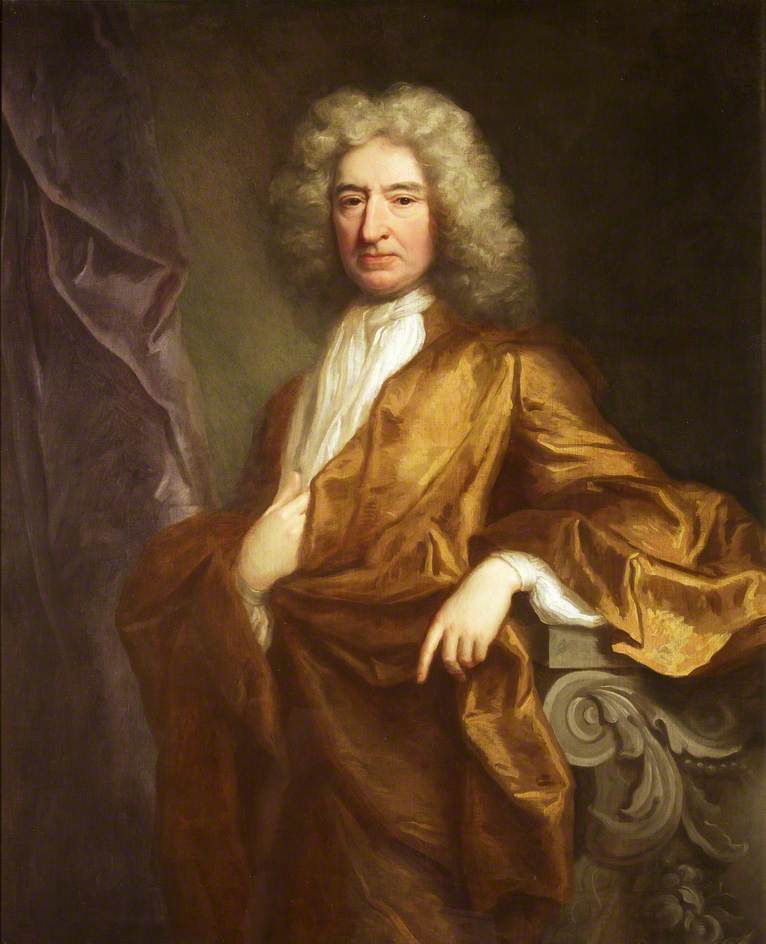
Edward Colston (2 November 1636 – 11 October 1721) was an English merchant, slave trader, philanthropist and Tory Member of Parliament.
Key Information


Colston followed his father in the family business becoming a sea merchant, initially trading in wine, fruits and textiles, mainly in Spain, Portugal and other European ports. From 1680 to 1692 he was a member of the Royal African Company, which held a monopoly on the English trade along the west coast of Africa, in slaves, gold, silver and ivory. He was deputy governor of the company from 1689 to 1690, the Governor being the Duke of York, the brother of Charles II of England.
Colston supported and endowed schools and other public institutions in Bristol, London and elsewhere. His name was widely commemorated in Bristol landmarks, and a statue of him was erected in 1895.
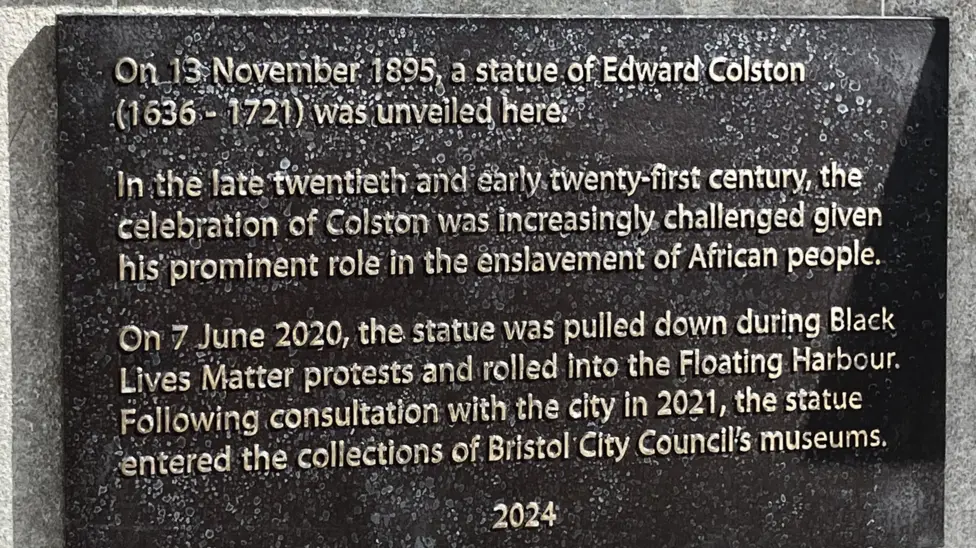
With growing awareness and disapproval in the late 20th century of his involvement in Britain's slave trade, there were protests and petitions for landmarks named after him to be renamed, culminating in June 2020, when his statue was toppled and pushed into Bristol Harbour during protests in support of Black Lives Matter. The city's concert venue, Colston Hall, was renamed Bristol Beacon along with several other locations that held his name.
Early life
[edit]Colston was born on 2 November 1636, in Temple Street, Bristol, and baptised in the Temple Church, Bristol.[1] His parents were William Colston, a prosperous Royalist merchant who was High Sheriff of Bristol in 1643, and his wife Sarah Batten, daughter of Edward Batten; he was the eldest of at least 11 and possibly as many as 15 children. The Colston family had lived in the city since the late 13th century.[2] Colston was brought up in Bristol until the time of the English Civil War, when he probably lived for a while on his father's estate in Winterbourne, just north of the city. The family then moved to London, and Colston was educated at the Christ's Hospital school.[3] The English Civil War shaped Colston's lifelong support for order and stability in the form of monarchy and High Anglicanism.[4]
Career
[edit]In 1654, Colston was apprenticed to the Mercers Company for eight years, and in 1673 he was enrolled into it.[3] By 1672, he had become a merchant in London.[2] Like his father, Colston exported in textiles from London while importing oils, wine and sherry from Spain and Portugal. He also traded silk with Virginia and was a regular trader of cod from Newfoundland to Naples.[5] He had built up a successful business trading with Spain, Portugal, Italy and Africa.[3]
In 1680, Colston became a member of the Royal African Company, which had held the monopoly in England on trading along the west coast of Africa in gold, silver, ivory and slaves from 1662.[3] Colston was deputy governor of the company from 1689 to 1690.[2] His association with the company ended in 1692.[2] The company was established by King Charles II, together with his brother the Duke of York (later King James II) as the governor of the company, City of London merchants and other investors.[6][7]
During Colston's involvement with the Royal African Company from 1680 to 1692, it is estimated that the company transported over 84,000 African men, women and children to the Caribbean and the rest of the Americas, of whom as many as 19,000 may have died on the journey.[8] The slaves were sold for labour on tobacco, and (increasingly) sugar plantations.[9]
In 1681 he probably began to take an active interest in the affairs of Bristol, where about this time he embarked in a sugar refinery.[10] In 1682, he made a loan of £1,800 to the Bristol Corporation and the following year, became a member of the Society of Merchant Venturers.[11] By 1685 he appears as the city's creditor for about £2,000.[10]
Although a Tory High Churchman and often in conflict with the Whig corporation of Bristol, Colston transferred a large segment of his original shareholding to William III at the beginning of 1689, securing the new regime's favour for the African Company. The value of Colston's shares increased and being without heirs he began to donate large sums to charities (see below).
Colston used his money and power to promote order in the form of High Anglicanism in the Church of England and oppose Anglican Latitudinarians, Roman Catholics, and dissenter Protestants.[12] He withdrew from the African Company in 1692, but continued working on his private businesses until he retired in 1708. Colston was then an MP for Bristol from 1710 to 1713.[13]
Philanthropic works
[edit]
Colston supported and endowed schools, houses for the poor, almshouses, hospitals and Anglican churches in Bristol, London and elsewhere. His name features widely on Bristol buildings and landmarks.[8][14]
In 1681, the date of his father's death, he appears as a governor of Christ's Hospital, to which he afterwards gave frequently. During the remainder of his life he seems to have divided his attention pretty equally between the city of his birth and that of his adoption.[10]
In 1691, on St Michael's Hill, Bristol, at a cost of £8,000 (equivalent to $1,700,000 in 2025), he founded Colstons Almshouses for the reception of 24 poor men and women, and endowed with accommodation for "Six Saylors", at a cost of £600, the merchant's almshouses in King Street. He also endowed Queen Elizabeth's Hospital school. In 1696, at a cost of £8,000, he endowed a foundation for clothing and teaching 40 boys (the books employed were to have in them "no tincture of Whiggism"); and six years afterwards he expended a further sum of £1,500 in rebuilding the schoolhouse. In 1708, at a cost of £41,200 (equivalent to $8,000,000 in 2025), he built and endowed his great foundation on Saint Augustine’s Back, for the instruction, clothing, maintaining and apprenticing of 100 boys; and in time of scarcity, during this and next year, he transmitted some £20,000 (equivalent to $3,100,000 in 2025) to the London committee,[10] to be managed by the Society of Merchant Venturers for its upkeep.[3] He gave money to schools in Temple (one of which went on to become St Mary Redcliffe and Temple School) and other parts of Bristol, and to several churches and the cathedral.[3][15]
Death
[edit]
Colston died of old age on 11 October 1721, aged 84, at his home, Cromwell House (demolished 1857), in Mortlake, south west London, where he had lived since about 1689.[16] His will stated that he wished to be buried simply without pomp, but this instruction was ignored.[17] His body was carried to Bristol and was buried at All Saints' Church. His monument was designed by James Gibbs, with an effigy carved by John Michael Rysbrack.[18]
Colston never married, and settled a "considerable fortune in land" on his nephew Edward Colston (MP for Wells), when Edward married in 1704.[19]
Memorials
[edit]
Buildings in Bristol formerly named in memory of Colston included the Colston Tower and Colston Hall (now Beacon Tower and Bristol Beacon, respectively). Colston Avenue and Colston Street are named after him, as is a regional bread bun, the Colston bun.[3][20] A statue of Colston is on the exterior of Bristol Guildhall, built 1843–1846.[21] There was an 1870 stained-glass window of the Good Samaritan by Clayton and Bell dedicated to Colston's memory in the north transept of St Mary Redcliffe,[22] which was removed in June 2020, following the toppling of his outdoor statue.[23] The largest window in Bristol Cathedral is also dedicated to Colston's memory; the Bishop of Bristol announced in June 2020 that the Anglican Diocese of Bristol would remove prominent references to Colston from the window.[24][25][26][27]
The Colston Society, which had operated for 275 years commemorating Colston, latterly as a charity, decided to disband in 2020.[28]
City-centre memorial statue
[edit]In 1895, 174 years after Colston's death, a statue designed by John Cassidy was erected in the centre of Bristol, to commemorate Colston's philanthropy.[29] Colston's slave-trading activities were subsequently uncovered in a biography of his life and work written by H.J. Wilkins in 1920,[30] and from the 1990s onwards, there were growing calls for the statue to be marked with a plaque stating that he was a slave trader, or taken down.[31]
In July 2018, Bristol City Council, which was responsible for the statue, made a planning application to add a second plaque which would "add to the public knowledge about Colston" including his philanthropy and his involvement in slave trading, though the initial wording suggested came in for significant criticism from members of the public and a Bristol Conservative councillor, with the result being that the plaque was reworded.[32][33] This wording was edited by a former curator at the Bristol Museum and Art Gallery, creating a third proposal which was backed by other members of the public, though it was criticised by the academic behind the first two versions, who claimed it "sanitised" history, minimising Colston's role, omitting the number of child slaves, and focussing on West Africans as the original enslavers.[8] Nevertheless, a wording was subsequently agreed upon and the bronze plaque was cast.[34] After the plaque was physically produced, its installation was vetoed in March 2019 by the Mayor of Bristol, Marvin Rees, who criticised the Society of Merchant Venturers for the rewording. A statement from the mayor's office called it "unacceptable", claimed that Rees had not been consulted, and promised to continue work on a second plaque.[34]
On 7 June 2020, the statue was toppled and pushed into Bristol Harbour by demonstrators during the George Floyd protests; one protester was shown kneeling on the statue's neck, referencing the manner in which Floyd died.[35][36] The statue was retrieved from the harbour four days later by Bristol City Council, and taken to a secure location.[37] After the statue was toppled, the Merchant Venturers said that it had been "inappropriate" for them to have become involved in the rewording of the plaque in 2018, and that the removal of the statue was "right for Bristol".[38]
From 4 June 2021, the statue was put on display in its damaged condition by Bristol's M Shed museum,[39] which stated "this temporary display is the start of a conversation, not a complete exhibition".[40]
A new plaque, with no mention of Colston as a "city benefactor", was installed on the empty plinth on 17 April 2025.[41][42]
Modern reappraisal
[edit]

Accounts of Colston written in the nineteenth century were extremely positive, lauding him for his philanthropy and for his 'nobleness' of his spirit. In the opening sentences to Thomas Garrard's 1852 biography, the author cited Pliny the Elder:
It is the especial duty of an Historian, says Pliny, "not to allow the memory of those men to sink into oblivion who have by their deeds merited an immortality of fame." That immortality has seldom been awarded to the lot of a nobler Philanthropist than Edward Colston.[43]
The first critical biography was that by Rev. Henry J. Wilkins in 1920,[44] his being the first account to demonstrate that Colston was a slave trader.[45] Wilkins was also critical of Colston's extreme antipathy to nonconformists. In highlighting these defects, Wilkins suggested that "we cannot picture him justly except against his historical background".[46] Colston's involvement in the slave trade predated the abolition movement in Britain, and was during the time when "slavery was generally condoned in England—indeed, throughout Europe—by churchmen, intellectuals and the educated classes".[47] Wilkins criticisms prompted a strong reaction from many in interwar Bristol who wanted to defend Colston's legacy, which was by this time commemorated annually in a Colston Day celebrations.[48] In 1925 Wilkins provided a further supplementary account of Colston's life with additional evidence of Colston's failings.[49] Noting evidence of his unscrupulousness in his business dealings, as well as charges of personal immorality, Wilkins proposed that:
I have urged (having regard to the unhistorical and ill-proportioned position Bristol has given to Edward Colston through the absence of documentary evidence and political partisanship with its charitable efforts) that Bristol should free herself from such a position, recall her heritage and rise to a true "Commemoration" on November 13th in each year of the noble galaxy of benefactors and worthies of "The Metropolis of the West."[50]
Colston made money from trading in commodities and money lending as well as the slave trade;[51][52][53] the proportion of his wealth that came from his involvement in the slave trade and slave-produced sugar is not known.
Since at least the 1990s, with increasing recognition of Colston's role in the slave trade, there has been growing criticism of his commemoration.[54] The Dolphin Society, which was formed to continue Colston's philanthropy, as of 2015 referred to "the evils of slavery" and recognised that "black citizens in Bristol today can suffer disadvantage in terms of education, employment and housing for reasons that connect back to the days of the trans-Atlantic slave trade".[14]
In April 2017 the Bristol Music Trust, a charity that ran the "Colston Hall",[55] announced that it would drop the name of Colston after a 2020 refurbishment. There had been protests and petitions calling for a name change, and some concertgoers and artists had boycotted the venue because of the Colston name.[56] Following the decision almost 10,000 people signed petitions to retain the name of Colston,[57] but the hall was renamed as the Bristol Beacon in September 2020 after three years of consultation.[58] However after debate it was decided in 2023 that street names in Bristol bearing the name ‘Colston’ would remain,this included the road that the former Colston Hall now Bristol Beacon is situated which is Colston Street and the neighbouring Colston Avenue.
In November 2017, the Colston's Girls' School, funded by the Society of Merchant Venturers, initially announced that it would not drop the name of Colston, because it was of "no benefit" to the school to do so.[59] After later consultations in 2020 with staff and pupils the school changed its name to Montpelier High School.
In April 2018, the Lord Mayor of Bristol ordered that a portrait of Colston be removed from her office, saying that she would not "be comfortable sharing it with the portrait", planning that the portrait would later be hung in the proposed Museum of Abolition.[60]
In summer 2018, Colston Primary School renamed itself Cotham Gardens Primary School after consultation with pupils and parents.[61] In February 2019, St Mary Redcliffe and Temple School announced that it would rename its former Colston house after the American mathematician Katherine Johnson.[62]
In June 2020, the pub formerly known as the Colston Arms temporarily changed its name to Ye Olde Pubby McDrunkface (a reference to the name for a research vessel voted for by the public in 2016), inviting suggestions from the public for a new name;[63] in December 2021 the pub was renamed the Open Arms.[64]
In 2020, at the sight of the toppling of the Edward Colston statue in Bristol, a member of the organisational team for the event "was adamant that Colston's charitable deeds in no way made up for the transportation of thousands of Africans into slavery. 'The statue was glorifying the acts of a slave trader. He gave some money to schools and good causes but it was blood money', she said".[65]
Stained glass windows celebrating Colston have been removed at St Mary Redcliffe church and Bristol Cathedral.[66]
See also
[edit]- Anchor Society – Bristol charity
- Bristol slave trade – Slavery in southwestern England
Biographical works
[edit]- Ball, R. (2017). 'The Royal African Company and Edward Colston (1680–92)’. Bristol: Bristol Radical History Group. Research Paper, No. 2.
- Garrard, Thomas (1852). Edward Colston, the philanthropist, his life and times; including a Memoir of his father; the result of a laborious investigation into the archives of the city. Bristol: J. Chilcott
- Hayton, D., Cruickshanks, E., Handley, S., eds. (2002). 'COLSTON, Edward II (1636-1721), of Mortlake, Surr.' The History of Parliament Online. London: History of Parliament Trust
- Morgan, Kenneth (1999). Edward Colston and Bristol. Bristol: Bristol Historical Association.
- Morgan, Kenneth (2021). 'Colston, Edward (1636–1721), merchant, slave trader, and philanthropist', Oxford Dictionary of National Biography. Oxford University Press. doi-org.bris.idm.oclc.org/10.1093/ref:odnb/5996
- Tovey, S. G. (1863). Colston the Philanthropist: Memorials of his Life and Deeds. Bristol: T. D. Taylor
- Wilkins, H. J. (1920). Edward Colston [1636-1721 A.D.]: A chronological account of his life and work. Bristol: Arrowsmith
- Wilkins, H. J. (1925). Edward Colston [1636-1721 A.D.]: Supplement to a Chronological Account of his Life and Work. Bristol: Arrowsmith
References
[edit]- ^ Morgan, Kenneth (1999). Edward Colston and Bristol (Bristol Historical Association pamphlets, no. 96), p.2.
- ^ a b c d Hanham, Andrew A. (April 2006). Hayton, David; Cruickshanks, Eveline; Handley, Stuart (eds.). "Colston, Edward II (1636–1721), of Mortlake, Surr". The History of Parliament. Cambridge University Press / Institute of Historical Research. Archived from the original on 1 December 2017. Retrieved 13 June 2020.
- ^ a b c d e f g Morgan, Kenneth (September 2004). "Colston, Edward". Oxford Dictionary of National Biography (online ed.). Oxford University Press. doi:10.1093/ref:odnb/5996. Retrieved 14 August 2010. (Subscription, Wikipedia Library access or UK public library membership required.)
- ^ Richards, Samuel J. (September 2020). "Historical Revision in Church: Re-examining the 'Saint' Edward Colston". Anglican and Episcopal History. 89 (3): 232, 242–243.
- ^ Morgan, Kenneth (1999). Edward Colston and Bristol (Bristol Historical Association pamphlets, no. 96), p.2.
- ^ Mohamud, Abdul; Whitburn, Robin (21 June 2018). "Britain's involvement with New World slavery and the transatlantic slave trade". The British Library. Archived from the original on 3 January 2020. Retrieved 18 October 2018.
- ^ Matthew, Parker (2011). The sugar barons: family, corruption, empire, and war in the West Indies. New York: Walker & Co. p. 126. ISBN 9780802717443. OCLC 682894539.
- ^ a b c Cork, Tristan (23 August 2018). "Row breaks out as Merchant Venturer accused of 'sanitising' Edward Colston's involvement in slave trade". Bristol Live. Reach plc. Archived from the original on 7 June 2020. Retrieved 9 June 2020.
- ^ "The archaeology of slavery". Liverpool Museums. Retrieved 7 April 2022.
- ^ a b c d One or more of the preceding sentences incorporates text from a publication now in the public domain: Chisholm, Hugh, ed. (1911). "Colston, Edward". Encyclopædia Britannica. Vol. 6 (11th ed.). Cambridge University Press. p. 736.
- ^ Latimer, John (1903). The history of the Society of Merchant Venturers of the City of Bristol; with some account of the anterior Merchants' Guilds. Robarts – University of Toronto. Bristol, Arrowsmith.
- ^ Richards, Samuel J. (September 2020). "Historical Revision in Church: Re-examining the "Saint" Edward Colston". Anglican and Episcopal History. 89 (3): 243.
- ^ Gardiner, Juliet (2000). The History Today Who's Who In British History. London: Collins & Brown Limited and Cima Books. p. 192. ISBN 1-85585-876-2.
- ^ a b "Edward Colston, the Dolphin Society and 268 years of letter-writing...History / Background". The Dolphin Society. 16 May 2015. Archived from the original on 19 October 2018. Retrieved 19 October 2018.
- ^ Richards, Samuel J. (September 2020). "Historical Revision in Church: Re-examining the 'Saint' Edward Colston". Anglican and Episcopal History. 89 (3): 225–254.
- ^ Deaton, Helen. The Story of Cromwell House at Mortlake. Barnes and Mortlake History Society.
- ^ Edward Colston Will, National archives Wills Online
- ^ Historic England. "Church of All Saints (1282313)". National Heritage List for England. Retrieved 16 March 2003.
- ^ "COLSTON, Edward I (aft.1672–1719), of Bristol". historyofparliamentonline.org. Retrieved 22 June 2020.
- ^ Davidson, Alan (1999). The Oxford Companion to Food. Oxford University Press. p. 114. ISBN 978-0-19-211579-9.
- ^ Historic England. "Guildhall, City of Bristol (1282368)". National Heritage List for England. Retrieved 26 August 2019.
- ^ Cobb, Peter G. (1994). "The Stained Glass of St. Mary Redcliffe, Bristol" (PDF). Transactions of the Bristol and Gloucestershire Archaeological Society. 112: 150. Archived from the original (PDF) on 3 April 2015. Retrieved 8 June 2020.
- ^ "Church windows celebrating slave trader removed". BBC News. 16 June 2020. Retrieved 18 June 2020.
- ^ "A Statement on Colston Windows" (Press release). Bishop of Bristol, Bristol Cathedral, St Mary Redcliffe Church, and the Diocese of Bristol. 16 June 2020.
- ^ "A Statement on Colston Windows – Bristol Cathedral". bristol-cathedral.co.uk. Anglican Diocese of Bristol. Retrieved 31 October 2020.
- ^ Edmunds, Chantalle (2 October 2020). "Incoming Dean not convinced removing the Edward Colston stained-glass window in Bristol Cathedral is the right answer". Premier Christian News.
- ^ Richards, Samuel J. (September 2020). "Historical Revision in Church: Re-examining the 'Saint' Edward Colston" (PDF). Anglican and Episcopal History. 89 (3): 225–254.
- ^ Cork, Tristan (13 September 2020). "Bristol's original Colston Society to disband after 275 years". Bristol Post. Retrieved 14 September 2020.
- ^ "Edward Colston". PMSA National Recording Project. Archived from the original on 9 January 2010. Retrieved 9 May 2007.
- ^ H. J. Wilkins, Edward Colston (1636-1721 A.D.): A chronological account of his life and work together with an account of the Colston Societies and memorials in Bristol (J. W. Arrowsmith Ltd., Bristol, 1920)
- ^ Wilkins, Emma (29 January 1998). "Graffiti attack revives Bristol slavery row". The Times. p. 11.
- ^ Cork, Tristan (22 July 2018). "The wording of second plaque proposed for Edward Colston statue linking him to 20,000 deaths". BristolLive. Archived from the original on 22 July 2018.
- ^ Cork, Tristan (23 July 2018). "Theft of second Colston plaque 'may be justified' says councillor". BristolLive. Archived from the original on 18 October 2018. Retrieved 13 May 2021.
- ^ a b Cork, Tristan (25 March 2019). "Second Colston statue plaque not axed and will still happen but mayor steps in to order a re-write". Bristol Live. Retrieved 8 June 2020.
- ^ Diver, Tony (7 June 2020). "Statue of slave trader Edward Colston pulled down and thrown into harbour by Bristol protesters". The Telegraph. Retrieved 7 June 2020.
- ^ "Edward Colston statue: Protesters tear down slave trader monument". BBC News. 8 June 2020. Retrieved 9 June 2020.
- ^ "Edward Colston statue pulled out of Bristol Harbour". BBC News. Bristol. 11 June 2020.
- ^ Booth, Martin (12 June 2020). "Merchant Venturers say 'It is right for Bristol' that Colston's statue was removed". Bristol24/7. Bristol24/7 CIC. Archived from the original on 29 June 2020.
- ^ Humphries, Will (4 June 2021). "Bristol's protracted debate over angle of Edward Colston statue". The Times.
- ^ "The Colston Statue: What next?". Bristol Museums. Archived from the original on 4 June 2021.
- ^ Nally, Carys (17 April 2025). "Edward Colston plaque installed with new slave trade wording". BBC News.
- ^ "Image of the 17 April 2025 plaque". Retrieved 24 May 2025.
- ^ Garrard, Thomas (1852). Edward Colston, the Philanthropist, his Life and Times. Bristol: J. Chilcott. p. 1.
- ^ Coates, Richard (2017). Wilkins of Westbury and Redland: the life and writings of the Rev Dr Henry John Wilkins (1865-1941). ALHA Books. Vol. 24. Avon Local History & Archaeology. pp. 14–15. ISBN 9781911592242.
- ^ Wilkins, H. J. (1920). Edward Colston [1636-1721 A.D.]: A chronological account of his life and work together with an account of the Colston Societies and memorials in Bristol. Bristol: Arrowsmith. pp. 20–23, 41–42, 48.
- ^ Wilkins, H. J. (1920). Edward Colston [1636-1721 A.D.]: A chronological account of his life and work. Arrowsmith. p. 93.
- ^ Morgan, Kenneth (1999). Edward Colston and Bristol (Bristol Historical Association pamphlets, no. 96), p.18.
- ^ "Edward Colston - Timeline of dissent and protest 1920 to 2020" (PDF). Bristol Radical History. June 2021. Retrieved 4 September 2025.
- ^ Wilkins, H. J. (1925). Edward Colston [1636-1721 A.D.]: Supplement to a Chronological Account of his Life and Work. Bristol: Arrowsmith.
- ^ Wilkins (1925). "Preface". Edward Colston [1636-1721 A.D.]: Supplement to a Chronological Account. p. 6.
- ^ Morgan, Kenneth (1999). Edward Colston and Bristol (Bristol Historical Association pamphlets, no. 96), p.3.
- ^ Gorsky, Martin (1999). Patterns of Philanthropy: Charity and Society in Nineteenth-Century Bristol. Woodbridge, Suffolk: Royal Historical Society. p. 207.
- ^ Richards, Samuel J. (September 2020). "Historical Revision in Church: Re-examining the 'Saint" Edward Colston". Anglican and Episcopal History. 89 (3): 239–241.
- ^ Evans, Judith (9 August 2018). "Bristol, the slave trade and a reckoning with the past". Financial Times. Retrieved 3 July 2020.
- ^ "About us". Colston Hall. Bristol Music Society. Retrieved 7 June 2020.
- ^ Morris, Steven (26 April 2017). "Bristol's Colston Hall to drop name of slave trader after protests". The Guardian. Retrieved 7 June 2017.
- ^ Ballinger, Alex (12 May 2017). "Colston Hall 'will not be going back' on decision as petitions to keep name reach almost 10,000 signatures". Bristol Live. Retrieved 18 October 2018.
- ^ "Colston Hall music venue renamed Bristol Beacon". BBC News. 23 September 2020.
- ^ Yong, Michael (2 November 2017). "Why Colston's Girls' School does not want to change its name". Bristol Live. Retrieved 18 October 2018.
- ^ Cork, Tristan (19 June 2018). "Historic moment as portrait of Edward Colston is removed from Lord Mayor's office". Bristol Post. Retrieved 5 January 2022.
- ^ Yong, Michael (11 September 2018). "Colston's Primary School starts life as Cotham Gardens after dropping slave trader's name". Bristol Live. Retrieved 8 June 2020.
- ^ Ballinger, Alex (11 February 2019). "Edward Colston: Bristol school to remove slave trader's name from house". BBC News. Retrieved 11 February 2019.
- ^ "Bristol pub named after Edward Colston becomes Pubby McDrunkface". ITV News. 30 June 2020. Retrieved 21 October 2022.
- ^ "The Colston Arms changes name permanently". ITV News. 27 December 2021. Retrieved 21 October 2022.
- ^ Wall, Tom (14 June 2020). "The day Bristol dumped its hated slave trader in the docks and a nation began to search its soul". The Guardian. Retrieved 24 November 2022.
- ^ "Edward Colston: Church windows honouring slave trader removed". BBC News. 16 June 2020. Retrieved 5 February 2026.

| International | |
|---|---|
| National | |
| People | |
| Other | |

Edward Colston
View on GrokipediaHe built his fortune primarily through commerce in London, including significant involvement in the Royal African Company, where he joined as a member in 1680 and served as deputy governor from 1689 to 1690, profiting from the Atlantic slave trade during a period when the company held a monopoly on such activities until 1698.[1][2]
Later in life, Colston directed much of his wealth toward charitable causes in Bristol, endowing institutions such as Colston's Hospital—a school for poor boys to which he contributed £30,000—and various almshouses, churches, and hospitals, while supporting Anglican initiatives and opposing Dissenters.[1][2]
Elected as a Tory Member of Parliament for Bristol in 1710 at age 74, he participated minimally in parliamentary debates due to his advanced age but represented the city's mercantile interests until 1713.[1]
Colston died unmarried at his Mortlake residence in Surrey and was buried with great ceremony in Bristol's All Saints Church, leaving a legacy that intertwined economic enterprise, including slave trading, with substantial civic benefaction.[1]