



Community hub
Recent from talks
Contribute something
Nothing was collected or created yet.
Elasticity tensor
View on WikipediaThe elasticity tensor is a fourth-rank tensor describing the stress-strain relation in a linear elastic material.[1][2] Other names are elastic modulus tensor and stiffness tensor. Common symbols include and .


The defining equation can be written as
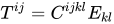
where and are the components of the Cauchy stress tensor and infinitesimal strain tensor, and are the components of the elasticity tensor. Summation over repeated indices is implied.[note 1] This relationship can be interpreted as a generalization of Hooke's law to a 3D continuum.


A general fourth-rank tensor in 3D has 34 = 81 independent components , but the elasticity tensor has at most 21 independent components.[3] This fact follows from the symmetry of the stress and strain tensors, together with the requirement that the stress derives from an elastic energy potential. For isotropic materials, the elasticity tensor has just two independent components, which can be chosen to be the bulk modulus and shear modulus.[3]


Definition
[edit]The most general linear relation between two second-rank tensors is

where are the components of a fourth-rank tensor .[1][note 1] The elasticity tensor is defined as for the case where and are the stress and strain tensors, respectively.


The compliance tensor is defined from the inverse stress-strain relation:

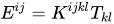
The two are related by

where is the Kronecker delta.[4][5][note 2]

Unless otherwise noted, this article assumes is defined from the stress-strain relation of a linear elastic material, in the limit of small strain.
Special cases
[edit]Isotropic
[edit]For an isotropic material, simplifies to

where and are scalar functions of the material coordinates , and is the metric tensor in the reference frame of the material.[6][7] In an orthonormal Cartesian coordinate basis, there is no distinction between upper and lower indices, and the metric tensor can be replaced with the Kronecker delta:


![{\displaystyle C_{ijkl}=\lambda \!\left(X\right)\delta _{ij}\delta _{kl}+\mu \!\left(X\right)\left(\delta _{ik}\delta _{jl}+\delta _{il}\delta _{kj}\right)\quad {\text{[Cartesian coordinates]}}}](https://wikimedia.org/api/rest_v1/media/math/render/svg/d188db9438d6cc19e04c91c09837b54812961069)
Substituting the first equation into the stress-strain relation and summing over repeated indices gives

where is the trace of . In this form, and can be identified with the first and second Lamé parameters. An equivalent expression is


where is the bulk modulus, and


are the components of the shear tensor .

Cubic crystals
[edit]The elasticity tensor of a cubic crystal has components

where , , and are unit vectors corresponding to the three mutually perpendicular axes of the crystal unit cell.[8] The coefficients , , and are scalars; because they are coordinate-independent, they are intrinsic material constants. Thus, a crystal with cubic symmetry is described by three independent elastic constants.[9]


In an orthonormal Cartesian coordinate basis, there is no distinction between upper and lower indices, and is the Kronecker delta, so the expression simplifies to


Other crystal classes
[edit]There are similar expressions for the components of in other crystal symmetry classes.[10] The number of independent elastic constants for several of these is given in table 1.[9]
| Crystal family | Point group | Independent components |
|---|---|---|
| Triclinic | 21 | |
| Monoclinic | 13 | |
| Orthorhombic | 9 | |
| Tetragonal | C4, S4, C4h | 7 |
| Tetragonal | C4v, D2d, D4, D4h | 6 |
| Rhombohedral | C3, S6 | 7 |
| Rhombohedral | C3v, D6, D3d | 6 |
| Hexagonal | 5 | |
| Cubic | 3 |
Properties
[edit]Symmetries
[edit]The elasticity tensor has several symmetries that follow directly from its defining equation .[11][2] The symmetry of the stress and strain tensors implies that

Usually, one also assumes that the stress derives from an elastic energy potential :


which implies
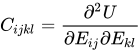
Hence, must be symmetric under interchange of the first and second pairs of indices:

The symmetries listed above reduce the number of independent components from 81 to 21. If a material has additional symmetries, then this number is further reduced.[9]
Transformations
[edit]Under rotation, the components transform as

where are the covariant components in the rotated basis, and are the elements of the corresponding rotation matrix. A similar transformation rule holds for other linear transformations.


Invariants
[edit]The components of generally acquire different values under a change of basis. Nevertheless, for certain types of transformations, there are specific combinations of components, called invariants, that remain unchanged. Invariants are defined with respect to a given set of transformations, formally known as a group operation. For example, an invariant with respect to the group of proper orthogonal transformations, called SO(3), is a quantity that remains constant under arbitrary 3D rotations.
possesses two linear invariants and seven quadratic invariants with respect to SO(3).[12] The linear invariants are

and the quadratic invariants are

These quantities are linearly independent, that is, none can be expressed as a linear combination of the others. They are also complete, in the sense that there are no additional independent linear or quadratic invariants.[12]
Decompositions
[edit]A common strategy in tensor analysis is to decompose a tensor into simpler components that can be analyzed separately. For example, the displacement gradient tensor can be decomposed as

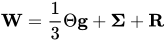
where is a rank-0 tensor (a scalar), equal to the trace of ; is symmetric and trace-free; and is antisymmetric.[13] Component-wise,


![{\displaystyle {\begin{aligned}\Sigma ^{ij}\equiv W^{(ij)}&={\frac {1}{2}}\left(W^{ij}+W^{ji}\right)-{\frac {1}{3}}\left(\mathrm {Tr} \,\mathbf {W} \right)g^{ij}\\R^{ij}\equiv W^{[ij]}&={\frac {1}{2}}\left(W^{ij}-W^{ji}\right)\end{aligned}}}](https://wikimedia.org/api/rest_v1/media/math/render/svg/921f866e55edc117fe767cdba73cdbd375ef0e9b)
Here and later, symmetrization and antisymmetrization are denoted by and , respectively. This decomposition is irreducible, in the sense of being invariant under rotations, and is an important tool in the conceptual development of continuum mechanics.[11]

![{\displaystyle [ij]}](https://wikimedia.org/api/rest_v1/media/math/render/svg/4d30520e09683aad1e38713ce1a8182cde93c0ce)
The elasticity tensor has rank 4, and its decompositions are more complex and varied than those of a rank-2 tensor.[14] A few examples are described below.
M and N tensors
[edit]This decomposition is obtained by symmeterization and antisymmeterization of the middle two indices:

where
![{\displaystyle {\begin{aligned}M^{ijkl}\equiv C^{i(jk)l}={\frac {1}{2}}\left(C^{ijkl}+C^{ikjl}\right)\\N^{ijkl}\equiv C^{i[jk]l}={\frac {1}{2}}\left(C^{ijkl}-C^{ikjl}\right)\end{aligned}}}](https://wikimedia.org/api/rest_v1/media/math/render/svg/e4d9401976ac8af3ff7e71483caaa117a0f65964)
A disadvantage of this decomposition is that and do not obey all original symmetries of , as they are not symmetric under interchange of the first two indices. In addition, it is not irreducible, so it is not invariant under linear transformations such as rotations.[2]


Irreducible representations
[edit]An irreducible representation can be built by considering the notion of a totally symmetric tensor, which is invariant under the interchange of any two indices. A totally symmetric tensor can be constructed from by summing over all permutations of the indices


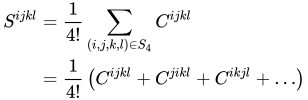
where is the set of all permutations of the four indices.[2] Owing to the symmetries of , this sum reduces to


The difference

is an asymmetric tensor (not antisymmetric). The decomposition can be shown to be unique and irreducible with respect to . In other words, any additional symmetrization operations on or will either leave it unchanged or evaluate to zero. It is also irreducible with respect to arbitrary linear transformations, that is, the general linear group .[2][15]



However, this decomposition is not irreducible with respect to the group of rotations SO(3). Instead, decomposes into three irreducible parts, and into two:

See Itin (2020)[15] for explicit expressions in terms of the components of .
This representation decomposes the space of elasticity tensors into a direct sum of subspaces:

with dimensions

These subspaces are each isomorphic to a harmonic tensor space .[15][16] Here, is the space of 3D, totally symmetric, traceless tensors of rank . In particular, and correspond to , and correspond to , and corresponds to .


See also
[edit]Footnotes
[edit]- ^ a b Here, upper and lower indices denote contravariant and covariant components, respectively, though the distinction can be ignored for Cartesian coordinates. As a result, some references represent components using only lower indices.
- ^ Combining the forward and inverse stress-strain relations gives Eij = Kijpq CpqklEkl. Due to the minor symmetries Cpqkl = Cqpkl and Cpqkl = Cpqlk, this equation does not uniquely determine Kijpq Cpqkl. In fact, Kijpq Cpqkl = a δkiδlj + (1 − a) δliδkj is a solution for any 0 ≤ a ≤ 1. However, only a = 1/2 preserves the minor symmetries of K, so this is the correct solution from a physical standpoint.
References
[edit]- ^ a b Thorne & Blandford 2017, p. 580.
- ^ a b c d e Itin & Hehl 2013.
- ^ a b Thorne & Blandford 2017, p. 581.
- ^ Hill 1965.
- ^ Cowin 1989.
- ^ Marsden & Hughes 1994, p. 223.
- ^ Hehl & Itin 2002.
- ^ Thomas 1966.
- ^ a b c d Landau & Lifshitz 1970.
- ^ Srinivasan & Nigam 1969.
- ^ a b Thorne & Blandford 2017.
- ^ a b Norris 2007.
- ^ Thorne & Blandford 2017, p. 571.
- ^ Moakher & Norris 2006, pp. 221–222.
- ^ a b c Itin 2020.
- ^ Olive, Kolev & Auffray 2017.
Bibliography
[edit]- The Feynman Lectures on Physics - The tensor of elasticity
- Cowin, Stephen C. (1989). "Properties of the Anisotropic Elasticity Tensor". The Quarterly Journal of Mechanics and Applied Mathematics. 42 (2): 249–266. doi:10.1093/qjmam/42.2.249. eISSN 1464-3855. ISSN 0033-5614.
- Hehl, Friedrich W.; Itin, Yakov (2002). "The Cauchy Relations in Linear Elasticity Theory". Journal of Elasticity and the Physical Science of Solids. 66 (2): 185–192. arXiv:cond-mat/0206175. doi:10.1023/A:1021225230036. ISSN 0374-3535. S2CID 18618340.
- Hill, R. (April 1965). "Continuum micro-mechanics of elastoplastic polycrystals". Journal of the Mechanics and Physics of Solids. 13 (2): 89–101. Bibcode:1965JMPSo..13...89H. doi:10.1016/0022-5096(65)90023-2. ISSN 0022-5096.
- Itin, Yakov; Hehl, Friedrich W. (April 2013). "The constitutive tensor of linear elasticity: Its decompositions, Cauchy relations, null Lagrangians, and wave propagation". Journal of Mathematical Physics. 54 (4): 042903. arXiv:1208.1041. Bibcode:2013JMP....54d2903I. doi:10.1063/1.4801859. eISSN 1089-7658. ISSN 0022-2488. S2CID 119133966.
- Itin, Yakov (20 April 2020). "Irreducible matrix resolution for symmetry classes of elasticity tensors". Mathematics and Mechanics of Solids. 25 (10): 1873–1895. arXiv:1812.03367. doi:10.1177/1081286520913596. eISSN 1741-3028. ISSN 1081-2865. S2CID 219087296.
- Landau, Lev D.; Lifshitz, Evgeny M. (1970). Theory of Elasticity. Vol. 7 (2nd ed.). Pergamon Press. ISBN 978-0-08-006465-9.
- Marsden, Jerrold E.; Hughes, Thomas J. R. (1994). Mathematical Foundations of Elasticity. Dover Publications. ISBN 978-0-486-67865-8. OCLC 1117171567.
- Moakher, Maher; Norris, Andrew N. (5 October 2006). "The Closest Elastic Tensor of Arbitrary Symmetry to an Elasticity Tensor of Lower Symmetry" (PDF). Journal of Elasticity. 85 (3): 215–263. doi:10.1007/s10659-006-9082-0. eISSN 1573-2681. ISSN 0374-3535. S2CID 12816173.
- Norris, A. N. (22 May 2007). "Quadratic invariants of elastic moduli". The Quarterly Journal of Mechanics and Applied Mathematics. 60 (3): 367–389. arXiv:cond-mat/0612506. doi:10.1093/qjmam/hbm007. eISSN 1464-3855. ISSN 0033-5614.
- Olive, M.; Kolev, B.; Auffray, N. (2017-05-24). "A Minimal Integrity Basis for the Elasticity Tensor". Archive for Rational Mechanics and Analysis. 226 (1). Springer Science and Business Media LLC: 1–31. arXiv:1605.09561. Bibcode:2017ArRMA.226....1O. doi:10.1007/s00205-017-1127-y. ISSN 0003-9527. S2CID 253711197.
- Srinivasan, T.P.; Nigam, S.D. (1969). "Invariant Elastic Constants for Crystals". Journal of Mathematics and Mechanics. 19 (5): 411–420. eISSN 0095-9057. ISSN 1943-5274. JSTOR 24901866.
- Thomas, T. Y. (February 1966). "On the stress-strain relations for cubic crystals". Proceedings of the National Academy of Sciences. 55 (2): 235–239. Bibcode:1966PNAS...55..235T. doi:10.1073/pnas.55.2.235. eISSN 1091-6490. ISSN 0027-8424. PMC 224128. PMID 16591328.
- Thorne, Kip S.; Blandford, Roger D. (2017). Modern Classical Physics: Optics, Fluids, Plasmas, Elasticity, Relativity, and Statistical Physics. Princeton University Press. ISBN 9780691159027.
Elasticity tensor
View on GrokipediaFundamentals
Definition
In linear elasticity, the fundamental constitutive relation links the stress tensor to the strain tensor through a linear mapping. The stress tensor , a second-rank tensor, represents the internal forces per unit area acting across an infinitesimal surface element within a deformable continuum.[3] The strain tensor , a symmetric second-rank tensor, measures the relative deformation or displacement gradients in the material.[4] Under the assumption of small deformations and linear material response, known as Hooke's law in its generalized tensorial form, the components of the stress tensor are related to those of the strain tensor by where summation over repeated indices and is implied, and denotes the components of the elasticity tensor. This fourth-rank tensor fully characterizes the material's elastic behavior by specifying how applied strains produce corresponding stresses. The elasticity tensor is a fourth-rank tensor in three-dimensional Euclidean space, possessing components in its most general form. Physically, quantifies the directional stiffness of the material, determining the resistance to deformation along specific axes and the coupling between different deformation modes.[5] This tensorial framework generalizes the scalar Hooke's law for uniaxial loading to arbitrary three-dimensional states, originating from Augustin-Louis Cauchy's foundational work in 1828 on the molecular theory of elasticity.[6]Notation Conventions
The elasticity tensor, denoted as , is a fourth-order tensor that relates the second-order stress tensor to the second-order infinitesimal strain tensor through the constitutive equation , where the Einstein summation convention is implied over repeated indices and .[7] In this full tensor notation, the components are defined with respect to a Cartesian coordinate system, and the tensor possesses 81 components in general, though symmetries reduce the number of independent components in practical cases, such as to 21 for materials without additional symmetry assumptions.[8] To facilitate computational and engineering applications, the elasticity tensor is often represented in contracted forms. The Voigt notation maps the fourth-order tensor to a 6×6 matrix , where the indices correspond to specific pairings of the original tensor indices: $11 \to 1, $22 \to 2, $33 \to 3, $23 \to 4 (or $32 \to 4), $13 \to 5 (or $31 \to 5), and $12 \to 6 (or $21 \to 6).[](https://dspace.mit.edu/bitstream/handle/1721.1/105251/12665_2016_Article_5429.pdf?sequence=1&isAllowed=y) In this scheme, the stress components are vectorized as \boldsymbol{\sigma} = [\sigma_{11}, \sigma_{22}, \sigma_{33}, \sigma_{23}, \sigma_{13}, \sigma_{12}]^T\boldsymbol{\epsilon} = [\epsilon_{11}, \epsilon_{22}, \epsilon_{33}, 2\epsilon_{23}, 2\epsilon_{13}, 2\epsilon_{12}]^T\boldsymbol{\sigma} = \mathbf{C} \boldsymbol{\epsilon}\mathbf{C}$ is the elasticity matrix used extensively in finite element analysis and engineering simulations.[9] An alternative to Voigt notation is the Kelvin notation, which also employs a 6×6 matrix representation but vectorizes both stress and strain without the factor of 2 on shear strains, instead using factors to maintain tensorial properties and simplify transformations.[9] Specifically, the vectors are and , ensuring that the matrix preserves the major and minor symmetries of the original tensor more naturally in numerical implementations.[8] This notation, originally proposed by Lord Kelvin in 1856, is particularly advantageous in contexts requiring invariant formulations, such as crystal physics.[9] The compliance tensor, denoted , is the inverse of the elasticity tensor, satisfying , where is the Kronecker delta, and it relates strain to stress via .[7] In matrix form, whether Voigt or Kelvin, the compliance matrix follows analogous index mappings, with adjustments for shear factors to ensure consistency in engineering applications.[8] For instance, in the general case without symmetries, the full has 81 components, mirroring the structure of , but reduces similarly under symmetry constraints.Symmetries
Intrinsic Symmetries
The elasticity tensor , which relates the stress tensor to the strain tensor via , possesses intrinsic symmetries that stem from fundamental properties of the stress and strain tensors as well as the thermodynamic framework of linear elasticity.[10] The minor symmetries arise directly from the symmetry of the stress and strain tensors. Specifically, since the stress tensor is symmetric (), it follows that ; similarly, the symmetry of the strain tensor () implies . These relations reduce the number of independent components of the fourth-rank tensor from 81 to 36, as the tensor can then be represented by a 6×6 matrix in Voigt notation with row and column symmetries.[10][2] The major symmetry, , originates from the existence of a strain energy potential in hyperelastic materials, where the elastic energy density is given by the quadratic form This symmetry ensures that is a scalar invariant under index permutation, and the positive definiteness of ( for nonzero ) guarantees material stability under small deformations.[10] The major symmetry is thermodynamically grounded in the requirement that the stress derives from the potential via , enforcing symmetry in the response functions.[11] This major symmetry is closely related to Onsager reciprocity principles, which stem from time-reversal invariance in non-dissipative thermodynamic systems; in elasticity, it manifests as the symmetry of the stiffness tensor, ensuring reciprocal relations between applied strains and resulting stresses.[12] When combined with the minor symmetries, these intrinsic properties further constrain the elasticity tensor to 21 independent components, forming a subspace of fully symmetric fourth-rank tensors in three dimensions.[10]Resulting Constraints
The intrinsic symmetries of the elasticity tensor significantly reduce the number of independent components required to describe linear elastic behavior. Without symmetries, the fourth-rank tensor has 81 components. The minor symmetries, stemming from the symmetry of the stress and strain tensors ( and ), reduce this to 36 independent components by enforcing . The major symmetry, arising from the existence of a strain energy potential (ensuring thermodynamic consistency), further imposes , yielding 21 independent components for the most general (triclinic) case.[13] In Voigt notation, which maps the tensor to a 6×6 matrix for computational convenience (as briefly referenced in standard notation conventions), these symmetries manifest as a symmetric matrix structure with 21 independent entries. The generic form for a triclinic material, where no additional crystal symmetries apply, is: This matrix enforces the required symmetries, with zeros absent only due to higher material symmetries (e.g., in cubic cases). All off-diagonal elements are independent except for the inherent symmetry .[14] For mechanical stability, the elasticity tensor must ensure positive strain energy for any non-zero deformation, expressed as the quadratic form for , where is the strain energy density, is the Voigt strain vector, and is the stiffness matrix. This requires to be positive definite, meaning all its eigenvalues are positive. Equivalently, Sylvester's criterion applies: all leading principal minors of the 6×6 symmetric matrix must be positive.[1][13] These positive definiteness conditions translate to explicit numerical inequalities that depend on material symmetry, generalizing simpler 2D cases to 3D. For example, in 2D orthotropic materials (reducing to a 3×3 matrix), stability requires , , , and , with conditions like emerging in isotropic limits where . In 3D, for cubic symmetry (3 independent components), the generalized Born stability criteria are , , and , ensuring no imaginary phonon frequencies or structural instabilities. For lower symmetries like triclinic, the full 21 conditions revert to checking the 6 leading principal minors or eigenvalues numerically. These constraints not only enforce stability but also bound the feasible parameter space for experimental or computational determination of elastic constants.[13][15]Special Material Cases
Isotropic Materials
Isotropic materials exhibit elastic properties that are independent of direction, resulting in the elasticity tensor possessing only two independent constants, typically the Lamé parameters λ and μ. The fourth-rank elasticity tensor for such materials takes the form where δ denotes the Kronecker delta, λ governs volumetric response, and μ represents the shear modulus.[16] This expression ensures that the material responds uniformly to applied stresses regardless of orientation, simplifying the general 21-component tensor to a structure with maximal symmetry.[16] In Voigt notation, which reduces the tensor to a 6×6 stiffness matrix by mapping indices (11→1, 22→2, 33→3, 23→4, 13→5, 12→6), the isotropic form exhibits a distinct pattern: the normal components are equal, the cross-normal terms are identical, and the shear components are uniform. The matrix is| 1 | 2 | 3 | 4 | 5 | 6 | |
|---|---|---|---|---|---|---|
| 1 | λ+2μ | λ | λ | 0 | 0 | 0 |
| 2 | λ | λ+2μ | λ | 0 | 0 | 0 |
| 3 | λ | λ | λ+2μ | 0 | 0 | 0 |
| 4 | 0 | 0 | 0 | μ | 0 | 0 |
| 5 | 0 | 0 | 0 | 0 | μ | 0 |
| 6 | 0 | 0 | 0 | 0 | 0 | μ |
Cubic and Other Crystal Symmetries
In crystals exhibiting cubic symmetry, the elasticity tensor possesses the highest level of rotational invariance among anisotropic materials, resulting in only three independent elastic constants in Voigt notation: , , and . The Voigt matrix for cubic crystals takes the form where , , , and all other components are zero: [18] This structure arises from the point group symmetries of the cubic system, including fourfold rotation axes along , threefold axes along , and mirror planes, which require the tensor to remain invariant under these operations, enforcing the equalities among components.[19] Face-centered cubic (FCC) metals, such as aluminum, exemplify this symmetry; for aluminum, typical values are , , and .[20] The degree of elastic anisotropy in cubic crystals is often quantified by the Zener anisotropy factor , which equals 1 for isotropic behavior and deviates from 1 to indicate directional variations in stiffness; for aluminum, . For crystals with lower symmetries, the number of independent elastic constants increases as fewer constraints are imposed by the point group operations. These operations—such as twofold rotations, mirrors, and glide planes—generate additional equalities or leave certain components distinct, reducing the full 21 independent components of the triclinic case stepwise.[21] The 32 crystal point groups, classified into 11 Laue classes for tensor properties (as inversion symmetry does not affect the elasticity tensor), yield the following independent constants for major symmetry classes:| Crystal System | Number of Independent Constants | Example Point Groups |
|---|---|---|
| Triclinic | 21 | 1, |
| Monoclinic | 13 | 2, m, 2/m |
| Orthorhombic | 9 | 222, mm2, mmm |
| Tetragonal | 6 or 7 | 4, , 4/m; 422, 4mm, , 4/mmm |
| Trigonal | 6 or 7 | 3, ; 32, 3m, |
| Hexagonal | 5 | 6, , 6/m; 622, 6mm, , 6/mmm |
| Cubic | 3 | 23, m; 432, , m |