


Community hub
Recent from talks
Contribute something
Nothing was collected or created yet.
Orthotropic material
View on Wikipedia

In material science and solid mechanics, orthotropic materials have material properties at a particular point which differ along three orthogonal axes, where each axis has twofold rotational symmetry. These directional differences in strength can be quantified with Hankinson's equation.
They are a subset of anisotropic materials, because their properties change when measured from different directions.
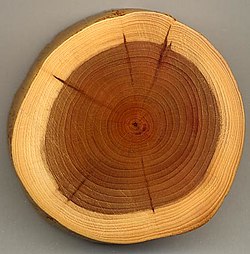
A familiar example of an orthotropic material is wood. In wood, one can define three mutually perpendicular directions at each point in which the properties are different. It is most stiff (and strong) along the grain (axial direction), because most cellulose fibrils are aligned that way. It is usually least stiff in the radial direction (between the growth rings), and is intermediate in the circumferential direction. This anisotropy was provided by evolution, as it best enables the tree to remain upright.
Because the preferred coordinate system is cylindrical-polar, this type of orthotropy is also called polar orthotropy.
Another example of an orthotropic material is sheet metal formed by squeezing thick sections of metal between heavy rollers. This flattens and stretches its grain structure. As a result, the material becomes anisotropic — its properties differ between the direction it was rolled in and each of the two transverse directions. This method is used to advantage in structural steel beams, and in aluminium aircraft skins.
If orthotropic properties vary between points inside an object, it possesses both orthotropy and inhomogeneity. This suggests that orthotropy is the property of a point within an object rather than for the object as a whole (unless the object is homogeneous). The associated planes of symmetry are also defined for a small region around a point and do not necessarily have to be identical to the planes of symmetry of the whole object.
Orthotropic materials are a subset of anisotropic materials; their properties depend on the direction in which they are measured. Orthotropic materials have three planes/axes of symmetry. An isotropic material, in contrast, has the same properties in every direction. It can be proved that a material having two planes of symmetry must have a third one. Isotropic materials have an infinite number of planes of symmetry.
Transversely isotropic materials are special orthotropic materials that have one axis of symmetry (any other pair of axes that are perpendicular to the main one and orthogonal among themselves are also axes of symmetry). One common example of transversely isotropic material with one axis of symmetry is a polymer reinforced by parallel glass or graphite fibers. The strength and stiffness of such a composite material will usually be greater in a direction parallel to the fibers than in the transverse direction, and the thickness direction usually has properties similar to the transverse direction. Another example would be a biological membrane, in which the properties in the plane of the membrane will be different from those in the perpendicular direction. Orthotropic material properties have been shown to provide a more accurate representation of bone's elastic symmetry and can also give information about the three-dimensional directionality of bone's tissue-level material properties.[1]
It is important to keep in mind that a material which is anisotropic on one length scale may be isotropic on another (usually larger) length scale. For instance, most metals are polycrystalline with very small grains. Each of the individual grains may be anisotropic, but if the material as a whole comprises many randomly oriented grains, then its measured mechanical properties will be an average of the properties over all possible orientations of the individual grains.
Orthotropy in physics
[edit]Anisotropic material relations
[edit]Material behavior is represented in physical theories by constitutive relations. A large class of physical behaviors can be represented by linear material models that take the form of a second-order tensor. The material tensor provides a relation between two vectors and can be written as

where are two vectors representing physical quantities and is the second-order material tensor. If we express the above equation in terms of components with respect to an orthonormal coordinate system, we can write


Summation over repeated indices has been assumed in the above relation. In matrix form we have

Examples of physical problems that fit the above template are listed in the table below.[2]


Condition for material symmetry
[edit]The material matrix has a symmetry with respect to a given orthogonal transformation () if it does not change when subjected to that transformation. For invariance of the material properties under such a transformation we require



Hence the condition for material symmetry is (using the definition of an orthogonal transformation)

Orthogonal transformations can be represented in Cartesian coordinates by a matrix given by


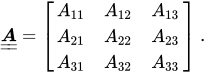
Therefore, the symmetry condition can be written in matrix form as

Orthotropic material properties
[edit]An orthotropic material has three orthogonal symmetry planes. If we choose an orthonormal coordinate system such that the axes coincide with the normals to the three symmetry planes, the transformation matrices are

It can be shown that if the matrix for a material is invariant under reflection about two orthogonal planes then it is also invariant under reflection about the third orthogonal plane.
Consider the reflection about the plane. Then we have


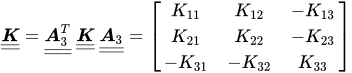
The above relation implies that . Next consider a reflection about the plane. We then have



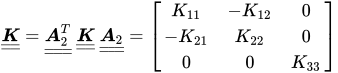
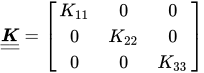
That implies that . Therefore, the material properties of an orthotropic material are described by the matrix

Orthotropy in linear elasticity
[edit]Anisotropic elasticity
[edit]In linear elasticity, the relation between stress and strain depend on the type of material under consideration. This relation is known as Hooke's law. For anisotropic materials Hooke's law can be written as[3]

where is the stress tensor, is the strain tensor, and is the elastic stiffness tensor. If the tensors in the above expression are described in terms of components with respect to an orthonormal coordinate system we can write


where summation has been assumed over repeated indices. Since the stress and strain tensors are symmetric, and since the stress-strain relation in linear elasticity can be derived from a strain energy density function, the following symmetries hold for linear elastic materials

Because of the above symmetries, the stress-strain relation for linear elastic materials can be expressed in matrix form as
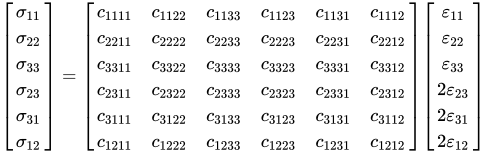
An alternative representation in Voigt notation is
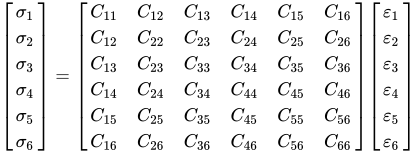
or

The stiffness matrix in the above relation satisfies point symmetry.[4]

Condition for material symmetry
[edit]The stiffness matrix satisfies a given symmetry condition if it does not change when subjected to the corresponding orthogonal transformation. The orthogonal transformation may represent symmetry with respect to a point, an axis, or a plane. Orthogonal transformations in linear elasticity include rotations and reflections, but not shape changing transformations and can be represented, in orthonormal coordinates, by a matrix given by

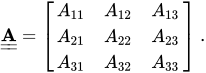
In Voigt notation, the transformation matrix for the stress tensor can be expressed as a matrix given by[4]


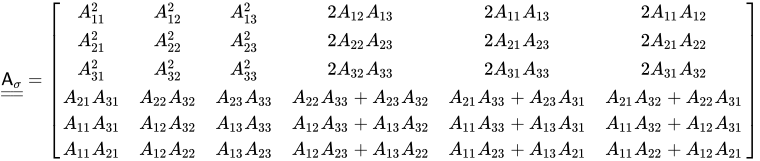
The transformation for the strain tensor has a slightly different form because of the choice of notation. This transformation matrix is
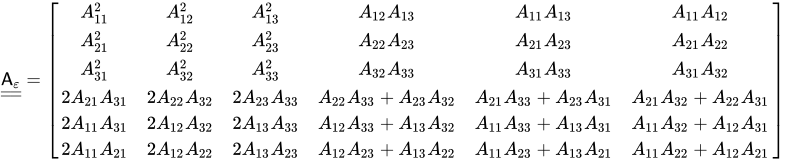
It can be shown that .

The elastic properties of a continuum are invariant under an orthogonal transformation if and only if[4]
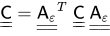
Stiffness and compliance matrices in orthotropic elasticity
[edit]An orthotropic elastic material has three orthogonal symmetry planes. If we choose an orthonormal coordinate system such that the axes coincide with the normals to the three symmetry planes, the transformation matrices are

We can show that if the matrix for a linear elastic material is invariant under reflection about two orthogonal planes then it is also invariant under reflection about the third orthogonal plane.
If we consider the reflection about the plane, then we have

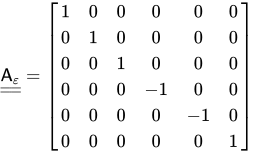
Then the requirement implies that[4]
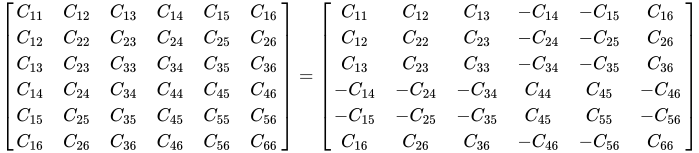
The above requirement can be satisfied only if

Let us next consider the reflection about the plane. In that case

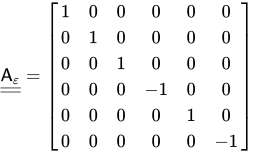
Using the invariance condition again, we get the additional requirement that

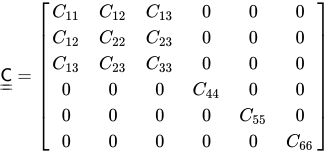
No further information can be obtained because the reflection about third symmetry plane is not independent of reflections about the planes that we have already considered. Therefore, the stiffness matrix of an orthotropic linear elastic material can be written as
The inverse of this matrix is commonly written as[5]
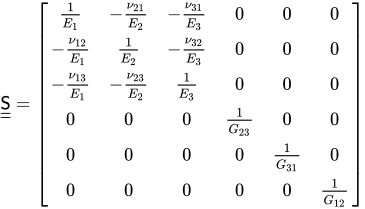
where is the Young's modulus along axis , is the shear modulus in direction on the plane whose normal is in direction , and is the Poisson's ratio that corresponds to a contraction in direction when an extension is applied in direction . Only nine (9) from these twelve (12) elastic constants are independent.


Bounds on the moduli of orthotropic elastic materials
[edit]The strain-stress relation for orthotropic linear elastic materials can be written in Voigt notation as

where the compliance matrix is given by

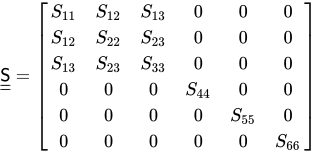
The compliance matrix is symmetric and must be positive definite for the strain energy density to be positive. This implies from Sylvester's criterion that all the principal minors of the matrix are positive,[6] i.e.,

where is the principal submatrix of .


Then,
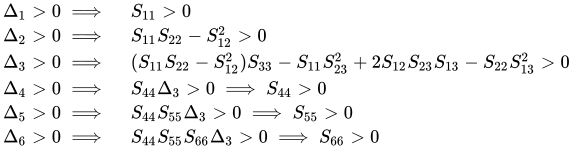
We can show that this set of conditions implies that[7]

or

However, no similar lower bounds can be placed on the values of the Poisson's ratios .[6]

See also
[edit]References
[edit]- ^ Geraldes DM et al, 2014, A comparative study of orthotropic and isotropic bone adaptation in the femur, International Journal for Numerical Methods in Biomedical Engineering, Volume 30, Issue 9, pages 873–889, DOI: 10.1002/cnm.2633, http://onlinelibrary.wiley.com/wol1/doi/10.1002/cnm.2633/full
- ^ Milton, G. W., 2002, The Theory of Composites, Cambridge University Press.
- ^ Lekhnitskii, S. G., 1963, Theory of Elasticity of an Anisotropic Elastic Body, Holden-Day Inc.
- ^ a b c d Slawinski, M. A., 2010, Waves and Rays in Elastic Continua: 2nd Ed., World Scientific. [1]
- ^ Boresi, A. P, Schmidt, R. J. and Sidebottom, O. M., 1993, Advanced Mechanics of Materials, Wiley.
- ^ a b Ting, T. C. T. and Chen, T., 2005, Poisson's ratio for anisotropic elastic materials can have no bounds,, Q. J. Mech. Appl. Math., 58(1), pp. 73-82.
- ^ Ting, T. C. T. (1996), "Positive definiteness of anisotropic elastic constants", Mathematics & Mechanics of Solids, 1 (3): 301–314, doi:10.1177/108128659600100302, S2CID 122747373.
Further reading
[edit]- Orthotropy modeling equations from OOFEM Matlib manual section.
- Hooke's law for orthotropic materials
Orthotropic material
View on GrokipediaFundamentals of Orthotropy
Definition and Basic Principles
An orthotropic material is defined as one that has three mutually perpendicular planes of symmetry, resulting in distinct mechanical properties along three principal directions.[1] These planes of symmetry are typically taken as the coordinate planes in the principal material coordinate system.[5] The physical basis for orthotropy stems from aligned microstructures within the material, where directional features like fiber orientations, crystal lattices, or layered arrangements impose direction-dependent responses to external loads.[6] For instance, in wood, the alignment of cellulose fibers along the grain direction leads to higher stiffness longitudinally than transversely, while in fiber-reinforced composites, deliberate fiber placement creates similar directional variations.[7] This microstructural alignment reduces the complexity of the general anisotropic behavior, constraining the material's response tensor. Mathematically, orthotropy simplifies the fully anisotropic elasticity tensor, which has 21 independent components in three dimensions, to just nine independent elastic constants due to the imposed symmetries.[8] These constants typically include three Young's moduli, three Poisson's ratios, and three shear moduli, one set for each principal direction, enabling a more tractable description of the material's linear elastic behavior without losing the essential directional distinctions.[9]Comparison with Isotropic and Anisotropic Materials
Isotropic materials possess mechanical properties that are identical in all directions, requiring only two independent elastic constants in three-dimensional linear elasticity, such as Young's modulus and Poisson's ratio .[5] In contrast, anisotropic materials exhibit direction-dependent properties, with the extent of this dependence governed by the material's symmetry class, which reduces the number of independent parameters needed to describe their behavior.[5] The most general anisotropic case, known as triclinic symmetry, features no planes of symmetry and thus demands 21 independent elastic constants to fully characterize the stiffness tensor.[5] Orthotropic materials, defined by three mutually perpendicular planes of symmetry, occupy an intermediate position in this classification spectrum, with nine independent elastic constants.[5] Transversely isotropic materials, which have one plane of isotropy with infinite rotational symmetry about the axis perpendicular to it, require five independent constants and serve as a special case that bridges isotropic uniformity and orthotropic directionality by equating properties in two orthogonal directions.[5] Monoclinic materials, possessing a single plane of symmetry, lie between orthotropic and fully anisotropic behaviors, necessitating 13 independent constants.[5] The following table summarizes the number of independent elastic constants and symmetry planes for these material classes:| Symmetry Class | Number of Symmetry Planes | Independent Elastic Constants |
|---|---|---|
| Isotropic | Infinite | 2 |
| Transversely Isotropic | One plane of isotropy | 5 |
| Orthotropic | Three mutually perpendicular planes | 9 |
| Monoclinic | One plane | 13 |
| Triclinic | None | 21 |
Symmetry and Material Properties
Conditions for Orthotropic Symmetry
Orthotropic materials exhibit symmetry such that their mechanical properties remain unchanged under 180-degree rotations about three mutually orthogonal axes, as well as under reflections across the three corresponding planes perpendicular to these axes.[10][5] This invariance defines the orthotropic symmetry class, distinguishing it from higher symmetries like transverse isotropy (one plane and axis) or full isotropy (all directions equivalent), while being a specific case of anisotropy with reduced complexity.[11] The transformation rules for orthotropic symmetry require that the stress-strain relations, encapsulated in the elasticity tensor, remain invariant under orthogonal transformations corresponding to these rotations and reflections. Specifically, for a symmetry operation represented by an orthogonal second-order tensor (with and ), the fourth-order elasticity tensor transforms as , and invariance demands .[11][5] For orthotropy, applying these transformations for the three pairwise orthogonal 180-degree rotations (or equivalent reflections) enforces the necessary constraints on the tensor components. In the orthotropic case, the elasticity tensor satisfies the intrinsic symmetries , which arise from the symmetry of the stress and strain tensors and the existence of a strain energy potential, reducing the general form to 21 independent components before further symmetry restrictions; orthotropy then limits it to nine independent components by nullifying cross-shear and certain coupling terms in the principal frame.[11][5] The derivation begins with the fully anisotropic elasticity tensor, which has 21 independent constants due to the aforementioned intrinsic symmetries. Applying the orthotropic symmetry operations sequentially—such as the 180-degree rotation about each principal axis—eliminates off-diagonal terms that couple shear in different planes or normal strains across non-aligned directions, yielding the nine-component form aligned with the material's symmetry.[11][5] The principal material coordinate system for orthotropic materials is defined such that the three orthogonal axes align with the symmetry directions: typically, axis 1 along the primary fiber or loading direction, axis 2 along a secondary in-plane direction, and axis 3 transverse to the plane of primary orientation.[5] In this system, the elasticity tensor takes its simplest diagonal-dominant form, facilitating analysis of directional properties.[11]Key Mechanical Properties
Orthotropic materials exhibit directional dependence in their mechanical properties due to the presence of three mutually perpendicular planes of symmetry, resulting in distinct responses to loading along the principal material axes. Specifically, these materials possess three independent Young's moduli, denoted as , , and , which characterize the stiffness in tension or compression along each principal direction. Similarly, there are three distinct shear moduli, , , and , governing resistance to shear deformation in the respective planes, and three independent Poisson's ratios, such as , , and , describing the lateral strain response to axial loading in the principal directions.[12][2] The orthotropic symmetry imposes limitations on coupling effects between different deformation modes. In the principal coordinate system aligned with the symmetry planes, there is no coupling between normal stresses and shear strains, or vice versa, simplifying the stress-strain relations compared to fully anisotropic materials. This absence of shear-extension coupling arises directly from the threefold rotational symmetry, ensuring that extensions occur independently of shears along the principal axes.[13] Beyond mechanical elasticity, orthotropic materials display anisotropic thermal behavior, with three independent coefficients of thermal expansion, , , and , corresponding to expansion in each principal direction. Thermal conductivity is similarly orthotropic, featuring distinct values , , and along the principal axes, which influences heat flow directionality in applications like composites.[14][15] For thermodynamic stability, the elastic properties must satisfy constraints ensuring the positive definiteness of the stiffness matrix, which requires all eigenvalues to be positive and imposes inequalities on the engineering constants, such as and specific bounds on Poisson's ratios to prevent unphysical negative strain energies.[16] The nine independent elastic constants for an orthotropic material are summarized in the following table:| Property | Symbol | Description |
|---|---|---|
| Young's modulus (direction 1) | Stiffness along axis 1 | |
| Young's modulus (direction 2) | Stiffness along axis 2 | |
| Young's modulus (direction 3) | Stiffness along axis 3 | |
| Shear modulus (plane 1-2) | Shear stiffness in plane 1-2 | |
| Shear modulus (plane 2-3) | Shear stiffness in plane 2-3 | |
| Shear modulus (plane 3-1) | Shear stiffness in plane 3-1 | |
| Poisson's ratio (12) | Lateral strain ratio for loading in direction 1 | |
| Poisson's ratio (13) | Lateral strain ratio for loading in direction 1 (transverse to 3) | |
| Poisson's ratio (23) | Lateral strain ratio for loading in direction 2 |