
Wikipedia
Electrelane
View on Wikipedia
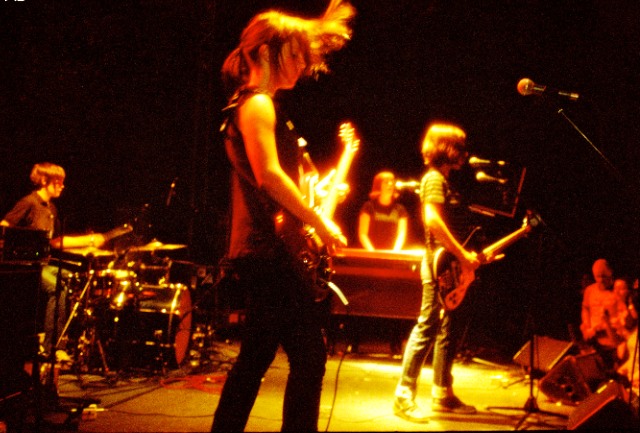
Electrelane is an English indie rock band, formed in Brighton in 1998 by Verity Susman and Emma Gaze. The band consists of Susman, Gaze, Mia Clarke, and Ros Murray. Their music draws from a wide range of influences including Neu!, Stereolab, Sonic Youth, and the Velvet Underground. When playing live, the band has a reputation for a focused show that minimizes audience interaction and rarely included more than one encore.[1][2][3]
Key Information


Although the band has strong feminist and political views in their personal lives, they generally prefer to not communicate that directly to their fans or through their music;[4] one exception is their inclusion of the protest song "The Partisan," - a Leonard Cohen cover - which they began playing while on tour in the United States during the months preceding the 2004 Presidential election.
History
[edit]Early years (1998–2000)
[edit]The band recorded their first single, "Film Music," and released it in January 2000 on the Skint Records offshoot label Indenial. They released another single ("Le Song") with Fierce Panda before creating their own label, Let's Rock!, with distribution by 3MV. The first two singles they released were "Gabriel" and "Blue Straggler" and in fall of 2000 they began work on their debut album. During this period, they had a number of personnel changes. The original bassist was Tracy Houdek, who left the band due to a pregnancy. She was briefly replaced by Rupert Noble until Rachel Dalley signed on. Original guitarist Debbie Ball was replaced by Mia Clarke.
Rock It to the Moon (2000–2003)
[edit]Their debut album, Rock It to the Moon, was released in April 2001 through Mr. Lady Records.[5] Although Electrelane started off as a traditional band with vocals, this album was mostly instrumental. Verity Susman explained, "Way way back, when we first started, we always had a lot of singing. But it never worked that well. When we did instrumental it was always more interesting. More completely we felt like we were doing something good, while the songs with the singing ended up quite bog-standard, boring, not very interesting."[6] NME rated the album an 8 out of 10, saying Rock It to the Moon was "just the way a debut album should be... utterly focused [and] stripped of all extraneous flab."[7]
The Power Out (2003–2004)
[edit]Electrelane brought in Steve Albini to record their second album, The Power Out, while production was still handled by the band.[8] The result was an album that added more vocals and structure to the songs, giving them almost pop-like vibes. It was released on Too Pure in February 2004. The album was widely recognised and praised as critics appreciated the added complexity and vocals on their new work.
Electrelane had not only added vocals to the work, but had transcended conventional expectations by employing a number of techniques. Of the nine songs with vocals, three of them were done in different languages. The album opener "Gone Under Sea" is sung completely in French. The third song, "The Valleys," featuring the vocals of the ensemble Chicago a cappella, had in part sections from Siegfried Sassoon's "A Letter Home." On "Oh Sombra!" the Spanish lyrics are a sonnet by 16th century Catalan poet Juan Boscán Almogáver. On "This Deed" the lyrics are a single line, in German, from Friedrich Nietzsche's Die fröhliche Wissenschaft followed by the exclamation "Hände hoch!" (or "Hands up!"). These touches, as one review put it, "managed to be unique without being a radical departure."[9]
Midway through 2004, Rachel Dalley left the group and was replaced by Ros Murray, an old friend of the group.[10]
Axes (2004–2006)
[edit]For their follow up, the mostly instrumental Axes, Electrelane once again returned to Steve Albini's studio in Chicago. In the first recording session for Axes, the band played through the entire album in one take.[11] This reflected the band's desire to have listeners of the album experience the band's live show. Emma Gaze explained the album was recorded "the way we rehearse and practise: we all stand in a circle and it is very relaxed. Our previous recording experiences have been with the bass in one room, the drums in a different room, the two guitarists in a different room and then the vocals are done afterwards. Obviously it works like that because that is how most bands do it. But we just wanted it to sound more live; there is a different kind of energy that comes from playing in the same room."[12] Verity Susman said that "We see the record as a continuous piece of music, not a collection of songs. It also reflects the way we improvise, moving from one idea to the next without a clear break. It's also how we play live."[11] The album was released on 9 May 2005 to mixed, but generally positive, reviews.
As with The Power Out, Electrelane supported Axes with a global tour. By now they had toured in the UK, the United States, Canada, France, Germany, the Netherlands, Italy, Switzerland, Sweden, Denmark, Norway, Ireland, Spain, Greece, Turkey, Japan and Australia. They both headlined their own tours and supported tours for the Ex and Le Tigre among others; they had also appeared at festivals such as South by Southwest and the ATP Festival.
No Shouts, No Calls and indefinite hiatus (2006–2007)
[edit]No Shouts, No Calls is Electrelane's fourth studio album, and their first which was entirely digitally recorded and mixed.[13] The group began writing material in Berlin's Planet Roc Studio in the summer of 2006, at the height of the World Cup. During that period, the band became fans of the sport, going so far as to rearrange their recording schedules around the event and including a sample of a match between Hertha BSC and FC Moskva in the song "Five" on their new album.
In August, Electrelane released Singles, B-Sides & Live, a rarities collection that included a number of live performances as well as original versions of tracks from their debut album. In September and October, they were in Benton Harbor recording and mixing their album. In November, the band announced on their official website that they had finished recording and had titled their album No Shouts, No Calls. The album was released in on 23 April 2007 in Japan, 3 May 2007 in the US and 30 April 2007 elsewhere. The first single, titled "To the East," was released on 12 March 2007. The album received generally positive reviews, with Heather Phares of AllMusic calling some songs "among the band's finest work";[14] detractors included Leonie Cooper of the Guardian, who mentioned the band had a "penchant for turning every tune [into] a proggy wig-out."[15] James Reed of the Boston Globe picked the album as one of the best of 2007.[16] In May and June 2007 the band toured the United States with Tender Forever and opened for Arcade Fire on several of their shows. For the rest of the summer, they played the Fuji Rock Festival in Japan as well as various festivals in Europe, including La Route du Rock, Summercase, Montreux Jazz Festival and Festival Paredes de Coura.
In early November 2007, Electrelane posted a message on their website, explaining that they would be on an indefinite hiatus. Their "last" show "for the foreseeable future" was on 1 December 2007 in Brighton, England. On 14 December, the band organised a benefit for the Anti-Trafficking Alliance at the Barfly in London. They did not perform, choosing to DJ instead.[17]
Brief reformation (2011–2012)
[edit]In February 2011, Electrelane announced they would play several festivals, including Field Day in London. During the spring, the band announced they would play The Big Chill festival held on the grounds of Eastnor Castle.[18] They toured Australia in early 2012 as well.[19] At the time, they announced no plans for new material or further tours.
New music announcement (2021)
[edit]The band announced in November 2021 that they are working together on their first new music since No Shouts, No Calls in 2007 and that "playing together again feels really, really good."[20]
Verity Susman has released two film scores and a proper album as Memorials, a new project with Wire's Matthew Simms, since 2022.[21][22]
Lineup
[edit]- Current members
- Verity Susman – lead vocals, keyboards, guitar, organ, saxophone, clarinet (1998-present)
- Emma Gaze – drums, artwork (1998-present)
- Mia Clarke – guitar, backing vocals (2000-present)
- Ros Murray – bass guitar, backing vocals (2005-present)
- Past members
- Tracey Houdek – bass guitar (1998-99)
- Debbie Ball – guitar, vocals (1998-2000)
- Rupert Noble – bass guitar (1999)
- Rachel Dalley – bass guitar (1999-2004)
Discography
[edit]- Studio albums
- 2001: Rock It to the Moon
- 2004: The Power Out
- 2005: Axes
- 2007: No Shouts, No Calls
- Singles and EPs
- 2000: Film Music
- 2000: Le Song
- 2000: Gabriel
- 2001: Blue Straggler
- 2002: I Want to Be President EP
- 2003: On Parade
- 2004: This Deed
- 2005: Two For Joy
- 2007: To the East
- 2007: In Berlin
- Compilations
- 2006: Singles, B-Sides & Live
References
[edit]- ^ Sanneh, Kelefah (3 April 2004). "Singing in Four Languages, Revealing in None". The New York Times. Retrieved 6 February 2008.
- ^ Dodero, Camille (4 December 2007). "Hugs and Kisses No. 22: Farewell to Electrelane". The Village Voice. Archived from the original on 6 January 2018. Retrieved 26 October 2016.
- ^ Draper, Jimmy (10 May 2007). "Top Live Show: Electrelane". Time Out New York. Archived from the original on 18 January 2008. Retrieved 6 February 2008.
- ^ Capper, Beth. "Never Mind The Bollocks..." Drowned in Sound. Archived from the original on 29 September 2007. Retrieved 6 February 2008.
- ^ "Electrelane Archives". Nme.com. 16 February 2011. Retrieved 27 May 2020.
- ^ Farouky, Jumana (2003). "Electrelane". Under the Radar. Archived from the original on 28 September 2007. Retrieved 6 February 2008.
- ^ Pattison, Louis (18 April 2001). "Electrelane: Rock it to the Moon". NME. Archived from the original on 11 January 2008. Retrieved 7 February 2008.
- ^ Thomas, Sean (23 June 2005). "Electrelane". tohellwith. Archived from the original on 10 December 2007. Retrieved 6 February 2008.
- ^ Phares, Heather (2004). "The Power Out". Allmusic. Retrieved 6 February 2008.
- ^ J., Matthews (28 September 2005). "Electrelane interview on Left of the Dial". Progressive Broadcast Service. Archived from the original on 28 September 2007. Retrieved 6 February 2008.
- ^ a b "Electrelane – Biography". Too Pure. 2005. Archived from the original on 11 July 2007. Retrieved 7 February 2008.
- ^ "Electrelane". Broken Spring Review. Archived from the original on 3 March 2007. Retrieved 6 April 2006.
- ^ Pollock, Jesse (8 March 2007). "Electrelane Interview". FecalFace.com. Retrieved 8 February 2008.
- ^ Phares, Heather (2004). "No Shouts No Calls". AllMusic. Retrieved 6 February 2008.
- ^ Cooper, Leonie (27 April 2007). "Electrelane, No Shouts No Calls". The Guardian. Retrieved 6 February 2008.
- ^ Reed, James (16 December 2007). "The Best CDs of 2007". The Boston Globe. Retrieved 6 February 2008.
- ^ Thompson, Paul (13 December 2007). "Electrelane Organize Anti-Trafficking Benefit". Pitchfork Media. Archived from the original on 15 February 2008. Retrieved 6 February 2008.
- ^ "The Big Chill 2011 – Electrelane". 20 April 2011. Archived from the original on 17 May 2011. Retrieved 20 April 2011.
- ^ "Interview: Electrelane". Oyster. 21 March 2012. Archived from the original on 2 April 2015. Retrieved 20 March 2015.
- ^ Pearis, Bill (13 November 2021). "Electrelane are back, working on first new music in 15 years". Brooklyn Vegan. Retrieved 14 January 2022.
- ^ Quietus, The (22 May 2023). "Future Hauntology: An Interview With Memorials". The Quietus. Retrieved 8 February 2025.
- ^ "MEMORIALS – FIRE RECORDS". www.firerecords.com. Retrieved 8 February 2025.
External links
[edit]
- Electrelane.com Archived 6 March 2015 at the Wayback Machine – Official band website
- Beggars Group: Electrelane
- Allmusic entry
- Electrelane collection at the Internet Archive's live music archive
- Electrelane interview by ZME Music, 24 July
| International | |
|---|---|
| National | |
| Artists | |

Grokipedia
Electrelane
View on GrokipediaHistory
Formation and early years (1998–2000)
Electrelane formed in early 1998 in Brighton, England, when Verity Susman and Emma Gaze, then sixth-form students, decided to start a band after securing a rehearsal space adjacent to Gaze's bedroom.[5] The initial lineup included Susman on piano, vocals, saxophone, and guitar; Gaze on drums; Debbie Ball on guitar; and Tracey Houdek on bass.[5] The band quickly played local gigs, which were described as shambolic but instrumental in developing their primarily non-vocal, experimental sound.[5] Houdek departed after the first performance due to pregnancy, with Rupert Noble briefly substituting on bass before Rachel Dalley joined permanently in 1999.[5][6] In 2000, guitarist Mia Clarke became a member, solidifying the core lineup of Susman, Gaze, Dalley, and Clarke.[5][6] That year, Electrelane signed with 3MV and issued their debut singles: "Film Music" in January on Indenial (an imprint of Skint Records), "Le Song" in June on Fierce Panda, and "Gabriel."[5][6] These releases marked the band's transition from local rehearsals to recorded output, with sessions for their first album Rock It to the Moon also occurring in 2000, though it appeared the following year.[5]Rock It to the Moon era (2000–2003)
In 2000, following the recruitment of guitarist Mia Clarke to replace Debbie Ball, Electrelane stabilized their lineup with Verity Susman on vocals and keyboards, Emma Gaze on drums, Clarke on guitar, and Rachel Dalley on bass.[1][6] The band issued three singles that year: "Film Music" on Indenial Records (an offshoot of Skint), "Le Song" on Fierce Panda, and "Gabriel" on their self-founded Let's Rock! label.[7] These releases featured instrumental tracks blending repetitive motorik rhythms with drone elements, establishing their early post-rock and krautrock influences.[7] The group recorded their debut album, Rock It to the Moon, over four weeks in September and October 2000 at Metway Studios in Brighton.[8] Self-released on Let's Rock! on April 30, 2001, in formats including CD and double vinyl, the 11-track album consisted largely of extended instrumentals evoking cinematic soundscapes, with tracks like "The Invisible Dog" and "Many Peaks" showcasing layered guitars, organ, and propulsive drumming.[9] In the United States, Mr. Lady Records handled distribution later that year.[10] Critics noted its taut, jam-intensive structure and consistency atypical for a debut, praising the drone-rock elegies and motorik epics while highlighting the band's raw power.[11][10] Subsequent activity included the EP I Want to Be the President in 2002, featuring vocal experiments amid continued instrumental focus.[7] Electrelane supported these releases with live performances, including BBC sessions and appearances that built their reputation in the UK indie scene, though extensive touring intensified later.[12] By 2003, the era culminated in growing recognition for their self-reliant approach, having handled much of their early production and distribution independently.[6]The Power Out period (2003–2004)
Electrelane recorded their second studio album, The Power Out, during April and May 2003 at Electrical Audio studios in Chicago, Illinois, with engineer Steve Albini handling the sessions while the band oversaw production.[13] [14] The recording marked a shift toward tighter song structures compared to the more experimental debut Rock It to the Moon, incorporating krautrock-inspired rhythms, motorik beats, and occasional multilingual vocals, including French and German elements drawn from the band's interests in Neu! and Can.[15] The album was released on compact disc and vinyl by the independent label Too Pure on February 2, 2004, in the United Kingdom, with the lead single "On Parade" preceding it.[16] [14] It received positive critical attention for its energetic propulsion and live-wire intensity, earning an 8.3 out of 10 rating on AllMusic, which praised its blend of post-punk drive and art-rock experimentation.[15] The band supported the release with an extensive tour, performing 35 concerts in 2004 across Europe and North America, including appearances at festivals and venues that highlighted their growing international profile.[17] During this period, Electrelane participated in notable radio sessions, including a live performance at The Old Market in Brighton for BBC Radio 1's One Live festival in 2003, hosted by John Peel, featuring tracks that previewed the album's material.[14] They also recorded a John Peel Session on January 7, 2004, at BBC Broadcasting House in London, further showcasing their evolving sound to UK audiences.[18] One unique live event involved performing with a choir shortly before the album's release, capturing an experimental arrangement not replicated elsewhere.[19]Axes and stylistic shift (2004–2006)
Following the release of The Power Out on March 29, 2004, which featured prominent vocals in multiple languages and structured songs, Electrelane pivoted toward a more experimental, predominantly instrumental approach for their third album, Axes.[20] This shift marked a deliberate return to the band's earlier krautrock-influenced roots, emphasizing raw textures and extended jams over lyrical content, with only sparse vocals on tracks like the cover of Leonard Cohen's "The Partisan."[21] The album was recorded in Chicago with engineer Steve Albini, whose production style contributed to its lo-fi, abrasive edge, contrasting the polished elements of prior work.[22] Axes, released on May 9, 2005, via Too Pure, comprises ten tracks spanning nearly 50 minutes, showcasing diverse instrumental explorations from droning repetitions to angular riffs reminiscent of Sonic Youth.[23] Critics noted the album's focus on group interplay and atmospheric builds, such as in "Eight Steps" and "Gone Darker," but highlighted its lack of melodic hooks compared to The Power Out, attributing this to the band's intent to prioritize sonic experimentation over accessibility.[20] The stylistic regression to instrumental dominance reflected internal creative evolution, with band members citing influences like Neu! and Can in interviews, though some reviews critiqued the uniformity as repetitive without vocal anchors.[21][24] The band toured extensively in support of Axes through 2005 and into 2006, performing at festivals like All Tomorrow's Parties and refining their live sound around the album's improvisational elements.[6] This period culminated in summer 2006, when Electrelane relocated to Berlin to begin writing material for their next release, signaling a potential further evolution amid the hiatus pressures from relentless touring.[25] The Axes era underscored the band's commitment to artistic autonomy, even at the risk of commercial detachment, as evidenced by modest chart performance and polarized reception.[20]No Shouts, No Calls and initial hiatus (2006–2011)
Electrelane released their fourth studio album, No Shouts, No Calls, on 30 April 2007 through Too Pure Records.[26] The record featured 11 tracks, including "The Greater Times," "To the East," "After the Call," "Tram 21," "In Berlin," "At Sea," "Between the Moon and Me," "Five Fathoms," "The Ghost That Walks," "Human," and "Cut and Run."[27] Produced by the band alongside engineer Gareth Jones, the album continued their exploration of indie rock with krautrock and post-punk influences, incorporating more prominent vocals from Verity Susman alongside intricate instrumentation and rhythmic experimentation.[28] The album received generally positive critical reception, with reviewers noting its adventurous structures and improved production clarity. Pitchfork praised tracks like "To the East" for defying expectations with extended intros and contrasting choruses, while highlighting the band's willingness to blend tension and melody.[29] PopMatters commended the range from hushed melodies to dynamic builds, emphasizing the group's versatility in songcraft.[30] SPIN observed a brighter mix that evoked Stereolab's warmth without detachment, marking an evolution in their sound.[31] Aggregate scores reflected this approval, averaging around 70 out of 100 on critic compilations.[32] Following promotion, including the single "In Berlin" released on 26 November 2007, Electrelane announced an indefinite hiatus on 8 November 2007 via their website and media statements.[33] The band cited the need for a break after years of intensive touring and recording, with members intending to pursue personal endeavors such as relationships and academic studies.[34] Their final performance for the foreseeable future occurred at Brighton's Pavilion Theatre on 13 December 2007.[35] From 2008 to 2011, the group remained inactive as a unit, allowing Verity Susman, Mia Clarke, Ros Murray, and Emma Gaze to focus on solo projects and individual lives, though no formal dissolution was declared.[36]Reformation and live performances (2011–2012)
In February 2011, Electrelane announced their reformation after a three-year hiatus, with plans for a series of live performances including summer festivals.[37][38] The band, consisting of core members Verity Susman, Mia Clarke, Emma Gaze, and Ros Murray, confirmed the reunion via their MySpace page, emphasizing a focus on UK and European dates without immediate plans for new recordings.[38] The group's 2011 live activities centered on festival appearances, beginning with the Big Chill festival on August 5 in Eastnor, England, followed by London's Field Day on August 6.[39] They performed at La Route du Rock on August 12 in Saint-Père, France, delivering sets drawn primarily from their earlier albums such as The Power Out and No Shouts, No Calls, with tracks like "To the East" and "On Parade" featured in recordings from the tour.[40] Additional European shows included a July 22 performance at La Plage du Glaz'Art in Paris, marking a brief but energetic return that drew positive reception for their krautrock-influenced instrumentation and live energy.[41] In total, the band played approximately 15 concerts that year, prioritizing festival slots over extensive touring.[17] Activity continued into 2012 with a short Australian tour, including shows at Manning Bar in Sydney on March 22, Corner Hotel in Melbourne on March 23, and The Zoo in Brisbane on March 24.[39] These performances, totaling around three documented dates, featured setlists with staples like "Bells," "Birds," and "One, Two, Three, Lots," reflecting the band's decision to revisit material from their 2000s catalog without introducing new songs.[42] The reunion concluded without further commitments, as members pursued individual projects, though the shows were later cited by the band as highlights of their career.[43]Recent developments and stalled revival (2021–present)
In November 2021, the original lineup of Electrelane—comprising Verity Susman, Emma Gaze, Mia Clarke, and Ros Murray—reconvened virtually during the COVID-19 pandemic for informal discussions, which evolved into collaborative songwriting sessions marking their first new material since the 2007 album No Shouts, No Calls.[44] These efforts included in-person gatherings at Clarke's home, where the band experimented with compact amplifiers and described the process as invigorating after a 15-year hiatus from joint composition.[45] The group publicly shared updates via social media, highlighting the spontaneity of the sessions and optimism for future output, with posts from November 2021 onward teasing progress on tracks.[4] Band members emphasized the joy of rediscovering their creative chemistry, though no specific release timeline was provided.[44] Despite this momentum, no new singles, albums, or live dates have been released or announced as of October 2025, with the absence of subsequent updates suggesting the revival has not advanced beyond initial writing stages.[46] Discography records confirm the band's catalog remains unchanged from prior eras, underscoring a pattern of intermittent activity without sustained output.[3]Musical style and influences
Genre classifications and core elements
Electrelane's music is primarily classified within the post-rock and indie rock genres, often incorporating elements of krautrock and experimental rock.[2][3] Early works emphasized instrumental compositions drawing from German avant-rock traditions, while later albums introduced vocal elements and pop structures without abandoning experimental roots.[7][2] Core elements of their sound include hypnotic, repetitive rhythms influenced by krautrock pioneers, featuring pounding percussion and motorik beats that evoke propulsive energy alongside contemplative atmospheres.[7][2] Retro keyboards, such as the Farfisa organ, provide icy symmetry and looping riffs, often punctuated by sudden dynamic shifts from calm soundscapes to hyper-kinetic intensity.[7][2] Instrumentals dominate early output, with lengthy jams building through minimalist guitar riffs, plinking piano, and abrasive noises, occasionally augmented by found sounds or scarcer vocals in English, French, or Spanish.[22][7] The band's multi-instrumental approach allows for eclectic fusions, blending punky post-rock drones, angular post-punk edges, and psychedelic grooves, while maintaining a focus on atmospheric arrangements over conventional song structures.[22] Modern production techniques contrast with vintage instrumentation, enabling dense experimental layers in albums like Axes.[2][22]Key influences and instrumentation
Electrelane's music drew from krautrock pioneers such as Neu!, evident in their repetitive motorik rhythms and hypnotic grooves, as well as post-punk and avant-garde elements from bands like the Velvet Underground and Sonic Youth.[12][47] The group also cited influences from the Stooges' raw punk energy and Broadcast's experimental electronica, blending these with punk ethics to create layered, instrumental-heavy compositions.[48] Early works like Rock It to the Moon (2001) reflected Stereolab's motorik and pop influences, while later albums incorporated multilingual vocals and choral arrangements, expanding their eclectic palette without diluting the core propulsion of rhythm and texture.[49] The band's instrumentation centered on a four-piece setup: Verity Susman handled lead vocals, piano, keyboards, guitar, saxophone, and organ; Mia Clarke played guitar; Ros Murray managed bass; and Emma Gaze provided drums.[5] This configuration emphasized live interplay, with keyboards and organs adding melodic and atmospheric depth to guitar-driven riffs and steady percussion, often prioritizing instrumental exploration over vocals—particularly in debut efforts where singing was minimal or absent.[50] Susman's multi-instrumentalism enabled fluid shifts, such as incorporating saxophone for textural accents, while the rhythm section maintained krautrock-inspired endurance, supporting extended jams and dynamic builds.[51] Over time, they integrated occasional choirs and non-English lyrics, but the focus remained on organic instrumentation to evoke emotional and rhythmic immersion rather than reliance on production effects.[52]Band members
Original and core members
Electrelane was formed in 1998 in Brighton, England, by multi-instrumentalist Verity Susman (also known as Vera November) and drummer Emma Gaze, who served as the band's founding members and remained constant throughout its active periods.[1][35][6] The initial lineup also included guitarist Debbie Ball and bassist Tracey Houdek, but Houdek departed shortly after the band's first performance due to pregnancy, with Ball exiting soon thereafter.[5] In 1999, bassist Rachel Dalley joined, followed by guitarist Mia Clarke in 2000, establishing the lineup that recorded Electrelane's debut album Rock It to the Moon (2001) and subsequent early releases.[6][2] Susman, Gaze, Clarke, and Dalley formed the core membership during the band's formative years (2000–2003), with Susman contributing lead vocals, keyboards, guitar, and occasional saxophone; Gaze handling drums and percussion; Clarke on guitar; and Dalley on bass and backing vocals.[2] This configuration defined Electrelane's initial sound, blending krautrock repetition with post-punk energy, before Dalley's replacement by bassist Ros Murray in 2003 amid lineup shifts.[5] Susman and Gaze's foundational roles extended to creative direction, with Gaze also designing album artwork.[53]Lineup changes and individual roles
Electrelane's initial lineup formed in Brighton in 1998 with Verity Susman on keyboards and vocals, Emma Gaze on drums, Debbie Ball on guitar, and Tracey Houdek on bass; Houdek departed shortly after the band's first performance due to pregnancy.[5] Bassist Rachel Dalley joined in 1999, solidifying the rhythm section, while guitarist Mia Clarke replaced Ball in 2000, establishing the core quartet responsible for the band's early recordings and tours.[35] [6] In mid-2004, amid recording sessions for the album Axes, Dalley left the band, and Ros Murray assumed bass duties, a change that coincided with shifts in the group's instrumental approach and persisted through subsequent releases.[34] This lineup—Susman, Clarke, Gaze, and Murray—remained intact until the band's indefinite hiatus in 2007 following the release of No Shouts, No Calls. Brief reformations in 2011 and 2012 for live performances, as well as a 2021 virtual reunion, featured the same four members without further alterations.[44] [54] Susman served as the primary songwriter, lead vocalist, and multi-instrumentalist, handling keyboards, guitar, and occasional organ to drive the band's melodic and textural elements.[2] Clarke provided lead guitar, contributing angular riffs and feedback-heavy solos that defined Electrelane's post-punk revival sound.[55] Gaze anchored the rhythm with precise, motorik-influenced drumming, often emphasizing krautrock-style propulsion.[12] Bassists Dalley and later Murray focused on foundational lines, with Murray additionally incorporating keyboards during live sets to expand the group's sonic palette.[53]Discography
Studio albums
Electrelane released four studio albums between 2001 and 2007, primarily through independent labels associated with the indie rock scene.[56]| Title | Release date | Label |
|---|---|---|
| Rock It to the Moon | April 30, 2001 | Let's Rock! Records[57][58] |
| The Power Out | January 26, 2004 | Too Pure[59][60] |
| Axes | May 9, 2005 | Too Pure[61][23] |
| No Shouts, No Calls | April 30, 2007 | Too Pure[62][28] |