Hubbry Logo
logo
Electromagnetically induced transparency
Community hub

Electromagnetically induced transparency

logo
0 subscribers

Wikipedia

from Wikipedia
The effect of EIT on a typical absorption line. A weak probe normally experiences absorption shown in blue. A second coupling beam induces EIT and creates a "window" in the absorption region (red). This plot is a computer simulation of EIT in an InAs/GaAs quantum dot

Electromagnetically induced transparency (EIT) is a coherent optical nonlinearity which renders a medium transparent within a narrow spectral range around an absorption line. Extreme dispersion is also created within this transparency "window" which leads to "slow light", described below. It is in essence a quantum interference effect that permits the propagation of light through an otherwise opaque atomic medium.[1]

Observation of EIT involves two optical fields (highly coherent light sources, such as lasers) which are tuned to interact with three quantum states of a material. The "probe" field is tuned near resonance between two of the states and measures the absorption spectrum of the transition. A much stronger "coupling" field is tuned near resonance at a different transition. If the states are selected properly, the presence of the coupling field will create a spectral "window" of transparency which will be detected by the probe. The coupling laser is sometimes referred to as the "control" or "pump", the latter in analogy to incoherent optical nonlinearities such as spectral hole burning or saturation.

EIT is based on the destructive interference of the transition probability amplitude between atomic states. Closely related to EIT are coherent population trapping (CPT) phenomena.

The quantum interference in EIT can be exploited to laser cool atomic particles, even down to the quantum mechanical ground state of motion.[2] This was used in 2015 to directly image individual atoms trapped in an optical lattice.[3]

Medium requirements

[edit]
EIT level schemes can be sorted into three categories; vee, ladder, and lambda.

There are specific restrictions on the configuration of the three states. Two of the three possible transitions between the states must be "dipole allowed", i.e. the transitions can be induced by an oscillating electric field. The third transition must be "dipole forbidden." One of the three states is connected to the other two by the two optical fields. The three types of EIT schemes are differentiated by the energy differences between this state and the other two. The schemes are the ladder, vee, and lambda. Any real material system may contain many triplets of states which could theoretically support EIT, but there are several practical limitations on which levels can actually be used.

Also important are the dephasing rates of the individual states. In any real system at non-zero temperature there are processes which cause a scrambling of the phase of the quantum states. In the gas phase, this means usually collisions. In solids, dephasing is due to interaction of the electronic states with the host lattice. The dephasing of state is especially important; ideally should be a robust, metastable state.

Currently [when?] EIT research uses atomic systems in dilute gases, solid solutions, or more exotic states such as Bose–Einstein condensate. EIT has been demonstrated in electromechanical[4] and optomechanical[5] systems, where it is known as optomechanically induced transparency. Work is also being done in semiconductor nanostructures such as quantum wells,[6] quantum wires and quantum dots.[7][8]

Theory

[edit]

EIT was first proposed theoretically by professor Jakob Khanin and graduate student Olga Kocharovskaya at Gorky State University (renamed to Nizhny Novgorod in 1990), Russia;[9] there are now several different approaches to a theoretical treatment of EIT. One approach is to extend the density matrix treatment used to drive Rabi oscillation of a two-state, single field system. In this picture the probability amplitude for the system to transfer between states can interfere destructively, preventing absorption. In this context, "interference" refers to interference between quantum events (transitions) and not optical interference of any kind. As a specific example, consider the lambda scheme shown above. Absorption of the probe is defined by transition from to . The fields can drive population from - directly or from ---. The probability amplitudes for the different paths interfere destructively. If has a comparatively long lifetime, then the result will be a transparent window completely inside of the - absorption line.

Another approach is the "dressed state" picture, wherein the system + coupling field Hamiltonian is diagonalized and the effect on the probe is calculated in the new basis. In this picture EIT resembles a combination of Autler-Townes splitting and Fano interference between the dressed states. Between the doublet peaks, in the center of the transparency window, the quantum probability amplitudes for the probe to cause a transition to either state cancel.

A polariton picture is particularly important in describing stopped light schemes. Here, the photons of the probe are coherently "transformed" into "dark state polaritons" which are excitations of the medium. These excitations exist (or can be "stored") for a length of time dependent only on the dephasing rates.

Slow light and stopped light

[edit]
Rapid change of index of refraction (blue) in a region of rapidly changing absorption (gray) associated with EIT. The steep and positive linear region of the refractive index in the center of the transparency window gives rise to slow light

EIT is only one of many diverse mechanisms which can produce slow light. The Kramers–Kronig relations dictate that a change in absorption (or gain) over a narrow spectral range must be accompanied by a change in refractive index over a similarly narrow region. This rapid and positive change in refractive index produces an extremely low group velocity.[10] The first experimental observation of the low group velocity produced by EIT was by Boller, İmamoğlu, and Harris at Stanford University in 1991 in strontium. In 1999 Lene Hau reported slowing light in a medium of ultracold sodium atoms,[11] achieving this by using quantum interference effects responsible for electromagnetically induced transparency (EIT).[12] Her group performed copious research regarding EIT with Stephen E. Harris. "Using detailed numerical simulations, and analytical theory, we study properties of micro-cavities which incorporate materials that exhibit Electro-magnetically Induced Transparency (EIT) or Ultra Slow Light (USL). We find that such systems, while being miniature in size (order wavelength), and integrable, can have some outstanding properties. In particular, they could have lifetimes orders of magnitude longer than other existing systems, and could exhibit non-linear all-optical switching at single photon power levels. Potential applications include miniature atomic clocks, and all-optical quantum information processing."[13] The current record for slow light in an EIT medium is held by Budker, Kimball, Rochester, and Yashchuk at U.C. Berkeley in 1999. Group velocities as low as 8 m/s were measured in a warm thermal rubidium vapor.[14]

Stopped light, in the context of an EIT medium, refers to the coherent transfer of photons to the quantum system and back again. In principle, this involves switching off the coupling beam in an adiabatic fashion while the probe pulse is still inside of the EIT medium. There is experimental evidence of trapped pulses in EIT medium. Authors created a stationary light pulse inside the atomic coherent media.[15] In 2009 researchers from Harvard University and MIT demonstrated a few-photon optical switch for quantum optics based on the slow light ideas.[16] Lene Hau and a team from Harvard University were the first to demonstrate stopped light.[17]

EIT cooling

[edit]
Three level lambda structure that is used for EIT cooling, with the Rabi frequencies and detunings of the cooling and coupling laser, respectively.

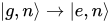
EIT has been used to laser cool long strings of atoms to their motional ground state in an ion trap.[18] To illustrate the cooling technique, consider a three level atom as shown with a ground state , an excited state , and a stable or metastable state that lies in between them. The excited state is dipole coupled to and . An intense "coupling" laser drives the transition at detuning above resonance. Due to the quantum interference of transition amplitudes, a weaker "cooling" laser driving the transition at detuning above resonance sees a Fano-like feature on the absorption profile. EIT cooling is realized when , such that the carrier transition lies on the dark resonance of the Fano-like feature, where is used to label the quantized motional state of the atom. The Rabi frequency of the coupling laser is chosen such that the "red" sideband lies on the narrow maximum of the Fano-like feature. Conversely the "blue" sideband lies in a region of low excitation probability, as shown in the figure below. Due to the large ratio of the excitation probabilities, the cooling limit is lowered in comparison to doppler or sideband cooling (assuming the same cooling rate).[19]

Absorption profile seen by the cooling laser as a function of detuning . The Rabi frequency is chosen so that the red sideband (red dashed line) lies on the narrow peak of the Fano-like feature and the blue sideband (blue dashed line) lies in a region of low probability. The carrier (black dashed line) lies on the dark resonance where the detunings are equal, i.e. , such that absorption is zero.

See also

[edit]

References

[edit]

Grokipedia

from Grokipedia
Electromagnetically induced transparency (EIT) is a quantum interference effect in which a strong coupling laser field renders an otherwise opaque atomic medium transparent to a weak probe laser field at resonant frequencies by creating a coherent dark state that suppresses absorption.[1] This phenomenon occurs in a three-level atomic system, typically in a Lambda (Λ) configuration, where the probe field couples one ground state to an excited state, and the coupling field links the other ground state to the same excited state, resulting in destructive interference that decouples the atoms from the probe light.[2] The transparency window is narrow, with a linewidth determined by the coupling field intensity and atomic decoherence rates, often expressed as γEIT=γ12+Ωc2/γ13\gamma_{EIT} = \gamma_{12} + |\Omega_c|^2 / \gamma_{13}, where Ωc\Omega_c is the coupling Rabi frequency and γ\gamma terms represent decay rates.[2] The effect was first theoretically predicted by Kocharovskaya and Khanin in 1988,[3] and proposed by S. E. Harris and colleagues in 1990 as a method to enable nonlinear optical processes without absorption.[4] EIT builds on earlier concepts like coherent population trapping from the 1970s. It was first experimentally observed in 1991 by Boller, Imamoglu, and Harris using hot strontium vapor with pulsed lasers, demonstrating near-perfect transparency in an optically thick medium.[1] EIT has profound implications for quantum optics and photonics, enabling phenomena such as ultraslow light propagation (group velocities reduced to meters per second), reversible storage of light pulses as atomic coherences for quantum memories, and lasing without population inversion.[5] Practical implementations often use thermal vapors of alkali atoms like rubidium or cesium, where Doppler effects and optical depth must be managed to achieve high-contrast EIT.[6] Analogs of EIT extend the effect beyond atomic systems, appearing in solid-state quantum dots, superconducting circuits, and mechanical resonators, broadening its utility in integrated quantum technologies and precision sensing applications like atomic clocks and magnetometers.[2]

Fundamentals

Definition and Basic Principles

Electromagnetically induced transparency (EIT) is a quantum interference effect that enables coherent control of light-matter interactions, creating a narrow transparency window within an otherwise absorbing medium at the resonance frequency of a weak probe field. This phenomenon arises when a strong control laser field modifies the medium's optical susceptibility, suppressing absorption and dispersion for the probe light through destructive interference between quantum pathways.[7] The fundamental setup for EIT involves a three-level atomic system in a lambda (Λ) configuration, featuring two long-lived ground states denoted as |1⟩ and |2⟩, and a short-lived excited state |3⟩. A weak probe field drives the transition from |1⟩ to |3⟩, which would normally be absorbed, while a strong control field couples the transition from |2⟩ to |3⟩, establishing a coherent coupling between the states.[7] In this system, the control field induces Autler-Townes splitting of the |3⟩ state into dressed components separated by the control field's Rabi frequency, but the key to transparency lies in the formation of a dark state—a stationary coherent superposition of |1⟩ and |2⟩ with no admixture of |3⟩. This dark state decouples the atoms from the probe field, as the excitation amplitude via the probe interferes destructively with that induced by the control, preventing population transfer to the absorbing excited state and resulting in transmission without loss or phase shift at line center.[7] EIT was first experimentally observed in 1991 by Boller, Imamoğlu, and Harris using hot strontium vapor, where the control field created a clear transparency window for the resonant probe beam in an optically thick sample.[1]

Historical Development

The foundational concepts leading to electromagnetically induced transparency (EIT) emerged from earlier studies of coherent optical interactions in atomic systems. In the 1960s, self-induced transparency was theoretically predicted and experimentally observed, describing how short, coherent light pulses could propagate through resonant media without absorption by forming solitons that match the medium's response time.[8] Building on this, coherent population trapping (CPT) was first demonstrated in 1976, where atoms in a three-level system were optically pumped into a non-absorbing superposition state, reducing fluorescence under bichromatic laser excitation in sodium vapor. These phenomena highlighted quantum interference effects in multilevel atoms, laying the groundwork for manipulating light-matter interactions without dissipation. The theoretical framework for EIT was proposed in 1990 by S. E. Harris, J. E. Field, and A. Imamoğlu, who predicted that a strong coupling laser could induce transparency in an otherwise absorbing probe transition within a three-level atomic system, accompanied by anomalous dispersion near resonance.[4] This work extended CPT principles to enable coherent control of optical susceptibility in dense media. Experimental confirmation followed in 1991 by K.-J. Boller, A. Imamoğlu, and S. E. Harris, who observed near-perfect transparency and steep dispersion in an optically thick strontium vapor using counterpropagating probe and coupling fields on an autoionizing transition.[1] During the 1990s, EIT was extended to diverse systems, enhancing its versatility. In 1994, ultraslow optical dephasing was measured in europium-doped yttrium orthosilicate crystals, revealing coherence times exceeding 100 μs that would later prove essential for realizing EIT in solid-state rare-earth systems.[9] By 1999, EIT was demonstrated in ultracold atomic ensembles, with L. V. Hau and colleagues achieving light propagation at reduced group velocities of 17 m/s in a Bose-Einstein condensate of sodium atoms, showcasing control over photonic propagation in quantum degenerate gases.[10] These advances solidified EIT's role in quantum optics.

Theoretical Framework

Atomic System and Quantum Interference

Electromagnetically induced transparency (EIT) arises fundamentally from the quantum mechanical dynamics of a three-level atomic system in a lambda (Λ) configuration, consisting of two ground states |1⟩ and |2⟩ (where |2⟩ is typically a metastable state) and a common excited state |3⟩. The probe field couples the transition |1⟩ ↔ |3⟩ with Rabi frequency Ω_p, while the control field couples |2⟩ ↔ |3⟩ with Rabi frequency Ω_c. Spontaneous decay occurs from |3⟩ to |1⟩ at rate γ_{31} and to |2⟩ at rate γ_{32}, with the ground-state coherence between |1⟩ and |2⟩ decaying at rate γ_{12} due to dephasing processes.[11] This system enables coherent control of atomic excitations through quantum interference, suppressing absorption of the probe field under resonant conditions.[12] The time evolution of the system is described by the density matrix formalism, governed by the master equation incorporating the Hamiltonian and dissipative terms. In the rotating frame and interaction picture, the Hamiltonian is given by
H=(Ωp31+Ωc32+h.c.), H = -\hbar \left( \Omega_p |3\rangle\langle 1| + \Omega_c |3\rangle\langle 2| + \text{h.c.} \right),
assuming resonant fields for simplicity (detunings can be included generally). The equations of motion for the density matrix elements ρ_{ij} include coherent driving terms from the fields and relaxation: for example, the coherence ρ_{31} evolves as ρ˙31=(γ31/2+iΔp)ρ31+iΩp(ρ11ρ33)+iΩcρ21\dot{\rho}_{31} = -(\gamma_{31}/2 + i\Delta_p) \rho_{31} + i \Omega_p (\rho_{11} - \rho_{33}) + i \Omega_c \rho_{21}, where Δ_p is the probe detuning, and similar expressions hold for other elements like ρ_{21} and ρ_{32}. The control field induces a Raman coherence ρ_{12} = ρ_{21}^* between the ground states, which plays a crucial role in the interference process. In the steady state, these equations reveal how the presence of Ω_c modifies the probe susceptibility.[11][12] A key feature of this dynamics is the formation of a coherent dark state |D⟩, a stationary eigenstate of the Hamiltonian that is orthogonal to the bright state and decoupled from the optical fields: |D⟩ = (Ω_c |1⟩ - Ω_p |2⟩) / √(|Ω_p|^2 + |Ω_c|^2). This state has zero eigenvalue and contains no admixture of the decaying excited state |3⟩, rendering it immune to spontaneous emission and long-lived, limited only by γ_{12}. The atomic population is driven into |D⟩ by the coherent fields, preventing excitation to |3⟩ and thus eliminating absorption.[11] The transparency mechanism stems from destructive quantum interference between excitation pathways. Without the control field, the probe induces a coherence ρ_{31} with imaginary part Im(ρ_{31}) proportional to absorption. The control field generates the Raman coherence ρ_{12}, which contributes an interfering term in the equation for ρ_{31}, effectively canceling Im(ρ_{31}) at resonance (Δ_p = 0). This interference redirects the probe interaction away from dissipative channels, resulting in a transparency window in the absorption spectrum. In the strong control field limit (|Ω_c| ≫ γ_{31}), near-perfect transparency is achieved on resonance over a wide spectral window of width approximately |Ω_c|, with the residual absorption determined by the ground-state dephasing rate γ_{12}, allowing for high-contrast features even in warm atomic ensembles where γ_{12} is finite but small compared to other rates.[11][12]

Susceptibility and Transparency Conditions

In the three-level lambda system, the linear susceptibility χ(ωp)\chi(\omega_p) for a weak probe field interacting with the transition from level 1|1\rangle to 3|3\rangle is given by
χ(ωp)=Nμ312ϵ0i(Δpiγ31)(Δpiγ31)(ΔpΔciγ21)Ωc2/4, \chi(\omega_p) = \frac{N |\mu_{31}|^2}{\epsilon_0 \hbar} \frac{i (\Delta_p - i \gamma_{31}) }{ (\Delta_p - i \gamma_{31})(\Delta_p - \Delta_c - i \gamma_{21}) - |\Omega_c|^2 / 4 },
where NN is the atomic density, μ31\mu_{31} is the dipole matrix element, Δp\Delta_p and Δc\Delta_c are the probe and coupling detunings from resonance, γ31\gamma_{31} and γ21\gamma_{21} are the coherence decay rates for the respective off-diagonal density matrix elements, and Ωc\Omega_c is the Rabi frequency of the coupling field on the 2|2\rangle to 3|3\rangle transition.[11] This expression arises from the steady-state solution of the density matrix equations under the weak probe approximation, capturing the coherent interaction between the probe and coupling fields.[11] Transparency occurs when the real part of the refractive index remains near unity while absorption is minimized, specifically when Re[χ(ωp)]0\operatorname{Re}[\chi(\omega_p)] \approx 0 and Im[χ(ωp)]0\operatorname{Im}[\chi(\omega_p)] \approx 0 at Δp=Δc=0\Delta_p = \Delta_c = 0. This condition is satisfied in the limit of strong coupling, Ωcγ31|\Omega_c| \gg \gamma_{31}, where the denominator becomes dominated by the coupling term, suppressing the probe absorption to nearly zero at line center.[11] The resulting transparency window has a width on the order of Ωc2/γ31|\Omega_c|^2 / \gamma_{31} in the weak coupling limit, which widens as the coupling strength increases. This enables high-fidelity transmission over a controllable spectral bandwidth. In the strong coupling limit, the window width approaches the Rabi splitting Ωc\sim |\Omega_c|.[11] Within this transparency window, the dispersion exhibits an anomalous positive slope, dRe[χ]dωp>0\frac{d \operatorname{Re}[\chi]}{d \omega_p} > 0, arising from the steep variation in the real part of the susceptibility near Δp=0\Delta_p = 0. This positive group index, ng=1+ωp2dRe[n]dωpn_g = 1 + \frac{\omega_p}{2} \frac{d \operatorname{Re}[n]}{d \omega_p} with n1+Re[χ]/2n \approx 1 + \operatorname{Re}[\chi]/2, contrasts with typical negative dispersion in absorbing media and underpins reduced group velocities without significant loss.[11] Dephasing effects, particularly the decay of ground-state coherence γ12\gamma_{12} between levels 1|1\rangle and 2|2\rangle, modify γ21=γ12+γsp\gamma_{21} = \gamma_{12} + \gamma_{\rm sp} (where γsp\gamma_{\rm sp} is the small spontaneous emission contribution), broadening the transparency window and reducing its depth. Increased γ12\gamma_{12} due to environmental interactions diminishes the interference efficiency, leading to residual absorption even at line center and a less pronounced dispersion slope.[11] In multi-level extensions such as V-type or ladder systems, the susceptibility formula undergoes modifications to account for additional couplings or decay pathways, potentially yielding multiple transparency windows or altered dispersion profiles while preserving the core interference mechanism.[11]

Experimental Aspects

Medium Requirements and Setup

To observe electromagnetically induced transparency (EIT), the medium must provide sufficient optical depth (OD), typically in the range of 1 to 100, to ensure significant interaction between the light fields and atoms while allowing measurable transmission changes.[13] The OD is given by OD = N σ L, where N is the atomic density, σ is the resonant absorption cross-section (on the order of λ²/2π for optical transitions, with λ the wavelength), and L is the medium path length (often several cm in vapor cells).[14] For effective EIT, N must exceed 10^{12} cm^{-3}, which corresponds to vapor pressures achievable in alkali metal cells at moderate heating.[13] Common media employ a lambda-type three-level atomic system, where the ground states |1\rangle and |2\rangle are long-lived (e.g., hyperfine-split levels), and |3\rangle is an excited state coupled to both. In alkali vapors such as rubidium (Rb) or cesium (Cs), the D2 transition is widely used, with |1\rangle as the 5S_{1/2} F=1 hyperfine level, |2\rangle as 5S_{1/2} F=2, and |3\rangle as a 5P_{3/2} level (typically F'=1 or F'=2).[13] Solid-state alternatives, such as praseodymium-doped yttrium silicate orthosilicate (Pr:YSO) crystals cooled to cryogenic temperatures (around 3-5 K), offer narrow linewidths and long coherence times due to the ionic environment, using spin states within the 4I_{9/2} and 4I_{11/2} manifolds for the lambda configuration.[15] The laser configuration involves a weak probe field (power on the order of nanowatts to avoid saturation) resonant with the |1\rangle to |3\rangle transition and a strong control field (milliwatts, with Rabi frequency Ω_c / 2π ~ 1-10 MHz) resonant with |2\rangle to |3\rangle.[13] These fields are typically co-propagating to satisfy phase-matching conditions and minimize walk-off, with matching linear polarizations (or orthogonal circular for specific Zeeman selections) and near-zero two-photon detuning for optimal transparency.[13] Environmental control is essential to suppress decoherence sources. For vapor cells, temperatures below 100°C (e.g., 40-80°C) maintain the required density while limiting Doppler broadening, whose width is Δω_D = (ω / c) \sqrt{k_B T / m} (with ω the transition frequency, m the atomic mass, k_B Boltzmann's constant, and T temperature), which can otherwise smear the EIT resonance over hundreds of MHz.[13] Buffer gases (e.g., neon or nitrogen at 10-100 Torr) or trapping cold atoms (via magneto-optical traps at μK temperatures) reduce atomic collisions and transit-time effects, enhancing coherence.[13] Key challenges include transit-time broadening, where atoms traverse the laser beam in time τ = w_0 / v_th (w_0 beam waist, v_th thermal velocity ~200 m/s), yielding linewidths Γ_tt ~ 10-100 kHz that limit EIT resolution in dilute beams.[13] Phase matching demands precise alignment (beam overlap angle <1 mrad) to prevent dephasing from atomic motion in the Doppler-broadened ensemble.[13] These factors tie into the theoretical susceptibility, where medium dispersion and absorption vanish under ideal EIT conditions.[13]

Key Demonstrations and Measurements

The first experimental demonstration of electromagnetically induced transparency (EIT) was conducted by Boller, Imamoglu, and Harris in 1991 using hot strontium vapor in a heat pipe, with a probe laser at 460.7 nm on the 5s² ¹S₀ – 5s5p ¹P₁ transition and a coupling laser at 689 nm on the 5s5p ¹P₁ – 5s5d ¹D₂ transition in a lambda-type three-level system. Transmission spectra revealed an increase in probe transmittance from approximately exp(-20) (effectively zero) without the coupling laser to exp(-1) (about 37%) with it, confirming the EIT window through destructive quantum interference that suppressed absorption. This measurement highlighted the potential for coherent control of optical properties in atomic vapors.[1] A landmark demonstration in cold atomic ensembles came in 1999 with the work of Hau et al., who observed EIT in a Bose-Einstein condensate of sodium atoms cooled to 450 nK. Using a magneto-optical trap and stimulated Raman coupling, they propagated a coherent light pulse through the condensate, achieving an optical depth of around 4 but demonstrating high-fidelity transparency with pulse transmission efficiencies exceeding 50%. This experiment underscored EIT's role in reducing group velocity while maintaining signal integrity in ultracold media. Subsequent cold-atom realizations, such as those in rubidium ensembles, have reported optical depths up to 100 with transmission efficiencies approaching 85%, as measured by probe pulse attenuation and recovery in magneto-optical traps. Direct measurements of dispersion in EIT have quantified the dramatic slowing of light via the group velocity, given by
vg=c1+ω2dRe(χ)dω, v_g = \frac{c}{1 + \frac{\omega}{2} \frac{d \operatorname{Re}(\chi)}{d\omega}},
where cc is the speed of light in vacuum, ω\omega is the probe frequency, and χ\chi is the susceptibility. In early experiments, Field, Hahn, and Harris (1995) observed pulse propagation at vgc/165v_g \approx c/165 (about 1.8 \times 10^6 m/s) in rubidium vapor, verified by time-of-flight measurements of delayed pulses with 55% transmission. Later cold-atom studies extended this to vg17v_g \sim 17 m/s (c/1.76×107c / 1.76 \times 10^7) in sodium condensates, with dispersion slopes dRe(χ)/dωd \operatorname{Re}(\chi)/d\omega on the order of 10810^8 to 101010^{10} contributing to slowdown factors of 10310^3 to 10610^6 times slower than cc. These results were obtained through interferometric pulse delay profiling and phase-sensitive detection. Efficiency metrics in EIT experiments emphasize near-complete absorption suppression and precise phase control. Absorption has been reduced to less than 1% at the transparency window center in optimized cold rubidium ensembles, quantified via calibrated probe power transmission and spectral fitting of the imaginary susceptibility. Phase shifts, indicative of the steep dispersion, have been measured using heterodyne detection techniques, revealing nonlinear phase accumulation up to several radians without significant loss in high-optical-depth media (OD > 50). These metrics establish EIT's viability for coherent manipulation, with efficiencies scaling with coupling intensity and atomic density.[16] Recent advances up to 2025 have extended EIT to room-temperature platforms, bypassing cryogenic requirements. In Rydberg atom vapors, Lin et al. (2024) reported room-temperature Rydberg EIT in rubidium vapor cells with neon buffer gas, enabling applications in electric field sensing, as quantified by high-resolution absorption spectroscopy.[17] As of 2025, further advances include EIT analogs in metamaterials achieving tunable transparency for optical applications and EIT-based storage for microwave quantum memories.[18][19]

Applications and Extensions

Slow and Stopped Light

Electromagnetically induced transparency (EIT) enables the dramatic reduction of light's group velocity through the steep dispersion relation near the transparency window, allowing propagation speeds far below the vacuum speed of light while maintaining low absorption. In a typical Λ-type atomic system, the group velocity $ v_g $ of the probe pulse is approximated by $ v_g \approx \frac{|\Omega_c|^2}{g^2 N} $, where $ \Omega_c $ is the Rabi frequency of the control field, $ g $ is the atom-light coupling constant, and $ N $ is the atomic density. By tuning $ \Omega_c $ to small values, $ v_g $ can be reduced to as low as a few meters per second, as demonstrated in ultracold atomic gases where slowdown factors exceeding $ 10^7 $ have been achieved. This coherent slowing arises from the storage of probe field information in the atomic ground-state coherence, preserving the pulse's quantum properties during propagation. Stopped light extends this control by effectively halting pulse propagation through dynamic EIT, where the control field is adiabatically turned off, mapping the probe pulse onto a long-lived atomic spin coherence within the medium. Upon turning the control field back on, the coherence is transferred back to the optical field, releasing the stored pulse with high fidelity. This process relies on the dark-state polariton formed in EIT, which transitions from a photonic to a purely atomic excitation as $ \Omega_c $ approaches zero. The first experimental realization of stopped light occurred in 2001 using a Bose-Einstein condensate (BEC) of sodium atoms, where a pulse was stored for up to 1 ms before retrieval. Subsequent experiments in the 2010s extended stopped light to solid-state systems, achieving storage times over one minute in rare-earth-ion-doped crystals such as praseodymium-doped yttrium orthosilicate (Pr:YSO), including coherent storage of light pulses and images. In erbium-doped materials, coherent storage of telecom-wavelength light pulses has been demonstrated, leveraging the long spin coherence times of solid hosts at cryogenic temperatures. These advancements highlight EIT's versatility beyond ultracold gases, enabling practical implementations in compact, room-temperature-compatible media. The achievable slowdown and storage durations in EIT are fundamentally limited by decoherence processes, such as atomic spin relaxation, and nonlinear effects like forward Raman scattering, which introduce noise and distortion. The maximum slowdown factor is typically on the order of the medium's optical depth (OD), as higher OD enhances dispersion but also amplifies decoherence rates, capping storage efficiency below unity for large delays.[20] Unlike incoherent slow-light techniques, such as those based on cavity-enhanced absorption or stimulated Brillouin scattering, EIT-based slowing preserves the quantum coherence and phase information of the light pulse due to its reliance on reversible atomic coherences rather than dissipative processes. This coherence preservation distinguishes EIT for applications requiring intact photonic quantum states, such as in quantum networks.

Quantum Memory and Information Processing

Electromagnetically induced transparency (EIT) enables quantum memory through dynamic control of light propagation in atomic ensembles, where a probe photon carrying quantum information is mapped onto a collective atomic coherence for storage and later retrieval. In the standard light storage protocol, a weak probe field resonant with the |1⟩ to |3⟩ transition co-propagates with a strong control field resonant with the |2⟩ to |3⟩ transition in a Λ-type three-level system, creating a dark-state polariton that propagates slowly within the EIT window. By adiabatically reducing the control field intensity, the polariton is compressed, transferring the probe's quantum state into a long-lived spin coherence between the ground states |1⟩ and |2⟩, effectively stopping the light while preserving its quantum properties. Retrieval is achieved by reapplying the control field in the reverse direction, which reconstructs the probe pulse with high temporal and spectral fidelity. This process, first theoretically proposed and experimentally demonstrated in rubidium vapor, forms the basis for reversible quantum state transfer in EIT-based memories.[21] Early demonstrations achieved storage efficiencies and fidelities exceeding 90% for classical coherent pulses, as reported by the Lukin group using optimized control pulse shaping in warm atomic vapors, enabling near-unity retrieval for pulses up to microseconds long. For quantum applications, EIT memories have stored heralded single photons generated via the Duan-Lukin-Cirac-Zoller (DLCZ) protocol, which creates correlated photon-atom excitations through spontaneous Raman scattering in atomic ensembles; subsequent EIT storage yields efficiencies around 70% while maintaining quantum coherence, as achieved in cold cesium atoms during the 2010s. These milestones highlight EIT's capability to handle nonclassical light states essential for quantum information tasks.[22] In quantum repeaters for long-distance networks, EIT-based memories facilitate entanglement distribution by storing photon-matter entanglement and enabling swapping operations, where Bell-state measurements on stored excitations from adjacent links extend entanglement over lossy channels without direct transmission. The original DLCZ repeater architecture relies on EIT storage to map photonic qubits onto atomic ensembles for purification and swapping, achieving heralded entanglement with low error rates in proof-of-principle experiments. Integration with cavity quantum electrodynamics (QED) enhances coupling efficiency by confining the probe and control fields in a high-finesse cavity, increasing the effective optical depth and enabling deterministic single-photon storage from cavity-QED sources, with theoretical efficiencies approaching unity for weak excitations.[23] Key challenges in EIT quantum memories include noise from spontaneous emission, which decoheres the stored spin state, and four-wave mixing (FWM) processes driven by the control field, generating spurious photons that degrade retrieval fidelity. Spontaneous emission limits storage times to milliseconds in warm vapors, while FWM noise, arising from third-order nonlinearities, can overwhelm weak quantum signals during readout. Solutions involve impedance-matched cavities, where the cavity decay rate is tuned to match the atomic absorption, minimizing reabsorption losses and suppressing noise by balancing input-output coupling, thereby boosting overall efficiency to over 80% even in low-optical-depth media. In the 2010s, hybrid approaches combining EIT with solid-state systems like diamond nitrogen-vacancy (NV) centers have advanced room-temperature quantum memories, leveraging the long coherence times of NV electron and nuclear spins under ambient conditions to store optical qubits with minimal cryogenic requirements.[24][25][26]

Cooling Techniques and Other Uses

Electromagnetically induced transparency (EIT) enables sub-Doppler laser cooling of neutral atoms by exploiting quantum interference to trap atoms in non-absorbing dark states, which suppresses spontaneous emission and minimizes recoil heating from photon absorption and re-emission.[27] In this process, atoms are optically pumped into velocity-selective dark states where the cooling mechanism relies on the detuning between the probe and control fields, creating momentum-dependent coherence that preferentially cools atoms near zero velocity. Theoretical analyses predict temperatures significantly below the Doppler limit of approximately 140 μK for rubidium-87 atoms using Λ-type three-level systems.[28] The cooling rate in EIT schemes is governed by the expression γcoolk2mΩcγ\gamma_{\text{cool}} \approx \frac{\hbar k^2}{m} \cdot \frac{\Omega_c}{\gamma}, where \hbar is the reduced Planck's constant, kk is the wave number of the probe light, mm is the atomic mass, Ωc\Omega_c is the Rabi frequency of the control field, and γ\gamma is the excited-state decay rate; this rate reflects the balance between recoil-induced diffusion and dark-state pumping efficiency.[29] By optimizing the control field intensity and detunings, the technique can reduce temperatures to subrecoil levels while maintaining high cooling efficiency, making it suitable for preparing ultracold ensembles for precision measurements. Beyond cooling, EIT enhances Kerr nonlinearities in atomic media, yielding giant values of the nonlinear refractive index n2105n_2 \sim 10^{-5} cm²/W, which is orders of magnitude larger than in conventional materials due to the coherent population transfer to dark states that amplifies phase shifts without significant absorption. This enhanced nonlinearity facilitates all-optical switching at low light intensities, enabling compact devices for signal processing where a weak probe beam's phase is modulated by a control beam via cross-phase modulation. In integrated photonics, EIT has been realized in silicon waveguides coupled to ring resonators, allowing tunable transparency windows and slow-light effects for on-chip optical buffers and modulators.[30] EIT-based sensing leverages shifts in the transmission spectrum linewidth or resonance position due to external fields, particularly for high-sensitivity magnetometry in alkali vapors. By monitoring Zeeman-induced splitting of EIT resonances in rubidium, high sensitivities in the fT/√Hz range have been achieved in compact vapor cells, surpassing traditional fluxgate sensors while operating without cryogenic shielding. These magnetometers exploit the narrow EIT linewidth (sub-kHz) for precise field detection over a wide dynamic range, with applications in geophysical surveying and biomedical imaging. Recent extensions of EIT include control of attosecond pulses in coherent atomic media, where a strong femtosecond control pulse induces transparency for an isolated attosecond extreme-ultraviolet probe, enabling manipulation of pulse absorption, emission, and delay on sub-femtosecond timescales.[31] In topological photonics, post-2020 implementations in metamaterials, such as two-dimensional photonic crystals, demonstrate EIT-like transparency combined with topological edge states, providing robust, backscattering-free light propagation for quantum information routing in disordered environments.[32] As of 2024, advances in integrated EIT devices have enabled scalable quantum memories for photonic quantum networks.[33]

References

User Avatar
No comments yet.