Hubbry Logo
Electronic ticketElectronic ticketMain
Open search
Electronic ticket
Community hub
Electronic ticket
logo
8 pages, 0 posts
0 subscribers
Be the first to start a discussion here.
Electronic ticket
Electronic ticket
from Wikipedia
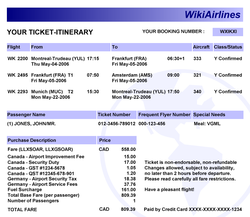
A sample itinerary for an open jaw electronic ticket from Montreal to Amsterdam, and returning from Munich

An electronic ticket is a method of ticket entry, processing, and marketing for companies in the airline, railways and other transport and entertainment industries.

Airline ticket

[edit]

E-tickets in the airline industry were devised in about 1994,[1] and have now largely replaced the older multi-layered paper ticketing systems. Since 1 June 2008, it has been mandatory for IATA members to use e-ticketing. Where paper tickets are still available, some airlines charge a fee for issuing paper tickets.

When a reservation is confirmed, the airline keeps a record of the booking in its computer reservations system. Customers can print out or may be provided with a copy of a e-ticket itinerary receipt which contains the record locator or reservation number and the e-ticket number. It is possible to print multiple copies of an e-ticket itinerary receipt.

Besides providing itinerary details, an e-ticket itinerary receipt also contains:

  • An official ticket number (including the airline's 3-digit ticketing code,[2] a 4-digit form number, a 6-digit serial number, and sometimes a check digit)
  • Carriage terms and conditions (or at least a reference to them)
  • Fare and tax details, including fare calculation details and some additional data such as tour codes. The exact cost might not be stated, but a "fare basis" code will always identify the fare used.
  • A short summary of fare restrictions, usually specifying only whether change or refund are permitted but not the penalties to which they are subject
  • Form of payment
  • Issuing office
  • Baggage allowance

Checking in with an e-ticket

[edit]

Passengers with e-tickets are required to check-in at the airport for a flight in the usual manner, except that they may be required to present an e-ticket itinerary receipt or personal identification, such as a passport, or credit card. They can also use the record locator, often called booking reference, a code of six letters and digits. Producing a print-out of an e-ticket itinerary receipt may be required to enter the terminal of some airports or to satisfy immigration regulations in some countries.[citation needed]

The introduction of e-tickets has allowed for various enhancements to checking-in processes.

Self-service and remote check-in

[edit]
  • online/mobile/telephone/self-service kiosk check-in (if the airline makes this option available)
  • early check-in
  • printing boarding passes at airport kiosks and at locations other than an airport
  • delivery of boarding pass bar-codes via SMS or email to a mobile device

Several websites assist people holding e-tickets to check in online in advance of the twenty-four-hour airline restriction. These sites store a passenger's flight information and then when the airline opens up for online check-in the data is transferred to the airline and the boarding pass is emailed back to the customer. With this e-ticket technology, if a passenger receives his boarding pass remotely and is travelling without check-in luggage, he may bypass traditional counter check-in.

The same provision also applies to airline ticket bookings made through online travel agencies (OTAs). The booking data are usually presented in the form of a barcode, which is scanned at the airport to obtain a physical ticket or boarding pass.

IATA mandated transition

[edit]

As part of the IATA Simplifying the Business initiative, the association instituted a program to switch the industry to 100% electronic ticketing. The program concluded on June 1, 2008, with the association saying that the resulting industry savings were approximately US$3 billion.[3]

In 2004 IATA Board of Governors set the end of 2007 as the deadline for airlines to make the transition to 100% electronic ticketing for tickets processed through the IATA billing and settlement plan;[4] in June 2007, the deadline was extended to May 31, 2008.[5]

As of June 1, 2008 paper tickets can no longer be issued on neutral stock by agencies reporting to their local BSP. Agents reporting to the ARC using company-provided stock or issuing tickets on behalf of an airline (GSAs and ticketing offices) are not subject to that restriction.

The industry was unable to comply with the IATA mandate and paper tickets remain in circulation as of February 2009.[citation needed]

Train tickets

[edit]

Amtrak started offering electronic tickets on all train routes on 30 July 2012.[6] These tickets can be ordered over the internet and printed (as a PDF file), printed at a Quik-Trak kiosk, or at the ticket counter at the station. Electronic tickets can also be held in a smart phone and shown to the conductor using an app. Mobile tickets are common with operators of US commuter train networks (e.g. MTA LIRR and Metro North) but they are usually only offered on the US version of the App Store and only accept US-issued credit cards as the app's payment page asks the user for the credit card's ZIP code to complete the purchase.

Several European train operators also offer self-printable or downloadable tickets. Often tickets can also be delivered by SMS or MMS. Railway operators in other countries also issue electronic tickets. The national operators of Denmark and Netherlands have a nationwide system where RFID smartcards are used as train tickets. In the UK, the issuance of printable or mobile tickets is at the discretion of train operators and is often available for advance tickets only (i.e. valid only on a specific train). This is very common in Europe for local urban rail, such as rapid transit/metros.[citation needed] During the 2010:s phone apps have been increasingly popular. Passengers do not have to visit a machine or a desk to buy a ticket or refill an RFID card, but can buy it in their phone.

In India, an SMS sent by the Indian Railways, along with a valid proof of identity is considered equivalent to a ticket[7] and also a e-ticket pdf can be downloaded from the IRCTC website or mobile app.

Sport, concert, and cinema tickets

[edit]

Many sport, concert venues, and cinemas use electronic ticketing for their events. Electronic tickets, or "eTickets" as they are sometimes referred, are often delivered as PDFs or another downloadable format that can be received via email or through a mobile app. Electronic tickets allow organizers to avoid the cost of producing and distributing physical tickets by transferring costs to the customer, who must own electronic hardware and purchase internet access in order to receive their ticket.

A printed copy of these tickets or a digital copy on a mobile phone should be presented on coming to the venue. These tickets now normally also have a barcode, which may be scanned on entry into the venue to streamline crowd processing. Electronic tickets have become increasingly prevalent in the entertainment industry over the last decade.

In some cases, spectators who want to see a match may not need a printable electronic ticket. If someone with a membership to a football team books a ticket online, the member can just verify his/her reservation with a membership card at the entrance. This is common with teams in the English Premiership League.

Implementations

[edit]

In January 2017 it was reported that Germany's Federal Minister of Transport and Digital Infrastructure, Alexander Dobrindt wants to create an electronic ticket to connect public bus and train services as well as parking spaces and potentially car-sharing services across all cities.[8][9][needs update] A nationwide electronic ticket system was introduced in Denmark in 2010, called Rejsekort.

In Bangalore Metro System, instead of paper tickets, NFC tokens were issued.[10] But these didn't offer a lot of benefits over paper tickets other than that they could be used again.

Currently both Bangalore and Kochi Metro allow users to book tickets through WhatsApp. Once the payment is done online, the system will send a QR code as a message on WhatsApp, which the passengers can scan to pass through the turnstiles.[11][12]

See also

[edit]

References

[edit]
[edit]
Revisions and contributorsEdit on WikipediaRead on Wikipedia
from Grokipedia
An electronic ticket, commonly abbreviated as e-ticket, is a paperless digital record that serves as proof of reservation and access for services such as , rail journeys, transportation, concerts, sporting events, and other activities. Unlike traditional paper tickets, it is stored electronically in a provider's database and typically verified through a unique ticket number, , or presented on a or printed at the point of entry or boarding. This system streamlines ticketing processes by eliminating physical document handling, reducing administrative errors, and enabling real-time updates to reservations. In the aviation industry, electronic ticketing was pioneered as a method to record passenger transportation sales without issuing value documents, requiring passengers to receive an itinerary receipt and mandatory notices as evidence of their journey. The (IATA) established global standards for e-ticketing in 1997, following the issuance of the first e-ticket in 1994, with full adoption achieved by 2008 when 100% of IATA member airlines transitioned to electronic formats. This shift, part of broader efficiency initiatives like the Billing and Settlement Plan (BSP) launched in 1971, significantly lowered distribution costs—e-tickets cost about 10% of tickets—and enhanced global across over 120 countries. Similar implementations in rail and , often aligned with standards like ISO/TR 21724-1 for intelligent transport systems, allow contactless validation via smart cards or mobile apps. For events and , e-tickets facilitate secure, scalable distribution through platforms, with digital verification at venues using scanners to prevent and . The technology's evolution has been driven by advancements in and secure data transmission, enabling features like , seat selection, and instant refunds, while promoting by curbing paper waste. Despite challenges such as digital divides and cybersecurity risks, e-ticketing has become the dominant standard worldwide, processing billions of transactions annually and integrating with emerging systems like IATA's ONE Order for unified retailing.

Overview

Definition and Scope

An electronic ticket, commonly referred to as an e-ticket, is a digital or virtual representation of a ticket that serves as a paperless alternative to traditional physical tickets, storing all necessary or event details electronically rather than on printed . This format confirms a user's right to access a service, such as a flight, ride, or , and is typically issued upon purchase, eliminating the need for physical issuance or mailing. The core purpose is to streamline ticketing processes by leveraging digital storage and transmission, often via , mobile applications, or centralized databases. Key characteristics of electronic tickets include their electronic verifiability, which allows for quick validation at entry points through scanning of codes or biometric checks, contrasting sharply with paper tickets that require manual inspection and are prone to loss or damage. In many implementations, e-tickets are designed to be non-transferable or tied to a specific user's identity, such as through personal identifiers or secure digital signatures, to prevent unauthorized resale or sharing and enhance . This identity linkage can involve integration with , like facial recognition, ensuring the ticket holder matches the during validation. Electronic tickets encompass various types and formats tailored to different user needs and technological capabilities. PDF e-tickets are simple digital files sent via , often containing printable barcodes or QR codes for scanning, suitable for basic access confirmation. Mobile tickets, or m-tickets, are app-based versions stored directly on smartphones, offering dynamic features like real-time updates and offline access without printing. Tokenized tickets represent a more advanced format, where the ticket is secured as a digital token in wallets or systems, embedding additional data such as seat assignments while enabling secure transfer under controlled conditions. Smart tickets extend this by incorporating embedded technologies, like NFC chips in cards or devices, for contactless validation and integration with other services. The scope of electronic tickets broadly covers sectors including (aviation, rail, and ), events (concerts and sports), and various services (museums or tours), where a verifiable right of entry or usage is required. This excludes purely digital reservations lacking distinct ticketing elements, such as bookings without assigned access codes, as well as any form of physical ticket. Early implementations emerged in around the late , marking the shift from paper to digital formats.

Historical Development

The development of electronic tickets, or e-tickets, traces its roots to early digital experiments in the airline industry during the , building on pre-digital precursors from the . In the mid-20th century, airline reservations relied on manual and semi-automated systems, including teletype networks for inter-office communication and the introduction of computer reservation systems (CRS) like ' in 1960, which digitized booking processes but still produced paper tickets. These systems laid the groundwork for electronic processing by enabling real-time data exchange, though physical tickets remained standard. The true shift to e-tickets began in 1994 when issued the world's first electronic ticket, eliminating paper for select domestic flights and allowing passengers to receive confirmation numbers for validation at . By 1998, expanded this innovation internationally, becoming the first carrier to offer e-ticketing across 44 countries, marking a pivotal step toward paperless in . Key milestones in the 2000s accelerated widespread adoption. The (IATA) adopted global standards for e-ticketing in 1997 and, in a landmark decision, mandated 100% electronic ticketing for its member airlines by June 1, 2008, effectively phasing out paper tickets worldwide and estimating annual savings of up to $3 billion for the industry. This initiative, part of IATA's Simplifying the Business program launched in 2004, achieved over 90% compliance by the deadline, with full adoption of e-ticketing by June 2008. E-ticketing expanded beyond aviation to rail and events; introduced electronic tickets in the early 2000s, enabling online bookings and digital validation for high-speed services between the and . Similarly, shifted to digital platforms in the mid-2000s, transitioning from physical sales at box offices to online e-tickets delivered via email, which revolutionized event access and reduced fraud through integration. The evolution of e-tickets progressed through distinct phases, from basic digital confirmations to advanced mobile and contactless systems. In the late 1990s, e-tickets typically arrived as PDF attachments via , requiring printing for boarding, but by the 2010s, apps from airlines like Delta and United allowed direct mobile boarding passes, enhancing convenience and reducing paper use. The COVID-19 pandemic further catalyzed this shift post-2020, accelerating contactless verification technologies such as NFC-enabled apps and biometric scans to minimize physical interactions at gates and turnstiles. Regionally, the aligned with global standards through oversight in 2008, ensuring e-ticket notices and accessibility for passengers, while the advanced rail passenger rights through updates to Regulation (EC) No 1371/2007, including the 2021 amendment (Regulation (EU) 2021/782) promoting through-ticketing and digital interoperability across member states' networks.

Technical Foundations

Core Technologies

Electronic tickets rely on robust backend systems to manage vast volumes of ticket records efficiently. Relational databases, such as those using SQL, are commonly employed to structure this data into tables representing entities like users, events, payments, venues, and bookings, enabling quick queries and updates for ticket issuance and management. For frontend interchange and user-facing delivery, formats like PDF are standard for rendering printable or viewable e-tickets, while XML facilitates structured data exchange between systems, ensuring compatibility in and ticket information transfer. The generation of electronic tickets involves algorithms that create unique identifiers to track and validate each ticket. In travel contexts, codes serve as a primary example, consisting of a six-character alphanumeric string generated upon booking to encapsulate itinerary details and serve as a retrieval key in reservation systems. Encoding these tickets for physical or digital presentation typically uses 2D barcode standards such as , Aztec, and QR codes, which embed metadata including unique identifiers, event details, and expiration dates to support compact storage and rapid scanning without requiring constant network access. Display and access mechanisms for electronic tickets emphasize user convenience through integration with mobile platforms. Mobile wallets like and allow tickets to be stored as digital passes, supporting scannable barcodes or NFC for seamless presentation at gates or entry points. API-based retrieval enables apps to fetch and update ticket data dynamically from backend systems, while offline capabilities are achieved via cached data in the wallet, permitting presentation without connectivity once the pass is downloaded. Interoperability across electronic ticketing ecosystems is facilitated by open standards that standardize data exchange. (EDI) protocols, including and XML-based formats, enable the structured transmission of ticket records between disparate systems, such as airlines and reservation platforms, ensuring seamless integration without proprietary lock-in. In , the (IATA) Passenger and Airport Data Interchange Standards (PADIS) extend these principles using XML for PNR and ticket data sharing, promoting global compatibility.

Security and Validation Mechanisms

Electronic tickets rely on robust encryption protocols to safeguard data during transmission, with Secure Sockets Layer (SSL) and its successor (TLS) widely employed to encrypt sensitive information such as payment details and personal identifiers when purchasing tickets online. mechanisms further protect ticket integrity through digital signatures enabled by Public Key Infrastructure (PKI), where issuers generate asymmetric keys to sign tickets, allowing verifiers to confirm authenticity and detect any alterations without revealing the private key. For enhanced validation, biometric integration, such as facial recognition, links the ticket to the holder's identity, enabling touchless verification at entry points by comparing live scans against pre-enrolled templates stored securely. Fraud prevention in electronic tickets incorporates techniques like embedded in ticket files, which invisibly encodes ownership data to deter unauthorized copying and facilitate traceability if duplication occurs. Dynamic QR codes address replication risks by generating time-sensitive or view-limited variants that expire or refresh upon each scan, making static ineffective and reducing duplicate entry attempts. Emerging pilots, particularly in event ticketing during the 2020s, leverage distributed ledgers to create tamper-proof records of ticket issuance and ownership, as demonstrated in trials by platforms like GET Protocol that minimize through non-fungible token (NFT) representations. Validation processes utilize specialized hardware for efficient checks, including optical scanners that read QR codes or barcodes via image processing and NFC readers that perform contactless proximity-based using . These systems often integrate real-time queries to central databases for cross-verification, ensuring the ticket remains valid and unrevoked before granting access. Error handling protocols manage invalid codes by alerting operators to potential fraud, such as through automated logging and fallback manual inspections, while preventing system-wide disruptions. Common vulnerabilities in electronic ticketing include where fraudsters impersonate issuers to steal ticket codes via deceptive emails or websites, leading to unauthorized resales or entry. Countermeasures such as two-factor authentication during ticket issuance require additional verification steps, like one-time passcodes or device confirmation, to confirm user identity and block unauthorized access to digital wallets or accounts.

Industry Applications

Aviation

In aviation, electronic tickets, or e-tickets, are issued through integration with global distribution systems (GDS) such as Sabre and Amadeus, which enable travel agencies and airlines to process bookings, fare calculations, and ticket issuance in real-time via APIs. These systems handle the generation of a unique 13-digit e-ticket number, where the first three digits identify the issuing airline per IATA standards, followed by a 10-digit serial number that ensures uniqueness and prevents reuse across passenger itineraries. Check-in for e-tickets typically begins 24 to 48 hours before departure, allowing passengers to complete online or remote through apps or websites, where they select seats, provide details, and receive a digital confirmation. kiosks at s further streamline this by scanning the e-ticket or entering the ticket number to print boarding passes or tags for . Mobile boarding passes, generated during this , display essential details like gate information, seat assignment, and a scannable or , which passengers can store on their smartphones for convenience. At boarding gates, e-ticket validation occurs via scanning the on the mobile or printed , which interfaces with systems to confirm identity, flight eligibility, and prevent duplicates through standards set by IATA. If an e-ticket is lost or inaccessible, airlines perform revalidation using the original ticket number, ensuring the same carrier, , class, and routing as per IATA guidelines, often requiring verification against the (PNR). The (IATA) mandated full adoption of e-ticketing through Resolution 838, effective June 1, 2008, following a 2007 initiative under the Simplifying the Business program that targeted 100% penetration by year's end, ultimately achieving this milestone across member airlines. Post-2020, IATA has piloted technologies, such as facial recognition integrated with e-tickets under the One ID initiative, to enable seamless, contactless boarding at select airports, enhancing efficiency and security.

Rail and Public Transport

Electronic ticketing in rail and public transport systems facilitates frequent, low-cost transactions through digital platforms, enabling seamless access to mass transit networks worldwide. These systems prioritize integration with urban mobility, allowing passengers to purchase and validate fares via mobile apps, smart cards, or contactless payments, which contrasts with the reservation-heavy models in aviation. Adoption has accelerated since the early 2000s, driven by the need for efficiency in high-volume commuter environments. Issuance models for rail and public transport e-tickets often rely on app-based purchases and rechargeable smart cards. For instance, introduced nationwide e-ticketing in 2012, allowing passengers to buy tickets through its and receive them as barcodes for display on smartphones, marking a shift from paper-based systems in the . Similarly, London's , launched in 2003 by , functions as a for pay-as-you-go fares on buses, Tube, and rail, with over 90 million cards issued by 2019 and evolving to support mobile integration via NFC-enabled devices. Validation methods in these systems emphasize quick, automated checks to minimize delays. Platform gates equipped with NFC readers enable passengers to tap smart cards or mobile devices for entry, as seen in urban networks where contactless validation processes fares in real-time. Conductors on like use handheld scanners to verify e-ticket barcodes on passengers' devices during boarding. In urban transit, real-time fare capping automatically limits daily or weekly expenditures using contactless bank cards; for example, applies caps across zones 1-9, ensuring commuters pay no more than a fixed amount regardless of journey volume. Integration of e-ticketing supports multi-modal travel, combining rail with buses or other services through unified digital passes. The 's Global Pass, available as a mobile e-pass via the Rail Planner app, allows access to trains across 33 countries with instant delivery to devices, facilitating seamless cross-border journeys since its digital rollout in the 2010s. Systems also address refunds for digital disruptions, such as app failures or network outages; under rail passenger rights, travelers can claim reimbursements for tickets via standardized forms if services are canceled or delayed beyond thresholds. In the US, Amtrak's policy permits online cancellations and refunds for e-tickets affected by disruptions, processed within seven business days for credit card payments. Regional implementations highlight diverse evolutions of these technologies. Japan's system, developed by JR East and launched on November 18, 2001, began as a contactless IC card for rail fares before expanding to mobile apps compatible with NFC devices like smartphones, enabling stored-value payments for transit and retail. In March 2025, JR East launched the Welcome Mobile app, enabling digital access via smartphones for tourists. launched its nationwide e-ticketing program in July 2012, fully transitioning to digital tickets on nearly all routes, eliminating paper tickets for most domestic services and integrating validation.

Events and Entertainment

Electronic tickets have revolutionized access to live events such as sports games, concerts, and cinema screenings by enabling seamless digital purchase, delivery, and validation processes tailored to high-demand, time-sensitive environments. Platforms like pioneered e-ticket adoption in the early , transitioning from paper-based systems to digital formats that allow fans to buy and receive tickets instantly via or mobile apps, often including interactive seat maps for better visualization of venue layouts. At venues, e-ticket validation typically involves scanning s displayed on mobile devices or linked to RFID wristbands, which streamline entry while integrating with fraud prevention technologies like secure barcodes to verify authenticity. In the , pilot programs for facial recognition entry have emerged at concerts and festivals, where pre-registered attendees scan their faces for rapid, contactless access, often combined with verification to enhance security. To combat , many systems impose transfer restrictions, limiting resale options to verified fan-to-fan platforms that require identity checks and prohibit multiple account usage by brokers. Unique to live events, e-tickets support algorithms that adjust costs in real-time based on demand, supply, and buyer behavior, helping organizers maximize revenue for sold-out shows while tying price changes directly to the digital ticket's metadata. Virtual queuing systems further manage high-demand sales by placing users in waiting rooms, ensuring fair access and preventing site crashes during peak times like concert onsales. In sports, the accelerated mobile ticketing in the 2010s, with teams like the implementing app-based entry in 2012 and the expanding usage significantly by 2015, allowing fans to transfer tickets securely without physical prints. For cinema, chains such as integrate e-tickets into their , where users purchase and display QR codes for entry while earning loyalty points through the AMC Stubs program, redeemable for rewards like discounted concessions.

Other Sectors

Electronic ticketing has extended beyond transportation and entertainment into utilitarian sectors such as parking and toll collection, where mobile applications generate QR codes for seamless access to barriers and payment verification. For instance, ParkMobile, launched in the early 2010s, allows users to pay for parking via its app and receive a digital confirmation that can be scanned at enforcement points to avoid citations, with the system processing over 1 million transactions in , by late 2011. In toll collection, RFID tags embedded in vehicle windshields enable automatic deduction of fees on highways without stopping, as seen in systems like , which operates across 17 U.S. states and supports for over 4 billion annual transactions as of 2023. In cultural and educational settings, electronic tickets facilitate controlled access with timed entries to manage crowds and resources. The Louvre Museum offers digital passes purchased online, granting entry within a specified 30-minute window to the permanent collections and temporary exhibitions, a measure implemented to streamline visitor flow since the adoption of online booking systems. Similarly, universities employ electronic ticketing software for campus events, such as lectures and graduations, where students scan mobile QR codes or NFC-enabled passes for secure, contactless validation, enhancing operational efficiency for events like athletic games and . Service-based applications leverage mobile codes for routine access and confirmations in everyday facilities. Gyms increasingly use QR codes generated through membership apps for check-ins, allowing members to scan at entry points for real-time attendance tracking and , as implemented by platforms like Virtuagym to reduce wait times and boost engagement. For services, mobile apps enable QR code payments at machines, providing digital receipts and access to equipment without coins, streamlining operations in self-service environments. In healthcare, electronic appointment confirmations serve as digital tickets, sent via or with scannable codes to verify arrivals and reduce no-shows by up to 80%, as utilized in patient management systems like Yosi Health. Emerging niches adapt electronic ticketing for specialized validations, including ride-sharing and veterinary services. In ride-sharing, platforms like provide digital receipts that function as verifiable records for trips, evolving toward integrated QR validations for shared mobility events or partnerships, though primarily used for post-ride confirmations accessible via app history. Veterinary clinics employ online booking systems with electronic confirmations as access codes for appointments, enabling pet owners to receive timed digital passes for consultations and reducing administrative burdens, as supported by tools like VETport.

Adoption and Challenges

Global Transition and Standards

The global transition to electronic tickets has been propelled by standardized frameworks established by international bodies, ensuring and widespread adoption across industries. In the sector, the (IATA) adopted Resolution 780, which mandated full implementation of electronic ticketing by June 2008, enabling seamless processing of e-tickets through systems like the (PNR). Complementing this, IATA's Billing and Settlement Plan (BSP) facilitates inter-airline settlements for e-ticket transactions, streamlining financial exchanges in multi-carrier journeys. In rail and , the (UIC) introduced standardized e-ticket formats in 2010 via the OSDM (Open Sales and Distribution Method) framework, which supports both online reservation and offline transport-only issuance for cross-border compatibility. This standard promotes uniform data exchange among operators, reducing fragmentation in international rail networks. Additionally, the adoption of (Europay, , Visa) standards for contactless payments has integrated secure, chip-based verification into rail e-ticketing, as seen in implementations like Thailand's system launched in November 2025. Broader global guidelines further support this transition. The (ICAO) endorses electronic ticketing in its Facilitation Manual, requiring states to accept digital air tickets and manifests when transmitted securely, aligning with Annex 9 standards for border facilitation. For , ISO 24014-1:2021 provides architecture and guidelines for interoperable fare management systems, enabling multi-operator e-ticketing across surface transport modes like buses and subways by defining core functions such as fare calculation and validation. Since 2008, e-ticket in has reached 100% among IATA member airlines, with full issuance of digital tickets globally, while the events and sector continues to see growth in driven by market expansion in platforms. Despite these advances, significant challenges remain in developing regions like and , where digital divides—exacerbated by limited and high costs—impede equitable access, as highlighted in analyses of the continent's connectivity gaps.

Benefits and Limitations

Electronic tickets offer significant cost reductions for issuers and operators by eliminating the expenses associated with printing, distributing, and handling physical tickets, with airlines reporting savings of approximately $9 to $16 per ticket compared to alternatives. This efficiency extends to broader operational savings, as digital systems reduce administrative overhead and enable scalable ticket management without material costs. Environmentally, electronic tickets contribute to reduced by replacing physical issuance, promoting in high-volume sectors like transportation and where millions of tickets are processed annually. Users benefit from enhanced convenience, including instant access via mobile devices and straightforward transfers or modifications without physical exchanges. Studies indicate that electronic ticketing can accelerate processing times by streamlining validation and entry, often achieving 20-30% improvements in throughput for transit and events compared to manual paper checks. Post-2020, touchless electronic verification has provided notable advantages, minimizing physical contact and reducing transmission risks in shared spaces. Despite these advantages, electronic tickets exacerbate the , excluding users without smartphones or reliable internet access, particularly affecting older adults and low-income groups in . They also introduce dependency on , where issues like device battery failure or connectivity loss can prevent access, and scalability challenges arise during high-volume events due to potential system overloads or fraud vulnerabilities. To mitigate these limitations, hybrid ticketing models combine digital and options, ensuring for diverse users while maintaining core electronic benefits.

Regulatory and Future Aspects

The legal frameworks governing electronic tickets encompass a range of laws, contractual principles, international treaties, and mechanisms designed to ensure fair treatment in digital transactions for , , and other services. These regulations address the unique challenges posed by electronic formats, such as data handling and system reliability, while harmonizing rights across jurisdictions. Consumer protections for electronic tickets are primarily enforced through directives and rules that mandate refunds and remedies for faulty digital services. In the , Directive (EU) 2019/770 on certain aspects of contracts for the supply of and digital services provides consumers with rights to remedies, including refunds, when digital services fail to conform to the contract, such as through non-delivery or technical defects. Similarly, in the United States, the Department of Transportation's 2024 final rule on refunds and consumer protections requires airlines to automatically issue prompt refunds for electronic tickets affected by cancellations or significant changes, including involuntary overbooking, ensuring passengers receive full fare reimbursement without request. Contractual aspects treat electronic ticket terms as binding digital contracts under established e-commerce laws, imposing liability on issuers for system failures that disrupt service. In jurisdictions like and the , electronic contracts formed via online platforms, including ticket purchases, are enforceable if they meet basic formation requirements such as offer, acceptance, and clear terms, with courts upholding them as equivalent to paper agreements under statutes like the Electronic Transactions Act. Issuers bear liability for breaches arising from system failures, such as erroneous overbooking due to technical glitches, where consumers may seek remedies including compensation for denied boarding, as reinforced by airline-specific regulations that classify such incidents as significant changes warranting refunds or rebooking. International treaties provide a unified framework for electronic air tickets, with implications extending to data privacy. The Montreal Convention of 1999 (MC99), ratified by over 130 countries, explicitly recognizes electronic tickets as valid documentation under Article 3, updating prior Warsaw Convention rules to accommodate digital issuance and thereby standardizing liability for passenger delays, cancellations, or losses in international carriage. Additionally, the EU's (GDPR) applies to personal embedded in electronic tickets, such as names, contact details, and information, requiring ticket sellers to obtain explicit consent for processing, ensure , and provide rights like access and erasure to prevent misuse in resale or marketing. Dispute resolution for electronic ticket issues often involves class actions targeting and unauthorized transfers in the 2020s. In the , the Federal Trade Commission's 2025 lawsuit against ticket resellers like Key Investment Group alleged illegal use of bots and electronic transfer tactics to bypass purchase limits and thousands of event tickets, including Taylor Swift's Eras Tour, leading to multimillion-dollar resales and resulting in enforcement actions for deceptive practices. Similar class actions, such as the 2025 suit against , claim failures in protecting digital tickets from unauthorized electronic transfers or via mobile apps, seeking for lost access and inadequate safeguards. These cases highlight growing judicial scrutiny of secondary markets, often resolved through settlements that enhance verification protocols. In recent years, has begun integrating deeply into electronic ticketing systems to enable personalized experiences, such as recommending events based on user preferences and past attendance data, while dynamically adjusting prices in real-time to match demand. For instance, AI algorithms analyze behavioral patterns to suggest tailored ticket bundles, enhancing user engagement and reducing cart abandonment rates by up to 30% in pilot implementations. Concurrently, platforms are facilitating virtual tickets for immersive VR events, allowing participants to access digital concerts and conferences without physical presence, as seen in events like Virtual Market on , which has drawn a cumulative total of over 10 million virtual attendees across all events. Sustainability efforts in electronic ticketing are advancing toward carbon-neutral digital ecosystems, where platforms incorporate automated carbon offset calculations at the point of purchase to neutralize emissions from data processing and user travel. This includes initiatives like Ticketebo's Trees for Change program, which plants trees for every SMS ticket sold, achieving cost-neutral environmental impact while promoting eco-friendly event attendance. Additionally, NFT-based tickets are gaining traction for verifiable ownership, with pilots at 2024-2025 music festivals like Coachella using blockchain to issue tokens that grant access and post-event perks, reducing fraud and enabling resale royalties for artists. These NFTs, projected to exceed 15 million issuances globally in 2024, represent a shift toward sustainable, tamper-proof digital collectibles. Technological evolutions are enhancing electronic ticketing through networks, which support real-time updates for seat availability, crowd management, and interactive features during live events, minimizing delays in high-density venues like stadiums. For example, private deployments enable instantaneous electronic scanning at entry gates and overlays for personalized navigation. On the security front, quantum-resistant encryption is emerging as a standard for long-term protection of ticketing data, employing algorithms like CRYSTALS-Kyber to safeguard against future threats in digital infrastructures. This approach ensures the integrity of blockchain-verified tickets, building on current uses for fraud prevention. Looking ahead, challenges in electronic ticketing include ensuring global equity in access, particularly in regions with limited infrastructure, where digital divides could exclude underserved populations from affordable event participation despite growth. Regulatory adaptation to ticketing poses another hurdle, as frameworks like the EU's require platforms to implement 100% reserves for stablecoin-linked NFTs and enhanced consumer protections, potentially slowing innovation in decentralized systems. These issues underscore the need for inclusive policies to balance technological advancement with equitable deployment.

References

Add your contribution
Related Hubs
User Avatar
No comments yet.