



Community hub
Recent from talks
Contribute something
Nothing was collected or created yet.
Ext functor
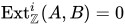
View on WikipediaIn mathematics, the Ext functors are the derived functors of the Hom functor. Along with the Tor functor, Ext is one of the core concepts of homological algebra, in which ideas from algebraic topology are used to define invariants of algebraic structures. The cohomology of groups, Lie algebras, and associative algebras can all be defined in terms of Ext. The name comes from the fact that the first Ext group Ext1 classifies extensions of one module by another.
In the special case of abelian groups, Ext was introduced by Reinhold Baer (1934). It was named by Samuel Eilenberg and Saunders MacLane (1942), and applied to topology (the universal coefficient theorem for cohomology). For modules over any ring, Ext was defined by Henri Cartan and Eilenberg in their 1956 book Homological Algebra.[1]
Definition
[edit]Let be a ring and let be the category of modules over . (One can take this to mean either left -modules or right -modules.) For a fixed -module , let for in . (Here is the abelian group of -linear maps from to ; this is an -module if is commutative.) This is a left exact functor from to the category of abelian groups , and so it has right derived functors . The Ext groups are the abelian groups defined by



for an integer i. By definition, this means: take any injective resolution

remove the term B, and form the cochain complex:

For each integer , is the cohomology of this complex at position . It is zero for negative. For example, is the kernel of the map , which is isomorphic to .


An alternative definition uses the functor , for a fixed -module . This is a contravariant functor, which can be viewed as a left exact functor from the opposite category to . The Ext groups are defined as the right derived functors :




That is, choose any projective resolution

remove the term , and form the cochain complex:

Then is the cohomology of this complex at position .

One may wonder why the choice of resolution has been left vague so far. In fact, Cartan and Eilenberg showed that these constructions are independent of the choice of projective or injective resolution, and that both constructions yield the same Ext groups.[2] Moreover, for a fixed ring R, Ext is a functor in each variable (contravariant in A, covariant in B).
For a commutative ring R and R-modules A and B, Exti
R(A, B) is an R-module (using that HomR(A, B) is an R-module in this case). For a non-commutative ring R, Exti
R(A, B) is only an abelian group, in general. If R is an algebra over a ring S (which means in particular that S is commutative), then Exti
R(A, B) is at least an S-module.
Properties of Ext
[edit]Here are some of the basic properties and computations of Ext groups.[3]
- Ext0
R(A, B) ≅ HomR(A, B) for any R-modules A and B. - Exti
R(A, B) = 0 for all i > 0 if the R-module A is projective (for example, free) or if B is injective. - The converses also hold:
- If Ext1
R(A, B) = 0 for all B, then A is projective (and hence Exti
R(A, B) = 0 for all i > 0). - If Ext1
R(A, B) = 0 for all A, then B is injective (and hence Exti
R(A, B) = 0 for all i > 0).
- If Ext1
- for all and all abelian groups and .[4]
- Generalizing the previous example, for all if is a principal ideal domain.
- If is a commutative ring and in is not a zero divisor, then


- for any -module . Here denotes the -torsion subgroup of , . Taking to be the ring of integers, this calculation can be used to compute for any finitely generated abelian group .
![{\displaystyle \operatorname {Ext} _{R}^{i}(R/(u),B)\cong {\begin{cases}B[u]&i=0\\B/uB&i=1\\0&{\text{otherwise,}}\end{cases}}}](https://wikimedia.org/api/rest_v1/media/math/render/svg/d29b19b92e3188770f876e89fe5d69f61f2bb030)
![{\displaystyle B[u]}](https://wikimedia.org/api/rest_v1/media/math/render/svg/a90757caa742e0cc078ebbf6130af886acd2d510)


- Generalizing the previous example, one can compute Ext groups when the first module is the quotient of a commutative ring by any regular sequence, using the Koszul complex.[5] For example, if R is the polynomial ring k[x1,...,xn] over a field k, then Ext*
R(k,k) is the exterior algebra S over k on n generators in Ext1. Moreover, Ext*
S(k,k) is the polynomial ring R; this is an example of Koszul duality. - By the general properties of derived functors, there are two basic exact sequences for Ext.[6] First, a short exact sequence of R-modules induces a long exact sequence of the form

- for any R-module A. Also, a short exact sequence induces a long exact sequence of the form
- for any R-module B.


- Ext takes direct sums (possibly infinite) in the first variable and products in the second variable to products.[7] That is:

- Let A be a finitely generated module over a commutative Noetherian ring R. Then Ext commutes with localization, in the sense that for every multiplicatively closed set S in R, every R-module B, and every integer i,[8]

Ext and extensions
[edit]Equivalence of extensions
[edit]The Ext groups derive their name from their relation to extensions of modules. Given R-modules A and B, an extension of A by B is a short exact sequence of R-modules

Two extensions


are said to be equivalent (as extensions of A by B) if there is a commutative diagram:

Note that the Five lemma implies that the middle arrow is an isomorphism. An extension of A by B is called split if it is equivalent to the trivial extension

There is a one-to-one correspondence between equivalence classes of extensions of A by B and elements of Ext1
R(A, B).[9] This can be made precise as follows.
Proof. Fix a short exact sequence

where is projective. Applying yields the long exact sequence


Given , choose such that . Consider the pushout of along , given by the cokernel of the map


Define as this pushout object. This yields the commutative diagram:


Here, is induced by the map . The bottom row is an extension of by , denoted , and the connecting map ensures that , proving surjectivity.


To show well-definedness on equivalence classes, suppose is another lift of . Then there exists such that . If is the pushout of and , then an isomorphism is induced, making the extensions equivalent.


Conversely, given an extension
- ,

the lifting property of gives a map fitting into the diagram


Here is the pushout of and . This shows that the map is injective.

Thus, the set of equivalence classes of extensions of by is naturally isomorphic to . ∎

The trivial extension corresponds to the zero element of Ext1
R(A, B).
The Baer sum of extensions
[edit]The Baer sum is an explicit description of the abelian group structure on , viewed as the set of equivalence classes of extensions of by .[10] Namely, given two extensions

![{\displaystyle 0\to B{\xrightarrow[{f}]{}}E{\xrightarrow[{g}]{}}A\to 0}](https://wikimedia.org/api/rest_v1/media/math/render/svg/99b91ef9769c22705bb158052b57276636e7906c)
and
![{\displaystyle 0\to B{\xrightarrow[{f'}]{}}E'{\xrightarrow[{g'}]{}}A\to 0,}](https://wikimedia.org/api/rest_v1/media/math/render/svg/c3c3b1f07bd8dcc1d933bb0a1b72b397a6e885e9)
first form the pullback over ,

Then form the quotient module

The Baer sum of and is the extension



where the first map is and the second is .
![{\displaystyle b\mapsto [(f(b),0)]=[(0,f'(b))]}](https://wikimedia.org/api/rest_v1/media/math/render/svg/ee75b87481bf9de19754e30ff4b98f9e3a93c53f)

Up to equivalence of extensions, the Baer sum is commutative and has the trivial extension as identity element. The negative of an extension is the extension involving the same module , but with the homomorphism replaced by its negative.


Construction of Ext in abelian categories
[edit]Nobuo Yoneda defined the abelian groups Extn
C(A, B) for objects A and B in any abelian category C; this agrees with the definition in terms of resolutions if C has enough projectives or enough injectives. First, Ext0
C(A,B) = HomC(A, B). Next, Ext1
C(A, B) is the set of equivalence classes of extensions of A by B, forming an abelian group under the Baer sum. Finally, the higher Ext groups Extn
C(A, B) are defined as equivalence classes of n-extensions, which are exact sequences

under the equivalence relation generated by the relation that identifies two extensions

if there are maps for all m in {1, 2, ..., n} so that every resulting square commutes that is, if there is a chain map which is the identity on A and B.



The Baer sum of two n-extensions as above is formed by letting be the pullback of and over A, and be the pushout of and under B.[11] Then the Baer sum of the extensions is



The derived category and the Yoneda product
[edit]An important point is that Ext groups in an abelian category C can be viewed as sets of morphisms in a category associated to C, the derived category D(C).[12] The objects of the derived category are complexes of objects in C. Specifically, one has
![{\displaystyle \operatorname {Ext} _{\mathbf {C} }^{i}(A,B)=\operatorname {Hom} _{D({\mathbf {C} })}(A,B[i]),}](https://wikimedia.org/api/rest_v1/media/math/render/svg/cd4f0a89006dc8d51c99160bf062be7b92891c2f)
where an object of C is viewed as a complex concentrated in degree zero, and [i] means shifting a complex i steps to the left. From this interpretation, there is a bilinear map, sometimes called the Yoneda product:

which is simply the composition of morphisms in the derived category.
The Yoneda product can also be described in more elementary terms. For i = j = 0, the product is the composition of maps in the category C. In general, the product can be defined by splicing together two Yoneda extensions.
Alternatively, the Yoneda product can be defined in terms of resolutions. (This is close to the definition of the derived category.) For example, let R be a ring, with R-modules A, B, C, and let P, Q, and T be projective resolutions of A, B, C. Then Exti
R(A,B) can be identified with the group of chain homotopy classes of chain maps P → Q[i]. The Yoneda product is given by composing chain maps:
![{\displaystyle P\to Q[i]\to T[i+j].}](https://wikimedia.org/api/rest_v1/media/math/render/svg/7e1db5574c44feacd2e3448b888bb92c98bb8c17)
By any of these interpretations, the Yoneda product is associative. As a result, is a graded ring, for any R-module A. For example, this gives the ring structure on group cohomology since this can be viewed as . Also by associativity of the Yoneda product: for any R-modules A and B, is a module over .


![{\displaystyle \operatorname {Ext} _{\mathbb {Z} [G]}^{*}(\mathbb {Z} ,\mathbb {Z} )}](https://wikimedia.org/api/rest_v1/media/math/render/svg/caa2d03e117e399c9fc5a96b1e4383be50277a2b)

Important special cases
[edit]- Group cohomology is defined by , where G is a group, M is a representation of G over the integers, and is the group ring of G.
- For an algebra A over a field k and an A-bimodule M, Hochschild cohomology is defined by
- Lie algebra cohomology is defined by , where is a Lie algebra over a commutative ring k, M is a -module, and is the universal enveloping algebra.
- For a topological space X, sheaf cohomology can be defined as Here Ext is taken in the abelian category of sheaves of abelian groups on X, and is the sheaf of locally constant -valued functions. Instead of , one can consider any sheaf of rings on X and take Ext in the category of sheaves of -modules.
- For a sheaf of modules on a ringed space , taking the right derived functors of the sheaf Hom , the internal Hom in the category of -modules, gives the Ext sheaves .[13] They are related to the global Ext groups via the local-to-global Ext spectral sequence.
- For a commutative Noetherian local ring R with residue field k, is the universal enveloping algebra of a graded Lie algebra π*(R) over k, known as the homotopy Lie algebra of R. (To be precise, when k has characteristic 2, π*(R) has to be viewed as an "adjusted Lie algebra".[14]) There is a natural homomorphism of graded Lie algebras from the André–Quillen cohomology D*(k/R,k) to π*(R), which is an isomorphism if k has characteristic zero.[15]
![{\displaystyle H^{*}(G,M)=\operatorname {Ext} _{\mathbb {Z} [G]}^{*}(\mathbb {Z} ,M)}](https://wikimedia.org/api/rest_v1/media/math/render/svg/75ea5c28b67c0bc2f3dea33b55aa97d33977f830)
![{\displaystyle \mathbb {Z} [G]}](https://wikimedia.org/api/rest_v1/media/math/render/svg/f40260c366fc309a5872899d2ea34cf094855857)







See also
[edit]Notes
[edit]- ^ Weibel (1999); Cartan & Eilenberg (1956), section VI.1.
- ^ Weibel (1994), sections 2.4 and 2.5 and Theorem 2.7.6.
- ^ Weibel (1994), Chapters 2 and 3.
- ^ Weibeil (1994), Lemma 3.3.1.
- ^ Weibel (1994), section 4.5.
- ^ Weibel (1994), Definition 2.1.1.
- ^ Weibel (1994), Proposition 3.3.4.
- ^ Weibel (1994), Proposition 3.3.10.
- ^ Weibel (1994), Theorem 3.4.3.
- ^ Weibel (1994), Corollary 3.4.5.
- ^ Weibel (1994), Vists 3.4.6. Some minor corrections are in the errata.
- ^ Weibel (1994), sections 10.4 and 10.7; Gelfand & Manin (2003), Chapter III.
- ^ Hartshorne, Robin (1977), Algebraic Geometry, Graduate Texts in Mathematics, vol. 52, New York: Springer-Verlag, ISBN 978-0-387-90244-9, MR 0463157, §III.6
- ^ Sjödin (1980), Notation 14.
- ^ Avramov (2010), section 10.2.
References
[edit]- Avramov, Luchezar (2010), "Infinite free resolutions", Six lectures on commutative algebra, Birkhäuser, pp. 1–108, doi:10.1007/978-3-0346-0329-4_1, ISBN 978-3-7643-5951-5, MR 2641236
- Baer, Reinhold (1934), "Erweiterung von Gruppen und ihren Isomorphismen", Mathematische Zeitschrift, 38 (1): 375–416, doi:10.1007/BF01170643, Zbl 0009.01101
- Cartan, Henri; Eilenberg, Samuel (1999) [1956], Homological algebra, Princeton: Princeton University Press, ISBN 0-691-04991-2, MR 0077480
- Eilenberg, Samuel; MacLane, Saunders (1942), "Group extensions and homology", Annals of Mathematics, 43 (4): 757–931, doi:10.2307/1968966, JSTOR 1968966, MR 0007108
- Gelfand, Sergei I.; Manin, Yuri Ivanovich (2003), Methods of homological algebra, Berlin, New York: Springer-Verlag, doi:10.1007/978-3-662-12492-5, ISBN 978-3-540-43583-9, MR 1950475
- Sjödin, Gunnar (1980), "Hopf algebras and derivations", Journal of Algebra, 64: 218–229, doi:10.1016/0021-8693(80)90143-X, MR 0575792
- Weibel, Charles A. (1994). An introduction to homological algebra. Cambridge Studies in Advanced Mathematics. Vol. 38. Cambridge University Press. ISBN 978-0-521-55987-4. MR 1269324. OCLC 36131259.
- Weibel, Charles A. (1999), "History of homological algebra" (PDF), History of topology, Amsterdam: North-Holland, pp. 797–836, ISBN 9780444823755, MR 1721123
Ext functor
View on GrokipediaBasic Concepts
Definition
In homological algebra, the Ext functor arises in the context of abelian categories, which are categories equipped with a zero object, finite biproducts, kernels and cokernels for every morphism, and the property that every monomorphism and epimorphism is normal. The Hom functor in an abelian category , denoted for objects , assigns to each pair of objects the abelian group of morphisms from to , and extends contravariantly in the first argument and covariantly in the second to yield a bifunctor .[4] This functor is left exact, meaning that if is a short exact sequence in , then is exact for any .[1] (Note: page 82 in the PDF.) To extend such left exact functors while measuring their failure to be exact, one defines derived functors using projective or injective resolutions of objects in , assuming has enough projectives or injectives. Specifically, the -th Ext group for and objects is defined as the -th right derived functor of evaluated at , or dually as the -th left derived functor of evaluated at .[5][1] (Note: Chapter V, Section 3, pp. 82-83 in the PDF.) This construction embeds into the broader framework of derived functors on the derived category of , where for the -th shift .[6] In this derived functor framework, the zeroth Ext group satisfies the universal property of recovering the original Hom functor: , establishing an isomorphism .[5][7] For , vanishes if is projective, reflecting the exactness of in that case.[1] (Note: Chapter VI, Section 1, p. 106 in the PDF.) A concrete illustration occurs in the category of abelian groups, where for .[8]Properties
The Ext functors possess a bifunctorial nature, being contravariant in the first argument and covariant in the second. This arises from its construction by considering and deriving the hom-functor in each argument direction separately. Specifically, for abelian groups (or modules over a ring) , and morphisms , , there is an induced natural transformation for each .[9] The contravariant behavior in the first argument is constructed explicitly using projective resolutions. To define the induced map : Construct projective resolutions for and for . By the Comparison Theorem for resolutions, the morphism lifts to a chain map that is unique up to chain homotopy: Apply the contravariant functor to the resolutions. Because is contravariant in the first slot, the direction of all arrows—including the lifted maps —is reversed: . This induces a morphism of cochain complexes . Passing to cohomology, the induced map on the -th cohomology group is , where is the cohomology class of a cocycle .[9][5] This assignment is well-defined on cohomology classes. The induced cochain map preserves cocycles and coboundaries: since is a chain map, , so if , then , making a cocycle. Similarly, the map sends coboundaries to coboundaries because it commutes with the differentials. Moreover, the map is independent of the choice of lift . By the Comparison Theorem, any two lifts and are chain homotopic, so there exist maps such that . For a cocycle , which is a coboundary. Thus, and define the same cohomology class.[9][5] The covariant behavior in the second argument is induced by applying the covariant functor to morphisms in the second variable, with induced maps arising from postcomposition on the appropriate complexes (typically using injective resolutions for the second argument). The contravariance in the first argument arises from deriving the contravariant Hom functor , which can be viewed as a left-exact functor from the opposite category to abelian groups, leading to induced maps often denoted or (pullback or precomposition on extensions).[9][5] This functoriality ensures that behaves compatibly with the category structure, forming a -functor in the sense of homological algebra.[1] A key algebraic property is dimension shifting, which arises from short exact sequences. For instance, consider a short exact sequence $0 \to K \to P \to A \to 0P\operatorname{Ext}^{n+1}(A, B) \cong \operatorname{Ext}^n(K, B)n \geq 0B.[](https://www.sas.rochester.edu/mth/sites/doug-ravenel/otherpapers/weibel-homv2.pdf) Similarly, in the second variable, if $0 \to B \to E \to I \to 0 with injective, the long exact sequence implies isomorphisms under vanishing conditions on intermediate terms, such as when for relevant .[1] These shifts facilitate computations by relating higher Ext groups to lower ones via resolutions. Applying the functor to a short exact sequence $0 \to B' \to B \to B'' \to 0 yields a five-term [exact sequence](/page/Exact_sequence) $0 \to \operatorname{Hom}(A, B') \to \operatorname{Hom}(A, B) \to \operatorname{Hom}(A, B'') \to \operatorname{Ext}^1(A, B') \to \operatorname{Ext}^1(A, B), reflecting the left exactness of .[9] This sequence captures the initial deviation from exactness and is a direct consequence of the derived functor construction. More generally, the Ext functors satisfy a long exact sequence property: for a short exact sequence $0 \to A' \to A \to A'' \to 0$ of abelian groups (or modules), the sequence is exact for all and any .[9][1] This long exact sequence is fundamental for analyzing how extensions behave under module homomorphisms and underpins many inductive arguments in homological algebra. The naturality of these constructions extends to compatibility with direct sums. In the category of modules over a ring, for arbitrary (possibly infinite) direct sums in the first variable, reflecting the contravariant additivity of .[9] In the second variable, , holding under the AB3 axiom for the category (small direct sums exact).[1] These isomorphisms hold for finite sums without qualification and are essential for decomposing computations in categories with good direct sum properties. As a concrete illustration, consider the category of vector spaces over a field . Here, every vector space is both projective and injective, so for all and any vector spaces .[9] In particular, implies that every short exact sequence $0 \to W \to E \to V \to 0$ splits, confirming that extensions are trivial in this semisimple category.[1]Extensions and Their Classification
Equivalence of Extensions
A short exact extension of the module by the module is a short exact sequence of the form where is injective, is surjective, and .[10] Two such extensions and are equivalent if there exists an isomorphism such that the diagram commutes, meaning and . This equivalence relation is defined via commutative diagrams with identity maps on and , ensuring the middle terms are isomorphic while preserving the exactness.[1][10] There is a natural bijection between the set of equivalence classes of these extensions and the group . This isomorphism, established by Baer, maps each equivalence class to an element of via a connecting homomorphism derived from projective resolutions of .[1] Specifically, given an extension, one constructs a lift of the identity on through a projective resolution , yielding a cohomology class in ; conversely, every element in arises from such a lift, corresponding to a unique equivalence class of extensions by the Yoneda lemma.[1][10] A morphism between two extensions induces a map in by composing with the connecting homomorphism, preserving the group structure. Baer's theorem confirms this correspondence is bijective, ensuring every class in lifts to an extension and morphisms act functorially.[1] For example, in the category of abelian groups, the group is isomorphic to , classifying extensions . The zero class corresponds to the split extension , while the generator class [11] yields the nonsplit extension where the inclusion is multiplication by , so with quotient by ; other classes are scalar multiples, all with middle term isomorphic to .[10][1] If , every extension is equivalent to the split extension , as the vanishing implies the existence of a section such that . This provides a criterion for uniqueness up to isomorphism: the extension splits precisely when its class in is zero.[10][1]Baer Sum
The Baer sum provides an addition operation on the set of equivalence classes of extensions in an abelian category, endowing with the structure of an abelian group.[12] Given two extensions and , the direct sum yields the extension with maps and . To obtain the Baer sum , first form the pushout of along the codiagonal map (given by ), resulting in an extension of by ; then take the pullback along the diagonal (given by ), yielding the middle term as the fiber product over . The inclusion into the Baer sum is the diagonal , and the projection is the codiagonal .[13][12] This construction is independent of the choices made in forming the direct sum and the pullback-pushout, as equivalent extensions yield equivalent Baer sums via natural isomorphisms of direct sums and the functoriality of pullbacks and pushouts in abelian categories.[12] The Baer sum is associative and commutative because direct sums are both, and the diagonal and codiagonal maps satisfy the required naturality conditions; the identity element is the equivalence class of the split extension (with inclusion to the second factor and projection from the first), and the inverse of is , obtained similarly by replacing the codiagonal on with the difference map . Thus, the set of equivalence classes of extensions acquires a unique abelian group structure with this operation.[12][13] The zero element in this group structure corresponds precisely to the equivalence class of the split short exact sequence.[12] For a representative example in the category of abelian groups, consider , where the Baer sum of equivalence classes corresponds to addition in this group.[12]Computing Ext Groups
Projective Resolutions
One standard method for computing the Ext groups in an abelian category with enough projective objects, such as the category of modules over a unital ring , involves constructing a projective resolution of the first argument . A projective resolution of is a long exact sequence , where each is projective (i.e., is an exact functor).[14] To compute , delete the term from the resolution to obtain the projective resolution complex . Apply the covariant Hom functor to yield the cochain complex where the differential is induced by composition with the resolution map , up to sign: for , with the resolution differential (the sign convention may vary but does not affect cohomology). Then, , the th cohomology group of this complex.[14] The step-by-step process begins with constructing the resolution: start with a surjection from a projective (often free), set , then choose a surjection from a projective , and iterate to obtain , ensuring exactness at each by the projectivity of the . After applying , compute the cohomology at each degree as The augmentation map and the exactness of the full resolution guarantee that and that the higher cohomology groups are independent of the choice of resolution, aligning with the axiomatic definition of Ext as the right derived functor of . In particular, is naturally isomorphic to . This follows from the long exact sequence induced by the short exact sequence , where is the augmentation, and inductively applying the projectivity to show vanishing of certain connecting homomorphisms.[14] A concrete example illustrates this process over the ring for a prime , with . The minimal projective resolution of is infinite and periodic: where the differentials are multiplication by for , and is the canonical projection (compositions vanish since in ). Deleting yields . Applying , note that for each term, as -linear maps are determined by the image of , which must annihilate . The induced differentials are zero, because composition with yields in . Thus, all cohomology groups are for , so for all .[14] Another simple example arises in the category of abelian groups (i.e., -modules), where we compute the Ext groups for an arbitrary abelian group and integer . A short projective resolution of is where is multiplication by and is the canonical quotient map. This resolution is exact because the kernel of is , and multiplication by maps isomorphically onto . Deleting the last term yields the complex (with degrees 1 and 0). Applying the contravariant functor produces the cochain complex where each via evaluation at 1. The differential is induced by composition with , so under the identification it corresponds to multiplication by : . The cohomology groups of this complex are then:- ,
- ,
- for .
| Operation | Resulting Group |
|---|---|
| (the -torsion subgroup) | |
Injective Resolutions
To compute the Ext groups using injective resolutions, embed the module into an exact sequence known as an injective resolution:where each is an injective module and the sequence is exact. Apply the functor to this resolution, yielding a cochain complex
The -th cohomology group of this complex is isomorphic to .[15] This approach computes the right derived functors of the left-exact covariant functor . By the balance theorem for Ext, these are naturally isomorphic to the left derived functors of the left-exact contravariant functor , allowing the same groups to be obtained via projective resolutions of . The isomorphism arises from dimension-shifting arguments in the homological algebra of abelian categories, ensuring consistency between the two computational methods.[16] The process involves truncating the injective resolution immediately after , so the relevant cochain complex for cohomology computation begins at and proceeds to higher terms without including . The cohomology is then calculated as the kernel of the map to the next term modulo the image from the previous term at each degree , with . This yields a well-defined invariant independent of the choice of resolution, up to natural isomorphism.[15] In the category of sheaves on a Riemann surface, injective resolutions facilitate computations of sheaf Ext groups; for instance, the Dolbeault resolution provides an injective resolution of the structure sheaf :
where denotes the sheaf of smooth -forms (fine sheaves, hence injective). Applying and taking cohomology computes , the space of conjugate Dolbeault classes, whose dimension equals the genus of the surface. Similar resolutions of the constant sheaf can be used to compute groups like .[9] This method is particularly preferable in categories lacking enough projective objects, such as the category of sheaves of abelian groups (or -modules) on a topological space, where projective sheaves are scarce or nonexistent beyond trivial cases, but enough injective sheaves (e.g., flabby or fine sheaves) always exist to form resolutions.[9]
Advanced Constructions
Derived Functor Approach
In homological algebra, the Ext functors are formalized as the right derived functors of the Hom bifunctor in an abelian category . Specifically, for objects , the groups are defined as the th right derived functor , or equivalently in the contravariant variable. This construction captures the failure of exactness of the Hom functor, with and higher Ext groups vanishing when is projective or is injective.[17] The left derived functors yield the same result, providing a dual perspective. To compute these derived functors, the category is embedded into the larger category of chain complexes over , where the Hom bifunctor extends to a bifunctor between complexes that is cohomological in each variable.[17] Objects of are viewed as concentrated in degree zero, and projective (or injective) resolutions of these objects provide acyclic complexes—meaning their homology vanishes except in degree zero—that replace the original objects up to quasi-isomorphism. A quasi-isomorphism is a chain map inducing isomorphisms on homology groups, ensuring that the derived functors are well-defined and independent of the choice of resolution.[17] The exactness properties of on such resolutions then yield long exact sequences for under short exact sequences in , reflecting the functorial derivation process. In certain settings, such as the category of abelian groups or modules over a ring, an analog of the universal coefficient theorem provides a splitting of the derived functors. For instance, the universal coefficient theorem provides a natural isomorphism for the singular cohomology of a space X with coefficients in an abelian group G. This approach unifies the computation of extensions across various algebraic structures. The derived functor perspective on Ext was developed by Henri Cartan and Samuel Eilenberg in the 1950s, as part of establishing the foundations of homological algebra, integrating disparate theories like group cohomology and Ext groups into a cohesive framework using resolutions and derived functors.Derived Category Interpretation
The derived category of an abelian category is obtained by localizing the homotopy category of chain complexes at the quasi-isomorphisms, resulting in a triangulated category where objects are complexes up to quasi-isomorphism and morphisms account for these localizations.[6] The shift functor $$ on translates a complex by degrees, shifting the degrees of its cohomology groups accordingly.[18] In this framework, the Ext groups admit a natural interpretation as morphisms in the derived category: for objects , viewed as complexes concentrated in degree 0, there is a canonical isomorphism .[6] This identification transforms the classical cohomological view of extensions into a homological one, where extensions correspond to morphisms from to the -th shift of .[18] This perspective offers several advantages, including the unification of cohomology computations as Hom-spaces, which streamlines the study of compositions via Yoneda products and facilitates the analysis of spectral sequences through triangulated structures.[6] The triangulated category is equipped with distinguished triangles, which upon applying the Hom functor yield long exact sequences in Ext groups, mirroring the classical long exact sequences from short exact sequences in .[18] For instance, in the bounded derived category of coherent sheaves on an algebraic variety , Ext groups between sheaves can be computed using Fourier-Mukai transforms, which are exact functors between such derived categories induced by kernels on the product space, providing a powerful tool for equivalence and reconstruction problems.[19]Yoneda Product and Composition
Definition of Yoneda Product
The Yoneda product is a bilinear map that is natural in the modules , , and over a ring .[2][20] This pairing endows the direct sum with a graded associative multiplication under suitable conditions, such as when as an -bimodule.[2] The construction proceeds by splicing extensions: given extensions representing classes and , where and , one identifies the cokernel of with the kernel of via the composite map , yielding a composite long exact sequence whose class in is the Yoneda product .[20] Equivalently, it arises from the connecting homomorphism in the long exact sequence of Ext groups induced by a short exact sequence involving .[2] Associativity of the Yoneda product follows from the associativity of composition in the category of extensions, ensuring that the induced multiplication on graded Ext groups is associative and turns into a graded ring when the middle term aligns appropriately.[2][20] In the derived category of -modules, the Yoneda product corresponds to the tensor product of morphisms followed by composition: a class in tensored with one in yields an element in via the natural composition, verifying the product's compatibility with the derived functor interpretation of Ext.[2] For example, in group cohomology, the Yoneda product on coincides with the cup product structure on , providing a ring structure that captures compositional aspects of group extensions.[2][20]Applications to Extension Composition
The Yoneda product provides a mechanism for composing extensions in abelian categories, generalizing the Baer sum from the case of degree 1 to higher degrees. Specifically, given an -extension representing an element of and an -extension representing an element of , their Yoneda product yields an -extension in .[2] This composition is bilinear and associative, allowing the iterative splicing of multiple extensions to build longer ones.[2] The construction of this composed extension relies on a splicing procedure that alternates between pushouts and pullbacks along the connecting morphisms at the shared module B. This diagrammatic splicing preserves the equivalence class under the Yoneda relation, where two extensions are equivalent if they differ by elementary transformations or length-two equivalences defined via pushouts and pullbacks.[2] Similar constructions using pushouts and pullbacks define the Baer sum, the group operation on short exact sequences in Ext^1.[2] In non-split scenarios, the Yoneda product distinguishes trivial from non-trivial compositions: the product vanishes if and only if the spliced extension is equivalent to the direct sum of the original extensions, indicating a split composition. Non-zero products correspond to genuine higher extensions that do not decompose, often obstructed by elements in intermediate Ext groups; for example, the existence of a -extension module for requires the vanishing of certain Yoneda products of consecutive 2-cocycles, though this condition is necessary but not always sufficient for higher .[21] Such obstructions highlight the role of the product in detecting indecomposability in extension classes.[21] A notable application arises in algebraic topology, where Yoneda products in sheaf cohomology facilitate the composition of stages in Postnikov towers. For a space , the -invariants classifying the extensions in the tower lie in sheaf cohomology groups , which are isomorphic to Ext groups for sheaf modules; splicing these via the product constructs the full tower, enabling the reconstruction of from its homotopy groups and Postnikov invariants. This compositional structure underpins the algebraic description of fibrations and their attachments. Yoneda products also manifest in the -terms of spectral sequences arising from filtered complexes or change-of-rings theorems, where they induce multiplicative structures compatible with differentials, such as in the Adams spectral sequence relating Ext groups to homotopy.[22]Special Cases and Applications
In Module Categories
In the category of modules over a ring , the Ext functor is defined for -modules and , where is typically taken as a left module and as a right module if is non-commutative, though the focus here is often on commutative rings. Projective -modules serve as the building blocks for computations, and every projective module is a direct summand of a free -module. Computations of frequently rely on projective resolutions of , as mentioned briefly in the context of homological methods.[2] A key property in module categories is the vanishing of higher Ext groups under certain conditions. Specifically, if is a projective -module, then for all and all -modules . Dually, if is an injective -module, then for all and all -modules . These vanishing theorems highlight the role of projective and injective modules in simplifying homological computations.[2][23] For commutative local rings where , explicit examples illustrate the structure of low-degree Ext groups. This isomorphism captures infinitesimal extensions and is fundamental in commutative algebra for studying singularities.[24] The projective dimension of a module over a commutative Noetherian local ring is given by . The Auslander-Buchsbaum formula relates this to depth: if has finite projective dimension, then . This result, established in the study of homological dimensions, provides a bridge between Ext non-vanishing and ring-theoretic invariants like depth. Change of rings theorems adapt Ext groups across ring homomorphisms, enabling computations over quotients or extensions. For a ring homomorphism and suitable modules, there are isomorphisms or spectral sequences relating to under flatness assumptions on over . A standard case involves quotient rings , where compatibility conditions yield when acts trivially or under resolution hypotheses. These allow transferring homological information between related rings.[2][25]In Other Abelian Categories
In the category of abelian groups, the first derived functor classifies the equivalence classes of short exact sequences up to congruence, where congruence means isomorphisms of extensions that are the identity on and . Higher derived functors vanish for , as the category of abelian groups has homological dimension 1.[9] In categories of sheaves, such as quasi-coherent sheaves on a ringed space, the Ext functors are computed using injective resolutions due to the frequent lack of enough projective objects, contrasting with module categories where projective resolutions are standard. A key feature is the local-to-global spectral sequence, which relates global Ext groups to local sheaf Ext sheaves and cohomology: , allowing computation of global extensions from local data.[26] This sequence distinguishes cohomology, which computes sheaf cohomology via covers and aligns with derived Ext in acyclic cases, from the full derived functor approach using resolutions.[26] For example, in the category of coherent sheaves on a scheme , the group parametrizes equivalence classes of extensions , which correspond to infinitesimal thickenings or first-order deformations of subschemes defined by when is supported on a closed subscheme. In the abelian category of modules over the Steenrod algebra (used in stable homotopy theory), the Ext functor appears as the -term of the Adams spectral sequence, , converging to the -primary stable homotopy groups of spectra, with post-2000 advancements enabling computations for exotic structures via synthetic spectra.[27]References
- WIDDER. Page 9. HOMOLOGICAL. ALGEBRA. By. HENRI CARTAN and. SAMUEL EILENBERG ... functor. It was then observed that the resulting sequence possessed the formal ...