Hubbry Logo
Extensor digitorum longus muscleExtensor digitorum longus muscleMain
Open search
Extensor digitorum longus muscle
Community hub
Extensor digitorum longus muscle
logo
8 pages, 0 posts
0 subscribers
Be the first to start a discussion here.
Extensor digitorum longus muscle
from Wikipedia
Extensor digitorum longus muscle
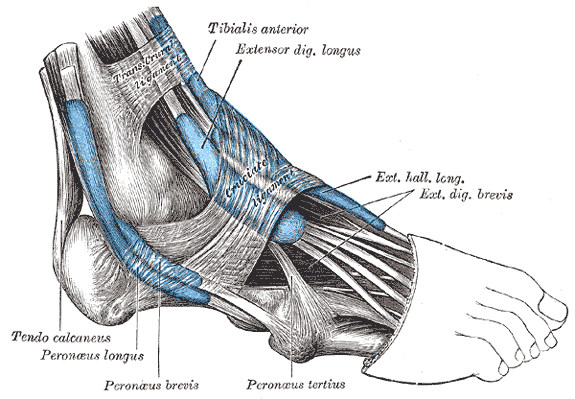
The mucous sheaths of the tendons around the ankle. Lateral aspect. (Extensor dig. longus labeled at upper right.)
Animation
Details
OriginAnterior lateral condyle of tibia, anterior shaft of fibula and superior 34 of interosseous membrane
InsertionDorsal surface; middle and distal phalanges of lateral four digits
ArteryAnterior tibial artery
NerveDeep fibular nerve
ActionsExtension of toes and dorsiflexion of ankle
AntagonistFlexor digitorum longus, flexor digitorum brevis
Identifiers
Latinmusculus extensor digitorum longus
TA98A04.7.02.038
TA22645
FMA22534
Anatomical terms of muscle

The extensor digitorum longus is a pennate muscle, situated at the lateral part of the front of the leg.

Structure

[edit]

It arises from the lateral condyle of the tibia; from the upper three-quarters of the anterior surface of the body of the fibula; from the upper part of the interosseous membrane; from the deep surface of the fascia; and from the intermuscular septa between it and the tibialis anterior on the medial, and the peroneal muscles on the lateral side. Between it and the tibialis anterior are the upper portions of the anterior tibial vessels and deep peroneal nerve.

The muscle passes under the superior and inferior extensor retinaculum of foot in company with the fibularis tertius, and divides into four slips, which run forward on the dorsum of the foot, and are inserted into the second and third phalanges of the four lesser toes.

The tendons to the second, third, and fourth toes are each joined, opposite the metatarsophalangeal articulations, on the lateral side by a tendon of the extensor digitorum brevis. The tendons are inserted in the following manner: each receives a fibrous expansion from the interossei and lumbricals, and then spreads out into a broad aponeurosis, which covers the dorsal surface of the first phalanx: this aponeurosis, at the articulation of the first with the second phalanx, divides into three slips — an intermediate, which is inserted into the base of the second phalanx; and two collateral slips, which, after uniting on the dorsal surface of the second phalanx, are continued onward, to be inserted into the base of the third phalanx.

Variations

[edit]

This muscle varies considerably in the modes of origin and the arrangement of its various tendons.

The tendons to the second and fifth toes may be found doubled, or extra slips are given off from one or more tendons to their corresponding metatarsal bones, or to the short extensor, or to one of the interosseous muscles.

A slip to the great toe from the innermost tendon has been found.

See also

[edit]

Additional images

[edit]

References

[edit]
[edit]
Revisions and contributorsEdit on WikipediaRead on Wikipedia
from Grokipedia
The extensor digitorum longus muscle (EDL) is a long, thin, located in the anterior compartment of the lower leg, primarily responsible for extending the lateral four toes (digits 2–5) at the metatarsophalangeal and interphalangeal joints while also contributing to ankle dorsiflexion and foot eversion. This muscle originates from the lateral condyle of the , the medial surface of the proximal , and the upper portion of the between the and . Its tendon divides into four slips after passing beneath the superior and inferior extensor retinacula at the ankle, with each slip inserting into the base of the middle phalanx and distal phalanx of the respective via the dorsal digital expansion. Positioned as the most lateral muscle in the anterior compartment, the EDL lies adjacent to the tibialis anterior medially and the peroneus tertius (when present) laterally, with the anterior tibial and deep peroneal passing anteriorly between it and the tibialis anterior. Innervated by the deep peroneal (fibular) nerve (L4–L5, S1), the EDL receives motor branches in the proximal third of the leg, enabling coordinated action during walking and running. Its blood supply is derived mainly from the anterior tibial artery proximally and the distally, with additional branches to the tendons from the anterior lateral malleolar, lateral tarsal, and digital arteries. Functionally, the EDL facilitates toe extension to clear the foot during the swing phase of and supports ankle dorsiflexion to prevent , while its eversion component aids in maintaining balance on uneven terrain. Clinically, or to the EDL—often from deep peroneal compression or anterior —can lead to impaired toe extension and compensatory overuse of adjacent muscles, potentially contributing to conditions like or abnormalities.

Anatomy

Origin

The extensor digitorum longus is a unipennate muscle in the anterior compartment of the , characterized by muscle fibers attaching obliquely to one side of a central , which enhances its force generation for extension. It originates primarily from the inferior aspect of the lateral condyle of the , providing an initial attachment point on the proximal tibia. The muscle also arises from the upper two-thirds to three-fourths of the medial surface of the shaft, which faces the and forms the bulk of its proximal attachment along the lateral aspect of the . Additional fibers connect to the superior portion of the anterior surface of the , the fibrous sheet spanning between the and that stabilizes the compartment and transmits forces between the bones. Further origins include the overlying (fascia cruris) and the anterior intermuscular septum, which anchor the muscle to surrounding soft tissues and dividing the compartments. These multiple attachment sites collectively position the extensor digitorum longus laterally within the anterior compartment of the , situated deep and lateral to the , allowing it to contribute to dorsiflexion and toe extension from a broad proximal base.

Insertion

The extensor digitorum longus muscle terminates distally through a common that divides into four distinct slips within the inferior extensor retinaculum, each encased in a synovial sheath as it descends toward the dorsum of the foot. These slips correspond to the lateral four toes (digits 2–5) and fan out over the proximal phalanges, forming triangular dorsal digital expansions known as extensor hoods. Within each extensor hood, the tendon divides into a central slip and two lateral slips. The central slip inserts into the base of the middle phalanx, while the two lateral slips merge and attach to the base of the distal phalanx, enabling extension at the interphalangeal joints. For the second through fourth toes, the medial portions of these extensor hoods receive contributions from the tendons of the , blending to reinforce the expansions. In contrast, the slip to the fifth toe typically lacks such reinforcement, functioning independently via its own extensor hood attachment to the middle and distal phalanges.

Course and relations

The extensor digitorum longus muscle occupies the lateral aspect of the anterior compartment of the leg, where its fleshy belly gradually narrows into a long, cord-like in the distal third of the leg, descending anteriorly toward the ankle joint. This courses deep to the superior extensor retinaculum—a transverse fibrous band located approximately 1 cm superior to the ankle joint—and passes through the lateral compartment of the inferior extensor retinaculum, a Y-shaped structure inferior to the malleoli that maintains alignment during movement. Throughout its course in the anterior compartment, the extensor digitorum longus lies lateral to the tibialis anterior and extensor hallucis longus muscles while being positioned medial to the ; the and anterior tibial vessels travel parallel alongside it, with the vessels specifically interposed between the tibialis anterior and the extensor digitorum longus. Just distal to the inferior extensor retinaculum, the tendon bifurcates into four distinct slips encased in a common synovial sheath, which then fan out across the dorsum of the foot to reach the lesser toes without any transverse displacement at the ankle joint level.

Variations

The extensor digitorum longus muscle exhibits several anatomical variations, particularly in the number and distribution of its tendinous slips to the toes. Extra slips may originate from the muscle belly or its tendons, inserting onto adjacent structures such as the bases of the metatarsals, the , or the dorsal interossei muscles. For instance, accessory tendinous slips have been documented inserting into the joint capsule of the fifth metatarsophalangeal joint or the dorsal aponeurosis of the fifth . Similar slips connecting to the or the first dorsal interosseous muscle have also been reported, providing additional to the extensor apparatus. A rare variation involves an accessory slip extending to the great toe (first digit), originating from the EDL or adjacent and inserting into the extensor hood of the hallux, as observed bilaterally in isolated cadaveric cases. Fusion or absence of slips occurs less frequently, with the to the fourth toe showing the greatest variability; reports include bifurcated slips or complete absence, potentially leading to atypical extensor contributions from neighboring tendons. These variations are typically but have been identified through routine cadaveric examinations.

Innervation and blood supply

Innervation

The extensor digitorum longus muscle is primarily innervated by the deep branch of the fibular (peroneal) nerve, which provides motor supply to enable its contraction and extension functions. This nerve branch arises from the near the fibular head and penetrates the to enter the anterior compartment of the , where it courses along the anterior surface of the , deep to the extensor digitorum longus muscle belly, before distributing branches directly to the muscle. The travels in close association with the anterior tibial artery, which provides accompanying vascular supply to the region. The spinal root contributions to this innervation originate from the L4, L5, and S1 segments of the , with motor fibers responsible for innervating the muscle fibers of the extensor digitorum longus. These motor axons facilitate precise control over dorsiflexion and toe extension by synapsing at neuromuscular junctions within the muscle.

Blood supply

The extensor digitorum longus muscle receives its primary arterial supply from the anterior tibial artery, which provides muscular branches that nourish the muscle throughout its course in the anterior compartment of the leg. These branches, including smaller perforating vessels, accompany the deep peroneal nerve along the , ensuring coordinated vascular and neural support. The proximal portion of the muscle is supplied by the anterior tibial artery directly, while the distal portion receives contributions from the fibular (peroneal) artery via its perforating branches. Venous drainage follows the arterial pattern via paired anterior tibial veins, which collect blood from the anterior compartment muscles, including the extensor digitorum longus, and ascend alongside the artery. These veins receive tributaries from the muscle's venae comitantes and drain into the popliteal vein at the level of the after uniting with the posterior tibial veins. The vascular network parallels the muscle's path from its origin on the and to its tendinous insertions on the , with rich anastomoses between anterior tibial, fibular, and posterior tibial branches enhancing collateral circulation. This arrangement is crucial for maintaining oxygenation and nutrient delivery during high-demand activities such as running, where repeated dorsiflexion and toe extension increase metabolic needs.

Function

Actions

The extensor digitorum longus muscle primarily functions to extend the four lateral toes (digits 2 through 5) at the metatarsophalangeal (MTP), proximal interphalangeal (PIP), and distal interphalangeal (DIP) joints through its tendons, which insert into the dorsal expansions of these digits. This extension action straightens the toes, countering flexion and aiding in toe-off phases of locomotion by lifting the toes upward. Contraction of the muscle also produces dorsiflexion at the ankle joint (talocrural joint), achieved as its tendon courses anteriorly under the superior extensor retinaculum and contributes to elevating the foot via the mechanism. Due to its lateral positioning relative to the ankle's axis of rotation, the muscle secondarily contributes to eversion of the foot, supplementing the primary evertors like the . The extensor digitorum longus coordinates with the to facilitate comprehensive dorsiflexion of the foot, where the former handles the lateral toes and the latter extends the hallux (digit 1), together ensuring balanced lift of the entire forefoot. It acts antagonistically to the flexor digitorum longus, which flexes the same toes at the MTP, PIP, and DIP joints, and to the flexor digitorum brevis, which flexes the MTP and PIP joints, maintaining reciprocal control over toe positioning.

Role in movement

The extensor digitorum longus (EDL) muscle plays a crucial role in the swing phase of , where it activates to contribute to ankle dorsiflexion and extension, elevating the foot and toes to ensure adequate clearance and prevent dragging on the ground. This coordinated action, peaking around mid-swing, works alongside the tibialis anterior to facilitate smooth forward progression of the limb. During heel strike and the early stance phase, the EDL provides eccentric support as a dorsiflexor, helping to control plantarflexion and ensure stable, controlled foot placement upon ground contact. Its activity in this phase, though secondary to the tibialis anterior, aids in absorbing impact and maintaining balance during initial weight transfer. In dynamic activities such as running, , and , the EDL supports rapid dorsiflexion to propel the body forward or upward, enhancing and stability on uneven surfaces. When the tibialis anterior is weakened, the EDL often compensates through increased recruitment and overactivity to maintain dorsiflexion, which can lead to muscle tightness and potential overuse issues. The EDL interacts synergistically with other anterior compartment muscles, such as the tibialis anterior and extensor hallucis longus, to generate balanced forces across the ankle and anterior tibiofibular structures, ensuring efficient and neutral foot motion during locomotion.

Clinical significance

Injuries and pathology

Tendonitis of the extensor digitorum longus (EDL) tendon is a common overuse injury, particularly among runners, resulting from repetitive dorsiflexion and extension during activities like uphill running or on uneven surfaces. This condition often presents with along the anterior aspect of the ankle and top of the foot, accompanied by localized swelling and tenderness, which can worsen with activity. In contrast to its normal role in extension and ankle dorsiflexion, EDL tendonitis disrupts these functions, leading to discomfort during . Muscle herniation of the EDL, often through acquired or congenital fascial defects, is a frequent cause of chronic anterior leg pain and can mimic other conditions like . It typically presents as a visible or palpable bulge along the lateral leg during muscle contraction or standing, exacerbated by exercise, and may result from trauma or repetitive strain. Ruptures of the EDL are rare and typically occur following traumatic events, such as acute ankle inversion injuries in sports. These injuries often involve partial or complete tears at the myotendinous junction, resulting in significant pain, swelling, and an inability to actively extend the lateral toes (digits 2-5). Traumatic ruptures differ from spontaneous ones by their association with high-force mechanisms, like sudden plantar flexion combined with inversion, and may involve fascial defects allowing muscle herniation. The EDL is part of the anterior compartment of the leg and can be affected in , where elevated intracompartmental pressure compromises blood flow, leading to muscle ischemia and severe pain. This condition, often exertional in athletes, causes disproportionate pain exacerbated by passive plantar flexion, with the EDL's involvement contributing to weakness in toe extension and dorsiflexion if untreated. Pressures exceeding 30 mmHg can initiate ischemia in the anterior compartment muscles, including the EDL. Injury or compression of the deep peroneal nerve, which innervates the EDL, can contribute to by impairing the muscle's dorsiflexion and toe extension capabilities, resulting in a steppage . This neuropathy often manifests as weakness across the anterior compartment, with EDL dysfunction exacerbating the drop. Additionally, in conditions like peroneal neuropathy with selective tibialis anterior inhibition, the EDL may exhibit secondary overactivity or tightness as a compensatory mechanism to maintain ankle stability during movement.

Diagnosis and treatment

Diagnosis of injuries or pathologies affecting the extensor digitorum longus (EDL) muscle and tendon typically begins with a thorough clinical examination, where healthcare providers assess patient history, symptoms such as pain along the anterolateral leg or dorsum of the foot, swelling, tenderness upon , and impaired toe extension or foot dorsiflexion. Specific tests include resisted dorsiflexion and toe extension to reproduce pain, alongside evaluation of and to differentiate EDL issues from similar conditions like anterior or peroneal tendon disorders. For suspected tendon tears or ruptures, which are rare but can occur from acute inversion injuries or chronic overuse, imaging modalities such as high-resolution musculoskeletal are preferred for their ability to detect partial tears, fascial defects, muscle herniation, and dynamic changes during movement; ultrasound often outperforms MRI in visualizing subtle herniations associated with EDL injuries. (MRI) may be employed to confirm full-thickness tears, associated fractures, or damage, while X-rays are used primarily to rule out bony abnormalities like stress fractures. Treatment strategies for EDL pathologies prioritize conservative management, particularly for or partial tears, beginning with the protocol (rest, ice, compression, elevation) to reduce inflammation and pain. Patients are advised to avoid aggravating activities, such as running or tight footwear that compresses the dorsum of the foot, and may use over-the-counter nonsteroidal anti-inflammatory drugs (NSAIDs) like ibuprofen for short-term relief. plays a central role, incorporating exercises for the calf and extensor muscles, progressive strengthening of ankle dorsiflexors, and techniques like ultrasound therapy or to address and improve tendon gliding. Orthotic devices, such as shoe inserts or braces, can alleviate pressure on the EDL tendon, especially in cases linked to biomechanical issues like . For more severe cases, such as complete ruptures or persistent symptoms unresponsive to 3-6 months of conservative care, surgical intervention may be necessary. Primary repair involves suturing the using non-absorbable braided sutures in a core technique, followed by immobilization in a splint or cast for several weeks to promote , with subsequent protected mobilization. In chronic ruptures or when primary repair is not feasible, tendon transfers (e.g., using adjacent extensors) or grafts from autologous or allograft sources are employed to restore function. Postoperative rehabilitation focuses on gradual weight-bearing, to regain strength and , and monitoring for complications like adhesions or weakness, with recovery typically spanning several months. Advanced options like injections or ultrasound-guided hydrodissection may be considered adjunctively to enhance in refractory . Overall, early and tailored treatment yield favorable outcomes, with most patients returning to normal activities within weeks to months.

References

Add your contribution
Related Hubs
User Avatar
No comments yet.