


Community hub
Recent from talks
Contribute something
Nothing was collected or created yet.
Falcon 9 prototypes
View on Wikipedia
Falcon 9 prototypes were experimental flight test reusable rockets that performed vertical takeoffs and landings.[1] The project was privately funded by SpaceX, with no funds provided by any government until later on.[2] Two prototypes were built, and both were launched from the ground.[3]
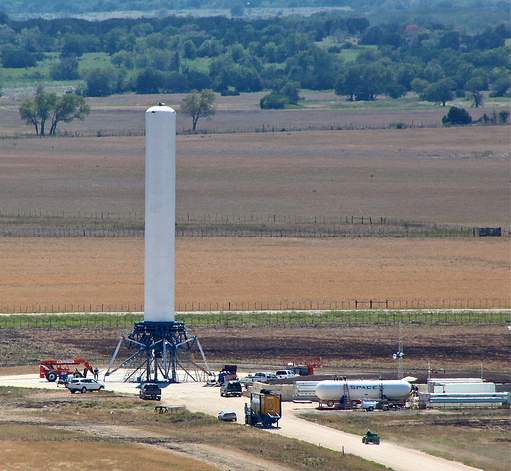
The earliest prototype was Grasshopper. It was announced in 2011[4] and began low-altitude, low-velocity hover/landing testing in 2012. Grasshopper was 106 ft (32 m) tall and made eight successful test flights in 2012 and 2013 before being retired. A second prototype of Falcon 9 was the larger and more capable Falcon 9 Reusable Development Vehicle (F9R Dev, also known as F9R Dev1) based on the Falcon 9 v1.1 launch vehicle. It was tested at higher altitudes and was capable of much higher velocity but was never tested at high velocity. The F9R Dev1 vehicle was built in 2013–2014 and made its first low-altitude flight test on 17 April 2014; it was lost during a three-engine test at the McGregor test site on 22 August 2014,[5] which ended the low-velocity test program. Further expansion of the flight test envelope for the reusable rocket was moved to descending Falcon 9 boosters that had been used on orbital flight trajectories on commercial orbital flights of the Falcon 9.
The Grasshopper and F9R Dev tests were fundamental to the development of the reusable Falcon 9 and Falcon Heavy rockets, which require vertical landings of the near-empty Falcon 9 and Falcon Heavy first-stage booster tanks and engine assemblies. The Grasshopper and the F9R Dev tests led into a series of high-altitude, high-speed controlled-descent tests of post-mission (spent) Falcon 9 booster stages that accompanied the commercial Falcon 9 missions since September 2013. The latter eventually resulted in the first successful booster landing on 21 December 2015.
History
[edit]
Grasshopper first became known publicly in the third quarter of 2011, when space journalists first wrote about it after analyzing space launch regulations of the Federal Aviation Administration.[1]
Shortly thereafter, SpaceX confirmed the existence of the test vehicle development program, and projected it would begin the Grasshopper flight test program in 2012.[4][6]
Releases of public information in 2011 indicated that the subsonic tests would occur in McGregor, Texas in three phases, at maximum flight altitudes of 670 to 11,500 ft (200 to 3,510 m), for durations of 45 to 160 s (0.75 to 2.67 min). At the time, testing was expected to take up to three years and the initial FAA permit allows up to 70 suborbital launches per year.[1][7] A half-acre concrete launch facility was constructed to support the test flight program.[6] In September 2012, SpaceX announced that they have requested FAA approval to increase the altitude of some of the initial test flights.[8] Looking forward to the next year, CEO Musk said in November 2012: "Over the next few months, we'll gradually increase the altitude and speed. ... I do think there probably will be some craters along the way; we'll be very lucky if there are no craters. Vertical landing is an extremely important breakthrough — extreme, rapid reusability."[9]
In May 2013, SpaceX announced that the higher-altitude, higher-velocity part of the Grasshopper flight test program would be done at Spaceport America near Las Cruces, New Mexico—and not at the Federal Government's adjacent White Sands Missile Range facility as previously planned[3][10][11][12]—and signed a three-year lease for land and facilities at the recently operational spaceport.[11] SpaceX indicated in May 2013 that they did not yet know how many jobs might move from Texas to New Mexico.[13]
SpaceX began constructing a 30 m × 30 m (98 ft × 98 ft) pad at Spaceport America in May 2013, 7 km (4.3 mi) southwest of the spaceport's main campus, planning to lease the pad for US$6,600 per month plus US$25,000 per test flight.[14]
Description
[edit]Grasshopper
[edit]Grasshopper consisted of "a Falcon 9 [v1.0] first-stage tank, a single Merlin-1D engine" with a height of 32 m (106 ft).[1] The landing gear was fixed.
As Elon Musk stated, Grasshopper could land on Earth with the accuracy of a helicopter.[15]
F9R Dev1
[edit]F9R Dev1 was constructed out of the used first-stage tank of the Falcon 9 v1.1,[16] it was 160-foot tall,[17] nearly 50% longer than the first Grasshopper.[18] The landing legs were retractable by design, with a telescoping piston mounted on an A-frame. The total span of the four legs was approximately 18 m (60 ft) and the weight less than 2,100 kg (4,600 lb); the deployment system used high-pressure helium.[19] The legs had less weight than on the first Grasshopper. The F9R Dev1 had a different engine bay than the first Grasshopper vehicle.[18]
The F9R Dev1 vehicle in Texas was intended to take off and accelerate with three engines—as the test flight never needs the full thrust to take off a fully loaded Falcon 9 with an orbital payload—while completing the descent and landing with only one engine.[20] The original Grasshopper had flown exclusively with only a single Merlin 1D engine in place, the center engine which is now used to complete the last phase of the deceleration and vertical landing on full-scale Falcon 9 rockets.
F9R Dev2 (never flown)
[edit]A third flight test vehicle—F9R Dev2—was initially planned to be flown only at the high-altitude test range at Spaceport America[11][2] and at altitudes of up to 91,000 meters (300,000 ft).[17][21][16] In September 2014, following the destruction of the F9R Dev1, SpaceX changed the plans, so the F9R Dev2 vehicle would fly first in McGregor for low-altitude testing. The initial FAA permit to fly the Falcon 9 Reusable Development Vehicle at McGregor in Texas was open until February 2015.[22]
On 19 February 2015 SpaceX announced that the F9R Dev2 would be discontinued.[23]
During April 2015, SpaceX performed tanking tests on the In-Flight Abort rocket on the Vandenberg Air Force Base SLC-4E. Since this rocket only had three Merlin 1D engines, and the New Mexico site was to have been used for testing the returned first stages, it was speculated that the discontinued F9R Dev2 was re-purposed as the launch vehicle in the In-Flight Abort Test.[24]
In May 2015, a press article stated that due to the technical success of many aspects of the booster rocket landing attempts on the sea and on the ASDS, SpaceX was planning on using the New Mexico site for testing the returned stages.[25][26]
Flight testing
[edit]Grasshopper flight tests
[edit]The first Falcon 9 prototype, Grasshopper, made a total of eight test flights between September 2012 and October 2013.[27] All eight flights were from the McGregor, Texas test facility.
Grasshopper began flight testing in September 2012 with a brief, three-second hop, followed by a second hop in November 2012 with an 8-second flight that took the testbed approximately 5.4 m (18 ft) off the ground, and a third flight in December 2012 of 29 seconds duration, with extended hover under rocket engine power, in which it ascended to an altitude of 40 m (130 ft) before descending under rocket power to come to a successful vertical landing.[28] Grasshopper made its eighth, and final, test flight on October 7, 2013, flying to an altitude of 744 m (2,441 ft) before making its eighth successful vertical landing.[29] The Grasshopper test vehicle is now retired.[27]
Flight tests at the Texas facility were limited to a maximum altitude of 2,500 ft (760 m) by the initial FAA regulatory permit.[30]
| # | Date (y-m-d) | Highest altitude | Duration | Video | Remarks |
|---|---|---|---|---|---|
| 1 | 2012-09-21[10] | 1.8 m (6 ft)[10] | 3s[10] | [31] | A "brief hop"[32] with a near-empty tank. |
| 2 | 2012-11-01[33] | 5.4 m (17.7 ft)[33] | 8s[33] | [33] | |
| 3 | 2012-12-17[34] | 40 m (131 ft)[34] | 29s[34] | [35] | First flight to include the cowboy mannequin |
| 4 | 2013-03-07[36] | 80 m (262 ft)[37] | 34s[37] | [38] | Touchdown thrust-to-weight ratio greater than one[39] |
| 5 | 2013-04-17[40] | 250 m (820 ft)[40] | 58s | [41] | Demonstrated ability to maintain stability in wind[42] |
| 6 | 2013-06-14[43] | 325 m (1,070 ft)[43] | 68s[44] | [45] | New navigation sensor suite tested; needed on the F9-R for precision landing[46] |
| 7 | 2013-08-13[47] | 250 m (820 ft)[47] | 60s | [48] | Successfully completed a "divert test" performing 100 m (330 ft) lateral maneuver before returning to the pad.[47] |
| 8 | 2013-10-07[49] | 744 m (2,440 ft)[50] | 79s[51] | [50] | Final flight of Grasshopper. Vehicle retired after the flight.[27] |
From the announcement in 2011 until 2014, SpaceX has achieved each of the schedule milestones that they publicly announced. SpaceX said in February 2012 that they were planning several vertical-takeoff, vertical-landing (VTVL) test flights during 2012,[3] and confirmed in June 2012 that they continued to plan to make the first test flight within the next couple of months.[6]
F9R Dev1 flight tests
[edit]The Falcon 9 Reusable Development Vehicle, or F9R Dev, was announced in October 2012. F9R Dev1 was initially named, since late 2012 until early 2014, as Grasshopper v1.1.[17][29] In March 2013 Musk said that SpaceX hoped to reach hypersonic speed before the end of 2013.[52] In March 2013, it was announced that the second Grasshopper-class suborbital flight vehicle would be constructed out of the Falcon 9 v1.1 first-stage tank that had been used for qualification testing in Texas at the SpaceX Rocket Development and Test Facility prior to March.[16]
In 2014, the FAA permit was increased to 10,000 ft (3,000 m) for the F9R Dev testing at McGregor,[21] when the first Grasshopper was limited to an altitude of 2,500 ft (760 m).
The F9R Dev1 was built on the much longer Falcon 9 v1.1 first stage tanks, and with retractable landing legs.
SpaceX performed a short-duration ground test (static test) of F9R Dev1 on March 28, 2014, at their McGregor, Texas test site,[53] and made their maiden test flight of the new vehicle, to an altitude of 250 meters (820 ft), on April 17, 2014.[21][20] The F9R Dev1 flew for the fifth and last time on August 22, 2014.[17][54] During this flight, anomalous sensor data from the vehicle during its ascent caused the rocket to deviate from nominal flight trajectory, prompting its flight termination system to end the mission by neutralizing the vehicle. No injuries or near-injuries were reported following the breakup of F9R Dev1 and an FAA representative was present during the test. Video from the accident was released by CBS and multiple images from the accident were posted on social media.[5][55]
| Test # | Date (year-month-day) | Test vehicle | Location | Highest altitude | Video | Remarks |
|---|---|---|---|---|---|---|
| 1 | 2014-04-17[17] | F9R Dev1 | McGregor | 250 m (820 ft)[17] | [56] | Hovered, moved sideways, landed successfully.[20] |
| 2 | 2014-05-01[57] | F9R Dev1 | McGregor | 1,000 m (3,280 ft)[58] | [58] | Hovered, moved sideways, landed.[57] |
| 3 | 2014-06-17 | F9R Dev1 | McGregor | 1,000 m (3,280 ft)[59] | [59] | First test flight with steerable grid fins.[59] |
| 4 | 2014-08-01[60] | F9R Dev1 | McGregor | No public information was provided by SpaceX about this flight.[61] | ||
| 5 | 2014-08-22[60] | F9R Dev1 | McGregor | [62][63] | Vehicle was destroyed following a flight anomaly that began to take F9R Dev1 off of its planned flight path. No injuries.[54][64] A blocked sensor was the cause of the anomaly. The sensor had no backup in the prototype F9R Dev vehicle but flight-rated Falcon 9 rockets do have a redundant backup.[65] First activation of an autonomous flight termination system on a US rocket.[66] |
Falcon 9 post-mission landing tests
[edit].jpg)
In 2013, SpaceX moved to using their mainstream Falcon 9 vehicles for VTVL testing, in addition to their existing tests with flying test vehicles. In March 2013, SpaceX announced that, beginning with the first flight of the stretch version of the Falcon 9 launch vehicle—the sixth flight overall of Falcon 9 (then anticipated for summer 2013), every first stage would be instrumented and equipped as a controlled descent test vehicle.[67] SpaceX attempted numerous over-water landings, both over the sea, resulting in soft landings into the water, and onto specialized Autonomous Spaceport Drone Ships, barges modified to be landing platforms. None were completely successful.
SpaceX eventually succeeded in landing a production vertical-landing rocket on land in late 2015. The first attempt to land the first stage of the Falcon 9 on land, near its launch site, occurred on Falcon 9 Flight 20, on 21 December 2015. The landing was successful, and the first stage of the Falcon 9 Full Thrust vehicle was recovered.[68][69][70] By May 27, 2016, SpaceX had successfully completed three first-stage landings on a drone ship at sea.[71]
See also
[edit]
- SpaceX launch vehicles – Launch vehicles developed and operated by SpaceX
- List of Falcon 9 first-stage boosters
- Kankoh-maru – Japanese orbital vehicle design
- McDonnell Douglas DC-X – Prototype single-stage-to-orbit rocket developed & flown between 1991-1996
- New Shepard – Rocket developed by Blue Origin
- Quad (rocket) – VTVL technology demonstrator
- Reusable Vehicle Testing – Japanese reusable rocket testing project
- SpaceX reusable launch system development program – Effort by SpaceX to make rockets that can fly multiple times
References
[edit]- ^ a b c d Mohney, Doug (2011-09-26). "SpaceX Plans to Test Reusable Suborbital VTVL Rocket in Texas". Satellite Spotlight. Archived from the original on 2016-08-04. Retrieved 2012-12-30.
- ^ a b Shotwell, Gwynne (June 4, 2014). Discussion with Gwynne Shotwell, President and COO, SpaceX. Atlantic Council. Event occurs at 22:35–26:20. Archived from the original on January 25, 2017. Retrieved June 9, 2014.
This technology element [reusable launch vehicle technology] all this innovation is being done by SpaceX alone, no one is paying us to do it. The government is very interested in the data we are collecting on this test series. ... This is the kind of thing that entrepreneurial investment and new entrants/innovators can do for an industry: fund their own improvements, both in the quality of their programs and the quality of their hardware, and the speed and cadence of their operations.
- ^ a b c Simberg, Rand (2012-02-08). "Elon Musk on SpaceX's Reusable Rocket Plans". Popular Mechanics. Archived from the original on 2012-02-11. Retrieved 2012-02-07.
- ^ a b Lindsey, Clark (2011-10-12). "Grasshopper news". RLV and Space Transport News. Archived from the original on 2011-11-18. Retrieved 2011-11-23.
- ^ a b Musk, Elon [@elonmusk] (23 August 2014). "Three engine F9R Dev1 vehicle auto-terminated during test flight. No injuries or near injuries. Rockets are tricky …" (Tweet). Archived from the original on 28 March 2023. Retrieved 17 April 2023 – via Twitter.
- ^ a b c "Reusable rocket prototype almost ready for first liftoff". Spaceflight Now. 2012-07-09. Archived from the original on 2016-11-16. Retrieved 2012-07-13.
SpaceX has constructed a half-acre concrete launch facility in McGregor, and the Grasshopper rocket is already standing on the pad, outfitted with four insect-like silver landing legs.
- ^ "Draft Environmental Assessment for Issuing an Experimental Permit to SpaceX for Operation of the Grasshopper Vehicle at the McGregor Test Site, Texas" (PDF). Federal Aviation Administration. 2011. Archived (PDF) from the original on 2013-01-12. Retrieved 2011-11-24.
- ^ Lindsey, Clark (2012-09-17). "SpaceX Grasshopper tests aim to quickly move up in altitude". NewSpace Watch. Archived from the original on 2014-09-28. Retrieved 2012-09-17.
- ^ Coppinger, Rod (2012-11-23). "Huge Mars Colony Eyed by SpaceX Founder Elon Musk". Space.com. Archived from the original on 2013-06-28. Retrieved 2012-11-25.
- ^ a b c d Clark, Stephen (2012-09-24). "SpaceX's reusable rocket testbed takes first hop". Spaceflightnow. Archived from the original on 2012-09-27. Retrieved 2012-09-25.
- ^ a b c Lindsey, Clark (2013-05-07). "SpaceX to test Grasshopper reusable booster at Spaceport America in NM". NewSpace Watch. Archived from the original on 2015-01-18. Retrieved 2013-05-07.
- ^ "Reusable rocket prototype almost ready for first liftoff". Spaceflightnow.com. 2012. Archived from the original on 2016-11-16. Retrieved 2012-05-12.
- ^ Abbot, Joseph (2013-05-07). "SpaceX moving Grasshopper testing to New Mexico". Waco Tribune. Archived from the original on 2017-12-31. Retrieved 2013-05-08.
- ^ Leone, Dan (2013-05-13). "SpaceX Leases Pad in New Mexico for Next Grasshopper Tests". SpaceNews. Archived from the original on September 3, 2013. Retrieved 2013-08-03.
- ^ "Musk's Space Talk Wows Crowd at South by Southwest". Moon and Back. 2013-03-11. Archived from the original on 2013-03-13. Retrieved 2013-03-11.
- ^ a b c "Spacex May try to land or recover the first stage of it next Falcon 9 v1.1 launch this summer". Next Big Future. 2013-03-23. Archived from the original on 2013-03-27. Retrieved 2013-04-06.
- ^ a b c d e f Bergin, Chris (2014-04-22). "Rockets that return home – SpaceX pushing the boundaries". NASAspaceflight.com. Archived from the original on 2014-04-25. Retrieved 2014-04-23.
- ^ a b "A 2nd-gen Grasshopper + A new video of first hop". NewSpace Watch. 2012-10-02. Archived from the original on January 4, 2013. Retrieved 2012-11-04.
- ^ Lindsey, Clark (2013-05-02). "SpaceX shows a leg for the "F-niner"". Archived from the original on 2013-05-25. Retrieved 2013-05-02.
F9R (pronounced F-niner) shows a little leg. Design is a nested, telescoping piston w A frame... High pressure helium. Needs to be ultra light.
- ^ a b c Abbott, Joseph (2014-04-17). "Grasshopper's successor flies at SpaceX's McGregor site". Waco Tribune. Retrieved 2014-04-18.
- ^ a b c Norris, Guy (2014-04-28). "SpaceX Plans For Multiple Reusable Booster Tests: Controlled water landing marks a major stride toward SpaceX's Falcon rapid-reusability goal". Aviation Week. Archived from the original on 2014-04-26. Retrieved 2014-04-26.
The April 17 F9R Dev 1 flight, which lasted under 1 min., was the first vertical landing test of a production-representative recoverable Falcon 9 v1.1 first stage, while the April 18 cargo flight to the ISS was the first opportunity for SpaceX to evaluate the design of foldable landing legs and upgraded thrusters that control the stage during its initial descent.
- ^ "Commercial Space Data / Active Permits". FAA Data & Research. U.S. Federal Aviation Administration. Archived from the original on May 2, 2014. Retrieved 2014-04-23.
Permit no. EP 14-010, Company: Space Exploration Technologies Corporation, Vehicle: Falcon 9-R, Location: Texas, Expiration: Feb 26, 2015
- ^ Klotz, Irene (19 February 2015). "SpaceX bypassing replacement for lost Falcon 9R landing test vehicle". Portal to the Universe. Archived from the original on 14 March 2018. Retrieved 13 March 2018 – via SEN.
- ^ Bergin, Chris (2015-04-10). "SpaceX conducts tanking test on In-Flight Abort Falcon 9". nasaspaceflight.com. Archived from the original on 2015-05-04. Retrieved 2015-05-10.
- ^ Bergin, Chris (2015-03-19). "Spaceport America set for SpaceX reusability testing". nasaspaceflight.com. Archived from the original on 2015-05-13. Retrieved 2015-05-12.
- ^ Abbott, Joseph (2014-09-12). "SpaceX updates: Launch moved to Sept. 20; new test rocket may arrive in 2 months". Waco Tribune. Archived from the original on 2018-12-31. Retrieved 2014-09-13.
- ^ a b c Klotz, Irene (2013-10-17). "SpaceX Retires Grasshopper, New Test Rig To Fly in December". Space News. Archived from the original on October 21, 2013. Retrieved 2013-10-21.
- ^ Boyle, Alan (2012-12-24). "SpaceX launches its Grasshopper rocket on 12-story-high hop in Texas". MSNBC Cosmic Log. Archived from the original on 2016-03-03. Retrieved 2012-12-30.
- ^ a b "Grasshopper flies to its highest height to date". Social media information release. SpaceX. 12 October 2013. Archived from the original on 17 January 2016. Retrieved 14 October 2013.
WATCH: Grasshopper flies to its highest height to date - 744 m (2441 ft) into the Texas sky. http://youtu.be/9ZDkItO-0a4 This was the last scheduled test for the Grasshopper rig; next up will be low altitude tests of the Falcon 9 Reusable (F9R) development vehicle in Texas followed by high altitude testing in New Mexico.
- ^ Abbott, Joseph (2013-05-08). "SpaceX's Grasshopper leaping to NM spaceport". Waco Tribune. Archived from the original on 2017-08-24. Retrieved 2013-10-25.
- ^ Grasshopper Takes Its First Hop / 9-21-12. SpaceX. 24 September 2012. Archived from the original on 14 November 2022. Retrieved 17 April 2023 – via YouTube.
- ^ Lindsey, Clark (2012-09-22). "SpaceX Grasshopper vertical takeoff/vertical landing rocket first test". NewSpace Watch. Archived from the original on 2020-06-10. Retrieved 2012-09-23.
- ^ a b c d Grasshopper Two-Story Hop 11/1/12. SpaceX. 5 November 2012. Archived from the original on 13 January 2023. Retrieved 17 April 2023 – via YouTube.
- ^ a b c "Grasshopper hops ever higher". NewSpace Journal. 24 December 2012. Archived from the original on 1 June 2013. Retrieved 25 December 2012.
- ^ Single Camera: Grasshopper 12-Story Test Flight 12/17/12. SpaceX. 24 December 2012. Archived from the original on 15 January 2023. Retrieved 17 April 2023 – via YouTube.
- ^ "FAA Permitted Launches". Federal Aviation Administration. 8 March 2013. Archived from the original on 6 March 2013. Retrieved 9 March 2013.
- ^ a b "More on Grasshopper's "Johnny Cash hover slam" test". NewSpace Journal. 9 March 2013. Archived from the original on 15 May 2013. Retrieved 9 March 2013.
- ^ Grasshopper 24-Story Hover Slam 3/7/13 | Single Angle. SpaceX. 12 March 2013. Archived from the original on 22 March 2021. Retrieved 17 April 2023 – via YouTube.
- ^ "GRASSHOPPER COMPLETES HIGHEST LEAP TO DATE". 10 March 2013. Archived from the original on 29 April 2013. Retrieved 25 April 2013.
- ^ a b Lindsey, Clark (2013-04-13). "SpaceX Grasshopper reaches 250 meters". NewSpace Watch. Archived from the original on 2013-04-29. Retrieved 2013-04-23.
- ^ Grasshopper 250m Test | Single Camera (Hexacopter). SpaceX. 23 April 2013. Archived from the original on 8 April 2023. Retrieved 17 April 2023 – via YouTube.
- ^ Musk, Elon [@elonmusk] (23 April 2013). "Grasshopper rocket flies up 250m, holds against wind and lands. Vid taken from our hexacopter http://t.co/LXmMCYDD0e" (Tweet). Archived from the original on 26 January 2023. Retrieved 17 April 2023 – via Twitter.
- ^ a b Bergin, Chris (14 June 2013). "Testing times for SpaceX's new Falcon 9 v.1.1". NASASpaceFlight (not affiliated with NASA). Archived from the original on 20 July 2013. Retrieved 15 June 2013.
- ^ Bergin, Chris (20 June 2013). "Reducing risk via ground testing is a recipe for SpaceX success". NASASpaceFlight (not affiliated with NASA). Archived from the original on 18 January 2017. Retrieved 21 June 2013.
- ^ Grasshopper 325m Test | Single Camera (Hexacopter). SpaceX. 6 July 2013. Archived from the original on 10 February 2023. Retrieved 17 April 2023 – via YouTube.
- ^ "VIDEO - Grasshopper 325-meter Test". SpaceNews.com. 8 July 2013. Retrieved 5 December 2022.
- ^ a b c Boyle, Alan (2013-08-14). "SpaceX's Grasshopper test rocket flies sideways successfully". NBC News. Archived from the original on 2013-08-17. Retrieved 2013-08-15.
- ^ Grasshopper Divert | Single Cam (Grasshopper vs. Cows). SpaceX. 8 September 2013. Archived from the original on 7 February 2023. Retrieved 17 April 2023 – via YouTube.
- ^ Kelly, Mackenzie [@mkelly007] (7 October 2013). "A friend in Mcgregor, Texas sent me this photo of a Space X rocket launch that happened earlier today. #spaceX http://t.co/B5zX6JIIAh" (Tweet). Archived from the original on 7 January 2022. Retrieved 17 April 2023 – via Twitter.
- ^ a b Grasshopper 744m Test | Single Camera (Hexacopter). SpaceX. 12 October 2013. Archived from the original on 14 March 2023. Retrieved 17 April 2023 – via YouTube.
- ^ Post, Hannah (16 October 2013). "Grasshopper Completes Half-Mile Flight in Last Test". Spacex.com. Archived from the original on 9 October 2018. Retrieved 9 October 2018.
- ^ Lindsey, Clark (2013-03-09). "Elon Musk debuted video of latest Grasshopper flight at SXSW". NewSpace Watch. Archived from the original on 2020-06-10. Retrieved 2013-03-14.
- ^ Malik, Tariq (2014-04-14). "SpaceX to Attempt Daring Reusable Rocket Test During Dragon Launch Today". SpaceNews. Archived from the original on 2014-04-14. Retrieved 2014-04-15.
- ^ a b Foust, Jeff (2014-08-23). "Falcon 9 test vehicle destroyed in accident". NewSpace Journal. Archived from the original on 2014-08-25. Retrieved 2014-08-23.
- ^ Stephen Clark (2014-08-22). "SpaceX rocket prototype explodes in test flight". Spaceflight Now. Archived from the original on 2014-08-25. Retrieved 2014-08-23.
- ^ F9R First Flight Test | 250m. SpaceX. 18 April 2014. Archived from the original on 5 February 2023. Retrieved 17 April 2023 – via YouTube.
- ^ a b Abbott, Joseph (2014-05-01). "SpaceX's Grasshopper successor flies again". Waco Tribune. Archived from the original on 2018-10-10. Retrieved 2014-05-02.
- ^ a b F9R Flight Test | 1,000m. SpaceX. 2 May 2014. Archived from the original on 9 January 2023. Retrieved 17 April 2023 – via YouTube.
- ^ a b c F9R 1000m Fin Flight | Onboard Cam and Wide Shot. SpaceX. 19 June 2014. Archived from the original on 13 January 2023. Retrieved 17 April 2023 – via YouTube.
- ^ a b "Commercial Space Data - Launches". Federal Aviation Administration. Archived from the original on 2014-08-10. Retrieved 2014-08-02.
Dates of Grasshopper launches
- ^ "SpaceX - F9R Development Updates". Spaceflight101. Archived from the original on 10 October 2018. Retrieved 9 October 2018.
- ^ SpaceX F9R Auto-termination explosion during test flight. Gunrun. 23 August 2014. Archived from the original on 5 April 2023. Retrieved 17 April 2023 – via YouTube.
- ^ How Not to Land an Orbital Rocket Booster, 14 September 2017, retrieved 2023-05-07
- ^ Harwood, William (August 22, 2014). "SpaceX rocket explodes during test flight in Texas". CBS News. Archived from the original on October 10, 2014. Retrieved September 28, 2014.
- ^ Dean, James (2014-08-03). "SpaceX targeting Saturday launch from Cape". Florida Today. Retrieved 2014-08-03.
- ^ Bergin, Chris (2014-08-26). "SpaceX makes late call to delay ASIASAT-6 launch". NASASpaceFlight.com. Retrieved 2023-05-07.
- ^ Lindsey, Clark (2013-03-28). "SpaceX moving quickly towards fly-back first stage". NewSpace Watch. Archived from the original on 2013-04-16. Retrieved 2013-03-29.
- ^ SpaceX [@SpaceX] (22 December 2015). "The Falcon 9 first stage landing is confirmed. Second stage continuing nominally. https://t.co/RX2QKSl0z7" (Tweet). Archived from the original on 26 March 2023. Retrieved 17 April 2023 – via Twitter.
- ^ "Wow! SpaceX Lands Orbital Rocket Successfully in Historic First". Space.com. 22 December 2015. Archived from the original on 28 November 2018. Retrieved 9 October 2018.
- ^ de Selding, Peter B. (2015-10-16). "SpaceX Changes its Falcon 9 Return-to-flight Plans". SpaceNews. Archived from the original on 16 October 2015. Retrieved 8 November 2015.
- ^ Kramer, Miriam (27 May 2016). "SpaceX does it again: Company lands third rocket on drone ship in the ocean". Mashable. Archived from the original on 11 June 2016. Retrieved 10 June 2016.
External links
[edit]

- Collected videos
- Video of 1st test launch, 21 September 2012
- Video of 2nd test launch, 1 November 2012
- Video of 3rd test launch H=40m, 17 December 2012
- Video of 4th test launch H=80m, 8 March 2013
- Video of 5th test launch H=250m, 17 April 2013
- Video of 6th test launch H=325m, 14 June 2013
- Video of 7th test launch H=250m L=100m, 13 August 2013
- Video of 8th test launch H=744m, 7 October 2013. Final Grasshopper test flight.
- Video of 9th test launch H=250m, 17 April 2014. First F9R Dev1 test flight.
- Video of 10th test launch H=1000m, 1 May 2014
- Video of 13th test launch, 22 August 2014. Final flight of F9R Dev1 as vehicle was destroyed after an anomaly occurred during the test flight.
- Steve Jurvetson personal comments on the destruction of F9R Dev1, 23 September 2014, SPARK 2014 Keynote address, @58:05. Jurvetson is a SpaceX board member and was present for the flight test on 22 August 2014.
| Launch vehicles |
| ||||||||
|---|---|---|---|---|---|---|---|---|---|
| Spacecraft |
| ||||||||
| Test vehicles |
| ||||||||
| Rocket engines | |||||||||
| Lists of missions | |||||||||
| Launch facilities | |||||||||
| Landing sites |
| ||||||||
| Other facilities | |||||||||
| Support |
| ||||||||
| Contracts | |||||||||
| R&D programs | |||||||||
| Key people |
| ||||||||
| Related | |||||||||
* denotes unflown vehicles or engines, and future missions or sites. † denotes failed missions, destroyed vehicles, and abandoned sites.
| |||||||||

Falcon 9 prototypes
View on GrokipediaDevelopment Background
Program Origins
SpaceX was founded in May 2002 by Elon Musk with the goal of reducing the cost of space travel through the development of reusable rocket technology, beginning with the expendable two-stage Falcon 1 launch vehicle designed for small satellite deployment to low Earth orbit.[8][9] The Falcon 1, powered by the Merlin engine in its first stage and the Kestrel engine in its second, represented SpaceX's initial effort to create a reliable, low-cost orbital rocket using off-the-shelf components and in-house manufacturing to compete with established aerospace firms.[10] Following the Falcon 1's first successful orbital flight on September 28, 2008—the first achieved by a privately developed liquid-fueled rocket—SpaceX began pivoting toward reusability to further drive down launch costs and enable ambitious goals like Mars colonization.[11] This shift was influenced by earlier experimental programs, notably NASA's DC-X (Delta Clipper-Experimental) from the mid-1990s, a suborbital prototype that successfully demonstrated vertical takeoff, horizontal flight, and vertical landing using RL10A-5 engines and composite materials.[12][13] The DC-X's rapid development cycle and proof-of-concept for single-stage reusability informed SpaceX's strategy, emphasizing iterative testing over traditional expendable designs despite the engineering challenges this imposed on the Falcon program.[14] In September 2011, SpaceX announced the Grasshopper project as a dedicated, low-cost VTOL testbed to validate reusable first-stage technologies for future Falcon rockets, building on the Merlin engine lineage that originated with Falcon 1.[15] Early Merlin prototypes, first static-fired in March 2003 at the McGregor test facility, provided the foundational propulsion system, achieving initial thrust levels of around 60,000 pounds while undergoing iterative improvements for reliability.[16][17] Constrained by private funding sources—including Musk's personal investments and venture capital—SpaceX adopted simplified prototype architectures to minimize development costs and accelerate validation of reusability, avoiding the high expenses of full-scale orbital vehicles during early experimentation.[9][14] This lean approach, reliant on surplus hardware and modular designs, allowed rapid prototyping under financial pressures that nearly bankrupted the company prior to the 2008 Falcon 1 success.[9]Reusability Objectives
The primary goal of the Falcon 9 prototype program was to demonstrate controlled vertical landings of the first-stage booster to enable its recovery and reuse after launch, fundamentally aiming to lower the overall cost of space access by reflying the most expensive component of the rocket. This reusability approach sought to reduce per-launch expenses from around $60 million for expendable flights to a fraction of that through multiple uses of the same hardware, with SpaceX projecting significant savings by avoiding the need to manufacture new boosters for each mission.[18][19] Secondary objectives included validating key technologies essential for precise booster control during descent and landing, such as cold gas thrusters for attitude adjustments and autonomous guidance software to manage the trajectory without ground intervention. Cold gas thrusters, utilizing pressurized nitrogen, provided reliable, low-complexity control for pointing and roll during the booster's return, complementing the main Merlin engines. The autonomous software handled real-time navigation, ensuring stability through phases like boost-back burns and entry. These elements were tested iteratively to integrate seamlessly with the full Falcon 9 architecture.[8][20] The program specifically addressed engineering challenges inherent to propulsive landings, including managing high dynamic pressure environments during atmospheric reentry, achieving precise throttle modulation of Merlin engines for stable hover and touchdown, and executing landings without parachutes to enable pinpoint accuracy and rapid turnaround. Early experiments, such as those with the Grasshopper prototype, served as subscale validations before scaling to full-size implementations on operational boosters. Economically, the reusability focus targeted at least 10 reuses per booster to drive costs down to approximately $1,000 per kilogram to low Earth orbit, a dramatic improvement over the $10,000+ per kilogram typical for expendable launchers at the time.[21][20][22]Grasshopper Prototype
Design and Specifications
The Grasshopper prototype featured a single-stage structure measuring 32 m (106 ft) in height, incorporating the tankage from the Falcon 9 v1.0 first stage.[23] This configuration allowed for suborbital testing of vertical takeoff and landing (VTVL) maneuvers while maintaining compatibility with core Falcon 9 hardware elements, such as carbon-overwrapped pressure vessels (COPVs) for pressurization.[23] Propulsion was provided by a single Merlin 1D engine, delivering sea-level thrust of approximately 650 kN (147,000 lbf) and capable of throttling between 50% and 100% to enable precise descent control.[24] The vehicle used RP-1 (refined kerosene) and liquid oxygen (LOX) as propellants, stored in the shared tankage, with a pressurant system employing nitrogen or helium to inert the tanks and maintain structural integrity during flight.[23] Guidance and control systems included four nitrogen-fed cold gas thrusters for attitude adjustments, supplemented by GPS and inertial navigation (INS) for positioning and trajectory management; steering during early operations relied on gimbaling of the main engine, without the addition of grid fins.[25] The landing system comprised four fixed steel legs, initially requiring manual deployment, which provided stable support upon touchdown.[23] In contrast to the operational Falcon 9, Grasshopper represented a subscale testbed with only one engine instead of nine, omitting the upper stage and payload fairing to prioritize reusability validation over orbital capability.[23]Flight Test Campaign
The Grasshopper flight test campaign took place at SpaceX's McGregor, Texas facility, beginning in September 2012 and spanning approximately 13 months.[23] The series consisted of eight progressively ambitious vertical takeoff and landing (VTVL) demonstrations, all successful with no failures, aimed at validating the vehicle's ability to perform controlled ascents, hovers, and descents while collecting data on key reusability elements such as thrust vector control, aerodynamic stability, and autonomous guidance software.[26][27] The campaign began with short, low-altitude hops to confirm basic liftoff and landing capabilities. The first flight on September 21, 2012, achieved a brief 3-second hover at 1.8 meters, demonstrating initial systems integration.[28] The second, on November 1, 2012, extended to 8 seconds at 5.4 meters, incorporating a short hover phase. Subsequent tests rapidly scaled in height and duration: the third on December 17, 2012, reached 40 meters for 29 seconds, marking the first inclusion of a test mannequin to simulate payload effects.[29] By March 7, 2013, the fourth flight hovered at 80 meters for 34 seconds, achieving a touchdown thrust-to-weight ratio exceeding one for enhanced landing control.[30] Advancements continued with the fifth flight on April 17, 2013, climbing to 250 meters over 58 seconds while testing stability in windy conditions. The sixth, on June 14, 2013, attained 325 meters in 68 seconds, validating a new navigation sensor suite essential for precise landings.[3] The seventh flight on August 13, 2013, returned to 250 meters for about 60 seconds but introduced a divert maneuver, shifting laterally 100 meters mid-flight before centering on the pad.[31] The campaign culminated on October 7, 2013, with the eighth and final flight reaching a record 744 meters in 79 seconds, after which Grasshopper was retired in favor of more advanced prototypes.[5] These tests provided foundational data for subsequent Falcon 9 recovery efforts, confirming the feasibility of propulsive landings without reliance on extensive ground infrastructure.[26]| Flight | Date | Altitude | Duration | Remarks |
|---|---|---|---|---|
| 1 | Sep 21, 2012 | 1.8 m | 3 s | Initial systems check with near-empty tank.[28] |
| 2 | Nov 1, 2012 | 5.4 m | 8 s | First hover demonstration. |
| 3 | Dec 17, 2012 | 40 m | 29 s | Included test mannequin; steady ascent/descent.[29] |
| 4 | Mar 7, 2013 | 80 m | 34 s | Touchdown TWR >1; doubled prior height.[30] |
| 5 | Apr 17, 2013 | 250 m | 58 s | Wind stability validation. |
| 6 | Jun 14, 2013 | 325 m | 68 s | Tested new navigation sensors.[3] |
| 7 | Aug 13, 2013 | 250 m | 60 s | 100 m lateral divert and recenter.[31] |
| 8 | Oct 7, 2013 | 744 m | 79 s | Record height; vehicle retired post-flight.[5] |