Hubbry Logo
Rocket CargoRocket CargoMain
Open search
Rocket Cargo
Community hub
Rocket Cargo
logo
8 pages, 0 posts
0 subscribers
Be the first to start a discussion here.
Rocket Cargo
Rocket Cargo
from Wikipedia

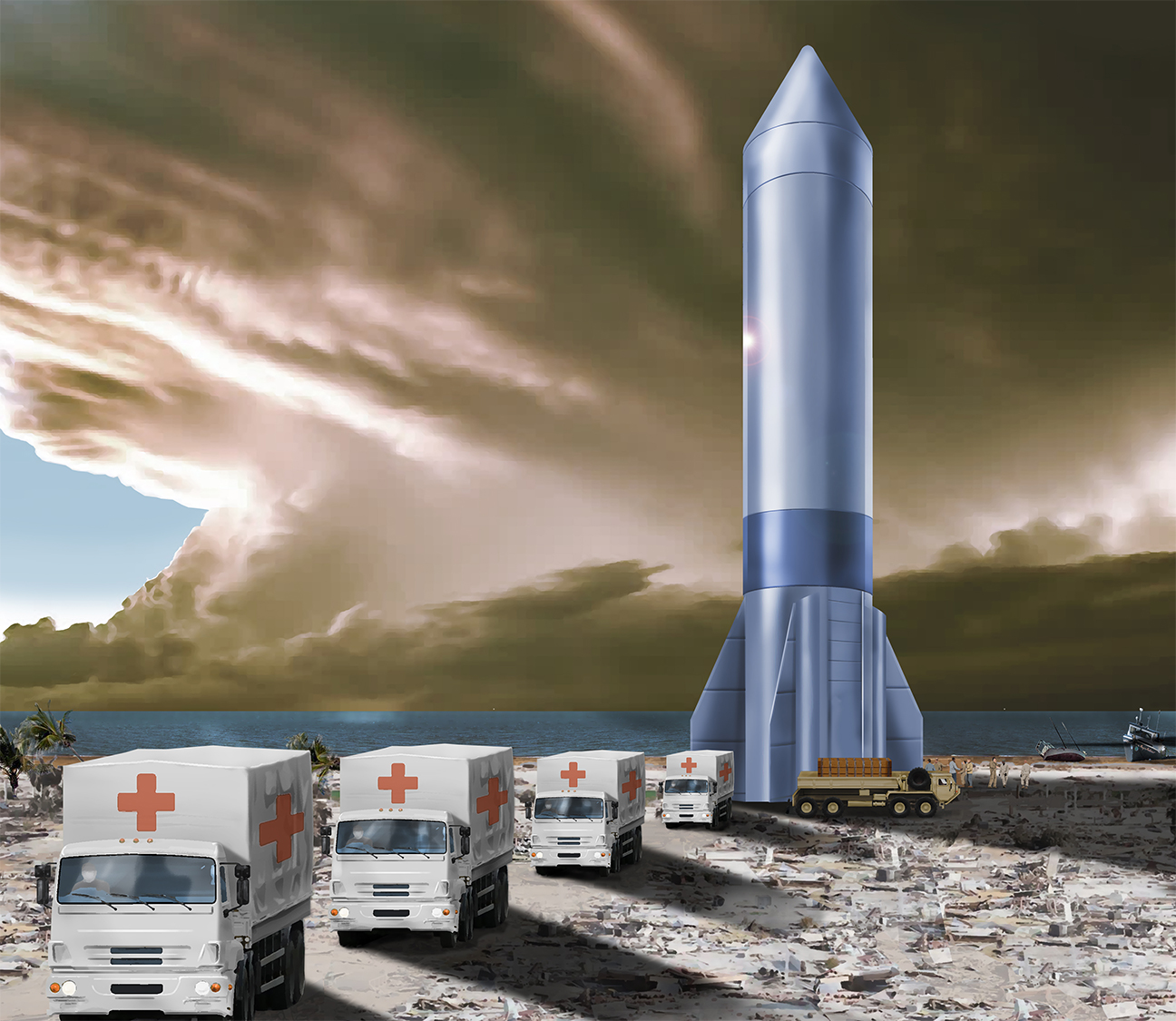
Rocket Cargo illustration

Rocket Cargo is a United States Space Force program run through the Air Force Research Laboratory (AFRL) for suborbital spaceflight rocket-delivered cargo involving point-to-point space travel. The program is to develop the capability to rapidly send cargo anywhere in the world on a rocket. It would involve reusable rockets that can perform propulsive landings on a variety of landing sites, to deliver a C-17's worth of cargo in an hour. The program was discussed in 2020 and announced in 2021, with a budget allocation request for Fiscal Year 2022.[1][2][3]

History

[edit]

In the 1960s, the military studied using Douglas Ithacus T-100 rockets to rocket off aircraft carriers to deliver marines to theatres.[4]

In 2018, the Air Force started studying delivering cargo via rockets.[5] In 2020, U.S. Transportation Command consulted with SpaceX on the delivery of 100 tons of cargo via rocket anywhere in the world in under 1 hour with Starship.[6] In 2021, the Pentagon announced the Rocket Cargo program, with the U.S. Space Force as the lead service on the program. $9.7 million U.S. dollars were allocated to Rocket Cargo in FY21.[6][5] The Pentagon Budget Office has requested $48 million US for FY 2022 for the program.[6] In 2022, the Department of the Air Force awarded a $102 million, 5-year contract to SpaceX to demonstrate technologies and capabilities to transport military cargo and humanitarian aid around the world.[7]

As of 2024, the Air Force and SpaceX aim to perform a demonstration mission as early as 2026 using SpaceX's Starship launch vehicle.[8] The Department of Defense has planned a test with Starship as part of their program to demonstrate the ability to rapidly deploy up to 100 tons of cargo and supplies, a capability it calls point to point delivery (P2PD). The test is envisioned to take place in FY25 or FY26.[9]

On 28 February 2025, the Department of the Air Force filed a Notice of Intent in the Federal Register for draft Environmental Assessment of Rocket Cargo testing at Johnston Atoll. This plan involved up to 10 reentry vehicle landings annually over 4 consecutive years, at two landing pads, but was suspended in July 2025.[10][11]

In May 2025, Rocket Lab was awarded a contract from AFRL to fly a Rocket Cargo "survivability experiment" under the Rocket Experimentation for Global Agile Logistics (REGAL) program. This experiment is scheduled to launch on a Rocket Lab Neutron rocket no earlier than 2026 and "re-enter Earth’s atmosphere, in a demonstration of re-entry capability for future REGAL missions."[12]

In August 2025, additional REGAL study contracts were awarded to Anduril and Blue Origin to study orbital cargo transport.[13]

Objectives

[edit]

The program is an Air Force Research Laboratory "Vanguard" program, a top importance science and technology research and development program. At the time of announcement, it was one of four such programs for the United States Department of the Air Force. The program is to examine modifying existing commercially available hardware for the program objectives. It would involve moving approximately a C-17 Globemaster III's worth of cargo or approximately 100 short tons (91 tonnes), anywhere in the world in under 1 hour. It would use a propulsively-landing reusable rocket that would transport cargo from source to destination, landing in all kinds of environments.[6][2][3][14][5]

See also

[edit]

References

[edit]

Further reading

[edit]
Revisions and contributorsEdit on WikipediaRead on Wikipedia
from Grokipedia
Rocket Cargo is an experimental program of the , administered through the , designed to assess the viability of employing commercial reusable rockets for suborbital point-to-point delivery of up to 100 metric tons of military cargo to any location on within 60 to 90 minutes. Initiated as a initiative in 2021, the program seeks to integrate emerging capabilities into Department of Defense to enable rapid resupply in high-threat environments, where traditional may be vulnerable or insufficient. Key developments include selection of Pacific landing sites for reentry vehicle tests and awards to industry partners such as for a 2026 demonstration mission involving return-to-Earth cargo transport, as well as study contracts to and Anduril for evaluating delivery architectures. While promising for transforming global sustainment by reducing transit times from days to hours, the initiative faces challenges in proving cost-effectiveness, precision landing reliability, and integration with existing supply chains, with ongoing experiments aimed at validating operational feasibility.

History

Pre-2021 Concepts

The concept of using rockets for rapid cargo delivery emerged in military planning during the mid-20th century, driven by the desire for intercontinental ballistic transport to outpace conventional aviation. In the 1950s, early proposals by Wernher von Braun envisioned orbital-class rockets for global logistics, building on ballistic missile technology to enable suborbital hops for supplies and personnel. These ideas gained traction amid Cold War imperatives for swift force projection, though high costs and technical immaturity limited implementation. A prominent example was the Ithacus project, proposed by Philip Bono at in 1963 as an inter-continental ballistic transport (ICBT) system. The Ithacus T-100 was conceptualized as a reusable, vertical takeoff and landing capable of carrying 170 or 60 metric tons of cargo to any point on within one to two hours via suborbital trajectories. Designed for launch from aircraft carriers or land bases, it featured a blunt-nosed, bullet-shaped powered by hydrogen-oxygen engines, with recovery via parachutes and jetpack-assisted landings for troops. The U.S. evaluated it for rapid theater insertion, but the program was abandoned due to prohibitive development expenses exceeding airline interest thresholds. Smaller-scale demonstrations underscored feasibility, such as the U.S. Army's 1959 use of a modified Redstone missile to deliver mail from White Sands to , covering 234 miles in 15 minutes. These efforts highlighted rockets' speed advantages over but faced scalability issues with payload fractions and reusability. Private sector innovation revived the idea in the . In September 2017, announced plans for to enable point-to-point Earth transport, proposing suborbital flights to deliver passengers and cargo between continents in under 30 minutes, with potential military applications for . This vision leveraged reusable rocket architecture to reduce costs, contrasting earlier disposable systems, and influenced subsequent U.S. explorations by demonstrating commercial viability for high-volume, rapid global delivery.

Program Launch and Early Phases (2021–2023)

The Rocket Cargo program was formally announced on June 4, 2021, by the Department of the as its fourth initiative, a high-priority effort designated to accelerate development of innovative capabilities. Led by the U.S. in partnership with the (AFRL) and U.S. Transportation Command (USTRANSCOM), the program aimed to demonstrate the feasibility of using commercial rocket vehicles for rapid, point-to-point cargo delivery globally, targeting delivery times under 90 minutes for payloads up to 100 tons—comparable to a C-17 Globemaster III . Initial funding supported conceptual studies and risk reduction, focusing on suborbital trajectories to bypass traditional limitations in contested environments. Early activities from 2021 to 2023 emphasized feasibility assessments and industry collaborations rather than hardware development or flights. In 2021, USTRANSCOM established a cooperative agreement with to study rocket-powered logistics viability, evaluating integration with military supply chains. By 2022, the program advanced to targeted evaluations, including a with to assess Starship's potential for point-to-point cargo transport, building on the vehicle's reusable architecture for cost-effective, high-volume deliveries. These phases involved modeling , payload protection during reentry, and infrastructure needs at ports, with demonstrations planned using existing commercial launch sites rather than new facilities. Through 2023, progress remained in the experimental stage, prioritizing on reliability, , and over operational deployment. AFRL coordinated with commercial providers to identify gaps in reusability and precision landing, informing future transitions to hybrid space-air without committing to specific vehicle procurements. No full-scale cargo flights occurred, as efforts focused on simulations and subscale tests to validate assumptions about speed advantages in peer conflicts, where traditional face to denial.

Expansion and Contracts (2024–2025)

In 2024, the U.S. Department of Defense intensified investments in reentry and point-to-point transportation technologies critical to Rocket Cargo, awarding four significant contracts over four months to advance global logistics capabilities. In September 2024, SpaceWERX granted Inversion Space a $71 million Strategic Funding Increase (STRATFI) award to develop next-generation autonomous re-entry capsules for on-demand delivery from space, emphasizing rapid cargo deployment. received a Reentry and Global Agile Logistics (REGAL) award in October 2024 to support related reentry vehicle maturation. The program's scope broadened in 2025 with targeted for demonstration missions and enabling technologies. In April 2025, Outpost Technologies secured a $1.8 million SpaceWERX to develop reusable technology for the Laboratory's (AFRL) Rocket Cargo Vanguard initiative, focusing on protecting payloads during atmospheric reentry. announced in May 2025 a U.S. to debut point-to-point cargo transportation using its rocket on a 2026 mission, aiming to validate suborbital delivery timelines under one hour. Further expansion came through AFRL study contracts awarded in August 2025 to evaluate operational feasibility. received $1.3 million to assess rocket integration for DoD cargo transport, while was awarded $1 million to explore autonomous systems for rapid global delivery via rocket platforms. These awards built on prior efforts, including SpaceX's 2022 $102 million demonstration contract, with the U.S. monitoring test flights in late 2024 for potential heavy-lift applications in future missions. By mid-2025, program adjustments included reevaluating testing sites to accommodate commercial rocket operations, signaling progression toward operational prototypes.

Objectives and Strategic Rationale

Military and Logistical Goals

The Rocket Cargo program, initiated by the U.S. Department of the Air Force in 2021, seeks to enable the rapid delivery of military cargo to any location on within approximately 90 minutes or less, leveraging reusable launch vehicles to address vulnerabilities in traditional logistics chains during peer conflicts. This capability aims to support time-sensitive resupply operations in contested environments, where conventional air and sea transport face risks from adversary anti-access/area-denial (A2/AD) systems, thereby enhancing operational tempo and force sustainment. Logistically, the initiative targets integration with existing Department of Defense (DoD) supply systems, including compatibility with standard cargo containers, to facilitate the transport of up to 100 metric tons of payload per mission, potentially including personnel in non-combat scenarios. Through the Air Force Research Laboratory's (AFRL) Rapid Global Assurance and Logistics (REGAL) effort, the program evaluates commercial rocket technologies for point-to-point suborbital trajectories, aiming to transition from experimental demonstrations to a formal program of record for sustained DoD use. A 2021 cooperative agreement with U.S. Transportation Command (TRANSCOM) underscores the focus on feasibility studies for rocket-powered logistics, prioritizing cost-effectiveness and reusability to minimize per-mission expenses compared to aircraft like the C-17 Globemaster III. Militarily, Rocket Cargo addresses strategic imperatives for distributed operations, such as those envisioned in the theater, by enabling just-in-time delivery of critical munitions, spare parts, and medical supplies to forward-deployed forces, thereby reducing reliance on vulnerable prepositioned stocks. Proponents argue this could shift logistics from predictable, attritable routes to unpredictable, high-speed vectors, complicating enemy interdiction efforts and supporting (JADC2) integration. However, realization depends on maturing technologies like precision landing and recovery, with ongoing evaluations of vehicles such as SpaceX's for their in operational contexts.

Broader Applications and Economic Incentives

Beyond , the Rocket Cargo program envisions applications in humanitarian assistance and relief, enabling the rapid delivery of up to 100 tons of supplies to remote or inaccessible areas within tactical timelines, such as conflict zones or post-natural sites. This capability supports U.S. Transportation Command missions for urgent resupply and , where traditional may be impeded by weather, infrastructure damage, or hostile environments. Potential civilian extensions include high-speed point-to-point transport for time-sensitive commercial cargo, such as critical industrial components or medical supplies, targeting markets served by express carriers like or . Economic incentives center on leveraging reusable commercial rockets to achieve delivery speeds of 60-90 minutes globally, far surpassing the 2-5 days typical of air freight, which justifies premium pricing for high-value payloads where delays incur significant opportunity costs—such as factory downtime estimated at millions per hour. Initial cost projections from , a key contractor, target $200 per kilogram, potentially declining to $20 per kilogram as reusability minimizes non-fuel expenses, rendering it competitive with air freight rates of approximately $33 per kilogram for equivalent 30-ton capacities akin to a . The U.S. Air Force's $102 million, five-year contract awarded to in early 2022 underscores the program's focus on assessing affordability through leased services rather than bespoke development, aiming to validate a where validation accelerates commercial scalability. However, viability hinges on maturing reusable technologies, as current rocket cargo remains constrained by limits and higher per-mission costs compared to optimized air operations, necessitating demonstrations to confirm net benefits over conventional methods.

Technical Foundations

Delivery Mechanisms and Trajectories

Rocket cargo delivery primarily employs reusable launch vehicles that follow suborbital ballistic to transport payloads point-to-point across , enabling transit times of 60 to 90 minutes for distances up to 10,000 kilometers or more. In this mechanism, the rocket ascends vertically using high-thrust engines to achieve the necessary velocity increment, transitioning from atmospheric flight to a near- coast phase where gravitational and inertial forces dominate the path. The is engineered to peak at altitudes of 100-200 kilometers, avoiding full orbital insertion to reduce energy requirements and enable rapid deorbit via atmospheric re-entry, followed by a powered descent for landing. This suborbital profile contrasts with traditional air freight by leveraging space-like speeds exceeding 25,000 km/h in , minimizing exposure to drag and allowing global reach without intermediate stops. Key delivery mechanisms integrate vertical takeoff and landing (VTOL) systems, often with grid fins or reaction control thrusters for trajectory correction during ascent and re-entry, ensuring precision delivery to unprepared or austere sites such as remote airfields or forward operating bases. The process begins with payload integration into a protected capsule or fairing, followed by launch from fixed or mobile pads; post-separation of boosters, the upper stage coasts ballistically while onboard avionics compute real-time adjustments for factors like wind, Earth's rotation, and target coordinates. Re-entry involves heat shield deployment to withstand peak heating rates, transitioning to aerodynamic deceleration and final engine relight for hover-slam or propulsive landing, achieving touchdown accuracies within tens of meters. These systems prioritize reusability, with rapid turnaround times targeted at hours between flights, supported by autonomous guidance algorithms derived from intercontinental ballistic missile (ICBM) heritage but adapted for cargo gentleness. Trajectory optimization focuses on minimizing propellant mass while maximizing payload fraction, often using Hohmann-like transfers adapted for suborbital hops, where delta-v requirements range from 6-8 km/s depending on range and inclination. For instance, paths exploit Earth's curvature for great-circle routes, with simulations accounting for overflight permissions and no-fly zones via iterative numerical propagation of equations. Suborbital arcs impose lower structural loads than orbital missions, enabling heavier cargo fractions—up to 100 metric tons in conceptual designs—but demand robust mitigation, typically limiting accelerations to 3-5g during ascent and re-entry to preserve sensitive supplies. Ongoing analyses, including those under U.S. contracts, evaluate hybrid trajectories blending suborbital boosts with skip re-entries to extend range or evade defenses, though full orbital relays remain secondary due to higher latency. These mechanisms underscore the program's emphasis on speed over cost for high-value, time-critical logistics in contested environments.

Payload Capacity and Reusability Requirements

The Rocket Cargo program targets a payload capacity equivalent to that of a , approximately 77 metric tons of cargo internally or up to 100 metric tons total, to enable rapid delivery of outsized military equipment and supplies over intercontinental distances. This scale addresses limitations in traditional , where C-17s require 18-24 hours for global transit, by leveraging suborbital trajectories for delivery in under 90 minutes. Initial assessments indicate that vehicles like SpaceX's could achieve 30 metric tons for point-to-point landings in early configurations, with iterative improvements potentially scaling toward the 100-ton threshold through optimized propellant use and structural refinements. Reusability forms a core requirement to ensure economic feasibility, as expendable launches would render routine cargo missions prohibitively costly compared to conventional air freight, estimated at thousands of dollars per ton versus potential rocket cargo rates aiming for affordability through high flight rates. The U.S. Air Force Research Laboratory's viability studies emphasize propulsive landings on unprepared sites and rapid turnaround times, drawing on commercial reusable systems demonstrated by SpaceX, which reduce per-flight costs by enabling booster and upper-stage recovery. Full reusability, including in-orbit refueling for extended operations, is projected to support sortie rates of multiple flights per day per vehicle, aligning with Department of Defense goals for sustained logistics in contested environments. Without reusability, payload fractions drop significantly—reusable configurations carry about 30% less than expendable modes—undermining the program's strategic rationale.

Involved Entities and Technologies

U.S. Military Programs

The program, administered by the (AFRL) under U.S. oversight, was established as the fourth Department of the Vanguard initiative on June 4, 2021, to explore suborbital rocket delivery for military logistics. This designation marked the 's inaugural lead role in a program, emphasizing agile experimentation with commercial launch technologies to enable point-to-point transport over long distances in under 90 minutes. The initiative builds on a 2021 cooperative agreement between U.S. Transportation Command and industry partners to assess rocket-powered resupply feasibility, targeting payloads up to 100 metric tons for time-sensitive deliveries such as munitions or . AFRL's Rapid Experimentation for Agile (REGAL) effort, synonymous with Rocket Cargo in recent phases, has progressed through vendor collaborations to containerize military for rocket integration, addressing challenges like payload standardization and recovery. In May 2025, AFRL contracted for a 2026 demonstration mission using the Neutron rocket to validate point-to-point capabilities, marking the program's first operational suborbital . Further advancing studies, AFRL awarded $1.3 million to and $1 million to Anduril in August 2025 under REGAL to evaluate one-hour global delivery of rocket-flown payloads, focusing on reusable systems and integration with DoD supply chains. The program envisions scaling to super-heavy lift vehicles, with the Space Force monitoring SpaceX's development for potential incorporation into future rocket cargo operations, given its capacity for massive payloads and rapid reusability. Testing infrastructure considerations include reactivating sites like for launches, reflecting adaptations to regulatory and environmental constraints while prioritizing operational tempo in contested environments. As of 2025, Rocket Cargo remains experimental but is positioned for transition to a formal program of record pending demonstration outcomes.

Commercial Providers and Vehicles

SpaceX has been a primary commercial partner in the U.S. military's Rocket Cargo program since January 2022, when the (AFRL) awarded the company a $102 million contract to assess the feasibility of using its vehicle for rapid cargo delivery. , a fully reusable super-heavy-lift launch system capable of carrying up to 150 metric tons to in its fully expendable configuration or 100 tons reusably, is designed for point-to-point Earth transport, enabling delivery of payloads equivalent to a C-17 Globemaster III's capacity anywhere on Earth within approximately 90 minutes via suborbital trajectories. The U.S. has continued monitoring 's development, including its test flights, for potential integration into operational rocket cargo missions as of November 2024. Rocket Lab joined the program through agreements signed in September 2022 to explore integration of its launch vehicles into defense , with AFRL selecting the company in May 2025 for an experimental return-to-Earth mission under the Rapid Global Airborne Launch (REGAL) initiative, also known as Rocket Cargo. This 2026 demonstration will test point-to-point cargo transportation using Rocket Lab's rocket or potentially its larger vehicle, focusing on smaller payloads for rapid resupply in austere environments. In September 2025, AFRL awarded study contracts to and to develop capabilities for delivering rocket-flown cargo globally within one hour, emphasizing reentry and landing technologies compatible with commercial heavy-lift vehicles like Blue Origin's rocket, which offers up to 45 metric tons to . These efforts align with the program's strategy to procure delivery services from commercial providers rather than developing government-owned rockets, leveraging maturing reusable launch technologies for scalable logistics. is also collaborating on payload containers and integration technologies to support these vehicles.

Demonstrations and Testing

Initial Experiments and Simulations

The Rocket Cargo program, designated as a U.S. Department of the Air Force initiative and led by the (AFRL), commenced in fiscal year 2021 with a primary emphasis on modeling, , and analysis (MS&A) to assess the viability of suborbital rocket delivery for military cargo. Announced on June 4, 2021, these initial efforts utilized computational tools to conduct operational analyses, verifying military utility through evaluations of performance parameters such as delivery speed (targeting under one hour for global point-to-point transport), payload integrity, and trajectory feasibility using reusable launch vehicles. Simulations incorporated real-world data from commercial reusable rocket launches to model scenarios involving loads equivalent to those of a C-17 Globemaster III aircraft, approximately 70 tons, while estimating operational costs against traditional methods. Key simulations focused on mission profile optimization, including numerical computations for ballistic and powered descent phases to austere sites. A 2023 analysis under the program framework employed methods to derive state variables like , altitude, and profiles, revealing that suborbital hops could achieve intercontinental ranges with minimal penalties compared to powered flights, though subject to constraints on reentry heating and precision . Parametric studies varied parameters such as payload mass (up to 100 tons in conceptual scales) and launch angles, confirming potential reductions in transit times from days to minutes for contested environments, albeit with higher per-mission costs offset by reusability assumptions derived from commercial data. These models highlighted causal factors like atmospheric drag and gravitational losses as primary influencers of efficiency, prioritizing causal realism in predictions over optimistic projections. Early phases eschewed physical hardware tests in favor of software-based validation to de-risk concepts, with AFRL's MS&A establishing baselines for military value before transitioning to empirical anchors. For instance, FY2021 simulations verified cost-effectiveness thresholds, projecting that rocket cargo could outperform in high-urgency scenarios despite 10-20 times higher unit costs per ton-mile, based on sensitivity analyses to fuel prices and turnaround times. Source credibility in these efforts draws from AFRL's internal expertise and peer-reviewed modeling, though program documents note reliance on commercial launch , which introduces variables from unverified data. No large-scale physical experiments occurred initially, as the Vanguard structure allocated resources to simulation maturation ahead of FY2022 validations for plume effects and separation dynamics.

Field Tests and Prototypes

The U.S. Air Force Research Laboratory's Rocket Cargo program has progressed through contracts with commercial entities to develop and test prototypes for rapid global cargo delivery, leveraging reusable launch vehicles. In 2022, SpaceX received a $102 million contract to analyze vehicle data and conduct demonstrations of point-to-point cargo capabilities using Starship prototypes, focusing on suborbital trajectories for payloads up to 100 tons. These efforts build on Starship's iterative field testing at SpaceX's Starbase facility in Boca Chica, Texas, where prototypes have validated key technologies like atmospheric reentry, propulsion, and landing precision essential for cargo operations. Early prototypes underwent suborbital hop tests to demonstrate controlled vertical landings. On August 4, 2020, prototype SN5 completed a 150-meter hop, followed by SN6 on September 3, 2020, which reached 500 feet (150 meters) and soft-landed successfully, testing fuel header tanks and Raptor engine performance under dynamic conditions. High-altitude prototypes advanced reentry and maneuverability: SN8 achieved a 12.5 km apogee on December 9, 2020, performing a belly-flop maneuver before a due to low pressure; subsequent iterations like SN15 on May 5, 2021, successfully landed after a similar profile, marking the first full recovery of a high-altitude . These tests informed cargo-relevant features, such as bay integration and rapid turnaround reusability. Integrated flight tests (IFTs) of have further prototyped end-to-end operations adaptable to cargo missions. By November 2024, the noted ongoing monitoring of IFTs for rocket cargo potential, with tests demonstrating booster catch mechanisms and upper-stage reentries. A October 14, 2025, launch tested reusable design elements, including deployment of dummy payloads simulating or cargo release, advancing reliability for . However, dedicated cargo field tests remain preparatory; a March 2025 environmental assessment outlined plans for demonstrating ton-scale delivery via reentry vehicles at remote sites, but these were suspended in July 2025 pending alternative locations to mitigate ecological risks. Other providers have prototyped complementary systems. In May 2025, secured an AFRL contract for a 2026 experimental mission using its rocket to test return-to-Earth cargo delivery, focusing on medium-lift suborbital profiles. Similarly, September 2025 selections of and Anduril aim to prototype integrated cargo solutions, including autonomous reentry and precision landing for one-hour global reach. These efforts emphasize scalable prototypes over full-scale operational tests, with no verified end-to-end cargo deliveries achieved by late 2025.

Challenges and Criticisms

Operational and Technical Hurdles

One primary technical hurdle involves the extreme and deceleration forces experienced during rocket launch and atmospheric reentry, which can exceed 3-5 g's longitudinally and impose significant vibrations, potentially damaging sensitive cargo unless specially ruggedized or packaged. This contrasts with conventional , where forces rarely surpass those of maneuvers, necessitating cargo compatibility testing to prevent structural failure or functionality loss in , perishables, or munitions. Reentry thermal management poses another challenge, as vehicles like must withstand peak heating exceeding 1,650°C while protecting payloads from radiant and convective , requiring advanced insulation or separation mechanisms that add mass and complexity. Precision landing accuracy remains unproven at scale for cargo operations, with current tests demonstrating variability in touchdown zones up to several kilometers, complicating integration with ground handling equipment and risking payload damage upon impact. Operationally, rapid turnaround for reusable vehicles demands fueling, inspection, and reloading within hours, yet prototypes as of 2024 required days between flights due to tile repairs and engine checks, hindering the envisioned sub-hour global delivery cycles. Infrastructure gaps include the need for hardened launch and landing pads worldwide, capable of handling cryogenic propellants and blast overpressures, alongside secure cargo encapsulation facilities to maintain chain-of-custody in contested environments. The U.S. Laboratory's Rocket Cargo program, initiated with a 2022 contract valued at $102 million, has faced delays in field demonstrations partly due to site selection issues, such as suspended plans for testing in July 2025 over logistical and environmental integration concerns. Unloading protocols for large payloads—potentially 100 metric tons—require automated or semi-autonomous systems to achieve operational tempo, as manual methods would extend ground times beyond tactical windows.

Economic and Regulatory Debates

Proponents of rocket cargo, particularly for military applications, argue that reusable launch vehicles like SpaceX's could enable delivery of up to 100 tons of globally in under 90 minutes, offering strategic advantages in time-sensitive that outweigh higher per-kilogram costs compared to conventional air freight. The U.S. (AFRL) initiated the Rocket Cargo program in 2021, awarding a $102 million contract in 2022 to study feasibility, emphasizing rapid resupply for contested environments where airlift vulnerabilities exist. Economic analyses suggest potential operating costs as low as $67 per kilogram for missions, potentially competitive with premium air cargo rates exceeding $100 per kilogram for long-haul routes like transpacific deliveries, though this assumes high flight cadences and full reusability not yet demonstrated at scale. Critics question the program's economic viability, highlighting that rocket cargo remains constrained by payload volume, acceleration forces incompatible with fragile goods, and upfront infrastructure costs for landing sites, limiting it to high-value, durable items rather than general freight. Initial demonstrations, such as AFRL's 2025 experiment with , underscore ongoing uncertainties in financial feasibility, with experts noting that while launch costs have plummeted—enabling the concept—sustained operations could exceed economics without massive volume to amortize development. For commercial applications, debates center on niche markets like urgent medical or deliveries, but projections indicate limited scalability until regulatory barriers ease and reliability improves, as point-to-point trajectories demand specialized cargo hardening not yet standardized. Regulatory debates focus on the Federal Aviation Administration's (FAA) licensing regime, which requires safety reviews for launches and reentries under Part 450, often delaying operations as seen in SpaceX's mishaps leading to proposed $633,009 penalties in 2024 for unauthorized changes. The FAA's framework, updated in 2021 to streamline processes, still grapples with integrating frequent suborbital flights into national airspace, with U.S. Space Command advocating for international agreements to permit overflights and foreign landings essential for global routes. use introduces further complexities under the of Armed Conflict, as commercial rockets repurposed for could blur distinctions between civilian and wartime assets, prompting calls for new treaties to address and liability in transoceanic trajectories. Overall, while the FAA lacks sufficient inspectors for rapid industry growth, proponents argue adaptive regulations are crucial to unlock economic potential without compromising safety.

Safety and Environmental Concerns

Rocket cargo operations, reliant on high-velocity launches and reentries of vehicles like SpaceX's , introduce safety risks exceeding those of conventional transport. Historical rocket launch failure rates have ranged from 3% to 6% in recent years, with early flights of new vehicles failing approximately 30% of the time due to or structural issues. In contrast, commercial exhibit failure rates orders of magnitude lower, often below 0.001%, benefiting from mature protocols and redundancy. Reusable mitigate some expendable risks through iterative testing, as evidenced by SpaceX's achieving over 300 consecutive successes since 2015, yet prototypes have experienced multiple explosions and debris dispersal events, such as the 2025 engine malfunction scattering fragments over and . Public and operational safety concerns amplify with proposed overland trajectories for point-to-point cargo, including potential hazards from sonic booms, heat, and uncontrolled reentries near populated areas. For instance, SpaceX's proposed flight paths crossing have prompted FAA scrutiny over risks to ground infrastructure and aviation corridors. In military contexts, rapid rocket cargo could be misidentified as hostile missiles, escalating geopolitical tensions, while integrity remains vulnerable to vibration-induced failures not typical in slower deliveries. Reusability introduces material fatigue risks, such as micro-cracks from repeated thermal stresses, potentially compromising structural margins despite refurbishment protocols. Environmentally, frequent rocket cargo launches pose cumulative threats from propellant combustion and atmospheric deposition. Starship's methane-liquid oxygen engines emit substantial CO2—approximately 2,683 metric tons per full-stack flight—along with , a potent 298 times more effective than CO2 over 100 years, plus trace and nitrogen oxides that deplete stratospheric and alter formation. Scaled to hundreds of annual launches, these high-altitude emissions could exacerbate forcing, as reactive persist longer in the than tropospheric exhaust. Locally, operations have discharged tens of thousands of gallons of industrial wastewater into wetlands per launch, harming ecosystems, while and vibrations threaten avian and marine , including sea turtles. Regulatory responses highlight these issues, with the U.S. Air Force suspending a 2025 hypersonic rocket cargo test on a Pacific due to projected harm to bird populations from launch noise and heat. The FAA's environmental impact statements for acknowledge risks to but have approved increased cadence with mitigations, though critics argue these underestimate global emission scaling from proliferated launches. Unlike solid rocket boosters, methalox systems avoid pollutants, potentially reducing some per-launch toxicity, but overall environmental costs hinge on launch frequency and efficiency gains.

Potential Impacts and Future Prospects

Geopolitical and Logistical Transformations

Rocket cargo systems, such as those under development in the U.S. Air Force Research Laboratory's (AFRL) Rocket Cargo program, promise to deliver up to 100 metric tons of to any location on Earth within 90 minutes, fundamentally altering global supply chains by reducing transit times from days or weeks via sea or air to under an hour via suborbital trajectories. This capability leverages reusable launch vehicles like SpaceX's , which AFRL has studied for scenarios involving rapid deployment of containerized cargo compatible with existing infrastructure. Logistically, such systems could bypass chokepoints like the or , which handle over 20% of global maritime trade but remain susceptible to disruptions from conflicts or natural events, enabling resilient, on-demand resupply for commercial and humanitarian operations. In military contexts, rocket cargo facilitates agile force projection by allowing the U.S. Department of Defense to surge supplies to forward-operating bases or contested theaters without reliance on vulnerable tankers or convoys, which can take 30-45 days to reposition forces across oceans. The U.S. has expressed interest in integrating for these missions, viewing it as a multiplier for operational tempo in peer conflicts, where timely delivery of munitions or medical supplies could determine outcomes. Demonstrations funded through programs like the 2021 Rocket Cargo initiative aim to validate this by 2026, potentially shrinking logistical tails that currently constrain . Geopolitically, widespread adoption could shift power dynamics toward nations with mature reusable launch capabilities, diminishing the strategic premium on naval dominance and air superiority for while elevating control over spaceports and orbital slots. For the U.S., this offers a deterrent edge through the latent threat of instantaneous global strike support, as articulated in analyses of Starship's military potential, though adversaries like may accelerate parallel programs to counter it, risking an in responsive . Overall, these transformations hinge on achieving high launch cadences—targeting daily flights for viability—but could render traditional infrastructure obsolete, fostering a of distributed, space-mediated economies less prone to blockade-induced scarcity.

Scalability and Commercial Viability

The scalability of rocket cargo systems hinges on achieving high launch cadences and rapid reusability, as demonstrated by ongoing efforts with vehicles like SpaceX's , which targets turnaround times of hours between flights through automated refurbishment and orbital refueling infrastructure. However, current prototypes face bottlenecks in propellant loading, thermal protection system inspections, and global landing site development, with estimates suggesting that full operational scalability requires dozens of simultaneous flights per day to handle meaningful cargo volumes beyond niche applications. The U.S. Air Force Research Laboratory's (AFRL) Rocket Cargo program, evaluating commercial rockets for tactical delivery, projects initial demonstrations in 2025-2026 using smaller vehicles like Rocket Lab's Neutron, but scaling to heavy-lift systems like would demand unprecedented infrastructure investments, including hardened pads at over 20 international sites to support suborbital hops. Commercial viability remains constrained by economics, with projected per-kilogram costs for suborbital rocket cargo starting at 1,0001,000-10,000 initially—far exceeding air freight's $2-5 per kg for intercontinental routes—limiting adoption to ultra-time-sensitive payloads such as medical isotopes or high-value electronics where hour-scale delivery justifies premiums. envisions marginal costs dropping below $100 per kg through mass production and reuse, potentially undercutting air cargo for volumes over 10 tons by offering 30-60 minute global transits, but this assumes flawless reliability and regulatory approval, which have yet to materialize as of late 2025. Analyses indicate that military contracts, like AFRL's, could subsidize early operations to build data on demand elasticity, but pure commercial markets may cap at 1-5% of global air freight volume without breakthroughs in safety and frameworks. Regulatory hurdles, including FAA integration and international treaties on overflight, further delay viability, as suborbital trajectories intersect paths, necessitating costly ground risk assessments. Optimistic projections from proponents highlight synergies with deployment economies, where Starship's 100+ ton low-Earth capacity could amortize fixed costs across dual-use missions, fostering hybrid models. Yet, empirical from 2024 AFRL simulations underscore persistent challenges in integrity during high-g reentries and precise autonomous landings, eroding confidence in scaling without iterative failures that could inflate premiums by factors of 10-100 over norms. In summary, while rocket cargo offers theoretical advantages in speed for contested environments, its commercial breakthrough depends on cost trajectories validated by operational fleets, projected not before the early barring accelerated testing.

References

Add your contribution
Related Hubs
User Avatar
No comments yet.