


Community hub
Recent from talks
Contribute something
Nothing was collected or created yet.
SpaceX Dragon 2
View on Wikipedia
 | |
| Manufacturer | SpaceX |
|---|---|
| Designer | SpaceX |
| Country of origin | United States |
| Operator | SpaceX |
| Applications | ISS crew and cargo transport; private spaceflight |
| Website | spacex.com/vehicles/dragon |
| Specifications | |
| Spacecraft type | Capsule |
| Launch mass | 12,500 kg (27,600 lb)[3][a] |
| Dry mass | 7,700 kg (16,976 lb)[4] |
| Payload capacity | |
| Crew capacity |
|
| Volume |
|
| Power |
|
| Batteries | 4 × lithium polymer |
| Regime | Low Earth orbit |
| Design life | |
| Dimensions | |
| Height | |
| Diameter | 4 m (13 ft)[5] |
| Width | 3.7 m (12 ft)[9] |
| Production | |
| Status | Active |
| Built | 13 (7 crew, 3 cargo, 3 prototypes) |
| Operational | 9 (5 crew, 3 cargo, 1 prototype) |
| Retired | 3 (1 crew, 2 prototypes) |
| Lost | 1 (crew, during uncrewed test) |
| Maiden launch |
|
| Related spacecraft | |
| Derived from | SpaceX Dragon 1 |
| Launch vehicle | Falcon 9 Block 5 |
| Thruster details | |
| Propellant mass | 2,562 kg (5,648 lb)[4] |
| Powered by |
|
| Maximum thrust |
|
| Specific impulse | Draco: 300 s (2.9 km/s) |
| Propellant | N2O4 / CH6N2[10] |
| Configuration | |
 Cross-sectional views of the Crew Dragon 1: Parachutes, 2: Crew access hatch, 3: Draco thrusters, 4: SuperDraco engines, 5: Propellant tank, 6: IDSS port, 7: Port hatch, 8: Control panel, 9: Cargo pallet, 10: Environmental control system, 11: Heat shield | |
| Part of a series on |
| Private spaceflight |
|---|

Dragon 2 is a class of partially reusable spacecraft developed, manufactured, and operated by the American space company SpaceX for flights to the International Space Station (ISS) and private spaceflight missions. The spacecraft, which consists of a reusable space capsule and an expendable trunk module, has two variants: the 4-person Crew Dragon and Cargo Dragon, a replacement for the Dragon 1 cargo capsule. The spacecraft launches atop a Falcon 9 Block 5 rocket, and the capsule returns to Earth through splashdown.[5]
Crew Dragon's primary role is to transport crews to and from the ISS under NASA's Commercial Crew Program, a task handled by the Space Shuttle until it was retired in 2011. It will be joined by Boeing's Starliner in this role when NASA certifies it. Crew Dragon is also used for commercial flights to ISS and other destinations and is expected to be used to transport people to and from Axiom Space's planned space station.
Cargo Dragon brings cargo to the ISS under a Commercial Resupply Services-2 contract with NASA, a duty it shares with Northrop Grumman's Cygnus spacecraft. As of January 2025, it is the only reusable orbital cargo spacecraft in operation, though it may eventually be joined by the under-development Sierra Space Dream Chaser spaceplane.[11]
Development and variants
[edit]There are two variants of Dragon 2: Crew Dragon and Cargo Dragon.[6] Crew Dragon was initially called "DragonRider"[12][13] and it was intended from the beginning to support a crew of seven or a combination of crew and cargo.[14][15] Earlier spacecraft had a berthing port and were berthed to ISS by ISS personnel. Dragon 2 instead has an IDSS-compatible docking port to dock to the International Docking Adapter ports on ISS. It is able to perform fully autonomous rendezvous and docking with manual override ability.[16][17] For typical missions, Crew Dragon remains docked to the ISS for a nominal period of 180 days, but is designed to remain on the station for up to 210 days,[c] matching the Russian Soyuz spacecraft.[18][19][20][21][22][23]
Crew Dragon
[edit]Crew Dragon is capable of autonomous operation. SpaceX and NASA state that it is capable of carrying seven astronauts, but in normal operations, it carries two to four crew members, and as of January 2025[update], has never carried more than four.[24]
Crew Dragon includes an integrated pusher launch escape system whose eight SuperDraco engines can separate the capsule away from the launch vehicle in an emergency. SpaceX originally intended to use the SuperDraco engines to land Crew Dragon on land; parachutes and an ocean splashdown were envisioned for use only in the case of an aborted launch. Precision water landing under parachutes was proposed to NASA as "the baseline return and recovery approach for the first few flights" of Crew Dragon.[25] However, propulsive landing was later cancelled, leaving ocean splashdown under parachutes as the only option.[26]
In 2012, SpaceX was in talks with Orbital Outfitters about developing space suits to wear during launch and re-entry.[27] Each crew member wears a custom-fitted space suit that provides cooling inside the Dragon (IVA type suit) but can also protect its wearer in a rapid cabin depressurization.[28][29] For the Demo-1 mission, a test dummy was fitted with the spacesuit and sensors. The spacesuit is made from Nomex, a fire-retardant fabric similar to Kevlar.
The spacecraft's design was unveiled on May 29, 2014, during a press event at SpaceX headquarters in Hawthorne, California.[30][31][32] In October 2014, NASA selected the Dragon spacecraft as one of the candidates to fly American astronauts to the International Space Station, under the Commercial Crew Program.[33][34][35] In March 2022, SpaceX President Gwynne Shotwell told Reuters that "We are finishing our final (capsule), but we still are manufacturing components, because we'll be refurbishing".[36] SpaceX later decided to build a fifth Crew Dragon capsule, to be available by 2024.[37] SpaceX also manufactures a new expendable trunk for each flight.
SpaceX's Commercial Crew Transportation Capabilities (CCtCap) contract values each seat on a Crew Dragon flight to be around US$88 million,[38] while the face value of each seat has been estimated by NASA's Office of Inspector General (OIG) to be around US$55 million.[39][40][41] This contrasts with the 2014 Soyuz launch price of US$76 million per seat for NASA astronauts.[42]
Cargo Dragon
[edit]Dragon 2 was intended from the earliest design concept to carry crew, or with fewer seats, both crew and cargo.
The cargo version, dubbed Cargo Dragon, became a reality after 2014, when NASA sought bids on a second round of multi-year contracts to bring cargo to the ISS in 2020 through 2024. In January 2016, SpaceX won contracts for six of these flights, dubbed CRS-2.[43] As of August 2025[update], Cargo Dragon had completed ten missions to and from the ISS with the eleventh mission in progress and more missions planned.
Cargo Dragons lack several features of the crewed variant, including seats, cockpit controls, astronaut life support systems, and SuperDraco abort engines.[44][45] Cargo Dragon improves on many aspects of the original Dragon design, including the recovery and refurbishment process.[46]
Since 2021, Cargo Dragon has been able to provide power to some payloads, saving space in the ISS and eliminating the time needed to move the payloads and set them up inside. This feature, announced on August 29, 2021, during the CRS-23 launch, is called Extend-the-Lab. "For CRS-23 there are 3 Extend-the-Lab payloads launching with the mission, and once docked, a 4th which is currently already on the space station will be added to Dragon".[47][48] For the first time, Dragon Cargo Dragon C208 performed test reboost of the ISS via its aft-facing Draco thrusters on November 8, 2024, at 17:50 UTC.[49]
On SpaceX CRS-33, Dragon included "boost kit" propulsion module in Dragon's hollow unpressurized trunk, which is typically used to carry larger experiments that are robotically attached to the outside of the ISS. The kit comprises six dedicated propellant tanks containing hydrazine and nitrogen tetroxide, a helium pressurant tank, and two Draco thrusters aligned with the station's velocity vector. The boost kit is based on, but operates independently from Dragon's primary propulsion system.[50][51] When activated, the system can add about 9 meters per second (20 mph) to the ISS's orbital velocity, equivalent to the total reboost impulse of roughly one-and-a-half Russian Progress cargo vehicles, which are normally responsible for orbit maintenance. The kit carries enough propellant to provide about one-third to one-fourth of the ISS's annual reboost needs.[50]
The US Deorbit Vehicle is a planned Cargo Dragon variant that will be used to deorbit the ISS and direct any remnants into the "spacecraft cemetery", a remote area of the southern Pacific Ocean.[52] The vehicle will attach to the ISS using one of the Cargo Dragon vehicles, which will be paired with a longer trunk module equipped with 30 additional Draco thrusters (in addition to the normal 16) and will carry 30,000 kg (66,000 lb) of propellant, nearly six times the normal load. NASA plans to launch the deorbit vehicle in 2030 where it will remain attached, dormant, for about a year as the station's orbit naturally decays to 220 km (140 mi). The spacecraft is to then conduct one or more orientation burns to lower the perigee to 150 km (93 mi), followed by a final deorbiting burn to push the station into the ocean.[53] In June 2024, NASA awarded a contract worth up to $843 million to SpaceX to build the deorbit vehicle as it works to secure funding.[54][55]
Design
[edit]

SpaceX, which aims to dramatically lower space transportation costs, designed Dragon 2 to be reused, not discarded as is typical of spacecraft. It is composed of a reusable capsule and a disposable trunk.
SpaceX and NASA initially certified the capsule to be used for five missions. As of March 2024[update], they are working to certify it for up to fifteen missions.[56]
To maximize cost-effectiveness, SpaceX incorporated several innovative design choices. The Crew Dragon employs eight side-mounted SuperDraco engines for its emergency escape system, eliminating the need for a traditional, disposable escape tower. Furthermore, instead of housing the critical and expensive life support, thruster, and propellant storage systems in a disposable service module, Dragon 2 integrates them within the capsule for reuse.

The trunk serves as an adapter between the capsule and the Falcon 9 rocket's second stage and also includes solar panels, a heat-dissipation radiator, and fins to provide aerodynamic stability during emergency aborts.[25] Dragon 2 integrates solar arrays directly into the trunk's structure, replacing the deployable panels of its predecessor, Dragon 1. On Cargo Dragon missions, the trunk can also be used to transport unpressurized payloads, such as the Roll Out Solar Array, or it can be fitted with a "boost kit" to perform reboosts of the ISS.[57] The trunk is connected to the capsule using a fitting known as "the claw".[58]
The typical Crew Dragon mission includes four astronauts: a commander who leads the mission and has primary responsibility for operating the spacecraft, a pilot who serves as backup for both command and operations, and two mission specialists who may have specific duties assigned depending on the mission. However, the Crew Dragon can fly missions with just two astronauts as needed, and in an emergency, up to seven astronauts could return to Earth from the ISS on Dragon.[7]

On the Crew Dragon, above the two center seats (occupied by the commander and pilot), there is a three-screen control panel. Below the seats is the cargo pallet, where around 230 kilograms (500 lb) of items can be stowed.[59] On the ground, crews enter the capsule through a side hatch. The capsule’s ceiling includes a small space toilet (with privacy curtain),[60] and an International Docking System Standard (IDSS) port. For private spaceflight missions not requiring ISS docking, the IDSS port can be replaced with a 1.2-meter (3 ft 11 in) domed plexiglass window offering panoramic views, similar to the ISS Cupola.[61] Additionally, SpaceX has developed a "Skywalker" hatch for missions involving extravehicular activities.[62]
The Cargo Dragon is loaded from the side hatch as well as through the IDSS port on the ceiling. It lacks the control panels, life support, windows, and seats of the Crew Dragon.
The spacecraft can be operated in full vacuum, and crew wears SpaceX-designed space suits to protect them from a rapid cabin depressurization emergency event. The spacecraft has also been designed to be able to land safely with a leak "of up to an equivalent orifice of 6.35 mm [0.25 in] in diameter".[25]
The spacecraft's nose cone protects the docking port and four forward-facing thrusters during ascent and reentry. This component pivots open for in-space operations.[25][32] Dragon 2's propellant and helium pressurant for emergency abort and orbital maneuvers are stored in composite-carbon-overwrap titanium spherical tanks at the capsule's base in an area known as the service section.
For launch aborts, the capsule relies on eight SuperDraco engines arranged in four redundant pairs. Each engine generates 71 kN (16,000 lbf) of thrust.[30] Sixteen smaller Draco thrusters placed around the spacecraft control its attitude and perform orbital maneuvers.
.jpeg)
When the capsule returns to Earth, a PICA-3 heat shield safeguards the capsule during reentry. Dragon 2 uses a total of six parachutes (two drogues and four mains) to decelerate after atmospheric entry and before splashdown, compared to the five used by Dragon 1.[63] The additional parachute was required by NASA as a safety measure after a Dragon 1 suffered a parachute malfunction. The company also went through two rounds of parachute development before being certified to fly with crew.[64] In 2024, the use of the SuperDraco thrusters for propulsive landing was enabled again, but only as a backup for parachute emergencies.[65]
Crewed flights
[edit]
Crew Dragon is used by both commercial and government customers. Axiom Space launches commercial astronauts to the ISS and intends to eventually launch to their own private space station. NASA flights to the ISS have four astronauts, with the added payload mass and volume used to carry pressurized cargo.[63]
On September 16, 2014, NASA announced that SpaceX and Boeing had been selected to provide crew transportation to the ISS. SpaceX was to receive up to US$2.6 billion under this contract to provide development test flights and up to six operational flights.[66] Dragon was the less expensive proposal,[34] but NASA's William H. Gerstenmaier considered the Boeing Starliner proposal the stronger of the two. However, Crew Dragon's first operational flight, SpaceX Crew-1, was on November 16, 2020, after several test flights, while Starliner suffered multiple problems and delays, with its first operational flight slipping to no earlier than 2026.[67]
In a departure from the prior NASA practice, where construction contracts with commercial firms led to direct NASA operation of the spacecraft, NASA is purchasing space transport services from SpaceX, including construction, launch, and operation of the Dragon 2.[68]
NASA approved a new propellant loading procedure due to the Falcon 9 rocket's novel use of superchilled propellants. Unlike earlier NASA spacecraft, such as the Saturn V and Space Shuttle—where propellants were fully loaded hours before launch and before astronauts boarded—on the Falcon 9, propellants are loaded just before launch to keep the liquid oxygen near −340 °F (−206.7 °C) and the kerosene near 20 °F (−7 °C).[69] Propellant loading begins approximately 40 minutes before liftoff, with the launch escape system active to ensure the crew can be safely pulled away from the rocket in the event of an emergency during fuel loading.[70]
The first uncrewed test mission, Demo-1, launched to the International Space Station (ISS) on March 2, 2019.[71] After schedule slips,[72] the first crewed flight, Demo-2, launched on May 30, 2020.[73]
Testing
[edit]SpaceX planned a series of four flight tests for the Crew Dragon: a pad abort test, an uncrewed orbital flight to the ISS, an in-flight abort test, and finally, a crewed flight to the ISS,[74] which was initially planned for July 2019,[72] but after a Dragon capsule explosion, was delayed to May 2020.[75]
Pad abort test
[edit].jpg)
The pad abort test was conducted successfully on May 6, 2015, at SpaceX's leased SLC-40 launch site.[63] Dragon landed safely in the ocean to the east of the launchpad 99 seconds after ignition of the SuperDraco engines.[76] While a flight-like Dragon 2 and trunk were used for the pad abort test, they rested atop a truss structure for the test rather than a full Falcon 9 rocket. A crash test dummy embedded with a suite of sensors was placed inside the test vehicle to record acceleration loads and forces at the crew seat, while the remaining six seats were loaded with weights to simulate full-passenger-load weight.[68][77] The test objective was to demonstrate sufficient total impulse, thrust and controllability to conduct a safe pad abort. A fuel mixture ratio issue was detected after the flight in one of the eight SuperDraco engines causing it to under perform, but did not materially affect the flight.[78][79][80]
On November 24, 2015, SpaceX conducted a test of Dragon 2's hovering abilities at the firm's rocket development facility in McGregor, Texas. In a video, the spacecraft is shown suspended by a hoisting cable and igniting its SuperDraco engines to hover for about 5 seconds, balancing on its 8 engines firing at reduced thrust to compensate exactly for gravity.[81] The test vehicle was the same capsule that performed the pad abort test earlier in 2015; it was nicknamed DragonFly.[82]
Demo-1: orbital flight test
[edit].jpg)
In 2015, NASA named its first Commercial Crew astronaut cadre of four veteran astronauts to work with SpaceX and Boeing – Robert Behnken, Eric Boe, Sunita Williams, and Douglas Hurley.[83] The Demo-1 mission completed the last milestone of the Commercial Crew Development program, paving the way to starting commercial services under an upcoming ISS Crew Transportation Services contract.[68][84] On August 3, 2018, NASA announced the crew for the DM-2 mission.[85] The crew of two consisted of NASA astronauts Bob Behnken and Doug Hurley. Behnken previously flew as mission specialist on the STS-123 and the STS-130 missions. Hurley previously flew as a pilot on the STS-127 mission and on the final Space Shuttle mission, STS-135.[86]
The first orbital test of Crew Dragon was an uncrewed mission, commonly called "Demo-1" and launched on March 2, 2019.[87][88] The spacecraft tested the approach and automated docking procedures with the ISS,[89] remained docked until March 8, 2019, then conducted the full re-entry, splashdown and recovery steps to qualify for a crewed mission.[90][91] Life-support systems were monitored for the entirety the test flight. The same capsule was planned to be re-used in June 2019 for an in-flight abort test before it exploded on April 20, 2019.[87][92]
Explosion during testing
[edit]On April 20, 2019, Crew Dragon C204, the capsule used in the Demo-1 mission, was destroyed in an explosion during static fire testing at the Landing Zone 1 facility.[93][94] On the day of the explosion, the initial testing of the Crew Dragon's Draco thrusters was successful, with the anomaly occurring during the test of the SuperDraco abort system.[95]
Telemetry, high-speed camera footage, and analysis of recovered debris indicate the problem occurred when a small amount of dinitrogen tetroxide leaked into a helium line used to pressurize the propellant tanks. The leakage apparently occurred during pre-test processing. As a result, the pressurization of the system 100 ms before firing damaged a check valve and resulted in the explosion.[95][96]
SpaceX modified the Dragon 2 replacing check valves with burst discs, which are designed for single use, and the adding of flaps to each SuperDraco to seal the thrusters prior to splashdown, preventing water intrusion.[97] The SuperDraco engine test was repeated on November 13, 2019, with Crew Dragon C205. The test was successful, showing that the modifications made to the vehicle were successful.[98]
Since the destroyed capsule had been slated for use in the upcoming in-flight abort test, the explosion and investigation delayed that test and the subsequent crewed orbital test.[99]
In-flight abort test
[edit]
The Crew Dragon in-flight abort test was launched on January 19, 2020, at 15:30 UTC from LC-39A on a suborbital trajectory to conduct a separation and abort scenario in the troposphere at transonic velocities shortly after passing through max Q, where the vehicle experiences maximum aerodynamic pressure. The Dragon 2 used its SuperDraco abort engines to push itself away from the Falcon 9 after an intentional premature engine cutoff, after which the Falcon was destroyed by aerodynamic forces. The Dragon followed its suborbital trajectory to apogee, at which point the spacecraft's trunk was jettisoned. The smaller Draco engines were then used to orient the vehicle for the descent. All major functions were executed, including separation, engine firings, parachute deployment, and landing.
Dragon 2 splashed down at 15:38:54 UTC just off the Florida coast in the Atlantic Ocean.[100] The test objective was to demonstrate the ability to safely move away from the ascending rocket under the most challenging atmospheric conditions of the flight trajectory, imposing the worst structural stress of a real flight on the rocket and spacecraft.[63] The abort test was performed using a Falcon 9 Block 5 rocket with a fully fueled second stage with a mass simulator replacing the Merlin engine.[101]
Earlier, this test had been scheduled before the uncrewed orbital test,[102] however, SpaceX and NASA considered it safer to use a flight representative capsule rather than the test article from the pad abort test.[103]
This test was previously planned to use the capsule C204 from Demo-1, however, C204 was destroyed in an explosion during a static fire testing on April 20, 2019.[104] Capsule C205, originally planned for Demo-2 was used for the In-Flight Abort Test[105] with C206 being planned for use during Demo-2. This was the final flight test of the spacecraft before it began carrying astronauts to the International Space Station under NASA's Commercial Crew Program.
Prior to the flight test, teams completed launch day procedures for the first crewed flight test, from suit-up to launch pad operations. The joint teams conducted full data reviews that needed to be completed prior to NASA astronauts flying on the system during SpaceX's Demo-2 mission.[106]
.jpg)
Demo-2: crewed orbital flight test
[edit].jpg)
On April 17, 2020, NASA administrator Jim Bridenstine announced the first crewed Crew Dragon Demo-2 to the International Space Station would launch on May 27, 2020.[107] Astronauts Bob Behnken and Doug Hurley crewed the mission, marking the first crewed launch to the International Space Station from U.S. soil since STS-135 in July 2011. The original launch was postponed to May 30, 2020, due to weather conditions at the launch site.[108] The second launch attempt was successful, with capsule C206, later named Endeavour by the crew, launching on 30 May 2020 19:22 UTC.[109][110] The capsule successfully docked with the International Space Station on May 31, 2020, at 14:27 UTC.[111][112][113] On August 2, 2020, Crew Dragon undocked and splashed-down successfully in the Atlantic Ocean. Launching in the Dragon 2 spacecraft was described by astronaut Bob Behnken as "smooth off the pad" but "we were definitely driving and riding a dragon all the way up ... a little bit less g's [than the Space Shuttle] but more 'alive' is probably the best way I would describe it".[114]
Regarding descent in the spacecraft, Behnken stated, "Once we descended a little bit into the atmosphere, Dragon really came alive. It started to fire thrusters and keep us pointed in the appropriate direction. The atmosphere starts to make noise—you can hear that rumble outside the vehicle. And as the vehicle tries to control, you feel a little bit of that shimmy in your body. ... We could feel those small rolls and pitches and yaws—all those little motions were things we picked up on inside the vehicle. ... All the separation events, from the trunk separation through the parachute firings, were very much like getting hit in the back of the chair with a baseball bat ... pretty light for the trunk separation but with the parachutes it was a pretty significant jolt".[115]
List of vehicles
[edit]| Serial
Number |
Name | Type | Status | Flights | Flight
time |
Total
flight time |
Notes | Cat. |
|---|---|---|---|---|---|---|---|---|
| C201 | DragonFly | Prototype | Retired | 1 | 99s (Pad Abort Test) | 99s | Prototype used for pad abort test at Cape Canaveral and tethered hover tests at the McGregor Test Facility. | 
|
| C202 | None | Prototype | Retired | N/A | N/A | N/A | Pressure vessel qualification module used for structural testing. | |
| C203 | None | Prototype | In use | N/A | N/A | N/A | Environmental control and life support system testing module, still in use for human-in-the-loop testing. | |
| C204 | None | Crew | Destroyed | 1 | 6d 5h 56m (Demo-1) | 6d 5h 56m | First Dragon 2 to fly in space. Only flight was Demo-1; accidentally destroyed during ground testing of the abort thrusters weeks after the flight. |
|
| C205 | None | Crew | Retired | 1 | 8m 54s (In-Flight Abort Test) | 8m 54s | Was originally to be used on Demo-2 but instead flew the Crew Dragon In-Flight Abort Test due to the destruction of C204 and was retired afterwards. |
|
| C206 | Endeavour | Crew | Active (docked to ISS) |
6 | 63d 23h 25m (Demo-2) | 701d 21h 16m | First vehicle to carry crew; named after Space Shuttle Endeavour. First flown during Crew Demo-2.[119] Has since flown Crew-2,[120] Axiom-1, Crew-6, Crew-8, and Crew-11. First Dragon to fly beyond the initial certification of 5 flights per Dragon. |
|
| 199d 17h 44m (Crew-2) | ||||||||
| 17d 1h 49m (Axiom-1) | ||||||||
| 185d 22h 43m (Crew-6) | ||||||||
| 235d 3h 35m (Crew-8) | ||||||||
| 85d 13h 10m (Crew-11, in progress) | ||||||||
| C207 | Resilience | Crew | Active | 4 | 167d 6h 29m (Crew-1) | 178d 19h 17m | First flew on Crew-1 on November 16, 2020.[121] Has since flown private spaceflight missions Inspiration4, Polaris Dawn, and Fram2. |
|
| 2d 23h 3m (Inspiration4) | ||||||||
| 4d 22h 13m (Polaris Dawn) | ||||||||
| 3d 14h 32m (Fram2) | ||||||||
| C208 | None | Cargo | Active | 5 | 38d 9h 8m (CRS-21) | 175d 13h 52m | First Cargo Dragon 2, which flew the CRS-21, CRS-23, CRS-25, CRS-28 and CRS-31 missions.[122] |
|
| 32d 19h 42m (CRS-23) | ||||||||
| 36d 18h 8m (CRS-25) | ||||||||
| 24d 22h 43m (CRS-28) | ||||||||
| 42d 16h 10m (CRS-31) | ||||||||
| C209 | None | Cargo | Active | 5 | 36d 9h 59m (CRS-22) | 175d 23h 36m | Second Cargo Dragon 2, which flew the CRS-22, CRS-24, CRS-27, CRS-30 and CRS-32 missions. |
|
| 34d 10h 57m (CRS-24) | ||||||||
| 31d 20h 28m (CRS-27) | ||||||||
| 24d 22h 43m (CRS-30) | ||||||||
| 33d 21h 29m (CRS-32) | ||||||||
| C210 | Endurance | Crew | Active | 4 | 176d 2h 39m (Crew-3) | 680d 7h 28m | First flew on Crew-3 on November 11, 2021.[123] Has since flown Crew-5, Crew-7, and Crew-10. |
|
| 157d 10h 1m (Crew-5) | ||||||||
| 199d 2h 20m (Crew-7) | ||||||||
| 147d 16h 29m (Crew-10) | ||||||||
| C211 | None | Cargo | Active (docked to ISS) |
3 | 45d 14h 58m (CRS-26) | 88d 7h 4m | Third Cargo Dragon 2, which flew the CRS-26, CRS-29,[124][125] CRS-33 missions. |
|
| 42d 16h 5m (CRS-29) | ||||||||
| 63d 2h 9m (CRS-33, in progress) | ||||||||
| C212 | Freedom | Crew | Active | 4 | 170d 13h 2m (Crew-4) | 372d 14h 50m | First flew on Crew-4 on April 24, 2022.[124] Has since flown Axiom-2, Axiom-3, and Crew-9. |
|
| 9d 5h 27m (Axiom-2) | ||||||||
| 21d 15h 40m (Axiom-3) | ||||||||
| 171d 4h 39m (Crew-9) | ||||||||
| C213 | Grace | Crew | Active | 1 | 20d 2h 59m (Axiom-4) | 20d 2h 59m | First flew on Axiom-4. |
|
List of flights
[edit]List includes only completed or currently manifested missions. Dates are listed in UTC, and for future events, they are the earliest possible opportunities (also known as NET dates) and may change.
Crew Dragon flights
[edit]| Mission and patch | Capsule[118] | Launch date | Landing date | Launch pad | Landing site | Remarks | Crew | Outcome |
|---|---|---|---|---|---|---|---|---|
| Pad Abort Test (patch) | C201 DragonFly | May 6, 2015 | SLC-40 | Atlantic Ocean | Simulating an escape from a rocket failure on the ground, Crew Dragon's SuperDraco engines lifted the capsule from a ground pad at SLC-40 and propelled it to a safe splashdown in the nearby ocean. | — | Success | |
| Demo-1 (patch) | C204 | March 2, 2019 | March 8, 2019 | LC-39A | Atlantic Ocean | Uncrewed orbital test flight, successfully docked with the ISS. | — | Success |
| In-Flight Abort Test (patch) | C205 | January 19, 2020 | LC-39A | Atlantic Ocean | Booster was commanded to simulate an in-flight engine failure. In response, Crew Dragon's SuperDraco engines fired successfully, propelling the capsule away to a safe splashdown. | — | Success | |
Demo-2 
|
C206‑1 Endeavour | May 30, 2020 | August 2, 2020 | LC-39A | Gulf of Mexico | First crewed flight test of Dragon 2. The mission was extended from two weeks to nine to allow the crew to bolster activity on the ISS ahead of Crew-1. | Success | |
Crew-1 
|
C207‑1 Resilience | November 16, 2020 | May 2, 2021 | LC-39A | Gulf of Mexico | First operational Commercial Crew flight. | Success | |
Crew-2 
|
C206‑2 Endeavour | April 23, 2021 | November 9, 2021 | LC-39A | Gulf of Mexico | First reuse of a capsule and booster rocket. | Success | |
| Inspiration4 (patch 1 and 2) | C207‑2 Resilience | September 16, 2021 | September 18, 2021 | LC-39A | Atlantic Ocean | The first fully private, all-civilian orbital flight. Crew reached a 585 km (364 mi) orbit and conducted science experiments and public outreach activities for three days.[126] First standalone orbital Crew Dragon flight and the first flight with the cupola. | Success | |
Crew-3 
|
C210‑1 Endurance | November 11, 2021 | May 6, 2022 | LC-39A | Gulf of Mexico | Success | ||
| Axiom-1 (patch) | C206‑3 Endeavour | April 8, 2022 | April 25, 2022 | LC-39A | Atlantic Ocean | First fully private flight to the ISS. Contracted by Axiom Space. Axiom employee served as commander with three tourists. | Success | |
Crew-4 
|
C212‑1 Freedom | April 27, 2022 | October 14, 2022 | LC-39A | Atlantic Ocean | Success | ||
Crew-5 
|
C210‑2 Endurance | October 5, 2022 | March 12, 2023 | LC-39A | Gulf of Mexico | First crew to include a Russian cosmonaut as part of Dragon–Soyuz seat swap program.[127] | Success | |
Crew-6 
|
C206‑4 Endeavour | March 2, 2023 | September 4, 2023 | LC-39A | Atlantic Ocean | Success | ||
| Axiom-2 (patch) | C212‑2 Freedom | May 21, 2023 | May 31, 2023 | LC-39A | Gulf of Mexico | Fully private flight to the ISS. Contracted by Axiom Space. Axiom employee served as commander, other seats purchased by SSA and a tourist.[128] | Success | |
Crew-7 
|
C210‑3 Endurance | August 26, 2023 | March 12, 2024 | LC-39A | Gulf of Mexico | Success | ||
| Axiom-3 (patch) | C212‑3 Freedom | January 18, 2024[129] | February 9, 2024 | LC-39A | Atlantic Ocean | Fully private flight to the ISS. Axiom employee served as commander, other seats purchased by AM, TUA, and SNSA/ESA. | Success | |
Crew-8 
|
C206‑5 Endeavour | March 4, 2024 | October 25, 2024 | LC-39A | Gulf of Mexico | Longest Crew Dragon mission. ISS stay extended and two makeshift seats added to allow Crew-8 to serve as "lifeboat" for the Boeing CFT crew if needed. | Success | |
| Polaris Dawn (patch) | C207‑3 Resilience | September 10, 2024 | September 15, 2024 | LC-39A | Gulf of Mexico | Fully private orbital flight, including two SpaceX employees. First of three planned flights of the private Polaris Program. Flew 1,400 km (870 mi) away from Earth, the highest orbit of the planet flown by a crewed spacecraft since the end of the Apollo program. Isaacman and Gillis made the first commercial spacewalk during the mission.[130] | Success | |
Crew-9 
|
C212‑4 Freedom | September 28, 2024 | March 18, 2025 | SLC-40 | Gulf of Mexico | Was the first crewed mission to launch from SLC-40.[131] Launched with only two crew members and returned with the crew of the Boeing Crew Flight Test due to issues with the Boeing Starliner Calypso.[132] |
|
Success |
Crew-10 
|
C210‑4 Endurance | March 14, 2025 | August 9, 2025 | LC-39A | Pacific Ocean | Success | ||
| Fram2 (patch) | C207‑4 Resilience | April 1, 2025 | April 4, 2025 | LC-39A | Pacific Ocean | Fully private, all-civilian orbital flight. First crewed mission to launch into an orbit over the planet's poles.[133][134] First crewed Dragon landing on the West Coast. | Success | |
| Axiom-4 (patch) | C213‑1 Grace | June 25, 2025 | July 15, 2025 | LC-39A | Pacific Ocean | Fully private flight to the ISS. Axiom employee served as commander; other seats purchased by ISRO, POLSA/ESA, and Hungary. | Success | |
Crew-11 
|
C206‑6 Endeavour[137] | August 1, 2025[138] | April 2026 | LC-39A | Pacific Ocean (planned) | Fastest Crew Dragon rendezvous to date. | In progress | |
| Crew-12[141] | TBA | March 31, 2026 | October 2026 | TBA | Pacific Ocean (planned) | Planned | ||
| Vast-1 | TBA | June 2026 | TBA | TBA | Pacific Ocean (planned) | Servicing of the Haven-1 space station.[143] | TBA | Planned |
| Crew-13[141] | TBA | TBA | TBA | TBA | Pacific Ocean (planned) | TBA | Planned | |
| Crew-14[141] | TBA | TBA | TBA | TBA | Pacific Ocean (planned) | TBA | Planned | |
| Polaris-2 | TBA | TBA | TBA | TBA | Pacific Ocean (planned) | Last Polaris Program flight to use Crew Dragon (final flight plans to use Starship).[144] |
|
Planned |


Cargo Dragon flights
[edit]| Mission and Patch | Capsule[145] | Launch date | Landing date | Remarks | Outcome |
|---|---|---|---|---|---|
CRS-21 
|
C208‑1 | December 6, 2020 | January 14, 2021 | First SpaceX mission performed under the CRS-2 contract with NASA and the first flight of Cargo Dragon 2. Also delivered the Nanoracks Bishop Airlock module. | Success |
CRS-22 
|
C209‑1 | June 3, 2021 | July 10, 2021 | Also delivered solar arrays iROSA 1 and iROSA 2 | Success |
CRS-23 
|
C208‑2 | August 29, 2021 | October 1, 2021 | Success | |
CRS-24 
|
C209‑2 | December 21, 2021 | January 24, 2022 | Success | |
CRS-25 
|
C208‑3 | July 15, 2022 | August 20, 2022 | Success | |
CRS-26 
|
C211‑1 | November 26, 2022 | January 11, 2023 | Also delivered solar arrays iROSA 3 and iROSA 4.[146] | Success |
CRS-27 
|
C209‑3 | March 15, 2023 | April 15, 2023 | Success | |
CRS-28 
|
C208‑4 | June 5, 2023 | June 30, 2023 | Also delivered solar arrays iROSA 5 and iROSA 6.[147] With this mission, Dragon 2 fleet's 1,324 days in orbit surpassed the Space Shuttle. This was the 38th Dragon mission to ISS, surpassing the Shuttle's 37.[148] | Success |
CRS-29 
|
C211‑2 | November 10, 2023 | December 22, 2023 | Success | |
CRS-30 
|
C209‑4 | March 21, 2024 | April 30, 2024 | First Dragon 2 launch from SLC-40. | Success |
CRS-31 
|
C208‑5 | November 5, 2024 | December 16, 2024 | First Dragon to perform a reboost of the ISS.[149] | Success |
CRS-32 
|
C209‑5 | April 21, 2025[150] | May 25, 2025 | First Cargo Dragon to splash down in the Pacific Ocean. | Success |
CRS-33 
|
C211‑3 | August 24, 2025 | December 2025 | Equipped with a "boost kit" capable of performing multiple re-boosts of the ISS.[151] | In progress |
| CRS-34 | TBA | 2026[152] | Planned | ||
| CRS-35 | TBA | November 2026[153] | Planned | ||
| United States Deorbit Vehicle | TBA | 2030[154] | To deorbit the ISS after it is decommissioned. | Planned |
Timeline
[edit]Crew Dragon has flown thirteen missions for NASA under its CCDev and CCP programs and seven privately funded crewed missions. Cargo Dragon has flown twelve cargo missions for NASA. For brevity, the Demo-1 mission is not shown.

See also
[edit]
- Comparison of crewed space vehicles
- Comparison of space station cargo vehicles
- List of crewed spacecraft
- Crew Dragon Launch Abort System
- Private spaceflight – Spaceflight not by a government
Notes
[edit]- ^ The reentry capsule weighs 9,600 kg (21,200 lb) including crew + 150 kg (330 lb) payload (Crew Dragon Demo-2)
- ^ up to 2,507 kg (5,527 lb) pressurized and up to 800 kg (1,800 lb) unpressurized
- ^ NASA extended the Crew-8 mission to 235 days to help mitigate the problems with the Starliner CFT mission
- ^ a b c d Axiom Space employee
- ^ a b SpaceX employee
- ^ Wang was born in China but lives primarily in Svalbard and since 2023 is also a citizen of Malta and Saint Kitts and Nevis through their golden visa programs. He wore the flag of Malta on his spacesuit during the spaceflight.[135]
- ^ Mikkelsen was born in the United Kingdom, but is now a citizen of Norway. She wore the flag of Norway on her spacesuit during the spaceflight.[136]
References
[edit]- ^ "DragonLab datasheet" (PDF). Hawthorne, California: SpaceX. September 8, 2009. Archived from the original (PDF) on January 4, 2011.
- ^ "NASA, SpaceX to Launch First Astronauts to Space Station from U.S. Since 2011". NASA. Retrieved June 20, 2024.
 This article incorporates text from this source, which is in the public domain.
- ^ Heiney, Anna (July 23, 2020). "Top 10 Things to Know for NASA's SpaceX Demo-2 Return". nasa.gov. Retrieved July 24, 2020.
At the time of undock, Dragon Endeavour and its trunk weigh approximately 27,600 pounds
This article incorporates text from this source, which is in the public domain.
- ^ a b "Final Environmental Assessment and Finding of No Significant Impact for Issuing SpaceX a Launch License for an In-Flight Dragon Abort Test" (PDF). Federal Aviation Administration. June 2019. Retrieved September 25, 2022.
- ^ a b c d e SpaceX (March 1, 2019). "Dragon". SpaceX. Archived from the original on March 2, 2019. Retrieved March 3, 2019.
- ^ a b c d Audit of Commercial Resupply Services to the International Space Station Archived August 30, 2018, at the Wayback Machine NASA April 26, 2018, Report No. IG-18-016 Quote: "For SpaceX, certification of the company's unproven cargo version of its Dragon 2 spacecraft for CRS-2 missions carries risk while the company works to resolve ongoing concerns related to software traceability and systems engineering processes" This article incorporates text from this source, which is in the public domain.
- ^ a b Howell, Elizabeth (August 9, 2024). "Will SpaceX carry Boeing Starliner crew home? Here's how Dragon could do it". Retrieved August 19, 2024.
- ^ Rauf, Jim (Fall 2023). "SpaceX Dragon Spacecraft" (PDF). University of Cincinnati.
- ^ a b Richardson, Derek. "Dragon 2". Orbital Velocity. Retrieved August 22, 2024.
- ^ "The Annual Compendium of Commercial Space Transportation: 2012" (PDF). Federal Aviation Administration. February 2012. Archived (PDF) from the original on June 19, 2013. Retrieved September 16, 2014. This article incorporates text from this source, which is in the public domain.
- ^ "Dream Chaser Lifting Body Set For Delivery To NASA Ahead Of 2024 Launch | Aviation Week Network". aviationweek.com. Retrieved December 8, 2023.
- ^ "Final Environmental Assessment for Issuing an Experimental Permit to SpaceX for Operation of the DragonFly Vehicle at the McGregor Test Site, McGregor, Texas" (PDF). FAA. pp. 2–3. Archived (PDF) from the original on February 1, 2017. Retrieved August 22, 2014. This article incorporates text from this source, which is in the public domain.
- ^ Gwynne Shotwell (March 21, 2014). Broadcast 2212: Special Edition, interview with Gwynne Shotwell. The Space Show. Event occurs at 24:05–24:45 and 28:15–28:35. 2212. Archived from the original on March 22, 2014. Retrieved March 22, 2014.
we call it v2 for Dragon. That is the primary vehicle for crew, and we will retrofit it back to cargo
- ^ "Q+A: SpaceX Engineer Garrett Reisman on Building the World's Safest Spacecraft". PopSci. April 13, 2012. Archived from the original on April 16, 2012. Retrieved April 15, 2012.
DragonRider, SpaceX's crew-capable variant of its Dragon capsule
- ^ "SpaceX Completes Key Milestone to Fly Astronauts to International Space Station". SpaceX. October 20, 2011. Archived from the original on May 3, 2012. Retrieved May 9, 2012.
- ^ "Dragon Overview". SpaceX. Archived from the original on April 5, 2013. Retrieved April 16, 2012.
- ^ Parma, George (March 20, 2011). "Overview of the NASA Docking System and the International Docking System Standard" (PDF). NASA. Archived from the original (PDF) on October 15, 2011. Retrieved March 30, 2012.
iLIDS was later renamed the NASA Docking System (NDS), and will be NASA's implementation of an IDSS compatible docking system for all future U.S. vehicles
This article incorporates text from this source, which is in the public domain.
- ^ Bayt, Rob (July 16, 2011). "Commercial Crew Program: Key Driving Requirements Walkthrough". NASA. Archived from the original on March 28, 2012. Retrieved July 27, 2011. This article incorporates text from this source, which is in the public domain.
- ^ Oberg, Jim (March 28, 2007). "Space station trip will push the envelope". NBC News. Archived from the original on July 10, 2020. Retrieved May 9, 2012.
- ^ Bolden, Charles (May 9, 2012). "2012-05-09_NASA_Response" (PDF). NASA. Archived from the original (PDF) on February 15, 2013. Retrieved June 20, 2012. This article incorporates text from this source, which is in the public domain.
- ^ With the exception of the Project Gemini spacecraft, which used twin ejection seats: "Encyclopedia Astronautica: Gemini Ejection" Archived April 25, 2005, at the Wayback Machine Astronautix.com Retrieved January 24, 2013
- ^ Chow, Denise (April 18, 2011). "Private Spaceship Builders Split Nearly US$270 Million in NASA Funds". Space.com. Archived from the original on December 31, 2011. Retrieved December 18, 2011.
- ^ "Spaceship teams seek more funding" MSNBC December 10, 2010, Retrieved December 14, 2010
- ^ "COMMERCIAL CREW PROGRAM" (PDF). NASA. p. 20. Retrieved November 30, 2024.
- ^ a b c d Reisman, Garrett (February 27, 2015). "Statement of Garrett Reisman, Director of Crew Operations, Space Explorations Technologies Corp. (SpaceX) before the Subcommittee on Space, Committee on Science, Space, and Technology, U.S. House of Representatives" (PDF). United States House of Representatives, Committee on Science, Space, and Technology. Archived (PDF) from the original on June 5, 2020. Retrieved June 5, 2020. This article incorporates text from this source, which is in the public domain.
- ^ "SpaceX Updates – Taking the next step: Commercial Crew Development Round 2". SpaceX. January 17, 2010. Archived from the original on July 27, 2013. Retrieved January 17, 2011.
- ^ Sofge, Eric (November 19, 2012). "The Deep-Space Suit". PopSci. Archived from the original on November 27, 2012. Retrieved November 19, 2012.
- ^ "Dragon". SpaceX. Archived from the original on March 2, 2019. Retrieved March 4, 2019.
- ^ Gibbens, Sarah. "A First Look at the Spacesuits of the Future". National Geographic. Archived from the original on March 6, 2019. Retrieved March 4, 2019.
- ^ a b Norris, Guy (May 30, 2014). "SpaceX Unveils 'Step Change' Dragon 'V2'". Aviation Week. Archived from the original on May 31, 2014. Retrieved May 30, 2014.
- ^ Kramer, Miriam (May 30, 2014). "SpaceX Unveils Dragon V2 Spaceship, a Manned Space Taxi for Astronauts — Meet Dragon V2: SpaceX's Manned Space Taxi for Astronaut Trips". Space.com. Archived from the original on February 20, 2017. Retrieved May 30, 2014.
- ^ a b Bergin, Chris (May 30, 2014). "SpaceX lifts the lid on the Dragon V2 crew spacecraft". NASAspaceflight.com. Archived from the original on May 31, 2014. Retrieved May 30, 2014.
- ^ Post, Hannah (September 16, 2014). "NASA Selects SpaceX to be Part of America's Human Spaceflight Program". SpaceX. Archived from the original on March 15, 2019. Retrieved March 3, 2019.
- ^ a b "Why NASA Rejected Sierra Nevada's Commercial Crew Vehicle". Aviation Week. Archived from the original on October 27, 2014. Retrieved March 3, 2019.
- ^ Berger, Eric (June 9, 2017). "So SpaceX is having quite a year". Ars Technica. Archived from the original on June 9, 2017. Retrieved June 9, 2017.
- ^ Roulette, Joey (March 28, 2022). "EXCLUSIVE SpaceX ending production of flagship crew capsule". Reuters. Retrieved March 28, 2022.
- ^ Foust, Jeff (November 19, 2022). "SpaceX to launch last new cargo Dragon spacecraft". SpaceNews. Retrieved February 18, 2023.
Walker revealed at the briefing SpaceX plans to build a fifth and likely final Crew Dragon.
- ^ Potter, Sean (August 31, 2022). "NASA Awards SpaceX More Crew Flights to Space Station". NASA.gov. NASA.
This is a firm fixed-price, indefinite-delivery/indefinite-quantity contract modification for the Crew-10, Crew-11, Crew-12, Crew-13, and Crew-14 flights. The value of this modification for all five missions and related mission services is $1,436,438,446. The amount includes ground, launch, in-orbit, and return and recovery operations, cargo transportation for each mission, and a lifeboat capability while docked to the International Space Station. The period of performance runs through 2030 and brings the total CCtCap contract value with SpaceX to $4,927,306,350
- ^ McCarthy, Niall (June 4, 2020). "Why SpaceX Is A Game Changer For NASA [Infographic]". Forbes. Archived from the original on June 27, 2020. Retrieved June 27, 2020.
According to the NASA audit, the SpaceX Crew Dragon's per-seat cost works out at an estimated $55 million while a seat on Boeing's Starliner is approximately $90 million ...
- ^ McFall-Johnsen, Morgan; Mosher, Dave; Secon, Holly (January 26, 2020). "SpaceX is set to launch astronauts on Wednesday. Here's how Elon Musk's company became NASA's best shot at resurrecting American spaceflight". Business Insider. Archived from the original on June 27, 2020. Retrieved June 27, 2020.
Eventually, a round-trip seat on the Crew Dragon is expected to cost about $US55 million. A seat on Starliner will cost about $US90 million. That's according to a November 2019 report from the NASA Office of Inspector General.
- ^ Wall, Mike (November 16, 2019). "Here's How Much NASA Is Paying Per Seat on SpaceX's Crew Dragon & Boeing's Starliner". Space.com. Archived from the original on June 27, 2020. Retrieved June 27, 2020.
NASA will likely pay about $90 million for each astronaut who flies aboard Boeing's CST-100 Starliner capsule on International Space Station (ISS) missions, the report estimated. The per-seat cost for SpaceX's Crew Dragon capsule, meanwhile, will be around $55 million, according to the OIG's calculations.
- ^ "SpaceX scrubs launch to ISS over rocket engine problem". Deccan Chronicle. May 19, 2012. Archived from the original on May 23, 2012. Retrieved May 23, 2012.
- ^ Bergin, Chris. "NASA lines up four additional CRS missions for Dragon and Cygnus". NASASpaceFlight.com. Archived from the original on January 30, 2017. Retrieved April 19, 2015.
- ^ Ralph, Eric. "Dragon 2 modifications to Carry Cargo for CRS-2 missions". SpaceX/Teslarati. Archived from the original on October 1, 2020. Retrieved September 29, 2020.
- ^ Audit of Commercial Resupply Services to the International Space Center (PDF). Office of Inspector General (Report). Vol. IG-18-016. NASA. April 26, 2018. pp. 24, 28–30. Archived (PDF) from the original on April 5, 2021. Retrieved September 29, 2020. This article incorporates text from this source, which is in the public domain.
- ^ Clark, Stephen (August 2, 2019). "SpaceX to begin flights under new cargo resupply contract next year". Spaceflight Now. Archived from the original on August 3, 2019. Retrieved September 29, 2020.
- ^ CRS-23 Mission, August 29, 2021, archived from the original on August 29, 2021, retrieved August 29, 2021
- ^ CRS-21 Mission
- ^ Foust, Jeff (November 5, 2024). "Falcon 9 launches cargo Dragon mission to ISS". SpaceNews. Retrieved November 5, 2024.
- ^ a b Clark, Stephen (August 24, 2025). "SpaceX launches cargo mission with ISS reboost capability". Ars Technica. Retrieved August 24, 2025.
- ^ Taveau, Jessica (August 24, 2025). "NASA Science, Cargo Launch on 33rd SpaceX Resupply Mission to Station". NASA. Retrieved August 24, 2025.
- ^ "NASA plans to take International Space Station out of orbit in January 2031 by crashing it into 'spacecraft cemetery'". Sky News. February 1, 2022. Archived from the original on October 10, 2023. Retrieved February 1, 2022.
- ^ Foust, Jeff (May 9, 2023). "NASA proposes 'hybrid' contract approach for space station deorbit vehicle". SpaceNews. Retrieved May 10, 2023.
- ^ "NASA Selects International Space Station US Deorbit Vehicle – NASA". Retrieved June 26, 2024.
- ^ Foust, Jeff (May 1, 2024). "Nelson lobbies Congress to fund ISS deorbit vehicle in supplemental spending bill". SpaceNews. Retrieved May 3, 2024.
- ^ Tingley, Brett (March 6, 2024). "NASA, SpaceX looking to extend lifespan of Crew Dragon spacecraft to 15 flights". space.com. Retrieved August 21, 2024.
- ^ Clark, Stephen (August 25, 2025). "SpaceX's latest Dragon mission will breathe more fire at the space station". Ars Technica. Retrieved August 25, 2025.
- ^ Davenport, Justin (September 14, 2024). "Polaris Dawn returns home after landmark commercial spaceflight". NASASpaceFlight.com. Retrieved September 22, 2024.
- ^ "Crew-1 Dragon Arrives At the International Space Station". SpaceNews. November 16, 2020. Retrieved August 22, 2024.
- ^ Roulette, Joey (November 11, 2021). "SpaceX's toilet is working fine, thanks for asking". The New York Times. ISSN 0362-4331. Retrieved August 22, 2024.
- ^ Howell, Elizabeth (March 30, 2021). "SpaceX's Dragon spaceship is getting the ultimate window for private Inspiration4 spaceflight". Space.com. Archived from the original on July 9, 2021. Retrieved July 8, 2021.
- ^ Sheetz, Michael (July 11, 2024). "Overview: Approaching Dawn". CNBC's Investing in Space Newsletter. Retrieved August 18, 2024.
- ^ a b c d Bergin, Chris (August 28, 2014). "Dragon V2 will initially rely on parachute landings". NASASpaceFlight.com. Archived from the original on August 28, 2014. Retrieved August 29, 2014.
- ^ Ralph, Eric (December 5, 2019). "SpaceX's Crew Dragon parachutes are almost ready for NASA astronauts". TESLARATI. Retrieved April 13, 2024.
- ^ McCrea, Aaron (October 10, 2024). "Dragon receives long-planned propulsive landing upgrade after years of development". NASASpaceFlight.com. Retrieved November 19, 2024.
- ^ "NASA Chooses American Companies to Transport U.S. Astronauts to International Space Station". NASA. Archived from the original on March 20, 2019. Retrieved September 16, 2014. This article incorporates text from this source, which is in the public domain.
- ^ Robinson-Smith, Will (June 7, 2025). "Further delays of Starliner's next flight mark anniversary of its first crewed Space Station docking – Spaceflight Now /". spaceflightnow.com. Retrieved July 18, 2025.
- ^ a b c Bergin, Chris (March 5, 2015). "Commercial crew demo missions manifested for Dragon 2 and CST-100". NASASpaceFlight.com. Archived from the original on June 17, 2015. Retrieved March 7, 2015.
- ^ Musk, Elon [@elonmusk] (December 17, 2015). "-340 F in this case. Deep cryo increases density and amplifies rocket performance. First time anyone has gone this low for O2. [RP-1 chilled] from 70F to 20 F" (Tweet). Archived from the original on December 31, 2015. Retrieved December 19, 2015 – via Twitter.
- ^ Garcia, Mark (August 17, 2018). "NASA, SpaceX Agree on Plans for Crew Launch Day Operations". NASA. Archived from the original on October 3, 2018. Retrieved November 25, 2018. This article incorporates text from this source, which is in the public domain.
- ^ "NASA's Commercial Crew Program Target Test Flight Dates". NASA. November 21, 2018. Archived from the original on November 25, 2018. Retrieved November 22, 2018. This article incorporates text from this source, which is in the public domain.
- ^ a b "NASA, Partners Update Commercial Crew Launch Dates". NASA Commercial Crew Program Blog. February 6, 2019. Archived from the original on March 2, 2019. Retrieved February 8, 2019. This article incorporates text from this source, which is in the public domain.
- ^ Chan, Athena (April 17, 2020). "Elon Musk Shares Simulation Video, Schedule Of Crew Dragon's First Crewed Flight". International Business Times. Archived from the original on April 20, 2020. Retrieved April 17, 2020.
- ^ Ray, Justin (December 13, 2016). "S.S. John Glenn freighter departs space station after successful cargo delivery". Spaceflight Now. Retrieved June 4, 2017.
- ^ "NASA sets tentative date for launching astronauts in SpaceX ship". futurism.com. June 26, 2019. Archived from the original on July 3, 2019. Retrieved July 3, 2019.
- ^ Clark, Stephen (May 6, 2015). "SpaceX crew capsule completes dramatic abort test". Spaceflight Now. Archived from the original on June 10, 2015. Retrieved May 14, 2015.
- ^ Bergin, Chris (April 3, 2015). "SpaceX preparing for a busy season of missions and test milestones". NASASpaceFlight.com. Archived from the original on April 7, 2015. Retrieved April 4, 2015.
- ^ "SpaceX Crew Dragon pad abort: Test flight demos launch escape system". collectspace.com. May 6, 2015. Archived from the original on May 18, 2015. Retrieved May 14, 2015.
- ^ Bergin, Chris (May 6, 2015). "Dragon 2 conducts Pad Abort leap in key SpaceX test". NASASpaceFlight. Archived from the original on May 22, 2015. Retrieved May 6, 2015.
- ^ Clark, Stephen. "SpaceX crew capsule completes dramatic abort test". Spaceflight Now. Archived from the original on July 30, 2020. Retrieved June 23, 2020.
- ^ Dragon 2 Propulsive Hover Test. SpaceX. January 21, 2016. Retrieved January 21, 2016.
- ^ Bergin, Chris (October 21, 2015). "SpaceX DragonFly arrives at McGregor for testing". NASASpaceFlight.com. Archived from the original on November 2, 2015. Retrieved October 30, 2015.
- ^ "NASA assigns 4 astronauts to commercial Boeing, SpaceX test flights". collectspace.com. Archived from the original on March 15, 2019. Retrieved March 3, 2019.
- ^ Kramer, Miriam (January 27, 2015). "Private Space Taxis on Track to Fly in 2017". Scientific American. Archived from the original on January 28, 2015. Retrieved January 27, 2015.
- ^ "NASA Assigns Crews to First Test Flights, Missions on Commercial Spacecraft". NASA. August 3, 2018. Archived from the original on March 20, 2020. Retrieved August 4, 2018. This article incorporates text from this source, which is in the public domain.
- ^ Nail, Rachael (July 16, 2021). "Commander of first crewed SpaceX launch Doug Hurley retires". Florida Today. Retrieved July 4, 2023.
- ^ a b "NASA, Partners Update Commercial Crew Launch Dates". NASA Commercial Crew Program Blog. February 6, 2019. Archived from the original on March 2, 2019. Retrieved February 6, 2019. This article incorporates text from this source, which is in the public domain.
- ^ "Crew Demo-1 | Launch". YouTube. March 2, 2019. Archived from the original on March 8, 2019. Retrieved March 8, 2019.
- ^ "SpaceX Crew Dragon Hatch Open". NASA. March 3, 2019. Archived from the original on March 4, 2019. Retrieved March 3, 2019. This article incorporates text from this source, which is in the public domain.
- ^ "Crew Demo 1 Mission Overview" (PDF). SpaceX. March 2019. Archived (PDF) from the original on March 2, 2019. Retrieved March 3, 2019.
- ^ SpaceX #CrewDragon Demonstration Flight Return to Earth. YouTube. March 8, 2019.
- ^ Baylor, Michael (April 20, 2019). "SpaceX's Crew Dragon spacecraft suffers an anomaly during static fire testing at Cape Canaveral". NASASpaceFlight.com. Archived from the original on April 1, 2020. Retrieved April 21, 2019.
- ^ Bridenstine, Jim [@JimBridenstine] (April 20, 2019). "NASA has been notified about the results of the @SpaceX Static Fire Test and the anomaly that occurred during the final test. We will work closely to ensure we safely move forward with our Commercial Crew Program" (Tweet). Retrieved April 21, 2019 – via Twitter.
- ^ Mosher, Dave. "SpaceX confirmed that its Crew Dragon spaceship for NASA was 'destroyed' by a recent test. Here's what we learned about the explosive failure". Business Insider. Archived from the original on May 7, 2019. Retrieved May 6, 2019.
- ^ a b Shanklin, Emily (July 15, 2019). "Update: In-Flight Abort Static Fire Test Anomaly Investigation". SpaceX. Archived from the original on April 13, 2020. Retrieved July 18, 2019.
- ^ William, Harwood (July 15, 2020). "Explosion that destroyed SpaceX Crew Dragon is blamed on leaking valve". CBS News. Archived from the original on July 16, 2019. Retrieved July 16, 2019.
- ^ Ralph, Eric (November 14, 2019). "SpaceX fires up redesigned Crew Dragon as NASA reveals SuperDraco thruster 'flaps'". Teslarati. Archived from the original on November 16, 2019. Retrieved November 16, 2019.
- ^ Clark, Stephen (November 13, 2019). "SpaceX fires up Crew Dragon thrusters in key test after April explosion". Spaceflight Now. Archived from the original on June 6, 2020. Retrieved August 12, 2020.
- ^ Johnson, Eric M. (June 18, 2019). "NASA boss says no doubt SpaceX explosion delays flight program". Journal Pioneer. Archived from the original on June 18, 2019. Retrieved June 18, 2019.
- ^ Northon, Karen (January 19, 2020). "NASA, SpaceX Complete Final Major Flight Test of Crew Spacecraft". NASA. Archived from the original on January 23, 2020. Retrieved June 3, 2020. This article incorporates text from this source, which is in the public domain.
- ^ Richardson, Derek (July 30, 2016). "Second SpaceX Crew Flight Ordered by NASA". Spaceflight Insider. Archived from the original on August 6, 2016. Retrieved August 9, 2016.
Currently, the first uncrewed test of the spacecraft is expected to launch in May 2017. Sometime after that, SpaceX plans to conduct an in-flight abort to test the SuperDraco thrusters while the rocket is traveling through the area of maximum dynamic pressure – Max Q.
- ^ Foust, Jeff (February 4, 2016). "SpaceX seeks to accelerate Falcon 9 production and launch rates this year". SpaceNews. Archived from the original on February 9, 2016. Retrieved February 6, 2016.
Shotwell said the company is planning an in-flight abort test of the Crew Dragon spacecraft before the end of this year, where the vehicle uses its thrusters to separate from a Falcon 9 rocket during ascent. That will be followed in 2017 by two demonstration flights to the International Space Station, the first without a crew and the second with astronauts on board, and then the first operational mission.
- ^ Siceloff, Steven (July 1, 2015). "More Fidelity for SpaceX In-Flight Abort Reduces Risk". NASA. Archived from the original on June 16, 2016. Retrieved June 19, 2016.
In the updated plan, SpaceX would launch its uncrewed flight test (DM-1), refurbish the flight test vehicle, then conduct the in-flight abort test prior to the crew flight test. Using the same vehicle for the in-flight abort test will improve the realism of the ascent abort test and reduce risk.
This article incorporates text from this source, which is in the public domain.
- ^ Shanklin, Emily (July 15, 2019). "Update: In-Flight Abort Static Fire Test Anomaly Investigation". SpaceX. Archived from the original on July 15, 2019. Retrieved January 26, 2020.
- ^ "SpaceX conducts successful Crew Dragon In-Flight Abort Test". NASA Spaceflight. January 17, 2020. Archived from the original on May 25, 2020. Retrieved January 26, 2020.
- ^ Northon, Karen (January 19, 2020). "NASA, SpaceX Complete Final Major Flight Test of Crew Spacecraft". NASA. Archived from the original on January 25, 2020. Retrieved January 26, 2020. This article incorporates text from this source, which is in the public domain.
- ^ Bridenstine, Jim [@JimBridenstine] (April 17, 2020). "BREAKING: On May 27, @NASA will once again launch American astronauts on American rockets from American soil! With our @SpaceX partners, @Astro_Doug and @AstroBehnken will launch to the @Space_Station on the #CrewDragon spacecraft atop a Falcon 9 rocket. Let's #LaunchAmerica pic.twitter.com/RINb3mfRWI" (Tweet). Retrieved April 17, 2020 – via Twitter. This article incorporates text from this source, which is in the public domain.
- ^ @SpaceX (May 27, 2020). "Standing down from launch today due to unfavorable weather in the flight path. Our next launch opportunity is Saturday, May 30 at 19:22 UTC" (Tweet). Retrieved May 27, 2020 – via Twitter.
- ^ @SpaceX (May 30, 2020). "Liftoff!" (Tweet). Retrieved May 31, 2020 – via Twitter.
- ^ @elonmusk (May 30, 2020). "Dragonship Endeavor" (Tweet) – via Twitter.
- ^ @SpaceX (May 31, 2020). "Docking confirmed – Crew Dragon has arrived at the @space_station!" (Tweet). Retrieved May 31, 2020 – via Twitter.
- ^ "SpaceX's historic Demo-2 delivers NASA astronauts to ISS". CNET. Retrieved April 19, 2024.
- ^ Bartels, Meghan (last update) (May 31, 2020). "SpaceX's 1st Crew Dragon with astronauts docks at space station in historic rendezvous". Space.com. Retrieved April 19, 2024.
- ^ "We were surprised a little bit at how smooth things were off the pad ... and our expectation was as we continued with the flight into second stage that things would basically get a lot smoother than the Space Shuttle did, but Dragon was huffing and puffing all the way into orbit, and we were definitely driving and riding a dragon all the way up, and so it was not quite the same ride, the smooth ride as the Space Shuttle was up to MECO. A little bit less g's but a little bit more 'alive' is probably the best way I would describe it". NASA Astronauts Arrive at the International Space Station on SpaceX Spacecraft. May 31, 2020. Event occurs at 03:46:02. Retrieved May 31, 2020.
- ^ Rincon, Paul (August 4, 2020). "SpaceX: Nasa crew describe rumbles and jolts of return to Earth". BBC News. Archived from the original on August 5, 2020.
- ^ Gebhardt, Chris (May 29, 2019). "NASA briefly updates status of Crew Dragon anomaly, SpaceX test schedule". NASASpaceFlight.com. Archived from the original on August 21, 2019. Retrieved May 29, 2019.
- ^ SCR00CHY (May 21, 2020). "List of Dragon Capsules". ElonX.net. Archived from the original on June 3, 2020. Retrieved June 3, 2020.
- ^ a b "Crew Dragon". Gunter's Space Page. Retrieved June 11, 2019.
- ^ "NASA astronauts launch from U.S. soil for first time in nine years". Spaceflight Now. May 30, 2020. Archived from the original on May 31, 2020. Retrieved May 31, 2020.
- ^ @jeff_foust (July 23, 2020). "McErlean: NASA's plans call for reusing the Falcon 9 booster from the Crew-1 mission on the Crew-2 mission, and to reuse the Demo-2 capsule for Crew-2 as well" (Tweet) – via Twitter.
- ^ "Crew-1 Makes Nighttime Splashdown, Ends Mission". NASA. May 2, 2021. Archived from the original on May 2, 2021. Retrieved May 2, 2021. This article incorporates text from this source, which is in the public domain.
- ^ @SpaceX (January 13, 2021). "Splashdown of Dragon confirmed, completing SpaceX's 21st @Space_Station resupply mission and the first return of a cargo resupply spacecraft off the coast of Florida" (Tweet). Archived from the original on May 28, 2021. Retrieved June 11, 2021 – via Twitter.
- ^ Garcia, Mark (October 25, 2021). "What You Need to Know about NASA's SpaceX Crew-3 Mission". NASA. Retrieved November 12, 2021.
- ^ a b Clark, Stephen (October 6, 2021). "SpaceX is adding two more Crew Dragons to its fleet". Spaceflight Now. Retrieved October 7, 2021.
- ^ Kanayama, Lee (September 16, 2022). "SpaceX and NASA in final preparations for Crew-5 mission". NASASpaceFlight.com. Retrieved September 17, 2022.
- ^ "Second phasing burn complete". Twitter. Archived from the original on September 16, 2021. Retrieved September 16, 2021.
- ^ "Rogozin says Crew Dragon safe for Russian cosmonauts". SpaceNews. October 26, 2021. Retrieved October 29, 2021.
- ^ "Saudi astronauts to research cancer, cloud seeding, microgravity in space". Al Arabiya English. March 23, 2023. Retrieved April 6, 2023.
- ^ "Falcon 9 Block 5 – Axiom Mission 3 (AX-3)". Next Spaceflight. Retrieved February 14, 2024.
- ^ "Polaris Dawn mission set to launch early Friday morning after delays". Fox 35 Orlando. Orlando, Florida. September 3, 2024. Retrieved September 4, 2024.
- ^ Niles-Carnes, Elyna (August 6, 2024). "NASA Adjusts Crew-9 Launch Date for Operational Flexibility – NASA's SpaceX Crew-9 Mission". NASA. Retrieved August 6, 2024.
- ^ "NASA decides to keep 2 astronauts in space until February, nixes return on troubled Boeing capsule". AP News. August 24, 2024. Retrieved August 26, 2024.
- ^ McDowell, Jonathan [@planet4589] (April 1, 2025). "First Space Force orbit data for Fram-2 out , showing it in a 202 x 413 km x 90.01 deg orbit" (Tweet) – via Twitter.
- ^ Berger, Eric (August 12, 2024). "SpaceX announces first human mission to ever fly over the planet's poles". Ars Technica. Retrieved August 26, 2024.
- ^ Rogge, Rabea [@rprogge] (November 27, 2024). "We just completed another round of training!" (Tweet). Retrieved March 10, 2025 – via Twitter.
- ^ Bjørnstad, Nora Thorp (December 2, 2024). "Jannicke Mikkelsen blir første nordmann i verdensrommet: Her er det første bildet" [Jannicke Mikkelsen becomes the first Norwegian in space: Here is the first photo]. VG (in Norwegian). Retrieved March 10, 2025.
- ^ NASA's SpaceX Crew-9 Post-Splashdown News Conference. March 18, 2025. Event occurs at 1:04:59. Retrieved March 18, 2025.
Right now, we think, we will fly probably the capsule 206, which is the fleet leader that will be on the sixth flight and we'll continue to work that with SpaceX.
- ^ Niles-Carnes, Elyna (October 15, 2024). "NASA Updates 2025 Commercial Crew Plan". NASA. Retrieved October 15, 2024.
- ^ "NASA Shares SpaceX Crew-11 Assignments for Space Station Mission - NASA". Retrieved March 27, 2025.
- ^ a b "Центр подготовки космонавтов им. Ю.А.Гагарина. Официальный Web-сайт" [Crews in training]. Yuri Gagarin Cosmonaut Training Center (in Russian). Retrieved February 10, 2025.
- ^ a b c Berger, Eric (June 3, 2022). "NASA just bought the rest of the space station crew flights from SpaceX". Ars Technica. Retrieved June 3, 2022.
- ^ "ESA astronauts Sophie Adenot and Raphaël Liégeois assigned for Space Station mission". ESA. May 21, 2024. Retrieved April 6, 2025.
- ^ "VAST Announces the Haven-1 and VAST-1 Missions". Vast Space. May 10, 2023. Retrieved May 10, 2023.
- ^ "Jared Isaacman, who led the first all-private astronaut mission to orbit, has commissioned 3 more flights from SpaceX". Washington Post. ISSN 0190-8286. Retrieved February 14, 2022.
- ^ "Dragon CRS-21 – CRS-35". Gunter's Space Page. Retrieved June 20, 2024.
- ^ Foust, Jeff (July 14, 2022). "SpaceX launches cargo Dragon mission to ISS". SpaceNews. Retrieved July 15, 2022.
After CRS-25, the next commercial cargo mission is NG-18, a Northrop Grumman Cygnus mission tentatively scheduled for mid-October. The SpaceX CRS-26 Dragon mission will follow late in the year, delivering among other cargo a set of solar arrays to be installed on the station by spacewalking astronauts.
- ^ Clark, Stephen (November 26, 2022). "SpaceX launches Dragon cargo ship to deliver new solar arrays to space station – Spaceflight Now". Spaceflight Now. Retrieved December 23, 2022.
- ^ Wall, Mike (June 9, 2023). "SpaceX Dragon breaks 2 space shuttle orbital records". Space.com. Retrieved June 9, 2023.
- ^ Graf, Abby (November 8, 2024). "Dragon Spacecraft Boosts Station for First Time". NASA. Retrieved November 8, 2024.
- ^ "Falcon 9 Block 5 | CRS SpX-32". nextspaceflight.com. Retrieved March 6, 2025.
- ^ NASA's SpaceX Crew-9 Post-Splashdown News Conference. March 18, 2025. Event occurs at 1:04:24. Retrieved March 18, 2025.
There is a particular SpaceX cargo flight, CRS-33, that has the ability to do some re-boosts for the space station and that needs to fly in than late August/early September timeframe, so we moved the handover up. The boost trunk, as we call it, will be there for a large part of the fall timeframe.
- ^ "Falcon 9 Block 5 | CRS SpX-34". nextspaceflight.com. Retrieved November 26, 2024.
- ^ "Falcon 9 Block 5 | CRS SpX-35". nextspaceflight.com. Retrieved November 26, 2024.
- ^ "NASA Selects International Space Station US Deorbit Vehicle – NASA". Retrieved June 27, 2024.

External links
[edit]
| Spacecraft |  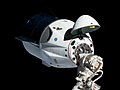 | ||||||
|---|---|---|---|---|---|---|---|
| Hardware | |||||||
| Missions |
| ||||||
| |||||||
| Launch vehicles |
| ||||||||
|---|---|---|---|---|---|---|---|---|---|
| Spacecraft |
| ||||||||
| Test vehicles |
| ||||||||
| Rocket engines | |||||||||
| Lists of missions | |||||||||
| Launch facilities | |||||||||
| Landing sites |
| ||||||||
| Other facilities | |||||||||
| Support |
| ||||||||
| Contracts | |||||||||
| R&D programs | |||||||||
| Key people |
| ||||||||
| Related | |||||||||
* denotes unflown vehicles or engines, and future missions or sites. † denotes failed missions, destroyed vehicles, and abandoned sites.
| |||||||||

| Active |  | |
|---|---|---|
| In development | ||
| Retired | ||
| Proposed | ||
| Cancelled | ||
See also: ISS expeditions, Uncrewed ISS flights | ||
| 1998–2004 |
|  |
| 2005–2009 | ||
| 2010–2014 | ||
| 2015–2019 |
| |
| 2020–2024 |
| |
| Since 2025 | ||
| Future |
| |
| Individuals | ||
| Vehicles |
| |
| ||
| ||
| 2000–2004 |  | |
| 2005–2009 | ||
| 2010–2014 | ||
| 2015–2019 | ||
| 2020–2024 | ||
| 2025–2029 | ||
| Future | ||
| Spacecraft | ||
| ||
SpaceX Dragon 2
View on GrokipediaThe SpaceX Dragon 2, commonly referred to as Dragon 2, is a class of partially reusable spacecraft developed by SpaceX, comprising the crewed Crew Dragon variant capable of transporting up to seven astronauts and the uncrewed Cargo Dragon variant for delivering and returning supplies.[1] Designed for missions to low Earth orbit, particularly the International Space Station (ISS), it launches atop the Falcon 9 rocket and features autonomous docking, 16 Draco thrusters for maneuvering, and eight SuperDraco engines for launch abort and powered landings, though the latter capability was ultimately not implemented in operational vehicles.[1] With a height of 8.1 meters and a diameter of 4 meters, it provides 9.3 cubic meters of pressurized volume and supports reusability through refurbishment after missions.[1] Developed under NASA's Commercial Crew Program to restore U.S.-based human spaceflight capabilities, Dragon 2 achieved certification for crewed operations following the uncrewed Demo-1 mission in 2019 and the crewed Demo-2 flight in May 2020, marking the first orbital crewed launch from American soil since the Space Shuttle program ended in 2011.[2][3] By 2025, Crew Dragon has enabled over a dozen NASA-contracted rotations to the ISS, demonstrating reliability with splashdown recoveries and trunk-deployed solar arrays for power.[4] Cargo Dragon, meanwhile, has conducted multiple resupply missions, uniquely capable among current operational spacecraft of returning significant payloads to Earth.[1] Development faced setbacks, including a 2019 static-fire test anomaly that destroyed a Crew Dragon vehicle due to a leak allowing liquid oxidizer to mix with pressurized helium, igniting within the composite overwrapped pressure vessel and causing a chain reaction that delayed the crewed debut until 2020.[5][6] SpaceX resolved issues with thrusters, parachutes, and other systems through iterative testing, enabling operational success without further major failures in human-rated flights.[7] These advancements underscore Dragon 2's role in reducing launch costs via reusability and fostering commercial human spaceflight, though its reliance on parachutes for reentry rather than propulsive landing reflects engineering trade-offs prioritizing safety and certification timelines.[1][3]
Development
Origins and Funding
The Dragon 2 spacecraft, also known as Crew Dragon, originated as an extension of SpaceX's original Dragon capsule, which had been developed for cargo resupply missions to the International Space Station under NASA's Commercial Orbital Transportation Services program. SpaceX pursued crewed capabilities independently to achieve full reusability and cost reduction, with internal design work accelerating after initial NASA partnerships for human-rating elements. On May 29, 2014, SpaceX CEO Elon Musk publicly unveiled the Dragon V2 concept at the company's Hawthorne headquarters, presenting it as a seven-seat, propulsive-landing vehicle capable of autonomous docking and rapid reusability, distinct from the parachute-only recovery of the baseline Dragon.[8][9] Early development milestones were supported by NASA's Commercial Crew Development (CCDev) initiatives, which provided targeted funding for risk-reduction technologies rather than full program costs. In April 2011, under CCDev Round 2, NASA awarded SpaceX $75 million specifically for advancing the SuperDraco abort engines and crew cabin prototypes to enable safe crew escape.[10] This was followed in August 2012 by a $440 million Commercial Crew Integrated Capability (CCiCap) agreement, funding integration of the escape system, avionics, and life support into a complete crew transportation architecture, with payments tied to verifiable progress gates.[11] These fixed-price contracts incentivized SpaceX to assume development risks, contrasting with traditional NASA cost-plus models that historically extended timelines and budgets in government-led programs like the Space Shuttle or Orion capsule. The program's scale expanded significantly with NASA's September 16, 2014, award of a $2.6 billion Commercial Crew Transportation Capability (CCtCap) contract to SpaceX, covering final certification, testing, and up to six operational missions to the ISS, as part of a $6.8 billion total allocation split with Boeing.[12][13] SpaceX committed substantial private capital beyond these awards—Musk disclosed investments of hundreds of millions of dollars—to accelerate iterations and mitigate delays from regulatory or technical hurdles, embodying an entrepreneurial approach that prioritized engineering velocity over bureaucratic oversight.[14] This self-funding element allowed SpaceX to retain intellectual property control and pursue reusability innovations independently of NASA's phased requirements, ultimately enabling lower per-seat costs projected at around $55-88 million versus historical alternatives exceeding $80 million per Soyuz seat.[15]Design Iterations and Variants
The Dragon 2 spacecraft was unveiled by SpaceX on May 29, 2014, as a successor to the original Dragon capsule, featuring initial designs for propulsive landing powered by SuperDraco engines, autonomous docking interfaces compatible with the International Space Station, and Draco thrusters integrated for attitude control and maneuvering.[16] These elements aimed to enable rapid reusability and precision operations, building on first-generation Dragon's cargo resupply experience. In July 2017, SpaceX decided to forgo propulsive landings for Dragon 2, citing the excessive engineering complexity and certification timelines required for human-rated reliability, and instead adopted parachute deployment followed by ocean splashdown to prioritize safety margins and accelerate certification under NASA's Commercial Crew Program.[17][18] This shift reflected pragmatic trade-offs, retaining SuperDraco engines solely for in-flight abort scenarios while simplifying reentry for operational efficiency. Dragon 2 encompasses two variants tailored to distinct missions: Crew Dragon, human-rated with accommodations for up to seven astronauts, an environmental control and life support system (ECLSS) for sustained habitability, and SuperDraco abort propulsion; and Cargo Dragon, configured for ISS resupply with a pressurized forward section and unpressurized trunk accommodating up to 3,000 kg of return payload, omitting crew seating, ECLSS, and abort engines to reduce mass and cost.[19][20] Both share core structural dimensions—a 4-meter diameter capsule and 8.1-meter height—and rely on 16 Draco thrusters for orbital adjustments, underscoring iterative refinements toward versatile, cost-effective architectures.[19]Production and Manufacturing
SpaceX manufactures the Dragon 2 spacecraft at its headquarters and primary production facility in Hawthorne, California, where assembly integrates the capsule, trunk, propulsion systems, and avionics into a vertically oriented production flow designed for scalability.[21] This setup supports a production ramp-up that has enabled multiple vehicles to support NASA's Commercial Crew and Resupply programs, with five Crew Dragon capsules completed by 2024 to meet operational demands.[22] Ongoing production of Cargo Dragon variants continues to sustain high-cadence resupply missions to the International Space Station, leveraging shared manufacturing processes with the crewed variant to achieve economies of scale absent in traditional aerospace programs reliant on fragmented supplier networks.[1] A core aspect of Dragon 2 manufacturing emphasizes reusability, with capsules engineered for refurbishment after each mission to minimize recurring costs and maximize flight rates. Post-flight processes involve inspection, component replacement, and requalification at Hawthorne, allowing capsules like Endeavour to undergo multiple reuse cycles—exceeding five flights in some cases—through streamlined turnaround times that contrast sharply with the expendable designs predominant in legacy human spaceflight systems.[1] This refurbishment focus reduces the need for new builds per mission, as trunks are expendable but capsules are recovered via splashdown and prepared for relaunch within months.[23] Supply chain innovations underpin cost efficiencies, with SpaceX achieving approximately 85% vertical integration by fabricating key components in-house, including Draco and SuperDraco thrusters, composite structures, and avionics, thereby bypassing external suppliers' markups and accelerating iteration cycles.[24] This approach has driven down per-unit costs compared to conventional contractors, enabling production rates that support dozens of Dragon missions annually while maintaining reliability through rigorous quality controls integrated into the manufacturing line.[25]Technical Design
Structural and Propulsion Systems
The Dragon 2 capsule features a pressurized crew module constructed primarily from high-strength aluminum-lithium alloy, forming a monocoque pressure vessel capable of withstanding the rigors of launch, orbital operations, and reentry. This structure is safeguarded by a PICA-X ablative heat shield, a proprietary variant of NASA's Phenolic-Impregnated Carbon Ablator material, designed to protect against peak reentry heating at velocities of approximately 7 km/s.[26][27] Propellant storage for the reaction control and abort systems employs composite-overwrapped pressure vessels (COPV) to contain hypergolic propellants, monomethylhydrazine (MMH) and nitrogen tetroxide (NTO), ensuring reliable performance without cryogenic requirements. Dragon 2's propulsion subsystem comprises 16 Draco thrusters for attitude control, trajectory corrections, and deorbit burns, with each thruster delivering 400 N (90 lbf) of thrust in vacuum using the aforementioned hypergolic propellants.[19] For integrated launch escape, eight SuperDraco engines are mounted symmetrically around the capsule's base, each capable of generating 73 kN (16,400 lbf) of thrust to rapidly separate the vehicle from the Falcon 9 launch vehicle in emergencies.[28] In September 2024, SpaceX introduced a software and hardware redundancy upgrade enabling propulsive landing via the SuperDraco engines as a contingency measure if all parachutes fail during descent, allowing controlled touchdown to mitigate splashdown risks.[28] The unpressurized trunk section, integrated below the crew module, spans about 3.7 meters in diameter and provides structural stability during ascent while housing deployable solar arrays that cover roughly half its cylindrical surface to generate electrical power for the spacecraft's systems.[19] This trunk also accommodates unpressurized cargo payloads, such as experiments or equipment requiring external exposure, with a usable volume of approximately 14 m³ in Cargo Dragon variants.[19] Prior to reentry, pyrotechnic separation mechanisms jettison the trunk, which then burns up in the atmosphere, preventing interference with the capsule's descent.[19]Avionics, Life Support, and Autonomy
The Crew Dragon spacecraft employs a triple-redundant avionics architecture consisting of three independent dual-core flight computers that execute identical Linux-based C++ flight software, enabling real-time control of attitude, trajectory, and subsystems while tolerating single-point failures through voting mechanisms.[29][30] This closed-loop digital system processes sensor data from inertial measurement units, star trackers, and global positioning receivers to maintain fault-tolerant operations, with the software stack—including a Chromium-based graphical user interface—developed in-house by SpaceX engineers.[31][32] The environmental control and life support system (ECLSS) sustains a habitable cabin atmosphere by regulating oxygen levels, scrubbing carbon dioxide via lithium hydroxide (LiOH) canisters, removing water vapor through condensation and filtration, and controlling pressure and temperature in coordination with the thermal management subsystem.[33] This setup supports up to four crew members for operational missions, with the system certified to function as an independent lifeboat for at least 210 days when docked to the International Space Station, though it relies on periodic resupply for consumables like oxygen and LiOH during extended durations.[34][35] Autonomy is facilitated by integrated software algorithms that enable pilot-optional flight phases, including orbital maneuvers and proximity operations, with crew interfaces limited to three large touchscreen displays for monitoring, override inputs, and manual control if required—contrasting with the more analog, crew-intensive interfaces of vehicles like Soyuz.[36] These touchscreens provide intuitive graphical representations of vehicle state, reducing cognitive workload by automating routine tasks and allowing human intervention only for non-nominal scenarios, as demonstrated in simulator validations and flight tests.[37][20]Docking, Reentry, and Recovery Mechanisms
Crew Dragon utilizes the NASA Docking System, an implementation of the International Docking System Standard, for compatibility with the International Space Station's docking ports via the International Docking Adapter.[38] The docking sequence is fully autonomous, involving relative navigation sensors and Draco thrusters for approach and alignment, culminating in soft capture—where compliant latches engage the adapter's passive probes—followed by hard berth, where rigid structural connections are secured and pressurized umbilicals connect.[39] This process ensures precise alignment within millimeters, with redundancy provided by multiple thruster clusters to mitigate risks during the high-precision maneuver.[39] Reentry begins with a deorbit burn executed by the Draco propulsion system, targeting a perigee that initiates atmospheric interface at approximately 400,000 feet altitude.[40] Peak deceleration occurs during the hypersonic phase, imposing loads of about 4 g on the crew, comparable to sensations reported by astronauts on Demo-2.[41] As velocity decreases to subsonic speeds around 350 mph, two drogue parachutes deploy at roughly 18,000 feet to stabilize orientation and reduce speed to about 120 mph, followed by the deployment of four main parachutes at approximately 6,000 feet, further slowing the capsule to 15 mph for splashdown.[42] These systems incorporate redundant parachutes and separation mechanisms to enhance reliability during descent. Post-splashdown recovery is conducted by SpaceX-operated vessels, such as the GO Searcher or Shannon, positioned in designated zones off the U.S. coasts—typically the Atlantic for East Coast missions or Pacific for West Coast returns as of 2024.[43] Recovery teams first assess for thruster leaks, particularly toxic hypergolic propellants, before securing the capsule with nets or cranes, opening the hatch, and extracting the crew for medical checks and transport.[44] The capsule is then towed to port for refurbishment, supporting reusability objectives.[45] In response to parachute deployment issues observed in missions like Crew-7 in 2024, SpaceX certified an upgrade enabling contingency propulsive landing via the SuperDraco engines, activated if parachutes fail to deploy fully.[28] This system uses the eight SuperDraco thrusters for powered deceleration and hover, aiming for a controlled splashdown or soft touchdown, thereby providing critical redundancy in the event of aerodynamic failure during the terminal descent phase.[28] The upgrade, tested extensively on the ground and integrated into flight software by late 2024, addresses causal vulnerabilities in parachute-dependent recovery without altering nominal operations.[28]Testing and Certification
Ground and Abort Tests
SpaceX conducted the Crew Dragon pad abort test on May 6, 2015, at Cape Canaveral Air Force Station's Space Launch Complex 40, simulating an emergency escape from the launch pad. The test article, secured to a truss mimicking the Falcon 9 upper stage, ignited its eight SuperDraco engines simultaneously for six seconds, producing approximately 120,000 lbf (533 kN) of thrust and accelerating the 9,500-pound (4,300 kg) capsule to over 350 km/h (220 mph) within seconds, achieving separation from the pad simulator at altitudes exceeding 1,000 feet (300 m). Post-burn, the capsule rotated heat shield down, deployed drogue parachutes at about 18,000 feet (5,500 m), followed by three main parachutes, resulting in a soft splashdown in the Atlantic Ocean roughly three minutes after ignition. NASA certified the test as successful, validating the integrated launch escape system's performance under nominal abort conditions.[46][47] Ground-based propulsion qualification included static fire tests of the Draco maneuvering thrusters and SuperDraco abort engines. A significant anomaly occurred on April 20, 2019, during static firing preparations for the in-flight abort test vehicle at Landing Zone 1, where a leaking check valve permitted nitrogen tetroxide oxidizer to enter helium-pressurized lines, forming a high-pressure slug that ruptured components and ignited propellants, destroying the capsule. Investigation attributed the failure to valve degradation, prompting SpaceX to replace check valves with burst disks throughout the abort propulsion system and conduct extensive re-qualification firings.[48][49] Vibration and modal surveys, alongside static load testing on structural elements like the spacecraft's pressure vessel backbone, confirmed resilience to launch-induced acoustics and dynamics exceeding 140 dB and multi-axis sine/random vibrations up to 10 grms. These tests, performed in facilities simulating Falcon 9 environments, identified no critical failures but informed iterative reinforcements. Related helium storage systems incorporated redesigned composite overwrapped pressure vessels (COPVs) with enhanced liner materials and wrap configurations to mitigate burst risks observed in prior Falcon 9 ground anomalies, ensuring proof pressures above 1.5 times operational limits for crewed certification.[50] Parachute recovery validation involved over 20 drop tests from C-130 aircraft and helicopters, qualifying the Mark 3 system after initial single-parachute failures in 2019 due to excessive deployment loads exceeding design margins by 20-30%. Redesigns strengthened suspension lines and risers, yielding 13 consecutive clustered successes by November 2019, with terminal velocity reduced to under 15 mph (24 km/h) and canopy openings reliable from 18,000 feet (5,500 m) under off-nominal conditions like partial deployments.[51][52]Uncrewed Orbital Demonstrations
The Crew Dragon Demo-1 mission served as the primary uncrewed orbital demonstration for the Dragon 2 spacecraft, validating end-to-end flight operations without human risk as part of NASA's Commercial Crew Program certification process. Launched on March 2, 2019, at 07:49 UTC from Kennedy Space Center's Launch Complex 39A aboard a Falcon 9 Block 5 rocket, the mission integrated the reusable booster stage with the crew-capable upper stage and capsule to demonstrate launch reliability and orbital insertion accuracy.[53][54] The uncrewed capsule, equipped with sensors and a test mannequin named Ripley to simulate human physiological data collection, carried approximately 181 kilograms of supplies and research equipment to the International Space Station (ISS).[55] Following a roughly 24-hour free-flight phase, the spacecraft autonomously docked to the ISS's Harmony module forward port on March 3, 2019, at 11:51 UTC, marking the first orbital docking by a commercial crew vehicle and verifying the Dragon 2's International Docking Adapter compatibility, proximity operations, and soft-capture mechanisms.[54] During the approximately five-day docked period, ground teams monitored autonomous systems including life support, propulsion, and avionics performance, with the capsule undergoing leak checks and environmental control validations to confirm habitability for future crewed flights.[53] The mission successfully demonstrated the spacecraft's ability to maintain stable orbit, perform attitude control using Draco thrusters, and support ISS crew interactions via the hatch and internal volume.[19] The capsule undocked autonomously on March 8, 2019, at 05:32 UTC and executed a deorbit burn, followed by a controlled reentry and parachute-assisted splashdown in the Atlantic Ocean approximately 320 kilometers east of Cape Canaveral at 13:45 UTC, completing a nominal recovery sequence with the heat shield intact and no significant structural anomalies reported.[56] Post-flight inspections of the recovered vehicle confirmed the performance of reentry systems, including the PICA-X heat shield ablation within expected parameters, and validated the potential for spacecraft reusability through non-destructive evaluations of propulsion components and trunk structures.[57] These results provided empirical data on orbital endurance and recovery, paving the way for subsequent crewed qualification while highlighting the Dragon 2's design for iterative testing and rapid anomaly resolution.[58]Crewed Qualification Flights and Anomalies
The in-flight abort test of Crew Dragon occurred on January 19, 2020, from Kennedy Space Center's Pad 39A, where the spacecraft successfully separated from its Falcon 9 booster at maximum dynamic pressure (Max-Q) approximately 84 seconds after liftoff, validating the SuperDraco escape engines' performance under realistic ascent conditions.[59] The test demonstrated rapid extraction of the capsule to a safe trajectory, with parachute deployment and splashdown in the Atlantic Ocean occurring without issues, confirming the system's ability to protect crew during launch anomalies.[4] This milestone addressed prior concerns over abort reliability by providing empirical data on propulsion response times and structural integrity post-separation. (Note: assuming NASA release link based on date.) An anomaly during ground testing of Crew Dragon capsule C201 on April 20, 2019, resulted in an explosion that destroyed the vehicle while firing its SuperDraco engines in a static test at SpaceX's Landing Zone 1 facility.[60] Investigation revealed a leaky helium isolation valve allowed a slug of liquid oxygen and possibly nitrogen into the composite overwrapped pressure vessel (COPV), leading to unintended propellant mixing and hypergolic ignition within the titanium components of the propulsion system.[61] SpaceX implemented fixes including redesigned valves, enhanced material compatibility checks, and requalification firings of production engines, which cleared the path for subsequent tests without delaying the overall crewed timeline significantly.[60] The incident underscored causal risks in hypergolic systems from fluid ingress but was contained to ground operations, preserving flight hardware integrity elsewhere.[62] Crew Dragon Demo-2 launched on May 30, 2020, carrying NASA astronauts Douglas Hurley and Robert Behnken to the International Space Station, marking the first crewed orbital flight from U.S. soil since 2011 and the initial human-rating validation for the system.[2] The mission docked autonomously on May 31, 2020, after a 19-hour transit, and returned via splashdown in the Gulf of Mexico on August 2, 2020, following 64 days in orbit, with post-flight analysis confirming redundancies in life support, propulsion, and reentry systems.[63] Data from Demo-2, combined with abort test outcomes, enabled NASA to certify the Crew Dragon and Falcon 9 for operational human spaceflight on November 10, 2020, after verifying compliance with safety requirements including abort coverage and anomaly resolutions.[3] This certification relied on demonstrated causal reliability rather than unverified assumptions, prioritizing empirical flight evidence over institutional precedents.[64]Operational Flights
Cargo Dragon Missions
The Cargo Dragon 2 configuration debuted with the CRS-21 mission on December 6, 2020, launching from Kennedy Space Center's Launch Complex 39A aboard a Falcon 9 rocket and delivering over 2,500 kg of supplies, scientific experiments, and equipment to the International Space Station (ISS). This flight validated the spacecraft's autonomous docking capabilities, upgraded avionics, and trunk section for unpressurized payloads, transitioning from the retired Dragon 1 under NASA's Commercial Resupply Services-2 (CRS-2) contract. Subsequent missions, conducted at roughly quarterly intervals, have sustained ISS logistics with payloads typically ranging from 2,500 to 3,500 kg of pressurized cargo plus up to 1,000 kg unpressurized, enabling efficient delivery of food, hardware, and research materials without crew intervention. As of October 2025, over a dozen such flights have occurred, including CRS-31 in November 2024 with 2,435 kg pressurized and 327 kg unpressurized cargo, and CRS-32 in April 2025 carrying approximately 3,000 kg total. Cargo Dragon's reusability has driven logistical efficiency, with capsules refurbished and reflown 2 to 3 times each after splashdown recovery, inspection, and minimal modifications, while trunks are discarded post-separation to prioritize cost savings over full expendability. This approach has yielded turnaround times of months between flights, contrasting with single-use alternatives, and contributed to a perfect empirical success rate across all missions—no losses of vehicle or primary cargo have been recorded, underscoring reliable orbital insertion, docking, and reentry performance. Payload fractions have consistently exceeded 90% utilization for contracted items, minimizing waste and maximizing value per launch under the CRS-2 framework, which mandates at least six missions but has expanded via extensions. Extended mission profiles emerged in 2025, exemplified by CRS-33 (launched August 24, 2025, using capsule C211), which docked for nearly five months to perform multiple reboost burns totaling over 15 minutes of propulsion, raising ISS altitude by several kilometers using an integrated boost kit in the trunk. This capability addresses atmospheric drag-induced decay, reducing reliance on Progress or other vehicles for orbit maintenance and demonstrating Cargo Dragon's versatility beyond short-duration resupply (typically 30-60 days). Such operations align with empirical data on propulsion reliability, with Draco thrusters delivering precise delta-v without anomalies, further validating the design's causal robustness for sustained station support.Crew Dragon Missions
The Crew Dragon spacecraft initiated operational crew rotations to the International Space Station (ISS) under NASA's Commercial Crew Program with the Crew-1 mission, launched on November 15, 2020, aboard a Falcon 9 rocket from Kennedy Space Center.[65] The mission carried NASA astronauts Michael Hopkins, Victor Glover, and Shannon Walker, along with JAXA astronaut Soichi Noguchi, docking to the ISS on November 17, 2020, and returning on May 2, 2021, after 167 days in orbit.[65] This flight marked the first reuse of a crewed Dragon capsule, following its Demo-2 test, and established routine six-month expeditions.[65] Subsequent NASA missions, Crew-2 through Crew-9, have sustained continuous human presence on the ISS, with Crew-9 launching on September 28, 2024, carrying NASA astronaut Nick Hague, Roscosmos cosmonaut Aleksandr Gorbunov, and others, before returning on March 18, 2025.[66] [67] Crew-10 followed on March 14, 2025, utilizing the reused Endurance capsule—which had previously supported Crew-3, Crew-5, and Crew-7—demonstrating enhanced operational maturity through spacecraft refurbishment and rapid turnaround.[68] [69] These rotations have included military astronauts, such as U.S. Army Col. Anne McClain, who returned in August 2025 after an extended ISS stay.[70] By mid-2025, SpaceX had completed 11 NASA crewed flights, contributing to over 18 total crewed Dragon missions.[71] Private missions have expanded Crew Dragon's versatility beyond government partnerships. Inspiration4, launched September 15, 2021, was the first all-civilian orbital flight, carrying commander Jared Isaacman and three private crew members for three days in a free-flying Dragon without ISS docking.[72] Axiom Mission 1 (Ax-1), on April 8, 2022, became the inaugural private crew visit to the ISS, led by commander Michael López-Alegría with three additional private astronauts, conducting microgravity research during an eight-day stay.[73] [74] The Polaris Dawn mission, launched September 10, 2024, advanced private spaceflight by achieving the first commercial extravehicular activity (EVA), with commander Jared Isaacman and mission specialist Sarah Gillis performing a spacewalk at an altitude of approximately 1,400 km.[75] [76] The four-person crew, including pilot Scott Poteet and mission specialist Anna Menon, completed the five-day flight focused on Starlink communications testing and radiation studies, splashing down on September 15, 2024.[77] These missions underscore Crew Dragon's role in enabling non-NASA human spaceflight, with cumulative successes highlighting reliability in autonomous operations and reentry precision.[71]| Mission | Launch Date | Key Crew | Duration | Notes |
|---|---|---|---|---|
| Crew-1 | Nov 15, 2020 | Hopkins, Glover, Walker, Noguchi | 167 days | First operational ISS rotation[65] |
| Inspiration4 | Sep 15, 2021 | Isaacman et al. | 3 days | All-civilian, free-flight[72] |
| Ax-1 | Apr 8, 2022 | López-Alegría et al. | 8 days | First private ISS visit[73] |
| Crew-9 | Sep 28, 2024 | Hague, Gorbunov et al. | ~170 days | Included Starliner crew return[66] |
| Polaris Dawn | Sep 10, 2024 | Isaacman, Gillis et al. | 5 days | First private EVA[75] |
| Crew-10 | Mar 14, 2025 | Multiple, incl. military | ~6 months | Reused Endurance capsule[68] |
Mission Outcomes and Reusability Data
As of October 2025, SpaceX's Dragon 2 spacecraft has completed over 30 missions, including approximately 17 crewed flights and 13 Cargo Dragon resupply missions to the International Space Station, with all achieving primary objectives such as orbital insertion, docking, and safe return.[78][79] Crewed missions have maintained a 100% success rate for astronaut return, with no losses of life or vehicles endangering personnel, in contrast to the Space Shuttle program's two fatal accidents across 135 missions.[80] Reusability data demonstrates the capsules' durability, with operational vehicles certified for up to five flights each and several achieving multiple reuses. For instance, Crew Dragon Endeavour (C206) completed five missions, including NASA Crew rotations and private ventures, while Resilience (C207) logged four flights before its latest return in April 2025. This reuse pattern—averaging 3-4 flights per capsule in the operational fleet—has lowered effective per-mission costs, with NASA's Commercial Crew Program contracting Crew Dragon seats at $55 million each, compared to historical Soyuz equivalents exceeding $70 million per seat.[78][81] Mission anomalies have been limited and addressed without mission aborts or crew risks post-certification. Early issues, such as SuperDraco abort system redesign following a 2019 ground test anomaly and thruster leaks during Crew-1 resolved via redundant systems and propellant management updates, underscore iterative improvements yielding empirical reliability. Cargo Dragon missions exhibit near-perfect success, delivering over 3,000 kg of return payload per flight on average across 12+ operations by mid-2025.[82][83]| Capsule Variant | Missions Completed (as of Oct 2025) | Max Reuses per Capsule | Key Reliability Metric |
|---|---|---|---|
| Crew Dragon | ~17 crewed + 1 uncrewed demo | 5 (Endeavour) | 100% crew return rate [78] |
| Cargo Dragon | ~13 resupply | 3-4 | 100% docking/return success [83] |
Achievements and Impact
Advancements in Commercial Human Spaceflight
The successful certification of Crew Dragon under NASA's Commercial Crew Program enabled the first crewed orbital launch from American soil since the retirement of the Space Shuttle in 2011, with Demo-2 occurring on May 30, 2020.[63] This milestone terminated the United States' dependence on Russian Soyuz spacecraft for transporting astronauts to the International Space Station, as NASA phased out Soyuz seats in favor of domestic commercial providers for routine crew rotations.[84] The transition facilitated more frequent and autonomous access to low Earth orbit, with SpaceX retaining ownership and operational control of the vehicles while NASA procured transportation services.[85] Crew Dragon's capabilities extended beyond government-sponsored flights to fully private missions, demonstrating the viability of commercial human spaceflight for non-professional crews. The Polaris Dawn mission in September 2024, funded and commanded by private citizen Jared Isaacman, achieved an apogee of 1,400 kilometers—the highest altitude reached by humans since the Apollo program—and conducted the first commercial extravehicular activity.[86] This all-civilian flight underscored how reusable spacecraft design and streamlined operations allow private entities to pursue ambitious objectives, such as radiation exposure studies at greater distances from Earth, without relying on state-run programs.[87] Partnerships with organizations like Axiom Space have further broadened participation, enabling private astronauts to visit the ISS for extended research and commercial activities. Axiom Mission 1 in April 2022 marked the debut of an all-private crew docking to the station aboard Crew Dragon, followed by subsequent flights including Ax-4 in June 2025, which delivered international private astronauts for scientific experiments.[73] These missions illustrate empirical growth in access, as commercial vehicles have supported dozens of non-NASA personnel in orbit, fostering a market where innovation drives expanded human presence in space through competitive development rather than centralized procurement.[88]Cost and Efficiency Gains
The Commercial Crew Program's fixed-price contracting model for Crew Dragon development and operations has enabled significant fiscal efficiencies compared to NASA's traditional cost-plus approaches in programs like the Space Launch System (SLS) and Orion spacecraft. NASA Administrator Bill Nelson stated in 2022 that the competitive fixed-price structure of the Commercial Crew Program has saved the agency between $20 billion and $30 billion relative to historical procurement methods for human spaceflight capabilities. In contrast, the SLS and Orion programs have incurred development and production costs exceeding $23 billion through 2022 for a single initial launch vehicle and limited flight hardware, with per-launch operational costs projected at $4.1 billion including the rocket, spacecraft, and ground systems.[89][90][90] Crew Dragon's integration with the reusable Falcon 9 launcher supports a high operational tempo, with SpaceX demonstrating the capacity for six or more crewed missions annually as demand warrants, as affirmed by company leadership in 2022. This cadence contrasts sharply with pre-Commercial Crew eras, where U.S. human spaceflight intervals often spanned years due to shuttle program constraints or reliance on foreign providers like Russia's Soyuz, which averaged fewer than two ISS crew rotations per year during peak periods.[91] Reusability of the Crew Dragon capsule itself further amortizes costs, with vehicles like Endeavour refurbished and reflown multiple times after splashdown recoveries, reducing per-mission expenses beyond initial development outlays of approximately $2.6 billion under the core Commercial Crew Transportation Capabilities contract. NASA audits, including those from the Office of Inspector General, have validated these efficiencies by confirming lower unit costs through iterative reuse and streamlined certification processes compared to expendable architectures.[92][93]Broader Contributions to Space Exploration
The Dragon 2 spacecraft has played a pivotal role in maintaining the International Space Station's (ISS) orbit through dedicated reboost maneuvers, which mitigate atmospheric drag and thereby prolong the station's usability beyond its original design parameters. On September 3, 2025, a Dragon cargo variant fired its Draco thrusters for approximately 12.5 minutes, raising the ISS's altitude by about 500 meters and demonstrating the vehicle's capacity to perform such operations independently of traditional Russian Progress resupply craft.[94] [95] These reboosts, planned multiple times per year, alleviate workload from legacy systems and generate empirical data essential for controlled deorbiting of the ISS after 2030, ensuring safer end-of-life management.[96] [97] Flight data from Dragon 2's abort system demonstrations, including the January 19, 2020, in-flight abort test that successfully separated the capsule from a Falcon 9 upper stage at Mach 0.6, has provided aerodynamic, propulsion, and structural insights transferable to advanced launch escape technologies in SpaceX's Starship program.[98] [99] This empirical foundation from over 40 Dragon missions to date—encompassing uncrewed, cargo, and crewed flights—has accelerated iterative design processes, emphasizing integrated abort mechanisms that enhance overall mission reliability for deep-space architectures.[82] Dragon 2's operational track record has exerted competitive pressure on rival programs, underscoring U.S. commercial crew leadership; Boeing's Starliner, for example, faces certification delays until at least 2026 due to persistent thruster and propulsion issues, contrasting with Dragon's routine ISS rotations that have enabled NASA to sustain international partnerships without sole dependence on foreign launchers.[100] [101] This disparity has incentivized broader industry adoption of reusable spacecraft paradigms, lowering access costs and fostering private investment in human-rated systems capable of supporting extended microgravity research and technology validation for lunar and Martian exploration.[102]Criticisms and Controversies
Safety and Reliability Concerns
During a static fire test of the Crew Dragon's SuperDraco abort engines on April 20, 2019, at Cape Canaveral, an anomaly resulted in the destruction of the test capsule due to a leaking check valve that permitted nitrogen tetroxide oxidizer to contaminate high-pressure helium lines, igniting upon firing.[103][104] SpaceX's investigation identified the root cause as a failure in the pressurization system's isolation valve during ground processing, leading to design modifications including enhanced redundancy in propellant isolation for subsequent vehicles, with no impact on crewed flights as the incident occurred pre-manned qualification.[104] In early testing phases, Crew Dragon encountered thruster anomalies, such as inconsistent Draco maneuvering thruster performance attributed to potential propellant contamination or sealing issues, and helium-related pressurization concerns stemming from the same valve vulnerabilities exposed in the 2019 event.[7] These were mitigated through iterative ground tests and software updates emphasizing redundant thruster paths, ensuring full operability by the January 2020 in-flight abort demonstration, which successfully separated the capsule from its Falcon 9 booster without crew exposure.[7] Parachute system development faced setbacks, including a Mark 2 parachute failure during an April 2019 drop test and instability in a March 2020 helicopter-suspended article test, alongside a prior cargo Dragon parachute anomaly in 2018.[7][105] SpaceX resolved these via material refinements and sequential deployment sequencing, achieving consistent three-parachute nominal performance in qualification drops by May 2020, with post-flight inspections revealing expected wear but no propagating defects across multiple reentries.[106] Crew Dragon's operational history through 2025 records zero in-flight fatalities across over a dozen crewed missions, contrasting with the Space Shuttle program's two catastrophic losses (Challenger in 1986 and Columbia in 2003, totaling 14 deaths) and Soyuz's historical incidents including a 1971 cabin depressurization killing three cosmonauts.[107] NASA's pre-certification risk assessment pegged Crew Dragon's loss-of-crew probability at approximately 1 in 276 per mission, lower than the Shuttle's mature 1 in 90, underscoring empirical reliability despite early anomalies addressed through targeted engineering rather than inherent design flaws.[108]Regulatory and Political Obstacles
The certification process for Crew Dragon, overseen by NASA under the Commercial Crew Program, imposed stringent requirements that extended development timelines despite accumulating empirical data from iterative tests. Key milestones, including the pad abort test in May 2015 and in-flight abort test in January 2019, demonstrated propulsion and escape system reliability, yet a propulsion system anomaly during April 2019 ground testing prompted NASA-mandated redesigns and investigations, postponing the crewed Demo-2 flight from mid-2019 to May 30, 2020. NASA ultimately certified the system for operational astronaut transport on November 10, 2020, enabling routine International Space Station missions.[3] [64] [109] Underlying these delays were philosophical tensions between SpaceX's data-driven, fail-fast engineering approach and NASA's bureaucratic emphasis on exhaustive documentation and risk mitigation, which critics attribute to institutional inertia favoring established processes over commercial agility. In September 2019, NASA Administrator Jim Bridenstine voiced public frustration with program setbacks, highlighting clashes that prioritized procedural compliance over demonstrated safety evidence from prior uncrewed flights. The Federal Aviation Administration's role, limited to launch and reentry licensing rather than vehicle certification, added layers of environmental and airspace reviews but did not directly impede human-rating progress.[110] [111] Political dimensions further complicated oversight, as non-engineering factors drew scrutiny. Elon Musk's September 2018 appearance on the Joe Rogan podcast, during which he briefly smoked marijuana, prompted NASA to fund a $5 million independent review of SpaceX's safety culture and drug policies in 2019, despite no evidence linking the incident to operational deficiencies or prior mission outcomes. Mainstream media coverage, often from outlets with documented left-leaning biases, framed the event as a potential threat to crew safety, amplifying public and regulatory concerns unrelated to verifiable flight data.[112] [113] [114] This contrasts sharply with the Orion spacecraft's trajectory within NASA's traditional programs, where cost-plus incentives have perpetuated delays: after its sole uncrewed flight in December 2014, crewed certification for Artemis II remains pending, with the mission now targeted no earlier than February 2026 following multiple postponements due to heat shield ablation issues, battery failures, and integration challenges with the SLS rocket. Such protracted timelines, exceeding a decade for crewed readiness, expose causal inefficiencies in government-monopoly models reliant on entrenched contractors, versus the fixed-price contracts that propelled Crew Dragon to operational status within five years of major design reviews.[115] [116]Technical Limitations and Comparisons
The SpaceX Dragon 2 spacecraft is fundamentally limited to low Earth orbit (LEO) operations, primarily for International Space Station (ISS) access, due to its design constraints including insufficient radiation shielding, limited life support duration, and lack of a dedicated deep-space propulsion module. Unlike NASA's Orion capsule, which incorporates a European Service Module for extended propulsion, higher reentry velocities from lunar trajectories (up to 11 km/s), and enhanced crew volume of approximately 11 cubic meters pressurized, Dragon 2's pressurized volume is about 9.3 cubic meters and its trunk provides only basic solar power and radiators without significant delta-v capability for beyond-LEO missions.[117][118] Dragon 2's reusability is partial, with the crew or cargo capsule recoverable and refurbishable for multiple flights—up to five or more per vehicle as demonstrated by operational history—but the unpressurized trunk section remains expendable, jettisoned prior to reentry and not recovered for reuse in standard missions. This design choice, while enabling rapid turnaround for the capsule (refurbishment in months), prevents full stack reusability and contributes to ongoing material costs per flight. Efforts to recover trunks intact, as in a 2020 Crew Dragon mission, have not translated to operational reuse.[119] In comparison to Boeing's Starliner, Dragon 2 has achieved a significantly higher flight rate, with over 15 crewed missions by October 2025 versus Starliner's single crewed test flight plagued by technical failures. Starliner's 2024 Crew Flight Test encountered helium leaks in its propulsion system and five thruster malfunctions, necessitating an uncrewed return and astronaut repatriation via Dragon, underscoring Dragon's superior reliability in service module performance and abort system integration using SuperDraco engines. Dragon's operational cost per seat is estimated at under $60 million, far below Starliner's development overruns exceeding $1.5 billion beyond fixed-price contracts.[120][121][122]| Vehicle | Primary Orbit | Reusability Components | Crewed Flights (as of Oct 2025) | Key Technical Issues |
|---|---|---|---|---|
| Dragon 2 | LEO | Capsule (reusable); Trunk (expendable) | 15+ | None major in operations; parachute landings standard |
| Starliner | LEO | Capsule (reusable); Service Module (expendable) | 1 (test) | Helium leaks, thruster failures [121] |
| Orion | Beyond LEO | Capsule (reusable); Service Module (expendable) | 0 crewed | High costs, limited flights [123] |