Hubbry Logo
FNB FieldFNB FieldMain
Open search
FNB Field
Community hub
FNB Field
logo
8 pages, 0 posts
0 subscribers
Be the first to start a discussion here.
FNB Field
FNB Field
from Wikipedia

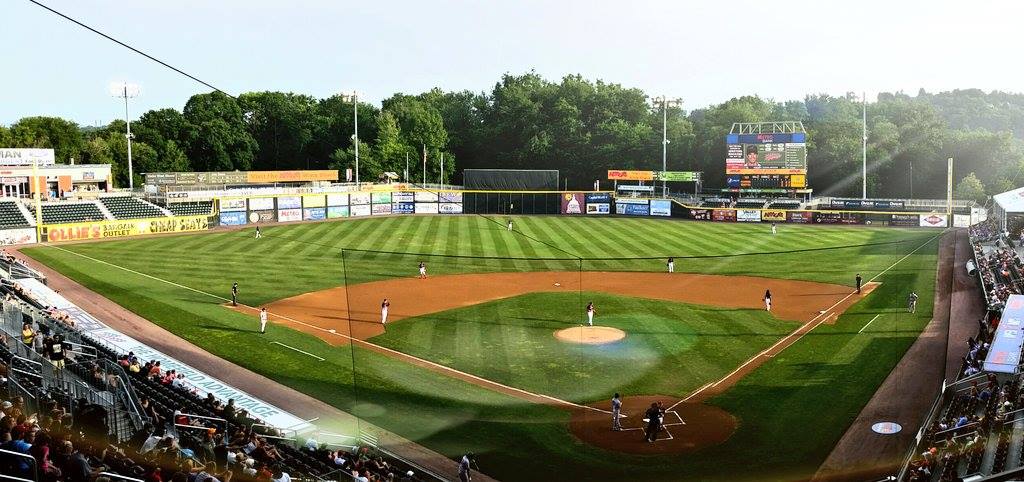
FNB Field is a baseball park in Harrisburg, Pennsylvania, on City Island in the Susquehanna River. It is the home field of the Harrisburg Senators, the Double-A Eastern League affiliate of the Washington Nationals, and was the home stadium of Penn FC of the USL. The original structure was built in 1987 and it was called Riverside Stadium until 2004. It has a capacity of 6,187.[8] The ballpark received a $45 million renovation that began in 2008.

Key Information

History

[edit]

FNB Field sits on the exact spot where baseball had been played earlier in the century, where other Harrisburg teams played from 1907 to 1952. The location, City Island, is a 62-acre waterfront park and sports complex. The facilities include volleyball courts, softball fields, a football/soccer field, water golf, nature tails, jogging paths, cycling paths, two marinas, the Pride of the Susquehanna paddlewheel riverboat, a food court called RiverSide Village, and a miniature train that runs around the island for tours.

The original ballpark is a steel and aluminum structure, and over the course of time, additional seating areas were built along first base, and box seats in foul territory and in front of the grandstands behind home plate to provide additional seating, despite official capacity being listed at over 6,000 since the park's inception. The stadium was used as the spring training facility in the movie Major League II, starring Charlie Sheen, Tom Berenger and Corbin Bernsen.

Stadium renovation

[edit]
The main entrance to FNB Field

FNB Field received a $45 million renovation ($18 million in city funding). Originally the renovation was scheduled to begin in 2005. However, problems with the availability of state funding for the project pushed it back to 2008, with the transfer of ownership between the 2007 and 2008 seasons.[9] The renovation project was finished in two phases, with the first phase being completed before Opening Day 2009.[10] The second phase of the project began in August 2009 and was completed prior to Opening Day 2010.[11]

The construction for the first phase of the project began in January 2009 and continued into April 2009. The changes and additions to FNB Field for the 2009 season were:

A public plaza and entrance was constructed in the left field corner; a boardwalk surrounding the outfield was constructed between the foul poles; a complete upgrade to the scoreboard; a new left field seating area; an outfield bar complete with drink rails; and new seating underneath the scoreboard; a new outfield wall constructed with static advertisement panels; and a new 8,600-square-foot (800 m2) Operations Building which houses the Senators front offices, ranger, security, first aid and the new box office along with the new Senators souvenir store, concession stand, and public rest rooms.[10]

The second phase of the construction project began in August 2009.[11] This project included the comprehensive changes to FNB Field that turned the stadium on City Island into one of the best and most unusual ballparks in minor league baseball.[12] The following is a comprehensive list of the renovation project:

  • Complete new seating bowl upgrades with individual chair back seats replacing the bench seating
  • Roofing covering the majority of the seating bowl
  • Construction of 20 suites with amenities including a glass wall located in the front of the suite to see the field and a in the back of the suite to see the city skyline
  • A new sound system
  • Creation of a "Midway" with activities and specialty areas geared towards children, teenagers and families
  • Completion of new concessions and restrooms on elevated concourses
  • Upgraded picnic areas which effectively double the size of the stadium picnic facilities
  • Reconfiguration of field lights including removal of two lights, addition of fixtures to remaining eight lights, re-lamp and re-aim of all lights, addition of quartz lighting bank for emergency purposes
  • Upgrade of the field-level concourse with brick pavers
  • Completion of the Operations Building by August 2009
  • New press box including new media and scoreboard control rooms
  • Complete renovation of existing buildings, including the home and visitors clubhouses and the restroom facilities
  • Development of a reserved parking lot.

The total construction costs for the project were $32 million and the total development budget for the entire project, including all costs, was approximately $45 million. Prior to the 2005 season, a new playing surface was installed which is also a part of the $45 million total project cost.

In the 2008 off-season, the renovation of the stadium began, with $500,000 in funding going towards a new public plaza, and other small amenities to be built into the stadium.[13] In the 2009 offseason, the rest of the stadium was renovated.

Stadium dimensions

[edit]
View of FNB Field from the outfield

The ballpark's original dimensions were fairly basic. The walls at the left and right field lines were 335 feet (102 m) from home plate, and the center field wall was 400 feet (120 m) from home plate, with the outfield wall pretty much the same setup that multi-purpose stadiums had in the 1980s (though FNB Field itself is not a multi-purpose stadium), with no extra bends or such in the wall, and the height of the wall at 8 feet (2.4 m). Billboards also ran around by the walls, and reached a height of 16 feet (4.9 m). Anything that hit the billboards was a home run. With the renovation of the park, and the addition of the boardwalk, some of the distances have changed, with left and right field now 325 feet from home plate. Center field's distance has stayed the same at 400 feet; however walls, unlike at left and right field, were raised to 16 feet instead of the original 8 feet, and the walls have extra bends that did not exist in the previous setup, predominantly in left center and right center field.

Dinosaur dance at FNB

Foul territory also currently varies, because there is a small amount of foul ground behind home plate. However, the further out toward the outfield, the wall on the foul ground stays somewhat parallel to the foul line in both left and right field, with only the box seats sticking out into foul ground helping to reduce the area somewhat. This was expected to change when the main grandstands are renovated in the 2009–2010 off-season. The bullpens were also located out in the foul territory by the outfield walls. While the visiting team's bullpen has stayed in the same place for the 2009 season, and is expected to be in the same general area for the 2010 season, the Senators moved their bullpen to a location behind the right field wall halfway through the season.

Trivia

[edit]
  • Because of the location, FNB Field is prone to flooding and a previous stadium at the site was washed out by a flood in 1935. Floods in the winter do not pose as much of a problem, as the ballpark can be repaired and ready for the next season, but floods during the baseball season can (and usually will) affect the Senators' schedule, forcing them to play their "home games" usually at their opponent's ballpark. In the 2006 season, a flood partially submerged the field and forced the Senators to play two "home games" against the Bowie Baysox as a doubleheader in Bowie. The most recent episode of this was during the 2011 playoffs when a flood completely submerged the field and forced the Senators to play their first two playoff "home games" against the Richmond Flying Squirrels in Richmond. Even though the Senators had the best record in the Eastern League, they went on to lose all three games in Richmond and were eliminated from the playoffs.
  • The record attendance at a Senators' game at FNB Field is 8,637, on September 1, 2011. The crowd was bolstered by a rehab start for Stephen Strasburg, while future Hall of Famer Iván Rodríguez caught for him, and the Senators' clinching of the division title.[14]

References

[edit]
[edit]
Revisions and contributorsEdit on WikipediaRead on Wikipedia
from Grokipedia
FNB Field is a situated on City Island in the in , serving as the home of the , the Double-A affiliate of the in . Opened in 1987 as , it has a seating capacity of 6,187 on a grass playing surface, with field dimensions of 325 feet to left and right fields and 400 feet to center. The stadium's history traces back to the revival of in Harrisburg after a hiatus, with the Senators franchise re-established in 1987 following earlier iterations dating to the on the same island site. Originally named , it underwent several renamings tied to sponsorships: Commerce Bank Park in 2004, Metro Bank Park in 2009, and its current designation as FNB Field in 2016. A major $45 million renovation project, implemented in phases starting in 2008, transformed the facility by adding a new seating bowl, protective roof over the stands, expanded clubhouses, and improved amenities to enhance fan experience and address environmental challenges like seasonal swarms; further improvements from 2023 to 2025 have included upgrades to lighting, clubhouses, and training facilities. FNB Field is renowned for its scenic riverside location, offering views of the Susquehanna while hosting Eastern League games, and it features unique attractions such as the Life-Size Bobblehead Hall of Fame, a permanent display of oversized bobbleheads of notable players and figures, and family-friendly elements like the Capital BlueCross Boardwalk and Kidzone play area. The venue has also accommodated non-baseball events, including the inaugural match "The Big Hitter" in 2022 and various community festivals, underscoring its role as a multifaceted hub in Pennsylvania's capital. Notable moments include record attendance of 8,637 in 2011 during a game featuring Washington Nationals prospect Stephen Strasburg's rehabilitation start, caught by Hall of Famer .

Overview

Location and Site

FNB Field is situated on City Island, a 63-acre recreational enclave in the , positioned between downtown Harrisburg and Wormleysburg in . Originally known by names such as Turkey Island, Maclay's Island, Forster's Island, and Hargast Island, the site served primarily for truck farming in its early years before being developed in the 1890s specifically for leisure and public enjoyment. It was formally designated City Island in 1898, transforming it into a key community asset amid the City Beautiful Movement's emphasis on urban green spaces. The island's central placement offers panoramic views of the river and surrounding urban landscape, enhancing its role as a hub for outdoor activities. The location at 245 Championship Way, Harrisburg, PA 17101, provides convenient access via pedestrian-friendly bridges, including the historic Walnut Street Bridge, connecting directly to downtown Harrisburg just across the river. This proximity facilitates easy reach for locals and visitors, with parking available on the island and nearby mainland areas. The site's historical significance includes hosting professional baseball starting in 1904, when the Harrisburg Athletics of the Tri-State League began playing there, building on initial wooden grandstands erected in 1900 for Island Park. Those grandstands were rebuilt in 1940 to improve safety and capacity amid growing attendance. Owing to its riverside position, the City Island site faces environmental vulnerabilities, particularly periodic flooding from the , which has inundated the area multiple times, including notable events in 1936, 1972, and 2011. These floods have historically disrupted operations and required protective measures, underscoring the challenges of maintaining infrastructure in such a dynamic waterway setting. FNB Field, as the primary venue on the island, serves as the home of the , the Double-A affiliate of the .

Capacity and Naming

FNB Field has a current of 6,187, which was established following the completion of its major renovation project in 2010. The stadium's record single-game attendance is 8,637, achieved on September 1, 2011, during a rehabilitation appearance by pitcher . This figure exceeded the venue's fixed seating limits due to additional standing-room accommodations for the high-profile event. The ballpark opened in 1987 under the name , reflecting its location along the . It was constructed at a cost of $1.3 million, equivalent to approximately $3.6 million in 2024 dollars when adjusted for inflation. It was renamed Commerce Bank Park in 2004 due to a sponsorship deal, then changed to Metro Bank Park in 2009 as part of a sponsorship agreement with the local following the of Commerce Bank. In 2016, following F.N.B. Corporation's acquisition of Metro Bank's parent company, the venue was renamed FNB Field to align with the new corporate ownership. The 2008–2010 renovation significantly expanded the stadium's capacity from its original configuration, enhancing fan accessibility and comfort.

History

Early Baseball on City Island

arrived on City Island in , in 1907, when the local team, known as the , joined the Class D Tri-State League. The Senators played their home games at Island Park, a ballfield situated on the 63-acre island in the , establishing the site as a hub for in central . Over the next several years through 1915, the team competed in the Tri-State League, achieving notable success including a league championship in 1912. Following a brief stint in the in 1915, the Senators returned to prominence in the 1920s and 1930s across multiple circuits, including the New York-Penn League from 1924 to 1930 and the Eastern League in 1931 and 1932. During this era, the team secured three league titles in 1927, 1928, and 1931, drawing strong local support and featuring standout players that underscored City Island's growing reputation in . The site also hosted Negro league teams, such as the Harrisburg Giants, who played there in the 1920s and 1930s, adding to the island's diverse baseball heritage. Catastrophic flooding from the in March 1936 devastated Island Park, washing away the and field, which temporarily halted operations in Harrisburg. The venue was rebuilt and reopened in 1940 with a new , allowing the Senators to resume play in the Interstate League through 1952. In the mid-20th century, following the Interstate League's disbandment, City Island served as a multi-purpose facility for amateur and semi-, high school games, and community events, preserving the site's role in local sports amid the absence of affiliated teams. This longstanding tradition on the island paved the way for the construction of a modern stadium in 1987.

Construction and Opening

Construction of Riverside Stadium, the original structure of what is now , began in late 1986 and was completed in early 1987 on City Island in , replacing the earlier Island Park grandstand that had hosted since 1900. The project emphasized functionality with a bare-bones design, providing essential seating and playing facilities without luxury suites or advanced amenities to quickly restore to the site after a 35-year hiatus since the last affiliated team departed in 1952. The stadium opened on April 11, 1987, coinciding with the Harrisburg Senators' home opener against the Vermont Reds, marking the revival of Double-A baseball in Harrisburg as an affiliate of the Pittsburgh Pirates. Initial seating capacity stood at 6,187, accommodating fans along the Susquehanna River with basic concessions and restrooms but lacking modern comforts like club seating or extensive scoreboards. Early operations highlighted the stadium's no-frills approach, which supported the Senators' successful 1987 season—they clinched the Eastern League championship despite the rudimentary setup—yet underscored challenges such as limited fan amenities and vulnerability to environmental issues like river flooding, though these were not immediately transformative. The Pirates affiliation lasted through 1990, followed by ties to the Montreal Expos from 1991 to 2004 and the Washington Nationals from 2005 onward, solidifying the venue's role in minor league baseball continuity.

Renovations and Upgrades

2008–2010 Renovation Project

The renovation of FNB Field, then known as Commerce Bank Park, was initiated in late to address the aging infrastructure of the stadium originally constructed in 1987. Announced on December 19, , by Harrisburg Stephen Reed, the project aimed to modernize the facility and enhance its role as a asset. The total cost was approximately $45 million, with funding sourced from $18 million in city bonds secured by ballpark and over $20 million in state grants, including $2 million from the Department of and and $18.5 million from the Redevelopment Assistance Capital Program. The project unfolded in two phases. Phase 1, spanning 2008 to 2009 and costing $6.35 million, focused on immediate upgrades to improve accessibility and spectator experience. Key additions included a new public plaza and entrance in left field, an , upgraded seating in left field, a new outfield bar and concessions area, a redesigned outfield wall with static advertising panels, and an 8,600-square-foot Operations Building housing offices, a , team store, additional concessions, and restrooms. An enhanced scoreboard was also installed during this phase. These improvements were completed in time for the 2009 on April 16. Phase 2, from 2009 to 2010 and budgeted at $13.14 million, addressed structural and premium enhancements. This included a rebuilt seating bowl with chair-back seats and partial roofing for weather protection, expanding overall capacity to 6,187; the addition of 20 luxury suites featuring glass walls and skyline views; a new sound system; a family-oriented "Midway" activities area; upgraded concessions and restrooms; doubled seating capacity; reconfigured field lighting; a brick-paver ; a modernized ; and renovated clubhouses and player restrooms. Outfield wall adjustments were finalized to optimize sightlines and safety. Construction wrapped up in October 2010, with the stadium fully operational by 2010. The renovation transformed FNB Field from a basic venue into a modern regional attraction, significantly improving fan amenities such as premium seating and family zones while upgrading player facilities for better performance and comfort. These changes boosted attendance and positioned the stadium as a key economic driver for City Island, drawing visitors for games and other events.

2023–2025 Improvements

In July 2023, the Harrisburg City Council unanimously approved a commitment of $6 million in funding for upgrades to FNB Field, supported by a matching Redevelopment Assistance Capital Program grant from the Commonwealth of , with the total project estimated at $11–12 million and targeted for completion ahead of the 2025 season. These improvements, including a new LED field lighting system, were deemed essential to address facility deficiencies and secure the long-term tenancy of the amid threats of team relocation. Key enhancements focused on player welfare and compliance with Baseball's updated facility standards following the 2021 reorganization, which mandated modernized amenities such as dedicated spaces for female staff and coaches. The project introduced a new two-story clubhouse along the left field line, featuring separate locker rooms for home and visiting teams, an on-site weight room, and upgraded training areas to better support professional athletes. Additional upgrades included expanded protective netting extending further into the outfield to enhance fan safety and improved practice facilities to meet league requirements for batting cages and pitching areas. Project oversight advanced in March 2024 when the City Council authorized hiring Alexander Building Construction as manager and EwingCole as , with the latter receiving a $1.06 million for design services. In January 2025, JEM Group was announced as a key contractor for the clubhouse and overall , marking a significant step in executing the targeted renovations to align the venue with contemporary operations. commenced in late 2024, ensuring the upgrades would bolster the stadium's viability without disrupting the 2025 season schedule. The improvements, including the new clubhouse and expanded netting, were completed in time for the 2025 season opener on April 4.

Facilities and Dimensions

Field Dimensions

FNB Field's dimensions measure 325 feet from home plate to the left and right foul poles and 400 feet to center field, establishing a symmetrical layout that meets the minimum requirements for professional baseball parks as defined by rules, which adopts for Double-A Eastern League facilities. The 2008–2010 renovation project modified configuration by introducing bends and sharp corners to the perimeter walls, along with variations in wall height, while adjusting the foul pole positions to fit the updated design. These changes created a more dynamic playing surface without altering the core distance measurements. Since its construction and opening in 1987, the field has utilized a natural grass surface, providing a traditional playing environment consistent with Eastern League standards. A dedicated riverboat-shaped in center field ensures clear visibility for hitters during games.

Amenities and Features

FNB Field provides a range of fan amenities designed to enhance the spectator experience. The stadium features 20 luxury suites located on the UPMC Suite Level, offering private seating for groups of 12 to 24 people, personal attendants, wait service for and beverages, and panoramic views of the field and downtown Harrisburg skyline. Concessions have been improved to include diverse options with local flavors, such as Dutch , crumb cake, and sandwiches, available at multiple stands throughout the . areas include the Midway activities center, which offers games and for children, along with expanded zones equipped with tables and shaded seating for pre-game gatherings. Player facilities at FNB Field support professional athletic needs through modern infrastructure. Following the 2023–2025 improvements, a new two-story clubhouse provides dedicated locker rooms for home and visiting teams, integrated weight training areas, and enhanced training spaces to meet Major League Baseball's standards for Double-A facilities. Adjacent practice and training fields have been upgraded for better usability and safety. The 2010 renovation introduced an Operations Building for administrative functions and team offices, streamlining daily operations. Additional features contribute to and inclusivity. The stadium is equipped with a comprehensive sound system for announcements and , upgraded during earlier renovations. Scoreboard capabilities include digital displays in the press box for real-time game information. accommodations encompass wheelchair-accessible seating sections, companion seats, and entry ramps to ensure compliance with ADA standards. For , energy-efficient LED field lighting was installed in 2025, reducing energy consumption while maintaining illumination quality.

Tenants and Events

Baseball Tenants

The Harrisburg Senators have been the primary baseball tenant at FNB Field since the stadium's opening in 1987, serving as the Double-A affiliate of Major League Baseball's Washington Nationals. The team joined the Eastern League upon relocating to Harrisburg that year, establishing a continuous presence that makes it one of the league's longest-tenured franchises. Prior to affiliating with the Nationals in , the Senators were the Double-A club for the from 1991 to 2006, following an initial partnership with the from to 1990. This succession reflects the team's role in developing prospects for its parent clubs, with notable including players who advanced to the majors during these affiliations. The Eastern League, founded in as a Double-A circuit, has hosted the Senators since their entry, positioning Harrisburg as a key hub for in the Northeast. The franchise's longevity in the league underscores its stability amid broader changes, including the 2021 Minor League Baseball reorganization, which streamlined affiliations and renamed the circuit the Double-A Northeast for one season before reverting to the Eastern League name in 2022 while preserving the Senators' Double-A status. Attendance at Senators games has historically averaged between 3,000 and 4,000 fans per game. In 2023 and 2024, averages exceeded 4,100, with the team setting an all-time single-season attendance record of 302,496 in 2024. In 2025, the average was 3,924. Peaks occur during playoffs or high-profile events, such as rehabilitation appearances by major leaguers, with the stadium's single-game record standing at 8,637 set on September 1, 2011.

Other Sports and Notable Events

In addition to baseball, FNB Field has hosted professional soccer as a tenant. The Harrisburg City Islanders of the (USL), later rebranded as Penn FC, played their home matches at the stadium from 2016 to 2018 after transitioning from Skyline Sports Complex; the field was converted into a soccer pitch for these games. Penn FC ceased operations after the 2018 season to pursue stadium development opportunities, sitting out 2019 before announcing a move to in 2020, though the club ultimately folded. The stadium appeared in the 1994 film Major League II as the fictional spring training facility for the Cleveland Indians, with scenes filmed at the City Island ballpark featuring the Harrisburg Senators' grounds. Due to its location on City Island in the Susquehanna River, FNB Field has been vulnerable to flooding throughout its history and that of its predecessors. A severe flood in March 1936 inundated Island Park, the site's earlier ballpark, causing significant damage during a harsh winter season. In June 2006, heavy rains led to widespread flooding in the Mid-Atlantic region, resulting in the cancellation of Harrisburg Senators games and forcing two "home" contests to be played in Bowie, Maryland. More dramatically, Tropical Storm Lee in September 2011 caused the Susquehanna River to overflow, submerging the field and necessitating the relocation of the Senators' Eastern League playoff series to Richmond, Virginia, where they were swept in the first round. Beyond sports, FNB Field has served as a venue for concerts, festivals, and special appearances. Country singer performed there during a , 2017, celebration tied to a Senators game, drawing crowds for patriotic festivities and fireworks. Annual events like the Senstoberfest , benefiting local charities, feature craft brews from over 30 regional breweries, food trucks, and live entertainment on the grounds. The has also hosted gatherings such as the Harrisburg Book Festival, including author meet-and-greets and family-oriented activities like movie nights and holiday celebrations on City Island.

References

Add your contribution
Related Hubs
User Avatar
No comments yet.