Hubbry Logo
FedExForumFedExForumMain
Open search
FedExForum
Community hub
FedExForum
logo
8 pages, 0 posts
0 subscribers
Be the first to start a discussion here.
FedExForum
FedExForum
from Wikipedia

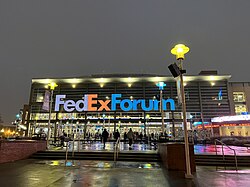
FedExForum is a multi-purpose indoor arena located in Downtown Memphis, Tennessee. It is the home of the Memphis Grizzlies of the National Basketball Association (NBA) and the NCAA Division I men's basketball program of the University of Memphis, both of whom previously played home games at the Memphis Pyramid. The venue also has the capability of hosting ice hockey games, concerts, and family shows.

Key Information

The arena officially opened in September 2004 after much debate and also a derecho wind storm on July 22, 2003, that nearly brought down the cranes that were building it near the famed Beale Street. It was built at a cost of US$250 million and is owned by the City of Memphis; naming rights were purchased by one of Memphis's best-known businesses, FedEx, for $92 million. FedExForum was financed using $250 million of public bonds, which were issued by the Memphis Public Building Authority (PBA).

Design

[edit]
FedExForum during a Memphis Grizzlies basketball game

Before FedExForum was built, Memphis' primary indoor entertainment venue had been The Pyramid, built in 1991. However, when city officials sought to lure either the Vancouver Grizzlies or Charlotte Hornets to Memphis, they discovered that the Pyramid was already obsolete as a potential NBA venue despite being only 10 years old. Retrofitting the Pyramid to NBA standards of the time would have not only been prohibitively expensive, but would have also required shuttering the arena for an entire season.[5] When the Grizzlies moved to Memphis for the 2001-02 season, they temporarily shared the Pyramid with the Memphis Tigers men's basketball team while a new arena was being built.

FedExForum was designed by architectural firm Ellerbe Becket. Concrete work done with the help of Dowco Construction and Apac. The arena is 805,850 ft2 (75,000 m2) in size, covering 14 acres (57,000 m2). The Arena is round, with a dome. The playing floor is lower than ground level. It is capable of seating 18,119[6] for basketball and has 1,000 premiere courtside seats. There are 27 courtside suites, 32 club suites, 4 party suites, and 80 club boxes. It also contains a full-sized practice basketball court, visible from the huge lobby. The plans called for a mass transit bus depot, which brought a federal grant of $6 million, but the depot was changed to a premium parking garage, and Memphis had to return the money.

FedExForum's interior was designed to pay tribute to Memphis' musical heritage, with paintings and murals depicting some of the city's most famous artists including Justin Timberlake, Elvis Presley, and B.B. King. Most of the Arena's restaurants are named in conjunction with FedExForum's overall theme of music with Opus Restaurant and the Blue Note Lounge. The two other restaurants are sponsor-driven with the Lexus Lounge just off the Arena Floor and Jack Daniel's Old No. 7 in the Grand Lobby of the Arena.

FedExForum was the first arena to utilize new "see-through" shot clock units which allow spectators seated behind the basket to see the action without having the clocks interfere with their view. The idea came when a fan of the NBA's New Jersey Nets who sat behind the basket at Continental Airlines Arena sent an e-mail to NBA Commissioner David Stern, asking for technology to improve his view, and Daktronics obliged with the innovation at FedExForum in 2004.[7] The NBA approved the unit a year later for full use and has seen the new units installed at Philadelphia's Wells Fargo Center, Spectrum Center, TD Garden, Moda Center, Capital One Arena, State Farm Arena, and Staples Center after the approval. As of the 2011–12 NBA season every NBA arena had implemented the transparent shot clocks, with Pepsi Center, The Palace of Auburn Hills, Oracle Arena, Target Center, and ARCO Arena being the last NBA arenas to install the clocks.

Hosted events

[edit]

College basketball

[edit]

On February 23, 2008, FedExForum hosted the college basketball game featuring the No. 1 ranked Memphis Tigers vs. the No. 2 ranked Tennessee Volunteers. The facility also hosted the Conference USA men's basketball tournament from 2005 to 2009. It was the site of the South regional semifinals and finals in the 2009, 2014, and 2017 editions of the NCAA Division I men's basketball tournament, and first- and second-round games of the 2024 tournament. FedExForum was one of the four regional finals in the 2010 NCAA Division I women's basketball tournament.

On March 12–15, 2014, the American Athletic Conference hosted their inaugural tournament at the FedExForum. It hosted the tournament again in 2019.[8]

Hockey

[edit]

On September 21, 2006, the Nashville Predators and the Columbus Blue Jackets played an NHL preseason game at FedExForum, the first ice hockey game ever held at the arena, won by the Predators 8–1.[9]

Boxing, WWE & MMA

[edit]

On September 25, 2004, FedExForum hosted the Roy Jones Jr. vs. Glen Johnson for the IBF Light heavyweight title. Johnson won the fight with a 9th-round knockout.

FedExForum has hosted three major professional wrestling events. In 2007, World Wrestling Entertainment's Unforgiven took place on September 16, headlined by The Undertaker and Mark Henry, and the PMG Clash of Legends independent show on April 27, featuring Hulk Hogan versus Paul Wight. In 2015, it hosted Fastlane on February 22. The first of five WWE house shows took place on September 19, 2004, shortly after the venue opened. It has hosted seven episodes of WWE Raw and four of WWE SmackDown. One notable instance of WWE at the arena was when Daniel Bryan "occupied" Raw with hundreds of his fans inside the ring and surrounding the ringside area on March 10, 2014.[10]

On December 12, 2009, FedExForum hosted an Ultimate Fighting Championship lightweight title fight, UFC 107: Penn vs. Sanchez

Other events

[edit]

In August 2010, the Professional Bull Riders' Built Ford Tough Series tour made their first appearance at FedExForum.[11]

On August 4, 2010, FedExForum held the memorial service to Memphis native Lorenzen Wright, a Memphis Tigers alum and former Memphis Grizzlies player.

The Church of God in Christ, Inc. (COGIC), a Holiness-Pentecostal denomination based in Memphis, held their annual Convocation at the FedExForum from 2004 to 2007.

The arena hosted Monster Jam for a few years, then in 2019 hosted Hot Wheels Monster Trucks Live.

Renovations

[edit]
Digital upgrades, which included a new scoreboard, were installed in time for the 2017-18 NBA season.

In order to keep the Grizzlies in Memphis, the City of Memphis has completed normal renovations to FedExForum to keep it up to NBA standards. In 2012, the arena's sound system was replaced[12] and the main basketball court was replaced for the Grizzlies for $200,000,[13] with the Tigers' court being replaced the following year. Three years later, FedExForum completed a renovation for the backstage areas, including a new video room, a renovation of the coaches' offices, and office space for FedExForum employees.[14] In 2017, the Grizzlies announced a $1.8 million renovation to the arena,[15] which includes an HD scoreboard four times the size of the former, new HD displays, new LED lighting, and other additional fan amenities, which were completed in time for the beginning of the 2017-2018 NBA Season.

See also

[edit]

References

[edit]
[edit]
Revisions and contributorsEdit on WikipediaRead on Wikipedia
from Grokipedia

FedExForum is a multi-purpose arena in , that opened in September 2004 as the primary venue for professional and collegiate basketball in the region.
It primarily serves as the home court for the National Basketball Association's and the Tigers men's basketball team of , accommodating approximately 18,400 spectators for basketball events.
Named through a corporate sponsorship agreement with secured in 2002 and extended as of 2025, the arena features advanced facilities including a large center-hung videoboard and has hosted numerous NBA playoff series, concerts, and other entertainment events since its inception.

History and Development

Planning and Financing (1990s–2002)

The relocation of the NBA's to Memphis, approved by the league in November 2000 and completed for the 2001–02 season, prompted city and county officials to accelerate plans for a modern arena to anchor the franchise and avert further relocation risks, as the existing Pyramid Arena lacked suitable amenities and revenue potential for professional . Mayor Willie Herenton advocated strongly for the project, emphasizing economic development and community prestige, while negotiating with stakeholders including the Grizzlies' ownership, who conditioned long-term commitment on arena upgrades. Financing centered on public mechanisms to fund the $250 million project without direct property tax increases, relying on incremental revenue streams projected to cover debt service through arena-generated activity. The plan included $65 million from state and local sales tax rebates on transactions within a designated zone, $52 million from hotel and motel taxes, and $21 million from car rental surcharges, all securitized via bonds issued by the New Memphis Arena Public Building Authority. These bonds were approved by the Memphis City Council in a 10-3 vote in early 2002, following debates where opponents argued that taxpayer-backed sports facilities diverted funds from pressing infrastructure needs like roads and schools, though proponents cited projected tourism and job growth as offsets. Private sector involvement supplemented public funds, with securing in October 2002 for $90 million over 20 years, providing upfront capital and branding synergy given the company's Memphis headquarters. This deal, part of a broader sponsorship package, helped bridge financing gaps and signaled corporate confidence in the venture, though it drew scrutiny over the allocation of public resources to benefit a relocating team owned by out-of-state interests. Overall, the package ensured construction could proceed without Grizzlies equity contributions, prioritizing retention of the franchise amid competitive NBA markets.

Construction and Opening (2002–2004)

for FedExForum occurred on , 2002, marking the start of construction for the multi-purpose arena in . The project, estimated at $250 million, featured design by the architectural firm , with contributions from local firms including Looney Ricks Kiss for urban integration elements. Construction progressed amid challenges, including a severe wind storm on July 22, 2003, which threatened on-site cranes but did not halt overall timelines. The arena reached substantial completion in July 2004, encompassing 750,000 square feet across 14 acres adjacent to the historic entertainment district. Engineering efforts emphasized robust concrete foundations, handled by contractors like Dowco Construction and Apac, to support the venue's circular structure and capacity for over 18,000 spectators in configuration. An attached five-level parking garage providing 1,500 spaces was developed concurrently, enhancing accessibility and facilitating the arena's role in anchoring urban redevelopment by linking flows to Beale Street's commercial and cultural vibrancy. This integration aimed to leverage the facility as a catalyst for economic activity in the surrounding streetscape, blending modern infrastructure with preserved historic surroundings. FedExForum officially opened in September 2004, hosting its inaugural preseason game shortly after structural completion. The venue's debut underscored its immediate utility for professional sports and entertainment, transitioning the NBA franchise from the aging Pyramid Arena and contributing to downtown Memphis's revitalization through increased foot traffic and event-driven investment in the area.

Early Operations and Tenant Stabilization (2004–2010)

The played their first full NBA regular season at FedExForum during 2004–05, averaging 16,862 attendees per home game, which represented a peak in early attendance figures amid the novelty of the new downtown venue. This season followed the arena's operational start in late 2004, with preseason exhibitions initiating regular use and helping to integrate the facility into the city's sports landscape. Concurrently, the Tigers men's team shifted its home games to FedExForum from the 2004–05 season onward, contributing to consistent utilization and drawing averages approaching 14,000 spectators annually in initial years. Diversified programming bolstered the arena's viability beyond basketball, with early concerts such as R. Kelly's performances on October 17 and 29, 2004, alongside , and on November 9, 2004, establishing FedExForum as a multi-purpose venue capable of hosting major entertainment acts. These events generated supplementary revenue, aiding tenant retention for , whose lease and operational costs were partially offset by shared facility income streams during the startup phase. No permanent secondary sports tenants, such as hockey teams, materialized despite the arena's ice-making capabilities, leaving as the primary stabilizer. Attendance trends reflected economic pressures, particularly the 2008 recession, which contributed to a league-wide decline in NBA spectatorship as reduced disposable income curtailed ticket sales. Grizzlies home crowds fell to a low of 12,745 per game in the 2007–08 season before a modest rebound to 13,485 in 2009–10, prompting operational adjustments like targeted promotions to maintain occupancy amid broader financial strain. Initial technical enhancements, including audio-visual systems tuned to NBA broadcast standards, were implemented post-opening to meet league requirements, ensuring the venue's competitiveness without major structural overhauls.

Architecture and Design

Site and Exterior Features

FedExForum is situated at 191 Beale Street in , encompassing approximately 14 acres of land adjacent to the historic entertainment district. The site's selection leveraged proximity to the , roughly 0.5 miles to the north, and built upon the legacy of the nearby Pyramid Arena, the Grizzlies' prior venue located directly on the riverfront, facilitating urban revitalization in the area following the team's relocation. The arena's exterior showcases a contemporary steel-and-glass facade, evoking Memphis's blues heritage through a "southern juke joint" aesthetic while prioritizing structural transparency and visibility. This design element rises to 144 feet, integrating into the city's skyline and supporting branding through prominent signage. In 2017, exterior enhancements included the installation of LED color displays overlooking , augmenting event illumination and dynamic lighting capabilities to draw crowds and enhance nighttime visibility. Post-opening developments incorporated a west-side plaza and repurposed alleyways as pedestrian walkways, improving access from and promoting connectivity within the surrounding urban fabric despite initial deviations from planned bus infrastructure.

Interior Layout and Capacity

FedExForum employs a multi-level interior layout comprising plaza (lower), club, and terrace (upper) bowls, facilitating efficient spectator flow and versatile event configurations. The arena seats approximately 18,000 patrons for , with 1,000 premium courtside positions including suites positioned at court level for intimate viewing. Club seating on the Pinnacle level provides wider seats and enhanced legroom, while upper terrace sections prioritize unobstructed sightlines to the . Seating arrangements are adaptable, expanding to nearly 19,000 for end-stage by retracting portions of the -level seating and utilizing standing areas. Acoustic engineering features distributed sound systems, including arrays, to deliver consistent clarity across the venue, supporting transitions from amplified sports announcements to performances. Lighting infrastructure, comprising LED fixtures and programmable grids, enables rapid reconfiguration for varying event demands, from high-intensity illumination to dynamic stage effects.

Naming Rights and Corporate Influence

The naming rights for were secured through a 20-year agreement valued at $90 million, announced on April 22, 2002, between Corporation and the . This deal provided the Grizzlies with annual payments that helped offset operational and development costs for the $250 million arena, which was primarily financed through public bonds issued by the Memphis Building Authority. The agreement allowed to prominently brand the venue, integrating its into a key Memphis landmark despite the arena's public funding origins. FedEx's involvement exemplified private-sector participation in public infrastructure projects, leveraging the company's Memphis headquarters and its role as the city's largest employer and hub to justify the investment. The sponsorship facilitated upfront capital for , including a $32.5 million advance in July 2003 from lenders in exchange for future payments, enhancing without additional taxpayer burden. This model demonstrated efficiency by attracting corporate funds to support a venue intended to anchor economic activity, with former Memphis Mayor stating that the relocation of "wouldn't have happened without FedEx." The between FedEx's global operations and local presence amplified branding value, positioning the arena as an extension of the company's . Compared to other NBA arenas, FedExForum's naming rights deal contributed to reduced reliance on public subsidies by generating substantial private revenue streams, a pattern observed in venues like those sponsored by similarly headquartered corporations. The partnership was extended in January 2025, ensuring continued corporate influence beyond the original term and underscoring the long-term viability of such arrangements in fostering mutual economic benefits. This approach highlights causal advantages of private investment in public projects, where aligned corporate interests can drive efficiency and without overextending fiscal resources.

Facilities and Amenities

Seating and Spectator Experience

FedExForum employs a tiered seating configuration across multiple levels, including a lower bowl with premium courtside and club seating, terrace level, and upper sections, supporting a capacity of 18,119. Lower-bowl seats, numbering around 27 courtside positions and supplemented by 32 club suites and 80 club boxes, provide close-range views, while upper tiers offer broader panoramas without significant obstructions. Spectator sightlines receive consistent praise in fan assessments for clarity and , with the arena's design minimizing poor vantage points even in upper sections, contributing to reported comfort levels during events. Reviews indicate no truly deficient seats, as the structure's moderate height for an NBA venue—lacking excessively steep upper bowls—facilitates equitable viewing, though comfort varies by seat padding and row spacing, which align with standard league norms. Concessions prioritize local Memphis barbecue and Southern staples, featuring items like Rendezvous BBQ nachos, smoked pork options, pepperoni and BBQ pizza slices, and regional craft beers, integrated into stands throughout the concourses. Pricing reflects arena premiums, with combinations such as a burger, nachos, and beer exceeding $20, positioning it comparably to other NBA facilities despite the emphasis on authentic regional flavors. Amenities extend to seamless parking integration via the attached five-level Gossett Motors Garage, providing 1,500 spaces with direct arena access points on Dr. M.L. King Jr. Avenue, which streamlines entry and egress for attendees relative to surface lots. This proximity reduces transit friction, supporting higher reported satisfaction in access among visitors.

Technology and Infrastructure

The arena's video display infrastructure includes a central and auxiliary screens designed to enhance spectator . In August 2017, FedExForum installed a new 360-degree borderless video display above center court, measuring nearly four times the size of the previous board, along with four high-definition screens in the upper corners for improved visibility of replays and event information. Networking systems support operational backend functions, including a high-density network powered by UniFi equipment. Deployed to handle up to 18,000 attendees with capacities for 9,000 concurrent connections, the system uses Enterprise Fortress Gateways, enterprise switches, and access points to ensure reliable connectivity for ticketing, scanners, and broadcasts. This architecture allows isolated sub-network updates without disrupting overall operations, with fan-facing introduced around 2014. Integration with the official mobile app facilitates digital ticketing, parking passes, and arena mapping for entry points. Heating, ventilation, and air conditioning (HVAC) systems incorporate energy-efficient features such as via plate-and-frame heat exchangers, which reduce compressor usage by leveraging outdoor air temperatures, thereby lowering demands during suitable conditions. Security infrastructure includes metal detectors implemented arena-wide in December 2015, requiring patrons to remove items like cell phones and keys before screening, supplemented by advanced weapons detection technology akin to EIA OpenGate systems used at the venue. These measures integrate with the venue's networking for scanner operations, supporting efficient .

Accessibility and Sustainability Features

FedExForum maintains full compliance with the Americans with Disabilities Act (ADA) across its facilities, including the grand lobby, , restaurants, concessions, team store, restrooms, suite levels, and Pinnacle Club. Wheelchair-accessible seating is distributed throughout the arena on plaza, terrace, and suite levels, with each space limited to one adjacent companion seat to maximize availability; event-specific locations and reservations are handled via the at 901-205-2640. Elevators provide vertical access at key points, such as Suite 101/127 and Section 103/116 on the plaza level, Suite 201/220 on the pinnacle level, and Section 205/229 on the terrace level, supplemented by escalators at Sections 104/116A (plaza) and 210/225 (terrace). Accessible restrooms are situated on the plaza level (Sections 102, 108, 112, 116) and terrace level (Sections 202, 208, 212, 220, 224, 228). Parking for guests with disabilities is available in the on-site Gossett Motors Garage, requiring a state-issued hang tag or license plate, with drop-off and pick-up zones on Boulevard. Additional services include complimentary wheelchairs and assistive listening devices at guest relations desks (Sections 102 and 202), advance ASL interpretation upon two-week notice, and accommodations for service animals with prior contact to 901-205-1535. Sustainability efforts at FedExForum center on operational rather than formal certifications like . The arena supports through event-specific placements of bins for plastics, aluminum, and paper, as implemented during ' Night in collaboration with the City of Memphis to promote proper disposal and diversion from landfills. No verified data indicates structural features such as widespread use of recyclable building materials or dedicated systems beyond standard arena practices.

Events and Tenants

Professional Basketball (Memphis Grizzlies)

The Memphis Grizzlies have served as the primary tenant of FedExForum since its opening on November 1, 2004, relocating their home games from the Pyramid Arena after the franchise's move from Vancouver in 2001. The arena was constructed specifically to anchor the team's presence in downtown Memphis, with the Grizzlies holding operational control over scheduling for their NBA regular-season and playoff games, typically hosting 41 home contests per regular season. The original lease agreement provided for a long-term commitment, but the current iteration expires after the 2028–29 NBA season, prompting ongoing negotiations for an extension that includes $550 million in arena renovations and a framework for the team to remain in Memphis beyond 2029, amid discussions on revenue sharing and facility upgrades. Grizzlies attendance at FedExForum has shown strong with on-court success, particularly during playoff appearances in the . The team's 2013 Western Conference Finals run, following first-round upsets over the and , drove average home attendance above 17,000 per game, approaching the arena's 18,119 capacity and exceeding 95% occupancy for postseason matchups. Similarly, the 2010–11 playoff berth, which included a seven-game series win over the San Antonio Spurs, contributed to season-long home crowds averaging 14,640, a marked increase from prior rebuilding years. These surges underscore the arena's role in amplifying fan engagement during competitive peaks, with sellouts common for high-stakes games despite occasional dips in regular-season averages during less successful periods, such as 13,485 per game in 2009–10. Quantifiable home-court advantages at FedExForum are evident in win rates during peak eras. In the 2022–23 season, the Grizzlies achieved a franchise-record 35–6 home mark (.854 ), outpacing their 25–16 away record (.610) and establishing the NBA's best home performance that year, fueled by crowd energy and familiarity with the venue's layout. Over the arena's history, sustained home dominance—such as 28–13 (.683) in 2012–13—has contrasted with variable road results, highlighting FedExForum's contribution to playoff seeding and series momentum without implying causation beyond empirical patterns.

Other Professional and Amateur Sports

FedExForum features configurations for using portable ice setups, enabling occasional events such as an NHL preseason matchup between the and on September 21, 2006. The arena has not hosted a resident professional or hockey team on a regular basis. Combat sports have been a staple of non-basketball programming, with the venue accommodating , , and to diversify event schedules and generate revenue during off-seasons. took place on December 12, 2009, headlined by versus , drawing nearly 14,000 spectators. Seven world championship cards have been staged there, featuring bouts sanctioned by major organizations. Professional wrestling events have included World Wrestling Entertainment's on September 16, 2007, and the PMG Clash of Legends on March 28, 2009. The facility has also supported amateur and youth-level competitions in , wrestling, and MMA, serving as a venue for developmental tournaments between major professional bookings. These events typically attract attendances in the thousands, contributing to the arena's utilization for combat sports variety.

College Basketball and University Events

FedExForum has served as the primary home venue for the Tigers men's and teams since the arena's opening in November 2004, hosting all regular-season home games under a lease agreement with the facility's operators, who also manage the . The agreement, extended through at least the 2026-27 season as of October 2024, requires a minimum of 16 home games per season for each team, with recent adjustments reducing capacity to approximately 13,351 seats for Tigers games to align with actual attendance patterns averaging around 12,000 announced fans in recent years. The arena has hosted multiple NCAA Tournament events, including men's regionals in 2009, 2014, 2017, and 2024, as well as a women's regional in 2010, often in partnership with the and local tourism entities to secure bidding rights. Tigers teams have also utilized the venue for (NIT) games, maintaining a 3-0 record in home NIT contests as of 2010. Annual American Athletic Conference (AAC) games and rivalries, such as against the (Ole Miss), frequently draw crowds exceeding 15,000; for instance, the December 28, 2024, matchup saw Memphis defeat the No. 16-ranked Ole Miss 87-70 before an announced attendance of 15,000 fans. Beyond athletics, FedExForum accommodates non-revenue university events, including commencement ceremonies held multiple times annually—such as spring sessions in May with three ceremonies and a combined summer/winter event in December—to accommodate large graduating classes without admission fees or tickets, leveraging the arena's capacity as the city's largest indoor public facility. These events, open to unlimited public attendance, have featured multiple sessions per graduation period, as seen in the May 2024 ceremonies drawing participants from various colleges.

Entertainment, Concerts, and Miscellaneous Events

FedExForum regularly hosts major concert tours by prominent recording artists, establishing it as a key venue for live music in the Mid-South region. Performances have included dates from tours by AC/DC, Ariana Grande, Billy Joel, Blake Shelton, Bon Jovi, Bruno Mars, and Taylor Swift, among others. Taylor Swift, for instance, headlined a show on October 30, 2011, as part of her Speak Now World Tour, drawing significant crowds to the arena. Earlier appearances by Swift at the venue occurred as an opening act, such as on October 28, 2006, with Rascal Flatts and on January 13, 2007, with George Strait and Ronnie Milsap. Family-oriented entertainment events, including ice shows and circus productions, form a staple of the venue's non-sports calendar, appealing to younger audiences and providing seasonal programming. Disney on Ice presentations have appeared multiple times, such as "Rockin' Ever After" from September 20-22, 2013, featuring characters from classic Disney films, and "Frozen" with eight shows scheduled from September 6-9, 2018. Circus acts, like Ringling Bros. and Barnum & Bailey's "Illuscination," have also utilized the arena's floor space for performances combining acrobatics and spectacle. Miscellaneous events encompass a range of productions beyond music and family shows, contributing to the venue's diverse booking portfolio. These include comedy tours and variety acts, with recent examples such as ' "The Golden Age Tour" announced for March 6, 2025. Such programming underscores FedExForum's role in delivering varied cultural experiences to Memphis, often filling gaps between peak concert seasons with accessible, broad-appeal entertainment.

Renovations and Upgrades

Post-Opening Modifications (2005–2015)

In 2006, shortly after opening, FedExForum's attached garage faced significant scrutiny for failing to comply with federal funding stipulations, including being 31 spaces short of the required 1,503 spots and prioritizing generation for the over access. This non-compliance led to the forfeiture of $6.3 million in federal grants originally allocated for the project. Operational adjustments were implemented to mitigate initial access bottlenecks, such as refined and entry protocols, though no major structural expansions to the garage occurred within the period. The ongoing controversy over plan deviations and fund usage prompted reviews into 2015, underscoring the need for incremental fixes to align with original public infrastructure goals. Routine maintenance addressed early wear on facilities to sustain NBA operational standards, including periodic updates to ensure compliance with league requirements for arena condition and safety, funded through municipal allocations for capital needs.

Balcony and Lobby Renovations (2010s–2020s)

In the early 2020s, FedExForum underwent a balcony-level renovation led by Turner Construction, which removed sections of the upper bowl to establish standing-room-only areas overlooking the court, enhancing visibility and atmosphere for spectators. The project incorporated glass handrails and design elements fostering an open-air environment, aiming to appeal to younger fans with dynamic viewing options from the terrace level. Unveiled as the Big River Steel Edge in September 2022, this west-end space between sections 201 and 232 features 34 televisions, a revitalized bar and grill with an updated menu, and standing tickets for Memphis Grizzlies and University of Memphis games, promoting social interaction and elevated fan engagement. Concurrent lobby and concessions upgrades improved circulation and service efficiency, integrating the new terrace overlook with the grand lobby for seamless flow between public areas and event spaces. These modifications expanded premium offerings, such as refreshed bars and targeted food selections, to streamline access and boost on-site spending during events. Amid the , FedExForum implemented contactless entry systems in 2021, replacing human ticket-takers with upright scanners in the lobby to minimize physical interactions and expedite access. This adjustment, combined with expanded entry points to reduce wait times, supported safer crowd management while maintaining operational continuity for limited-capacity events.

Proposed Major Overhaul (2024–Ongoing)

In late 2023, Memphis city officials and the organization proposed a comprehensive $550 million of FedExForum to address aging infrastructure and maintain competitiveness with contemporary NBA arenas. The project, spanning an estimated 7 to 10 years with potential completion by 2032, emphasizes phased upgrades to minimize operational disruptions during the Grizzlies' season and other events. In May 2025, Populous Architects was selected to lead early design efforts, focusing on enhancements to premium suites, advanced technology integrations such as improved audiovisual systems and connectivity, and expanded fan zones for better engagement. The overhaul prioritizes fiscal realism by aligning investments with the arena's projected revenue streams and the need to meet evolving NBA facility standards, which have driven similar upgrades in other markets to retain franchises. Key priorities include modernizing seating configurations, bolstering structural elements unaddressed since the 2004 opening, and incorporating sustainable features to extend the venue's beyond two decades of use. This approach aims to secure ' long-term presence in Memphis, as outdated arenas risk franchise relocation amid league-wide emphasis on fan experience and operational efficiency. Funding mechanisms blend public bonds, incremental hotel-motel tax increases approved by the Memphis City Council in March 2025, and direct contributions from , targeting an initial $80 million for phase one while bridging identified shortfalls through structured debt service tied to venue-generated income. Phased execution allows sequential implementation—starting with non-intrusive interior and tech updates—ensuring continuity of 200+ annual events without full closures, thereby preserving economic viability during .

Economic and Community Impact

Revenue Generation and Tourism Boost

The FedExForum contributes substantially to Memphis's economy through visitor spending associated with its events, including games, concerts, and other gatherings. A 2010 study commissioned by the Greater Memphis Chamber of Commerce estimated the combined annual economic impact of the Grizzlies franchise and the arena at $223 million, encompassing direct spending by fans, teams, and visitors on tickets, concessions, lodging, and local commerce. This figure reflects multipliers from out-of-town attendance, though subsequent analyses of similar arena studies have noted potential overestimation due to assumptions about spending displacement. Hotel and motel tax revenues, largely driven by tourism linked to FedExForum events, generate up to $11.4 million annually to service the venue's obligations, demonstrating a direct fiscal return from increased overnight stays. These funds stem from a 9.25% combined on , with allocations prioritizing coverage before promotion, underscoring how event-driven visitors sustain this revenue stream without requiring general taxpayer subsidies for core operations. Grizzlies playoff appearances further amplify tourism by spiking downtown foot traffic and patronage at nearby attractions like , where businesses report heightened demand from traveling fans. The team's national exposure enhances Memphis's profile as a sports destination, drawing regional and out-of-state visitors who extend stays beyond games to explore the city's music and cultural offerings, thereby broadening economic benefits across and retail sectors.

Job Creation and Local Development

The construction and operation of FedExForum, which opened on October 26, 2004, generated direct opportunities in arena management, including positions in operations, guest services, public safety, and event staffing. Ongoing roles encompass full-time staff for basketball operations and part-time event workers for concerts and , supporting hundreds of local workers annually. Indirect job creation stems from increased event activity driving demand in , retail, and transportation sectors. A 2010 Memphis Chamber of Commerce study attributed 1,534 jobs—encompassing direct, indirect, and induced effects—to the economic activity generated by the ' presence at the arena, including visitor spending that bolsters surrounding businesses. This figure reflects annual impacts from game-day and non-basketball events, contributing to sustained growth in downtown Memphis post-2004. FedExForum acted as an anchor for , spurring private investments in the surrounding area through heightened foot traffic and visibility. Since its opening, downtown Memphis has seen over $16 billion in announced development projects by 2024, including residential lofts, retail expansions, and mixed-use properties that transformed previously underutilized blocks near the . initiatives linked to the venue further promote local development by enhancing youth access to sports and education. The Foundation, tied to the team hosting events at FedExForum, funds mentoring programs and grants that provide underprivileged youth with tickets, clinics, and facility access, such as annual Mentor Nights and STEM events held onsite, aiming to build skills and ties.

Fiscal Costs and Taxpayer Burden

As of July 2020, approximately $150 million in principal debt remained outstanding from the original $250 million public bond issuance for FedExForum's construction, completed in 2004. This debt is serviced through dedicated revenues, primarily an 8.25% Shelby County hotel-motel tax (allocated 2.25% to the arena) and incremental sales taxes captured within the surrounding district, mechanisms that rely on visitor spending but extend to local consumers. The City of Memphis faces an annual obligation of $1.95 million in operating subsidies to the under the lease agreement, effective through fiscal year 2030, to cover shortfalls after event revenues and other allocations. These payments, totaling part of a $44.8 million commitment over the lease's remainder as of , draw from general funds when dedicated sources fall short, prompting scrutiny over allocation amid competing demands for , , and policing. The exacerbated repayment pressures, with 2020 analyses questioning whether sharp declines in ticket sales, concessions, and hotel occupancy—venue revenues dropped to near zero during lockdowns—would strain the $12-15 million annual debt service, reliant on tourism-linked taxes that also declined. While officials asserted that bond covenants and reserves mitigated defaults, the episode underscored vulnerabilities in subsidy-dependent models, where regressive taxes like hotel levies (increased to 4% citywide in 2025 for related upgrades) burden visitors and lower-income households disproportionately relative to progressive alternatives.

Controversies and Criticisms

Public Funding Debates and Debt Issues

The construction of FedExForum in 2004 was financed through public bonds issued by the Memphis and Shelby County Sports Authority, including general obligation bonds backed by hotel-motel taxes and increments from a downtown development district, with repayment structured to rely on event-generated revenues and tourism fluctuations. These bonds, totaling hundreds of millions, have been serviced semiannually from dedicated sources like ticket surcharges and concessions, though early shortfalls arose when tourism zone taxes underperformed projections, prompting guarantees. In 2006, a erupted over the adjacent , originally funded with $20 million in federal grants earmarked for a public park-and-ride facility including a bus terminal to improve air quality and reduce congestion. Plans were altered to convert it into a private, profit-oriented premium garage without building the terminal, violating grant conditions and resulting in the forfeiture of approximately $6.3 million in state and federal funds, plus an FBI probe into the decision-making process. City council members criticized the changes as prioritizing private benefits over public transit commitments, leading to calls for investigations and highlighting risks of public funds being redirected to favor arena operators. Ongoing debates have intensified around subsidies for operations and renovations, with critics arguing they constitute corporate welfare by transferring taxpayer dollars to the privately owned Memphis Grizzlies franchise amid lease expiration in 2029. For the proposed $550 million overhaul starting in 2024, a funding gap estimated at $60-100 million prompted proposals to divert hotel-motel taxes from tourism promotion, alongside $230 million in state allocations and $80 million city transfers approved in March 2025, despite warnings that such shifts could jeopardize broader tourism revenues exceeding $3.5 billion annually. Relocation threats from the Grizzlies, tied to inadequate upgrades, have pressured local governments, though empirical analyses of similar stadium subsidies indicate net fiscal losses for taxpayers as economic benefits often fail to materialize beyond displaced spending. Recurring annual subsidies, such as $1-2 million from sports authority surpluses for team operations, have fueled demands to eliminate guarantees favoring owners over direct public investments.

Safety and Crime Concerns

A 2023 of crime data surrounding NBA arenas ranked FedExForum as the league's most dangerous venue for spectators, assigning it the lowest score based on perimeter incidents including assaults, robberies, and thefts within a one-mile . This assessment highlighted Memphis's elevated rates in the area, where the arena is located, contributing to higher-than-average post-event disturbances compared to other NBA markets. Specific incidents underscore these risks, such as a March 22, 2025, targeted outside the adjacent Westin Hotel that killed rapper Latorian Hunt (known as Sayso P) and injured another individual, occurring in broad daylight near the arena's perimeter. Additional reports include car break-ins and thefts during and after events, like vehicles ransacked near the arena during a October 2023 Grizzlies game and stolen cars found in the FedExForum parking garage in December 2021. Shots fired incidents outside the venue, such as in April 2024 leading to aggravated assault charges, further illustrate post-event vulnerabilities tied to dispersing crowds in high- zones. While FedExForum employs internal security protocols including metal detectors, clear bag policies, and walk-through screenings implemented since 2015, these measures primarily address venue interiors and have not fully mitigated external threats from Memphis's broader Downtown crime environment, which features rates exceeding national averages for violent offenses. Fan perceptions reflect ongoing unease, with reports of weapons occasionally breaching entry points and pedestrian safety concerns for walks to nearby districts, prompting temporary boosts like the Memphis Safe Task Force presence during 2024-2025 game openings to enhance external patrols. Despite such interventions, the arena's location amid persistent urban crime challenges continues to elevate risks relative to league peers.

Lease and Management Disputes

In June 2024, the City of Memphis discovered it owed approximately $2 million to the Memphis and Shelby County Sports Authority to cover operating expenses for the at FedExForum, prompting city council members to scrutinize budget shortfalls in arena support. This obligation stemmed from contractual commitments for facility operations, highlighting tensions in financial accountability between municipal entities and the Sports Authority, which oversees venue management. The Grizzlies' lease at FedExForum, set to expire in 2029, has fueled ongoing negotiations for an extension, with discussions complicated by the team's expressed concerns over downtown Memphis conditions and the need for substantial arena upgrades. Relocation rumors surfaced in mid-2025 amid stalled talks, partly attributed to administrative changes like the mayor's cabinet reshuffle, though city officials maintained optimism for a resolution tied to a $550 million commitment. These dynamics underscore enforcement challenges in lease terms, where facility improvements are prerequisites for long-term retention, potentially eroding relocation protections post-2029 without agreement. Historical frictions have centered on allocation and operational deficits, with a relieving taxpayers of shortfalls linked to ticket sales but shifting more responsibility to the team for non-basketball event viability. Earlier agreements, such as a , aided in stabilizing operating costs borne by , yet persistent debates over shared maintenance and booking reveal imbalances in contractual duties between the franchise and public overseers. The Sports Authority's role in coordinating these elements has occasionally strained relations, as seen in delays for non-Grizzlies programming that impact overall venue utilization.

References

Add your contribution
Related Hubs
User Avatar
No comments yet.