


Community hub
Recent from talks
Contribute something
Nothing was collected or created yet.
Memphis International Raceway
View on Wikipedia
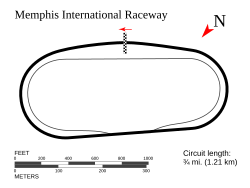
Memphis International Raceway (formerly known as Memphis Motorsports Park) was an auto racing park located near the Loosahatchie River in Shelby County, Tennessee, United States, approximately ten miles south of Millington, and a few miles north of the city of Memphis.
Key Information


History
[edit]The Memphis International Raceway (more commonly known as MIR) was founded in 1986 by Ed Gatlin, who along with a group of investors, bought a 400-acre tract of land within the northeastern section of Shelby County, and built a drag strip with an adjacent road course, including a dirt track and a go-kart track.[2] The facility opened in 1987 with a drag strip and 1.770 mi (2.849 km) road course. It includes a 0.750 mi (1.207 km) tri-oval short track, built in 1998, which once hosted the NASCAR Nationwide Series and NASCAR Camping World Truck Series, as well as an ASA Late Model Series race. The 4,400-foot (1,340 m) drag strip hosts events such as International Hot Rod Association (IHRA) World Finals and Nitro Jam, Professional Drag Racers Association (PDRA), HOT ROD Power Tour, Super Chevy Show, Fun Ford Series and Mega Mopar Action Series.
The entire facility was purchased by the Grand Prix Association of Long Beach in 1996, and in 1997, a ¾-mile paved tri-oval was added on the site of the old dirt track, while a new dirt track was built on the site of the former go-kart track. The name of the facility was also changed to Memphis Motorsports Park and the tri-oval opened on June 5, 1998.
The following month, Memphis Motorsports Park was acquired by Dover Motorsports in connection with its purchase of the Grand Prix Association of Long Beach. Memphis Motorsports Park closed October 30, 2009, due to lack of finances. Its parent company, Dover Motorsports, Inc. announced that it was ceasing all operations at Memphis Motorsports Park and that it would not be promoting any events in Memphis in 2010. The Memphis facility was under an agreement of sale to Gulf Coast Entertainment but Gulf Coast was unable to secure financing.[3] The track's Camping World Truck Series date was moved to Nashville Superspeedway and its Nationwide Series date to Gateway International Raceway, and later abandoned after a year. Dover Motorsports, Inc. auctioned off the complex on December 14, 2010, to Palm Beach International Raceway for $1.9 million.[4][5][6]
It was announced on January 31, 2011, that the deal between Palm Beach International and Dover Motorsports was finalized, and the track re-opened in April 2011. The track was also renamed to Memphis International Raceway, and a new logo was created to reflected the change which adopted a similar theme with its sister track in Palm Beach.[7][8] The track became sanctioned with IHRA, which has held the IHRA Nitro Jam finale at Memphis since 2011.[9]
2013
[edit]
In 2013, MIR gained more events for the park, including the 2nd annual Ford Fun Weekend at Memphis (was hosted at MIR in 2012 as well),[10] and the Mega Mopar Action Series.[11] This was the first year where the three major domestic manufacturers (Chevy, Ford, and Dodge) held an event at Memphis in the same year under the new owners. The track also drew attention to the Mid South Region of NASA, which uses the road course for track events featuring High Performance Driving Events (HPDEs), Time Trial, Wheel to Wheel Racing, and NASA-X autocross events. Retired NASCAR driver, Rusty Wallace opened up his driving experience and go kart facility on the NASCAR Oval in May 2013.[12] MIR also picked up the Xtreme Xperience Supercar venue which allows anyone to drive vehicles such as Ferrari's, Lamborghini's, and Audi's around the track for a fee. Its first event was February 9 and 10, but the event was prematurely canceled on the 10th due to weather.[13] A make-up event was rescheduled for a Sunday run on October 20, 2013.[14] The ARCA series also made a return to the oval, making it the first racing event held on the oval since the new ownership in 2011.[15] The Memphis 250 was held on October 26 with Brian Campbell being the race winner.[16]
2022
[edit]The track was sold sometime around March 2022, and held its last event on June 17, 2022; as of June 2025, 3 years after its last event, the track (including the drag strip and paved oval) currently sits abandoned.[17]
Tracks
[edit]Drag strip
[edit]The drag strip immediately drew the attention of the NHRA and was awarded a sanction in 1988 as the host site of the Mid-South Nationals. While the NHRA has 140 member tracks, Memphis was one of only 23 to host a national event. It also was the section of the complex used by other events such as the Mid-South SCCA events and the Super Chevy Show. The last NHRA race at Memphis, O’Reilly NHRA Mid-South Nationals, was to be hosted on October 4, 2009, but a rain delay postponed the event to October 5, 2009. In the winner's circle were Jeff Arend (Funny Car), Morgan Lucas (Top Fuel), Jason Line (Pro Stock) and Michael Phillips (Pro Stock Motorcycle).[18]
The strip will host IHRA events with its new owner, including a Nitro Jam event, as their sister track in Palm Beach is also affiliated with IHRA. The American Drag Racing League announced, on March 3, 2011, that they would hold an event during the weekend of May 20, 2011, at MIR.[19] The IHRA Nitro Jam series continues to race at Memphis, and have set up another finale event for 2014.[20]
Paved oval
[edit]
On September 13, 1998, before a sold-out crowd and a national television audience, the facility hosted its first NASCAR event—the NASCAR Craftsman Truck Series Memphis 200. NASCAR returned every year since with two events—the Truck Series in the summer, and the Nationwide Series in the fall. Ron Hornaday took home his second consecutive Elvis trophy in the last MemphisTravel.com 200 Camping World Truck Series race held at the oval. A late caution forced a green-white-checkered finish which gave Hornaday the edge on the restart to beat Brian Scott. On October 24, 2009, Brad Keselowski won the race at the oval by holding off Kyle Busch to the finish line on the 11th and final annual racing event, for both the Nationwide Series and the oval, as the track would not carry any racing events in 2010, when Dover Motorsports, Inc. announced the closure of Memphis Motorsports Park, a week after that race.
Records
[edit]| Series | Driver | Car | Date | Speed | Time | Layout |
|---|---|---|---|---|---|---|
| ARCA CRA Super Series | Derek Griffith | Chevrolet SS | October 26, 2013 | 124.804 miles per hour (200.85 km/h) | 21.634 | NASCAR Oval |
| NASCAR Busch Qualifying | Jeff Green | Chevrolet Monte Carlo | October 28, 2000 | 120.267 miles per hour (193.55 km/h) | 22.450 | NASCAR Oval |
| NASCAR Busch Race | Kevin Harvick | Chevrolet Monte Carlo | October 28, 2000 | 92.352 miles per hour (148.63 km/h) | 2:01:49 | NASCAR Oval |
| NASCAR Camping World Qualifying | Greg Biffle | Ford F-150 | June 24, 1999 | 120.139 miles per hour (193.34 km/h) | NASCAR Oval | |
| NASCAR Camping World Race | Travis Kvapil | Ford F-150 | June 30, 2007 | 91.806 miles per hour (147.75 km/h) | 1:38:02 | NASCAR Oval |
| NHRA Top Fuel ET* | Brandon Bernstein | Hemi Powered Top Fuel | September 2008 | 3.825 | Drag Strip | |
| NHRA Top Fuel MPH* | Brandon Bernstein | Hemi Powered Top Fuel | September 2008 | 313.88 miles per hour (505.14 km/h) | Drag Strip | |
| NHRA Funny Car ET* | Tim Wilkerson | Ford Mustang | August 2016 | 4.050 | Drag Strip | |
| NHRA Funny Car MPH* | Del Worsham | Toyota Camry | August 2016 | 316.81 miles per hour (509.86 km/h) | Drag Strip | |
| NHRA Pro Stock ET | Allen Johnson | Dodge Stratus R/T | September 2008 | 6.591 | Drag Strip | |
| NHRA Pro Stock MPH | Greg Anderson | Pontiac GXP | September 2007 | 209.17 miles per hour (336.63 km/h) | Drag Strip | |
| NHRA Pro Stock Bike ET | Chip Ellis | Suzuki Pro Stock Bike | September 2007 | 6.892 | Drag Strip | |
| NHRA Pro Stock Bike MPH | Chip Ellis | Suzuki Pro Stock Bike | September 2007 | 193.21 miles per hour (310.94 km/h) | Drag Strip |
*Top Fuel and Funny Car based on 333 yards 1 foot (304.80 m) records under current NHRA regulations. Pro Stock and Pro Stock Motorcycle are still 440 yards (402.34 m).
Series hosted
[edit]Former
[edit]- AMA Superbike Championship (1987)
- ARCA Menards Series
- Sioux Chief PowerPEX 200 (1998, 2001, 2017–2020)
- ASA National Tour (1999–2002)
- Global Rallycross (2017)
- International Hot Rod Association (2011–2022)
- NASCAR Camping World Truck Series
- MemphisTravel.com 200 (1998–2009)
- NASCAR K&N Pro Series East (2017–2019)
- NASCAR Nationwide Series
- Kroger On Track for the Cure 250 (1999–2009)
- NASCAR Southeast Series (1998–2002)
- NHRA Full Throttle Drag Racing Series (1988–2009)
- National Auto Sport Association (2011–2021)
- Trans-Am Series (1987)
- X-1R Pro Cup Series (2014)
See also
[edit]References
[edit]- ^ "Trans-Am Memphis 1987". 13 September 1987. Retrieved 23 March 2023.
- ^ Wade, Kelly (2020-12-15). "Can't Help Falling In Love With Memphis International Raceway". WinLightNews.com. Retrieved 2021-11-20.
- ^ "Dover Motorsports, Inc. Announces Closing of Memphis Motorsports Park and Realignment of Racing Dates (press release)". October 30, 2010. Retrieved October 31, 2010.
- ^ Memphis Daily News (November 11, 2010). "Motorsports Park Set for Auction Block". Retrieved January 16, 2011.
- ^ Memphis Daily News (December 14, 2010). "Memphis Motorsports Park Sells for $1.9M". Retrieved January 16, 2011.
- ^ Yahoo! Finance (December 20, 2010). "Entry into a Material Definitive Agreement". Retrieved January 16, 2011.
- ^ "Deal closed on sale of Memphis Motorsports Park". USA Today. January 31, 2011. Retrieved January 31, 2011.
- ^ "Moroso Investment Partners closes on Memphis Motorsports Park facility". January 31, 2011. Archived from the original on February 10, 2011. Retrieved February 3, 2011.
- ^ "Memphis International Raceway joins IHRA family". February 8, 2011. Retrieved February 14, 2011.[permanent dead link]
- ^ Ford Fun Weekend (May 1, 2013). "MEMPHIS ANNOUNCES 2013 FUN FORD WEEKEND SCHEDULE, RACE AND CAR SHOW CLASSES". Archived from the original on January 22, 2015. Retrieved December 2, 2013.
- ^ Memphis International Raceway (May 24, 2013). "Memphis International Raceway joins Mega MOPAR Action Series". Archived from the original on December 6, 2013. Retrieved December 2, 2013.
- ^ Memphis International Raceway (May 8, 2013). "New Home of Rusty Wallace Racing Experience". Archived from the original on December 6, 2013. Retrieved December 2, 2013.
- ^ WMCTV 5, NBC (February 8, 2013). "Xtreme Xperience Supercar Racetrack Event". Archived from the original on December 5, 2013. Retrieved December 2, 2013.
{{cite web}}: CS1 maint: numeric names: authors list (link) - ^ Xtreme Xperience (October 20, 2013). "Memphis International Raceway". Archived from the original on December 3, 2013. Retrieved December 2, 2013.
- ^ Memphis International Raceway (June 5, 2013). "Racing's Back! Memphis 250- Coming to Memphis International Raceway on October 26th". Archived from the original on December 6, 2013. Retrieved December 2, 2013.
- ^ ARCA Racing (October 28, 2013). "Campbell wins in return to Memphis". Archived from the original on December 5, 2013. Retrieved December 2, 2013.
- ^ On The Road: Saying Goodbye To Memphis International Raceway
- ^ "AREND, TEAM KALITTA CELEBRATE EMOTIONAL WIN". October 5, 2009. Retrieved January 17, 2011.
- ^ "ADRL Adds Memphis International Raceway As Tenth Race for 2011 Tour". March 3, 2011. Retrieved March 3, 2011.
- ^ "Nitro Jam Schedule". December 2, 2013. Retrieved December 2, 2013.
External links
[edit]Memphis International Raceway
View on GrokipediaHistory
Founding and early development
Memphis International Raceway was founded in 1986 by Ed Gatlin and a group of investors, who acquired approximately 400 acres of land in Shelby County, Tennessee, near the Loosahatchie River, to develop a multi-purpose motorsports facility.[8][1] Construction began shortly thereafter, and the track officially opened in 1987, featuring a quarter-mile drag strip and a 1.77-mile road course designed to host a variety of racing events.[8][3] Under Gatlin's ownership, which lasted until 1995, the facility quickly established itself as a regional racing venue, attracting drag racing and road course competitions.[3] In 1996, the Grand Prix Association of Long Beach acquired the property and managed operations through 1998, focusing on expansions to broaden its appeal.[3] During this period, a key development was the construction and opening of a 0.75-mile paved tri-oval in 1998, which enhanced the site's capabilities for oval racing.[1] Concurrently, the facility was renamed Memphis Motorsports Park to reflect its evolving multi-discipline focus.[3] Early events underscored the track's drag racing prominence, with the National Hot Rod Association (NHRA) adding the Mid-South Nationals to its national tour starting in 1988, drawing top competitors and spectators to the quarter-mile strip.[9][1] This marked the beginning of a sustained partnership with NHRA, establishing the venue as a key stop in the professional drag racing calendar.[9] The addition of the tri-oval in 1998 paved the way for a transition to NASCAR-sanctioned oval racing events later that year.[1]NASCAR and oval racing era
In 1998, Dover Motorsports, Inc. acquired Memphis Motorsports Park as part of its purchase of the Grand Prix Association of Long Beach, which had previously taken ownership of the facility in 1996.[10] Under Dover's ownership, the track underwent significant expansion, including the construction and opening of a 0.75-mile paved tri-oval short track on June 5, 1998, designed to host oval racing events.[1] This addition transformed the venue into a multi-purpose motorsports complex capable of accommodating high-profile stock car competitions. The tri-oval quickly became a key asset for NASCAR events, with the track hosting the inaugural NASCAR Camping World Truck Series race, the Memphis 200, on September 13, 1998, marking the series' debut at the facility.[11] Beginning in 1999, Memphis Motorsports Park also welcomed the NASCAR Nationwide Series (formerly Busch Series) for annual events, such as the Sam's Town 250, continuing through 2009 and establishing the track as a regular stop on the schedule. These races drew competitive fields and highlighted emerging talents in stock car racing during the era. Complementing the major NASCAR series, the ARCA Menards Series (then ARCA Racing Series) began racing at the tri-oval in 1998 with the ARCA 100, followed by additional events like the 2001 edition, providing a platform for developmental drivers. The oval's permanent grandstands offered seating for up to 35,000 spectators, while the adjacent drag strip accommodated 25,000, enabling large crowds for combined motorsports weekends.[12] Notable highlights included Kevin Harvick's victory in the 2000 Sam's Town 250, where he led the final 121 laps and averaged 92.3 mph to secure his first Busch Series win.[13] By the late 2000s, persistent economic challenges and declining attendance plagued the facility, exacerbated by the failed sale to Gulf Coast Entertainment due to financing issues.[14] On October 30, 2009, Dover Motorsports announced the cessation of all operations at Memphis Motorsports Park, citing unsustainable economic factors, with no events scheduled for 2010.[15] This closure ended the track's NASCAR oval racing era, leading to the relocation of its 2010 series dates to other venues like Nashville Superspeedway and Gateway International Raceway.[16]Reopening under IHRA
Following its closure in 2009 due to financial difficulties, Memphis International Raceway was sold at auction in December 2010 to a group affiliated with Palm Beach International Raceway for approximately $1.9 million.[17] The new owners, led by figures including Michael Dezer and Jason Rittenberry, invested approximately $2 million in renovations and renamed the facility Memphis International Raceway, reopening it in April 2011 with a renewed emphasis on drag racing operations.[18][4] The reopening featured a multi-year sanctioning agreement with the International Hot Rod Association (IHRA), establishing the track as a key IHRA venue for drag racing from 2011 to 2022.[4] This partnership included hosting national opens as part of the IHRA Nitro Jam and Summit SuperSeries, with the track serving as the site for the IHRA Summit Racing Equipment World Finals starting in 2012.[19] In 2013, the ownership group acquired full control of the IHRA itself, further solidifying the venue's role in professional and regional drag events while prioritizing the drag strip over other configurations. During this period, the ARCA Menards Series returned to the oval for events from 2017 to 2020, providing limited stock car racing before the oval ceased operations.[19] Alongside IHRA-sanctioned competitions, the track maintained a schedule of local bracket racing through the IHRA Summit SuperSeries program, attracting regional racers weekly.[19] It also continued hosting the annual Super Chevy Show, a multi-day event combining drag racing, car shows, and vendor displays, with editions running consistently through the 2010s and into 2022.[20] Ownership remained under the IRG Sports + Entertainment umbrella, which had managed the facility since the 2011 acquisition, though by around 2020 the group began facing operational challenges including deferred maintenance on the aging infrastructure, such as water seepage on the drag strip surface.[21] Attendance at events dwindled amid broader industry pressures, contributing to financial strain and prompting sale discussions by early 2022.[20][22] The track's final major event under IHRA affiliation occurred on June 17, 2022, marking the end of over a decade of active drag racing operations.[21]Closure and abandonment
In March 2022, IRG Sports + Entertainment, the owner of Memphis International Raceway since acquiring it from Dover Motorsports in 2011, agreed to sell the 342-acre facility to an undisclosed non-racing party, with the transaction aimed at commercial redevelopment rather than continued motorsport use.[21] The sale overlooked a competing preservation offer from racing interests, who proposed rehabilitating the track for ongoing use, in favor of the higher bid tied to non-motorsport development plans that ultimately went unfulfilled due to environmental and rezoning hurdles.[21] Contributing to the decision were severe maintenance issues, such as unlit and mold-infested bathrooms, persistent leaks causing water accumulation, and potholes on the racing surfaces, which IRG failed to address despite their impact on safety and user experience.[23] The track hosted its final event, an IHRA drag racing meet, on June 17, 2022, after which operations ceased permanently with no plans for reopening.[7] Post-closure, IRG auctioned off key assets, further stripping the site of its functionality as a racetrack.[23] As of November 2025, the facility remains abandoned, with overgrown vegetation encroaching on the drag strip, oval, and road course areas, and no racing or public events occurring.[1] Partial demolition has occurred, but stalled development proposals—initially including warehouse construction—have left the property in a state of neglect, raising concerns among racing enthusiasts about the loss of a key grassroots venue without viable alternative uses emerging.[1] This closure echoes an earlier shutdown in 2009 due to financial woes under previous ownership.[21]Facilities
Drag strip
The drag strip at Memphis International Raceway consists of a quarter-mile (0.25 miles) racing surface made of asphalt, extending to a total length of 0.833 miles (1,340 meters or 4,400 feet) when including the shutdown area equipped with concrete guard walls.[24][25] This configuration was designed specifically for straight-line drag racing, serving as the facility's primary feature since its opening in 1986, when local investors envisioned the site as a dedicated drag racing venue.[21] To optimize traction for high-speed runs, the drag strip employs a VHT (Vapor Honed Traction) coating applied to the asphalt surface, which provides enhanced grip under dry conditions but becomes notably slippery during wet weather, often necessitating event postponements or cancellations.[26] The facility supports a spectator capacity of approximately 25,000, accommodating crowds for major drag racing competitions in its operational years.[27] In its later years of operation, the drag strip faced maintenance challenges, including surface wear from prolonged use, which affected track conditions and contributed to broader operational difficulties before the facility's closure in 2022.[1] Prior to 1998, the drag strip was briefly integrated into certain road course layouts for combined circuit use.[28]Paved oval
The paved oval at Memphis International Raceway is a 0.75-mile D-shaped tri-oval track built in 1998 as part of the facility's expansion to accommodate stock car racing series.[1][12] The asphalt-surfaced oval measures approximately 1,200 meters in length and was designed with progressive banking to facilitate high-speed turns, including 11 degrees in the corners, 4 degrees on the front straightaway, and 3 degrees on the back straightaway.[1] The track supported a spectator capacity of 35,000 in permanent grandstands, allowing for large crowds during events. It was also equipped for night racing, as demonstrated by Saturday evening races hosted on the oval.[29][30] Following the facility's closure in 2022, the paved oval has deteriorated significantly, with the asphalt surface becoming worn and abrasive, and the infield overtaken by dense overgrowth and brush as observed in mid-2025. The site remains abandoned, showing signs of gradual demolition amid encroaching vegetation.[1]Road course configurations
The Memphis International Raceway opened in 1986 with an asphalt road course that integrated the facility's drag strip as its primary straightaway, allowing for a combined layout that supported both drag and circuit racing activities.[21][25] This original configuration spanned approximately 1.7 miles and featured a mix of high-speed sections and technical turns designed for road racing.[31] Following the addition of a 0.75-mile paved oval in 1998, the road course saw a decline in regular use as the facility shifted focus toward oval and drag events, leading to its effective discontinuation for major operations at that time.[32] However, the layout was periodically revived in later years for non-professional activities, evolving into a 1.7-mile, eight-turn circuit that included distinctive elements such as a sweeping carousel with elevation changes, a series of tight "M's" esses for rhythm braking and acceleration, the challenging "90s" section for precise cornering, and the high-speed "Grant's Tomb" sweeper.[31][33] To accommodate wet conditions and avoid the drag strip's VHT-treated surface, which could become dangerously slick, a bypass route was implemented using the pothole-prone hot pit area and a narrow "can-opener" gap to rejoin the main straight mid-way, maintaining usability during inclement weather.[23] From the early 2000s through 2022, the road course primarily hosted club racing events, open track days, and drift sessions organized by groups like NASA Mid-South, providing enthusiasts with a demanding, technical venue until the facility's overall closure.[31][22]Dirt oval and go-kart track
The facility also included a dirt oval track, originally a quarter-mile configuration that hosted various dirt racing events until 1997, after which it was replaced by the paved oval. A new dirt track was later constructed on the site of the former go-kart track.[8] The go-kart track supported local karting activities and was part of the initial development in the 1980s.Events and series
Professional drag racing series
Memphis International Raceway hosted National Hot Rod Association (NHRA) national events from 1988 to 2009 as part of the NHRA Full Throttle Drag Racing Series, primarily featuring the O'Reilly NHRA Mid-South Nationals in the Midwest Division.[9] The inaugural Mid-South Nationals in 1988 marked the track's entry into major NHRA competition, drawing top professional categories like Top Fuel, Funny Car, and Pro Stock, with the event running annually thereafter until its final edition in 2009, which was postponed due to rain and completed the following day on October 5.[34][35] These races showcased high-level drag racing on the facility's quarter-mile drag strip, contributing to the venue's reputation in the NHRA circuit.[1] Following a period of closure, the track reopened in 2011 under a partnership with the International Hot Rod Association (IHRA), hosting national-level events through 2022, including the IHRA Summit SuperSeries national opens and qualifiers for the IHRA World Finals.[36] The IHRA Summit World Finals were held annually at the venue from 2012 onward, crowning champions in categories such as Top Fuel and Funny Car, with events like the 2014 finals featuring 15 world titles decided on the drag strip.[37] These professional IHRA competitions emphasized bracket racing and nitro classes, solidifying Memphis as a key Mid-South hub until the track's operations ceased.[38] The World Series of Drag Racing, a longstanding professional bracket racing event, made its Memphis debut in 2016 at the raceway, attracting top nitro and alcohol racers over two days of competition.[39] During the event, Top Fuel driver Clay Millican set a track record with a 3.91-second elapsed time at 296 mph in the final round.[40] This appearance highlighted the venue's capability for high-stakes professional drag racing beyond sanctioning body series. Memphis International Raceway also served as a key stop for HOT ROD Drag Week, an annual professional street/strip drag racing challenge organized by MotorTrend, with the track hosting competition days in years including 2012 and 2013.[41] Participants drove street-legal vehicles between tracks, competing in time trials and heads-up racing on the quarter-mile, underscoring the facility's role in blending professional and enthusiast-level drag events.[42]Oval and stock car series
The paved oval at Memphis International Raceway hosted the NASCAR Camping World Truck Series from 1998 to 2009, beginning with the inaugural Memphis 200 on September 13, 1998, which marked the track's first NASCAR-sanctioned event.[11] This series featured annual races, such as the 2009 MemphisTravel.com 200 won by Ron Hornaday Jr., drawing competitive fields on the 0.75-mile tri-oval with 11-degree corner banking.[43] The events contributed to the series' emphasis on short-track racing dynamics during its early growth phase.[44] The NASCAR Nationwide Series, later rebranded as the Xfinity Series, competed at the facility from 1999 to 2009, with races like the Kroger On Track for the Cure 250 providing a platform for emerging stock car talent.[44] These events often paired with Truck Series weekends, showcasing high-speed oval action that highlighted the track's abrasive asphalt surface and progressive banking. The final Nationwide race in 2009 was won by Brad Keselowski, underscoring the venue's role in mid-tier NASCAR development before the series shifted focus elsewhere.[32] The ARCA Menards Series maintained a presence on the oval from 1998 to 2001, with returns in 2013 and annually from 2017 to 2020, starting with the ARCA 100 on June 7, 1998, won by Bob Schacht.[45] Races like the Sioux Chief PowerPEX 200 exemplified the series' commitment to developmental stock car racing at intermediate ovals, with the track's configuration supporting close-quarters competition, culminating in the final event in 2020.[1] This period solidified Memphis as a key stop for ARCA's national tour.[46] Other short-track series, including the Masters of the Pros, utilized the oval from 2013 to 2019, featuring Pro Late Model events such as the non-points 125-lap race in October 2013 won by Justin South and the 2019 edition secured by Bubba Pollard.[47] These invitationals attracted top regional drivers, emphasizing the track's suitability for high-stakes, short-oval-style stock car battles before its closure.[48]Road racing and specialty events
Memphis International Raceway hosted a variety of non-professional road racing activities through the NASA Mid-South region, which organized track days and club races on the facility's road course configuration from at least 2014 until 2022.[49][50] These events provided amateur drivers with opportunities for high-performance driving education and competitive sprint racing in a controlled environment, emphasizing skill development and sportsmanship across beginner, intermediate, and advanced run groups.[51] In 2022, NASA Mid-South partnered with the track for multiple Sunday track days, allowing participants to test vehicles on the 1.8-mile layout before the facility's closure.[52] The road course also supported drift events as part of the venue's specialty offerings, including the State of Drift series rounds held in 2016, which welcomed novice and professional drivers under the Turismo Drift rulebook for tandem battles across three-event seasons.[53] Additional drift experiences, such as the annual Stoopidcold Car Show and Drift events in 2021 and 2022, combined automotive displays with on-track drifting sessions, drawing local enthusiasts for winter-season activities on the paved surfaces.[54][55] Local bracket racing found a home at the drag strip through the Summit Bracket Racing Series presented by COMP Cams, a recurring program that ran bi-weekly points meets from the mid-2010s onward, featuring classes like Super Pro, Footbrake, DOT, and Junior Dragster with over 100 entries per event.[56][57] These amateur-focused competitions emphasized heads-up racing and included incentives like racer funds for season-end payouts, continuing as a staple until the track's final operations in 2022.[56] Automotive enthusiast shows, such as the annual Super Chevy Show (later rebranded as the Memphis Chevy Show), brought together Chevrolet-focused displays, vendor markets, and drag racing from 1986 until its 35th and final edition in April 2022, serving as a farewell event amid the facility's impending closure for redevelopment.[20] Regional bracket series like the Great American Guaranteed Million further highlighted the track's role in amateur drag events, capping entries at 450 for Memorial Day weekend competitions in 2020 with substantial prize pools to attract southern racers.[58] Other regional gatherings, including car meets and specialty runs, utilized the drag strip and oval for community-driven activities throughout the venue's active years.[34]Records
Drag strip records
The drag strip at Memphis International Raceway has been the site of several notable elapsed time (ET) and terminal speed records in professional drag racing categories, particularly during NHRA and IHRA-sanctioned events from the late 1980s through the mid-2010s. These achievements highlight the facility's reputation for favorable racing conditions, including a 4,400-foot concrete and asphalt surface that allowed for high-performance runs under optimal weather and preparation. In the Top Fuel category, Brandon Bernstein established both the track ET record of 3.825 seconds and the speed record of 313.88 mph during Friday qualifying at the 2008 NHRA O'Reilly Mid-South Nationals.[59] This performance in his Budweiser/Lucas Oil dragster not only secured the provisional No. 1 qualifying position but also underscored the strip's capability for sub-4-second quarter-mile passes in the era before NHRA shortened Top Fuel races to 1,000 feet in 2017. Earlier NHRA Division 2 events from 1988 to 2009, such as the inaugural Mid-South Nationals in 1988, featured competitive Top Fuel runs that contributed to divisional benchmarks, though specific ETs from that period emphasized speeds around 280 mph as the technology evolved.[9] For Funny Car, the 2016 World Series of Drag Racing produced dual track records in a single nitro showdown. Tim Wilkerson set the ET mark at 4.05 seconds over 1,000 feet, surpassing the previous record held by Ashley Force.[40] In the same race, Del Worsham achieved the speed record of 316 mph in his Toyota Camry, defeating Wilkerson and demonstrating the strip's support for speeds exceeding 300 mph in Funny Cars.[40] In Top Alcohol Funny Car, IHRA events at the venue yielded strong benchmarks, with Kirk Williams posting a 5.79-second ET to win the category at the 2012 ADRL Memphis Drags, edging Dale Brand on a holeshot in the final.[60] Such performances during IHRA's tenure, including the annual World Finals, reflected the class's reliance on methanol-fueled consistency, often in the mid-5-second range at speeds near 260 mph. Bracket racing classes, prominent in local and IHRA Summit SuperSeries events, prioritized dial-in accuracy over absolute ETs, but the strip hosted record participation and championships. For instance, the 2015 IHRA Summit World Finals drew regional bracket winners for world titles, with Jeff Parrish claiming the Super Pro crown after a season of precise .01-second victories across IHRA tracks.[61] Representative low ETs in these classes, such as 8.10 seconds in Super Pro during big-money races like the Great American Guaranteed Million, established the venue's scale for grassroots competition.[62]| Category | Driver | Record Type | Value | Event/Year | Source |
|---|---|---|---|---|---|
| Top Fuel | Brandon Bernstein | ET | 3.825 sec | NHRA Mid-South Nationals, 2008 | Draglist.com |
| Top Fuel | Brandon Bernstein | Speed | 313.88 mph | NHRA Mid-South Nationals, 2008 | Draglist.com |
| Funny Car | Tim Wilkerson | ET | 4.05 sec | World Series of Drag Racing, 2016 | Yahoo Finance |
| Funny Car | Del Worsham | Speed | 316 mph | World Series of Drag Racing, 2016 | Yahoo Finance |
| Top Alcohol Funny Car | Kirk Williams | ET (win) | 5.79 sec | ADRL Memphis Drags, 2012 | Dragzine |
| Bracket (Super Pro) | Jeff Parrish | Championship (representative) | N/A (dial-in focus) | IHRA Summit World Finals, 2015 | Dragstory.com |
Oval track records
The paved oval at Memphis International Raceway, measuring 0.75 miles with 11 degrees of banking in the turns and 4 degrees on the frontstretch and 3 degrees on the backstretch, facilitated high-speed stock car racing across multiple series until its closure for such events in 2009.[1] This configuration allowed for competitive lap times, particularly in qualifying sessions and race averages, though the abrasive asphalt surface often influenced tire wear and strategy.[1] Key oval track records from major stock car series highlight the facility's role in short-track racing. In the NASCAR Nationwide Series (now Xfinity Series), the qualifying record stands at 120.267 mph, set by Jeff Green in a Chevrolet Monte Carlo on October 28, 2000.[63] For the ARCA CRA Super Series, a prominent short-track series, the track record of 124.804 mph (21.634 seconds) was established by Derrick Griffin in a Chevrolet SS during qualifying on October 26, 2013.[64] The NASCAR Camping World Truck Series, which raced at the oval from 1998 to 2009, saw its qualifying record of 120.139 mph set by Greg Biffle in a Ford F-150 on May 8, 1999. Race lap specifics from this era varied due to frequent cautions and the track's layout, with no single fastest race lap officially documented across the 12 events, though averages typically ranged from 85 to 95 mph influenced by the progressive banking. (Note: Secondary source for context; primary race data from series archives confirm the qualifying mark via archived results.)| Series | Record Type | Driver | Vehicle | Speed/Time | Date | Source |
|---|---|---|---|---|---|---|
| NASCAR Nationwide | Qualifying | Jeff Green | Chevrolet Monte Carlo | 120.267 mph | October 28, 2000 | Race-Database.com |
| ARCA CRA Super Series | Track (Qualifying) | Derrick Griffin | Chevrolet SS | 124.804 mph (21.634 s) | October 26, 2013 | STARS National Series |
| NASCAR Truck | Qualifying | Greg Biffle | Ford F-150 | 120.139 mph | May 8, 1999 | NASCAR Archives via Motorsport.com (archived results) |