


Community hub
Recent from talks
Contribute something
Nothing was collected or created yet.
Jackson, Tennessee
View on Wikipedia
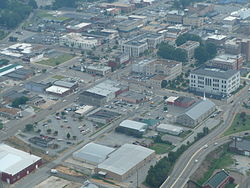
Jackson is a city in and the county seat of Madison County, Tennessee, United States. Located 70 miles (110 km) east of Memphis and 130 Miles Southwest of Nashville, it is a regional center of trade for West Tennessee. Its total population was 68,205 as of the 2020 United States census.[6] Jackson is the primary city of the Jackson, Tennessee metropolitan area, Madison County's largest city, and the second-largest city in West Tennessee after Memphis.[7] It is home to the Tennessee Supreme Court's courthouse for West Tennessee, as Jackson was the major city in the west when the court was established in 1834.
Key Information


.jpg)


In the antebellum era, Jackson was the market city for an agricultural area based on cultivation of cotton, the major commodity crop. Beginning in 1851, the city became a hub of railroad systems ultimately connecting to major markets in the north and south, as well as east and west. This was key to its development, attracting trade and many workers on the railroads in the late 19th century with the construction of railroads after the American Civil War. Through the 1960s, the city was served by 15 passenger trains daily, but industry restructuring reduced such service and caused the loss of jobs. The economy has adjusted to new businesses, with major manufacturing in the area.
History
[edit]Early settlement
[edit]
This area was occupied by the historic Chickasaw people at the time of European encounter. They were pushed out by European-American settlers under various treaties with the United States, in actions authorized by the Indian Removal Act of 1830 and ratified by the US Senate.
European-American settlement of Jackson began along the Forked Deer River before 1820, primarily by migrants from eastern areas of the Upper South, such as Virginia and Kentucky. Originally named Alexandria, the city was renamed in 1822 to honor General Andrew Jackson, a hero of the War of 1812. He was later elected as President of the United States.[8]
The City of Jackson was founded by an act of the Tennessee General Assembly, passed in 1821, entitled an "act to establish a seat of justice for Henry, Carroll, Henderson and Madison Counties." The act required 50 acres (20 ha) of land to be deeded to the commissioners. The commissioners chosen by the Legislature were Sterling Brewer and James Fentress. The places considered for the seat of justice were Alexandria, Golden's Station, and Jackson. The larger portion of the settlers at that time were living on Cotton Grove Road, and as Jackson was closer to them than either of the other settlements, this settlement was determined to be the more suitable site for the seat of justice.[9]
At the time of the second Tennessee State Constitution in 1834, when the Tennessee Supreme Court was established, Memphis had not yet been developed. The county seat of Jackson was the most significant city in West Tennessee and this was designated as a site for the State Supreme Court in this part of the state.[10]
The city of Jackson did not establish public elections until 1837, with a Board of Aldermen elected at-large. From 1854 to 1915, Jackson had a Board of Aldermen of eight members elected from four districts, each with two members elected at-large. Free people of color and freedmen were not allowed to vote in the state until after passage of federal constitutional amendments following the Civil War that granted them citizenship and suffrage.[11]
This area was initially developed for agricultural purposes, especially cotton plantations for producing the chief commodity crop of the Mississippi Valley and Deep South. Cotton plantations were dependent on the labor of slaves, and thousands were brought into the area as it was developed. As county seat, Jackson was a trading town and retail center for surrounding agricultural areas.
But developing as a railroad hub of several lines was most important to Jackson's industrial and population growth, from 1852 on for the next hundred years.
Civil War through 19th century
[edit] | This section needs additional citations for verification. (April 2024) |
In 1862, Tennessee came under the control of Union forces and was occupied until General Ulysses S. Grant decided to concentrate his efforts to the South. Between December 11, 1862, and January 1, 1863, an engagement at Jackson occurred during Confederate Brigadier General Nathan Bedford Forrest's expedition into West Tennessee. Forrest wanted to disrupt the rail supply line to Grant's army, which was campaigning along the route of the Mississippi Central Railroad. If Forrest destroyed the Mobile & Ohio Railroad running south from Columbus, Kentucky through Jackson, Grant would have to curtail or halt his operations altogether.
Forrest's 2,100-man cavalry brigade crossed the Tennessee River on December 17. Grant ordered a soldier concentration at Jackson under Brigadier General Jeremiah C. Sullivan and sent a cavalry force under Colonel Robert G. Ingersoll. Forrest's command defeated the Union cavalry in Lexington, Tennessee on December 18. As Forrest continued his advance the following day, Sullivan ordered Colonel Adolph Englemann to take a small force northeast of Jackson.
At Old Salem Cemetery, acting on the defensive, Englemann's two infantry regiments repulsed a Confederate mounted attack, then withdrew a mile closer to the city. The fight amounted to no more than a feint and show of force intended to hold Jackson's Union defenders in position, while two mounted Confederate columns destroyed railroad track to both the north and south of the town, then returned. Forrest withdrew from the Jackson area to attack Trenton and Humboldt after this mission was accomplished.[12]
As a result of the destruction of the railroad, Grant abandoned his plans to invade Mississippi from Tennessee in favor of an attack on Vicksburg, Mississippi, for control of the river. Federal troops left Jackson and moved to Memphis, which became a major center for Union troops for the duration of the war. Forrest returned to Jackson in early 1864 and used the city as his headquarters as his forces attacked Federal positions in northern West Tennessee and Fort Pillow, a Union position on the Mississippi north of Memphis. Forrest returned to Jackson again later that year in preparation for an attack on Federal river traffic on the Tennessee River east of Paris and the supply base at Johnsonville.
With the emancipation of slaves and passage of US constitutional amendments granting suffrage to African-American males, Jackson's freedmen and formerly free people of color began to participate in the political system. But secret vigilante groups, such as the Ku Klux Klan, developed chapters in Tennessee and throughout the South that intimidated and attacked freedmen in order to exercise white supremacy. As Reconstruction continued, they worked to suppress the black Republican vote.
In the late 19th century, the white-dominated state legislature passed several laws that made voter registration and voting more difficult, including payment of a poll tax, and resulted in reducing voting by many blacks and poor whites.[11] After Reconstruction, white violence increased against blacks. In 1886, Eliza Woods, an African-American woman, was lynched in Jackson after being accused of poisoning and killing her employer, Jessie Woolen. Woolen's husband later confessed to the crime.[13][14] Two other African Americans were known to have been lynched by whites in Madison County in this period that extended into the early 20th century.[15]
20th century
[edit]In 1915, Jackson was one of several cities in the state to adopt a commission form of government, changing its electoral scheme to at-large voting citywide for three designated positions: a mayor and two commissioners. This resulted in a government dominated by the majority, with no representatives elected from minority populations. (Other cities to make this change included Clarksville, Chattanooga, Knoxville and Nashville.) Although the state in 1913 enacted a law enabling cities to adopt the commission form of government independently, Jackson was chartered by the state for this change.[11] The commissioners each were allocated specific responsibilities, for instance, for the school system and city departments.[11]
In the late 19th century, the state of Tennessee had already adopted residency requirements, voting process, and poll taxes that sharply reduced the ability of African Americans to register and vote. The City Charter was amended to include run-off elections within two weeks in cases of one candidate not receiving a majority of votes. This created an extra burden on campaigns by less wealthy candidates. In Jackson, the total effect of these changes to the city electoral system was to reduce the ability of African Americans in the 20th century to elect candidates of their choice and to participate in the political system.[11]
In 1977, the former company town of Bemis just south of Jackson, was annexed by the city of Jackson.[16]
In 1977, three city residents filed suit against the city in US District Court, in Buchanan v. City of Jackson (1988), (683 F.Supp. 1515), challenging the structure and electoral system of the city government because the at-large voting had diluted the voting power of the city's significant minority of African-American residents. (According to the 1980 Census, the city population was 49,074, of whom 16,847, or 34.3%, were black.)[11] Since 1915, no black person had ever been elected to, or served on, the Board of Commissioners.[11] The court found this commission electoral system to be discriminatory in effect. Over the decades, the African-American minority was effectively closed out of city government. The case was appealed and affirmed; the defendants ultimately proposed a new system, approved in 1988 by the court. By a new city charter, in 1989 the city created a Board of Commission based on nine single-member districts for broader representation.[11] The mayor is elected at-large.
Similar legal challenges to the electoral and city systems in Clarksville and Chattanooga led to changes in their city charters to establish more numerous members of a city council or board of commission, to be elected from single-member districts. As a result, more African-American and women candidates have been elected as representatives from those jurisdictions.
The dissolution of the former government in Jackson resulted in the need for an elected city school board, since one of the commissioners had previously managed education. The city commissioners chose to consolidate their school system with that of the Madison County school system in 1990, creating the Jackson-Madison County School Board. This was also done to achieve desegregation goals. The nine-member board is elected from six districts across the county; three districts elect two members each and the other three each elect one member. All members are elected for four-year terms, with elections held on a staggered basis every two years. The demographics of the county in 2012 for major ethnic groups were 60.3% white and 37% African American.[17] In 2008 the school system was still under a court order supervising its desegregation progress.[18]
In the post-World War II era, the railroad industry underwent restructuring and mergers. (See section below). By the end of the 1960s, it sharply reduced passenger service to Jackson; there were related losses of associated industrial jobs supporting the railroads, causing economic problems in the region.
1999 to present
[edit]
Between 1999 and 2008, several violent tornadoes struck large portions of the city. The McKellar-Sipes Regional Airport was severely damaged in January 1999, a storm that resulted in eleven fatalities. The 1999 tornado also damaged the 30-acre (120,000 m2) Riverside Cemetery, where 40 known Confederate soldiers, 140 unknowns, and many families of the founders of Jackson are buried. The cemetery's acres of old trees and many of the statues, monuments, and graves were damaged during the tornado.
Parts of the Union University campus were damaged in November 2002. The downtown area was devastated in May 2003 by an F4 tornado, and there were eight deaths. Many dormitories at the Union campus were demolished in a storm in February 2008.
On May 1, 2010, a severe thunderstorm hit Jackson, dropping 13 inches of rain in a short period of time.[19] Flash floods destroyed many homes and streets.[20][21][22]
Railroad history
[edit]Jackson developed rapidly just prior to the Civil War as a railroad junction and maintenance shop for several early railroads, including the Mississippi Central, the Tennessee Central and the Mobile and Ohio lines. Located over seventy miles east of Memphis, Jackson lies along the shortest rail route between Cairo, IL; Jackson, Mississippi (Mississippi's capital); and New Orleans, Louisiana. As the railroad was extended from the Great Lakes to the Gulf of Mexico, Jackson, Tennessee was perfectly situated as a station along the north–south line; and, to serve as a junction between the north–south line, and lines east and west between Memphis and Nashville, the major cities of West and Middle Tennessee.
The first was the Mobile and Ohio Railroad, which began in October 1849 in Mobile, Alabama. The line first entered Jackson in 1851. These tracks were completely destroyed during the Civil War. The line merged with the Gulf, Mobile and Northern Railroad in 1940 to become the Gulf, Mobile and Ohio Railroad.[23] The second railroad to enter Jackson was the Mississippi Central & Tennessee. In 1873, the line was contracted and later controlled by the Illinois Central Railroad.[23]
On December 29, 1886, the Tennessee Midland Railway received a charter to build a railroad from Memphis to the Virginia state line. The line from Memphis to Jackson was completed on June 1, 1888. In 1893, the Tennessee Midland went into receivership and was sold at foreclosure to the L&N Railroad. Circa 1968, the remainder of the Tennessee Midland was abandoned east of Cordova with the exception of some track in Jackson. That track is now used to deliver goods to Jackson's east and west industrial parks.
The Tennessee Midland Railway Company line from Memphis to Jackson was the forerunner of the Nashville, Chattanooga and St. Louis Railway. This line was often referred to as the "NC" by locals. Like all other railroads to enter Jackson, it was built with funds subscribed by citizens and investors of Jackson. The first passenger train entered Jackson from Memphis on June 1, 1888. The highly profitable railroad was merged into the Louisville and Nashville Railroad following WWII. Eventually the L&N was merged into, and is now part of, CSX Transportation.[23]
A charter was granted by the State of Tennessee on August 16, 1910, and construction began on July l, 1911. The first sector extended from Jackson to the station of Tigrett, and by April 20, 1912, 38 miles (61 km) of the line were ready for operations. On June 16 the remaining 11-mile (18 km) sector was set into service, connecting Dyersburg with Jackson. When the line began operations in 1912, its president was Isaac B. Tigrett, a prominent young banker of Jackson. The railroad became an important local thoroughfare, used to transport much of the produce of the region to market in Jackson and Dyersburg. The Birmingham and Northwestern Railway Company had four locomotives, five passenger cars, and 92 freight cars. When Isaac B. Tigrett became President of the GM&N in 1920, he ceased to direct the affairs of the Birmingham and Northwestern Railroad Company. After he became president of the GM&O, the railroad was purchased and merged to become the Dyersburg branch.
Passenger trains in the 20th century
[edit]
Jackson had been a west Tennessee hub for passenger train service. Passengers had direct service to Memphis, Nashville, Meridian, Montgomery, Mobile, Birmingham, Jacksonville, Daytona, Miami, Centralia, Champaign-Urbana, Springfield, Chicago, St. Louis, and New Orleans.[23] From the 1930s to the 1960s, multiple regularly scheduled passenger trains of the Gulf, Mobile and Ohio and the Illinois Central made stops at Union Station.[24]
Gulf, Mobile and Ohio trains included:[25]
- Gulf Coast Rebel (St. Louis, Missouri – Mobile, Alabama)
- The Rebel (Chicago – New Orleans, Louisiana)
Illinois Central trains included:[26][27][28]
- The City of Miami (Chicago, Illinois – Miami, Florida)
- The Floridan (Chicago – Miami)
- The Seminole (Chicago – Jacksonville, Florida)
- Sunchaser (Chicago and St. Louis – Miami)
Geography
[edit]According to the United States Census Bureau, the city has a total area of 49.5 square miles (128 km2), all land.
Climate
[edit]Jackson has a humid subtropical climate (Cfa) within the Köppen climate classification system, with hot, humid summers and cool winters.
| Climate data for Jackson, Tennessee (Jackson Exp Stn), 1991–2020 normals, extremes 1895–present | |||||||||||||
|---|---|---|---|---|---|---|---|---|---|---|---|---|---|
| Month | Jan | Feb | Mar | Apr | May | Jun | Jul | Aug | Sep | Oct | Nov | Dec | Year |
| Record high °F (°C) | 79 (26) |
83 (28) |
92 (33) |
91 (33) |
102 (39) |
104 (40) |
107 (42) |
110 (43) |
106 (41) |
99 (37) |
88 (31) |
80 (27) |
110 (43) |
| Mean maximum °F (°C) | 69.4 (20.8) |
73.6 (23.1) |
81.3 (27.4) |
86.2 (30.1) |
89.5 (31.9) |
94.2 (34.6) |
96.9 (36.1) |
97.1 (36.2) |
94.1 (34.5) |
87.7 (30.9) |
79.0 (26.1) |
70.6 (21.4) |
98.6 (37.0) |
| Mean daily maximum °F (°C) | 48.5 (9.2) |
53.1 (11.7) |
62.3 (16.8) |
72.5 (22.5) |
80.2 (26.8) |
87.5 (30.8) |
90.6 (32.6) |
90.3 (32.4) |
84.8 (29.3) |
74.2 (23.4) |
61.4 (16.3) |
51.7 (10.9) |
71.4 (21.9) |
| Daily mean °F (°C) | 37.9 (3.3) |
41.7 (5.4) |
50.6 (10.3) |
60.1 (15.6) |
69.0 (20.6) |
76.7 (24.8) |
80.0 (26.7) |
78.9 (26.1) |
72.4 (22.4) |
60.9 (16.1) |
49.2 (9.6) |
41.3 (5.2) |
59.9 (15.5) |
| Mean daily minimum °F (°C) | 27.4 (−2.6) |
30.4 (−0.9) |
38.8 (3.8) |
47.8 (8.8) |
57.9 (14.4) |
65.9 (18.8) |
69.3 (20.7) |
67.4 (19.7) |
60.0 (15.6) |
47.6 (8.7) |
37.0 (2.8) |
30.9 (−0.6) |
48.4 (9.1) |
| Mean minimum °F (°C) | 11.7 (−11.3) |
16.0 (−8.9) |
22.5 (−5.3) |
32.3 (0.2) |
43.4 (6.3) |
54.7 (12.6) |
60.7 (15.9) |
58.0 (14.4) |
45.3 (7.4) |
32.5 (0.3) |
22.3 (−5.4) |
16.9 (−8.4) |
9.2 (−12.7) |
| Record low °F (°C) | −18 (−28) |
−21 (−29) |
7 (−14) |
23 (−5) |
31 (−1) |
41 (5) |
45 (7) |
44 (7) |
30 (−1) |
19 (−7) |
0 (−18) |
−21 (−29) |
−21 (−29) |
| Average precipitation inches (mm) | 4.29 (109) |
4.65 (118) |
5.75 (146) |
5.46 (139) |
5.33 (135) |
5.08 (129) |
4.99 (127) |
3.57 (91) |
4.07 (103) |
3.97 (101) |
4.45 (113) |
5.28 (134) |
56.89 (1,445) |
| Average snowfall inches (cm) | 1.1 (2.8) |
0.9 (2.3) |
0.4 (1.0) |
0.1 (0.25) |
0.0 (0.0) |
0.0 (0.0) |
0.0 (0.0) |
0.0 (0.0) |
0.0 (0.0) |
0.0 (0.0) |
0.0 (0.0) |
0.2 (0.51) |
2.7 (6.9) |
| Average precipitation days (≥ 0.01 in) | 11.0 | 10.2 | 11.7 | 10.9 | 11.0 | 9.9 | 9.7 | 8.3 | 7.8 | 9.0 | 10.3 | 11.7 | 121.5 |
| Average snowy days (≥ 0.1 in) | 0.6 | 0.6 | 0.1 | 0.0 | 0.0 | 0.0 | 0.0 | 0.0 | 0.0 | 0.0 | 0.0 | 0.2 | 1.5 |
| Source: NOAA[29][30] | |||||||||||||
Demographics
[edit]
| Census | Pop. | Note | %± |
|---|---|---|---|
| 1850 | 1,006 | — | |
| 1860 | 2,407 | 139.3% | |
| 1870 | 4,119 | 71.1% | |
| 1880 | 5,377 | 30.5% | |
| 1890 | 10,039 | 86.7% | |
| 1900 | 14,511 | 44.5% | |
| 1910 | 15,779 | 8.7% | |
| 1920 | 18,860 | 19.5% | |
| 1930 | 22,172 | 17.6% | |
| 1940 | 24,332 | 9.7% | |
| 1950 | 30,207 | 24.1% | |
| 1960 | 34,376 | 13.8% | |
| 1970 | 39,996 | 16.3% | |
| 1980 | 49,258 | 23.2% | |
| 1990 | 48,949 | −0.6% | |
| 2000 | 59,643 | 21.8% | |
| 2010 | 65,211 | 9.3% | |
| 2020 | 68,205 | 4.6% | |
| Sources:[31][32][3] | |||
Jackson is the larger principal city of the Jackson-Humboldt CSA, a Combined Statistical Area that includes the Jackson metropolitan area (Chester and Madison counties) and the Humboldt micropolitan area (Gibson County),[33][34][35] which had a combined population of 180,509 at the 2020 census.[36]
2020 census
[edit]| Race | Num. | Perc. |
|---|---|---|
| White (non-Hispanic) | 31,116 | 45.62% |
| Black or African American (non-Hispanic) | 29,878 | 43.81% |
| Native American | 109 | 0.16% |
| Asian | 1,097 | 1.61% |
| Pacific Islander | 9 | 0.01% |
| Other/Mixed | 2,509 | 3.68% |
| Hispanic or Latino | 3,487 | 5.11% |
In the 2020 United States census, there were 68,205 people, 25,925 households, and 16,075 families residing in the city.
2010 census
[edit]In the census[4] of 2010, there were 65,211 people, 25,191 households, and 15,951 families residing in the city. The population density was 1,317 inhabitants per square mile (508/km2). There were 28,052 housing units at an average density of 566.3 per square mile (218.6/km2). Since the 2010 Census, the city has added 9.4459 (24.5/km2). The racial makeup of the city was 49.2% White, 45.07% African American, 0.2% Native American, 1.2% Asian, 0.02% Pacific Islander, 2.3% from other races, and 1.5% from two or more races. Hispanic or Latino of any race were 4.0% of the population.
There were 25,191 households, out of which 29.7% had children under the age of 18 living with them, 37.6% were married couples living together, 21.4% had a female householder with no husband present, and 36.7% were non-families. 30.8% of all households were made up of individuals, and 10.59% had someone living alone who was 65 years of age or older. The average household size was 2.42 and the average family size was 3.03.
In the city, the population was spread out, with 24.7% under the age of 18, 13.4% from 18 to 24, 25.4% from 25 to 44, 23.8% from 45 to 64, and 12.7% who were 65 years of age or older. The median age was 33.8 years. For every 100 females, there were 87.4 males. For every 100 females age 18 and over, there were 81.7 males.
The median income for a household in the city was $38,169, and the median income for a family was $45,938. Males had a median income of $41,085 versus $30,436 for females. The per capita income for the city was $23,762. About 15.6% of families and 21.6% of the population were below the poverty line, including 36% of those under age 18 and 8.24% of those age 65 or over.
Crime
[edit]As of 2020, the Jackson metropolitan area, Tennessee ranked 38th worst in the United States, with 624.6 violent crimes per 100,000 residents.[38]
According to Morgan Quitno's 2010 Metropolitan Crime Rate Rankings [39] the Jackson metropolitan area had the 13th highest crime rate in the United States. In 2007, Jackson ranked 9th most dangerous.[40] In 2006, it had been listed as the 18th most dangerous.[41]
Arts and culture
[edit]Rock-A-Billy Hall of Fame
[edit]Jackson was the site of the now permanently closed International Rock-A-Billy Hall of Fame Museum, which recognized the contributions of Tennessee musicians to this genre.

Casey Jones Home & Railroad Museum
[edit]In 1956, the city of Jackson purchased the Chester Street home of famed locomotive engineer, Casey Jones, to turn into a museum and tourist attraction. The museum opened to the public on April 30, and Governor Frank Clement was the main speaker for the ceremony.[42] In 1978, a proposal to move the home and museum north to a plot of land next to Interstate 40 was approved, though not without much debate. The building was moved that winter.[43][44]
Ned R. McWherter West Tennessee Cultural Arts Center
[edit]As of April 2022, a large portion of the historic Downtown area has been officially designated by the Jackson City Council as the Arts District, and is home to the Ned R. McWherter West Tennessee Cultural Arts Center, known locally as "The Ned," as well as The Carnegie Center for Arts and History. Some of the art that is displayed in the area includes murals, performance art shows, galleries, live concerts, and theatrical/ballet productions. The district is also home to a number of small shops.[45]
Carl Perkins Civic Center
[edit]Built in 1973, the Carl Perkins Civic Center is a multi purpose events facility with seating for 2,200. It is named for singer Carl Perkins. The center is located on the south side of the downtown square.[46]
Sports
[edit]College Athletics
[edit]The city of Jackson is home to a number of institutions of higher learning which offer collegiate sports, including Union University, Lane College, and Jackson State Community College.
Union University has won six national titles (NAIA- 1998, 2005, 2006, 2009, 2010 and NCCAA- 2014) in women's basketball. In 2018, the Lady Bulldogs advanced to the Final Four of the NCAA Division II women's basketball tournament.[47] In addition to success in women's basketball, Union boasts NCCAA national titles in volleyball (2003), men's soccer (2004), and softball (2001, 2002, 2004, 2013).[48]
Minor League Baseball
[edit]The Jackson Generals, a Double-A Minor League Baseball team of the Southern League played at The Ballpark at Jackson from 1998 to 2020.[49] In conjunction with Major League Baseball's reorganization of the minor leagues after the 2020 season, the Generals were not invited to serve as any team's affiliate, effectively ending their run in affiliated baseball.[50] After a legal battle with the city, the Generals ceased operations in 2021 after an arbiter ruled in favor of the city.[51]
Originally known as the West Tenn Diamond Jaxx, the team changed its name to the Generals in 2011.[49] The new name was in reference to the Jackson Generals who played in the Kentucky–Illinois–Tennessee League from 1935 to 1942 and 1950 to 1954.[49] The original Generals were preceded by teams called the Jackson Jays (1926), Jackson Giants (1925), Jackson Blue Jays (1924), Jackson Climbers (1911),[52] and Jackson Railroaders (1903).[49]
With the Generals gone in 2021, the Winnipeg Goldeyes of the independent American Association temporarily moved their operations to Jackson due to COVID-19 restrictions shutting down the US-Canada border, preventing them from playing in their normal home, Shaw Park in Winnipeg.[53] The Goldeyes played 33 games in Jackson before being given permission by the Canadian government to return across the border on August 3.[54]
In 2022, the city of Jackson welcomed back professional baseball in the form of the Jackson Rockabillys of the Prospect League. The Rockabillys play in the city-owned The Ballpark at Jackson, which was previously occupied by the city's minor league franchise.[55]
Other sports
[edit]The Hub City Hurricanes of the IBL played in Jackson for one season in 2007.
Jackson Jammers (1992) of the Global Basketball Association (GBA) starting out as the Music City Jammers (1991–92)
In 1974, a little league team from Jackson played in the Little League World Series in Williamsport, PA – to date, the only team from West Tennessee to qualify.[56]
From 1990 to 2011, Jackson hosted the NAIA Women's Division I National Championship basketball tournament in the Oman Arena.
The Jackson TN Underdawgs have participated in The Basketball Tournament since 2016. The Underdawgs have played spoiler in multiple years, defeating some of the tournaments top-ranked teams. In 2021, while ranked the 15-seed, the Underdawgs defeated the number 2-seed in their region. In 2016, they upset the number 1-seed in their region.[57]
Parks and recreation
[edit]- Jackson hosts the Miss Tennessee Volunteer Pageant [58] and the Miss Volunteer America Pageant.[59]
- West Tennessee Healthcare Sportsplex is a travel baseball and softball complex completed in 2007.[60]
- A tennis complex in northern Jackson hosts the City Closed tennis tournament.[citation needed]
- Jackson is home to the Rusty's TV & Movie Car Museum, which hosts a collection of cars that have been shown in TV and film, including the green Mitsubishi Eclipse driven by Paul Walker in the original "Fast and Furious."[61]
Education
[edit]Colleges and universities
[edit]- Jackson State Community College
- Lane College
- Union University
- University of Memphis at Lambuth
- University of Tennessee at Martin – Jackson Center
The following is near the city but in an unincorporated area:
Primary and secondary schools
[edit]K-12 public schools in the city and county are operated by the consolidated Jackson-Madison County School System.[62] High schools include:
- Jackson Central-Merry Early College High School
- Liberty Technology Magnet High School
- Madison Academic Magnet High School
- North Side High School
- South Side High School
Specialist schools operated by the State of Tennessee include:
Private schools include:
Media
[edit]Newspaper
[edit]Jackson is served by one daily, The Jackson Sun. The Sun is delivered to 13 counties in total and is considered one of western Tennessee's major newspapers.
Television
[edit]As of the 2015–2016 television season, the Jackson television market is the smallest market in Tennessee and 176th overall by Nielsen Media Research.[63] The market is served by three major commercial stations: WBBJ-TV 7 (ABC, with CBS/MeTV on DT3), WJKT 16 (Fox), and WNBJ-LD 39 (NBC). Jackson is also served by a PBS member station, WLJT 11, as well as several other low-power stations (among them Antenna TV/MyNetworkTV affiliate WYJJ-LD 27).
Radio
[edit]Infrastructure
[edit]Transportation
[edit]Ground transportation
[edit]Interstate 40 runs through the city in an east–west direction, connecting the city with Memphis to the west and Nashville to the east. I-40 has six exits in the city. U.S. Route 45 runs in a north–south direction.[64]
The Jackson Transit Authority line provides intra-city bus service,[65] while the Greyhound Bus line provides inter-city service.[66]

U.S. Route 45, locally known as Highland Avenue, runs north to south to Gibson County and Chester County. A bypass route of US 45 (known as the Keith Short Bypass) goes through the western part of the city.
U.S. Route 412 runs east from Lexington in Henderson County northwest to Dyersburg, Tennessee, and I-55 reaches westward to St. Louis.
U.S. Route 70 or State Route 1 runs east to west between Huntingdon and Brownsville.
Air service
[edit]McKellar-Sipes Regional Airport (MKL) serves the city.
Healthcare
[edit]West Tennessee Healthcare (Jackson-Madison County General Hospital District), created by a law passed by the Tennessee General Assembly in 1949, serves as the public hospital system of the city of Jackson. The city appoints some of the members of the board of directors.[67]
Notable people
[edit]- Jessi Alexander, singer/songwriter
- Allison Alderson, former Miss Tennessee
- Monroe Dunaway Anderson, born in Jackson, was a cotton trader and capitalist, whose financial endowment helped found the Anderson, Clayton & Company in Oklahoma City, Oklahoma in 1904, the M. D. Anderson Foundation in Houston, Texas and the University of Texas MD Anderson Cancer Center in Houston
- Micajah Autry, hero of The Alamo, practiced law in Jackson from 1831 to 1835
- Big Maybelle, R & B singer
- Dick Davis, football player
- Gene Evans, actor, relocated to Jackson after appearing in the film Walking Tall
- Steve Fossett, aviator, first man to fly solo non-stop around the world in a hot air balloon, born in Jackson
- Greg Goff, head baseball coach at Purdue
- Jabari Greer, football player
- Hayes Nance, orthodontist
- Thomas Harris, author noted for his bestseller The Silence of the Lambs, born in Jackson
- Sylvester Hicks, NFL player
- Joe Hunter, pianist, one of The Funk Brothers studio band, played on many Motown hits in the 1960s
- Adam Huntsman, lawyer and politician, defeated David Crockett for Congress in 1835
- Luther Ingram, singer
- Casey Jones, Illinois Central Railroad engineer who, before colliding with a stalled freight train near Vaughan, Mississippi, told his fireman to jump to safety; Jones died at the throttle and saved the lives of all the passengers
- Christopher Jones, actor, born in Jackson
- Ed "Too Tall" Jones, football player
- Jacoby Jones, football player attended Lane College in Jackson
- Van Jones, environmental advocate, civil rights activist, lawyer, born in Jackson
- Richard D. King, architect
- Fred Lane, football player attended Lane College in Jackson
- Denise LaSalle, blues singer, known as "Queen of the Blues", resident and business owner in Jackson for many years
- Brandon Lay, singer-songwriter
- Ron Lollar, Tennessee state representative
- Wink Martindale, game show host
- Willis S. Matthews, US Army major general[68]
- Mike Norton, comic book artist and writer, known for his work on Battlepug
- Kenny Parchman, rockabilly musician
- JR Payne, women's basketball head coach, University of Colorado
- Carl Perkins, singer, lived for years in Jackson; the Civic Center is named for him[69]
- Casey Prather (born 1991), basketball player in the Israeli Basketball Premier League
- Lauren Pritchard, soul singer, songwriter and actress, known by her stage name Lolo; born and spent her childhood in Jackson
- Ron Reynolds, Texas politician, born in Jackson in 1973
- Joe Rogers, Sr. co-founder of Waffle House, born in Jackson in 1919
- Josh Robbins, HIV/AIDS activist, blogger, social media marketer, talent agent, grew up in Jackson
- Ryan Rolison, MLB pitcher
- Gil Scott-Heron, musician born in Chicago, Illinois, spent his early childhood in Jackson, at the home of his maternal grandmother[70]
- Charles Alexander Shaw, United States District Court judge
- Trey Teague, football player
- Isaac Burton Tigrett, co-founder of the Hard Rock Cafe chain of themed restaurants[71]
- Al Wilson, football player
See also
[edit]References
[edit]- ^ "Tennessee Blue Book" (PDF). State.tn.us. 2005–2006. pp. 618–625.
- ^ "ArcGIS REST Services Directory". United States Census Bureau. Retrieved October 15, 2022.
- ^ a b "Census Population API". United States Census Bureau. Retrieved October 15, 2022.
- ^ a b "U.S. Census website". United States Census Bureau. Retrieved January 31, 2008.
- ^ "US Board on Geographic Names". United States Geological Survey. October 25, 2007. Retrieved January 31, 2008.
- ^ "Population and Housing Unit Estimates". Retrieved July 18, 2019.
- ^ "Find a County". National Association of Counties. Archived from the original on May 31, 2011. Retrieved June 7, 2011.
- ^ "Jackson". Encyclopædia Britannica. Retrieved September 19, 2014.
- ^ "History of Madison County". Goodspeed's History of Tennessee. Transcribed by David Donahue. TNGenWeb Project. Archived from the original on June 15, 2024. Retrieved February 4, 2025.
{{cite web}}: CS1 maint: others (link) First published in 1887 by Goodspeed Publishing, OCLC 9776920 (all editions). - ^ "High 10: Some Supreme Court History". Civics. Tennessee History for Kids. Archived from the original on July 19, 2024. Retrieved February 4, 2025.
- ^ a b c d e f g h BUCHANAN v. CITY OF JACKSON, 683 F. Supp. 1515 (W.D. Tenn. 1988), Case Text website
- ^ Battles in Tennessee Archived February 1, 2015, at the Wayback Machine
- ^ "A Woman Lynched", The New York Times, August 20, 1886.
- ^ Paula J. Giddings. Ida: A Sword Among Lions. Harper Collins, 2009, pp. 117, 152.
- ^ "Lynching in America/ Supplement: Lynching by County, 3rd edition, Montgomery, AL: Equal Justice Initiative, 2017" (PDF). Archived from the original (PDF) on October 23, 2017. Retrieved June 11, 2018.
- ^ Higgs, Linda J. "History of Madison County". Madison County, Tennessee (government). Archived from the original on June 18, 2018. Retrieved July 26, 2014.
- ^ "Jackson-Madison County School System, Tennessee", Ballotpedia
- ^ Tennessee Advisory Committee, School Desegregation in Tennessee, to the US Commission on Civil Rights, April 2008
- ^ "Flooding and 14 Tornadoes across the Mid-South on May 1 & 2, 2010". National Weather Service Weather Forecast Office. Retrieved August 3, 2012.
- ^ Simer, Tracie (May 1, 2010). "SUBMERGED: Flash floods cause outages, sink holes, road closings". The Jackson Sun. Archived from the original on January 26, 2013. Retrieved August 3, 2012.
- ^ Thomas, Will. "TSLA::"Disasters in Tennessee"". Tennessee State Library and Archives. Retrieved August 3, 2012.
- ^ "At least 5 dead in Tennessee flooding; tornado warnings in Arkansas". CNN. May 1, 2010. Archived from the original on August 8, 2012. Retrieved August 3, 2012.
- ^ a b c d "How the Railroads Came to Jackson" (PDF). Cityofjackson.net. Archived from the original (PDF) on November 9, 2007.
- ^ Library of Congress, Union Station, North Royal Street, Jackson, Madison County, TN https://www.loc.gov/item/tn0100/
- ^ "Gulf, Mobile and Ohio, Tables 10, 11". Official Guide of the Railways. 82 (3). National Railway Publication Company. August 1949.
- ^ 'Flashback Miami' June 3, 2015; includes reference to 'Floridan' without a second 'i' http://flashbackmiami.com/2015/06/03/seaboard-railroad/
- ^ 'Official Guide of the Railways,' August 1936, Illinois Central section, additional reference documenting 'Floridan' spelling
- ^ "Illinois Central, Table 4". Official Guide of the Railways. 82 (3). National Railway Publication Company. August 1949.
- ^ "NOWData – NOAA Online Weather Data". National Oceanic and Atmospheric Administration. Archived from the original on June 8, 2021. Retrieved May 28, 2021.
- ^ "Summary of Monthly Normals 1991–2020". National Oceanic and Atmospheric Administration. Retrieved May 25, 2021.
- ^ "Incorporated Places and Minor Civil Divisions Datasets: Subcounty Resident Population Estimates: April 1, 2010 to July 1, 2012". Population Estimates. U.S. Census Bureau. Archived from the original on June 11, 2013. Retrieved December 11, 2013.
- ^ "Census of Population and Housing: Decennial Censuses". United States Census Bureau. Retrieved March 4, 2012.
- ^ "Metropolitan Statistical Areas and Components, December 2006, With Codes". May 26, 2007. Archived from the original on May 26, 2007.
- ^ "Micropolitan Statistical Areas and Components, December 2006, With Codes". June 29, 2007. Archived from the original on June 29, 2007.
- ^ "Combined Statistical Areas and Component Core Based Statistical Areas, December 2006, With Codes". June 29, 2007. Archived from the original on June 29, 2007.
- ^ "Metropolitan and Micropolitan Statistical Areas Population Totals: 2020-2022". July 1, 2022.
- ^ "Explore Census Data". data.census.gov. Retrieved December 8, 2021.
- ^ "Metropolitan areas with the highest violent crime rate in the United States in 2020". Retrieved July 24, 2023.
- ^ "Archived copy" (PDF). Archived from the original (PDF) on June 28, 2014. Retrieved March 18, 2011.
{{cite web}}: CS1 maint: archived copy as title (link) - ^ "City Crime Rankings by Population Group". Archived from the original on June 15, 2011. Retrieved July 24, 2014.
- ^ "City Crime Rankings by Population Group". Archived from the original on December 8, 2012. Retrieved September 6, 2010.
- ^ "Casey Jones Home and Museum Open". The Jackson Sun. April 30, 1956. p. 1. Retrieved December 19, 2023.
- ^ "Casey Jones Home Debate". The Jackson Sun. January 6, 1978. p. 1. Retrieved December 19, 2023.
- ^ "Casey Jones Home to Be Moved this Winter". The Jackson Sun. November 28, 1978. p. 1. Retrieved December 19, 2023.
- ^ "Developing a Downtown Arts District". Our Jackson Home. Retrieved January 29, 2023.
- ^ "City of Jackson Tennessee". jacksontn.gov. Retrieved December 19, 2023.
- ^ "Women's Basketball Record Book and History". Retrieved July 27, 2023.
- ^ "About Union University Athletics". Retrieved July 27, 2023.
- ^ a b c d "Jackson, Tennessee Encyclopedia". Baseball-Reference. Sports Reference. Retrieved May 22, 2020.
- ^ Friedman, Adam (December 9, 2020). "Jackson Generals Not Invited to Join the New Minor League Baseball, Future Is Uncertain". Jackson Sun. Retrieved December 10, 2020.
- ^ Reichard, Kevin (November 10, 2021). "City Takes Control of the Ballpark at Jackson After Arbitration Win". Ballpark Digest. Retrieved November 11, 2021.
- ^ "1911 Harrisburg Miners/Jackson Climbers Statistics". Stats Crew. Retrieved May 22, 2020.
- ^ "Winnipeg Goldeyes moving to Jackson, Tenn., temporarily – Winnipeg | Globalnews.ca". Global News. Retrieved July 25, 2021.
- ^ "Goldeyes leaving Jackson". WBBJ TV. July 23, 2021. Retrieved July 25, 2021.
- ^ Hamilton, Jarod. "Prospect League's Jackson baseball team to be called the Rockabillys". The Jackson Sun. Retrieved January 29, 2023.
- ^ "Little League Baseball World Series Participants". Littleleaguebiglegacy.com. Archived from the original on September 11, 2014. Retrieved June 26, 2014.
- ^ "The Basketball Tournament 2022: Jackson TN Underdawgs Team Profile". July 8, 2022. Retrieved July 27, 2023.
- ^ "Miss Tennessee Volunteer". Retrieved July 27, 2023.
- ^ "Miss Volunteer America". Retrieved July 27, 2023.
- ^ "USSSA Tournaments: West Tennessee Healthcare Sportsplex". Usssa.com. Retrieved June 26, 2014.
- ^ BECK, KEN. "Rusty's TV & Movie Car Museum provides some fast-lane memories". The Wilson Post. Retrieved January 29, 2023.
- ^ "2020 CENSUS - SCHOOL DISTRICT REFERENCE MAP: Madison County, TN" (PDF). U.S. Census Bureau. Retrieved July 23, 2022.
- ^ "Local Television Market Universe Estimates 2015–2016" (PDF). Archived from the original (PDF) on December 20, 2016. Retrieved June 18, 2016.
- ^ 2007 Tennessee Official State Transportation Map
- ^ "RideJTA". Retrieved September 16, 2010.
- ^ "Locations: Jackson, Tennessee". Greyhound.com. Archived from the original on November 21, 2008. Retrieved November 15, 2009.
- ^ "About Us". West Tennessee Healthcare. Retrieved December 2, 2021.
- ^ "Obituary, Willis Small Matthews". Assembly. West Point, New York. March 1982. p. 123 – via Google Books.
- ^ "Famous folks call West Tennessee home". The Jackson Sun. Archived from the original on January 26, 2013. Retrieved September 19, 2014.
- ^ Scott-Heron, Gil. 2012. The Last Holiday: A Memoir, Grove Press, New York
- ^ "Creator profile: Isaac Burton Tigrett". Isaac-tigrett.com. Archived from the original on July 13, 2011. Retrieved September 19, 2014.
Further reading
[edit]- Stillwell, Leander (1917). "Chapter VI. Bethal—Jackson—June and July, 1862". The Story of a Common Soldier of Army Life in the Civil War (1st ed.). Erie, Kansas: Press of the Erie Record. pp. 47–52. LCCN 17029817. OCLC 1085327623 – via Internet Archive.
External links
[edit]
 Media related to Jackson, Tennessee at Wikimedia Commons
- Official website


| International | |
|---|---|
| National | |
| Geographic | |
| Other | |
Jackson, Tennessee
View on GrokipediaHistory
Founding and Early Settlement (1819–1860)
The lands encompassing modern Madison County were opened to white settlement following the Treaty of Chickasaw Council House, signed on October 19, 1818, which ceded territory from the Chickasaw Nation to the United States for $300,000.[6] The Tennessee General Assembly established Madison County on November 7, 1821, naming it after President James Madison and carving it from portions of previously unorganized western Tennessee territory.[7] Initial pioneer families arrived in 1819, settling primarily as farmers east of the eventual town site in an area called Cotton Gin Grove, drawn by the region's fertile alluvial soils suitable for agriculture.[8] Jackson originated as the county seat when the legislature designated a town site along the Forked Deer River, initially naming it Alexandria before renaming it Jackson on August 17, 1822, in honor of Andrew Jackson.[6] Dr. William Butler, who had settled near the river in 1819, donated 30 acres for the downtown core, attracting early residents including farmers, craftsmen such as carpenters and blacksmiths, and merchants.[6] The town's central location at regional crossroads spurred modest growth, with its population reaching 675 by the 1830 census and approximately 900 by 1833.[6] Educational institutions emerged early, including the Jackson Male Academy founded in 1823, followed by West Tennessee College in 1844, reflecting community investment in basic infrastructure.[7] The local economy centered on cotton production, leveraging the surrounding plantation system and river access for transport via keelboats, flatboats, and small steamboats to markets down the Forked Deer and Mississippi Rivers.[7] This agricultural focus supported a hierarchical society, with enslaved labor integral to operations on large holdings. By 1860, Madison County recorded 11,400 white residents, 10,012 enslaved individuals, and 83 free persons of color, underscoring the scale of plantation agriculture.[7] River-based trade persisted until railroads, including the Mississippi and Tennessee Central and Mobile and Ohio lines, reached Jackson in 1857, marking the onset of enhanced connectivity just before the Civil War.[7]Civil War Era and Reconstruction (1861–1900)
At the outset of the Civil War, Madison County, including Jackson, aligned with the Confederate cause, contributing significantly to Southern military efforts; the county produced two Confederate generals, Alexander W. Campbell and William H. “Red” Jackson, and served as a key recruiting station.[2][7] Tennessee's secession in June 1861 positioned West Tennessee, with its rail hubs like Jackson, as strategically vital for Confederate supply lines. Union forces initiated formal occupation of Jackson on June 6, 1862, under Brigadier General Jeremiah C. Sullivan, confiscating homes for barracks and engaging in widespread foraging that strained local resources.[9] This occupation lasted approximately one year until June 6, 1863, when retreating Federals burned structures upon evacuation.[9][7] Several engagements marked the period, including the Battle of Britton Lane on September 1, 1862, where nearly 3,000 Confederate cavalry under Frank C. Armstrong clashed with outnumbered Union troops in a rain-soaked fight, resulting in Confederate capture of cannons but no pursuit.[10] The Battle of Jackson, also known as Salem Cemetery, occurred on December 19, 1862, as Brigadier General Nathan Bedford Forrest's cavalry, after defeating Union forces at Lexington, advanced to ambush Federal troops, delaying Ulysses S. Grant's Vicksburg campaign; Confederate casualties numbered around 78 killed and wounded, against Union losses of about 40.[11][12] A skirmish ensued on July 13, 1863, between Confederate and Union forces in Jackson.[9] In February 1864, Union Colonel Fielding Hurst demanded a $5,139.25 ransom under threat of burning the city; despite payment, he torched 14 buildings, contributing to extensive downtown destruction later that year by Federal raiders.[9][8] West Tennessee College's main building functioned as a hospital for both armies.[7] Tennessee's rapid readmission to the Union in 1866 under Presidential Reconstruction minimized prolonged federal oversight compared to other Southern states, allowing Jackson to prioritize rail repairs and economic stabilization.[13] Postwar recovery centered on Jackson's rail nexus, with lines like the Louisville and Nashville and Illinois Central expanding and consolidating; the Illinois Central established an engine shop, Jackson's inaugural major unionized industry.[7] Early industrialization emerged through firms such as the Southern Engine and Boiler Works and Southern Seating and Cabinet Company, leveraging the city's position linking Midwestern commerce to Gulf ports.[7] In education, the Colored Methodist High School opened in 1882, later developing into Lane College, providing instruction to freedmen amid broader Southern transitions from slavery to sharecropping and wage labor.[7] By 1870, Jackson's urban landscape reflected rebuilding efforts, as depicted in period views showing a recovering commercial core.Industrial Growth and 20th Century Development (1901–1998)
The establishment of Jackson as a railroad hub facilitated significant industrial expansion in the early 20th century, building on post-Reconstruction rail infrastructure that connected the city to Midwestern and Gulf Coast markets. The Illinois Central Railroad's engine shop, operational since the late 19th century, emerged as a major unionized employer, fostering skills in mechanical repair and manufacturing. Complementing this, Southern Engine and Boiler Works—originally founded in 1874—diversified into automotive production, manufacturing around 600 Marathon automobiles between 1906 and 1910. These developments shifted the local economy from agrarian dependence toward diversified manufacturing, with railroads providing efficient transport for raw materials like cotton and processed goods.[7][14] A pivotal milestone occurred in 1900 when Bemis Brothers Bag Company erected a textile mill three miles south of Jackson, which rapidly grew into Madison County's largest employer by employing thousands in bag and fiber production until its closure in 1991. Supporting industries included Southern Seating and Cabinet Company for furniture and cabinetry, alongside ancillary firms in boiler works and seating. Agricultural processing persisted, with the West Tennessee Research and Education Center—established in 1907—enhancing crop yields in cotton, soybeans, and grains through scientific advancements funded by federal acts like the Smith-Lever Act of 1914. This era's growth mirrored broader regional patterns, where rail access enabled Jackson to process local commodities efficiently, though economic disruptions like the Great Depression tempered expansion until postwar recovery.[7][14] Post-World War II infrastructure improvements accelerated industrialization, including the completion of Interstate 40 in the late 1960s, which improved freight mobility alongside expansions of U.S. Highways 45 and 70. In 1971, Toyota Motor Manufacturing USA opened an engine production facility in Jackson, marking a transition to advanced automotive components and attracting supplier networks. Concurrently, the Procter & Gamble Pringles plant began operations in 1971, bolstering food processing capabilities inherited from earlier mills like ADM Milling Company (established 1923). By the 1990s, these investments fueled a manufacturing resurgence, with employment in the sector rising amid diversification into consumer goods and machinery; Madison County's population increased from approximately 65,000 in 1950 to over 91,000 by 1990, largely attributable to industrial job creation.[7][14][15]Modern Era and Economic Revival (1999–Present)
Following a dip in total investment of approximately $140 million in 1999, primarily due to the absence of major upgrades at Procter & Gamble's facility, Jackson's economy demonstrated resilience and pursued continued expansion into the 2000s.[16] The city's population grew steadily from 59,643 in 2000 to 68,098 in 2023, reflecting an average annual increase of 0.6 percent and a cumulative rise of 13.74 percent over the period.[17] This growth supported economic diversification beyond traditional manufacturing, leveraging the city's position as a service center in the rural corridor between Memphis and Nashville, with manufacturing maintaining a significant role alongside expanding sectors like healthcare and logistics.[15] Healthcare emerged as Jackson's largest industry by the 2010s, anchored by West Tennessee Healthcare, while manufacturing included major employers such as Toyota Motor Manufacturing Tennessee, Kellanova (producer of Pringles and other snacks), Delta Faucet Company, and Stanley Black & Decker.[3] [18] The Jackson MSA's total employment reached 89,872 by the third quarter of 2023, underscoring a stable labor market serving a regional population exceeding 300,000.[4] Urban renewal initiatives, including the 2010 Jackson Center City Revitalization Project, targeted improvements in housing, neighborhood conditions, and job creation to bolster economic vitality. In the 2020s, Jackson experienced accelerated economic momentum, with over $656 million in investments from new and expanding companies in 2023 alone.[19] Downtown revitalization gained traction, as evidenced by 21 new businesses opening in 2024, generating 56.5 jobs, alongside 28 building rehabilitation projects and $7.5 million in commercial investments.[20] Notable projects included Dixie Jackson's $425 million expansion, the largest single investment in county history, and announcements for 6K Energy's $166 million battery materials facility set to create 230 jobs by 2025, as well as MAT Industries' $9 million expansion adding 30 jobs.[21] [22] [23] Tourism and infrastructure enhancements, including plans for Great Wolf Lodge, further contributed to this revival, positioning Jackson as an alternative hub for regional business and residential expansion.[24] [25] Updated master plans addressed subareas like Downtown and West Jackson to accommodate rising population and employment demands.[26]Railroad and Transportation Legacy
Railroads reached Jackson in the mid-1850s, transforming the city into a key transportation center in West Tennessee. The Mobile and Ohio Railroad initiated service in 1857, with the first line completed through Madison County in 1858, largely due to the advocacy of Judge Milton Brown.[8][27] This development positioned Jackson as a regional hub, facilitating commerce and population growth by connecting it to broader markets.[28] By the late 19th century, Jackson hosted multiple major rail lines, including the Gulf, Mobile & Ohio, Illinois Central, and Nashville, Chattanooga & St. Louis. Union Station, built in 1876, served as a central facility for passenger and freight operations, underscoring the city's rail prominence until its eventual demolition.[29][30] These networks supported industrial expansion, with railroads enabling efficient shipment of goods like cotton and timber from surrounding areas. The legacy is epitomized by John Luther "Casey" Jones, a Jackson resident and Illinois Central engineer who died in a April 30, 1900, collision near Vaughn, Mississippi, while attempting to maintain schedule despite signals.[31] His heroism inspired the folk song "The Ballad of Casey Jones," cementing Jackson's association with rail lore; the Casey Jones Home & Railroad Museum, adjacent to his preserved residence, exhibits artifacts from his career and the era's railroading.[5] Passenger service persisted into the 20th century, with Jackson Union Station handling routes until mid-century declines. Today, the West Tennessee Railroad operates freight on surviving former Mobile & Ohio trackage between Jackson and Kenton since 1984, maintaining a freight legacy amid reduced passenger rail.[32] Complementing this, Interstate 40's alignment through Jackson since the 1960s has reinforced its transportation role, linking it 80 miles east of Memphis and 120 miles west of Nashville for modern logistics.[33]Geography
Location and Topography
Jackson is the county seat of Madison County, located in the western region of Tennessee, United States.[3] Positioned approximately 70 miles (113 km) east of Memphis and serving as a central hub in West Tennessee, the city occupies a strategic location at the confluence of major transportation routes, including Interstate 40.[34] Its geographic coordinates are 35°37′04″N 88°48′52″W.[35] The city's elevation averages 410 feet (125 meters) above sea level, with surrounding elevations ranging up to 660 feet in Madison County.[35] [36] Jackson lies within the West Tennessee Plain of the Coastal Plain physiographic province, characterized by low-relief, gently rolling terrain composed of unconsolidated sands, clays, and loess deposits.[37] This landscape features minimal topographic variation, facilitating agriculture on fertile alluvial soils, though subject to periodic flooding from nearby waterways.[38] Hydrologically, the area is drained primarily by the Forked Deer River system, with the South Fork Forked Deer River passing west of Jackson and influencing local floodplains and wetlands.[39] The Hatchie River, one of the state's least altered waterways, flows southward approximately 20 miles from the city, contributing to the broader Mississippi River basin dynamics.[40] These features result in a predominantly flat to undulating topography, with occasional low ridges and bottomland hardwoods defining the regional landforms.[37]Climate and Environmental Factors
Jackson, Tennessee, experiences a humid subtropical climate (Köppen classification Cfa), characterized by hot, humid summers and mild winters with no prolonged cold season.[41] Average annual temperatures range from a January low of approximately 31°F to a July high of 90°F, with an overall yearly mean of about 60°F.[42] Precipitation averages 54 inches annually, distributed fairly evenly but with peaks in spring and fall, contributing to lush vegetation and occasional flooding risks along local waterways such as the Forked Deer River.[43] Snowfall is minimal, averaging 4 inches per year, typically occurring in isolated events during winter.[43] The region is prone to severe weather events, including thunderstorms, hail, and tornadoes, as part of Tennessee's broader exposure to such hazards documented in state mitigation plans. From 1980 to 2024, Tennessee recorded 77 billion-dollar weather disasters, with severe storms and tornadoes prominent; Jackson's location in West Tennessee places it within areas affected by these, including the 2021 outbreak that spawned multiple tornadoes nearby.[44] Flooding poses a recurrent threat due to heavy rainfall on impermeable urban surfaces and proximity to rivers, exacerbating runoff as noted in regional pollution and stormwater analyses.[45] Air quality in Jackson remains generally moderate, with an air pollution risk score of 36.56% and maximum Air Quality Index (AQI) levels reaching 110 (unhealthy for sensitive groups) over recent years, primarily from episodic events like wildfires or industrial emissions rather than chronic pollution.[46] Environmental monitoring indicates low vulnerability to wind-related damage from hurricanes, though climate trends may intensify precipitation and heat extremes, aligning with state-level projections for increased risks over the next three decades.[47][48]Demographics
Population and Census Data
As of the 2020 United States census, Jackson had a population of 68,205. This marked an increase of 3.5% from the 65,903 residents enumerated in the 2010 census. The U.S. Census Bureau's July 1, 2024, estimate placed the city's population at 69,303, reflecting modest annual growth of approximately 0.4% since 2020. Historical census data indicate consistent expansion driven by industrial and service sector development, though at a decelerating pace in recent decades. The table below summarizes decennial census figures for the city:| Census Year | Population |
|---|---|
| 2000 | 59,643 |
| 2010 | 65,903 |
| 2020 | 68,205 |
Racial Composition and Segregation Patterns
As of the 2020 United States Census, Jackson's population stood at 68,337, with the racial composition comprising 46.0% White (non-Hispanic), 44.5% Black or African American (non-Hispanic), 3.3% two or more races, 3.1% Hispanic or Latino (of any race), 1.6% Asian, and smaller percentages for other groups. This near parity between White and Black residents reflects a slight shift from the 2000 Census, when the city was 55.1% White and 42.1% Black, amid overall population stability around 65,000-68,000 since 1990.[49] In contrast, the broader Jackson Metropolitan Statistical Area (encompassing Madison County) had a whiter profile in 2020, at approximately 68.5% White and 29.2% Black, due to predominantly White suburban and rural enclaves surrounding the urban core.[51]| Year | Total Population | White (%) | Black (%) | Hispanic/Latino (%) | Other/Multiracial (%) |
|---|---|---|---|---|---|
| 2000 | 59,643 | 55.1 | 42.1 | 1.0 | 1.8 |
| 2010 | 65,211 | 50.5 | 43.9 | 2.5 | 3.1 |
| 2020 | 68,337 | 46.0 | 44.5 | 3.1 | 6.4 |
Economic Indicators and Poverty Rates
In 2023, the median household income in Jackson was $51,552, marking an increase from $48,058 the previous year, though this remains below the national median of approximately $75,000.[51] Per capita income stood at $38,658 during the same period, reflecting modest personal earnings amid a regional economy reliant on manufacturing and services.[1] The poverty rate in Jackson was 21.8% based on recent American Community Survey estimates, higher than the 18.6% rate for Madison County and the Tennessee state average of around 14%.[58] [59] This elevated city-level figure, affecting over 13,900 individuals, correlates with concentrations of lower-wage employment sectors and limited upward mobility, as urban areas often aggregate socioeconomic challenges not as pronounced in surrounding rural zones.[58] For the broader Jackson metropolitan statistical area (MSA), the poverty rate was lower at 16.5%, indicating some dispersion of economic pressures beyond city limits.[4] Unemployment in the Jackson MSA averaged 4.3% in recent months of 2024, down from 4.7% a year prior and below the long-term historical average of 6.12%, signaling relative labor market stability despite national fluctuations.[60] Employment grew by 0.9% over the year ending in the third quarter of 2023, driven by gains in goods-producing industries, though the civilian labor force participation remains tied to cyclical manufacturing demands.[4] These indicators highlight a resilient but underperforming local economy, with income and poverty metrics underscoring persistent gaps compared to state and national benchmarks.[61]Crime Rates and Public Safety Challenges
Jackson, Tennessee, experiences crime rates substantially higher than national averages, with an overall crime rate approximately 96% above the U.S. figure.[62] The city's violent crime rate stands at about 1,095 incidents per 100,000 residents, more than double the national average of around 380 per 100,000.[63] This equates to a 1 in 91 chance of becoming a victim of violent crime annually, compared to 1 in 264 nationally.[64] Aggravated assaults dominate violent offenses, occurring at a rate of 764 per 100,000 residents—over twice the national rate of 282.7—while murders reach 13.2 per 100,000 versus 6.1 nationally.[65] Robberies, at 80.8 per 100,000, fall below the U.S. average of 135.5, though property crimes remain elevated, with a 1 in 30 victimization risk.[64][65] Burglaries increased nearly 7% in recent reporting periods, reaching 278 cases, alongside a 16% rise in robberies to 58.[66] Public safety efforts face ongoing challenges from these elevated rates, contributing to Jackson's ranking in the bottom 4% for safety nationwide.[67] The Jackson Police Department responded to 66,035 calls in 2024, reflecting sustained demand on resources.[68] Despite this, preliminary data indicate a significant overall decrease in crime activity for 2024-2025 compared to prior years, attributed to departmental initiatives.[69] High poverty and economic disparities correlate with these patterns, exacerbating risks of property and impulsive violent acts.[62]| Crime Type | Jackson Rate (per 100,000) | National Average (per 100,000) | Comparison |
|---|---|---|---|
| Violent Crime | 1,095 | ~380 | +188% |
| Aggravated Assault | 764 | 282.7 | +170% |
| Murder/Nonnegligent Manslaughter | 13.2 | 6.1 | +116% |
| Property Crime | 3,371 | ~1,950 | +73% |
Economy
Major Industries and Employment
The economy of Jackson, Tennessee, is dominated by manufacturing and health care sectors, with significant contributions from education and logistics tied to its railroad heritage. In the Jackson metropolitan statistical area (MSA), manufacturing employed 14,846 workers in 2023, representing a key pillar due to the presence of facilities producing automotive parts, appliances, and food products.[70] Production occupations, a proxy for manufacturing intensity, accounted for 13.4% of local area employment in May 2023, more than double the national share of 5.8%.[71] Major manufacturing employers include Delta Faucet Company, Kellanova (formerly Kellogg's), and Arconic, which leverage the region's central location and transportation infrastructure for distribution.[22] Health care and social assistance is the largest employment sector in the Jackson MSA, with 17,133 jobs as of recent estimates, driven by West Tennessee Healthcare and Jackson-Madison County General Hospital, the area's top employer with over 5,000 workers.[4][15] This sector's prominence reflects aging demographics in West Tennessee and expansions in medical services, including specialized care at facilities like the hospital's campuses.[72] Education employs thousands through the Jackson-Madison County School System and Union University, a private Christian institution with around 3,000 students that supports faculty and administrative roles.[22]| Sector | Employment (Jackson MSA, 2023) | Share of Total Employment |
|---|---|---|
| Health Care & Social Assistance | 17,133 | ~19% |
| Manufacturing | 14,846 | ~16% |
| Retail Trade | ~9,000 (est.) | ~10% |
Workforce and Labor Market Trends
The civilian labor force in the Jackson-Humboldt Metropolitan Statistical Area, which includes Madison County and Jackson, totaled approximately 48,505 individuals as of recent estimates, with a labor force participation rate of 61.1%.[75] This participation rate trails the national average of around 62.5%, potentially attributable to demographic factors such as a higher proportion of retirees and lower educational attainment in the workforce, which limits entry into high-skill sectors.[76] Unemployment in the Jackson MSA has remained low and stable post-pandemic, reflecting recovery in key industries like manufacturing and logistics. The annual average unemployment rate was 3.5% in 2023, down from 7.6% in 2020 amid COVID-19 disruptions, and rose slightly to 3.8% in 2024.[77] Monthly data through August 2025 showed rates hovering between 3.9% and 4.0%, below the contemporaneous national rate of approximately 4.2%.[78] These figures, derived from Bureau of Labor Statistics household surveys, indicate a tight labor market but one vulnerable to sector-specific slowdowns, such as automotive production fluctuations affecting local plants.| Year | Unemployment Rate (%) |
|---|---|
| 2020 | 7.6 |
| 2021 | 4.8 |
| 2022 | 3.7 |
| 2023 | 3.5 |
| 2024 | 3.8 |