Hubbry Logo
Molar concentrationMolar concentrationMain
Open search
Molar concentration
Community hub
Molar concentration
logo
7 pages, 0 posts
0 subscribers
Be the first to start a discussion here.
Molar concentration
Molar concentration
from Wikipedia
Molar concentration
Common symbols
c, [chemical symbol or formula]
SI unitkmol/m3
Other units
mol/L, M
Derivations from
other quantities
c = n/V
Dimension

Molar concentration (also called amount-of-substance concentration or molarity) is the number of moles of solute per liter of solution.[1] Specifically, It is a measure of the concentration of a chemical species, in particular, of a solute in a solution, in terms of amount of substance per unit volume of solution. In chemistry, the most commonly used unit for molarity is the number of moles per liter, having the unit symbol mol/L or mol/dm3 (1000 mol/m3) in SI units. Molar concentration is often depicted with square brackets around the substance of interest; for example with the hydronium ion [H3O+] = 4.57 x 10⁻⁹ mol/L.[2]

Definition

[edit]

Molar concentration or molarity is most commonly expressed in units of moles of solute per litre of solution.[3] For use in broader applications, it is defined as amount of substance of solute per unit volume of solution, or per unit volume available to the species, represented by lowercase :[4]

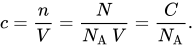
Here, is the amount of the solute in moles,[5] is the number of constituent particles present in volume (in litres) of the solution, and is the Avogadro constant, since 2019 defined as exactly 6.02214076×10²³ mol−1. The ratio is the number density .

In thermodynamics, the use of molar concentration is often not convenient because the volume of most solutions slightly depends on temperature due to thermal expansion. This problem is usually resolved by introducing temperature correction factors, or by using a temperature-independent measure of concentration such as molality.[5]

The reciprocal quantity represents the dilution (volume) which can appear in Ostwald's law of dilution.

Formality or analytical concentration

[edit]

If a molecule or salt dissociates in solution, the concentration refers to the original chemical formula in solution, the molar concentration is sometimes called formal concentration or formality (FA) or analytical concentration (cA). For example, if a sodium carbonate solution (Na2CO3) has a formal concentration of c(Na2CO3) = 1 mol/L, the molar concentrations are c(Na+) = 2 mol/L and c(CO2−3) = 1 mol/L because the salt dissociates into these ions.[6]

Units

[edit]

While there is clear consensus on the equivalence of units:

1 mol/m3 = 10−3 mol/dm3 = 10−3 mol/L = 10−3 M = 1 mM = 1 mmol/L

guidance on unit names and abbreviations varies:

[A]mount concentration ...[a]lso called amount-of-substance concentration, substance concentration (in clinical chemistry) and in older literature molarity. ...The common unit is mole per cubic decimetre (mol dm−3) or mole per litre (mol L−1) sometimes denoted by M.

In the older literature this quantity was often called molarity, a usage that should be avoided due to the risk of confusion with the quantity molality. Units commonly used for amount concentration are mol L−1 (or mol dm−3), mmol L−1, mmol L−1 etc., often denoted M, mM, uM etc. (pronounced molar, millimolar, micromolar).

The term molarity and the symbol M should no longer be used because they, too, are obsolete. One should use instead amount-of-substance concentration of B and such units as mol/dm3, kmol/m3, or mol/L. (A solution of, for example, 0.1 mol/dm3 was often called a 0.1 molar solution, denoted 0.1 M solution. The molarity of the solution was said to be 0.1 M.)

The SI prefix "mega" (symbol M) has the same symbol. However, the prefix is never used alone, so "M" unambiguously denotes molar. Sub-multiples, such as "millimolar" (mM) and "nanomolar" (nM), consist of the unit preceded by an SI prefix:

Name Abbreviation Concentration
(mol/L) (mol/m3)
millimolar mM 10−3 100=1
micromolar μM 10−6 10−3
nanomolar nM 10−9 10−6
picomolar pM 10−12 10−9
femtomolar fM 10−15 10−12
attomolar aM 10−18 10−15
zeptomolar zM 10−21 10−18
yoctomolar yM 10−24
(6 particles per 10 L)
10−21
rontomolar rM 10−27 10−24
quectomolar qM 10−30 10−27
[edit]

Number concentration

[edit]

The conversion to number concentration is given by

where is the Avogadro constant.

Mass concentration

[edit]

The conversion to mass concentration is given by

where is the molar mass of constituent .

Mole fraction

[edit]

The conversion to mole fraction is given by

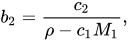
where is the average molar mass of the solution, is the density of the solution.

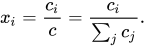
A simpler relation can be obtained by considering the total molar concentration, namely, the sum of molar concentrations of all the components of the mixture:
Mass fraction

[edit]

The conversion to mass fraction is given by

Molality

[edit]

For binary mixtures, the conversion to molality is

where the solvent is substance 1, and the solute is substance 2.

For solutions with more than one solute, the conversion is

Properties

[edit]

Sum of molar concentrations – normalizing relations

[edit]

The sum of molar concentrations gives the total molar concentration, namely the density of the mixture divided by the molar mass of the mixture or by another name the reciprocal of the molar volume of the mixture. In an ionic solution, ionic strength is proportional to the sum of the molar concentration of salts.

Sum of products of molar concentrations and partial molar volumes

[edit]

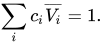
The sum of products between these quantities equals one:
Dependence on volume

[edit]

The molar concentration depends on the variation of the volume of the solution due mainly to thermal expansion. On small intervals of temperature, the dependence is
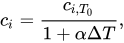
where is the molar concentration at a reference temperature, is the thermal expansion coefficient of the mixture.

Examples

[edit]
  • 11.6 g of NaCl is dissolved in 100 g of water. The final mass concentration ρ(NaCl) is
    ρ(NaCl) = 11.6 g/11.6 g + 100 g = 0.104 g/g = 10.4 %.

    The volume of such a solution is 104.3mL (volume is directly observable); its density is calculated to be 1.07 (111.6g/104.3mL)

    The molar concentration of NaCl in the solution is therefore

    c(NaCl) = 11.6 g/58 g/mol / 104.3 mL = 0.00192 mol/mL = 1.92 mol/L.
    Here, 58 g/mol is the molar mass of NaCl.
  • A typical task in chemistry is the preparation of 100 mL (= 0.1 L) of a 2 mol/L solution of NaCl in water. The mass of salt needed is
    m(NaCl) = 2 mol/L × 0.1 L × 58 g/mol = 11.6 g.
    To create the solution, 11.6 g NaCl is placed in a volumetric flask, dissolved in some water, then followed by the addition of more water until the total volume reaches 100 mL.
  • The density of water is approximately 1000 g/L and its molar mass is 18.02 g/mol (or 1/18.02 = 0.055 mol/g). Therefore, the molar concentration of water is
    c(H2O) = 1000 g/L/18.02 g/mol ≈ 55.5 mol/L.
    Likewise, the concentration of solid hydrogen (molar mass = 2.02 g/mol) is
    c(H2) = 88 g/L/2.02 g/mol = 43.7 mol/L.
    The concentration of pure osmium tetroxide (molar mass = 254.23 g/mol) is
    c(OsO4) = 5.1 kg/L/254.23 g/mol = 20.1 mol/L.
  • A typical protein in bacteria, such as E. coli, may have about 60 copies, and the volume of a bacterium is about 10−15 L. Thus, the number concentration C is
    C = 60 / (10−15 L) = 6×10¹⁶ L−1.
    The molar concentration is
    c = C/NA = 6×10¹⁶ L−1/6×1023 mol−1 = 10−7 mol/L = 100 nmol/L.
  • Reference ranges for blood tests, sorted by molar concentration:

See also

[edit]

References

[edit]
[edit]
Revisions and contributorsEdit on WikipediaRead on Wikipedia
from Grokipedia
Molar concentration, also known as molarity or amount-of-substance concentration, is a measure of the concentration of a in a solution, defined as the (in moles) divided by the volume of the solution in liters. This quantity, often denoted by the symbol c or M, expresses how many moles of solute are present per liter of solution, making it essential for quantifying solution composition in chemical reactions and processes. In the (SI), the base unit is mole per cubic meter (mol/m³), but the most commonly used practical unit is moles per liter (mol/L or mol/dm³), equivalent to 1000 mol/m³. Molar concentration is particularly valuable in analytical and synthetic chemistry because it directly relates the number of moles of reactants and products to solution volumes, facilitating stoichiometric calculations in titrations, dilutions, and equilibrium studies. Unlike mass-based concentrations, it accounts for the molecular scale through the mole concept, enabling precise predictions of reaction behavior without needing to know the solute's explicitly in many cases. It is distinct from related measures like (moles per of ) or mass concentration (grams per liter), as it depends on the total of the solution, which can vary with and solute-solvent interactions. In practice, molar concentrations range from dilute solutions (e.g., 0.001 M) used in biological assays to concentrated ones (e.g., 12 M for ), and preparing solutions of known molarity involves dissolving a calculated of solute and adjusting to a specific . This unit's widespread adoption stems from its compatibility with volumetric glassware and its role in standardizing chemical analyses across industries, from pharmaceuticals to .

Definition and Basic Concepts

Definition

Molar concentration, denoted as cic_i for a specific solute ii, is defined as the ratio of the of the solute, expressed in moles (nin_i), to the volume of the solution ([V](/page/V.)[V](/page/V.)), mathematically expressed as ci=niV.c_i = \frac{n_i}{V}. This quantity represents the amount-of-substance concentration according to IUPAC , where the amount of substance is measured in moles, a unit that quantifies the number of entities (such as molecules or ions) proportional to Avogadro's constant. The common term "molarity" specifically refers to molar concentration when the volume is expressed in liters, yielding units of moles per liter (mol/), often symbolized as . In general usage, molar concentration maintains the abstract form without fixed units, allowing flexibility across different volume measures, though mol/ is standard in contexts. In a solution, the solute is the component present in smaller quantity that dissolves into the , the primary dissolving medium (typically a like ). For dilute solutions, where the solute amount is small relative to the , the total volume of the solution approximates the volume of the alone, as the partial volume contributed by the solute is negligible; this assumption simplifies practical calculations but holds less accurately for concentrated solutions. The concept of molar concentration emerged in the late , building on the introduction of the "mole" term by around 1900 to denote the mass in grams equal to the molecular weight of a substance, facilitating stoichiometric expressions in solutions. In modern chemistry, it assumes familiarity with the mole as the SI unit for . Unlike , which normalizes to the mass of , molar concentration uses the solution's volume, making it sensitive to temperature and pressure changes.

Formality and Analytical Concentration

In , formality (F) represents the total concentration of solute formula units dissolved per liter of solution, calculated based on the amount of solute added without accounting for dissociation into ions or other . This unit is particularly relevant for electrolytes, where it provides a standardized way to express the prepared concentration irrespective of the solution's behavior after dissolution. For instance, a solution made by dissolving 0.1 mol of NaCl in 1 L has a formality of 0.1 F, corresponding to the formula units of NaCl, even though it dissociates completely into Na⁺ and Cl⁻ ions. Analytical concentration, often denoted as c or C_A, refers to the total molar amount of the solute (or ) per liter of solution, measured as the sum of all chemical forms derived from the original solute without distinguishing between dissociated or undissociated . This concept is essential in and quantitative analysis, where the focus is on the overall quantity of solute introduced rather than the concentrations of individual ions or molecules. For example, in a titration involving a salt like KCl, the analytical concentration equals the formality and is used to determine equivalence points based on the total solute present. Formality approximates true molarity closely in dilute solutions of non-electrolytes or strong electrolytes where dissociation is complete and does not affect the volume significantly, as the concentration of the aligns with the effective species concentrations. However, for weak electrolytes like acetic acid, the formality or analytical concentration (e.g., 0.1 F) exceeds the true molar concentration of the dissociated species, such as [H⁺] ≈ 0.001 M, due to partial . This distinction is critical in analytical contexts, as true molarity reflects the actual reactive species (e.g., [H⁺] in acid-base equilibria), while formality and analytical concentration treat the solute as undissociated for simplicity in preparation and stoichiometric calculations.

Units and Measurement

Standard Units

The primary unit for molar concentration, also known as amount concentration, is the mole per cubic decimeter (mol/dm³), which is equivalent to moles per liter (mol/) and commonly denoted by the symbol for molarity. This unit expresses the in moles dissolved in one cubic decimeter of solution. The coherent SI unit for molar concentration is the mole per cubic meter (mol/m³), but it is seldom employed in chemical practice due to the resulting large numerical values; the conversion factor is 1 = 1000 mol/m³. In chemical equations and discussions, the molar concentration of a species A is frequently denoted using square brackets as [A], equivalent to the amount concentration cA=[A]c_A = [A]. Decimal submultiples of the molar unit, such as millimolar (mM = 10310^{-3} M) and micromolar (μM = 10610^{-6} M), are standard in biochemical and trace analysis applications to represent dilute solutions. The International Union of Pure and Applied Chemistry (IUPAC) defines with the solution volume measured at a specified to ensure consistency accounting for volumetric changes with .

Unit Conversions and Practical Measurement

Molar concentration expressed in the SI unit of mol/m³ is calculated by multiplying the value in molar (M, or mol/L) by 1000, reflecting the volume equivalence of 1 L = 0.001 m³. To obtain mass concentration from , the molarity is multiplied by the solute's ; specifically, for c in mol/L and M in g/mol, the mass concentration ρ equals c × M in g/L, which numerically equals kg/m³ due to unit consistency. Molar concentration exhibits temperature dependence because solution volume expands or contracts with thermal changes, altering the moles per unit volume; as a result, values are typically reported at 20°C, the standard reference temperature for calibration of volumetric glassware per ISO and ASTM standards, to ensure comparability; thermodynamic standard states often use 25°C. Volumetric glassware is calibrated at 20°C per international standards (ISO 4787), with corrections applied for other temperatures. Titration serves as a primary experimental method for determining molar concentration, involving the addition of a titrant of known concentration to the until the , from which the unknown concentration is derived via stoichiometric ratios and delivered volumes; acid-base titrations, for instance, are routinely applied to quantify acids or bases. measures concentration through light absorption, governed by the Beer-Lambert law: A=ϵclA = \epsilon \, c \, l where AA is absorbance, ϵ\epsilon is the molar absorptivity (unique to the solute and wavelength), cc is molar concentration, and ll is the optical path length; this enables direct calculation of cc from measured absorbance after calibration. Gravimetry provides a confirmatory approach by isolating the analyte as a precipitate, weighing it to determine moles, and back-calculating the original solution concentration based on the sample volume. Measurement errors in molar concentration often stem from density variations, especially in non-aqueous solvents where densities deviate substantially from 1 g/mL (as in water), leading to inaccuracies in volume determinations and thus concentration values; compensating requires solvent-specific density corrections and high-precision volumetric tools. In laboratory practice, pipettes and burettes are calibrated either "to contain" (TC), specifying the volume they hold when filled to the mark, or "to deliver" (TD), indicating the volume dispensed after accounting for retained liquid on internal surfaces, ensuring accurate transfers for concentration assays.

Volume-Based Measures

Volume-based measures of concentration quantify the amount of solute relative to the total of the solution, providing absolute scales that depend on the solution's , which can vary with and composition. Molar concentration, or molarity (c), expresses this in terms of moles of solute per liter of solution, emphasizing the number of molecules or formula units on a molecular scale. In contrast, other volume-based measures like number concentration and concentration use different quantifiers—particles or —while sharing the same denominator, allowing direct comparisons and conversions under specific conditions. Number concentration, denoted as n/Vn/V, represents the number of particles (such as molecules, ions, or colloids) per unit volume of solution, typically in particles per liter or per cubic meter. It relates directly to molar concentration via Avogadro's constant (NA6.022×1023mol1N_A \approx 6.022 \times 10^{23} \, \mathrm{mol}^{-1}), where c=(n/V)/NAc = (n/V) / N_A, converting the count of individual entities to moles per liter. This relation highlights how molar concentration scales the microscopic particle count to a macroscopic chemical unit, with NAN_A defined exactly as the number of entities in one mole. Mass concentration, often symbolized as ρ=m/V\rho = m/V, measures the mass of solute per unit volume, commonly in grams per liter (g/L) or milligrams per liter (mg/L). It connects to molar concentration through the solute's molar mass (MM, in g/mol), via c=ρ/Mc = \rho / M, enabling conversion between mass-based and mole-based expressions. For instance, in dilute aqueous solutions, units like parts per million (ppm) approximate mass concentration as mg/L, facilitating environmental assessments. The key differences among these measures lie in their focus: molar concentration prioritizes the molecular scale by using moles, which accounts for the solute's chemical identity and ; mass concentration targets macroscopic properties like total solute weight, independent of molecular structure; and number concentration emphasizes discrete entity counting, useful for systems where particle identity matters over or moles. These distinctions arise because moles incorporate Avogadro's constant to bridge atomic-level counts to bulk quantities, while and number do not. Applications of number concentration are prominent in colloidal suspensions and gaseous systems, where tracking individual particle densities informs stability, aggregation, or behavior—such as in for particulate matter. Mass concentration, meanwhile, dominates , where ppm equivalents (≈ mg/L) quantify pollutant levels in or air, guiding regulatory limits without needing molar masses. In dilute solutions, these measures exhibit approximate proportionality due to near-constant solution density and negligible volume changes upon mixing, allowing simple scaling factors like NAN_A or MM for interconversions; however, in concentrated mixtures, deviations occur from non-ideal volume effects and solute-solvent interactions, requiring more complex adjustments.

Compositional Fractions

Compositional fractions quantify the relative proportions of components in a by expressing each as a share of the total composition, rendering these measures scale-invariant and independent of absolute volume or mass. Unlike absolute concentrations such as molarity, which depend on solution volume, compositional fractions emphasize the intrinsic makeup of the , making them valuable for comparative analyses in multi-component mixtures. The mole fraction xix_i of a component ii is defined as the ratio of the moles of ii to the total moles in the : xi=nintotalx_i = \frac{n_i}{n_\text{total}} This satisfies xi=1\sum x_i = 1 and is widely used in thermodynamics due to its additivity and independence from temperature or pressure variations in ideal cases. In ideal dilute aqueous solutions, where the solvent dominates, xici/ctotalx_i \approx c_i / c_\text{total} and ctotal55.5c_\text{total} \approx 55.5 M for water, providing a direct link to molar concentration cic_i. For gas mixtures, mole fractions facilitate calculations of partial pressures via Dalton's law, enhancing their utility in equilibrium studies. The mass fraction wiw_i parallels this by representing the mass of component ii relative to the total mass: wi=mimtotalw_i = \frac{m_i}{m_\text{total}} Like mole fraction, it is dimensionless with wi=1\sum w_i = 1, but it weights components by mass rather than molecular count, proving advantageous in material balances and density-dependent processes. Conversion from molarity yields wi=(ciMi)/ρtotalw_i = (c_i M_i) / \rho_\text{total}, where MiM_i is the molar mass of ii and ρtotal\rho_\text{total} is the solution density, highlighting its ties to physical properties. Mole and mass fractions diverge notably in systems where molar masses vary significantly; mole fraction emphasizes molecular abundance, yielding low values for heavy components like polymers despite substantial mass contributions, whereas mass fraction reflects weight dominance in such cases. This distinction is critical for isotopes (near-identical fractions) versus polydisperse polymers (pronounced divergence). In , mole underpins for ideal solutions, where the partial vapor pressure pi=xipip_i = x_i p_i^* (pip_i^* being the pure-component ) governs vapor-liquid equilibria.

Non-Volumetric Measures

Molality represents a non-volumetric measure of concentration, defined as the ratio of the amount of solute to the of the rather than the volume of the solution. Unlike molarity, which depends on the solution's volume and thus varies with and , molality provides a stable metric for describing solution composition. The molality of a solute ii, denoted mim_i, is given by mi=nimsolventm_i = \frac{n_i}{m_{\text{solvent}}} where nin_i is the amount of substance of solute ii in moles and msolventm_{\text{solvent}} is the mass of the solvent in kilograms; the unit of molality is therefore mol/kg. This definition, established by the International Union of Pure and Applied Chemistry (IUPAC), emphasizes the solvent's mass as the normalizing factor, making it particularly suitable for systems where volume fluctuations are undesirable. The relationship between molality mm and molarity cc for a single-solute solution is m=cρcM1000m = \frac{c}{\rho - c \cdot \frac{M}{1000}} where ρ\rho is the of the solution in g/ and MM is the of the solute in g/mol. In dilute aqueous solutions, where the of the ρsolvent1\rho_{\text{solvent}} \approx 1 kg/L for , molality approximates molarity (mcm \approx c), but deviations arise due to changes in solution from solute addition and interactions. For instance, volume contraction upon dissolution increases the effective concentration relative to volume-based measures. A key advantage of molality is its independence from temperature, as both the moles of solute and the mass of solvent remain constant regardless of thermal expansion or contraction, unlike the volume-dependent molarity. This property makes molality the preferred unit for colligative properties, which depend solely on the number of solute particles relative to solvent molecules, such as boiling point elevation given by ΔTb=Kbmi\Delta T_b = K_b m i, where KbK_b is the ebullioscopic constant and ii is the van't Hoff factor accounting for dissociation. However, molality has limitations in practical application, as it requires precise determination of the solvent's mass rather than the more straightforward volumetric measurement of the total solution, which can be less intuitive and more time-consuming for solvents. Additionally, it assumes a clear distinction between solute and solvent, which may complicate analysis in complex mixtures without a dominant . As an illustration of the distinction from molarity, a 1 M NaCl solution in at 25°C has a molality of approximately 1.02 mol/kg, reflecting the volume contraction that reduces the solution's to about 1.037 g/mL.

Mathematical Properties

Normalizing Relations

In multi-component solutions, the molar concentrations of individual solutes are defined with respect to the total volume VV of the solution, such that the concentration of component ii is ci=ni/Vc_i = n_i / V, where nin_i is the number of moles of ii. The sum of these concentrations over all solutes gives the total solute molar concentration ci=(ni)/V\sum c_i = (\sum n_i) / V. This sum is exact by definition but assumes a fixed total volume; in non-ideal solutions, VV is not simply the sum of individual component volumes but is given by V=nkVˉkV = \sum n_k \bar{V}_k, where Vˉk\bar{V}_k is the partial molar volume of each component kk (including the ). For normalizing the composition, the relative mole fraction of a solute ii among all solutes is ci/cjc_i / \sum c_j, which provides a simple proportional measure useful for comparing relative amounts in the absence of solvent contributions. However, the true thermodynamic mole fraction of solute ii in the entire solution is xi=ni/(nsolvent+nj)=ci/(csolvent+cj)x_i = n_i / (n_\text{solvent} + \sum n_j) = c_i / (c_\text{solvent} + \sum c_j), where csolvent=nsolvent/Vc_\text{solvent} = n_\text{solvent} / V. This relation highlights that molar concentrations must be adjusted by the solvent's contribution for accurate overall composition normalization. In dilute solutions, where the total solute concentration ci55.5\sum c_i \ll 55.5 (the molarity of pure , calculated as 1000/18.01555.51000 / 18.015 \approx 55.5 mol/L at 25°C), the volume VnsolventVˉsolventV \approx n_\text{solvent} \bar{V}_\text{solvent}, making csolvent55.5c_\text{solvent} \approx 55.5 nearly constant. Under this approximation, the simplifies to xici/55.5x_i \approx c_i / 55.5 , and the sum of solute mole fractions xi(ci)/55.5\sum x_i \approx (\sum c_i) / 55.5 , with the mole fraction xsolvent1xix_\text{solvent} \approx 1 - \sum x_i. This dilute limit normalization is widely used in aqueous chemistry for low-concentration systems. The total molar concentration of the entire solution (including ) is ctotal=(nk)/V=1/xkVˉkc_\text{total} = (\sum n_k) / V = 1 / \sum x_k \bar{V}_k, where the sum is over all components; this expression accounts for non-ideal mixing effects through the partial molar volumes Vˉk\bar{V}_k. In non-ideal cases, apparent molar volumes V_\phi_i = (V - n_\text{solvent} \bar{V}_\text{solvent}^*) / n_i (for binary systems, where Vˉsolvent\bar{V}_\text{solvent}^* is the pure molar volume) provide a practical way to estimate deviations from ideality in the total volume, allowing refinement of concentration sums beyond simple additivity. For multi-solute systems, such as a binary solute in , the combined solute concentrations c1+c2c_1 + c_2 relate to the overall ρ\rho via V=mtotal/ρV = m_\text{total} / \rho, where adjustments using apparent molar volumes help normalize the composition when solute-solute interactions affect the total volume.

Volume Dependence and Partial Molar Volumes

The molar concentration of a solute component ii in a multicomponent solution is given by ci=ni/Vc_i = n_i / V, where nin_i is the amount of substance of ii in moles and VV is the total volume of the solution. Unlike ideal mixtures where volumes are strictly additive, the total volume VV of real solutions varies with the addition of solute due to intermolecular interactions and solvation effects, causing cic_i to depend on the composition beyond simple dilution. This leads to cross-differentiation effects where the change in concentration of one component upon adding another is nonzero: (cinj)T,P,nki,j0\left( \frac{\partial c_i}{\partial n_j} \right)_{T,P,n_{k \neq i,j}} \neq 0 for iji \neq j. To rigorously describe this volume dependence, partial molar volumes are employed. The partial molar volume Vˉi\bar{V}_i of component ii is defined as the partial derivative Vˉi=(Vni)T,P,nji\bar{V}_i = \left( \frac{\partial V}{\partial n_i} \right)_{T,P,n_{j \neq i}}, representing the infinitesimal change in solution volume upon adding one mole of ii while holding temperature TT, pressure PP, and amounts njn_j of other components constant. Because volume is an extensive property and homogeneous of degree one in the composition variables, the total volume admits the integrated form V=iniVˉiV = \sum_i n_i \bar{V}_i. Substituting this into the expression for molar concentration yields ci=ni/jnjVˉjc_i = n_i / \sum_j n_j \bar{V}_j, highlighting how variations in Vˉj\bar{V}_j with composition influence cic_i. A key consequence is the dimensionless normalizing relation iciVˉi=1\sum_i c_i \bar{V}_i = 1, which arises directly from the definitions. To derive it, start with the differential of volume at constant TT and PP: dV=iVˉidnidV = \sum_i \bar{V}_i \, dn_i. Integrating for extensive scaling gives V=iniVˉiV = \sum_i n_i \bar{V}_i, assuming Vˉi\bar{V}_i depends only on composition (valid for intensive conditions). Then, iciVˉi=i(ni/V)Vˉi=(1/V)iniVˉi=(1/V)V=1\sum_i c_i \bar{V}_i = \sum_i (n_i / V) \bar{V}_i = (1/V) \sum_i n_i \bar{V}_i = (1/V) \cdot V = 1. This relation holds generally for solutions where concentrations are expressed in molar units (mol/L) and partial molar volumes in reciprocal units (L/mol), serving as a thermodynamic consistency condition. For a pure component ii, it simplifies to ci=1/Vˉic_i = 1 / \bar{V}_i, where Vˉi\bar{V}_i reduces to the pure molar volume; in mixtures, however, composition-dependent Vˉi\bar{V}_i introduce apparent volume contractions or expansions, altering concentrations nonlinearly. In concentrated solutions, partial molar volumes exhibit non-additivity, deviating significantly from the sum of pure-component volumes due to molecular packing, hydrogen bonding, or other interactions, which complicates the prediction of VV and thus cic_i. This non-ideality is particularly pronounced in solutions, where partial molar volumes inform theories like Debye-Hückel, accounting for ionic hydration and electrostatic effects on solution volume at moderate concentrations.

Applications and Examples

Calculation Methods

Molar concentration, denoted as cc or [solute][ \text{solute} ], is calculated from the mass of the solute and the volume of the solution using the formula c=msolute/MVsolutionc = \frac{m_{\text{solute}} / M}{V_{\text{solution}}}, where msolutem_{\text{solute}} is the mass of the solute in grams, MM is the molar mass of the solute in grams per mole, and VsolutionV_{\text{solution}} is the volume of the solution in liters. This method assumes the volume is measured after complete dissolution and mixing, ensuring the solute fully contributes to the total volume. Conversely, the mass of solute required to achieve a desired molar concentration can be found by rearranging the formula: msolute=c×Vsolution×Mm_{\text{solute}} = c \times V_{\text{solution}} \times M. Converting a molar concentration value (e.g., in μM) directly to mass in mg is not possible without knowing the molecular weight of the solute and the solution volume. The general formula for such cases is: Mass (mg) = concentration (μM) × Volume (L) × Molecular Weight (g/mol) × 0.001. This derives from the fundamental relation mass (g) = c (mol/L) × V (L) × M (g/mol), with adjustments for units (where c (mol/L) = concentration (μM) × 10^{-6} and mg = g × 1000). For a 50 μM concentration, the mass in mg is given by 50 × Volume (L) × Molecular Weight (g/mol) × 0.001. For dilutions, the final molar concentration is determined by cfinal=cinitial×VinitialVfinalc_{\text{final}} = c_{\text{initial}} \times \frac{V_{\text{initial}}}{V_{\text{final}}}, derived from the conservation of moles where the product of concentration and remains constant before and after dilution. This formula applies to stepwise processes, such as preparing standard solutions from a , by iteratively applying the relation for each step. In multicomponent mixtures, the molar concentration of each species ii is given by ci=niVtotalc_i = \frac{n_i}{V_{\text{total}}}, where nin_i is the moles of component ii and VtotalV_{\text{total}} is the total solution volume. VtotalV_{\text{total}} can be obtained from the densities of pure components if volumes are additive, or measured directly; for non-ideal mixtures, density data or empirical corrections may be needed to compute the effective volume. For ionic solutions of weak acids, the true molar concentration of dissociated species, such as [\ceH+][\ce{H+}], differs from the analytical concentration due to partial dissociation and is approximated by [\ceH+]=Kac[\ce{H+}] = \sqrt{K_a \cdot c}
Add your contribution
Related Hubs
User Avatar
No comments yet.