Hubbry Logo
Solubility equilibriumSolubility equilibriumMain
Open search
Solubility equilibrium
Community hub
Solubility equilibrium
logo
7 pages, 0 posts
0 subscribers
Be the first to start a discussion here.
Solubility equilibrium
from Wikipedia

Solubility equilibrium is a type of dynamic equilibrium that exists when a chemical compound in the solid state is in chemical equilibrium with a solution of that compound. The solid may dissolve unchanged, with dissociation, or with chemical reaction with another constituent of the solution, such as acid or alkali. Each solubility equilibrium is characterized by a temperature-dependent solubility product which functions like an equilibrium constant. Solubility equilibria are important in pharmaceutical, environmental and many other scenarios.

Definitions

[edit]

A solubility equilibrium exists when a chemical compound in the solid state is in chemical equilibrium with a solution containing the compound. This type of equilibrium is an example of dynamic equilibrium in that some individual molecules migrate between the solid and solution phases such that the rates of dissolution and precipitation are equal to one another. When equilibrium is established and the solid has not all dissolved, the solution is said to be saturated. The concentration of the solute in a saturated solution is known as the solubility. Units of solubility may be molar (mol dm−3) or expressed as mass per unit volume, such as μg mL−1. Solubility is temperature dependent. A solution containing a higher concentration of solute than the solubility is said to be supersaturated. A supersaturated solution may be induced to come to equilibrium by the addition of a "seed" which may be a tiny crystal of the solute, or a tiny solid particle, which initiates precipitation.[citation needed]

There are three main types of solubility equilibria.

  1. Simple dissolution.
  2. Dissolution with dissociation reaction. This is characteristic of salts. The equilibrium constant is known in this case as a solubility product.
  3. Dissolution with ionization reaction. This is characteristic of the dissolution of weak acids or weak bases in aqueous media of varying pH.

In each case an equilibrium constant can be specified as a quotient of activities. This equilibrium constant is dimensionless as activity is a dimensionless quantity. However, use of activities is very inconvenient, so the equilibrium constant is usually divided by the quotient of activity coefficients, to become a quotient of concentrations. See Equilibrium chemistry § Equilibrium constant for details. Moreover, the activity of a solid is, by definition, equal to 1 so it is omitted from the defining expression.

For a chemical equilibrium the solubility product, Ksp for the compound ApBq is defined as follows where [A] and [B] are the concentrations of A and B in a saturated solution. A solubility product has a similar functionality to an equilibrium constant though formally Ksp has the dimension of (concentration)p+q.

Effects of conditions

[edit]

Temperature effect

[edit]

Solubility is sensitive to changes in temperature. For example, sugar is more soluble in hot water than cool water. It occurs because solubility products, like other types of equilibrium constants, are functions of temperature. In accordance with Le Chatelier's Principle, when the dissolution process is endothermic (heat is absorbed), solubility increases with rising temperature. This effect is the basis for the process of recrystallization, which can be used to purify a chemical compound. When dissolution is exothermic (heat is released) solubility decreases with rising temperature.[1] Sodium sulfate shows increasing solubility with temperature below about 32.4 °C, but a decreasing solubility at higher temperature.[2] This is because the solid phase is the decahydrate (Na
2
SO
4
·10H
2
O
) below the transition temperature, but a different hydrate above that temperature.[citation needed]

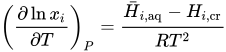
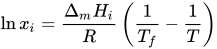
The dependence on temperature of solubility for an ideal solution (achieved for low solubility substances) is given by the following expression containing the enthalpy of melting, ΔmH, and the mole fraction of the solute at saturation: where is the partial molar enthalpy of the solute at infinite dilution and the enthalpy per mole of the pure crystal.[3]

This differential expression for a non-electrolyte can be integrated on a temperature interval to give:[4]

For nonideal solutions activity of the solute at saturation appears instead of mole fraction solubility in the derivative with respect to temperature:

Common-ion effect

[edit]

The common-ion effect is the effect of decreased solubility of one salt when another salt that has an ion in common with it is also present. For example, the solubility of silver chloride, AgCl, is lowered when sodium chloride, a source of the common ion chloride, is added to a suspension of AgCl in water.[5] The solubility, S, in the absence of a common ion can be calculated as follows. The concentrations [Ag+] and [Cl] are equal because one mole of AgCl would dissociate into one mole of Ag+ and one mole of Cl. Let the concentration of [Ag+(aq)] be denoted by x. Then Ksp for AgCl is equal to 1.77×10⁻¹⁰ mol2 dm−6 at 25 °C, so the solubility is 1.33×10⁻⁵ mol dm−3.

Now suppose that sodium chloride is also present, at a concentration of 0.01 mol dm−3 = 0.01 M. The solubility, ignoring any possible effect of the sodium ions, is now calculated by This is a quadratic equation in x, which is also equal to the solubility. In the case of silver chloride, x2 is very much smaller than 0.01 M x, so the first term can be ignored. Therefore a considerable reduction from 1.33×10⁻⁵ mol dm−3. In gravimetric analysis for silver, the reduction in solubility due to the common ion effect is used to ensure "complete" precipitation of AgCl.

Particle size effect

[edit]

The thermodynamic solubility constant is defined for large monocrystals. Solubility will increase with decreasing size of solute particle (or droplet) because of the additional surface energy. This effect is generally small unless particles become very small, typically smaller than 1 μm. The effect of the particle size on solubility constant can be quantified as follows: where *KA is the solubility constant for the solute particles with the molar surface area A, *KA→0 is the solubility constant for substance with molar surface area tending to zero (i.e., when the particles are large), γ is the surface tension of the solute particle in the solvent, Am is the molar surface area of the solute (in m2/mol), R is the universal gas constant, and T is the absolute temperature.[6]

Salt effects

[edit]

The salt effects[7] (salting in and salting-out) refers to the fact that the presence of a salt which has no ion in common with the solute, has an effect on the ionic strength of the solution and hence on activity coefficients, so that the equilibrium constant, expressed as a concentration quotient, changes.

Phase effect

[edit]

Equilibria are defined for specific crystal phases. Therefore, the solubility product is expected to be different depending on the phase of the solid. For example, aragonite and calcite will have different solubility products even though they have both the same chemical identity (calcium carbonate). Under any given conditions one phase will be thermodynamically more stable than the other; therefore, this phase will form when thermodynamic equilibrium is established. However, kinetic factors may favor the formation the unfavorable precipitate (e.g. aragonite), which is then said to be in a metastable state.[citation needed]

In pharmacology, the metastable state is sometimes referred to as amorphous state. Amorphous drugs have higher solubility than their crystalline counterparts due to the absence of long-distance interactions inherent in crystal lattice. Thus, it takes less energy to solvate the molecules in amorphous phase. The effect of amorphous phase on solubility is widely used to make drugs more soluble.[8][9]

Pressure effect

[edit]

For condensed phases (solids and liquids), the pressure dependence of solubility is typically weak and usually neglected in practice. Assuming an ideal solution, the dependence can be quantified as: where is the mole fraction of the -th component in the solution, is the pressure, is the absolute temperature, is the partial molar volume of the th component in the solution, is the partial molar volume of the th component in the dissolving solid, and is the universal gas constant.[10]

The pressure dependence of solubility does occasionally have practical significance. For example, precipitation fouling of oil fields and wells by calcium sulfate (which decreases its solubility with decreasing pressure) can result in decreased productivity with time.

Quantitative aspects

[edit]

Simple dissolution

[edit]

Dissolution of an organic solid can be described as an equilibrium between the substance in its solid and dissolved forms. For example, when sucrose (table sugar) forms a saturated solution An equilibrium expression for this reaction can be written, as for any chemical reaction (products over reactants): where Ko is called the thermodynamic solubility constant. The braces indicate activity. The activity of a pure solid is, by definition, unity. Therefore The activity of a substance, A, in solution can be expressed as the product of the concentration, [A], and an activity coefficient, γ. When Ko is divided by γ, the solubility constant, Ks, is obtained. This is equivalent to defining the standard state as the saturated solution so that the activity coefficient is equal to one. The solubility constant is a true constant only if the activity coefficient is not affected by the presence of any other solutes that may be present. The unit of the solubility constant is the same as the unit of the concentration of the solute. For sucrose Ks = 1.971 mol dm−3 at 25 °C. This shows that the solubility of sucrose at 25 °C is nearly 2 mol dm−3 (540 g/L). Sucrose is unusual in that it does not easily form a supersaturated solution at higher concentrations, as do most other carbohydrates.

Dissolution with dissociation

[edit]

Ionic compounds normally dissociate into their constituent ions when they dissolve in water. For example, for silver chloride: The expression for the equilibrium constant for this reaction is: where is the thermodynamic equilibrium constant and braces indicate activity. The activity of a pure solid is, by definition, equal to one.

When the solubility of the salt is very low the activity coefficients of the ions in solution are nearly equal to one. By setting them to be actually equal to one this expression reduces to the solubility product expression:

For 2:2 and 3:3 salts, such as CaSO4 and FePO4, the general expression for the solubility product is the same as for a 1:1 electrolyte

(electrical charges are omitted in general expressions, for simplicity of notation)

With an unsymmetrical salt like Ca(OH)2 the solubility expression is given by Since the concentration of hydroxide ions is twice the concentration of calcium ions this reduces to

In general, with the chemical equilibrium and the following table, showing the relationship between the solubility of a compound and the value of its solubility product, can be derived.[11]

Salt p q Solubility, S
AgCl
Ca(SO4)
Fe(PO4)
1 1 Ksp
Na2(SO4)
Ca(OH)2
2
1
1
2
Na3(PO4)
FeCl3
3
1
1
3
Al2(SO4)3
Ca3(PO4)2
2
3
3
2
Mp(An)q p q

Solubility products are often expressed in logarithmic form. Thus, for calcium sulfate, with Ksp = 4.93×10⁻⁵ mol2 dm−6, log Ksp = −4.32. The smaller the value of Ksp, or the more negative the log value, the lower the solubility.

Some salts are not fully dissociated in solution. Examples include MgSO4, famously discovered by Manfred Eigen to be present in seawater as both an inner sphere complex and an outer sphere complex.[12] The solubility of such salts is calculated by the method outlined in dissolution with reaction.

Hydroxides

[edit]

The solubility product for the hydroxide of a metal ion, Mn+, is usually defined, as follows: However, general-purpose computer programs are designed to use hydrogen ion concentrations with the alternative definitions.

For hydroxides, solubility products are often given in a modified form, K*sp, using hydrogen ion concentration in place of hydroxide ion concentration. The two values are related by the self-ionization constant for water, Kw.[13] For example, at ambient temperature, for calcium hydroxide, Ca(OH)2, lg Ksp is ca. −5 and lg K*sp ≈ −5 + 2 × 14 ≈ 23.

Dissolution with reaction

[edit]
When a concentrated solution of ammonia is added to a suspension of silver chloride dissolution occurs because a complex of Ag+ is formed

A typical reaction with dissolution involves a weak base, B, dissolving in an acidic aqueous solution. This reaction is very important for pharmaceutical products.[14] Dissolution of weak acids in alkaline media is similarly important. The uncharged molecule usually has lower solubility than the ionic form, so solubility depends on pH and the acid dissociation constant of the solute. The term "intrinsic solubility" is used to describe the solubility of the un-ionized form in the absence of acid or alkali.

Leaching of aluminium salts from rocks and soil by acid rain is another example of dissolution with reaction: alumino-silicates are bases which react with the acid to form soluble species, such as Al3+(aq).

Formation of a chemical complex may also change solubility. A well-known example is the addition of a concentrated solution of ammonia to a suspension of silver chloride, in which dissolution is favoured by the formation of an ammine complex. When sufficient ammonia is added to a suspension of silver chloride, the solid dissolves. The addition of water softeners to washing powders to inhibit the formation of soap scum provides an example of practical importance.

Experimental determination

[edit]

The determination of solubility is fraught with difficulties.[6] First and foremost is the difficulty in establishing that the system is in equilibrium at the chosen temperature. This is because both precipitation and dissolution reactions may be extremely slow. If the process is very slow solvent evaporation may be an issue. Supersaturation may occur. With very insoluble substances, the concentrations in solution are very low and difficult to determine. The methods used fall broadly into two categories, static and dynamic.

Static methods

[edit]

In static methods a mixture is brought to equilibrium and the concentration of a species in the solution phase is determined by chemical analysis. This usually requires separation of the solid and solution phases. In order to do this the equilibration and separation should be performed in a thermostatted room.[15] Very low concentrations can be measured if a radioactive tracer is incorporated in the solid phase.

A variation of the static method is to add a solution of the substance in a non-aqueous solvent, such as dimethyl sulfoxide, to an aqueous buffer mixture.[16] Immediate precipitation may occur giving a cloudy mixture. The solubility measured for such a mixture is known as "kinetic solubility". The cloudiness is due to the fact that the precipitate particles are very small resulting in Tyndall scattering. In fact the particles are so small that the particle size effect comes into play and kinetic solubility is often greater than equilibrium solubility. Over time the cloudiness will disappear as the size of the crystallites increases, and eventually equilibrium will be reached in a process known as precipitate ageing.[17]

Dynamic methods

[edit]

Solubility values of organic acids, bases, and ampholytes of pharmaceutical interest may be obtained by a process called "Chasing equilibrium solubility".[18] In this procedure, a quantity of substance is first dissolved at a pH where it exists predominantly in its ionized form and then a precipitate of the neutral (un-ionized) species is formed by changing the pH. Subsequently, the rate of change of pH due to precipitation or dissolution is monitored and strong acid and base titrant are added to adjust the pH to discover the equilibrium conditions when the two rates are equal. The advantage of this method is that it is relatively fast as the quantity of precipitate formed is quite small. However, the performance of the method may be affected by the formation supersaturated solutions.

See also

[edit]

References

[edit]
[edit]
Revisions and contributorsEdit on WikipediaRead on Wikipedia
from Grokipedia
Solubility equilibrium refers to the dynamic equilibrium established in a saturated solution of a sparingly soluble ionic compound, where the rate of dissolution of the solid equals the rate of of the ions, resulting in constant concentrations of the dissolved species. This equilibrium is governed by the , denoted as Ksp, which is the for the dissociation reaction of the compound into its ions, expressed as Ksp = [My+]x [Ax-]y for a general salt MxAy(s) ⇌ x My+(aq) + y Ax-(aq). The value of Ksp is specific to each compound at a given and indicates its ; for example, a small Ksp value, such as 1.6 × 10⁻¹⁰ for AgCl, signifies low . Several factors influence solubility equilibria, allowing predictions about how the position of equilibrium shifts. The reduces solubility when an from another soluble salt is present, as it increases the concentration of that and suppresses further dissolution according to Le Châtelier's principle. Changes in can also affect solubility, particularly for salts involving weak acids or bases, by altering the concentration of the relevant through or . impacts solubility variably: it generally increases for most solids but decreases for gases, shifting the equilibrium to favor dissolution or accordingly. These factors enable calculations of molar solubility from Ksp values or predictions of when the product Q exceeds Ksp. Solubility equilibria have broad applications in chemistry and related fields, underpinning processes such as qualitative for separating metal ions based on differential solubilities. In , they are crucial for by precipitating contaminants like and for understanding natural phenomena such as the formation of scale in pipes from . Additionally, these principles inform pharmaceutical design, where controlling drug affects , and efforts to mitigate by enhancing the solubility of greenhouse gases in solvents.

Basic Principles

Definition and Saturation

Solubility equilibrium describes the dynamic state in a solution where a solid solute is in contact with its dissolved ions or molecules, and the forward process of dissolution occurs at the same rate as the reverse process of , resulting in no net change in the concentrations of the involved. This reversible process establishes a balance that persists as long as the system remains undisturbed. In general terms, this equilibrium can be represented as: solute(s)solute(aq)\text{solute(s)} \rightleftharpoons \text{solute(aq)} where the solid solute dissolves into its aqueous form, and the aqueous can recrystallize onto the phase. At equilibrium, the solution is saturated, meaning it contains the maximum concentration of dissolved solute possible under the prevailing conditions, and adding more solute leads to rather than further dissolution. Compounds are categorized by their tendency to reach this equilibrium based on the extent of dissolution in water: highly soluble substances, such as (NaCl), readily form saturated solutions with substantial solute concentrations, while sparingly soluble compounds, like (AgCl), achieve equilibrium with only trace amounts dissolved, and insoluble compounds dissolve negligibly, remaining largely as solids. This distinction arises from the inherent stability of the solid lattice versus the interaction with the solvent.

Solubility Product Constant

The solubility product constant, denoted as KspK_{sp}, is the equilibrium constant specific to the dissolution of a sparingly soluble ionic compound into its constituent ions in an . For a simple binary compound such as AB(s) ⇌ A⁺(aq) + B⁻(aq), the KspK_{sp} is derived from the general expression by excluding the activity of the pure solid AB, which is constant and equal to 1, yielding Ksp=[A+][B]K_{sp} = [A^+][B^-]. This expression generalizes to compounds producing multiple ions according to their ; for example, in the dissociation A₃B₂(s) ⇌ 3A²⁺(aq) + 2B³⁻(aq), the Ksp=[A2+]3[B3]2K_{sp} = [A^{2+}]^3 [B^{3-}]^2. Examples of ionic dissolution equations and corresponding KspK_{sp} expressions for some sparingly soluble compounds include:
  • PbCl₂(s) ⇌ Pb²⁺(aq) + 2Cl⁻(aq); Ksp=[Pb2+][Cl]2K_{sp} = [Pb^{2+}][Cl^-]^2
  • Ag₂S(s) ⇌ 2Ag⁺(aq) + S²⁻(aq); Ksp=[Ag+]2[S2]K_{sp} = [Ag^+]^2 [S^{2-}]
  • Sr₃(PO₄)₂(s) ⇌ 3Sr²⁺(aq) + 2PO₄³⁻(aq); Ksp=[Sr2+]3[PO43]2K_{sp} = [Sr^{2+}]^3 [PO₄^{3-}]^2
  • SrSO₄(s) ⇌ Sr²⁺(aq) + SO₄²⁻(aq); Ksp=[Sr2+][SO42]K_{sp} = [Sr^{2+}][SO₄^{2-}]
These examples demonstrate how the general KspK_{sp} expression is applied to compounds with different stoichiometries. Thermodynamically, KspK_{sp} is defined in terms of ion activities (effective concentrations relative to standard states), making it dimensionless, though it is commonly reported using molar concentrations in dilute solutions, which imparts units of (mol/L)n where n is the total number of ions produced. A small KspK_{sp} value indicates low solubility; for instance, calcium carbonate (CaCO₃) has Ksp=3.36×10⁹K_{sp} = 3.36 \times 10^{-9} at 25°C, reflecting its limited dissolution as CaCO₃(s) ⇌ Ca²⁺(aq) + CO₃²⁻(aq) with Ksp=[Ca2+][CO32]K_{sp} = [Ca^{2+}][CO_3^{2-}]. In deriving and applying KspK_{sp}, activity coefficients (γ) are assumed to approximate 1 for each ion in dilute solutions, allowing concentrations to substitute directly for activities without significant error.

Factors Influencing Solubility

Temperature and Pressure Effects

The solubility of solids in liquids varies with temperature based on the thermodynamics of the dissolution process. For endothermic dissolutions, where heat is absorbed, solubility generally increases as temperature rises; a classic example is potassium nitrate (KNO₃), whose solubility in water rises from about 13 g/100 mL at 0°C to over 240 g/100 mL at 100°C, as the added heat drives the equilibrium toward more dissolved ions per Le Chatelier's principle. In contrast, exothermic dissolutions, which release heat, exhibit decreased solubility with higher temperatures; calcium hydroxide (Ca(OH)₂) illustrates this, with solubility dropping from 0.173 g/100 mL at 10°C to 0.065 g/100 mL at 100°C, as the system shifts to counteract the heat input. This temperature dependence is quantitatively captured by the van't Hoff equation applied to the solubility product constant (K_{sp}): ln(Ksp2Ksp1)=ΔHR(1T21T1)\ln\left(\frac{K_{\mathrm{sp}_2}}{K_{\mathrm{sp}_1}}\right) = -\frac{\Delta H^\circ}{R} \left(\frac{1}{T_2} - \frac{1}{T_1}\right) where ΔH\Delta H^\circ is the standard of dissolution, RR is the (8.314 J/mol·K), and TT is the absolute in ; a positive ΔH\Delta H^\circ yields increasing K_{sp} (and thus ) with . Experimental data confirm that dissolution is endothermic (positive ΔH\Delta H) for most ionic salts, such as NaCl and KNO₃, resulting in higher at elevated s for the majority of cases. Pressure effects on solubility are minimal for solids and liquids owing to their incompressibility, but they are pronounced for gases in liquids. governs this, stating that gas solubility is directly proportional to its over the solution: C=kPC = k \cdot P, where CC is the concentration of dissolved gas, PP is the , and kk is the Henry's law constant (temperature-dependent). For instance, carbonated beverages maintain high CO₂ solubility under the elevated pressure (about 2–4 atm) in sealed containers, but upon opening, the pressure drop causes CO₂ to escape as bubbles. A relevant environmental example is oxygen (O₂) solubility in , which decreases with —holding about 14 mg/L at 0°C versus 7 mg/L at 30°C at 1 atm—but increases with . In , surface waters near the (warmer, ~25°C) have lower O₂ solubility (~5–6 mg/L), while deeper layers experience higher solubility due to hydrostatic pressure (increasing ~1 atm per 10 m depth), though overall dissolved oxygen profiles are also shaped by .

Common-Ion and Salt Effects

The common-ion effect refers to the reduction in solubility of a sparingly soluble salt when another soluble salt sharing a common ion is added to the solution, shifting the dissolution equilibrium toward the undissolved solid in accordance with Le Chatelier's principle. For instance, the solubility of silver chloride (AgCl) decreases significantly in the presence of chloride ions from sodium chloride (NaCl), as the increased [Cl⁻] suppresses the dissociation of AgCl(s) ⇌ Ag⁺(aq) + Cl⁻(aq). This effect is particularly pronounced for salts with low solubility product constants (Ksp), where even modest concentrations of the common ion can drive the ion product Q below Ksp, favoring precipitation over dissolution. Quantitatively, the impact can be illustrated using the solubility product expression for AgCl, where Ksp = [Ag⁺][Cl⁻] ≈ 1.8 × 10⁻¹⁰. In pure , the molar solubility of AgCl is approximately √Ksp ≈ 1.3 × 10⁻⁵ M, yielding equal concentrations of Ag⁺ and Cl⁻. However, in a 0.1 M NaCl solution, [Cl⁻] ≈ 0.1 M dominates, reducing [Ag⁺] to Ksp / [Cl⁻] ≈ 1.8 × 10⁻⁹ M (roughly 10-8 M), a decrease by several orders of magnitude compared to pure (10-5 M). This suppression enhances selective , as seen in qualitative analysis schemes where adding a common ion, such as HCl to precipitate Ag⁺ or Ba²⁺ from mixtures, allows isolation of specific cations by controlling solubility thresholds. Beyond the , broader salt effects arise from the influence of added electrolytes on activities in solution, primarily through changes in , defined as
I=12icizi2I = \frac{1}{2} \sum_i c_i z_i^2
where cic_i is the concentration and ziz_i the charge of each ii. The Debye-Hückel models these interactions by accounting for electrostatic shielding around , which alters activity coefficients (γ) and thus effective concentrations in the Ksp expression; higher generally lowers γ for like-charged , further modulating .
Salt effects manifest as salting-out or salting-in, depending on the solute and salt concentration. Salting-out decreases solubility of nonpolar or weakly polar solutes, such as proteins or organic compounds, by increasing ionic strength and reducing water availability for hydration shells, leading to precipitation; for example, ammonium sulfate at high concentrations (e.g., >1 M) is used to fractionate proteins by selectively precipitating those with lower solubility based on hydrophobicity and charge. In contrast, salting-in initially increases solubility at moderate salt levels (e.g., 0.1–0.5 M NaCl) for charged macromolecules like proteins, by screening repulsive electrostatic interactions and stabilizing solvation; this is evident in redissolving protein precipitates upon adding low concentrations of salts following initial aggregation. The Hofmeister series ranks ions by their salting efficacy, with kosmotropes like SO4²⁻ promoting salting-out and chaotropes like I⁻ favoring salting-in for certain organics.

Particle Size and Phase Effects

The solubility of a solid solute in a can be influenced by the , particularly when particles are reduced to the nanoscale, due to increased that raises the and thus the dissolution tendency. This effect is described by the , which relates the SS of a small particle of radius rr to that of a bulk particle S0S_0: ln(SS0)=2γVmrRT\ln\left(\frac{S}{S_0}\right) = \frac{2\gamma V_m}{rRT} where γ\gamma is the surface tension, VmV_m is the molar volume of the solute, RR is the gas constant, and TT is the temperature. Smaller particles exhibit higher apparent solubility because the curvature of their surface increases the chemical potential, making it easier for molecules to escape into solution compared to larger, flatter-surfaced particles. In practical examples, nanoscale silver particles demonstrate this enhanced solubility; for instance, silver nanoparticles with diameters below 20 nm dissolve more rapidly than bulk silver due to their elevated , leading to higher release rates in aqueous environments. This effect is particularly relevant in pharmaceuticals, where reducing drug to the nanoscale improves for poorly soluble compounds by accelerating dissolution kinetics, as seen in solid dispersions of drugs like naringenin, though extreme nanosizing may not yield proportional gains due to aggregation. The phase of the solute also affects solubility equilibrium, with different polymorphs or amorphous forms exhibiting varying solubilities stemming from differences in and molecular packing. For , the amorphous phase is significantly more soluble than its crystalline polymorphs like or , owing to the disordered structure that lowers the energy barrier for dissolution, often by factors of 10 to 100 times higher solubility. Amorphous solids in general surpass their crystalline counterparts in solubility because the lack of long-range order reduces thermodynamic stability, facilitating faster integration into the solvent phase. In suspensions approaching equilibrium, occurs as a coarsening mechanism where smaller particles dissolve preferentially due to their higher , and the released material diffuses to deposit on larger particles, increasing overall polydispersity over time. This process is driven by the curvature-dependent gradient and operates near equilibrium conditions, ultimately leading to fewer but larger particles in the system. While reducing through grinding or milling markedly increases the surface area and thus the initial dissolution rate—following the Noyes-Whitney equation's dependence on area—it does not alter the true , which remains governed by the bulk phase properties. Finer particles approach saturation more quickly, but prolonged contact with the yields the same final concentration as coarser ones, barring phase transformations or effects.

pH Effects

Changes in can significantly influence the of certain sparingly soluble salts, particularly those involving anions from weak acids (e.g., carbonates, phosphates, sulfides) or cations from weak bases (e.g., hydroxides). Lowering the increases by providing H⁺ ions that react with the anion, forming the weak acid and removing it from the equilibrium, thus shifting dissolution forward per Le Châtelier's principle. For example, the of (CaCO₃) increases in acidic conditions as CO₃²⁻ + 2H⁺ → H₂CO₃ → CO₂ + H₂O, effectively reducing [CO₃²⁻] and promoting further dissolution of CaCO₃(s) ⇌ Ca²⁺ + CO₃²⁻. Conversely, higher can decrease for basic salts. This effect is crucial in applications like impacting dissolution or controlling precipitation in .

Thermodynamic Foundations

Relation to Gibbs Free Energy

The solubility equilibrium of a sparingly soluble ionic compound is thermodynamically described by the standard Gibbs free energy change (ΔG°) for its dissolution reaction, which is directly related to the solubility product constant (Ksp). For a general dissolution process such as MX(s) ⇌ M+(aq) + X-(aq), the relationship is given by ΔG=RTlnKsp\Delta G^\circ = -RT \ln K_{sp} where R is the gas constant (8.314 J mol-1 K-1) and T is the absolute temperature in Kelvin. This equation arises from the fundamental thermodynamic connection between the standard free energy change and the equilibrium constant for the reaction. A negative value of ΔG° indicates that the dissolution is spontaneous under standard conditions, corresponding to Ksp > 1 and thus high of the compound. In contrast, for sparingly soluble salts where Ksp << 1, ΔG° is positive, signifying that the solid phase is favored over the dissolved ions at standard concentrations, and only a small amount dissolves to reach equilibrium. The standard states in this context define the reference for ΔG°: the pure solid solute has an activity of 1 (standard state as the pure substance at 1 bar pressure), while the aqueous ions are referenced to a hypothetical ideal solution of 1 mol L-1 concentration, where activities approximate molar concentrations in dilute solutions. The temperature dependence of solubility equilibrium is captured through the variation of ΔG° with temperature, as described by the Gibbs-Helmholtz equation: ((ΔG/T)T)P=ΔHT2\left( \frac{\partial (\Delta G^\circ / T)}{\partial T} \right)_P = -\frac{\Delta H^\circ}{T^2} This relation shows how changes in the standard enthalpy of dissolution (ΔH°) influence Ksp via the temperature effect on ΔG°. For example, silver chloride (AgCl) has Ksp = 1.77 × 10⁻¹⁰ at 25°C (298 K). Substituting into the equation yields ΔG° ≈ 55.6 kJ mol-1, a positive value that reflects its low solubility.

Enthalpy and Entropy in Dissolution

The dissolution process of a solute in a involves both and entropic contributions that determine its spontaneity and dependence. The change, ΔH, for dissolution arises primarily from the balance between the energy required to break the solute's lattice (or intermolecular forces) and the energy released upon solute-solvent interactions, such as hydration for ionic compounds. In ionic solids, the —the energy to separate ions against strong electrostatic attractions—is often high and endothermic, while is exothermic as molecules form oriented shells around the ions. If exceeds , dissolution is endothermic (ΔH > 0), as seen in many salts; conversely, if hydration dominates, it is exothermic (ΔH < 0). The entropy change, ΔS, reflects the disorder associated with dispersing solute particles into the solvent. For ionic solids dissolving in water, ΔS is typically positive because the ordered crystal lattice breaks into freely moving ions, increasing the number of microstates in solution; however, this can be partially offset by negative contributions from the formation of structured hydration shells that impose order on surrounding water molecules. In contrast, for hydrophobic solutes or nonpolar molecules, ΔS is often negative due to the highly ordered "cages" of water molecules formed around the solute to minimize unfavorable interactions. For gases like oxygen (O₂) dissolving in water, ΔS is negative because the highly disordered gas phase transitions to a more ordered solvated state, requiring energy to create solvent cavities. The overall spontaneity of dissolution is governed by the Gibbs free energy change, given by: ΔG=ΔHTΔS\Delta G = \Delta H - T \Delta S where T is the absolute . For processes where ΔH > 0 and ΔS > 0, solubility increases with temperature because the -TΔS term becomes more negative, favoring spontaneity (ΔG < 0) at higher T; this is common for many ionic solids. A representative example is sodium chloride (NaCl), with ΔH ≈ +3.9 kJ/mol (slightly endothermic) and ΔS ≈ +43 J/mol·K (positive due to ion dispersion), making dissolution entropy-driven and increasingly favorable as temperature rises. For gases like O₂, both ΔH < 0 (exothermic due to weak interactions) and ΔS < 0 lead to decreased solubility with increasing temperature, as the -TΔS term becomes more positive. Enthalpy-entropy compensation often occurs in dissolution processes, where variations in ΔH and TΔS are correlated such that changes in one largely offset the other, resulting in relatively constant ΔG across conditions or solvents. This phenomenon arises from underlying molecular interactions, such as solvent reorganization, and is evident in series of related solutes where more favorable enthalpies (more negative ΔH) coincide with less favorable entropies (smaller ΔS), maintaining similar solubilities. Such compensation highlights the subtle balance driving solubility rather than dominance by a single thermodynamic term.

Mathematical Models

Simple Dissolution Processes

Simple dissolution processes describe the equilibrium established when a molecular solute, typically a non-electrolyte, dissolves in a solvent without undergoing ionization or complex chemical reactions. The process is represented by the equilibrium S(s)S(aq)\text{S(s)} \rightleftharpoons \text{S(aq)} where S denotes the undissociated solute in its solid and dissolved states. At saturation, the rate of dissolution equals the rate of crystallization, maintaining a constant concentration of the solute in solution. The equilibrium constant for this process, known as the solubility constant KK, is given by K=[S(aq)]K = [\text{S(aq)}] since the activity of the pure solid phase is defined as unity. This constant directly equals the molar solubility of the solute in mol/L under ideal conditions. In the ideal solubility approximation, the activity of the dissolved solute is assumed to equal its concentration, neglecting deviations due to non-ideal interactions such as solute-solute associations or significant solute-solvent specific forces. This simplification holds best for dilute solutions where the solute behaves independently. Representative examples illustrate this model. Sucrose, a non-electrolyte sugar, exhibits a solubility in water of approximately 200 g per 100 mL at 25°C, corresponding to a molar solubility of about 5.84 mol/L and thus K5.84K \approx 5.84 mol/L. Similarly, benzoic acid, treated here as an undissociated molecular solute under neutral conditions, has a solubility in water of 0.34 g per 100 mL at 25°C, or roughly 0.028 mol/L, yielding K0.028K \approx 0.028 mol/L. These values are commonly expressed in mass per volume units (g/100 mL) for practical applications in chemistry and industry, emphasizing the straightforward quantification of saturation without ionic contributions. For gaseous molecular solutes, a specialized form of this equilibrium applies under , particularly for non-reactive gases like oxygen or nitrogen in water. The dissolved concentration is proportional to the partial pressure of the gas above the solution: [gas]=KH×Pgas[\text{gas}] = K_H \times P_{\text{gas}} where KHK_H is the Henry's law constant (in mol/L·atm) and PgasP_{\text{gas}} is the partial pressure in atm. This relation assumes dilute solutions and ideal gas behavior, limiting its accuracy to low pressures and non-interacting gases that do not undergo reactions like hydrolysis in the solvent. Despite its utility, the simple dissolution model has limitations, as it overlooks solute self-association (such as dimerization in non-polar environments) or potential hydrolysis, which can shift the effective equilibrium concentration away from the ideal value. For instance, molecular size disparities or specific solvation effects may cause entropy deviations, altering solubility beyond the basic K=[S(aq)]K = [\text{S(aq)}] prediction. These factors necessitate more advanced models for solutes prone to such interactions.

Dissolution with Ionization

Dissolution with ionization refers to the equilibrium process in which sparingly soluble ionic compounds dissociate into their constituent ions in aqueous solution, governed by the solubility product constant, KspK_{sp}. For a general ionic solid \ceAB(s)\ce{AB(s)} that dissociates as \ceAB(s)<=>A+(aq)+B(aq)\ce{AB(s) <=> A+(aq) + B-(aq)}, the KspK_{sp} is expressed as Ksp=[\ceA+][\ceB]K_{sp} = [\ce{A+}][\ce{B-}]. If the solubility of the compound is ss (in mol/L), then at equilibrium, [\ceA+]=s[\ce{A+}] = s and [\ceB]=s[\ce{B-}] = s, leading to Ksp=s2K_{sp} = s^2 and thus s=Ksps = \sqrt{K_{sp}}
Add your contribution
Related Hubs
User Avatar
No comments yet.