Hubbry Logo
Vachellia xanthophloeaVachellia xanthophloeaMain
Open search
Vachellia xanthophloea
Community hub
Vachellia xanthophloea
logo
8 pages, 0 posts
0 subscribers
Be the first to start a discussion here.
Vachellia xanthophloea
from Wikipedia

Fever tree
Scientific classification Edit this classification
Kingdom: Plantae
Clade: Tracheophytes
Clade: Angiosperms
Clade: Eudicots
Clade: Rosids
Order: Fabales
Family: Fabaceae
Subfamily: Caesalpinioideae
Clade: Mimosoid clade
Genus: Vachellia
Species:
V. xanthophloea
Binomial name
Vachellia xanthophloea
(Benth.) P. J. H. Hurter[2]
Synonyms

Acacia xanthophloea Benth.

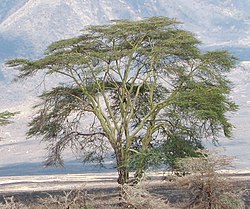
Vachellia xanthophloea (previously Acacia xanthophloea) is a tree in the family Fabaceae, commonly known in English as the fever tree.[3] This species of Vachellia is native to eastern and southern Africa (Botswana, Kenya, Malawi, Mozambique, Somalia, South Africa, Eswatini, Tanzania, Zambia, Zimbabwe). It has also become a landscape tree in other warm climates, outside of its natural range.

Description

[edit]

The trees grow to a height of 15–25 m (49–82 ft). The characteristic bark is smooth, powdery and greenish yellow, although new twigs are purple, flaking later to reveal the characteristic yellow.[4] It is one of the few trees where photosynthesis takes place in the bark. Straight, white spines grow from the branch nodes in pairs. The leaves are twice compound, with small leaflets (8 mm × 2 mm or 0.3 in × 0.1 in). The flowers are produced in scented pale cream spherical inflorescences, clustered at the nodes and towards the ends of the branches. The pale brown pods contain 5–10 elliptical, flattened green seeds and are 5–19 cm (2.0–7.5 in) long, straight, flat and rather papery, the segments are mostly longer than they are wide, often breaking up to form small clusters of segments each containing an individual seed. As the pods mature they change colour from green to pale greyish brown.[4]

Fever trees are fast growing and short lived. They have a tendency to occur as single-aged stands, and are subject to stand-level diebacks that have been variously attributed to elephants, water tables, and synchronous senescence.[5][6][7][8]

Etymology

[edit]
In KwaZulu-Natal

The name xanthophloea is derived from Greek and means "yellow bark" (ξανθός "yellow, golden"; φλοιός "bark"). The common name, fever tree, comes from its tendency to grow in swampy areas: early European settlers in the region noted that malarial fever was contracted in areas with these trees. It is now understood that malarial fever is spread by mosquitos living in the swampy areas that often support this tree species, and not by the tree species itself. This is because mosquitos often lay eggs in moist swampy areas, which they need blood to do.[9]

Ecology

[edit]
Trunk with greenish yellow bark

Vachellia xanthophloea is found growing near swamps, riverine forests or on lake shores, in semi-evergreen bush land and woodland where there is a high groundwater table. In seasonally flooded areas it often forms dense single species stands.[4]

The leaves and pods are used to provide food for livestock while the young branches and foliage are eaten by African elephants while giraffe and vervet monkeys eat the pods and leaves. The flowers are used for foraging by bees and provides favoured nesting sites for birds. Like other acacias and Fabaceae it is a nitrogen fixer, so improves soil fertility.[4] The gum is part of the diet of the Senegal bushbaby (Galago senegalensis) especially in the dry season.[10]

Butterflies recorded as feeding on Vachellia xanthophloea in Kenya included the Kikuyu ciliate blue (Anthene kikuyu), Pitman's hairtail (Anthene pitmani), common ciliate blue (Anthene definita), African babul blue (Azanus jesous), Victoria's bar (Cigaritis victoriae) and common zebra blue (Leptotes pirithous). In addition 30 species of larger moths have been recorded as feeding on this tree.[11]

Other uses

[edit]
Fever trees lining a road near Hartbeespoort Dam in South Africa

Vachellia xanthophloea are planted next to dams and streams on farms to control soil erosion, as a live fence or hedge and in ornamental planting for shade and shelter in amenity areas. Vachellia xanthophloea is often planted as a source of firewood, but its gummy sap leaves a thick, black, tarlike residue when burnt. The valuable timber of Vachellia xanthophloea is pale reddish brown with a hard, heavy texture, and, because it is liable to crack, it should be seasoned before use. The timber is used to make poles and posts.[4]

Invasive species

[edit]
Flowers

In Australia, Vachellia xanthophlea is a prohibited invasive plant in the state of Queensland under the Biosecurity Act 2014, under which it must not be given away, sold, or released into the environment without a permit. The act further requires that all sightings of Vachellia xanthophlea are to be reported to the appropriate authorities within 24 hours and that within Queensland everyone is obliged to take all reasonable and practical steps to minimise the risk of Vachellia xanthophlea spreading until they have received advice from an authorised officer. Thus far it has only been found in a few gardens and not in the "wild".[12] It is also a "declared pest" in Western Australia.[13]

[edit]

These trees are immortalized by Rudyard Kipling in one of his Just So Stories, "The Elephant's Child", wherein he repeatedly refers to "the great grey-green, greasy Limpopo River, all set about with fever-trees".[14]

Shamanic usage

[edit]

This tree has been used for thousands of years by African tribes as a divination tool. Bark from this tree and four other herbs including Silene capensis (African dream root) and Synaptolepis kirkii are boiled into a brew. This is taken to induce lucid dreams, which they call "white paths". Before going to sleep a question is asked that will be answered in their dreams. Medicinally, the roots and a powder made from bark stripped from the trunk are used as an emetic and as a prophylactic against malaria.[4]

[edit]

Notes and references

[edit]

Bibliography

[edit]
[edit]
Revisions and contributorsEdit on WikipediaRead on Wikipedia
from Grokipedia
Vachellia xanthophloea, commonly known as the , is a medium-sized, semi-deciduous tree in the genus of the family, characterized by its striking greenish-yellow bark, bipinnate leaves, paired white spines, spherical yellow flower heads, and flat, papery pods containing multiple seeds. It typically grows to 10–25 meters tall with a straight bole up to 60 cm in diameter and an open, spreading crown, though it can reach 30 meters under optimal conditions. Native to eastern and southern Africa, V. xanthophloea ranges from Somalia and Kenya in the north through Tanzania, Malawi, Mozambique, Zambia, Zimbabwe, and Botswana to northern South Africa and Eswatini. It thrives in tropical and subtropical savannas, particularly in riparian zones, swampy lowlands, floodplains, and areas with high water tables or seasonal flooding, often on alluvial clay or sandy soils up to 2,100 meters elevation. The tree's preference for moist environments led to its common name, as it was historically associated with malaria outbreaks in stagnant water areas where it grows, though the disease is transmitted by mosquitoes rather than the tree itself. Ecologically, V. xanthophloea is a fast-growing pioneer species, capable of height increases of up to 1.5 meters per year, and it forms symbiotic relationships with nitrogen-fixing bacteria, enhancing soil fertility in its habitats. It supports diverse wildlife, providing fodder for elephants, giraffes, monkeys, and livestock, nectar for bees, and habitat for birds, while its seeds are dispersed by mammals and water. In human use, the tree is valued for its durable wood in construction, furniture, and charcoal production; its bark yields tannins for leather processing; and it serves as an ornamental species in gardens and urban landscapes due to its attractive bark and flowers. Traditionally, in regions like Kenya, Tanzania, and South Africa, its bark and roots are used in decoctions to treat ailments such as malaria, indigestion, fever, and sickle cell anemia, with phytochemical analyses confirming antiplasmodial and antibacterial properties.

Taxonomy

Etymology

The genus name honors the Reverend George Harvey Vachell (c. 1799–1839), an English chaplain to the British East India Company who served in Macao and collected botanical specimens in during the early . The specific epithet xanthophloea derives from the Greek words xanthos (yellow or golden) and phloios (bark), alluding to the tree's characteristic smooth, bark. The common name "" originated among early European settlers in , who associated the species with outbreaks of (then known simply as "fever") due to its prevalence in mosquito-infested swampy lowlands, though the connection was later understood to stem from the insect vectors rather than the tree itself. A variant, "," emphasizes both the bark color and this historical link to disease in humid habitats. In regional African languages, it is known as umHlosinga in Zulu and mgunga in , reflecting vernacular usage among indigenous communities without direct ties to the fever association.

Classification and synonyms

Vachellia xanthophloea belongs to the kingdom Plantae, phylum Tracheophyta, class Magnoliopsida, order Fabales, family Fabaceae, and subfamily Mimosoideae (formerly treated separately from Caesalpinioideae in some older systems). It is placed in the genus Vachellia, with the specific epithet xanthophloea. The species was first described as Acacia xanthophloea by George Bentham in 1875, based on specimens from East Africa. Phylogenetic analyses in the early 2000s revealed that the broadly defined genus Acacia was polyphyletic, prompting the International Legume Database & Information Service (ILDIS) to propose in 2005 the segregation of African acacias into distinct genera, including Vachellia for the subgenus formerly known as Acacia subg. Acacia. This reclassification was formalized through subsequent nomenclatural combinations, such as Vachellia xanthophloea (Benth.) Banfi & Galasso in 2008, supported by molecular studies confirming the clade's monophyly. Accepted synonyms include the basionym Benth. (1875) and the heterotypic synonym Harms (1908), which was later reduced to synonymy based on morphological and distributional overlap. No subspecies or varieties are currently recognized for V. xanthophloea.

Description

Morphology

Vachellia xanthophloea is a tree that typically reaches heights of 15–25 m, featuring a straight bole up to 60 cm in diameter, an open crown that is rounded to flattish, and spreading branches. The bark is smooth and powdery, appearing greenish-yellow on younger trees and transitioning to yellowish-green with age; it often exudes gum and may flake in thick pieces, revealing sculptured patterns. The leaves are bipinnate, measuring 8–14 cm in length, with 3–8 pairs of pinnae and 10–20 pairs of small, obliquely oblong leaflets per pinna that are 2–6.5 mm long and 1–2 mm wide; the leaflets are pale yellow-green and glabrous, with a hairy midrib on some specimens. Branches bear prominent white, recurved or straight paired stipular spines up to 7 cm long, which are more slender and sometimes underdeveloped on mature trees; these spines serve a defensive role in biotic interactions. Flowers are pale cream to yellow, fragrant, and bisexual, arranged in spherical heads approximately 1 cm in that cluster in axillary racemes on peduncles 1.5–2.5 cm long; blooming occurs from to . The fruits are straight or slightly curved, linear-oblong pods measuring 4–13.5 cm long by 0.5–1.5 cm wide, initially green and turning pale brown, with a papery texture, wavy margins, and constrictions between seeds; they are indehiscent and contain 5–10 flattened, orbicular to seeds that are 4.5–5.5 mm long and 3.5–4 mm wide, smooth, and brown.

Growth habits

Vachellia xanthophloea is a fast-growing species, typically achieving an annual height increase of 1–1.5 m under optimal conditions. The tree has a relatively short lifespan for its size, generally ranging from 50 to 100 years, often exhibiting periodic stand-level diebacks triggered by events such as pest infestations or severe disturbances. In terms of , V. xanthophloea is during dry seasons, shedding leaves to conserve water while demonstrating moderate , though it thrives in moist soils with a high . It is also a nitrogen-fixing , forming symbiotic root nodules with bacteria to enhance . Key adaptations include high tolerance to waterlogging and periodic flooding, which support its establishment in riparian zones, contrasted by sensitivity to frost temperatures below -2°C.

Distribution and habitat

Native distribution

Vachellia xanthophloea is native to eastern and , with its range spanning from in the north through , , , , , , and , extending south to (particularly , , and provinces) and . The species occurs across a broad altitudinal gradient from 600 to 2,100 meters, favoring low-lying areas within this range. The tree thrives in tropical to subtropical ecosystems, where annual rainfall typically ranges from 600 to 1,200 millimeters, often concentrated in a wet summer season. Mean annual temperatures in its native habitats fall between 15°C and 30°C, supporting its growth pattern in response to seasonal dry periods. It commonly inhabits riverine forests, floodplains, and swampy depressions, where high levels sustain its water demands despite variable . Vachellia xanthophloea prefers alluvial and sandy-loam soils with good drainage but access to permanent or seasonal sources, often forming monodominant stands in these moist, nutrient-rich environments. While its overall range has remained stable, local populations have experienced declines since the early 1900s due to habitat conversion for and , particularly along riparian zones in .

Introduced ranges

Vachellia xanthophloea has been introduced to several regions outside its native African range primarily for ornamental purposes, leveraging its distinctive bark and fast growth for landscaping and shade provision. In , it was planted in and as an aesthetic tree in gardens and urban settings since the early , but it is now classified as a prohibited in under the Act 2014 due to its potential to form dense thickets in wet areas. In , it is listed as a declared pest, with detections limited to cultivated sites and no widespread reported, though monitoring continues for escape into wetlands. In the United States, specifically , Vachellia xanthophloea was introduced as a landscape tree in the early , appearing in arboretums and private gardens for its ornamental value and tolerance to , but its spread remains limited owing to challenges in availability and establishment outside irrigated areas. Similarly, introductions to and occurred for similar landscaping reasons, with plantings noted in warm climates, though self-sustaining populations have not been widely documented. In , the species was brought from in the as an ornamental addition to parks and gardens. Beyond ornamentation, introductions have included uses for shade, along riverbanks, and potential in systems, as highlighted in South African cultivation guidelines from 2021 that promote its nitrogen-fixing properties for sustainable . In , recent observations indicate naturalization along ephemeral rivers, where it has established self-sustaining populations from ornamental plantings in towns and lodges, prompting concerns over its expansion into non-native habitats. Overall, while Vachellia xanthophloea exhibits limited spread in most introduced areas due to habitat specificity and low seed viability outside cultivation, it is actively monitored for invasiveness potential, particularly in regions with suitable conditions similar to its native preferences.

Ecology

Habitat requirements

Vachellia xanthophloea thrives in environments with reliable access to , such as swamps, riverbanks, lake margins, and floodplains, where it can tap into permanent or seasonal via its deep root system. This species is highly dependent on moist conditions and shows intolerance to prolonged , with physiological studies indicating reduced growth and survival when water availability drops below critical thresholds. The tree requires full for optimal growth and prefers fertile, moist soils ranging from sandy alluvial types to heavy black clays, often in areas with poor drainage. It tolerates neutral to slightly alkaline levels between 6.5 and 8.0, adapting well to waterlogged substrates that support its morphological features like extensive lateral roots for stability in wet habitats. In terms of climate, Vachellia xanthophloea favors warm, humid tropical and subtropical conditions, with an elevation range up to 2,100 meters, but it is frost-sensitive particularly in juvenile stages while mature trees can endure moderate frosts. Vachellia xanthophloea frequently forms dense, pure stands in riparian and floodplain zones but also occurs in mixed woodlands, associating with species such as Burkea africana and Combretum spp. in transitional miombo savannas.

Biotic interactions

_Vachellia xanthophloea forms symbiotic relationships with nitrogen-fixing bacteria, primarily species of Bradyrhizobium and Ensifer, which inhabit root nodules and convert atmospheric nitrogen into forms usable by the plant, enhancing its growth in nutrient-poor soils. This mutualism not only benefits the tree but also contributes to overall soil enrichment in its habitat. Additionally, the tree's bright yellow, fragrant flowers attract pollinators such as bees and butterflies, facilitating cross-pollination and genetic diversity within populations. Seed dispersal is aided by mammals, including elephants that consume and break open the pods, as well as vervet monkeys that eat the pods and deposit seeds via scat, promoting wider distribution. The tree experiences significant herbivory from large mammals, with browsing young branches, stripping bark, and consuming leaves and pods, though its paired thorns provide partial deterrence against smaller browsers. Giraffes, , and other antelopes like and feed on the foliage and pods, while vervet monkeys target flowers, leaves, and pods. Despite these pressures, V. xanthophloea shows resilience to browsing, often resprouting vigorously after damage. The "fever tree" moniker stems from a historical myth associating the tree with outbreaks in swampy areas where it thrives, due to breeding rather than any inherent toxicity; however, like many acacias, its leaves can accumulate in drought conditions, posing risks to if overconsumed as . Through and leaf litter decomposition, V. xanthophloea improves by increasing nitrogen and levels, supporting plant growth and microbial activity in riparian zones. It also bolsters by providing nesting sites for birds such as grey louries and habitat for insects, including that utilize species as larval hosts. The tree is susceptible to pathogens, particularly in wet environments, where fungal infections cause —a bacterial or fungal leading to oozing sap and stem cankers—and root rots from species like or . fungi, such as those in the genus Uromyces, produce black spots on bark and leaves, weakening the plant. Studies have highlighted pest pressures, including wood-boring beetles from families like Cerambycidae that infest trunks, exacerbated by climate-driven stresses, and outbreaks of witches' broom linked to fungal pathogens in regions like and (as of 2024).

Reproduction

Flowering and pollination

Vachellia xanthophloea flowers from late winter to early summer in its native southern African range, typically between August and November, aligning with the spring to early summer season in the . The inflorescences are spherical heads that produce abundant and , serving as key rewards for visiting pollinators. These flowers are bisexual and entomophilous, meaning they rely exclusively on rather than wind dispersal. The bright yellow blooms attract a variety of insects, with honeybees (Apis mellifera) acting as the primary pollinators due to their efficiency in transferring pollen between flowers. Other insects, including butterflies and various bees, also visit the fragrant inflorescences, contributing to cross-pollination. Pollination success remains high in native habitats owing to the abundance of these pollinators and the tree's synchronous flowering, which promotes outcrossing. The breeding system of V. xanthophloea remains largely unknown, though mechanisms to promote outcrossing are suggested by flowering phenology. Flowering phenology is strongly influenced by environmental cues, particularly rainfall, which triggers bud initiation and synchronizes blooming across populations in savanna ecosystems. In regions with variable , such as eastern and , the onset of the often precedes peak flowering by one to two months, ensuring resource availability for pollinators.

Seed production and dispersal

Following successful , fruit development in Vachellia xanthophloea begins, with pods maturing 4–6 months after flowering, typically from January to April in . The pods are linear-oblong, pale brown, 4–13.5 cm long and 0.5–1.5 cm wide, constricted between seeds, and indehiscent, meaning they do not split open naturally but break into segments upon falling or disturbance, each containing 3–10 elliptical, flattened, dark brown seeds. These pods are retained on the tree until physically disturbed, such as by or animal activity, which aids in gradual seed release. Seed viability in V. xanthophloea is generally high, with rates of approximately 70% achievable after appropriate treatment, though overall seed production can be limited by predation in natural habitats. Seeds exhibit physical due to their hard coat, requiring —such as mechanical abrasion or soaking in hot () overnight—to promote swelling and , which typically occurs within two weeks under suitable conditions. As orthodox seeds, they can be stored dry for several years at low temperatures (e.g., 10°C) with 4.5–9% moisture content, maintaining viability, though they remain susceptible to damage during storage. Dispersal of V. xanthophloea seeds occurs primarily through a combination of abiotic and biotic agents, facilitated by the tree's riparian . plays a key role, carrying lightweight pod segments along floodplains and rivers where the species thrives. Mammals are significant dispersers; vervet monkeys consume the pods as a favored food, potentially aiding endozoochory, while larger herbivores like and giraffes ingest pods and excrete viable seeds in dung, with gut passage often enhancing through natural . contributes to short-distance dispersal of detached pod segments, and human activities enable long-distance spread in introduced ranges. In addition to via seeds, V. xanthophloea can propagate vegetatively through cuttings, which root readily under nursery conditions, providing an alternative to seed-based methods. Seeds contribute to persistent soil seed banks that remain viable for over a year, and likely longer as with many , allowing recruitment during favorable wet periods in semi-arid environments.

Uses

Traditional and medicinal applications

In Zulu traditional medicine, Vachellia xanthophloea, known locally as umHlosinga, is primarily utilized for its bark, which is prepared as a powdered emetic from the stem and roots to treat and prevent . The bark decoction serves as a remedy for fever, abdominal pains (including ), blood purification via , and eye infections, reflecting its role in practices for common ailments. Among the , a bark infusion is employed for magical and protective purposes, such as charms to promote or . Ethnobotanical studies have validated some of these applications, particularly the antimalarial properties; previous research reported moderate antiplasmodial activity for stem bark extracts against , while leaf extracts exhibit similar activity attributed to compounds like methyl gallate and novel such as 3,7,8,2′,4′,5′-hexamethoxyflavone. In broader southern African contexts, the species is also used for wound treatment through bark applications to address skin disorders, though documentation is less specific to Zulu or Swazi groups. Despite these benefits, precautions are essential due to potential ; overharvesting of bark for medicinal purposes has raised conservation concerns in , prompting calls for sustainable collection methods to prevent population decline. Its use as for should be moderated to avoid overconsumption risks associated with some species.

Commercial and ornamental value

Vachellia xanthophloea provides a versatile timber valued for its hardness and , making it suitable for , furniture, poles, and posts. The heartwood is pale brown with a tinge, distinctly demarcated from the paler sapwood, and has a of approximately 900 kg/m³ at 12% content, rendering it a general-purpose wood that requires to prevent cracking. Despite its durability in structural applications, the wood is susceptible to and borers, limiting long-term use without treatment. Additionally, it serves as an important fuel source, producing high-quality and effective , though the exuded gum can leave a black tar-like residue during burning. In systems, Vachellia xanthophloea contributes to and fertility enhancement due to its nitrogen-fixing roots, which are particularly effective for along riverbanks and near water bodies. Its foliage and pods offer nutritious for , while the flowers support production, yielding a high-quality product that attracts beekeepers in suitable regions. Cultivation protocols in recommend planting at 4 m inter-row spacing to optimize growth and resource use, with seedlings transplanted at 1 m height after 6–12 months; this spacing supports integration while allowing for light shade over crops or pastures. As an ornamental species, Vachellia xanthophloea is prized for its striking greenish-yellow bark, feathery foliage, and rapid growth rate, which make it ideal for in gardens, parks, and urban settings. It provides light dappled shade when planted in small groups of up to five trees, enhancing aesthetic appeal in parking lots and along streets, though its aggressive roots necessitate placement at least 2 m from structures. The tree's nature and tolerance to moderate further suit it for initiatives in subtropical and areas. Economically, Vachellia xanthophloea supports minor trade in bark extracts, with approximately 7,500 kg traded on South African local markets in 1988, supplemented by imports from . Its potential in sustainable lies in fuelwood and erosion-control plantations, leveraging the species' fast growth and soil-enriching properties, though specific yield data remains limited for commercial-scale operations.

Conservation

Status and threats

Vachellia xanthophloea is assessed as Least Concern (LC) on the , according to the 2019 evaluation by the Botanic Gardens and the IUCN SSC Global Tree Specialist Group, reflecting its wide distribution across eastern and and lack of immediate global risk. Despite this status, regional population declines have been documented, particularly in riparian habitats vulnerable to environmental pressures. Key threats to Vachellia xanthophloea include habitat loss from driven by and , which has reduced riparian woodlands in areas such as the basin in and parts of . Overbrowsing by causes significant damage to younger trees, limiting recruitment in high-density zones, though the species demonstrates notable resilience to recover from such impacts. exacerbates these risks through projections of increased temperatures and variable rainfall affecting regeneration in environments. Illegal harvesting of bark for traditional medicinal uses further stresses accessible populations outside protected zones. Population trends remain stable within protected areas like in , where reduced human interference supports regeneration, but fragmentation and decline occur in farmlands due to ongoing land conversion. Conservation efforts prioritize protection in national reserves across its native range, including and sites in and , with initiatives focused on habitat restoration to counter and hydrological changes.

Management as invasive species

Vachellia xanthophloea has been identified as a potential outside its native range, particularly in , where it is classified as a prohibited in under the Biosecurity Act 2014, prohibiting its keeping, movement, sale, or release into the environment. It is also declared a pest in , with ongoing efforts to prevent establishment through regulatory measures. Although currently rare and not naturalized in , limited detections in gardens and botanic sites, such as on the Gold Coast and in Perth, have prompted immediate eradication to mitigate risks, including a 2025 detection in reported via the Weed Spotters Network that was successfully removed. The species poses ecological threats in non-native riparian and wetland habitats, where its preference for moist soils enables it to outcompete native and form dense stands that alter local and reduce . High seed production, with prolific output from insect-pollinated flowers leading to numerous pods each containing 5–10 viable seeds, contributes to its spread potential, supported by a long-lived that complicates control efforts. In suitable climates, such as subtropical savannas, it could invade grazing lands and waterways, similar to other invasive acacias, potentially incurring significant management costs. Management focuses on prevention and early intervention, including strict bans and for early detection in high-risk areas like wetlands. In 2024, new self-sustaining populations were documented as native-alien along the in southern , prompting recommendations for prompt eradication to protect local riparian ecology. Biological control options remain unexplored for this , with emphasis placed on regulatory exclusion to avoid broader establishment.

References

Add your contribution
Related Hubs
User Avatar
No comments yet.