Hubbry Logo
First American RegimentFirst American RegimentMain
Open search
First American Regiment
Community hub
First American Regiment
logo
8 pages, 0 posts
0 subscribers
Be the first to start a discussion here.
First American Regiment
from Wikipedia

First American Regiment
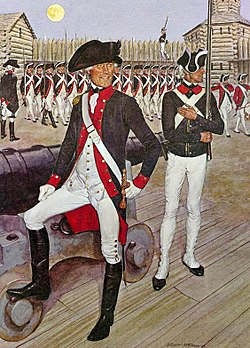
Uniform of the First American Regiment in 1786
Active12 August 1784 – 17 May 1815
Country United States
BranchUnited States Army
TypeInfantry
SizeRegiment
Garrison/HQFort McIntosh
NicknameHarmar's Regiment
EngagementsNorthwest Indian War

Lewis and Clark Expedition
War of 1812

Commanders
Notable
commanders
Josiah Harmar
Jacob Kingsbury

The First American Regiment (also known as Harmar's Regiment, The United States Regiment, The Regiment of Infantry, 1st Sub-legion, 1st Regiment of Infantry and 1st Infantry Regiment) was the first peacetime regular army infantry unit authorized by the Confederation Congress after the American Revolutionary War. Organized in August 1784, it served primarily on the early American frontier west of the Appalachian Mountains. In 1815, following the end of the War of 1812, it was consolidated with several other regiments to form the 3rd Infantry Regiment.

Formation

[edit]

After the conclusion of the American Revolution in 1783, Congress ordered the Continental Army to disband, and General George Washington resigned his commission as commander-in-chief.[1] A Congressional committee under Alexander Hamilton sought opinions on a permanent armed force. Washington submitted his "Sentiments on a Peace Establishment," which called for only a small force, only a 2,631 man regiment to guard the western frontier and the borders with Canada and Spanish Florida.[2] Economic constraints forced the new nation to rely heavily on militia.[3]

While the bulk of the Continental Army was disbanded by the end of 1783, Jackson's Continental Regiment, commanded by Colonel Henry Jackson, and an artillery company under Brevet Major John Doughty remained in service. On June 2, 1784, Congress reissued the disbandment order under the principle that "standing armies in time of peace are inconsistent with the principles of republican government, dangerous to the liberties of a free people, and generally converted into destructive engines for establishing despotism."[4] Jackson's regiment was disbanded later that month, and Doughty's battery was retained at West Point guarding artillery and ammunition.

On June 3, 1784, Congress passed a new resolution:[5]

Resolved, That the Secretary at War take order for forming the said troops when assembled, into one regiment, to consist of eight companies of infantry, and two of artillery, arming and equipping them in a soldier-like manner: and that he be authorised to direct their destination and operations, subject to the order of Congress, and of the Committee of the states in the recess of Congress.

Thomas Mifflin, the president of Congress, named his former aide, Josiah Harmar, to be the commander of the new regiment, with the rank of lieutenant colonel. Harmar was commissioned as the regiment's "lieutenant colonel commandant" on August 12, 1784. The regiment was used primarily to man frontier outposts and guard against Native American attacks. Doughty's company became the 2d Continental Artillery Regiment. The regiment's first posting was to Fort McIntosh in Beaver, Pennsylvania. Half of the regiment's enlisted and non-commissioned officers were born outside the United States.[6]

In 1786, Secretary of War Henry Knox ordered Colonel Harmar to the outpost village of Vincennes to restore order. The Kentucky militia, which had been left behind by George Rogers Clark to help defend Vincennes but had become a lawless mob, fled at the approach of the regiment. Harmar left 100 regulars under the command of Major Jean François Hamtramck to build a new fort and conduct operations deep within the Ohio Country.

Northwest Indian War

[edit]

The First American Regiment was renamed the Regiment of Infantry on September 29, 1789, when the United States Army was formally instituted under the Constitution of the United States.[7] In 1790, Harmar – who had been breveted as a brigadier general in 1787 – led 320 regulars and over 1,000 militia on the disastrous Harmar campaign in October 1790. The Regiment of Infantry suffered over 70 casualties.

An act of Congress on March 3, 1791, reorganized the U.S. Army to have two regiments of infantry under the command of Major General Arthur St. Clair. As a result, the regiment was designated as the 1st Infantry Regiment with Harmar retained as its commanding officer.[8] It comprised the main force of regulars under St. Clair in the campaign to destroy Kekionga, a large Miami village central to the Northwestern Confederacy of Native American nations. For a brief time, the First American Regiment was commanded by Major John Hamtramck—a French Canadian immigrant—and his second-in-command, Major David Ziegler—a German immigrant.[9]

While on campaign, the 1st Infantry under Hamtramck was sent to find an overdue supply train. The supplies were never found, but as the infantry marched to rejoin the main force on November 4, 1791, gunfire was heard. Native Americans under Miami Chief Little Turtle had attacked in what came to be known as St. Clair's defeat, the worst loss to American Indians by the United States Army in history. Survivors broke through Little Turtle's lines and warned Hamtramck, who fell back to Fort Jefferson instead of covering the retreat.

In response to St. Clair's defeat, the Army was reorganized in 1792 as the Legion of the United States under Major General Anthony Wayne. The First Infantry became the infantry component of the 1st Sub-Legion, commanded by Hamtramck, who was promoted to lieutenant colonel commandant. Under Wayne's leadership, the Legion trained extensively before marching north to meet the Native American confederacy that had defeated St. Clair. The Legion was victorious at the Battle of Fallen Timbers in 1794. The trading post at Kekionga was rebuilt and named Fort Wayne and was garrisoned by the First Sub-Legion under Hamtramck. William Henry Harrison, later to become the 9th President of the United States, was a junior officer in the 1st Sub-Legion.[7]

Later service

[edit]
The 3rd Infantry's coat-of-arms features a tricorn hat to represent its roots in the First American Regiment.

In October 1796, the Legion of the United States reverted to being named the United States Army, and the 1st Sub-Legion was designated as the 1st Infantry Regiment. In 1803, Captain Meriwether Lewis of the 1st Infantry was appointed by President Thomas Jefferson to command the Corps of Discovery which conducted the Lewis and Clark Expedition to explore newly acquired territories of the United States. During the War of 1812, the 1st Infantry served in Upper Canada (Ontario province) and saw action at the battles of Chippawa and Lundy's Lane and the Siege of Fort Erie.

Consolidation

[edit]

In October 1815, the 1st Infantry was consolidated with the 5th, 17th, 19th, and the 28th Infantry regiments to form the 3rd U.S. Infantry Regiment (The Old Guard). The 3rd Infantry, with its roots in the First Infantry Regiment, dating back to 1784, is recognized as the oldest regular army regiment in the United States Army.

Commanding officers

[edit]
  • Brevet Brigadier General Josiah Harmar (August 12, 1784 – January 1, 1792)
  • Major John F. Hamtramck (January 1, 1792 – September 4, 1792)
  • Major Richard Call (September 4, 1792 – September 28, 1792)
  • Major Eskurius Beatty (September 28, 1792 – November 27, 1792)
  • Major Thomas Doyle (November 27, 1792 – February 18, 1793)
  • Colonel John F. Hamtramck (February 18, 1793 – April 11, 1803)
  • Colonel Thomas Hunt (April 11, 1803 – August 18, 1808)
  • Colonel Jacob Kingsbury (August 18, 1808 – May 17, 1815)

Notable members

[edit]

References

[edit]
[edit]
Revisions and contributorsEdit on WikipediaRead on Wikipedia
from Grokipedia
The First American Regiment was the inaugural peacetime regular infantry unit of the , authorized by the Confederation Congress on June 3, 1784, to consist of 700 men recruited primarily from , , New York, and , with the primary mission of securing the against Native American threats in the aftermath of the Revolutionary War. This formation marked the transition from wartime forces to a standing federal military establishment under the , reflecting early congressional efforts to maintain national defense without reliance on state militias alone. Initially commanded by , the regiment established its first garrison at Fort McIntosh along the , where troops rehabilitated the facility and conducted patrols to enforce frontier order amid ongoing conflicts with indigenous tribes. During the , elements of the unit participated in campaigns against hostile Native American coalitions, contributing to the eventual restructuring of U.S. forces into the in 1792 under Major General . By 1789, following the ratification of the U.S. Constitution, the regiment was absorbed into the reorganized Army, forming the basis for the 1st Infantry Regiment and influencing the lineage of the modern 3rd U.S. Infantry Regiment, known as The Old Guard.

Background and Formation

Post-Revolutionary Military Needs

Following the Treaty of Paris on September 3, 1783, which ceded the south of the to the , American settlers faced intensified resistance from Native American confederacies unwilling to recognize the agreement. British agents from forts such as continued supplying arms and encouragement to tribes including the , , and , fueling raids that killed hundreds of settlers annually in the Ohio Valley during the mid-1780s. These attacks targeted isolated farms and river traffic, undermining treaty enforcement and exposing the fragility of federal claims to the region amid disputes over land cessions like those at in 1784. State militias, the primary defensive recourse under the , demonstrated severe limitations in countering coordinated Indian warfare, as seen in the disorganized 1782 where approximately 300 and militiamen were ambushed, resulting in over 70 deaths and numerous captives tortured. Lacking centralized command, professional training, and reliable , these part-time forces often disbanded prematurely or pursued retaliatory strikes without strategic coordination, allowing raiders to evade decisive engagements and prolong insecurity through 1784. This reliance on voluntary state levies exacerbated vulnerabilities, as governors prioritized local concerns over distant territorial defense. The Confederation Congress grappled with these realities in debates over military policy, authorizing a modest force of rangers in for patrols yet struggling to fund even partial implementation amid postwar debt exceeding $40 million. While and Anti-Federalist apprehensions of a permanent as a tool for tyranny tempered ambitions for larger establishments, accumulating evidence of failures—coupled with raid-induced displacement of thousands—highlighted the causal imperative for a federal standing force to assert and deter British-influenced aggression.

Authorization and Initial Organization

The Confederation Congress authorized the First American Regiment on June 3, 1784, establishing it as the inaugural peacetime regular unit of the following the disbandment of most forces after the Treaty of Paris. This measure addressed immediate needs for frontier security amid ongoing threats from Native American tribes in the , while navigating that limited the force to a modest size. The was structured to include eight companies of and two of , totaling approximately 700 men, with enlistments capped at one year to minimize long-term federal expenditures. Recruitment quotas were allocated specifically to , , New York, and , drawing from state militias and civilians through incentives such as state-level bounties—, for instance, offered bonuses to attract enlistees. Lieutenant Colonel , a veteran, was appointed to command the regiment and oversee its formation, beginning with the mustering of initial companies in the fall of 1784. However, manpower shortages persisted due to the brief enlistment terms, economic disincentives for service in remote areas, and public wariness of federal military authority, resulting in scattered postings and incomplete staffing that strained early operations. The regiment's initial organization emphasized practicality over expansion, with the first assembled companies directed to Fort McIntosh in for rehabilitation of the dilapidated structure and initiation of patrol duties along the . This posting, reached by Pennsylvania-recruited units by , 1784, underscored the regiment's foundational role in maintaining supply lines and deterring incursions without broader offensive mandates at inception. Congressional adjustments in permitted direct federal enlistments to address vacancies, highlighting the pragmatic adaptations required to sustain the unit amid recruitment shortfalls.

Frontier Defense and Operations

Early Postings and Defensive Duties

The First American Regiment, authorized by on June 3, 1784, initially assembled recruits at Fort Pitt in , , before dispatching detachments to forward positions along the frontier. Late in 1784, the unit established its first permanent post at Fort McIntosh near the confluence of the and Beaver Rivers, where troops under Colonel Josiah Harmar undertook rehabilitation of the dilapidated structure, including repairs to log walls and barracks originally built by the Continental Army in 1778. These early postings emphasized defensive postures, with companies distributed across scattered garrisons to deter irregular raids by Native American warriors allied with residual British influences in the . Primary duties involved routine patrols and reconnaissance missions to monitor trails and river crossings, alongside escorting supply convoys vulnerable to ambush along the Ohio River. Infrastructure efforts extended to clearing paths and fortifying outposts, as the regiment's 700 authorized enlisted men—drawn from Pennsylvania, New Jersey, New York, and Connecticut—faced constant low-level threats from hostile tribes, resulting in sporadic small-scale clashes that claimed isolated casualties without escalating to formal engagements. In support of the Land Ordinance of 1785, which mandated systematic township surveys for western lands, detachments provided armed protection for geometer parties beginning in 1786, notably safeguarding Winthrop Sargent's team during initial measurements of the Seven Ranges in eastern Ohio, where ambushes on surveyors underscored the precarious balance between expansion and deterrence. Logistical challenges compounded these operations, as Harmar contended with chronic supply shortages, including irregular deliveries of provisions and across rudimentary networks lacking dedicated wagons or depots. Manpower issues arose from high desertion rates among short-term enlistees, often unseasoned farmers incentivized by modest bounties but demoralized by harsh frontier conditions and delayed pay, leading to chronic understrength companies that prioritized static defense over proactive deterrence. This reliance on minimally trained recruits, without complementary militia reforms, exposed vulnerabilities in sustaining prolonged frontier vigilance amid intermittent hostilities.

Engagements in the Northwest Indian War

The First American Regiment formed the core of U.S. forces in Brigadier General Josiah Harmar's 1790 expedition against villages in the , contributing 320 regulars organized into two battalions under Majors John Doughty and John Wyllys. Departing Fort Washington on , the column advanced toward , facing ambushes that culminated in defeats on October 19 and 22, where militia detachments collapsed under fire from a confederated force of , , and other tribes supported by British-supplied arms from Canadian forts. U.S. casualties exceeded 200, including over 130 killed, primarily due to unreliability, while the regiment's regulars demonstrated greater cohesion before ordered retreats, underscoring the limitations of levies against disciplined native resistance backed by foreign influence. In St. Clair's 1791 campaign, the expanded First American Regiment, numbering around 1,200 alongside levies and militia, marched north from Fort Washington starting September 6 to challenge the same confederacy at . On November 4, near the , warriors under and launched a dawn , routing the camp and inflicting 623 killed and 242 wounded—the deadliest defeat for U.S. forces against Native Americans—exposing supply shortages, poor scouting, and leadership errors amid a force plagued by desertions. Congressional inquiries criticized St. Clair's tactics but noted the regiment's maintaining formation longer under volleys, preserving some order in the panic, which highlighted the necessity for professional training to counter the confederacy's tactical ambushes and British-fueled logistics. Elements of the First American Regiment, hardened by prior campaigns, integrated into Major General Anthony Wayne's by 1793, undergoing rigorous drills that emphasized and rapid maneuvers to address lessons from Harmar and St. Clair. On August 20, 1794, at Fallen Timbers along the , the Legion's 2,000 troops, including regiment veterans, shattered a 1,500-strong allied force in under an hour, suffering only 33 killed and 100 wounded against heavier enemy losses, owing to superior firepower from muskets and artillery that overpowered warriors sheltered amid fallen trees and reliant on British aid from nearby Fort Miami, which offered no support. This decisive engagement compelled the confederacy's collapse, paving the way for the in 1795, which ceded southern and secured U.S. claims through demonstrated military professionalism over fragmented resistance.

Reorganization and Expansion

Integration into the Legion of the United States

Following the ratification of the U.S. Constitution, authorized the establishment of a small on September 29, 1789, redesignating the existing First American Regiment as the Regiment of Infantry to place it under federal authority. This act legalized the regiment's eight companies of , totaling approximately 700 men, supplemented by a separate , enabling centralized command and funding to address ongoing frontier threats from Native American confederacies that state militias had proven inadequate to counter. Secretary of War advocated for structural reforms emphasizing integration, drawing from models to create versatile units capable of offensive operations in irregular terrain. In response to defeats like those under in 1790 and in 1791, Congress expanded the army on March 5, 1792, forming the with four sublegions, each incorporating , riflemen, artillery, and dragoons for balanced firepower and mobility; the of , now grown to over 1,000 effectives through drives, formed the core of the 1st Sublegion. This reorganization prioritized under federal control, allowing rapid mobilization against persistent incursions without reliance on unreliable volunteer levies. Major General Anthony Wayne assumed command of the Legion in 1792, assigning elements of the former First American Regiment to sublegions and instituting rigorous training at Legionville, Pennsylvania, focused on light infantry maneuvers, skirmishing lines, and rapid deployment to mitigate ambush vulnerabilities observed in prior campaigns. These tactics, emphasizing dispersed formations and volley fire adapted to wooded frontiers, reflected empirical adjustments to Native warriors' guerrilla methods rather than rigid European line infantry doctrines. Funding these expansions sparked debates in the early 1790s, with Treasury Secretary Alexander Hamilton championing federal assumption of debts and military outlays to build national credit and security, arguing that a professional force was essential for sovereignty amid British and Spanish border influences. Jeffersonian Republicans, including Thomas Jefferson, expressed skepticism toward standing armies as potential tools of executive overreach, favoring militia economies to preserve republican virtues, yet persistent defeats compelled congressional approval prioritizing operational necessities over anti-federalist reservations. This resolution under Knox's oversight marked a shift toward sustained federal military investment, enabling the Legion's cohesion against existential frontier pressures.

Later Campaigns and Consolidation

Following the decisive U.S. victory at the on August 20, 1794, elements of the First American Regiment, as part of Major General Anthony Wayne's , shifted to garrison duties at key frontier posts including , Fort Greenville, and the newly constructed Fort Wayne (rebuilt at the site of ). These assignments focused on securing supply lines, patrolling ceded territories, and enforcing compliance with the , signed August 3, 1795, between the U.S. and allied Native American tribes. The treaty compelled the tribes to relinquish claims to substantial lands south of a demarcation line running from Fort Loramie to and eastward to the , encompassing roughly the southern two-thirds of present-day and facilitating settlement across approximately 25,000 square miles. Garrison operations effectively curtailed organized Native American resistance, with frontier raids on settlements dropping sharply as the defeated confederacy fragmented and British support waned following evacuation of posts like under the 1794 (ratified 1795). Settler accounts and military dispatches noted a near cessation of large-scale incursions, validating the Legion's disciplined structure in maintaining peace where prior expeditions had failed, though sporadic skirmishes persisted until full adherence. The regiment's companies, hardened by Wayne's rigorous training, suffered minimal casualties in these enforcement roles—contrasting earlier losses exceeding 1,000 in failed campaigns—demonstrating the efficacy of a professional standing force in territorial consolidation over ad hoc levies. By 1796, with hostilities subdued and fiscal pressures mounting, enacted reorganization on April 30, dissolving the Legion's sub-legion structure and consolidating its components into a peacetime of four regiments totaling about 3,000 men. The First Sub-Legion, incorporating the core of the original First American Regiment, formed the basis of the 1st Regiment (redesignated October 31, 1796), while other elements contributed to the 2nd , ending the experimental Legion model and institutionalizing permanent frontier defense amid the Treaty's geopolitical stabilization. This transition underscored the regiment's role in achieving over 20,000 square miles in secured cessions through military pressure, prioritizing empirical gains in land access and raid suppression over protracted .

Leadership and Personnel

Commanding Officers

Lieutenant Colonel served as the first of the First American Regiment, assuming the role of commandant on August 12, 1784, and retaining seniority in the United States Army until October 1791. A Revolutionary War veteran with prior experience in frontier service, Harmar directed the regiment's initial recruitment from states including , , New York, and , organizing it into eight companies totaling approximately 700 personnel by late 1784. His tenure focused on establishing frontier posts such as Fort McIntosh and Fort Harmar, but the 1790 Harmar Expedition—comprising about 1,453 men, including regiment detachments and —suffered defeats on October 19 and 22, with over 120 killed and limited territorial gains, attributed by contemporaries to flawed militia coordination, supply shortages, and underestimation of Native American tactics. Following Harmar's resignation amid criticism of the expedition's outcomes, Major John Hamtramck briefly commanded the regiment in 1791–1792, supported by Major David Ziegler as second-in-command. Hamtramck, a veteran of French Canadian descent, managed residual operations amid army-wide reductions and relocations to posts like Fort Washington, preserving unit cohesion during transitional supply challenges and minor skirmishes. His leadership emphasized administrative stability over offensive actions, though the regiment faced high rates exceeding 20% annually due to harsh conditions and low enlistment incentives. In the 1792 reorganization under the , the regiment's infantry nucleus formed the core of the 1st Sub-Legion, with Hamtramck promoted to commandant overseeing its tactical elements until 1796. Overarching command shifted to Anthony Wayne, appointed April 1792 and serving until his death in December 1796. Wayne enforced strict drills, bayonet training, and logistical reforms on roughly 3,000 Legion troops, rejecting heavy dependence on unreliable state militia in favor of professional regulars; this approach yielded the rout of a Native American coalition at Fallen Timbers on August 20, 1794, where U.S. forces of about 1,000 inflicted 30–40 enemy casualties while suffering only 33, securing the and opening the . Wayne's decisions prioritized merit-based discipline, contrasting with prior reliance on politically influenced adjunct forces that had contributed to earlier setbacks.

Notable Members

Captain Ebenezer Denny (1761–1822), a junior officer in the early U.S. Army, exemplified the regiment's junior leadership during frontier campaigns. Commissioned as a captain, Denny participated in Colonel Harmar's 1790 expedition against Native American forces in the , where the First American Regiment formed the core of the regular troops, numbering around 300 men amid larger militia detachments. His detailed journal records tactical movements, skirmishes with and warriors on October 19 and 22, 1790, and the challenges of maintaining discipline in harsh conditions, highlighting personal initiative in reconnaissance and combat despite militia unreliability. Denny's service extended to advisory roles in subsequent operations, including as to Major General in 1791, linking regiment experience to broader expeditionary efforts. Post-military, Denny transitioned to civic leadership as Pittsburgh's first mayor from 1816 to 1817, demonstrating how regiment-honed organizational skills contributed to urban development in frontier settlements. His accounts underscore junior officers' valor in sustaining amid high-risk engagements. Enlisted personnel in the First American Regiment, often drawn from urban laborers and immigrants in eastern cities like , faced grueling conditions but showed resilience in actions like on November 4, 1791, where the regiment's contingent suffered severe casualties—over 600 killed or wounded overall—yet survivors maintained formation during retreat, as noted in contemporary reports. Pension applications from these veterans, filed under early federal relief acts, reveal endurance through wounds and privations, with many continuing service or settling claims based on verified combat exposure. Recruitment targeted economically disadvantaged groups, but evidence points to voluntary enlistments incentivized by federal pay of about $6.67 net monthly for privates after deductions, plus clothing allowances and prospects of land bounties under expansionist policies, rather than systemic . Officers' recruiting challenges on the , as documented in service profiles, involved offering these tangible benefits to attract able-bodied men for three-year terms, fostering a force reliant on individual discipline despite low overall numbers—struggling to reach 700 authorized strength by 1790.

Strategic Role and Legacy

Contributions to Frontier Security

The First American Regiment's sustained military presence and engagements in the exerted coercive pressure that contributed to the collapse of Native American confederacy resistance, culminating in the decisive U.S. victory at the on August 20, 1794, and the subsequent signed August 3, 1795. This treaty ceded approximately two-thirds of present-day to the , directly suppressing large-scale raids that had previously averaged hundreds annually in the Ohio Valley from the 1780s through 1794, with settlers facing constant attacks on river traffic and border communities. Post-treaty, major hostilities ceased until the , enabling the orderly implementation of the of 1787 by facilitating safe surveys, land sales, and migration; non-Native population in the region surged from fewer than 5,000 in 1790 to over 45,000 by 1800, fostering agricultural expansion and trade networks previously hindered by insecurity. By establishing a professional federal force of up to 700 and , the regiment demonstrated the efficacy of centralized authority in frontier defense, countering the decentralized inefficiencies of state militias evident in pre-1784 raid responses and the routs during campaigns like on November 4, 1791, where militia flight exacerbated losses. Prior to its formation on June 3, 1784, the absence of a under the allowed unchecked violence, with British-held posts supplying Native warriors; the regiment's forts and patrols asserted federal primacy, controlling settler influx and compelling treaty negotiations backed by force rather than appeasement alone, which had repeatedly failed as in the 1785 Treaty of Fort McIntosh. The regiment's professionalism yielded advantages in disciplined operations and fort construction, such as Fort Jefferson in , which sustained long-term deterrence beyond sporadic militia efforts, though at the drawback of substantial fiscal strain—private pay at $6.67 monthly struggled to retain enlistees amid harsh conditions, consuming a disproportionate share of the Confederation's limited budget and fueling debates over standing armies. While effective in breaking resistance, operations involved occasional village burnings and reprisals aligning with mutual frontier warfare norms, where Native raids routinely included , , and captive-taking of hundreds of settlers annually; U.S. troops mirrored such total-war tactics in response, without systematic deviation from era-specific practices on either side.

Historical Assessments and Lineage

The First American Regiment's lineage traces directly to the 3rd Infantry Regiment, designated "The Old Guard," the oldest continuously serving infantry unit in the U.S. , constituted on June 3, 1784. Following reorganizations, including its integration into the in 1792 and subsequent consolidations in 1815 with elements of the 5th, 17th, 19th, and 28th Infantry Regiments to form the 3rd Infantry, this continuity underscores institutional adaptation derived from early experiences. The unbroken service exemplifies preservation of operational lessons in and stabilization, influencing modern ceremonial and combat roles within the regiment's active-duty structure. Historians assess the regiment's effectiveness as pivotal in demonstrating the advantages of professional training over reliance in asymmetric conflicts, where disciplined formations mitigated vulnerabilities evident in initial Northwest campaigns. Contemporary critiques, echoing Anti- concerns over the perils of standing armies, emphasized fiscal burdens without accounting for the raids' tangible costs, including widespread property destruction and impeded settlement that strained frontier economies. advocates, such as in Federalist No. 25, countered these alarms by invoking empirical threats from post-Revolutionary border disorders, including persistent Native American incursions, which necessitated a permanent force to avert rather than defer to unreliable state . This historical evaluation debunks underestimations of early military imperatives by highlighting causal linkages between undefended frontiers and escalated violence, as unchecked raids not only inflicted direct losses but also deterred investment and expansion critical to national consolidation. The regiment's foundational role thus validated standing armies as instruments of causal realism in securing sovereignty amid existential instabilities, a perspective reinforced by the long-term lineage's endurance as a testament to adaptive efficacy over ideological aversion to professional forces.

References

Add your contribution
Related Hubs
User Avatar
No comments yet.