Hubbry Logo
search
logo
2116377

Focus (geometry)

logo
Community Hub0 Subscribers
Read side by side
from Wikipedia
Point F is a focus point for the red ellipse, green parabola and blue hyperbola.

In geometry, focuses or foci (/ˈfs/ or /ˈfk/; sg.: focus) are special points with reference to which any of a variety of curves is constructed. For example, one or two foci can be used in defining conic sections, the four types of which are the circle, ellipse, parabola, and hyperbola. In addition, two foci are used to define the Cassini oval and the Cartesian oval, and more than two foci are used in defining an n-ellipse.

Conic sections

[edit]

Defining conics in terms of two foci

[edit]
The foci of an ellipse (purple crosses) are at intersects of the major axis (red) and a circle (cyan) of radius equal to the semi-major axis (blue), centred on an end of the minor axis (grey)

An ellipse can be defined as the locus of points for which the sum of the distances to two given foci is constant.

A circle is the special case of an ellipse in which the two foci coincide with each other. Thus, a circle can be more simply defined as the locus of points each of which is a fixed distance from a single given focus. A circle can also be defined as the circle of Apollonius, in terms of two different foci, as the locus of points having a fixed ratio of distances to the two foci.

A parabola is a limiting case of an ellipse in which one of the foci is a point at infinity.

A hyperbola can be defined as the locus of points for which the absolute value of the difference between the distances to two given foci is constant.

Defining conics in terms of a focus and a directrix

[edit]

It is also possible to describe all conic sections in terms of a single focus and a single directrix, which is a given line not containing the focus. A conic is defined as the locus of points for each of which the distance to the focus divided by the distance to the directrix is a fixed positive constant, called the eccentricity e. If 0 < e < 1 the conic is an ellipse, if e = 1 the conic is a parabola, and if e > 1 the conic is a hyperbola. If the distance to the focus is fixed and the directrix is a line at infinity, so the eccentricity is zero, then the conic is a circle.

Defining conics in terms of a focus and a directrix circle

[edit]

It is also possible to describe all the conic sections as loci of points that are equidistant from a single focus and a single, circular directrix. For the ellipse, both the focus and the center of the directrix circle have finite coordinates and the radius of the directrix circle is greater than the distance between the center of this circle and the focus; thus, the focus is inside the directrix circle. The ellipse thus generated has its second focus at the center of the directrix circle, and the ellipse lies entirely within the circle.

For the parabola, the center of the directrix moves to the point at infinity (see Projective geometry). The directrix "circle" becomes a curve with zero curvature, indistinguishable from a straight line. The two arms of the parabola become increasingly parallel as they extend, and "at infinity" become parallel; using the principles of projective geometry, the two parallels intersect at the point at infinity and the parabola becomes a closed curve (elliptical projection).

To generate a hyperbola, the radius of the directrix circle is chosen to be less than the distance between the center of this circle and the focus; thus, the focus is outside the directrix circle. The arms of the hyperbola approach asymptotic lines and the "right-hand" arm of one branch of a hyperbola meets the "left-hand" arm of the other branch of a hyperbola at the point at infinity; this is based on the principle that, in projective geometry, a single line meets itself at a point at infinity. The two branches of a hyperbola are thus the two (twisted) halves of a curve closed over infinity.

In projective geometry, all conics are equivalent in the sense that every theorem that can be stated for one can be stated for the others.

Astronomical significance

[edit]

In the gravitational two-body problem, the orbits of the two bodies about each other are described by two overlapping conic sections with one of the foci of one being coincident with one of the foci of the other at the center of mass (barycenter) of the two bodies.

Thus, for instance, the minor planet Pluto's largest moon Charon has an elliptical orbit which has one focus at the Pluto-Charon system's barycenter, which is a point that is in space between the two bodies; and Pluto also moves in an ellipse with one of its foci at that same barycenter between the bodies. Pluto's ellipse is entirely inside Charon's ellipse, as shown in this animation of the system.

By comparison, the Earth's Moon moves in an ellipse with one of its foci at the barycenter of the Moon and the Earth, this barycenter being within the Earth itself, while the Earth (more precisely, its center) moves in an ellipse with one focus at that same barycenter within the Earth. The barycenter is about three-quarters of the distance from Earth's center to its surface.

Moreover, the Pluto-Charon system moves in an ellipse around its barycenter with the Sun, as does the Earth-Moon system (and every other planet-moon system or moonless planet in the Solar System). In both cases the barycenter is well within the body of the Sun.

Two binary stars also move in ellipses sharing a focus at their barycenter; for an animation, see here.

Cartesian and Cassini ovals

[edit]

A Cartesian oval is the set of points for each of which the weighted sum of the distances to two given foci is constant. If the weights are equal, the special case of an ellipse results.

A Cassini oval is the set of points for each of which the product of the distances to two given foci is constant.

Generalizations

[edit]

An n-ellipse is the set of points all having the same sum of distances to n foci (the n = 2 case being the conventional ellipse).

The concept of a focus can be generalized to arbitrary algebraic curves. Let C be a curve of class m and let I and J denote the circular points at infinity. Draw the m tangents to C through each of I and J. There are two sets of m lines which will have m2 points of intersection, with exceptions in some cases due to singularities, etc. These points of intersection are the defined to be the foci of C. In other words, a point P is a focus if both PI and PJ are tangent to C. When C is a real curve, only the intersections of conjugate pairs are real, so there are m in a real foci and m2m imaginary foci. When C is a conic, the real foci defined this way are exactly the foci which can be used in the geometric construction of C.

Confocal curves

[edit]

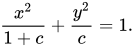
Let P1, P2, …, Pm be given as foci of a curve C of class m. Let P be the product of the tangential equations of these points and Q the product of the tangential equations of the circular points at infinity. Then all the lines which are common tangents to both P = 0 and Q = 0 are tangent to C. So, by the AF+BG theorem, the tangential equation of C has the form HP + KQ = 0. Since C has class m, H must be a constant and K but have degree less than or equal to m − 2. The case H = 0 can be eliminated as degenerate, so the tangential equation of C can be written as P + fQ = 0 where f is an arbitrary polynomial of degree 2m.[1]

For example, let m = 2, P1 = (1, 0), and P2 = (−1, 0). The tangential equations are

so P = X2 − 1 = 0. The tangential equations for the circular points at infinity are

so Q = X2 +Y2. Therefore, the tangential equation for a conic with the given foci is

or

where c is an arbitrary constant. In point coordinates this becomes
References

[edit]
Revisions and contributorsEdit on WikipediaRead on Wikipedia
from Grokipedia
In geometry, a focus (plural: foci) is a special point that plays a central role in the definition and construction of conic sections, serving as a fixed point from which distances to points on the curve satisfy specific constant-sum or constant-difference properties. These points are essential for distinguishing the shapes and behaviors of various conics, including circles, parabolas, ellipses, and hyperbolas.[1] For a circle, the focus coincides with the center, representing the set of all points equidistant from this single point, with an eccentricity of zero.[1] In a parabola, there is one focus paired with a directrix (a fixed line), where the defining property is that the distance from any point on the curve to the focus equals the distance to the directrix; this yields an eccentricity of 1, and the focus is located at a distance pp from the vertex along the axis of symmetry.[1] An ellipse features two foci, with the sum of distances from any point on the curve to these foci being constant (equal to the major axis length 2a2a); the foci are positioned at (±c,0)(\pm c, 0) from the center, where c=a2b2c = \sqrt{a^2 - b^2} and bb is the semiminor axis, resulting in an eccentricity e=c/a<1e = c/a < 1.[1] Conversely, a hyperbola also has two foci, but the absolute difference of distances from any point on the curve to the foci is constant (equal to 2a2a); the foci lie at (±c,0)(\pm c, 0), with c=a2+b2c = \sqrt{a^2 + b^2} and eccentricity e=c/a>1e = c/a > 1.[1] The positions and properties of foci are intimately linked to the eccentricity ee of a conic section, which quantifies its deviation from circularity: e=0e = 0 for circles, 0<e<10 < e < 1 for ellipses, e=1e = 1 for parabolas, and e>1e > 1 for hyperbolas.[1] Foci also underpin practical applications, such as in optics where parabolic mirrors reflect light to a focus or elliptical orbits in astronomy where planets maintain a constant sum of distances to the two foci (the Sun being one).[2] In general, conic sections are loci of points defined relative to a focus (or foci) and one or more directrices, providing a unified geometric framework for these curves.[1]

Definition and Basic Properties

General Definition

In geometry, a focus of a plane curve is a distinguished point such that the curve is defined as the locus of all points whose distances to the focus and to a fixed line, called the directrix, maintain a constant ratio known as the eccentricity ee. Formally, for a point PP on the curve, the distance from PP to the focus FF divided by the distance from PP to the directrix DD equals ee: PFPD=e\frac{PF}{PD} = e, where 0<e<0 < e < \infty. This distance-based property distinguishes the focus as a fundamental element in characterizing certain curves, particularly conic sections, unifying their definitions under a single framework.[3] The study of conic sections originated in ancient Greek mathematics with mathematicians like Menaechmus and Euclid, and was systematized by Apollonius of Perga in his eight-volume treatise Conics during the 3rd century BCE, where geometric properties essential for classifying and analyzing conic sections as intersections of planes with cones were emphasized.[4] The focus-directrix formulation evolved from these properties, with the explicit ratio definition (eccentricity) refined by Pappus of Alexandria around 300 CE, and the term "focus" introduced by Johannes Kepler in the 17th century to describe the point in elliptical orbits around the Sun.[5] For conic sections, the focus-directrix definition provides a basic example of this property: the curve comprises all points where the ratio of the distance to the focus and to the directrix is the constant eccentricity ee, with values of ee determining the specific type (e.g., e=1e = 1 for a parabola). This approach highlights the focus's role in capturing the curve's shape through simple distance constraints, without relying on cone intersections. Conic sections serve as the primary examples of curves defined via foci, illustrating the concept's foundational importance in plane geometry.[6] In polar coordinates with the focus at the origin and the directrix positioned at a perpendicular distance dd from the focus (typically along the line θ=π\theta = \pi), the equation of the conic takes the form
r=ed1+ecosθ. r = \frac{ed}{1 + e \cos \theta}.
This equation encapsulates the distance property, where rr is the radial distance from the focus, and θ\theta is the polar angle; variations in orientation adjust the trigonometric term (e.g., sinθ\sin \theta for vertical directrices). The parameter dd relates to the latus rectum and scales the curve's size relative to the focus.[7]

Geometric and Reflective Properties

In conic sections, the foci exhibit distinctive reflective properties that govern the behavior of light rays or signals interacting with the curve. For an ellipse, any ray emanating from one focus strikes the elliptical boundary and reflects such that it passes through the other focus, following the law of reflection where the incident and reflected rays make equal angles with the tangent at the point of incidence. This optical characteristic arises because the ellipse is defined by a constant sum of distances from any point on the curve to the two foci, ensuring that the reflected path maintains this constant length, analogous to the shortest path in an unfolded configuration. Similarly, in a hyperbola, a ray directed toward one focus reflects off the curve in a direction away from the other focus, preserving the constant absolute difference of distances to the foci. For a parabola, which has a single focus, incoming rays parallel to the axis of symmetry reflect through the focus, concentrating parallel beams at this point. These reflective behaviors stem from the geometric role of foci in extremizing path lengths along the curve. In an ellipse or hyperbola, the foci define points where the total path length from one focus to a curve point and back to the other (via reflection) is constant, making it stationary with respect to small variations along the tangent—thus satisfying the reflection principle without calculus. For the parabola, the focus equates the path length to the perpendicular distance to the directrix, ensuring that parallel rays converge optimally at the focus after reflection. A practical geometric construction highlighting the foci's role is the string property of the ellipse: fix two pins at the foci and use a string of length equal to the major axis (twice the semi-major axis), looped around the pins; as a pencil traces while keeping the string taut, it generates the ellipse, since the sum of distances to the foci remains constant at all points on the curve. The foci also possess invariance properties under certain geometric transformations. Specifically, affine transformations map a conic section to another of the same type (ellipses to ellipses, parabolas to parabolas, hyperbolas to hyperbolas), and the images of the original foci become the foci of the transformed conic, preserving the overall focal configuration in an affine sense despite distorting distances and angles.

Foci in Conic Sections

Ellipse and Hyperbola: Two-Foci Definitions

In geometry, an ellipse is defined as the set of all points in a plane such that the sum of the distances from any point on the curve to two fixed points, called foci, remains constant.[8] This constant sum, denoted as 2a2a, equals the length of the major axis of the ellipse./09%3A_Conics/9.01%3A_Ellipses) The distance between the two foci is 2c2c, where c<ac < a, and the relationship b2=a2c2b^2 = a^2 - c^2 holds, with 2b2b representing the length of the minor axis.[8] Similarly, a hyperbola is the set of all points in a plane such that the absolute difference of the distances from any point on the curve to the two foci is constant.[9] This constant difference, denoted as 2a2a, is less than the distance between the foci, 2c2c, where c>ac > a, and the relationship b2=c2a2b^2 = c^2 - a^2 applies, with 2b2b the length of the conjugate axis./12%3A_Analytic_Geometry/12.02%3A_The_Hyperbola) The curve consists of two separate branches opening away from each other.[9] The standard equation for an ellipse centered at the origin with major axis along the x-axis is x2a2+y2b2=1\frac{x^2}{a^2} + \frac{y^2}{b^2} = 1, where the foci are located at (±c,0)(\pm c, 0).[8] For a hyperbola with transverse axis along the x-axis, the standard equation is x2a2y2b2=1\frac{x^2}{a^2} - \frac{y^2}{b^2} = 1, with foci at (±c,0)(\pm c, 0)./12%3A_Analytic_Geometry/12.02%3A_The_Hyperbola) A practical geometric construction for an ellipse, known as the gardener's method, involves fixing two pins at the foci and using a loop of string of length 2a2a; a pencil pulls the string taut to trace the curve as it moves around the pins.[10] The eccentricity e=c/ae = c/a distinguishes these conics, with e<1e < 1 for ellipses and e>1e > 1 for hyperbolas.[11]

Parabola: Focus and Directrix Definition

A parabola is defined as the set of all points in the plane equidistant from a fixed point, known as the focus, and a fixed straight line, known as the directrix.[12] This locus-based definition captures the parabola's characteristic U-shape and distinguishes it within the family of conic sections./08:_Analytic_Geometry/8.04:_The_Parabola) In the standard form of a parabola opening upward with its vertex at the origin, the focus is located at (0,p)(0, p) and the directrix is the line y=py = -p, where p>0p > 0 represents the focal length, or the distance from the vertex to the focus./08:_Analytic_Geometry/8.04:_The_Parabola) To derive the equation, consider a point (x,y)(x, y) on the parabola. The distance from this point to the focus equals the distance to the directrix:
x2+(yp)2=y+p \sqrt{x^2 + (y - p)^2} = |y + p|
Squaring both sides yields:
x2+(yp)2=(y+p)2 x^2 + (y - p)^2 = (y + p)^2
Expanding and simplifying:
x2+y22py+p2=y2+2py+p2 x^2 + y^2 - 2py + p^2 = y^2 + 2py + p^2
x2=4py x^2 = 4py
Thus, the equation is y=x24py = \frac{x^2}{4p}.[13] Geometrically, the parabola opens away from the directrix, curving toward the side of the focus, with the vertex positioned midway between the focus and directrix along the axis of symmetry./08:_Analytic_Geometry/8.04:_The_Parabola) The latus rectum is the chord passing through the focus and parallel to the directrix; for this standard parabola, its endpoints are at (±2p,p)(\pm 2p, p), giving a length of 4p4p.[14]

Focus, Directrix, and Eccentricity

A conic section is the locus of all points in a plane such that the ratio of the distance from any point on the conic to a fixed point, called the focus, and the distance from that point to a fixed line, called the directrix, is a constant value known as the eccentricity $ e $.[1] This focus-directrix property provides a unified definition for all non-degenerate conic sections. The eccentricity $ e $ classifies the conic based on its value: when $ 0 < e < 1 $, the curve is an ellipse; when $ e = 1 $, it is a parabola; and when $ e > 1 $, it is a hyperbola.[1] For the special case $ e = 0 $, the conic degenerates to a circle, where the focus coincides with the center and the directrix is effectively at infinity. In ellipses and hyperbolas, the eccentricity is expressed as $ e = \frac{c}{a} $, where $ a $ is the semi-major axis length and $ c $ is the distance from the center to a focus. The directrix is the fixed line in this definition, positioned such that the perpendicular distance from the focus to the directrix relates to the conic's parameters.[1] An associated geometric construction is the directrix circle, which is centered at the focus with a radius equal to $ e $ times the perpendicular distance from the focus to the directrix, making it tangent to the directrix.[15] This circle aids in visualizing the focus-directrix relationship and the conic's shape.[16]

Applications in Astronomy and Physics

In astronomy, the concept of the focus plays a central role in describing planetary and cometary motion under gravitational influence. Johannes Kepler's first law states that the orbit of each planet around the Sun is an ellipse, with the Sun located at one of the two foci. This positioning explains the varying distances of planets from the Sun, as the focus is offset from the geometric center of the ellipse. The eccentricity ee of the orbit determines its shape: for e<1e < 1, the orbit is elliptical and bound, allowing periodic returns; e=1e = 1 yields a parabolic trajectory for marginal escape; and e>1e > 1 results in a hyperbolic path, indicating unbound motion away from the solar system. These principles, derived from observations of Mars, underpin modern orbital mechanics. Comet trajectories further illustrate the role of foci in non-bound orbits. Many comets follow parabolic paths (e=1e = 1) with the Sun at the focus, representing the boundary between capture and escape from the Sun's gravity. Others, particularly long-period or interstellar comets, exhibit hyperbolic orbits (e>1e > 1), where the Sun acts as a gravitational slingshot, accelerating the comet without capturing it permanently. For instance, Comet Hale-Bopp approached a near-parabolic trajectory, while interstellar objects like 'Oumuamua followed hyperbolic paths, confirming their extrasolar origins through eccentricity measurements., and the more recent interstellar comet 3I/ATLAS (discovered in 2025).[17] The gravitational two-body problem reduces the motion of two interacting masses to an equivalent one-body problem orbiting the center of mass, which occupies one focus of a conic section trajectory. In the solar system, this places the focus at the barycenter, often near the more massive body like the Sun, enabling predictions of relative motion via Keplerian elements. This framework extends to binary star systems and spacecraft trajectories, where the focus facilitates solving for positions and velocities under inverse-square gravity. In physics, foci enable practical applications in optics and acoustics leveraging conic reflective properties. Parabolic mirrors, with their focus positioned to converge parallel incoming rays—such as starlight from distant sources—to a single point, form the basis of reflecting telescopes like the Hubble Space Telescope's primary mirror. This design eliminates spherical aberration, achieving diffraction-limited imaging for astronomical observations. Similarly, elliptical geometries create whispering galleries, where sound waves originating at one focus reflect off the curved walls and reconverge at the other focus, allowing whispers to be heard clearly across distances, as demonstrated in elliptical chambers like the National Statuary Hall in the U.S. Capitol.[18] These acoustic effects arise from the ellipse's reflective property, concentrating energy without significant loss.

Curves Defined by Foci

Cartesian Ovals

A Cartesian oval is defined as the locus of points PP in the plane such that the weighted sum of the distances from PP to two fixed foci F1F_1 and F2F_2 equals a constant: $ m \cdot r_1 + n \cdot r_2 = c $, where $ r_1 = d(P, F_1) $, $ r_2 = d(P, F_2) $, $ m $ and $ n $ are distinct positive constants representing ratios related to optical media, and $ c > 0 $ is the constant.[19][20] This definition embodies the bireflection property, where the curve acts as a boundary enabling precise focusing through reflection or refraction at two distinct points, generalizing conic sections to non-equal weights.[20] The curve was discovered by René Descartes in 1637 as part of his investigations into refraction in La Géométrie, where he sought algebraic solutions to optical problems involving light bending at interfaces between media of different densities.[19][20] Descartes' work on these ovals arose directly from applying coordinate geometry to Snell's law, leading to curves that ensure rays from one focus converge to the other after refraction.[20] When $ m = n $, the equation reduces to that of an ellipse with the two foci, highlighting the conic relation, though the general case with $ m \neq n $ produces a distinct quartic curve.[19] In bipolar coordinates (τ,σ)(\tau, \sigma), with foci at (±a,0)(\pm a, 0), the equation simplifies to $ m r + n r' = c $, where $ r = a (\cosh \tau - \cos \sigma) $ and $ r' = a (\cosh \tau + \cos \sigma) $ are the distances, yielding a form that solves as roots of a quartic equation in Cartesian coordinates (x,y)(x, y).[19][20] The resulting curve typically consists of two nested ovals symmetric about the line joining the foci, but for specific ratios of $ m/n $ and values of $ c $ near the distance between foci, it can take a lemniscate-like figure-eight shape crossing at the midpoint.[19] Cartesian ovals possess two primary foci and exhibit rotational symmetry around the axis connecting them, making them anallagmatic curves invariant under certain inversions.[20] In optics, they are crucial for designing lenses that achieve stigmatic imaging, where rays from a point source in one medium (with refractive index proportional to $ 1/m $) focus perfectly to a point in another medium (index proportional to $ 1/n $), as seen in applications like aspheric lenses for cameras and microscopes.[20] This property stems from the constant optical path length along the curve, directly tying back to Descartes' refraction origins.[20]

Cassini Ovals

Cassini ovals are quartic plane curves defined as the locus of points in the plane such that the product of the distances to two fixed foci, separated by a distance of 2c2c, equals a constant b2b^2. This contrasts with conic sections, which involve sums or differences of distances. The curves are named after the Italian-French astronomer Giovanni Domenico Cassini, who first investigated them in 1680 while exploring models of planetary motion.[21][22] The shape of a Cassini oval varies with the ratio of bb to cc. When b<cb < c, the curve consists of two disjoint ovals, each enclosing one focus. When b=cb = c, it is a lemniscate of Bernoulli, a figure-eight curve that crosses itself at the origin (midpoint between the foci). When c<b<c2c < b < c \sqrt{2}, it forms a single peanut-shaped loop with a narrow waist enclosing both foci. When bc2b \geq c \sqrt{2}, the curve is a single convex oval. These forms arise from the geometric constraint on the product of distances, producing symmetric, non-conic profiles centered on the line joining the foci.[21][23] In Cartesian coordinates with foci at (±c,0)(\pm c, 0), the equation of a Cassini oval is given by
(x2+y2+c2)24c2x2=b4. (x^2 + y^2 + c^2)^2 - 4 c^2 x^2 = b^4.
This quartic equation confirms that Cassini ovals are not conic sections, as they are degree-four curves rather than degree-two. Key properties include bilateral symmetry about the x-axis and the origin. The area enclosed by the curve requires evaluation via elliptic integrals; for the lemniscate case, it simplifies to 2c22 c^2. Similarly, the arc length or perimeter involves complete elliptic integrals of the first and second kinds, reflecting the curves' transcendental nature.[21][23] Cassini ovals find applications in approximating planetary orbits, as Cassini proposed them as an alternative to elliptical paths for the Earth-Sun system, though Kepler's laws ultimately prevailed. They also serve as level curves in bipolar coordinate systems, useful for solving potential problems in physics and engineering, such as electrostatics or fluid flow between two poles. In modern contexts, their symmetrical structures aid in modeling bistatic radar coverage zones, where the foci represent transmitter and receiver positions.[21][22]

Extensions and Generalizations

Confocal Families of Curves

In geometry, confocal families of curves consist of sets of ellipses and hyperbolas that share the same two foci, forming orthogonal trajectories in the plane. These families are generated by varying a parameter in the conic equation while keeping the foci fixed, resulting in a pencil of curves where ellipses and hyperbolas intersect at right angles at every intersection point.[24] This orthogonality arises because the tangent lines to the curves at any intersection point are perpendicular, a property that distinguishes confocal conics from other families of conics.[24] The standard equation for confocal conics with foci at (±c,0)(\pm c, 0) and semi-major axis a>b>0a > b > 0 along the x-axis is given by
x2a2+λ+y2b2+λ=1, \frac{x^2}{a^2 + \lambda} + \frac{y^2}{b^2 + \lambda} = 1,
where λR{a2,b2}\lambda \in \mathbb{R} \setminus \{-a^2, -b^2\}, with c2=a2b2c^2 = a^2 - b^2. For λ>b2\lambda > -b^2, the curves are ellipses; for a2<λ<b2-a^2 < \lambda < -b^2, they are hyperbolas. This parameterization ensures all curves pass through the common foci and form an orthogonal pencil, covering the plane such that every point (except on the axes between foci) lies on exactly one ellipse and one hyperbola.[24] Elliptic coordinates (u,v)(u, v) provide a natural framework for these families, defined such that curves of constant uu are confocal ellipses and constant vv are confocal hyperbolas, with the coordinates related to Cartesian (x,y)(x, y) via x=ccoshucosvx = c \cosh u \cos v and y=csinhusinvy = c \sinh u \sin v for u0u \geq 0, 0v<2π0 \leq v < 2\pi. These coordinates transform the metric into an orthogonal form ds2=hu2du2+hv2dv2ds^2 = h_u^2 du^2 + h_v^2 dv^2, where hu=hv=csinh2u+sin2vh_u = h_v = c \sqrt{\sinh^2 u + \sin^2 v}, facilitating separation of variables.[24][25] The properties of confocal families are particularly useful in solving Laplace's equation 2ϕ=0\nabla^2 \phi = 0 in two dimensions, as the elliptic coordinate system allows separation of variables into ordinary differential equations involving Mathieu functions. Harmonic functions in these coordinates can exhibit constant values along the confocal curves, corresponding to equipotential surfaces for certain charge distributions at the foci, such as two equal line charges of opposite sign yielding elliptic equipotentials.[25][26] This separability underscores their application in potential theory and integrable systems like elliptic billiards.[24]

Higher-Dimensional and Non-Euclidean Generalizations

In three dimensions, the generalization of foci for ellipsoids replaces the two point foci of a 2D ellipse with a pair of confocal conic curves: a focal ellipse and a focal hyperbola lying in mutually orthogonal planes. These focal conics define the ellipsoid as part of a confocal pencil of quadrics, where the surface consists of points satisfying certain quadratic relations relative to these foci, analogous to the constant sum of distances in the planar case but extended through ellipsoidal coordinates.[27][28] In n-dimensional Euclidean space, conic sections generalize to quadric hypersurfaces such as hyperspheres and hyperboloids, obtained as intersections of hyperplanes with quadratic cones in higher-dimensional space. Foci extend to lower-dimensional subspaces—for instance, points in 2D become line segments or curves in 3D and higher—while eccentricity is preserved as a parameter characterizing the shape, defined via the ratio of distances from points on the hypersurface to the focal subspace and a directrix hyperplane.[29][30] In spherical geometry, conics on the sphere, known as sphero-conics, arise from intersections of the sphere with quadratic cones and possess two foci as points on the sphere connected by great circles. These foci define the curve as the locus of points where the absolute sum or difference of geodesic (great arc) distances to the foci remains constant, combining elliptic and hyperbolic properties within the closed elliptic metric of the sphere.[31] In hyperbolic geometry, conic sections are defined analogously using foci, but with distances measured in the hyperbolic metric, such as in the Poincaré disk model where the space is a unit disk with conformal metric. The eccentricity governs the constant ratio of hyperbolic distances from points on the conic to a focus and directrix, yielding ellipses (eccentricity <1), parabolas (=1), and hyperbolas (>1), though these definitions are not mutually equivalent as in the Euclidean plane.[32] Applications of these generalizations appear in general relativity, where null geodesics describing light paths around massive bodies exhibit conic-like orbits in effective potentials, with focal properties adapted to the curved spacetime metric for modeling gravitational lensing. In multidimensional optics, generalized foci facilitate the design of lenses and wavefronts in higher dimensions, enabling multi-focal arrays for beam shaping and imaging beyond planar constraints.[33][34]
User Avatar
No comments yet.