Hubbry Logo
Fort CarillonFort CarillonMain
Open search
Fort Carillon
Community hub
Fort Carillon
logo
8 pages, 0 posts
0 subscribers
Be the first to start a discussion here.
Fort Carillon
Fort Carillon
from Wikipedia

Fort Carillon, presently known as Fort Ticonderoga, was constructed by Pierre de Rigaud de Vaudreuil, Governor of New France, to protect Lake Champlain from a British invasion. Situated on the lake some 15 miles (24 km) south of Fort Saint-Frédéric, it was built to prevent an attack on Canada and slow the advance of the enemy long enough for reinforcements to arrive.[1]

Key Information

Assigned to remedy Fort Saint Frédéric's inability to resist a constant British threat to the south, French King's Engineer Michel Chartier de Lotbinière began construction of Fort Carillon where Lake George, at that time called Lac Saint Sacrement, joins Lake Champlain by the La Chute river. Construction began in October 1755.[2]

Location

[edit]
Location of Fort Carillon.

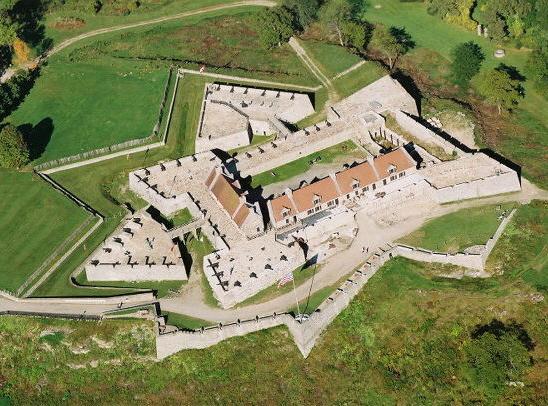
Fort Carillon was situated south of Lake Champlain and north of Lake George, a natural point of conflict between the French forces, which were advancing south from Quebec City through the Richelieu River towards Lake Champlain and the Hudson Valley, and the British forces, which were hoping to move north. The area was chosen so as to control the southern point of Lake Champlain as well as access to the Hudson Valley. The fort is surrounded by water on three sides, and on half of the fourth side by a moat. The portion remaining was strongly fortified by deep trenches, sustained by three batteries of cannon and, in front of the fort, blocked by trees which had been cut down and the pointed ends strengthened by fire, creating a formidable defensive system.

Handicapped by corruption, the construction continued at a slow pace. By mid-July 1756, four bastions with cannon were placed at a height of 18 ft (5.5 m). Two of the bastions were directed to the northeast and northwest, away from the lake. They were the Reine and Germaine bastions, with two demilunes (an outwork in front of a fort, shaped like a crescent moon) further extending the works on the land side. The two other bastions provided cover for the landing area outside the fort. They were the Joannes and Languedoc bastions, which overlooked the lake to the south. The walls were seven feet (2.1 meters) high and fourteen feet (4.3 meters) thick, and the whole works was surrounded by a glacis and a dry moat five feet (1.5 metres) deep and 15 feet (4.6 m) wide. The fort was armed with cannon brought in from Fort St. Frédéric and Montréal.[3][4]

By fall, the fort was still not finished when an important discovery was made: as soon as the trees of the peninsula were cut, the French realized that the location they chose did not join well with the junction between the two lakes. To correct this, a second but smaller fort was built closer to the lake, known as Redoute des Grenadiers. By January 1757, the fort was still incomplete and composed of earth and moats, mounted by 36 cannon waiting for an attack that the French were anticipating. The French and Canadians did not want to wait passively for the British assault however, and decided to attack first. In April, 8,000 men, under the command of Marquis de Montcalm, mustered at Fort Carillon. In August 1757, they crossed Lake George to take Fort William Henry. The operation was a success and Montcalm brought back his men to Fort Carillon for the summer.[2]

Lower and upper town of Carillon

[edit]
Plan of Fort Carillon in 1758

In 1756, the Canadian and French troops developed "le Jardin du Roi" on the sandy plain below the heights. It was intended to feed the summer garrison charged with constructing the new fort.[5]

By 1758, Fort Carillon and its surroundings were composed of a lower town, an upper town, two hospitals, hangars, and barracks for the soldiers. The Upper town itself took the form of a triangle with the fort as its northern tip, and the lower town the southern part of the triangle. There, taverns with wine cellars for the soldiers, bakeries, and nine ovens were located.[5] It was important to construct batteries for the lower town, and the earth removed for construction of the lower town was taken closer to the fort.[6]

On July 22, 1759, when orders were given to set fire to the town, the Indians could not believe that the French and Canadians would abandon what they had worked so hard to build. Heavy smoke rose from the two hospitals, the hangars of the lower and upper town, and the soldiers' barracks. All was to be abandoned to the advancing British army.[7] None of the buildings were ever reconstructed as was the case in Louisbourg, Cape Breton.

Garrison at Fort Carillon

[edit]

Les troupes de terre

[edit]
Regiment flags at Fort Carillon

The troupes de la terre were composed of professional soldiers of the French Army, sent from France to America, who were disciplined and well trained. At Fort Carillon in 1758, these troops were made up of the second battalions of seven regiments sent from different regions of France.[8] The regiments represented in the garrison were those of La Reine (345 soldiers), Guyenne (470 soldiers), Berry (450 soldiers), Béarn (410 soldiers), La Sarre (460 soldiers), Royal Roussillon (480 soldiers), and Languedoc (426 soldiers). The Berry regiment also had a second battalion, but their numbers were not known.[9]

The requisite white uniform of the French regular infantry is likely to have been similarly modified for all the battalions. The uniform of the Régiment de Guyenne and Régiment Berry was a bit like the Régiment de la Reine: a white-grey coat with red reversed sleeves with three ornate buttons, red vest, white-grey pants, and black shoes with metallic buckles. However, contrary to La Reine, the tricorn hat was black felt with a gold medallion.[10] The uniforms of the other regiments had blue vests and blue cuffs, except for Régiment de La Sarre which had red vests and blue cuffs. The French musket was of a smaller caliber than the British musket.

Les troupes de la Marine

[edit]

The Troupes de la Marine were led by Chevalier de Lévis with 150 Canadians. There were also about 250 Canadian Indians at Fort Carillon, for a total of 3,500 soldiers.[9] The French and Canadians often made use of guns placed on the walls of the fort, although for the Battle of Carillon, because the fighting took place 3/4 of a mile from the fort, it was essentially a battle of musket and bayonet.[citation needed]

Fort Carillon 1757

[edit]

Louis-Joseph de Montcalm, in command of the French troops at Fort Carillon decided to attack Fort William Henry from Fort Carillon. On August 9, 1757, Montcalm, with an army of 7,000 men consisting of French soldiers, Canadian militia, and Indians from various tribes, took Fort William Henry, situated at the southern point of Lake George. The Indians, who thought that an agreement had been made without their consent, revolted. What ensued were violent attacks by the Indians intoxicated by alcohol. There were, according to sources, between 70 and 150 people killed, scalped, and decapitated. After this massacre, the French soldiers accompanied the survivors to Fort Edward to avoid further bloodshed.[11]

After his victory, Montcalm could have taken Fort Edward, but he took instead the destroyed Fort William Henry, and returned to Fort Carillon. The British had been humiliated and Montcalm had shown the compassion of a great general by stopping any further bloodshed by the Indians and accompanying the survivors. However, Montcalm knew that he had to withdraw because of the anger and loss of the Indians as allies, as well as a shortage of provisions.

In 1756, New France had suffered a disastrous crop failure. Montcalm was forced to release the Canadian militiamen who made up more than half of his force. The Canadians were urgently needed to return home for the harvest. However, in 1757, disaster struck again and the harvest was the worst in Canadian history. Conditions were particularly bad around Montreal, which was "the granary of Canada." By late September, the inhabitants were subsisting on a half-pound of bread a day, and those at Quebec on a quarter-pound of bread. A month later, there was no bread at all. "The distress is so great that some of the inhabitants are living on grass," Bougainville wrote. There was a feeling of dispirited despair in the colony and the conclusion was that its military prospects would soon become indefensible.[12]

After a string of French victories in 1757, the British were prompted to organize a large-scale attack on the fort as part of a multifaceted campaign strategy against Canada.[13] In June 1758, British General James Abercrombie began amassing a large force at Fort William Henry in preparation for the military campaign directed up the Champlain Valley. These forces landed at the north end of Lake George, only four miles from the fort, on July 6.[14] The French general Louis-Joseph de Montcalm, who had only arrived at Carillon in late June, engaged his troops in a flurry of work to improve the fort's outer defenses. They built, over two days, entrenchments around a rise between the fort and Mount Hope, about three-quarters of a mile (one kilometer) northwest of the fort, and then constructed an abatis (felled trees with sharpened branches pointing out) below these entrenchments.[15] Abercrombie's failure to advance directly to the fort on July 7 made much of this defensive work possible. Brigadier General George Howe, Abercromby's second-in-command, had been killed when his column encountered a French reconnaissance troop. Abercrombie "felt [Howe's death] most heavily" and may have been unwilling to act immediately.[16]

1757 was therefore a bad year for the British in North America, not only because of their defeat in northern New York, but in the Ohio Valley and Nova Scotia as well. That year, British Prime-Minister William Pitt named General James Wolfe commander of the British troops in North America.[11]

British force sent against Fort Carillon

[edit]

The British force sent against Fort Carillon was made up of regular British regiments and provincial regiments. The British units were the 27th (Enniskillen) Regiment of Foot, the 42nd (Highland) Regiment of Foot, the 44th Regiment of Foot, 46th Regiment of Foot, the 55th Regiment of Foot, the 1st and 4th battalions of 60th (Royal American) Regiment, and Gage's Light Infantry.[17]

The British regiments were in their customary red coats with the exception of Gage's light infantry, which wore grey. The soldiers were armed with muskets, bayonets, hatchets or tomahawks, and knives. The standard battle issue for British soldiers was 24 rounds of ammunition; Howe may have ordered his soldiers to carry as many rounds as they could. The provincial regiments wore blue, but extensive modification of uniform was made to suit forest warfare with coats being cut back and any form of headgear and equipment permitted. Rogers' Rangers most likely wore their distinctive green. Along with Rogers' Rangers, there were regiments from New York, Massachusetts, Rhode Island, Connecticut, and New Jersey.[17]

Early preparations to the Battle of Carillon (1758)

[edit]
Drummer uniform in royal livery and drum

Although the French government knew that the British had dispatched 8,000 men to North America, Canada had only received 1,800 men, most of whom were assigned to Louisbourg. The army's small size forced Major-General Louis-Joseph de Montcalm, commander of French forces in Canada, to rely on Indians, and although traditional French allies like the Nipissing, Algonkin, and Abenaki contributed a thousand warriors, it was not enough. Determined to capture both Fort William Henry and Fort Edward, Governor Vaudreuil also recruited a thousand warriors from tribes around the upper Great Lakes. The large number of different tribes meant that there were not enough interpreters, and potentially dangerous tribal rivalries needed attention. Dealing with Indians was never an easy matter, but these Indians did not see themselves as subjects of New France, just temporary allies in search of loot. However, even traditional French allies had scalped wounded British when the garrison at Oswego surrendered, and then forced the French to buy back a number of English prisoners.[11]

While Montcalm and Vaudreuil were raising an army, American rangers proved to be too few to stop Indians from raiding the area around Fort William Henry at will. In late June, a powerful Indian raiding party discovered that the road between the two forts was basically unguarded. The French had a clear picture of the strategic situation in June, but six separate scouting parties were unable to penetrate the Indian screen to learn anything more detailed than that there was a large force at Fort Carillon.[18]

The destruction of Fort William Henry should have guaranteed the safety of Fort Carillon, but the British government had made North America the priority, while France had not, so another attempt was made at Fort Carillon.

Battle of Fort Carillon

[edit]
Map of the Battle of Fort Carillon in 1758

The British were alarmed by the outcome of losing Fort William Henry, which was their northernmost fort. They decided to prepare for a massive attack against Fort Carillon. Close to 16,000 men (the largest troop deployment ever assembled on the North American continent) was united under the orders of General James Abercrombie, commander in chief of the British forces in North America. The actual officer in charge of the land operation was Brigadier-General Lord Howe. On July 8, 1758, the British army of General James Abercrombie with 16,000 men, (6,000 British soldiers and 10,000 colonials) and their allies the Mohawks (who did not participate in the battle), attacked Fort Carillon commanded by Louis-Joseph de Montcalm with 3,600 soldiers, including 400 Canadians from Lévis and 300 Abenakis. Abercrombie was determined to go ahead with his advancement before he lost the advantage. The British however faced a well-fortified position. While the fort was still under construction,[disputeddiscuss] the French forces dug deep trenches flanked by three batteries of cannon. The fort was also defended by a line of sharpened trees pointed towards the exterior and intertwined with branches and spikes installed during the night on orders from Montcalm. Part of the French forces were dispersed in the adjoining forest. The land around the fort gave way to only one opening, since the fort was surrounded on three sides by water and at half of the rear by a moat. Abercrombie could have gone around the French, but wanting a quick victory, he decided against this maneuver. Informed by his lieutenant that it would be possible to take the French by assault, he opted for a massive frontal attack. However, the French defenses proved to be well prepared and they were not in danger of enemy fire. The French easily decimated the British ranks with cannon fire. (The French were lined up in 3 rows: the first row fired while the third was reloading their rifles, permitting a strong even fire).[19]

The British soldiers had to climb on each other's shoulders in order to reach the top of the trenches, so it was easy for the French to repulse them as they arrived near the summit of the defenses. Only one time were the British capable of breaking through the French defenses, only to be repulsed by a charge of bayonets. The British tried to take the fort, but were driven back time and time again by the French artillery. Abercrombie sent his men to assail the fort several times; he lost 551 soldiers, 1,356 were wounded and 77 disappeared. They retreated to Fort William Henry. As for the French and Canadians, they had 104 killed and 273 wounded.[20]

British capture

[edit]

Jeffery Amherst, now commander in chief of the British forces in America with 12,000 soldiers, prepared to move against Fort Carillon on July 21, 1759. On July 22 and 23, Bourlamaque left the fort with 3,600 men and deployed 400 soldiers to set fire to the two hospitals, hangars, barracks, and to the lower part of the town. During four days, from July 23 to 26, the British bombed the fort, using artillery positioned where Captain Hébécourt and his men were retrenched. On July 26, they left at 10 pm, and at midnight, the explosives demolished most of the fort.[21] They then moved out to Fort Saint Frédéric with the regiment of Hébécourt, captain of the La Reine regiment. Bourlamaque did the same to Fort Saint Frédéric on July 31. After that, they moved up to Isle-aux-Noix where Amherst declined to advance against them, preferring to consolidate his forces in the lower Lake Champlain area.[22] In withdrawing, the French used explosives to destroy what they could of the fort and spiked or dumped cannon they did not take with them.[23] The British moved in on July 27 and, though they worked in 1759 and 1760 to repair and improve the fort (which they renamed Fort Ticonderoga),[24] the fort saw no more significant action in the war. After the war, the British garrisoned it with a small number of troops but allowed it to fall into disrepair. Colonel Frederick Haldimand, in command of the fort in 1773, wrote that it was in "ruinous condition".[25]

Photos of Fort Carillon

[edit]

Legacy of Fort Carillon

[edit]

The importance of Fort Carillon, the Battle of Carillon, and the Flag of Carillon; have long been a source of pride for French Canadians and to the people of Quebec.[26] The Flag of Quebec was modeled after the Carillon flag and the Fort and its history bring honor to Canada as well as the province of Quebec.

See also

[edit]
The Flag of Carillon

References

[edit]
[edit]
Revisions and contributorsEdit on WikipediaRead on Wikipedia
from Grokipedia
Fort Carillon, later renamed , was a strategic French fortress constructed between and 1757 on the Ticonderoga Peninsula in , to defend the vital waterway corridor between Lake George and during the . Designed by French colonial engineer Lieutenant Michel Chartier de Lotbinière under the oversight of Governor Pierre de Rigaud de Vaudreuil, the fort featured earthen ramparts, log breastworks, and obstacles, making it one of the strongest fortifications in at the time. Positioned at the southeastern tip of the overlooking La Chute River and South Bay, Fort Carillon controlled access between and the British American colonies, serving as a critical defensive outpost against British advances from the south. Its location on a rocky height provided natural advantages, surrounded by water on three sides and marshy terrain on the fourth, which enhanced its defensibility. Additional entrenchments were hastily reinforced in July 1758 by engineers such as Pontleroy and Desandrouins under General , including seven-to-eight-foot-high log breastworks and sandbag reinforcements. The fort's most notable engagement was the on July 8, 1758, where approximately 3,250 to 3,526 French and Canadian troops under Montcalm repelled a much larger British and provincial force of 13,000 to 15,350 men led by James Abercrombie, resulting in a decisive French victory despite the odds. The British assault faltered due to poor coordination, disrupted formations from , and effective French fire from the breastworks, with British casualties estimated at 500 to 4,000 (most commonly 1,500 to 2,000 killed and wounded), while French losses were around 104 killed and 273 wounded. This improbable triumph temporarily secured French control of the region but highlighted vulnerabilities, such as limited provisions that could have doomed the fort to a prolonged . In July 1759, British forces under General Jeffery Amherst captured the fort after the French abandoned and partially destroyed it, with minimal resistance and British losses of 16 killed and 51 wounded. During the , American forces seized the renamed unopposed on May 10, 1775, repurposing its fortifications and altering them from 1775 to 1777, marking it as a pivotal early in the fight for . Overall, Fort Carillon exemplified advanced colonial and its role in shaping the balance of power in North American colonial conflicts.

Geography and Strategic Role

Location and Terrain

Fort Carillon is located at the narrows between to the north and Lake George to the south, in present-day . Its geographical coordinates are approximately 43°50′30″N 73°23′15″W, positioning it on a southeast-northwest trending that spans about 600 acres and is surrounded by water on three sides. This strategic site lies within , and extends toward , at the outlet of Lake George via Ticonderoga Creek. The fort occupies an elevated rocky promontory rising to about 269 feet (82 m) above —or about 174 feet (53 m) above —with the fort site itself at approximately 197 feet (60 m) above . Steep slopes characterize the terrain, particularly to the south along the La Chute River with gradients of 18-60% and precipitous drops up to 60 feet (18 m), and to the east where cliffs and bold acclivities provide inherent barriers. These natural elevations and inclines, combined with proximity to vital water routes like and Ticonderoga Creek, facilitated supply lines while enhancing the site's defensibility against landward approaches. Environmental factors further shaped the landscape, including dense forests of white oak and white pine that covered the slopes and surrounding areas, offering materials for and natural . Nearby swamps and marshy ground, such as the deep morass at the northern end of the and drainage ravines up to 1,600 feet (488 m) long and 7 feet (2.1 m) deep, created nearly impassable obstacles that hindered enemy movements and protected the fourth side of the . The clayey soils, like Vergennes silty clay loam, added to the rugged character, complicating earthworks but bolstering the overall natural fortifications during the fort's development and use.

Strategic Importance in Colonial Wars

Fort Carillon was constructed in 1755 as part of the French response to escalating Anglo-French tensions in following the British defeat at in 1755, marking the onset of open hostilities in the . This fortification represented a critical element in France's strategy to secure its northern frontiers and counter British expansion into the Ohio Valley and beyond. The fort's location at the southern tip of positioned it to dominate the primary water route connecting to the British colonies, providing essential control over access to the lake and the adjacent Valley. By commanding the lake's narrowest point, approximately one-quarter mile wide, Fort Carillon enabled the French to blockade potential invasion paths into while facilitating the movement of supplies and troops via bateaux and canoes along this vital corridor. This waterway dominance was pivotal in the broader imperial rivalry, as served as a gateway for French communications between and interior outposts, underscoring the site's role in sustaining colonial logistics during the Seven Years' War. Tactically, Fort Carillon functioned as a for French offensives into British-held territories south of Lake George, allowing raids on settlements and disruptions to enemy supply lines originating from Albany. Simultaneously, its elevated terrain and placements made it a formidable defensive bulwark against British incursions northward, repelling advances and protecting the strategic Champlain corridor from conquest. These dual capabilities highlighted the fort's indispensable position in French defensive-offensive doctrine amid the colonial conflicts.

Construction and Fortifications

Planning and Initial Build (1755)

In response to escalating British threats following the on September 8, 1755, Governor Pierre de Rigaud de Vaudreuil ordered the construction of a fort at the strategic narrows between Lake George and to secure French control over key invasion routes. The site, known as Carillon Point on the Ticonderoga Peninsula, was selected for its elevated terrain offering defensive advantages and oversight of the waterways. Vaudreuil appointed his cousin, King's engineer and lieutenant Michel Chartier de Lotbinière, to lead the project, drawing on Lotbinière's expertise in colonial fortifications. Construction commenced in October 1755, with initial efforts focused on clearing dense and establishing basic earthworks to create a defensible perimeter. Lotbinière mobilized up to 2,000 men, primarily drawn from the at nearby Fort St. Frédéric (Crown Point), to fell trees and level the ground for foundational structures. By late , workers had erected a timber of logs reaching approximately 7 feet in height, substituting for scarce stone materials in the rudimentary setup. The early phase faced significant obstacles, including harsh autumn weather that brought ice formation by late , effectively halting outdoor labor. Supply constraints compounded these issues, as limited availability of stone and skilled workmen forced reliance on local timber and basic tools, resulting in a rapid but incomplete that prioritized speed over permanence. These challenges underscored the logistical strains of frontier engineering in a remote location distant from major supply hubs like .

Design Features and Enhancements (1756-1758)

Fort Carillon was constructed as a classic Vauban-style star fort, characterized by a rectangular layout enclosing a central parade ground and featuring four bastions at the corners to provide overlapping fields of fire and protection against enfilading . The overall perimeter measured approximately 500 yards, with ramparts reinforced by timber revetments and earthworks up to 14 feet thick at the base. Defensive elements included a dry roughly five feet deep and 15 feet wide surrounding the walls, slopes cleared of cover to expose approaching attackers, and two triangular ravelins positioned to the north and west for enhanced counter-battery capabilities. By , the fortifications supported numerous cannons along the ramparts, including heavy mortars capable of firing 200-pound shells over distances exceeding 2,900 yards. Enhancements in 1756 emphasized logistical support, with the addition of outer entrenchments extending the defensive lines across the Heights of and the erection of a on the La Chute River to process local timber for ongoing construction needs. From 1757 to 1758, under the direction of engineers following General Louis-Joseph de Montcalm's oversight, further upgrades incorporated stone facings on key rampart sections—cut from local up to 15 feet deep—for improved resistance to bombardment, alongside the construction of secure powder magazines housed within the bastions to protect stores.

French Occupation and Garrison

Composition of Forces

The French garrison at Fort Carillon during its active period from 1755 to 1759 was composed primarily of two main categories of troops: les troupes de terre, consisting of regular infantry and artillery units from under the Ministry of War, and les troupes de la Marine, colonial forces administered by the Ministry of the Navy that included Canadian-born soldiers and . These were supplemented by irregular support from Indigenous allies, drawn from various nations including the , Algonquin, Huron, and . The overall composition reflected the French strategy of combining professional European soldiers with locally adapted colonial and allied forces to defend the corridor. By 1757, the garrison's strength had grown through reinforcements under General , who arrived on June 30 with the regiment's second and engineers such as Captain Pontleroy, joining six other regular s already in : La Reine, Guyenne, Royal-Roussillon, , La Sarre, and . These troupes de terre provided the core defensive capability, with each typically organized into 12 companies and one company, though understrength due to campaign demands. Les troupes de la Marine numbered around 450 at this time, focused on scouting and roles, while added several hundred more for labor and auxiliary duties; Indigenous allies contributed about 200 warriors for and harassment tactics. Seasonal rotations brought influxes of colonial in spring and summer, with many returning to farms in winter, maintaining a fluctuating but resilient force structure. The garrison reached its peak strength of approximately 3,500 men by mid-1758, just before the Battle of Carillon, comprising about 3,111 regulars from the second battalions of La Reine (345–365 men), Béarn (410), Guyenne (470), La Sarre (460), Languedoc (426), Royal-Roussillon (480), and Berry (450, plus a 50-man detachment from the third battalion). This regular force was bolstered by 150 Troupes de la Marine under commanders like Chevalier de Lévis, who handled advanced positions and flat terrain defenses, and an additional 250 Canadian militiamen for support roles. Indigenous allies swelled to 400–600 warriors during this period, providing critical scouting and psychological leverage, though their numbers varied with diplomatic alliances. Further reinforcements in July 1758, including 400 picked men from Lévis and up to 3,000 Canadians under Pierre Rigaud, temporarily pushed totals toward 6,000–7,000, but the core garrison reverted to around 3,500 effectives for sustained operations. Artillery units within the troupes de terre included specialized detachments for siege and field pieces, ensuring the fort's defensive armament. By late 1758, rotations saw most regulars withdrawn to Canada for winter, leaving a reduced force of 300–400.
Troop TypeApproximate Numbers (Peak 1758)Key Roles
Troupes de terre (Regulars: & )3,111 (from 7+ battalions, e.g., La Reine, )Main line defense, entrenchments, heavy
(Colonial Regulars)150–450Scouting, defense, light
Canadian Militia & Volunteers250–3,000 (seasonal)Labor, flat ground support, reinforcements
Indigenous Allies400–600, harassment, reserves

Daily Operations and Command Structure

The French garrison at Fort Carillon operated under a hierarchical command structure led by Louis-Joseph de Montcalm, who assumed overall command of French forces in in 1756 and frequently directed operations from the fort during key periods. Montcalm's second-in-command, François-Gaston de Lévis, played a critical role in tactical dispositions, such as organizing defenses and patrols while Montcalm was engaged elsewhere, ensuring coordinated responses to potential threats. As governor of , Pierre de Rigaud de Vaudreuil exerted influence over broader strategy, often coordinating with Montcalm on resource allocation and reinforcements, though tensions between military and civilian authority occasionally complicated decision-making. Daily routines for the emphasized defensive vigilance and upkeep. Maintenance tasks focused on the fort's earthworks and palisades. Logistical operations relied heavily on bateaux for transporting essential supplies like flour, gunpowder, and munitions from via the and , with convoys navigating challenging rapids and seasonal ice. was strict, particularly after poor harvests prompted Montcalm to reduce portions starting in November 1756, exacerbating morale issues from isolation and harsh winters. The fort's strategic position allowed continued resupply until British advances intensified.

Major Military Campaigns

1757 Expedition to Fort William Henry

In July 1757, French General Louis-Joseph de Montcalm assembled a large expeditionary force at Fort Carillon, utilizing the fort as a strategic staging base for an offensive against British positions to the south. The force totaled approximately 8,000 troops, including about 6,000 French regulars, Canadian militia, and troupes de la marine, supplemented by roughly 2,000 Indigenous warriors from various allied tribes. Fort Carillon's garrison, reinforced earlier that summer under Montcalm's command, provided essential logistical support for this assembly, including supplies and embarkation facilities along Lake Champlain. On August 3, 1757, Montcalm's army departed Fort Carillon, advancing south via a combination of bateaux on Lake George and overland marches to encircle the British-held . The expedition arrived at the target that same day, initiating a that lasted until August 9, during which French artillery—transported from Carillon—bombarded the fort, forcing the British garrison under Lieutenant Colonel George Monro to capitulate after sustaining heavy casualties and supply shortages. Following the surrender, some Indigenous allies, frustrated by the terms of capitulation and rumors of British bounties on their scalps, attacked the withdrawing British prisoners, resulting in the deaths of approximately 70 to 180 captives in what became known as the Fort William Henry Massacre; Montcalm intervened to halt the violence and protect the majority. By August 11, the French forces had withdrawn back to Fort Carillon, where they consolidated their territorial gains in the Lake George region and repaired equipment damaged during the campaign. The successful operation demonstrated Fort Carillon's critical role as a forward base, enabling rapid deployment and secure return for French operations in the theater of the .

Battle of Carillon (1758)

In July 1758, during the , British forces under General James Abercrombie advanced on with approximately 15,000 troops, including British regulars and colonial provincials, departing from Lake George on July 5. The army, transported by over 800 boats, landed about 3.5 miles north of the fort on July 6 without immediately deploying their , which was instead positioned for a potential that Abercrombie ultimately did not employ. A skirmish during the landing resulted in the death of the popular Colonel George Howe, temporarily halting the British advance and allowing time for French preparations. French commander Louis-Joseph de Montcalm, with around 3,600 troops including regulars, , and Native American allies, quickly reinforced the fort's outer defenses by constructing hasty breastworks and on the Heights of Carillon, about three-quarters of a mile from the fort itself. These fortifications, leveraging the fort's elevated terrain and wooded slopes for defensive advantage, positioned Montcalm's forces to repel an assault without relying on the main structure. On July 8, Abercrombie ordered a series of uncoordinated frontal starting around 1:00 p.m., with units like the regiment charging the entrenched lines; despite initial progress in some sectors, the assaults were repelled after six waves, as French musket fire and bayonets inflicted heavy losses on the exposed British troops. The battle concluded with devastating casualties: the British suffered 551 killed, 1,356 wounded, and 27 missing, marking one of the bloodiest days in North American colonial warfare up to that point, while French losses totaled about 372 (106 killed and 266 wounded). Abercrombie ordered a retreat on , withdrawing the demoralized army back to Lake George and abandoning supplies and equipment, thus failing to capture the fort. The victory preserved French control of the Lake Champlain corridor temporarily, greatly boosting morale among Montcalm's outnumbered forces and enhancing his reputation, though it further strained French resources amid ongoing multi-front pressures in .

British Capture (1759)

In the summer of 1759, following the failed British assault on Fort Carillon the previous year, Jeffery Amherst commanded a force of approximately 11,000 British regulars, provincials, and Native American allies in a methodical advance toward the fort from Lake George. Departing Lake George on July 21, Amherst's army proceeded slowly, constructing a road through the dense wilderness to facilitate the transport of heavy artillery and supplies, reaching the vicinity of the fort by July 22 after landing at the head of the La Chute River. This cautious approach, informed by the 1758 debacle, allowed Amherst to position cannons on high ground overlooking the fort, preparing for a formal siege without immediate combat. The French, under the command of François-Charles de Bourlamaque—who had succeeded the deceased —initially mustered about 3,000 troops to defend the position but faced overwhelming British superiority in numbers and artillery. Bourlamaque conducted a brief action, skirmishing with the advancing British on July 23 before withdrawing the bulk of his forces northward to Crown Point to safeguard more critical positions closer to . By July 26, with Amherst's siege preparations underway and no prospect of reinforcement, the remaining French garrison of around 400 men abandoned the fort, recognizing the futility of prolonged resistance against the encroaching British lines. Prior to their evacuation on July 26–27, the French forces spiked the fort's cannons to render them unusable and ignited an explosion in the overstocked powder magazine, which demolished parts of the interior structures and created a massive crater but left the outer walls largely intact. Amherst's troops occupied the damaged fort on July 27 without opposition, immediately renaming it Fort Ticonderoga and using it as a base to pursue the retreating French, who continued their withdrawal to Crown Point while destroying additional defenses along Lake Champlain. This nearly bloodless capitulation, with British casualties of about 36 killed and wounded from prior skirmishes and cannon fire, marked a significant British strategic gain in the campaign for control of the lake corridor.

Later History and Transformation

British Control and Renaming

Following the British capture of Fort Carillon on July 26, 1759, the structure was officially renamed later that year. The new name derived from a corruption of the Mohawk term tekontaró:ken, meaning "at the junction of two waterways," reflecting the fort's strategic position between Lake George and . Under British command, General Jeffery Amherst oversaw immediate repairs to the damaged fortifications, as the retreating French had demolished key sections, including the powder magazine, to deny resources to the victors. Engineers restored the walls and bastions in line with the original French star-shaped design, while additional were constructed to accommodate the and support operations. Fort Ticonderoga then functioned primarily as a during the final phases of the , stockpiling provisions, ammunition, and equipment to facilitate Amherst's 1760 campaign against . British forces under Amherst advanced from the fort along , contributing to the coordinated offensive that led to the fall of . With the signing of the Treaty of Paris in 1763, which ended the war and ceded French territories in to Britain, Fort Ticonderoga remained under British control but saw its strategic importance diminish. The garrison was reduced to a small detachment for routine maintenance, with little military activity until the outbreak of the in 1775.

Role in the American Revolutionary War

On May 10, 1775, and the , in coordination with and militia, captured from a small British garrison without significant resistance, marking the first offensive victory of the . The fort, originally known as Fort Carillon during its French period, yielded approximately 59 cannons and other artillery pieces that proved vital for the Continental Army. In late 1775, Colonel led an expedition to transport these heavy guns overland through harsh winter conditions from Ticonderoga to , where they were emplaced on in March 1776, compelling the British evacuation of the city on March 17. Following the capture, Major General , appointed commander of the Northern Department, oversaw repairs and fortifications at Ticonderoga to strengthen it as a key defensive position and supply base for American operations in the region. In mid-1776, Schuyler directed the construction of additional works on nearby Mount Independence, enhancing the site's defenses amid ongoing threats from British forces in . The fort served as a logistical hub, storing provisions and supporting campaigns such as the invasion of Quebec under , until strategic priorities shifted southward. In 1777, during General John Burgoyne's , British forces advanced from and positioned on Mount Defiance, overlooking Ticonderoga, prompting Major General to evacuate the fort on the night of July 5–6 without a major battle. The British captured the site on , seizing supplies but facing delays from American rear-guard actions, including the Battle of Fort Anne on July 8, where Pierse Long's detachment repelled pursuers under Lieutenant John Hill. These delaying tactics preserved American forces for later victories, but Ticonderoga's vulnerability led to its abandonment as a permanent base after the British occupation, with Continental operations shifting elsewhere in the .

Preservation and Modern Significance

19th-Century Decline and Rediscovery

Following the , Fort Ticonderoga (formerly Fort Carillon) was abandoned by British forces in November 1777 after their defeat at Saratoga, and the site quickly fell into neglect as a outpost. The State of New York acquired the property in but transferred it to Union and Columbia Colleges in 1803 for educational purposes, during which time it served primarily as farmland and pasture. By the early , local residents had scavenged much of the fort's stone, timber, and metal for nearby construction projects, accelerating its deterioration into a picturesque ruin amid overgrown fields. In 1816, New York merchant William Ferris Pell leased the site after spotting the ruins during a steamboat trip, marking an early spark of private interest in its historical value. He purchased the 546-acre property outright in 1820 for $6,008 from the colleges, halting further illicit quarrying and converting the grounds into a rural estate with gardens and a Greek Revival house (later destroyed by fire in 1825). Under Pell's ownership, the site became part of the popular "Northern Tour" itinerary for travelers, attracting visitors who marveled at its romantic decay; by 1826, Pell had built The , a neoclassical to accommodate tourists seeking views of the scenic ruins. Artists like William Henry Bartlett captured this evocative state in sketches and engravings, such as his 1837 "View of the Ruins of Fort Ticonderoga," which emphasized the fort's ivy-covered walls against the Adirondack backdrop. The mid-19th century saw growing historical recognition, fueled by antiquarian efforts amid rising patriotic sentiment. Historian Benson J. Lossing visited in the 1840s and 1850s, documenting the site's Revolutionary War significance in his influential Pictorial Field-Book of the Revolution (1851–1852), complete with illustrations and interviews with aging veterans to highlight its role in early American independence. Lossing's work, drawing on primary accounts and on-site sketches, spurred public awareness and visits by members of emerging historical societies, positioning the ruins as a symbol of national heritage rather than mere scenery. This momentum laid the groundwork for later preservation, though the fort remained privately held and largely unrestored through the century's end.

20th-Century Reconstruction and Tourism

In 1908, Stephen H. P. Pell and his wife purchased the remaining shares of the property from other heirs, initiating one of the earliest major historic reconstruction efforts in the United States. The project, funded in part by Sarah Pell's father W. Thompson with an initial pledge of $500,000, focused on restoring the site's 18th-century structures using surviving original and construction plans discovered on the property. Between 1908 and the 1920s, workers progressively rebuilt the fort's stone ramparts, curtain walls, and two-story enclosing the courtyard, incorporating timber revetments and local mortar to replicate the French-era design while underpinning remnants of the original walls up to 15 feet deep into the bedrock. The reconstructed , in particular, followed the fort's original blueprints to ensure architectural fidelity. The Fort Ticonderoga Museum opened to the public on July 6, 1909, initially displaying artifacts collected by the Pells, including weaponry and documents from the colonial period. In the 1930s, the Fort Ticonderoga Association was established in 1931 to oversee the site's preservation and operation as a public historic shrine, enabling further expansions to the museum's holdings. During the 1930s and 1950s, the museum added dedicated exhibits on the French and Indian War era, featuring original artillery pieces, uniforms, and maps that highlighted Fort Carillon's role in 18th-century conflicts, drawing from the Pells' growing collection of over 200,000 artifacts by mid-century. These developments transformed the site from private ruins into an accessible educational resource. Annual reenactments began in the 1970s, with early events recreating key moments like Ethan Allen's 1775 capture of the fort, attracting visitors through immersive living history programs. Today, the Fort Ticonderoga Association manages the site as a nonprofit historic attraction, offering guided tours of the reconstructed fortifications from May to October, daily artillery demonstrations using period cannons, and access to the Thompson-Pell Research Center for scholarly study of 18th-century military artifacts and archives. Recent preservation efforts include the restoration of the 1826 Pell Pavilion, now offering guided tours as of 2025, the acquisition of over 3,000 additional Revolutionary War artifacts through a $12 million fundraising campaign announced in October 2025, and a three-year commemoration of the Revolutionary War's 250th anniversary beginning in May 2025, featuring expanded reenactments and exhibits.

References

Add your contribution
Related Hubs
User Avatar
No comments yet.