


Community hub
Recent from talks
Contribute something
Nothing was collected or created yet.
Fresno Yosemite International Airport
View on Wikipedia
Fresno Yosemite International Airport (IATA: FAT, ICAO: KFAT, FAA LID: FAT) is a joint military–public airport in Fresno, California, United States. It is the primary commercial airport for the San Joaquin Valley and three national parks: Yosemite, Sequoia and Kings Canyon. It offers scheduled passenger flights to several major airline hubs in the United States and international service to Mexico. The facility opened in June 1942 as Hammer Field, a military airfield. The airport is owned and operated by the city of Fresno and operates two runways on a property spanning 1,728 acres (699 ha). Its airport code "FAT" stands for Fresno Air Terminal, a former name for the airport.
Key Information


The airport has seen double-digit growth in its passenger traffic every year since 2018 (except 2020 due to the pandemic). As of 2024[update], the passenger terminal is undergoing a significant expansion project to expand the size of the security screening area, add new gates, and build a new international arrivals facility.
Due to its central location within the state, the airport is home to several military, law enforcement, firefighting, and medical air units. The Fresno Air National Guard Base on the southeast corner of the airport is home to the 144th Fighter Wing of the California Air National Guard. The Fresno Air Attack Base on the eastern side of the airport supports aerial firefighting aircraft. Other government and military operators with facilities at the airport include the California Army National Guard, the California Highway Patrol, the Fresno County Sheriff's Office, and the Fresno Police Department.
Fresno is home to a large operations base for SkyWest Airlines, the nation's largest regional airline.
History
[edit]Military beginnings
[edit]The Fresno Yosemite International Airport opened as a military airfield in June 1942, just six months after Japan's attack on Pearl Harbor, leading the United States to enter World War II. The new airfield was named Hammer Field and was used by the United States Army Air Forces as a training facility for the new pilots of the Fourth Air Force. It had a single northwest/southeast oriented runway with a length of 7,200 feet (now runway 11L/29R).[4]

Night fighter training, using Northrop P-61s, was moved to Hammer Field in January 1944, initially with the 481st Night Fighter Operational Training Group, replaced by the 319th Wing in May 1944. Training for the Bell P-59 Airacomet was added to the 319th mission in 1944, as well, confirmed Col. Ralph H. Snavely, commanding officer of the 319th Wing.[5]
At the time, civil and commercial aviation used Chandler Field that had opened in November 1929.[6] Chandler is 1.5 miles (2.4 km) west of downtown Fresno, on a small site. Less than a decade after it opened, it was clear that the small runway at Chandler would not be able to accommodate coming larger airliners.[6]
Conversion to civil use
[edit]After World War II, Hammer Field was inactivated by the Army Air Forces, and the city of Fresno saw an opportunity to use the site to create a commercial airport much larger than Chandler Field. In 1946, the War Assets Administration reallocated the property to the city, and the construction of a passenger terminal on the northeast side of the airfield was immediately begun. In 1948, the newly renamed Fresno Air Terminal (FAT) opened. Trans World Airlines (TWA) and United Airlines flights to San Francisco/Oakland and Los Angeles moved from Chandler Field to the newly opened airport. Chandler Field was retained by the city of Fresno as a reliever airport and continues to operate as the Fresno Chandler Executive Airport.[7][6]
Strategic Air Command facilities for Convair B-36 operations were initially proposed for “Hammer Air Force Base,” but objections from the City of Fresno led them to be changed to Travis Air Force Base instead. The Fresno upgrade was projected to cost $22.3 million.[8]
The California Air National Guard moved to the airport in the 1950s and established the Fresno Air National Guard Base on the southeast corner of the property. The guard also built munition storage bunkers along the northern edge of the airport grounds.[9] The 194th Fighter Squadron moved to the facility in late 1954, followed by the 144th Fighter Wing in 1957.[10] As the guard moved in, a second parallel runway (11R/29L) was constructed and opened to traffic in 1956.[7]

Construction started on a new, larger passenger terminal in 1959 on the south side of the field.[7] The building was a long, simple shape that housed a baggage claim area, a central lobby, and a ticketing area. The $1.5 million terminal had long walls of glass for the baggage claim and the ticketing areas, which book-ended the central lobby of solid masonry block which bears a venetian glass mosaic called "Sky and Ground" from Raymond Rice.[11][12] From the central lobby, passengers used a tunnel to reach the open-air, remote concourse where they boarded planes from ground level.[7] The terminal opened on March 28, 1962 and shortly after received an award from the San Joaquin Valley Chapter of the American Institute of Architects.[13] Although renovated, the original terminal building is still in use today for the same functions that it was designed for. The current air traffic control tower was built around the same time as the terminal and opened in 1961.[7]
Pacific Air Lines was first to schedule jets to Fresno, with Boeing 727-100s in 1966.[14] United was the dominant carrier at the airport throughout the mid-1970s. At the airlines' peak, United operated daily DC-8s jet service to Denver, San Francisco and Los Angeles. Hughes Airwest and PSA jets also served the airport at this time.[15]
The first significant expansion to the passenger terminal came in 1978 when a concourse was built straight out from the central lobby. This building, unlike the original remote concourse, was enclosed and climate-controlled.[7]
The airport saw significant down-gauging of flights following airline deregulation in 1978. By 1983, the airport mainly saw turboprop service from smaller carriers and United Airlines ended intrastate flights from Fresno.[16] Delta Air Lines operated mainline jets to Los Angeles, Salt Lake City and Reno in the mid-1990s,[17] but by 1999, the only mainline jet flights remaining at Fresno was the American Airlines service to Dallas/Fort Worth.[18]
In 1996, the airport's name was changed from Fresno Air Terminal to Fresno Yosemite International Airport to attract out-of-state and international visitors to Yosemite National Park to the airport. Despite the new name, scheduled international commercial flights would not begin operating in Fresno for nearly a decade.[19] At the time, airport managers petitioned the FAA for a new identifier code to replace FAT, which they said carries a negative connotation and no longer matched the initials of the airport. The request was denied, with the FAA reaffirming its long-standing policy to only issue a new identifier code when an airport is physically relocated.[20] In recent years, airport managers have embraced the FAT identifier code, naming a major expansion project “FATforward.”[21]
Fresno has been the headquarters for a few airlines throughout its history. In the mid-1980s, Far West Airlines was founded in Fresno and used the airport as a small intrastate hub serving Burbank, Los Angeles, Modesto, Oakland, Orange County, Sacramento, and San Jose.[22] Air 21 was founded in Fresno in January 1994 and operated service between several western cities before ceasing operations in January 1997.[23] Allegiant Air was founded in Fresno in January 1997 with a single DC-9, offering charter flights to Tahoe and other destinations. By 1999, it expanded to three planes serving Las Vegas, Burbank, and South Lake Tahoe.[24] After declaring bankruptcy in 2000, its headquarters moved to a Las Vegas suburb under new leadership.[25]
Expansion and remodeling
[edit]
At the turn of the 21st century, the city began a series of projects to expand and remodel the passenger terminal. The first and most notable project was the expansion of the boarding areas. The project, designed by DMJM Aviation, extended the concourse further, creating a new two-level section with six jet bridges. Before this project, passengers boarded all planes using stairs or ramps. When completed in 2002, the new concourse building received praise for its design and was named one of the top 10 projects in Fresno Architecture for the decade, with critics commending the use of steel and the curved glass facade.[26]
A U.S. Customs and Border Protection facility for international arrivals was added in early 2006, giving federal officials space to check passports and complete customs work. Completion of that facility allowed Fresno to begin receiving scheduled international commercial flights. The first international service started in April 2006 with Mexicana operating flights between Fresno and Mexico City with an intermediate stop in Guadalajara.[19]

With the new concourse extension and new international arrivals facility completed, portions of the original 1960s terminal building were given a major renovation. The project was designed by CSHQA and completed in several phases between 2006 and 2010. While keeping the facility operational, nearly every part of the building was updated, including the baggage claim area, security checkpoint, central lobby, ticketing area, and low-level concourse. The centerpiece of the project was “Sequoiascape,” a public art display in the central terminal lobby that depicts a life-size replica sequoia forest, reflecting the airport's role as a gateway to the nearby national parks. The giant trees appear to be supporting the roof of the terminal. They are surrounded by fallen logs, foliage, and the split rail fencing and granite curbs that visitors would see at the region’s national parks.[27][28][29][30]
A consolidated rental car facility opened at the airport in 2009. The $22 million project allows customers of most rental car companies to pick up and drop off vehicles just outside the terminal. The project also included the construction of maintenance buildings and storage lots on a nearby 11-acre site.[31]
Direct international service from Fresno briefly ended in August 2010 when Mexicana went bankrupt. International service resumed, with more flights, less than a year later when both Aeroméxico and Volaris added service between Fresno and Guadalajara in April 2011.[32][33]
The secondary runway (11R/29L) was widened, lengthened and strengthened in a $30 million project completed in October 2012.[34]
Southwest Airlines began serving the airport on April 25, 2021, the first time the airline provided services at Fresno's airport, with daily flights to Las Vegas and Denver.[35]
The airport added a 917-space, four-level parking garage in November 2021. The project cost $32 million.[36]
Future expansion
[edit]
Fresno Yosemite International Airport is currently working on a $127 million expansion project that will make several changes to the terminal, including the addition of a new concourse building with two new gates that can be used for both domestic and international flights, enlarging the screening area for arriving international passengers, expanding the luggage-handling and sorting area for outbound flights, new shopping/dining areas, and expanding the Transportation Security Administration security checkpoint.[37][38]
Airport managers initially anticipated that construction on the terminal expansion would begin in early 2021 and be operational before the summer 2022 travel season.[39] However, due to the COVID-19 pandemic, the process was delayed, and construction did not start until spring 2023[36] and is now scheduled to be completed in fall 2025.[38][40] The air traffic control tower is also expected to be replaced by 2024 in a $30 million project.[38]
The airport's primary runway (11L/29R) is scheduled to be reconstructed between 2025 and 2027, a $45 million project.[38]
Airline service
[edit]
SkyWest carries about 34% of the passenger traffic at Fresno, more than any other carrier.[2] The regional airline operates under contract with mainline partners as American Eagle, Alaska Airlines, Delta Connection and United Express. SkyWest has a 17-acre (6.9 ha) maintenance and overnight parking facility on the east side of the airfield with 21 aircraft positions and an approximately 92,000-square-foot (8,500 m2) hangar.[7] SkyWest also uses Fresno as a crew base for pilots and flight attendants.[41]
Airlines that operate narrow-body aircraft from either the Airbus A320 family or the Boeing 737 family of jets include Alaska Airlines,[42] Allegiant Air,[43] American Airlines,[44] Delta Air Lines,[45] Southwest Airlines,[46] and United Airlines.[47]
Aeroméxico and Volaris both operate international service between Fresno and Guadalajara, Mexico's second-largest city and a major airline hub in the country.[48][49] Additionally, Volaris also operates service to Morelia, the capital of and largest city in Mexico's Michoacán state and León, the largest city in Mexico's Guanajuato state.[49] Direct international service from Fresno began on April 1, 2006, and are now some of the busiest flights from the airport.[19] As of 2016, international service on Aeroméxico and Volaris accounted for about 6% of all flights to Fresno but carried more than 13% of all passengers flying to the airport, a combined total of almost 201,000 people.[50]
United Airlines is the carrier with the longest continuous operation out of Fresno Yosemite International Airport, which began serving the airport on its opening day alongside Trans World Airlines (TWA) which would later merge into American Airlines.[4]
Infrastructure
[edit]
Fresno Yosemite International Airport covers 1,728 acres (699 ha) at an elevation of 336 ft (102 m) above mean sea level, with two paved asphalt runways. The primary runway, 11L/29R, is 9,539 by 150 ft (2,907 by 46 m) and the secondary runway, 11R/29L, 8,008 by 150 ft (2,441 by 46 m).[1][51]
In 2022, 2.1 million passengers passed through the Fresno Yosemite International Airport, representing an 11% increase from the previous record set in 2021, when 1.94 million passengers flew in and out of the airport, and breaking the record for most passengers, previously set in 2019.[52][53]
For the year ending February 28, the airport had 92,361 aircraft operations, an average of 253 per day: 54% general aviation, 26% scheduled commercial, 11% air taxi and 8% military. At that time, there were 187 aircraft based at the airport: 100 single-engine, 33 multi-engine, 24 military, 11 jet and 19 helicopter.[1]
Airlines and destinations
[edit]Passenger
[edit]As of August 2025[update], Fresno Yosemite International Airport has non-stop passenger flights scheduled to 13 domestic and 3 international destinations in Mexico, operated by 8 airlines.[54]
Cargo
[edit]| Airlines | Destinations | Refs. |
|---|---|---|
| Ameriflight | Burbank, Ontario, Santa Maria | [60][61] |
| FedEx Express | Denver, Grand Junction, Memphis, Oakland, Tulsa, Visalia | [61] |
| UPS Airlines | Louisville, Ontario | [62] |
Statistics
[edit]Top destinations
[edit]| Rank | City | Passengers | Carriers |
|---|---|---|---|
| 1 | Dallas/Fort Worth, Texas | 218,000 | American |
| 2 | Las Vegas, Nevada | 217,000 | Allegiant, Southwest |
| 3 | Denver, Colorado | 132,000 | Southwest, United |
| 4 | Phoenix, Arizona | 123,000 | American |
| 5 | Seattle–Tacoma, Washington | 87,000 | Alaska |
| 6 | Salt Lake City, Utah | 68,000 | Delta |
| 7 | San Diego, California | 67,000 | Alaska |
| 8 | San Francisco, California | 59,000 | United |
| 9 | Los Angeles, California | 46,000 | United |
| 10 | Portland, Oregon | 36,000 | Alaska |
Airline market share
[edit]| Rank | Airline | Passengers | Share |
|---|---|---|---|
| 1 | SkyWest Airlines | 768,000 | 35.09% |
| 2 | American Airlines | 612,000 | 27.97% |
| 3 | Southwest Airlines | 399,000 | 18.24% |
| 4 | Allegiant Air | 145,000 | 6.64% |
| 5 | United Airlines | 106,000 | 4.85% |
| — | All others | 158,000 | 7.21% |
Passenger traffic
[edit]| Year | Passengers | Change | Fresno Yosemite International Airport passenger totals 2002–present (in millions) |
|---|---|---|---|
| 2002 | 908,314 | - |
 |
| 2003 | 915,911 | +0.8% | |
| 2004 | 1,031,291 | +12.6% | |
| 2005 | 1,092,130 | +5.9% | |
| 2006 | 1,189,967 | +9.0% | |
| 2007 | 1,248,255 | +4.9% | |
| 2008 | 1,273,813 | +2.0% | |
| 2009 | 1,128,695 | −11.4% | |
| 2010 | 1,146,685 | +1.6% | |
| 2011 | 1,159,989 | +1.2% | |
| 2012 | 1,240,286 | +6.9% | |
| 2013 | 1,328,972 | +7.2% | |
| 2014 | 1,390,704 | +4.6% | |
| 2015 | 1,392,070 | +0.1% | |
| 2016 | 1,540,922 | +10.7% | |
| 2017 | 1,538,833 | −0.1% | |
| 2018 | 1,765,963 | +14.8% | |
| 2019 | 1,964,489 | +11.2% | |
| 2020 | 990,627 | −49.6% | |
| 2021 | 1,948,313 | +96.7% | |
| 2022 | 2,181,841 | +12.0% | |
| 2023 | 2,449,418 | +12.3% | |
| 2024 | 2,672,881 | +9.1% |
Military and government operations
[edit]The 144th Fighter Wing of the California Air National Guard is based at the Fresno Yosemite International Airport.[63] The California Army National Guard also has an Aviation Classification Repair Activity Depot (AVCRAD) at the airport.[7] The depot performs high-level maintenance and repair of Army aircraft. Its jurisdiction covers a 15-state region in the Western United States.[64]
The United States Forest Service, Sierra National Forest and the California Department of Forestry and Fire Protection (CAL FIRE) jointly operate the Fresno Air Attack Base at the airport for fighting forest fires with aerial tankers. The air attack base has a command center and four loading pits where fire retardant is pumped into aircraft with the capacity to load up to 300,000 gallons each day.[65]
Other government operators with facilities at the airport include the California Highway Patrol (CHP), the Fresno County Sheriff's Office, and the Fresno Police Department.[7]
Ground transportation and access
[edit]The airport is located about one mile (1.6 km) north of California State Route 180, with vehicles using Peach Avenue to connect between the airport and the highway.[66] California State Route 180 connects to all of the other freeways in the Fresno area: California State Route 41, California State Route 99, and California State Route 168.[67] Yosemite National Park can be accessed by California State Route 41 and Kings Canyon National Park and Sequoia National Park can be accessed by California State Route 180.[68][69]
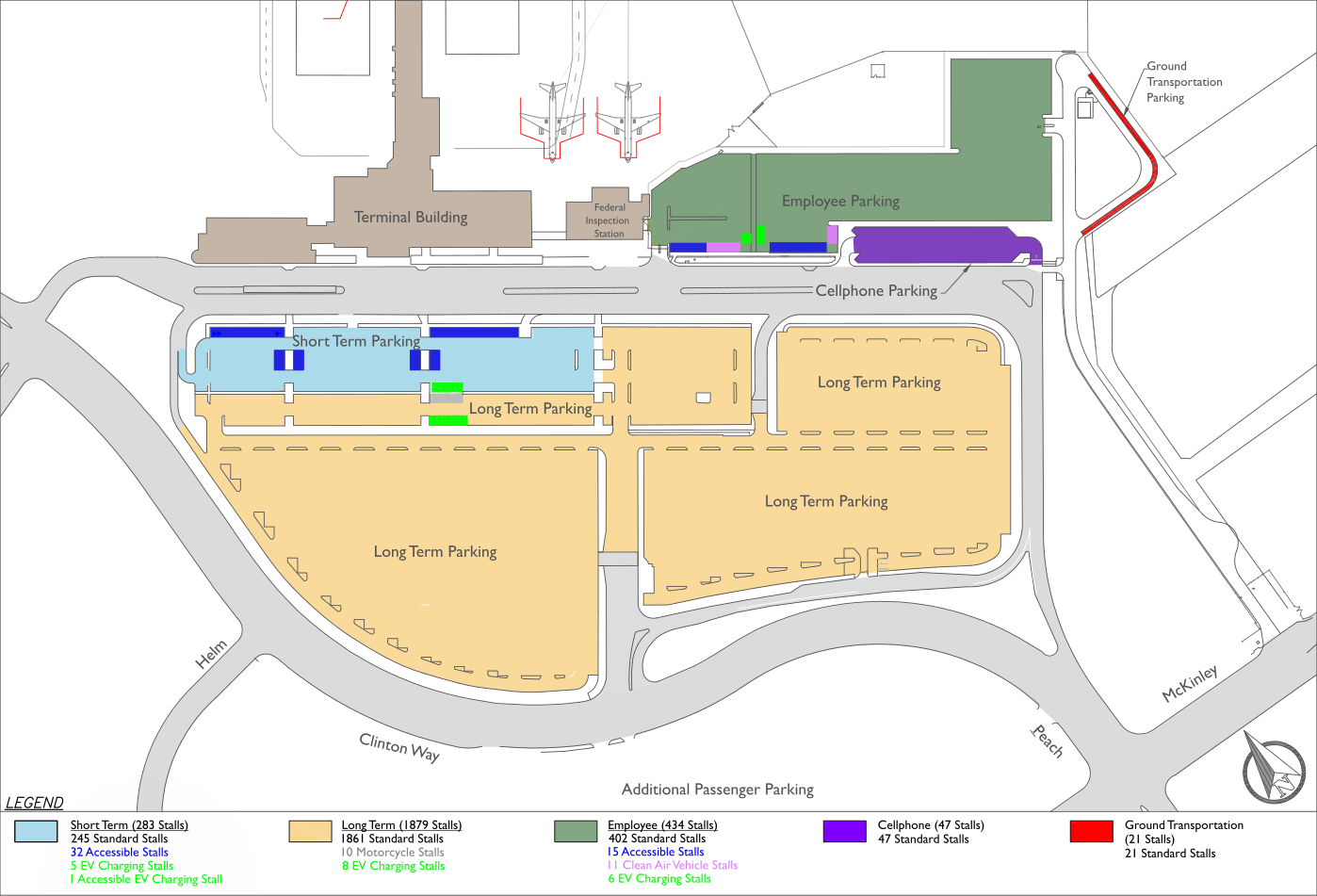
The city of Fresno offers paid on-site parking in a 900-space parking garage south of the airport terminal, a large lot south of the terminal, and several smaller lots east of the terminal. A separate cell phone waiting lot located on the southeast corner of the airport property has stalls designated for drivers waiting for arriving passengers.[70][71]
Fresno Area Express (FAX) operates two public transit bus routes to the airport, each with half-hourly service. Route 26 Palm / Butler runs between the airport and North Fresno via Southeast and Downtown Fresno (where passengers may transfer to other FAX routes). Route 39 FYI/Clinton runs between the airport and West Fresno.[72]
The City of Visalia operates the V-LINE bus between the airport and the Visalia Transit Center (where passengers can connect to Visalia Transit routes) and the Visalia Airport (which offers V-LINE passengers free long-term parking for up to ten days).[73][74]
The airport offers a consolidated rental car facility at the terminal's west end. Nine rental car companies have passenger service counters inside the terminal near the baggage claim area, and up to 400 cars can be parked in a lot just west of the terminal building.[31] The 11-acre rental car facility opened in 2009 and was built at a cost of $22 million.[31]
The airport has covered bicycle parking racks inside the parking garage south of the terminal.[75] Nearby roads East Clinton Way and East McKinley Avenue have Class II bike lanes (on-roadway, separated) and they connect to the Class I bike path (off-roadway) that runs alongside North Clovis Avenue.[76] As of 2025[update], the City of Fresno is constructing a Class I bike path along McKinley that will provide a better connection to the Clovis Avenue path and also travel as far east as Blackstone Avenue.[77]
Accidents and incidents
[edit]- On December 14, 1994, a private jet on a military training mission, attempting to land at Fresno, crashed onto a street and skidded into an apartment complex, killing both pilots and injuring 21 people on the ground.[78] The Learjet 35, piloted by two civilians and belonging to a Georgia-based company, Phoenix Air Group, was contracted by the US Air Force to provide training for California Air National Guard pilots. The plane had been involved in a war game with an F-16 fighter jet and was on its way back to the airport when the flight crew declared an emergency due to engine fire indications. They directed the plane toward their requested runway but the aircraft continued past the airport. On radio transmissions, the flight crew was heard attempting to diagnose the emergency conditions and control the aircraft, until the plane crashed with its landing gear down about 2 miles (3.2 km) southwest of the airport. It then plowed into an apartment complex and exploded in a fireball. Twelve apartment units in two buildings were destroyed or substantially damaged by the impact or the subsequent fire. The National Transportation Safety Board determined that the probable causes of the accident were improperly installed electrical wiring that led to an in-flight fire which damaged the aircraft's systems causing a loss of control and improper maintenance and inspection of the aircraft.[79]
- On September 13, 2015, a McDonnell Douglas MD-87 jetliner converted for aerial firefighting use as an air tanker operated by Erickson had an engine failure after taking off from the airport. Pieces of the engine struck a car, damaging it. The aircraft was able to return to the airport safely.[80]
- On December 18, 2019, a 17 year old girl was arrested after attempting to steal a Beechcraft King Air 200 . She was able to start one engine before eventually crashing into a Landmark Aviation building.[81][82]
References
[edit]- ^ a b c FAA Airport Form 5010 for FAT PDF. Federal Aviation Administration. Effective August 11, 2022.
- ^ a b c d "RITA | BTS | Transtats: Fresno, CA: Fresno Yosemite International (FAT)". Bureau of Transportation Statistics. Retrieved April 1, 2025.
- ^ Calderon, Vikkie (January 21, 2025). "Airport Reaches New Heights in 2024 With Over 2.6 Million Passengers Served". Fresno Yosemite International Airport (Press release). Retrieved January 21, 2025.
- ^ a b "Fresno Airports Master Plan – Working Paper #1: Introduction" (PDF). Kimley-Horn. February 2017. Archived (PDF) from the original on December 6, 2018. Retrieved November 2, 2017.
- ^ "Jet-Plane Training Centered at Fresno". The San Bernardino Daily Sun. Vol. 51. Associated Press. September 30, 1944. p. 2.
- ^ a b c "Fresno Chandler Executive Airport Website". www.flyfresno.com. Archived from the original on December 1, 2017. Retrieved November 2, 2017.
- ^ a b c d e f g h i Fresno Airports Master Plan – Working Paper #2: Inventory (PDF). Kimley-Horn. May 2017. Archived (PDF) from the original on December 11, 2017. Retrieved November 2, 2017.
- ^ "New Locations For Bases Asked". The San Bernardino Daily Sun. Vol. LVIII, Number 24. United Press. September 27, 1951. p. 5.
- ^ "Inside the 144th FW". 144th Fighter Wing, California Air National Guard. 2010. Archived from the original on December 31, 2010. Retrieved December 23, 2010.
- ^ "History of the 144th". Air National Guard – 144th Fighter Wing. February 4, 2013. Archived from the original on March 23, 2018. Retrieved November 2, 2017.
- ^ Publicly owned art in Fresno, California. Fresno, Calif.: Fresno County and City Chamber of Commerce. 1973.
- ^ "Mosaics". Estate of Ray and Miriam Rice. Archived from the original on July 20, 2021. Retrieved July 20, 2021.
- ^ Canty, Donald (July 1962). "New airport design, in the U.S. and abroad" (PDF). Architectural Forum. No. 117. p. 80. Archived (PDF) from the original on July 20, 2021. Retrieved July 20, 2021.
- ^ "Pacific Air Lines Timetable". Pacific Air Lines. April 30, 1967. Archived from the original on March 14, 2018. Retrieved March 13, 2018.
- ^ "Fresno Air Terminal Schedule". www.departedflights.com. April 15, 1975. Archived from the original on January 3, 2019. Retrieved November 1, 2018.
- ^ "Fresno Air Terminal Schedule". www.departedflights.com. July 1, 1983. Archived from the original on January 3, 2019. Retrieved November 1, 2018.
- ^ "Fresno Schedule". www.departedflights.com. April 2, 1995. Archived from the original on January 3, 2019. Retrieved November 1, 2018.
- ^ "Fresno Yosemite International Airport Schedule". www.departedflights.com. June 1, 1999. Archived from the original on January 3, 2019. Retrieved November 1, 2018.
- ^ a b c "Mexicana Airlines Introduces First International Service between Mexico and Fresno". Hispanic PR Wire (Press release). March 27, 2006. Retrieved December 16, 2017.[permanent dead link]
- ^ Fresno Yosemite International (2010). "Frequently Asked Questions". City of Fresno. Archived from the original on March 20, 2011. Retrieved December 23, 2010.
- ^ "FATforward". Fresno Yosemite International Airport. Archived from the original on August 23, 2022. Retrieved July 30, 2022.
- ^ "Far West Airlines September 17, 1984, Route Map". www.departedflights.com. Archived from the original on July 2, 2020. Retrieved July 2, 2020.
- ^ "Air 21 March 4, 1996, Route Map". www.departedflights.com. Departedflights.com. Archived from the original on June 28, 2019. Retrieved July 2, 2020.
- ^ Tehee, Joshua (November 20, 2024). "Flights from Fresno to Portland for under $50? Airline offering new nonstop route". The Fresno Bee. Retrieved December 31, 2024.
- ^ "About Us". Allegiant Air. Retrieved December 31, 2024.
- ^ "Decade in Review: Top 10 in Fresno Architecture". archop. December 31, 2009. Archived from the original on February 26, 2013. Retrieved May 1, 2013.
- ^ "Sequoia Trees Create Unique Sense of Place at Fresno Yosemite International Airport" (PDF). CSHQA. July 27, 2009. Archived (PDF) from the original on March 13, 2018. Retrieved December 16, 2017.
- ^ "Fresno Yosemite International Airport Terminal Renovation". CSHQA. Archived from the original on January 30, 2018. Retrieved December 16, 2017.
- ^ "Fresno Yosemite Int'l Airport". Roebbelen Contracting, Inc. Archived from the original on June 25, 2018. Retrieved September 4, 2014.
- ^ "Fresno Yosemite International Airport Profile" (PDF). Fresno Yosemite International Airport. Archived (PDF) from the original on September 27, 2019. Retrieved September 27, 2019.
- ^ a b c "Rental Car Facility (ConRAC) at Fresno-Yosemite International Airport (FAT)". PGAL. March 8, 2016. Archived from the original on September 26, 2017. Retrieved September 25, 2017.
- ^ "Volaris to Start Flying from FYI to Mexico". FOX26 News. March 1, 2011. Archived from the original on March 7, 2012. Retrieved March 4, 2011.
- ^ Sheehan, Tim (March 10, 2011). "Aeroméxico to start Fresno flights April 4". The Fresno Bee. Archived from the original on March 11, 2011. Retrieved March 10, 2011.
- ^ "Airports $35 Million Improvements Award Provide Economic Boost to Valley" (Press release). Fresno Yosemite International Airport. September 29, 2011. Archived from the original on March 15, 2013. Retrieved June 29, 2012.
- ^ Vasconcelos, Vanessa (December 16, 2020). "Southwest Airlines to offer flights at Fresno Yosemite International Airport in spring 2021". ABC30 Action News. Archived from the original on December 16, 2020. Retrieved December 16, 2020.
- ^ a b Oliveira, Jason (April 14, 2021). "Progress continues on parking structure at Fresno Yosemite International Airport". ABC30 Action News. Archived from the original on July 16, 2021. Retrieved July 16, 2021.
- ^ Jacob, Brittany (June 29, 2021). "Traveling this summer? What you need to know before going to Fresno Yosemite International Airport". ABC30 Action News. Archived from the original on July 16, 2021. Retrieved July 16, 2021.
- ^ a b c d Thompson, Henry (August 11, 2022). "FATforward Update". City of Fresno. Archived from the original on December 23, 2022. Retrieved August 11, 2022.
- ^ Sheehan, Tim (February 1, 2019). "More parking coming in Fresno airport expansion. Will new airlines be coming, too?". The Fresno Bee. Archived from the original on April 11, 2019. Retrieved December 17, 2020.
- ^ Garcia, Nic (November 11, 2021). "More expansion projects in the works at Fresno Yosemite International Airport". ABC30 Action News. Archived from the original on March 6, 2023. Retrieved November 13, 2021.
- ^ "Fact Sheet" (PDF). SkyWest Airlines. April 2018. Archived (PDF) from the original on April 17, 2018. Retrieved April 16, 2018.
- ^ a b "Route maps". Alaska Airlines. Archived from the original on May 5, 2019. Retrieved January 28, 2021.
- ^ a b "Allegiant Interactive Route Map". Allegiant Air. Archived from the original on July 17, 2017. Retrieved January 28, 2021.
- ^ a b "American Airlines Map". Archived from the original on April 8, 2018. Retrieved January 28, 2021.
- ^ a b "Delta Air Lines Map". Archived from the original on April 10, 2021. Retrieved April 7, 2025.
- ^ a b "Check Flight Schedules". Archived from the original on February 2, 2017. Retrieved April 24, 2021.
- ^ a b c "U.S. and International Route Maps". United Airlines. Archived from the original on August 8, 2018. Retrieved January 28, 2021.
- ^ a b "Book Flight". Aeroméxico. Archived from the original on February 7, 2021. Retrieved January 28, 2021.
- ^ a b c "Volaris Coronavirus (COVID-19) update". Volaris. Archived from the original on January 21, 2021. Retrieved January 28, 2021.
- ^ Sheehan, Tim (October 25, 2017). "Volaris adds second Mexico flight destination from Fresno airport". The Fresno Bee. Archived from the original on March 5, 2018. Retrieved March 13, 2018.
In 2016, Volaris and Aeroméxico accounted for about 6% of all arriving and departing flights at Fresno Yosemite International airport, but their combined passenger totals of almost 201,000 represented more than 13% of all passengers flying to and from Fresno last year.
- ^ "FAT airport data at skyvector.com". skyvector.com. Archived from the original on September 7, 2022. Retrieved September 7, 2022.
- ^ "Fresno airport reaches record for most customers served in 2022". ABC30 Fresno. January 30, 2023. Archived from the original on January 31, 2023. Retrieved January 31, 2023.
- ^ Sheehan, Tim (January 20, 2020). "Fresno-Yosemite International Airport sets passenger record. Here's where they were going". The Fresno Bee. Archived from the original on February 5, 2020. Retrieved February 4, 2020.
- ^ a b c d e "Flights from Fresno (FAT)". FlightConnections. August 13, 2025. Retrieved August 13, 2025.
- ^ "Allegiant Ties Record for Largest Expansion in Company History with 44 New Nonstop Routes, plus 3 New Cities". Allegiant Air (Press release). November 19, 2024. Retrieved November 19, 2024 – via PR Newswire.
- ^ "American Airlines offering direct flights from Fresno to Chicago starting June 3". ABC30 Action News. February 27, 2021. Archived from the original on February 27, 2021. Retrieved February 27, 2021.
- ^ "Southwest Airlines adding nonstop flights between Fresno and San Diego". ABC30 Action News. February 6, 2025. Retrieved February 6, 2025.
- ^ "Flights from Fresno to Dallas". FlightConnections. August 13, 2025. Retrieved August 13, 2025.
- ^ "Flights from Fresno to Chicago". FlightConnections. August 13, 2025. Retrieved August 13, 2025.
- ^ "Fleet & Bases". Ameriflight. Archived from the original on April 13, 2018. Retrieved April 12, 2018.
- ^ a b "Flight Finder". FlightAware. Archived from the original on April 13, 2018. Retrieved April 12, 2018.
- ^ "The Independent Pilots Association". inside.ipapilot.org. Archived from the original on April 11, 2019. Retrieved July 13, 2021.
- ^ "Fresno Air National Guard Base". Global Security. 2005. Archived from the original on January 28, 2011. Retrieved March 5, 2011.
- ^ Van Dyke, Col. Mark (August 24, 2015). "1106th TASMG Overview Presentation" (PDF). National Commission on the Future of the Army. Archived from the original (PDF) on March 14, 2018. Retrieved March 13, 2018.
- ^ "Fresno Air Attack Base factsheet" (PDF). California Department of Forestry. January 2005. Archived from the original (PDF) on May 8, 2018. Retrieved March 13, 2018.
- ^ Hostetter, George (December 23, 2014). "Fresno's Peach Avenue gets long-sought widening". The Fresno Bee. Archived from the original on April 17, 2018. Retrieved April 16, 2018.
- ^ "State Route 180". California Highways. Archived from the original on April 17, 2018. Retrieved April 16, 2018.
- ^ "Driving Directions – Yosemite National Park". National Park Service. Archived from the original on April 12, 2019. Retrieved April 28, 2018.
- ^ "Driving Directions – Sequoia & Kings Canyon National Parks". National Park Service. Archived from the original on April 12, 2019. Retrieved April 28, 2018.
- ^ "Parking Information". Fresno Yosemite International Airport. Archived from the original on January 28, 2022. Retrieved March 11, 2022.
- ^ "Parking map". Fresno Yosemite International Airport. Archived from the original on November 17, 2017. Retrieved September 25, 2017.
- ^ "Department of Transportation | FAX Routes & Schedules". www.fresno.gov. Archived from the original on September 25, 2017. Retrieved September 25, 2017.
- ^ Gaytan, Marina (November 17, 2015). "Visalia Transit rolls out V-Line service". Visalia Times-Delta. Archived from the original on May 15, 2019. Retrieved September 25, 2017.
- ^ "V-LINE Stops". Visalia Transit. Archived from the original on August 5, 2020. Retrieved September 25, 2017.
- ^ Covered bike racks inside the parking garage at Fresno Yosemite International Airport (Image). August 7, 2022. Archived from the original on August 23, 2022. Retrieved August 8, 2022.
- ^ "City of Fresno Active Transportation Plan" (PDF). City of Fresno. December 2016. Archived (PDF) from the original on October 26, 2022. Retrieved August 8, 2022.
- ^ Morris, Ben (November 22, 2024). "7-mile bike, walking trail progresses toward completion in Fresno". YourCentralValley.com. Retrieved March 15, 2025.
- ^ Arax, Mark (December 15, 1994). "At Least 3 Killed as Plane Crashes on Fresno Street : Accident: Learjet has engine trouble while returning to airport. It slams into apartment complex, creating grim scene of destruction". Los Angeles Times. ISSN 0458-3035. Archived from the original on April 10, 2016. Retrieved December 27, 2017.
- ^ Hall, James E.; Francis II, Robert T.; Hammerschmidt, John (August 1, 1995). Aircraft Accident Report: Crash During Emergency Landing, Phoenix Air, Learjet 35A, N521PA. Fresno, California, December 14, 1994 (PDF) (Report). National Transportation Safety Board. PB95-910404. Archived (PDF) from the original on May 5, 2017. Retrieved December 27, 2017.
- ^ Gonzalez, Liz (September 14, 2015). "Engine Parts Fall Off Plane, Into Fresno Neighborhood". FOX26 News. Archived from the original on October 6, 2021. Retrieved December 17, 2020.
- ^ Albert, Victoria (December 18, 2019). "Fresno plane crash: 17-year-old steals plane in California before crashing it into building, officials say - CBS News". www.cbsnews.com. Retrieved June 16, 2025.
- ^ "Teen tried to steal plane from Fresno airport. So, just how easy is it to start an airplane?". Fresno Bee. December 21, 2019. Retrieved June 16, 2025.
External links
[edit]
- Official website

- FAA Airport Diagram (PDF), effective October 30, 2025
- FAA Terminal Procedures for FAT, effective October 30, 2025
- Resources for this airport:
- AirNav airport information for KFAT
- ASN accident history for FAT
- FlightAware airport information and live flight tracker
- NOAA/NWS weather observations: current, past three days
- SkyVector aeronautical chart for KFAT
- FAA current FAT delay information

 City of Fresno City of Fresno | |||||||
|---|---|---|---|---|---|---|---|
| Transportation | |||||||
| Landmarks | |||||||
| Research & education |
| ||||||
| Government and military | |||||||
| Sports | |||||||
| Other | |||||||

Operational military installations in California | |||||||||||||||
|---|---|---|---|---|---|---|---|---|---|---|---|---|---|---|---|
| Army |
|  | |||||||||||||
| Marines |
| ||||||||||||||
| Navy |
| ||||||||||||||
| Air Force |
| ||||||||||||||
| Space Force |
| ||||||||||||||
| National Guard |
| ||||||||||||||
| Coast Guard |
| ||||||||||||||
| Attractions |
| |||||||
|---|---|---|---|---|---|---|---|---|
| People | ||||||||
| Lodging and camping | ||||||||
| Natural disasters | ||||||||
| Transportation | ||||||||
| Nearby municipalities | ||||||||
| Additional information | ||||||||




| International | |
|---|---|
| National | |
| Geographic | |
Fresno Yosemite International Airport
View on GrokipediaHistory
Origins and military use
The origins of what would become Fresno Yosemite International Airport trace back to 1928, when the site was designated Chandler Field as an emergency landing field for Transcontinental Air Transport, an early airline operation that required reliable stopover points along transcontinental routes.[10] Informal aviation activity had already begun there after World War I, with pilots using the open fields on Senator Wilber F. Chandler's farm for landings following crop harvests.[11] In November 1929, the field was formally dedicated as Fresno Municipal Airport on a 100-acre donation from Senator Chandler and his wife, Edna Marie Chandler, drawing 10,000 attendees to the event; initial improvements included a 2,500-foot oiled runway, a control station, a superintendent's house, a comfort station, and a hangar funded by $50,000 in local contributions.[12][13] By the mid-1930s, Chandler Field evolved into a more structured municipal airport through federal relief efforts amid the Great Depression. The Works Progress Administration (WPA) initiated development around 1935, with major construction occurring from 1936 to 1937 under Project #2236, which upgraded airfield infrastructure and built four key structures in Streamline Moderne, Art Deco, and Spanish Revival styles: an Administration Building, an Annex, an Electrical Control Building, and a Bathroom Building.[13] These enhancements, designed by Fresno Public Works Commissioner Jean Vincenz, supported growing civilian aviation needs, including scheduled flights by Transcontinental and Western Air; the main runway was reoriented and extended to 4,000 feet by 1938 to accommodate larger aircraft.[11] With the onset of World War II, the airport underwent a rapid transformation into a military installation. In early 1941, the Fresno City Council leased the site to the U.S. Army Air Corps, and it opened as Fresno Army Air Base on April 3, 1941, before being renamed Hammer Field in January 1942 in honor of World War I pilot Lieutenant Earl M. Hammer; the base was formally dedicated in May 1942 under the Fourth Air Force.[14] Primarily serving as a training facility, it hosted pilot instruction for light bombardment squadrons, night fighter operations starting in March 1944, and transition training for aircraft like the B-18A Douglas bomber and B-25 Mitchell; over 60,000 troops were trained there, supported by expansions that included multiple hangars, barracks, an ordnance storage area, and a large station hospital with 85 buildings and capacity for 932 beds (expandable to 1,112).[14][15] Following the war's end, Hammer Field was deactivated by the Army Air Forces, with the War Department announcing surplus status on October 24, 1945, and operations fully ceasing by December 1946.[16] The City of Fresno assumed control on December 5, 1946, repurposing the extensive military infrastructure for civilian aviation while retaining much of the wartime layout.[16]Transition to civilian operations
Following World War II, the War Assets Administration transferred control of Hammer Field to the City of Fresno in 1946, enabling the initial shift toward civilian aviation operations.[17] The city assumed operational responsibility under an interim license on May 5, 1946, repurposing the military-era facilities for general aviation and preparing for commercial use.[18] The airport formally reopened for civilian flights in 1948 as the Fresno Air Terminal, marking the start of scheduled commercial service. Trans World Airlines (TWA) and United Airlines inaugurated operations that year, providing flights to San Francisco, Oakland, and Los Angeles using Douglas DC-3 aircraft.[19] This transition addressed the limitations of the smaller Chandler Field, which had previously handled civil aviation but could not accommodate expanding postwar air traffic.[3] Throughout the 1950s, the airport underwent key infrastructure adaptations to support growing demand, including runway extensions and the construction of a parallel secondary runway (11R/29L) in 1956 to prepare for larger propeller aircraft and eventual jet operations. Funding for these enhancements relied on a combination of federal grants through the Federal Aviation Administration and local bonds issued by the city, addressing challenges in securing resources for a regional facility.[20] Passenger volumes increased steadily, driven by the needs of Fresno's agricultural economy for efficient transport of goods and personnel, as well as rising tourism to nearby Yosemite National Park.[21] A milestone in the era came with the construction and dedication of the airport's first passenger terminal in 1962.[22] The facility welcomed its first scheduled jet service from Pacific Air Lines in 1964, further solidifying its role as a vital hub for Central California.Expansions and renaming
In the 1970s, Fresno Yosemite International Airport expanded its passenger terminal to address rising demand from agricultural exports and growing tourism in California's Central Valley. This included the addition of a new concourse in 1978, which extended directly from the central lobby to improve passenger flow and accommodate more flights.[16] During the 1980s and 1990s, the airport invested in infrastructure upgrades to support larger aircraft and increased jet service. These developments were part of broader efforts to position the airport as a regional hub for both cargo related to agriculture and leisure travel.[23][21] A multi-phase terminal expansion program began in 1990 to boost overall capacity amid surging passenger volumes. Phase one, completed in 1994, added a new concourse with additional gates. Phase two, finalized in 2002, introduced a two-story structure with four enclosed passenger jet bridges, marking the largest expansion in the airport's history at that time and incorporating natural light through extensive glass elements. Phase three, wrapping up around 2007, focused on ancillary improvements including a new parking garage. Environmental impact assessments were conducted for these projects to evaluate effects on local air quality, noise, and wildlife habitats near the airport.[23][22] The 2000s saw further remodeling to modernize facilities and address post-9/11 security requirements. In 2008, a comprehensive terminal renovation doubled the baggage claim area, remodeled the lobby, and upgraded security screening checkpoints to comply with enhanced federal standards, improving efficiency for international and domestic travelers. Gate expansions during this period added flexibility for airline operations.[3] In 1996, the airport was renamed Fresno Yosemite International Airport from its previous designation as Fresno Air Terminal, a change aimed at highlighting its proximity to Yosemite National Park and boosting tourism. This rebranding was supported by marketing campaigns emphasizing the facility's role as a gateway to the park and other Central Valley attractions, drawing more out-of-state and international visitors.[24]Facilities
Passenger terminal
The passenger terminal at Fresno Yosemite International Airport consists of a single main building that handles all arriving and departing flights, designed to facilitate efficient movement for both domestic and international travelers. Originally opened in 1962 as the Fresno Air Terminal, the structure has been progressively updated to meet modern standards and growing demand.[25] A major renovation completed in 2008 doubled the size of the baggage claim area, remodeled the lobby, and upgraded security screening capabilities to improve passenger flow.[26] In November 2025, the FATforward terminal expansion project was completed, adding a new 96,500-square-foot terminal wing, two additional passenger boarding gates (increasing the total to 14 main gates), an expanded 13,000-square-foot security checkpoint with more lanes including dedicated TSA PreCheck, and enhanced concessions and amenities.[5][19][27] Prior to the expansion, the terminal supported a capacity of up to approximately 3.3 million passengers annually; the upgrades enhance overall capacity to accommodate projected growth beyond 3 million passengers.[28][8] The terminal's layout begins with a spacious ticketing hall on the upper level, where major airlines maintain counters for check-in and bag drop. Adjacent to this is the security checkpoint area, which includes dedicated TSA PreCheck lanes for eligible passengers to expedite screening by allowing them to keep shoes, belts, and light jackets on while passing through advanced imaging technology.[29] Beyond security, passengers enter the secure airside area leading to the concourses, which feature seating, charging stations, and restrooms distributed for convenience. The lower level houses the baggage claim area with multiple carousels equipped for efficient retrieval, including special handling for international luggage. Concessions within the terminal emphasize local Fresno flavors and provide a range of dining and shopping options to enhance the passenger experience. Restaurants such as Tap & Pour Gastropub offer regionally inspired meals like the Fresno Burger and Yosemite Breakfast Plate, alongside quick-service outlets including Peet's Coffee for beverages and grab-and-go items.[30] Retail shops stock souvenirs highlighting Central Valley agriculture and culture, with selections of local products to reflect Fresno's agricultural heritage.[31] Recent enhancements focus on comfort, connectivity, and inclusivity for all travelers. Free Wi-Fi is available throughout the terminal, enabling passengers to stay connected during waits.[32] Artistic elements, including the Sequoiascape Lobby installation featuring a life-size sequoia forest display, celebrate the airport's proximity to Yosemite, Sequoia, and Kings Canyon National Parks, creating an inviting atmosphere tied to the region's natural landmarks.[33] Accessibility is prioritized through features like the MagnusCards mobile app, which provides visual guides and social stories for neurodivergent, elderly, and non-English-speaking passengers to navigate the terminal more easily, in addition to standard ADA-compliant elements such as elevators, ramps, and service animal relief areas.[34] For international operations, a dedicated Federal Inspection Station (FIS) processes arrivals from nonstop flights to Guadalajara, Mexico. The 2025 expansion included a new/replacement FIS with capacity for up to 400 international arrivals per hour, improving handling of increased cross-border traffic.[35][3][36]Runways and aprons
Fresno Yosemite International Airport features two parallel runways oriented 11/29, designed to handle a range of aircraft from general aviation to commercial jets. The primary runway, 11L/29R, measures 9,539 feet in length by 150 feet in width and is surfaced with grooved asphalt in fair condition, enabling safe operations for Boeing 737 and larger aircraft with a single-wheel weight-bearing capacity of 70,000 pounds.[2] It is equipped with high-intensity runway edge lights (HIRL) and an approach lighting system with sequenced flashers on the 29R end, supporting Category II/III instrument approaches.[2] The secondary runway, 11R/29L, spans 8,008 feet by 150 feet, also with grooved asphalt surfacing in good condition and medium-intensity runway edge lights (MIRL), primarily accommodating general aviation and smaller commercial flights while sharing similar weight-bearing capabilities.[2][37] Navigational aids enhance operational safety on both runways, including an Instrument Landing System (ILS) with Distance Measuring Equipment (DME) for Runway 11L and 29R, alongside LOC/DME for 11R and VOR/DME approaches airport-wide.[38] The taxiway network, featuring reconstructed Taxiway C and high-speed exits like B3, connects the runways to aprons with centerline lighting on primary routes to support low-visibility operations under the Surface Movement Guidance and Control System (SMGCS).[39][40] Apron areas total over 13 acres of active pavement across the terminal and east commercial zones following the 2025 expansion, providing approximately 18 aircraft parking positions including 14 main boarding gates with passenger boarding bridges, two ancillary gates, and two dedicated international stands.[41][42] Recent reconfigurations have added 3.02 acres of Portland cement concrete apron and enhanced shoulders for improved aircraft maneuvering and flexibility.[41] De-icing services are available through dedicated ground handling operations to ensure safe winter departures.[43] To promote safety, the airport maintains FAA-compliant runway safety areas (RSAs) extending beyond each runway end and side, designed to reduce excursion risks, while ongoing wildlife hazard management programs actively deter bird strikes through habitat control and deterrence measures.[44][45] These runways have benefited from historical extensions, such as lengthening efforts documented in prior master plans, to meet growing demand.[28]Air traffic control and other infrastructure
The air traffic control services at Fresno Yosemite International Airport are provided by the Federal Aviation Administration (FAA) through the Airport Traffic Control Tower (ATCT), a 24/7 facility staffed by approximately 35 personnel across five control positions and six Terminal Radar Approach Control (TRACON) positions.[46] The tower, measuring 80 feet from ground level to the cab floor, oversees aircraft movements on the runways, taxiways, and aprons, including alignments such as 11L/29R and 11R/29L, while coordinating with regional approach control for safe arrivals and departures.[46] It supports a range of operations encompassing commercial passenger flights, air cargo, military activities, and general aviation, handling approximately 90,000 annual aircraft operations as of 2024.[28][47] The ATCT incorporates radar and communication systems essential for monitoring and directing traffic, including ground surveillance capabilities to detect potential conflicts on runways and taxiways.[46] These systems enable real-time tracking and voice communications via frequencies such as tower at 118.2 MHz and ground control at 121.7 MHz, ensuring compliance with FAA standards for airspace management.[2] Fuel infrastructure at the airport includes storage and distribution systems for Jet A and aviation gasoline (Avgas), managed primarily through fixed-base operators (FBOs) that provide fueling services with volume discounts and 24-hour availability where applicable.[2] Two primary FBOs—Signature Aviation and Atlantic Aviation—offer comprehensive general aviation support, including aircraft maintenance in dedicated hangars, storage, and ramp services for transient and based aircraft.[48][49] Cargo operations are facilitated by dedicated facilities supporting daily freight handling from carriers like FedEx and UPS, including warehouse space, wide-body aircraft parking, and U.S. Customs clearance for international shipments.[50] Maintenance hangars accommodate airline and general aviation needs, with on-site repair services for airframes, engines, and avionics provided by FBOs and airline partners.[51] Sustainability initiatives include a 4.2-megawatt solar farm installed in 2009, which generates renewable energy to offset a portion of the airport's operational demands such as lighting and HVAC systems.[46] Additionally, 14 electric vehicle (EV) charging stations are available free of charge in the short-term and long-term parking lots, promoting low-emission ground transportation for passengers and employees.[52]Airlines and destinations
Passenger services
Fresno Yosemite International Airport (FAT) serves a variety of passenger airlines, primarily focusing on domestic routes to major U.S. hubs and limited international service to Mexico. The airport is served by eight major carriers, including full-service and low-cost operators that provide nonstop flights to approximately 15 destinations.[53][6][54] Major carriers include Alaska Airlines, which operates as a regional hub connector with flights to West Coast cities like Seattle, Portland, and San Diego, emphasizing convenient access for Pacific Northwest travel. American Airlines provides service via its hubs in Dallas/Fort Worth and Phoenix, offering connections to the eastern U.S. and beyond. Delta Air Lines connects through Salt Lake City. Southwest Airlines, the largest operator at FAT by flight volume, serves multiple routes including Las Vegas, Denver, and San Diego (with daily service added in October 2025), known for its point-to-point model and high-frequency domestic flights; it also operated seasonal service to Dallas Love Field during summer 2025. United Airlines links to its hubs in Denver, San Francisco, and Los Angeles, with seasonal nonstop service to Chicago O'Hare. Allegiant Air focuses on leisure travel with low-cost, nonstop flights to destinations like Las Vegas; it operated seasonal summer service to Portland in 2025. Volaris, a Mexican low-cost carrier, operates international routes to Guadalajara, León, and Morelia, with service to Guadalajara beginning in 2022 and expansions to the other cities adding Central Mexico connectivity. Aeroméxico complements Volaris on the Guadalajara route, providing additional options for cross-border travel. Alaska Airlines operated seasonal daily flights to Guadalajara during winter 2024-2025.[53][6][19] Nonstop domestic destinations encompass key cities such as Las Vegas (served by Allegiant and Southwest), Denver (Southwest and United), Seattle (Alaska), Los Angeles and San Francisco (United), Phoenix (American), Salt Lake City (Delta), San Diego (Alaska and Southwest), Portland (Alaska), and Dallas/Fort Worth (American). International nonstop flights are limited to Guadalajara, León, and Morelia in Mexico, operated primarily by Volaris with Aeroméxico on Guadalajara; these routes saw a 27.5% increase in passengers in 2024, totaling over 411,000 travelers. Service frequencies vary, with many routes offering daily flights, while others like Chicago (United) operate seasonally to align with peak tourism periods, including summer travel to support visits to nearby Yosemite National Park via connecting ground transportation.[6][54][8] Low-cost carriers, including Southwest, Allegiant, and Volaris, dominate passenger services at FAT, providing affordable options that drive a significant portion of the airport's traffic through high-frequency, point-to-point routes. Several airlines participate in codeshare agreements, allowing seamless connections; for example, Delta and United leverage partnerships with regional operators like SkyWest for efficient feeder services to their hubs. Recent developments include Southwest's expanded San Diego service, enhancing options for both leisure and business passengers.[55][56]| Airline | Primary Hubs/Connections from FAT | Key Nonstop Destinations |
|---|---|---|
| Alaska Airlines | Seattle, Portland | Seattle, Portland, San Diego[6] |
| American Airlines | Dallas/Fort Worth, Phoenix | Dallas/Fort Worth, Phoenix[6] |
| Delta Air Lines | Salt Lake City | Salt Lake City[6] |
| Southwest Airlines | Point-to-point focus | Las Vegas, Denver, San Diego[6][56] |
| United Airlines | Denver, San Francisco | Denver, Los Angeles, San Francisco, Chicago (seasonal)[6] |
| Allegiant Air | Leisure-focused | Las Vegas[6] |
| Volaris | Mexico City (connections) | Guadalajara, León, Morelia[6][35] |
| Aeroméxico | Mexico City | Guadalajara[6] |
Cargo operations
Fresno Yosemite International Airport (FAT) supports cargo operations primarily through daily services provided by FedEx and UPS, which handle the majority of freight movements at the facility.[50] These carriers operate regular flights, focusing on overnight package delivery and time-sensitive shipments, with recent upgrades to larger Boeing 767 aircraft from previous 757 models to accommodate increased demand.[57] The airport features a dedicated cargo apron spanning 12 acres, designed for efficient handling with in-pavement ground power, energy-efficient flood lighting, and parking for up to nine wide-body aircraft.[50][58] Supporting infrastructure includes a primary runway measuring 150 feet by 9,539 feet, capable of accommodating fully loaded wide-body freighters, and a secondary runway of 150 feet by 8,008 feet, along with 24/7 fueling and U.S. Customs and Border Protection services onsite for international clearance.[50] The City of Fresno's Department of Airports operates a 14,000-square-foot warehouse facility, fully occupied and integrated with the cargo ramp for streamlined logistics.[58] Access is enhanced by two separate highway routes, ensuring redundancy for ground transport.[50] Cargo volume at FAT reached over 20 million pounds in 2024, reflecting steady growth driven by the Central Valley's agricultural sector, which relies on air freight for exporting perishable goods such as fruits and nuts.[57] This equates to approximately 9,000 metric tons annually, with agricultural products forming a significant portion due to the region's status as a major producer of fresh produce requiring rapid transport to domestic and international markets.[57] Ground handling is managed by providers like Worldwide Flight Services, which offers cargo processing, storage, and distribution tailored to time-critical shipments.[59] International cargo operations are facilitated through partnerships with FedEx and UPS networks, enabling shipments to destinations in Mexico and Asia, supported by the airport's customs infrastructure.[50] Recent e-commerce expansion has contributed to volume increases, as online retail demands faster regional fulfillment from the Central Valley's distribution hubs.[57]Traffic and statistics
Passenger volume
Fresno Yosemite International Airport (FAT) has demonstrated steady growth in passenger volume since the 1990s, reflecting its role as the primary commercial gateway for the Central San Joaquin Valley. In 1990, the airport handled 614,614 enplanements, primarily driven by regional travel needs.[60] By the late 2010s, this had more than doubled, reaching a pre-pandemic peak of 966,607 enplanements in 2019, equivalent to approximately 1.96 million total passengers served.[61][62] The onset of the COVID-19 pandemic caused a dramatic downturn, with enplanements plummeting 49.7% to 486,081 in 2020 amid widespread travel restrictions.[63] Post-pandemic recovery has been swift and sustained, fueled by pent-up demand and expanded air service. Enplanements rebounded to 960,594 in 2021 (a 97.6% increase from 2020), 1,077,710 in 2022, 1,201,789 in 2023 (an 11.5% year-over-year rise), and a record 1,318,250 in 2024 (preliminary data, up 9.7%).[64][65][66] These figures correspond to total passenger volumes of over 2.1 million in 2022, 2.4 million in 2023, and 2.6 million in 2024.[67][7][8] The Federal Aviation Administration (FAA) classifies FAT as a primary commercial service airport, defined by annual enplanements exceeding 10,000, which qualifies it for federal funding and underscores its economic significance.[68] Passenger growth has been influenced by the Central Valley's robust agricultural economy, which supports business travel, and tourism to nearby destinations like Yosemite National Park, drawing leisure visitors.[69] Additionally, the expansion of low-cost carriers has made air travel more accessible, contributing to double-digit annual increases in traffic since 2018 (excluding 2020).[70] Airlines such as Allegiant Air, Frontier Airlines, and Southwest Airlines have played key roles in this expansion by adding routes and capacity.[71] The following table summarizes key annual enplanement and total passenger data, highlighting the long-term upward trend and recent recovery:| Year | Enplanements | Total Passengers Served (approx.) | Year-over-Year Change (Enplanements) |
|---|---|---|---|
| 1990 | 614,614 | N/A | N/A |
| 2019 | 966,607 | 1,960,000 | +13.3% (from 2018) |
| 2020 | 486,081 | ~972,000 | -49.7% |
| 2023 | 1,201,789 | 2,400,000 | +11.5% (from 2022) |
| 2024 | 1,318,250 | 2,600,000 | +9.7% |
Top destinations and market share
Fresno Yosemite International Airport's traffic is dominated by domestic routes to West Coast and Rocky Mountain hubs, as well as popular leisure destinations. Las Vegas stands out as the busiest route, handling approximately 20% of the airport's overall traffic with around 300,000 passengers annually. Other major domestic destinations include Los Angeles (15% market share), Denver (10%), Seattle, and Phoenix, reflecting strong demand for business, tourism, and connections to national networks. Internationally, Guadalajara emerges as the primary route, contributing to the growing Mexico market.[8] The following table summarizes the top 10 routes by passenger volume for 2024, based on origin-destination enplanements:| Rank | Destination | Passengers (2024) | Share of Total Enplanements |
|---|---|---|---|
| 1 | Las Vegas, NV | 300,000 | 20% |
| 2 | Los Angeles, CA | 225,000 | 15% |
| 3 | Denver, CO | 150,000 | 10% |
| 4 | Seattle, WA | 120,000 | 8% |
| 5 | Phoenix, AZ | 105,000 | 7% |
| 6 | San Francisco, CA | 90,000 | 6% |
| 7 | Dallas/Fort Worth, TX | 75,000 | 5% |
| 8 | Guadalajara, Mexico | 70,000 | 5% |
| 9 | San Diego, CA | 60,000 | 4% |
| 10 | Salt Lake City, UT | 45,000 | 3% |