Hubbry Logo
GCR Class 8KGCR Class 8KMain
Open search
GCR Class 8K
Community hub
GCR Class 8K
logo
8 pages, 0 posts
0 subscribers
Be the first to start a discussion here.
GCR Class 8K
GCR Class 8K
from Wikipedia

GCR Classes 8K and 8M
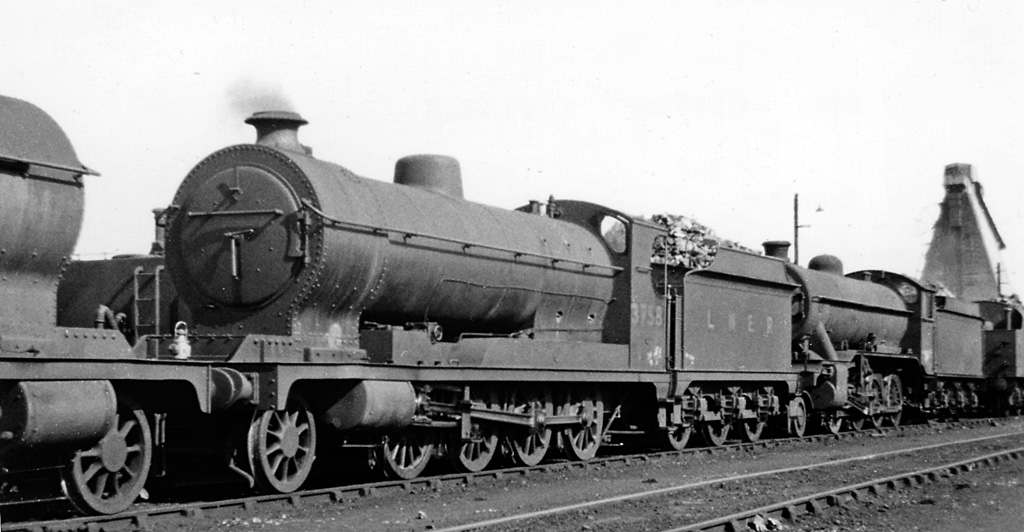
No. 3758 at Whitemoor Depot
Type and origin
Power typeSteam
DesignerJohn G. Robinson
Builder
Build date1911–1914
Total produced
  • 8K: 126
  • 8M: 19
  • ROD 2-8-0: 521
Specifications
Configuration:
 • Whyte2-8-0
 • UIC1′D h2
Gauge4 ft 8+12 in (1,435 mm) standard gauge
Leading dia.3 ft 6 in (1,067 mm)
Driver dia.4 ft 8 in (1,422 mm)
Tender wheels4 ft 4 in (1,321 mm)
Wheelbase51 ft 2.5 in (15.608 m) ​
 • Engine25 ft 5 in (7.75 m)
 • Tender13 ft (4.0 m)
Length61 ft 8.5 in (18.809 m)
Loco weight72.5–74.65 long tons (73.66–75.85 t; 81.20–83.61 short tons)
Fuel typeCoal
Fuel capacity6 long tons 0 cwt (13,400 lb or 6.1 t)
Water cap.4,000 imp gal (18,000 L; 4,800 US gal)
Firebox:
 • TypeBelpaire (some engines were fitted with round top fireboxes when the GCR was grouped into the LNER)
 • Grate area26.24 sq ft (2.438 m2)
Boiler:
 • Tube plates15 ft (4,600 mm)
Boiler pressure180 psi (1.24 MPa)
Heating surface:
 • Firebox153 sq ft (14.2 m2)
 • Tubes1,348 sq ft (125.2 m2)
 • Total surface1,756 sq ft (163.1 m2)
Superheater:
 • TypeRobinson
 • Heating area225 sq ft (20.9 m2)
CylindersTwo, outside
Cylinder size21 in × 26 in (533 mm × 660 mm)
Valve gearStephenson
Valve typePiston valves
Performance figures
Tractive effort31,325 lbf (139.34 kN)
Career
Operators
Class
  • GCR: 8K, 8M
  • LNER: O4, O5
Power classBR: 7F
NumbersLNER (from 1946): 3500–3920
BR: 63570–63920
Axle load classLNER/BR: Route Availability 6
WithdrawnDecember 1958 - April 1966
DispositionOne preserved, remainder scrapped

The Great Central Railway (GCR) Class 8K 2-8-0 is a class of steam locomotive designed for heavy freight. Introduced in 1911, and designed by John G. Robinson, 126 were built for the GCR prior to the First World War. Including wartime construction for the British Army ROD and the post-war GCR Class 8M, the class and its derivatives totalled 666 locomotives.[1]

Great Central Railway

[edit]
GCR Class 8K (later LNER Class O4/1) loco 63664 at Langwith Junction engine shed on 7 August 1960

The first of the 8K class was outshopped from the GCR's Gorton workshops in 1911. It was essentially a superheated version of an earlier 0-8-0,[2] the 8A class, with the addition of a pony truck. This both supported the greater front end weight and gave a steadier ride. The 8K was introduced to anticipate the increased traffic from the GCR's vast new docks complex at Immingham[3] in North East Lincolnshire and 126 were in traffic by June 1914. During the First World War there were experiments with oil burning 8Ks with larger bogie tenders.

Post-war, a further 19 locomotives were built in 1918–21 to a modified design with a larger boiler (GCR class 8M). In 1922 the GCR rebuilt two Class 8M to Class 8K.

Railway Operating Division

[edit]

Robust and straightforward, the Class 8K 2-8-0 steamed well and proved outstandingly reliable, qualities that commended the design to the Ministry of Munitions. Sir Sam Fay ensured that it became the standard locomotive during the First World War as the ROD 2-8-0, used by the Railway Operating Division of the Royal Engineers. 521 ROD locomotives were built in 1917–19 to essentially the same design as the GCR's 8K locomotives, differing only in minor details, such as the fitting of Westinghouse Air Brakes and the use of steel for the boiler tubes and inner firebox. After the war, the surviving ROD locomotives were sold to various railway companies, with the GCR itself purchasing 3 in 1919, which were added to its indigenous 8K fleet.

Other surplus ROD locomotives were sold to the London and North Western Railway (30 locomotives), its successor the London, Midland and Scottish Railway (75 locomotives, see LMS ex-ROD 2-8-0), the Great Western Railway (100 locomotives, see GWR 3000 Class), and to various purchasers in Australia and China. Many of these had short lives with their new owners – the LMS locomotives were all scrapped or sold by the 1930s, and half of the GWR fleet was gone by 1930. However, other GWR engines survived well into the 1950s. The last of 13 locomotives sold to J & A Brown for use on the Richmond Vale railway line, in Australia, was retired in 1973, and 3 locomotives in China were only retired in 1990.

LNER and BR ownership

[edit]

Upon its formation in 1923 the London and North Eastern Railway inherited a total of 131 class 8K and 17 class 8M locomotives from the Great Central Railway. Under the LNER's ownership the 8Ks became known as Class O4, and the 8Ms as Class O5, although all of the O5s were converted to Class O4s by 1946. They were joined by a further 273 former ROD locomotives purchased in 1923–27, bringing the total LNER O4 fleet to 421 locomotives. Some 92 of these were requisitioned by the War Department in 1941 for use in support of Commonwealth forces in the Middle East, none of which would return to Britain.

The O4 locos served widely throughout the LNER system, many being modified to help extend their useful working life on heavy freight trains. Fifty-eight of the class were rebuilt into LNER Thompson Class O1s in 1944–49. 329 LNER O4 locomotives passed to British Railways ownership in 1948. Five locomotives were sold to the Government in 1952 for use in Egypt, and routine withdrawals of BR's class O4s commenced in December 1958. The last examples of the class were withdrawn from operations in the Doncaster area in April 1966, not long before the abandonment of steam altogether.

Preservation

[edit]
J & A Brown 23 shunting on the Richmond Vale Railway in June 1973

One of the GCR-built 8Ks, BR number 63601 (originally GCR No. 102 built at Gorton in 1911[4]), is preserved in Great Britain where it runs on the preserved Great Central Railway at Loughborough.[5] There are also three ROD 2-8-0s (not used by the GCR or LNER) in New South Wales, Australia. Two are stored at the Dorrigo Steam Railway and Museum and one is being restored on the Richmond Vale Railway.[6]

Models

[edit]

In 2009 Bachmann Branchline announced a ready-to-run '00' scale model of the Class 8K, marketing it under the LNER class name of O4. The models were of preserved 63601, and models of two scrapped examples (BR 63635 and LNER 6190) have since been released.[7]

In October 2012, RailSimulator.com released a payware add-on of the GCR 8K, again marketed under its LNER O4 classification, for Train Simulator 2013. It was released as a companion to the Woodhead Line add-on, released earlier in the year, and features sounds from the preserved O4 63601 before its boiler ticket ran out, and includes four scenarios for the Woodhead Line and Quickdrive compatibility.

See also

[edit]

References

[edit]
[edit]
Revisions and contributorsEdit on WikipediaRead on Wikipedia
from Grokipedia
The GCR Class 8K is a class of 2-8-0 tender locomotives designed by John G. Robinson for the (GCR), introduced in 1911 specifically for hauling heavy coal and mineral freight trains to the new docks at . With a total of 129 locomotives built between 1911 and 1919 at GCR's Works, the class featured outside cylinders measuring 21 inches by 26 inches, a operating at 180 psi, and a of 31,326 lbf, making it well-suited for the demanding gradients and loads of the GCR's northern network. Following the 1923 Grouping, the class was absorbed into the London and North Eastern Railway (LNER) as the O4 subclass, where it became one of the most numerous heavy freight types, eventually totaling 405 examples including variants acquired from the Railway Operating Division (ROD) after World War I. The ROD 2-8-0s, a wartime adaptation of the 8K design, saw over 500 built primarily by the North British Locomotive Company, with many loaned or sold to the LNER post-war for continued use in coal traffic and military duties, including deployments to the Middle East in 1941. Under British Railways from 1948, the locomotives were renumbered into the 63xxx series and remained in service until the mid-1960s, with the last withdrawals occurring in 1966 as dieselization advanced. One example of the original GCR 8K survives today, highlighting the class's historical significance as a cornerstone of British freight through two world wars. The most notable preserved locomotive is No. 63601 (originally GCR No. 102, built in January 1912), which operated for over 50 years across depots like , , and before withdrawal in 1963 and entry into the National Railway Collection. Currently based at the heritage line, it is undergoing a major overhaul since 2018, with restoration targeted for completion in 2027 in its original GCR livery as No. 102, retaining its rare Belpaire boiler—one of only three such O4s preserved. Additionally, three ROD variants endure in at sites like the Dorrigo Steam Railway and Richmond Vale Railway Museum, underscoring the class's global wartime legacy.

Design and Development

Background and Origins

In the early , the (GCR) faced growing demands for efficient freight haulage, particularly in transporting heavy coal loads from the coalfields to the newly developed Docks on the , which opened in to facilitate increased coal exports. This expansion required locomotives capable of handling substantial mineral traffic over varied GCR routes, prompting the need for a more powerful and versatile design than existing classes. John G. Robinson, who had served as the GCR's Chief Mechanical Engineer since , addressed these requirements by designing the Class 8K, a optimized for heavy freight and mineral trains. The choice of configuration allowed for greater compared to earlier designs, enabling it to pull longer and heavier trains while maintaining stability through a leading pony truck. Robinson drew influences from his prior GCR Class 8A (later LNER Q4) locomotives, which had proven reliable for freight but lacked the flexibility for routes with tighter curves; he enhanced this foundation by incorporating technology inspired by continental European practices, specifically the Schmidt system developed in . The initial prototype, numbered 966, was constructed at the GCR's Works and completed in September 1911, following an order placed in August 1910. Design goals emphasized achieving a high of approximately 31,325 lbf to boost haulage capacity and ensuring broad across the GCR network, including lines to . Early testing revealed the locomotive's potential but necessitated modifications, such as refinements to the elements, before committing to full-scale production.

Technical Specifications

The GCR Class 8K was a 2-8-0 Consolidation-type , featuring a single leading pony truck with 3 ft 6 in wheels to provide stability on curved routes while supporting the pony truck's weight without a full . Key dimensions included a of 4 ft 8 in, a designed for 180 psi working pressure (with later variants rated at 200 psi), and a weight of 73 tons 4 cwt. The firebox measured 154 sq ft in heating surface area with a grate of 26.24 sq ft, initially fitted as a Belpaire type in early builds for improved steam production. The cylinder configuration consisted of two outside cylinders measuring 21 by 26 , equipped with and 10 in piston valves for efficient steam distribution in the superheated setup. Superheaters varied across builds, with early GCR examples using 18 or 22 elements, contributing to a total evaporative heating surface of approximately 1,809 sq ft. Tractive effort for the class was calculated at 31,326 lbf using the standard formula for British superheated simple-expansion steam locomotives: TE=0.85×d2×n×s×P2×wTE = \frac{0.85 \times d^2 \times n \times s \times P}{2 \times w} where dd is the bore in inches (21), nn is the number of cylinders (2), ss is the stroke in inches (26), PP is the boiler in psi (180), and ww is the diameter in inches (56); the constant 0.85 accounts for as a of boiler . This value was derived at 85% of boiler , establishing the locomotive's capability for heavy freight haulage. Variants included the original GCR 8K designation (LNER O4/1 subclass), which retained the 180 psi boiler and braking, paired with a 4,000 imperial gallon tender carrying 5 tons of coal. The ROD superheated version (O4/3) featured steam-only braking for wartime simplicity. Under LNER ownership, O4/2 rebuilds adapted ROD locomotives with 3,250 gallon tenders (later enlarged to 4,000 gallons) to comply with loading gauge restrictions, while O4/4 rebuilds incorporated larger O2-class boilers at 200 psi and extended frames for enhanced power, alongside piston valve upgrades. Braking systems varied by subclass, with brakes standard on O4/1 for controlled freight operations and brakes on O4/3 for basic functionality. Tenders were typically of the Robinson 4,000 type with 5 tons capacity, though some O4/2 examples used shallower 3,250 designs initially. The class complied with loading gauge restrictions, limiting overall height and width to suit northern English infrastructure without requiring modifications for most routes.

Construction

Great Central Railway Production

The production of the GCR Class 8K locomotives began at the railway's Works in , with the first example, numbered 966, completed in September 1911. Designed by Chief Mechanical Engineer John G. Robinson for heavy freight haulage, particularly coal trains to the new Docks, the class quickly demonstrated its effectiveness in service. Following the success of the initial locomotive, further examples were produced in six batches, completing 126 Class 8K engines by 1914 to meet growing demand on the GCR network: 56 built at Works, 20 by Kitson & Co., and 50 by the . These builds incorporated a superheated similar in size to that used on Robinson's earlier Q4 class 0-6-0, contributing to the locomotive's robust performance and reliability for mineral traffic. The outbreak of the First World War disrupted broader railway manufacturing efforts across Britain due to resource constraints, though the GCR continued limited production at Gorton, adding five more locomotives between 1915 and 1917. By the 1923 Grouping, this brought the total to 131 GCR-owned Class 8K examples inherited by the London and North Eastern Railway.

Railway Operating Division and Wartime Builds

In 1917, the Railway Operating Division (ROD) of the Royal Engineers placed initial orders for 325 2-8-0 locomotives based on the Great Central Railway's successful Class 8K design, selected for its reliability in heavy freight service and suitability for mass production to support British military logistics during World War I. These orders were expanded with additional batches totaling 521 units completed between 1917 and 1919, forming the ROD's standard heavy freight locomotive and significantly expanding the overall class size beyond the original GCR builds to over 650 locomotives. The wartime production was distributed among several major British builders to accelerate output, with the constructing 369 examples, producing 82, Nasmyth, Wilson and Company building 32, and delivering 32; a small number of 6 were also assembled at the GCR's Works. To prioritize speed and simplicity amid wartime constraints, the ROD variants incorporated minor adaptations to the GCR 8K design, including steel fireboxes for easier fabrication, while early batches employed saturated boilers before transitioning to superheated types in later production. These changes facilitated rapid assembly and deployment, with many shipped directly for use on supply lines behind the Western Front. Production peaked during as demands intensified, reaching rates of up to 20 locomotives per month to sustain the , contrasting sharply with the smaller-scale GCR in-house builds. Following the in November , surplus ROD locomotives were repatriated to the , where 498 were loaned to various British railway companies between 1919 and 1921 to handle postwar freight backlogs, retaining their original ROD numbering in the 1–521 series for identification during civilian service.

Operational History

Great Central Railway Service

The GCR Class 8K locomotives were primarily employed for hauling heavy mineral trains, particularly , from the coalfields to Docks, which had opened in to facilitate export traffic. These 2-8-0s were designed to handle substantial loads, demonstrating their capability for intensive freight work on the network. This role underscored their importance in supporting the GCR's coal export operations, building on the class's origins in addressing the demands of heavy mineral traffic. Allocated mainly to the London Extension and the Manchester-Sheffield lines, the Class 8K engines proved effective on challenging routes, including the steep gradients of the Woodhead Pass. At depots like from 1914 onward, they managed coal trains from Annesley to , while those based at tackled bulk mineral hauls over the Woodhead Route, maintaining steady performance despite the terrain. Their and adhesion allowed reliable operation on these lines, contributing to the GCR's freight efficiency in the pre-war years. Early teething problems with the superheaters, introduced as a key feature for improved efficiency, were resolved by through refinements at Works, resulting in high reliability for the class. This enhanced availability made the 8Ks a staple for demanding freight diagrams, earning praise from crews for their robust construction and straightforward handling. Drivers and firemen appreciated the locomotive's power in pulling heavy trains, noting its stability and ease of maintenance during long shifts on mineral workings. Beyond primary mineral duties, the Class 8K saw use in general freight services across the GCR and provided occasional assistance on passenger trains until 1917, adapting to varied operational needs without compromising their core freight focus. These versatile applications highlighted the class's adaptability within the domestic network prior to wartime reallocations.

World War I and ROD Deployment

The ROD-built locomotives of the GCR Class 8K, standardized as the design, began deployment to France in 1917 to bolster British on the Western Front. Over 295 of these engines were shipped overseas, forming a critical component of the Railway Operating Division's (ROD) network amid severe shortages of French and Belgian . These locomotives primarily operated on supply lines, hauling munitions, equipment, and troops from key including Boulogne and to forward positions, ensuring the timely delivery of war materials essential for Allied operations. To suit continental operations, the ROD 2-8-0s underwent adaptations for the narrower French loading gauge, incorporating steel inner fireboxes for durability under harsh conditions and Westinghouse air brakes in place of the original steam systems. Their robust construction proved reliable in intensive freight service, with many accumulating high mileage despite the rigors of wartime rail infrastructure. However, performance was hampered by challenges, including frequent disruptions from shelling, shortages, and enemy , which contributed to accidents such as derailments on sabotaged tracks. Following the in November 1918, the majority of the deployed ROD 2-8-0s were repatriated to Britain by mid-1919, though approximately 50 remained in to support lingering Allied occupation forces. These engines faced initial storage and disposal issues due to surplus, but by the early , surviving examples were gradually allocated to domestic railway companies for civilian freight duties, marking their transition from military to peacetime service ahead of the full LNER integration in 1923.

LNER Ownership

Upon the Grouping of 1923, which formed the London and North Eastern Railway (LNER), the Great Central Railway's Class 8K locomotives were absorbed and renumbered as 6680–6810, while the ex-Railway Operating Division (ROD) variants received numbers in the 63800–64072 range; with approximately 256 locomotives of the class in stock by the end of 1923, including the 131 inherited GCR 8K and 125 ex-ROD acquired that year. Under LNER control, the class was primarily allocated to the North Eastern Area, where they handled heavy coal and traffic from the coalfields to and the , with major depots at , , Annesley, , Staveley, , and maintaining the largest concentration until 1939. In , several locomotives were rebuilt as sub-class O4/4, incorporating higher-pressure 200 psi boilers equipped with thermic syphons, which enhanced compared to the original saturated designs. These modifications addressed earlier limitations in steaming and power output, allowing sustained performance on demanding mineral hauls. During , the O4s played a vital role in reinforcing freight operations, including the hauling of evacuation trains and essential wartime supplies, amid increased demands on the network; additionally, 92 O4s were sent to the in 1941 to support Allied operations. By 1944, the oldest saturated variants began to be withdrawn due to maintenance challenges and the need to prioritize newer rebuilds.

British Railways Era

Upon nationalization on 1 January 1948, 329 surviving locomotives of the , encompassing the original Class 8K designs and related variants, passed into British Railways ownership. These were renumbered in the 63500–63928 series, with primary allocations to the Eastern and North Eastern Regions for continued freight duties. Among them, encompassing 278 O4 locomotives (including variants) and 51 O1 rebuilds derived from O4 conversions. In the post-war period, the O4s handled heavy freight traffic, including coal and mineral trains along the , hauls to docks, and steel transports from works. They proved reliable for such demanding services despite some LNER-era rebuilds incorporating updated boilers for improved efficiency. By the early , however, increasing competition from diesel locomotives began eroding their roles, prompting gradual reductions in active numbers. Withdrawals commenced in December 1958, accelerating from 1959 as British Railways pursued modernization plans favoring diesel traction. Final allocations concentrated at depots such as Colwick and Frodingham, where the locomotives managed residual heavy mineral workings in and colliery trips. Notable events included overhauls at works in 1964 for a handful of examples, though rising maintenance costs—particularly for tube replacements—hastened their demise. The last O4/1 subclass was scrapped in 1965, with O4/4 variants lingering until February 1966; the entire class was withdrawn by April 1966.

Legacy

Preservation

The only surviving original GCR-built example of the Class 8K is No. 102, later numbered LNER 5102 (renumbered to 3509 in 1946 and 3601 in 1947) and BR 63601, constructed in January 1912 at Works. This locomotive was withdrawn from service in June 1963 at Frodingham shed after a career primarily hauling heavy freight in the area. Selected for preservation in 1960 shortly after its final overhaul, it was initially stored at before being moved to various locations, including Stratford, , a proposed Museum of Technology in in the 1970s, Dinting Railway Centre from 1976 to 1990, and the (NRM) in from 1990 to 1996. Owned by the NRM (object number 1975-7027), it was loaned to the (GCR) on 6 June 1996, where it has remained based at . Restoration efforts at the GCR commenced immediately upon arrival, supported by a £70,000 appeal launched in 1997 through Steam Railway magazine, which raised funds including a £25,000 donation from the Main Line Steam Trust. The major overhaul was completed, and the locomotive returned to steam on 24 January 2000 after 37 years out of service, initially in BR black livery. Subsequent maintenance included a boiler lift and new smokebox in 2001, tube replacement and brick arch renewal in 2006, valve and piston examinations in 2007, and superheater re-end and further brick arch work in 2011 to extend its boiler certificate for the locomotive's centenary celebrations. A heavy general overhaul began in October 2018 following an Armistice Day event, with the boiler lifted in July 2020; as of November 2025, work continues with a target return to operation in 2027, repainted in original GCR goods livery (unlined black) as No. 102. From 2000 to 2012, No. 102 operated extensively on the preserved GCR, hauling passenger and freight trains, and made guest appearances at other heritage lines including the in 2009 and Railfest at the NRM in 2012. Its early preservation years were marked by mechanical challenges, such as hotbox failures in the 1960s and 1970s, bent frames requiring repairs, and tender issues, often addressed through volunteer labor at storage sites. Parts sourcing has relied on components salvaged from scrapped sister locomotives, while ongoing funding appeals and volunteer efforts have sustained the 2020s overhaul amid rising costs for heavy maintenance. Currently non-operational but statically displayed at the GCR, it represents the only preserved GCR-built example of the class and continues to draw enthusiasts for its historical significance in freight haulage. Three examples of the related variant, classified as LNER O4/3 under the LNER, survive in . These locomotives, built during primarily by the , were sold postwar and used by industrial concerns in . As of 2017, one (former ROD No. 2004, J&A Brown No. 23) at the Richmond Vale Railway and Museum has been cosmetically restored to its configuration, while the others are static exhibits at sites including the Dorrigo Steam Railway and NSW Rail Transport Museum.

Models and Replicas

The GCR Class 8K, reclassified as LNER Class O4, has been represented in model form across several scales, primarily through ready-to-run (RTR) productions and kitbuilt options for enthusiasts. In larger scales such as Gauge 0 (7mm) and above, early tinplate models were produced by Bassett-Lowke in the 1920s, reflecting the class's contemporary popularity for freight hauling, though specific examples of the 8K design are rare and often customized from general Robinson locomotive templates. Modern offerings in these scales include imported brass kits from Japan, such as those by Tenshodo or similar manufacturers, which provide high-detail etched and cast components for scratchbuilders focusing on the locomotive's distinctive long boiler and eight-coupled drivers. In (1:76 scale), Bachmann's Branchline range introduced RTR models of the O4 in 2008, covering variants like the O4/1 with its original GCR-style cab and detailing accurate to the Robinson design, including separately fitted handrails and pipework. These models feature a five-pole motor, DCC-ready 21-pin socket, and NEM coupling pockets for enhanced running and compatibility. Subsequent releases in 2013 expanded to the O4/3 subclass, incorporating wartime modifications such as ROD-specific tender and etched nameplates for historical accuracy. N gauge (1:148 scale) representations are limited, with no major RTR production identified for the O4 or 8K, though etched kits from specialist producers like ABS or similar offer components for and assembly tailored to the class's Stephenson motion and tender variations. For kitbuilders in OO and O gauges, options include etched brass kits from Nu-Cast, Little Engines, and Gladiator Models, emphasizing accurate reproduction of the class's inside cylinder arrangement, Stephenson , and interchangeable tenders (such as the ROD or LNER diagrams). These kits, often requiring High Level or Alan Gibson chassis components like gearboxes and wheels, allow customization for sub-variants like the O4/4 with extended . Alan Gibson provides supplementary parts such as spoked wheels and valve gear etches, while High Level specializes in drive systems for smooth operation in scratchbuilt projects. No full-size operational replicas of the GCR Class 8K exist, as the surviving examples—one original GCR-built and three ex-ROD variants—are original locomotives rather than new builds. Static displays utilizing components from scrapped members of the class are featured in museums; for instance, the ex-ROD O4s preserved in , , with one cosmetically restored to World War I configuration for exhibit at the NSW Rail Transport Museum. In the UK, parts from withdrawn O4s contribute to displays at institutions like the in , supporting interpretive exhibits on freight locomotive evolution.
Add your contribution
Related Hubs
User Avatar
No comments yet.