Hubbry Logo
GWR 101 ClassGWR 101 ClassMain
Open search
GWR 101 Class
Community hub
GWR 101 Class
logo
8 pages, 0 posts
0 subscribers
Be the first to start a discussion here.
GWR 101 Class
GWR 101 Class
from Wikipedia

GWR 101 Class[1]
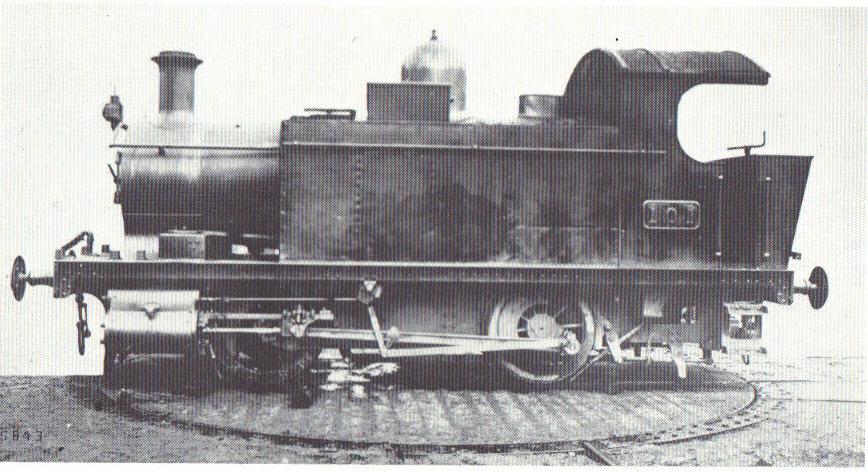
101 after conversion to burn coal in 1905
Type and origin
Dimensions are for coal-burning version
Power typeSteam
DesignerGeorge Jackson Churchward
BuilderGWR Swindon Works
Order numberLot 136
Serial number1969
Build date1902
Total produced1 (prototype)
Rebuild date1905
Specifications
Configuration:
 • Whyte0-4-0T
Gauge1,435 mm (4 ft 8+12 in)
Coupled dia.3 ft 8 in (1.118 m)
Wheelbase9 ft (2.743 m)
Length:
 • Over buffers26 ft 8+14 in (8.134 m)
Loco weight28 long tons 13 cwt (64,200 lb or 29.1 t)
(32.1 short tons) full
Fuel typeOil (Original)
Coal (Rebuilt)
Water cap.500 imp gal (2,300 L; 600 US gal)
Firebox:
 • Grate area7.78 sq ft (0.723 m2)
Boiler pressure160 lbf/in2 (1.10 MPa)
CylindersTwo, outside
Cylinder size13 in × 22 in (330 mm × 559 mm)
Valve gearJoy valve gear
Performance figures
Tractive effort12,168 lbf (54.1 kN)
Career
OperatorsGWR
Numbers101
Withdrawn1911
DispositionScrapped

The GWR 101 Class consisted of a single experimental 0-4-0T side-tank steam locomotive. It was built at GWR Swindon Works under the direction of George Jackson Churchward in June 1902.[2][3]

Originally built as an oil-burning locomotive 'on Holden's system'[3][a], it had an unusual boiler containing a firebox constructed as an arched chamber made from fire-bricks, opening to the firetubes in front, and with two oil-burning nozzles at the back. Over this was mounted a short saddle tank for the oil fuel. There was no outer firebox, but the 8 ft × 5 ft (2.438 m × 1.524 m) boiler, pressed to 180 psi (1.2 MPa), contained 289 firetubes in the lower part and a large steam space above.

As soon as July 1902, it was redesigned with a smaller firebox and a single burner. It was given a Lentz boiler with a cylindrical corrugated firebox inside the barrel in 1903. The saddle tank for fuel was removed and oil stored at the rear end of the side tanks. In 1905, the locomotive was rebuilt as a coal burner, with the cab backplate replaced by a bunker.

It was intended for light passenger service on the Wrington Vale Light Railway near Bristol. However, due to technical issues associated with the design, the locomotive never saw the intended service. It remained at Swindon Works, used as a works shunter. No further engines were built to this design, and the locomotive was withdrawn and scrapped in 1911.[2][3]

Despite it being a unique, obscure and short-lived experimental loco, Hornby have been producing a 00 scale model of No. 101 since 1978, in many prototypical and non-prototypical guises. It is currently sold as part of the Railroad range.[5] Hornby have sometimes inaccurately ascribed the whole design to Holden, instead of just the oil-burning mechanism.[6]

See also

[edit]

Notes

[edit]

References

[edit]

Further reading

[edit]
Revisions and contributorsEdit on WikipediaRead on Wikipedia
from Grokipedia
The GWR 101 Class was a single experimental 0-4-0T side-tank steam locomotive designed by James Holden and constructed by the Great Western Railway at its Swindon Works in 1902, bearing works number 1969. This unique engine, fitted with outside cylinders, top-mounted valves, 3-foot driving wheels, a covered cab, and a lever reversing mechanism, was initially designed to burn oil fuel for efficient operation on light duties. In 1903, the locomotive underwent significant modifications, including installation of a Lentz boiler and a Vanderbilt circular corrugated firebox, along with Joy valve gear, though it retained elements of the original Holden system. In 1905, it was converted to coal-burning. Intended as a potential power unit for railmotors on lesser-used branch lines, it never entered full revenue service and instead functioned primarily as a works shunter at . No additional units were produced, and the engine was withdrawn from service and scrapped in 1911 due to its non-standard design and operational limitations.

Background

Origins and Purpose

In the early 1900s, the Great Western Railway (GWR) underwent significant expansion into light railways and branch lines to serve rural and underdeveloped areas, facilitated by the Light Railways Act of 1896, which promoted economical construction of minor lines. A notable example was the Wrington Vale Light Railway, a seven-mile branch near connecting Congresbury on the Cheddar Valley line to Blagdon, which opened on 4 December 1901 to support local mining and agricultural traffic. This network of underused branches required efficient, low-maintenance motive power to handle light passenger and freight duties amid growing competition from . George Jackson Churchward, who became Locomotive Superintendent of the GWR in June 1902 after serving as chief assistant since 1897, emphasized innovative lightweight designs to modernize the fleet and replace outdated, coal-hungry locomotives. Under his influence, the GWR pursued experiments in streamlined operations for branch lines, including the development of steam railmotors—self-propelled units introduced from 1903 to provide frequent, cost-effective services with minimal crew, typically just a driver and guard, on routes like the Stroud Valley. The GWR 101 Class emerged as an experimental 0-4-0T side-tank locomotive built at in June 1902, specifically as a to power light duties on such branches, including the Wrington Vale Light Railway, aiming for economical operation on low-traffic lines. Its primary purpose was to test oil-burning technology, adapted from systems developed by former GWR engineer , to enhance in remote areas where supply was challenging and costly. This one-off design reflected Churchward's broader philosophy of simplification and standardization, seeking to reduce operational expenses while proving the viability of alternative fuels for the GWR's expanding rural network.

Design Influences

The GWR 101 Class drew from the Great Western Railway's tradition of compact tank locomotives suited to light duties, particularly echoing the design principles of earlier and 0-4-2T classes like the 517 Class, which had been employed since the 1860s for shunting and operations. These predecessors emphasized maneuverability and low axle loads for secondary routes, but the 101 Class represented a scaled-down iteration, reducing weight and dimensions to better accommodate even lighter workloads on remote branches while maintaining the side-tank configuration for self-sufficiency. A key innovation was the adoption of an oil-burning system, adapted from the patented design developed by during his time as chief mechanical engineer of the . Holden's system, first implemented in the late 1880s on GER locomotives using waste products like , was modified for the 101 Class to utilize more efficiently, incorporating elements such as a complex arched firebox and later a with a cylindrical corrugated firebox upon rebuilding—drawing indirect inspiration from American locomotive practices where oil firing had gained traction for its fuel economy on long-haul routes. This adaptation aimed to demonstrate potential cost savings in fuel handling and maintenance for British operations, though it required adjustments for standard gauge and GWR infrastructure. Under George Jackson Churchward's direction as Locomotive Superintendent from 1902, the 101 Class embodied his broader philosophy of simplicity and standardization, informed by his engineering studies abroad. During tours of French and American railways in the early 1900s, Churchward observed advanced and heavy freight designs, such as French Atlantics and U.S. consolidations, which reinforced his preference for robust, interchangeable components to streamline production at . These insights influenced the 101's straightforward mechanical layout, prioritizing ease of assembly over complexity. The locomotive was conceived partly to power combined units with railmotor trailers on underutilized branch lines, allowing a single small engine to haul lightweight passenger sets and thereby cut operational expenses compared to full-sized locomotives. This integration sought to enhance efficiency on low-traffic routes, aligning with GWR's push toward economical self-propelled services in the railmotor era.

Design and Specifications

Configuration and Dimensions

The GWR 101 Class featured a of 0-4-0T side-tank, with driving wheels measuring 3 ft 8 in in diameter. This compact configuration was chosen to facilitate operations on light railways with tight curves. The locomotive's overall dimensions included a length over buffers of 26 ft 8¼ in and a of 9 ft. It weighed 28 long tons 13 cwt (29.1 t) in working order. The side-mounted tanks provided a capacity of 500 imperial gallons and were integrated with the cab to maintain a low profile and enhance maneuverability. The design was initially intended for oil burning to support economical short-haul duties. It featured a covered cab and lever reversing mechanism.

Boiler and Fuel System

The GWR 101 Class featured a specialized oil-burning as its primary power plant, marking an experimental effort to evaluate fuel for service. The was designed with a fire-brick lined firebox to support the combustion process, operating at a working of 180 lbf/in² (1.24 MPa) for efficient steam generation without the need for a traditional grate. This configuration allowed for a compact setup suited to the 's small frame. The fuel delivery system utilized patented oil-burning apparatus, originally developed by James Holden for the to mitigate smoke emissions in urban tunnels. In the 101 Class, this system incorporated a single burner positioned at the firebox entrance, which atomized into a fine spray for optimal mixing with preheated air, ensuring high combustion efficiency and minimal production. The design targeted reduced maintenance requirements by avoiding accumulation, which could damage light track infrastructure, and provided cleaner operation ideal for branch lines with limited ventilation. Water storage consisted of 500 imperial gallons held in side tanks, sufficient for short-haul duties, while the oil tank was integrated into the locomotive's frame. These capacities emphasized the experimental focus on self-contained, low-infrastructure handling compared to coal-fired alternatives.

Cylinders and Valve Gear

The GWR 101 Class was equipped with two outside cylinders, each with a bore and stroke of 13 in × 22 in, positioned to drive the coupled wheels directly and provide efficient steam distribution for its compact 0-4-0T configuration. This arrangement allowed for straightforward access during maintenance and contributed to the engine's suitability for experimental light duties, where the cylinders' dimensions balanced power output with the limitations of a small frame. The valve gear employed Joy valve gear to operate top-mounted piston valves, a choice favored for its mechanical simplicity and reduced number of moving parts compared to more complex systems, making it ideal for a diminutive experimental locomotive like the 101 Class. This design minimized the need for intricate eccentric mechanisms, relying instead on the expansion link and return crank for , which enhanced reliability in low-speed operations. The resulting tractive effort stood at 12,168 lbf (54.1 kN), calibrated specifically for light passenger or shunting tasks at speeds of up to 10-15 mph, ensuring adequate without excessive strain on the experimental oil-burning setup.

Construction and Trials

Building at

The GWR 101 Class prototype, an experimental 0-4-0T oil-burning tank locomotive numbered 101, was constructed at the Great Western Railway's in June 1902. It was assigned Works Number 1969 and produced under Lot 136, as documented in the Swindon locomotive drawings. The build process occurred under the direction of George Jackson Churchward, who had assumed the role of Locomotive Superintendent earlier that year, with assembly handled by the works' experimental staff. Drawing records indicate a boiler specification from October 1902, reflecting the progression from initial fabrication to completion within the year. This single represented early efforts to test innovative features, such as the oil-burning system.

Initial Testing and Early Modifications

Following its completion at in June 1902, the GWR 101 Class underwent initial operational trials at the same facility in July 1902. These tests quickly revealed significant issues with the original oil-burning system, including overheating of the firebox and inefficient fuel combustion due to the oversized furnace design. The problems stemmed from the firebox's excessive dimensions, which hindered proper and steam generation, prompting immediate redesign efforts. In July 1902, modifications were implemented, reducing the firebox length to 3 feet 1 inch and replacing the dual oil burners with a single to improve and control oil flow. These changes also included shortening the side tanks to balance the locomotive's weight distribution after the firebox alterations. The work resulted in approximately 12 months of further development and testing before the engine entered stock in June 1903. Post-modification performance evaluations highlighted persistent limitations, such as inadequate output for prolonged running, rendering the unsuitable for its planned light duties on branch lines without additional overhauls. As a result, the 101 Class was considered an experimental failure in its intended role and was redirected toward evaluation for lighter shunting duties at .

Operational History

Intended Deployment

The GWR 101 Class was originally intended to haul light passenger trains on the Vale Light Railway, a standard-gauge in designed under the Light Railways Act of 1896. The route extended approximately 7 miles from Congresbury on the Cheddar Valley line to Blagdon, serving local villages and industry in the Yeo Valley with intermediate stations at , Langford, and Burrington. Its tight curves and challenging gradients, including sections as steep as 1 in 50, necessitated a compact 0-4-0T suited for efficient operation on such terrain. The line opened on 4 December 1901 for both goods and passenger traffic. The 101 Class was built in 1902 as an experimental oil-burner specifically to meet these operational demands. This deployment aligned with the Great Western Railway's expansion of its network in the early 1900s, which included over a dozen branches to serve rural areas and compete with emerging road and electric transport options. The locomotive's design emphasized versatility for coupling with auto-trailers, facilitating one-man crews on short passenger formations of 4 to 6 vehicles at modest speeds around 20 mph, reflecting GWR efforts to optimize costs on low-volume lines.

Actual Service as Shunter

Following its initial trials, the GWR 101 Class was assigned to shunting duties at from late , where it handled wagon movements and light assembly in the yard. The engine saw intermittent use during , accumulating low total mileage owing to reliability problems with the experimental oil-burning system. By early 1904, records indicated that No. 101 had performed little work in recent months, reflecting ongoing operational challenges. In its shunting role, the proved adequate for short hauls of less than 1 mile across yard tracks but necessitated frequent stops for oil system adjustments; it typically operated with a of two to three members.

Modifications and Withdrawal

1903 Boiler Upgrade

The 1903 boiler upgrade on the GWR 101 Class locomotive was prompted by ongoing problems with the original boiler's oil combustion system, which resulted in consistently low steam pressure and poor performance. To rectify these flaws, the locomotive received a new Lentz-type boiler featuring a corrugated firebox, installed during a major rebuild at Swindon Works in 1903; this design enhanced heat transfer efficiency. The overhaul process involved complete disassembly of the , followed by a six-month reconstruction period. Post-upgrade, the revised enabled more reliable raising, though performance remained marginal for intended passenger duties; however, it sufficiently prolonged the engine's usefulness for shunting operations at .

1905 Conversion to Coal

In 1905, the GWR 101 Class was rebuilt at to convert it from to firing, prompted by the poor of the and inefficient firebox . The burners and related equipment were removed, and a standard firebox with a grate measuring 3 ft 3 in long by 2 ft 8 in wide was installed in their place. A small was added by replacing the cab backplate, along with adjustments to the side tanks and cab for improved weight balance. The work was completed after the locomotive had been stored out of service from June 1904 to May 1905. Photographs from the post-conversion period document the in its new coal-burning configuration performing works shunting.

Reasons for Withdrawal and Scrapping

The GWR 101 Class locomotive was withdrawn from service in September 1911 after approximately nine years of limited use primarily as a shunter at , having accumulated 36,458 miles consistent with its experimental and restricted role. Key factors contributing to its withdrawal included ongoing mechanical challenges stemming from its non-standard experimental features, such as the Joy valve gear, which resulted in elevated maintenance demands that proved uneconomical for continued operation. Additionally, under G.J. Churchward's leadership from 1902, the Great Western Railway pursued aggressive standardization of locomotive designs to improve efficiency and reduce costs, rendering older, bespoke prototypes like the 101 Class obsolete in favor of more versatile and reliable classes, including the 2021 Class tanks introduced for similar shunting duties. Following withdrawal, the locomotive was dismantled for scrapping at in September 1911, with components likely repurposed in other GWR engines as was standard practice for non-preserved stock; the boiler remained in use until 1913. No efforts were made to retain it intact, reflecting its perceived status as a failed experiment in oil-burning technology and overall . The final documentation of its service appears in Great Western Railway maintenance logs from the period, though no physical artifacts survive beyond historical technical diagrams and photographs.

Legacy

Historical Significance

The GWR 101 Class is one of George Jackson Churchward's early prototypes as Chief Mechanical Engineer in 1902, embodying his initial foray into innovative locomotive engineering at . This single experimental 0-4-0T side-tank engine tested pioneering concepts, such as lightweight tank configurations, which informed the evolution of subsequent GWR tank designs. Built specifically to evaluate oil-burning capabilities, the underscored the practical constraints of this fuel in the British context, including supply challenges and climatic incompatibilities that expedited the GWR's commitment to standardization. Intended as a potential power unit for railmotors on lesser-used branch lines, its design and trials reinforced a focus on reliable, coal-based for operational efficiency. As the sole unit of a short-lived design, the 101 Class exemplifies a rare "failed" prototype amid Churchward's predominantly triumphant innovations, yet it advanced the GWR's early 1900s modernization by delineating viable paths forward in and structural , including through its 1903 modifications that tested non-standard components like the Lentz boiler, ultimately supporting Churchward's push for standardized parts.

Representation in Models

The GWR 101 Class has been represented in scale models primarily through Hornby's (1:76 scale) offerings, which have been in production since 1978. These models typically depict the locomotive in its post-1905 coal-burning configuration, featuring a in place of the original oil tank, as this version is the most photographically documented. Early releases, such as the R.077 from 1978-1979, inaccurately attributed the design to James , GWR Locomotive Superintendent, despite the locomotive being developed under William Dean's direction. Later versions, including the current RailRoad range like R30053, are painted in GWR green livery and classified as Era 3, reflecting the pre-Grouping period. Beyond Hornby, representations are limited to custom kits and modifications, often based on the 1905 coal version due to the scarcity of detailed images of the original oil-fired prototype. Enthusiasts frequently adapt Hornby models with aftermarket detailing, DCC fittings, and repaints for greater accuracy in or works shunting scenarios. Retailers like Hattons have offered limited runs and exclusive editions of Hornby models, such as the R2957 GWR 175 Swindon Collection variant. Hornby's long-standing production has revived interest in this obscure locomotive among modelers, with the class appearing in hobby videos, online forums, and layouts simulating GWR branch lines or operations. As collectible items, new Era 3 models typically retail for £50-£150 as of 2025, depending on edition and condition, with earlier releases commanding higher values among collectors.

References

  1. https://commons.wikimedia.org/wiki/File:GWR_101_Class.jpg
Add your contribution
Related Hubs
User Avatar
No comments yet.