Hubbry Logo
Gabor transformGabor transformMain
Open search
Gabor transform
Community hub
Gabor transform
logo
8 pages, 0 posts
0 subscribers
Be the first to start a discussion here.
Gabor transform
Gabor transform
from Wikipedia

The Gabor transform, named after Dennis Gabor, is a special case of the short-time Fourier transform. It is used to determine the sinusoidal frequency and phase content of local sections of a signal as it changes over time. The function to be transformed is first multiplied by a Gaussian function, which can be regarded as a window function, and the resulting function is then transformed with a Fourier transform to derive the time-frequency analysis.[1] The window function means that the signal near the time being analyzed will have higher weight. The Gabor transform of a signal x(t) is defined by this formula:

Magnitude of Gaussian function.

The Gaussian function has infinite range and it is impractical for implementation. However, a level of significance can be chosen (for instance 0.00001) for the distribution of the Gaussian function.

Outside these limits of integration () the Gaussian function is small enough to be ignored. Thus the Gabor transform can be satisfactorily approximated as

This simplification makes the Gabor transform practical and realizable.

The window function width can also be varied to optimize the time-frequency resolution tradeoff for a particular application by replacing the with for some chosen .

Inverse Gabor transform

[edit]

The Gabor transform is invertible. Because it is over-complete, the original signal can be recovered in a variety of ways. For example, the "unwindowing" approach can be used for any :
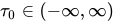
Alternatively, all of the time components can be combined:

Properties of the Gabor transform

[edit]

The Gabor transform has many properties like those of the Fourier transform. These properties are listed in the following tables.

Signal Gabor transform Remarks
1 Linearity property
2 Shifting property
3 Modulation property
Remarks
1 Power integration property
2 Energy sum property
3 Power decay property
4 Recovery property

Application and example

[edit]
Time/frequency distribution.

The main application of the Gabor transform is used in time–frequency analysis. Take the following function as an example. The input signal has 1 Hz frequency component when t ≤ 0 and has 2 Hz frequency component when t > 0

But if the total bandwidth available is 5 Hz, other frequency bands except x(t) are wasted. Through time–frequency analysis by applying the Gabor transform, the available bandwidth can be known and those frequency bands can be used for other applications and bandwidth is saved. The right side picture shows the input signal x(t) and the output of the Gabor transform. As was our expectation, the frequency distribution can be separated into two parts. One is t ≤ 0 and the other is t > 0. The white part is the frequency band occupied by x(t) and the black part is not used. Note that for each point in time there is both a negative (upper white part) and a positive (lower white part) frequency component.

Discrete Gabor-transformation

[edit]

A discrete version of Gabor representation

with

can be derived easily by discretizing the Gabor-basis-function in these equations. Hereby the continuous parameter t is replaced by the discrete time k. Furthermore, the now finite summation limit in Gabor representation has to be considered. In this way, the sampled signal y(k) is split into M time frames of length N. According to , the factor Ω for critical sampling is .

Similar to the DFT (discrete Fourier transformation) a frequency domain split into N discrete partitions is obtained. An inverse transformation of these N spectral partitions then leads to N values y(k) for the time window, which consists of N sample values. For overall M time windows with N sample values, each signal y(k) contains K = N M sample values: (the discrete Gabor representation)

with

According to the equation above, the N M coefficients correspond to the number of sample values K of the signal.

For over-sampling is set to with N′ > N, which results in N′ > N summation coefficients in the second sum of the discrete Gabor representation. In this case, the number of obtained Gabor-coefficients would be MN′ > K. Hence, more coefficients than sample values are available and therefore a redundant representation would be achieved.

Scaled Gabor transform

[edit]

As in short time Fourier transform, the resolution in time and frequency domain can be adjusted by choosing different window function width. In Gabor transform cases, by adding variance , as following equation:

The scaled (normalized) Gaussian window denotes as:

So the Scaled Gabor transform can be written as:

With a large , the window function will be narrow, causing higher resolution in time domain but lower resolution in frequency domain. Similarly, a small will lead to a wide window, with higher resolution in frequency domain but lower resolution in time domain.

Time-causal analogue of the Gabor transform

[edit]

When processing temporal signals, data from the future cannot be accessed, which leads to problems if attempting to use Gabor functions for processing real-time signals. A time-causal analogue of the Gabor filter has been developed in [2] based on replacing the Gaussian kernel in the Gabor function with a time-causal and time-recursive kernel referred to as the time-causal limit kernel. In this way, time-frequency analysis based on the resulting complex-valued extension of the time-causal limit kernel makes it possible to capture essentially similar transformations of a temporal signal as the Gabor function can, and corresponding to the Heisenberg group, see [2] for further details.

See also

[edit]

References

[edit]
Revisions and contributorsEdit on WikipediaRead on Wikipedia
from Grokipedia
The Gabor transform is a linear time-frequency analysis method that represents a signal in both time and frequency domains simultaneously by applying the Fourier transform to segments of the signal windowed by a Gaussian function, achieving an optimal balance between time and frequency localization as per the Heisenberg uncertainty principle. Introduced by Hungarian-British physicist Dennis Gabor in his 1946 paper "Theory of Communication," it models signals as superpositions of elementary waveforms—harmonic oscillations modulated by Gaussian envelopes—each representing a minimal unit of information in the time-frequency plane. Mathematically, the continuous Gabor transform of a square-integrable signal f(t)f(t) is defined as Gf(t,ω)=f(τ)g(τt)eiωτdτ,G_f(t, \omega) = \int_{-\infty}^{\infty} f(\tau) \overline{g(\tau - t)} e^{-i \omega \tau} \, d\tau, where g(t)g(t) is a Gaussian window function, typically g(t)=(2πσ2)1/4eπt2/(2σ2)g(t) = (2\pi \sigma^2)^{-1/4} e^{-\pi t^2 / (2\sigma^2)}, tt denotes time localization, ω\omega is angular frequency, and the overline indicates the complex conjugate. This formulation satisfies the uncertainty relation ΔtΔω1/2\Delta t \cdot \Delta \omega \geq 1/2, with the Gaussian window attaining equality for minimal joint spread. The transform is linear, energy-bounded by the Schwarz inequality Gf(t,ω)f2g2|G_f(t, \omega)| \leq \|f\|_2 \|g\|_2, and invertible via f(t)=12πg22Gf(τ,ω)g(tτ)eiωtdωdτ.[](https://faculty.washington.edu/kutz/Kutztimefreq.pdf)f(t) = \frac{1}{2\pi \|g\|_2^2} \int_{-\infty}^{\infty} \int_{-\infty}^{\infty} G_f(\tau, \omega) g(t - \tau) e^{i \omega t} \, d\omega \, d\tau.[](https://faculty.washington.edu/kutz/Kutz_time_freq.pdf) In discrete settings, the transform operates on sampled signals using lattice parameters for time and frequency shifts, enabling efficient computation via fast Fourier transform algorithms, though it faces challenges like the Balian-Low theorem, which precludes the existence of well-localized windows generating Riesz bases in the critically sampled case, allowing oversampled frames with good localization for perfect reconstruction. The discrete Gabor transform extends these ideas to digital signals and images, often employing 2D versions for multidimensional . Key properties include shift-invariance in the time-frequency plane and the ability to form frames for stable signal reconstruction, making it superior to the pure for non-stationary signals. Historically, Gabor's work built on earlier communication by Nyquist and Hartley, influencing quantum mechanics-inspired signal decomposition, and evolved through contributions addressing computational efficiency and frame in the late . Applications of the Gabor transform span diverse fields, including audio for and music analysis, where it captures transient features like formants and harmonics. In image , 2D Gabor filters excel at texture , , and feature extraction due to their biological plausibility, mimicking simple cells in the human . It also finds use in signal analysis for target detection, seismic data interpretation for fault diagnosis, and biomedical imaging for in textures like fingerprints or medical scans. Recent advancements as of 2025 integrate it with , such as hybrid Gabor attention networks for liver and tumor segmentation in , enhancing denoising and tasks.

Introduction

Definition and History

The Gabor transform is a linear time-frequency representation of a signal, defined as the Fourier transform of the signal multiplied by a Gaussian window function centered at time tt. This windowing provides optimal joint localization in both time and frequency domains due to the Gaussian's minimal uncertainty product, as per the Heisenberg uncertainty principle. The continuous Gabor transform of a signal f(τ)f(\tau) is given by G(t,ω)=f(τ)g(τt)eiωτdτ,G(t, \omega) = \int_{-\infty}^{\infty} f(\tau) \, g(\tau - t) \, e^{-i \omega \tau} \, d\tau, where g()g(\cdot) is the Gaussian window function, typically g(u)=(2πσ2)1/2eu2/(2σ2)g(u) = (2\pi \sigma^2)^{-1/2} e^{-u^2 / (2\sigma^2)} for some scale parameter σ>0\sigma > 0. The transform was introduced by Dennis Gabor in his 1946 paper "Theory of Communication," where he proposed expanding signals into elementary functions that are Gaussian-modulated sinusoids to achieve simultaneous resolution in time and frequency. Gabor's original motivation stemmed from communication theory, aiming to improve signal analysis beyond traditional Fourier methods by addressing limitations in resolving transient events, and drew explicit analogies to quantum mechanics, viewing signals as analogous to wave packets with inherent time-frequency uncertainty. In the paper, he described these elementary signals as quanta of information, enabling a more efficient representation for noisy channels and pulse analysis in electrical engineering. The concept evolved in the ensuing decades, with significant refinements in the 1980s by Martin J. Bastiaans, who formalized the expansion of arbitrary signals into discrete sets of Gaussian elementary signals and proved its existence under certain sampling conditions, bridging Gabor's ideas to practical applications. Bastiaans' work emphasized the transform's role in optical signal representation and introduced sampling theorems for the complex , solidifying its theoretical foundation.

Motivation and Relation to Other Transforms

The provides a comprehensive -domain representation of a signal but inherently discards temporal information, rendering it inadequate for analyzing non-stationary signals where content evolves over time. To address this limitation in , introduced a method for joint time- analysis that localizes components within specific time intervals, enabling the of complex signals into elementary quanta resembling modulated Gaussian pulses. The Gabor transform serves as a specialized form of the (STFT), differing primarily in its use of a Gaussian window function to modulate the signal before . This choice of window is optimal because the Gaussian achieves the minimum product of time and frequency spreads, saturating the Heisenberg uncertainty principle for signal representations and providing the most concentrated joint time-frequency resolution possible. In contrast to wavelet transforms, which employ scalable basis functions to offer multi-resolution analysis suitable for signals with varying frequency scales, the Gabor transform relies on a fixed Gaussian modulated by sinusoids, yielding uniform resolution across frequencies at the cost of less adaptability to sparse or transient events. Both frameworks adhere to uncertainty trade-offs, but wavelets prioritize frequency-dependent localization, while Gabor emphasizes balanced, minimal-uncertainty coverage for quasi-periodic structures. The structure of Gabor functions also draws biological parallels, as their form closely models the receptive fields of simple cells in the mammalian primary , which respond selectively to oriented edges and spatial frequencies in visual stimuli. This connection, established through neurophysiological studies, has facilitated applications in computational models of human , bridging with .

Mathematical Formulation

Continuous Gabor Transform

The continuous Gabor transform is a specialized form of the (STFT) obtained by selecting a , which achieves optimal localization in both time and frequency domains. It maps a continuous-time signal x(t)x(t) into a two-dimensional time-frequency representation via the integral Gx(t,ω)=x(τ)g(τt)eiωτdτ,G_x(t, \omega) = \int_{-\infty}^{\infty} x(\tau) \, \overline{g(\tau - t)} \, e^{-i \omega \tau} \, d\tau, where tt parameterizes the temporal position of the analysis window and ω\omega the central frequency of the modulation. The window function is the Gaussian g(u)=(πσ2)1/4exp(u22σ2)g(u) = (\pi \sigma^2)^{-1/4} \exp\left( -\frac{u^2}{2\sigma^2} \right), with σ>0\sigma > 0 controlling its width; this form ensures L2L^2-normalization, i.e., g(u)2du=1\int_{-\infty}^{\infty} |g(u)|^2 \, du = 1, preserving the signal's energy in the transform domain. This formulation derives directly from the general STFT by restricting the window to a Gaussian, motivated by the need for minimal joint uncertainty in time-frequency analysis. In the STFT, the transform correlates the signal with shifted and modulated versions of a fixed window; choosing the Gaussian minimizes the Heisenberg uncertainty product ΔtΔω1/2\Delta t \cdot \Delta \omega \geq 1/2 (in radians), where Δt\Delta t and Δω\Delta \omega are the standard deviations of the window in time and its in frequency, respectively. Equality holds uniquely for the Gaussian due to its self-Fourier property, where the g^(ν)=g(u)ei2πνudu\hat{g}(\nu) = \int_{-\infty}^{\infty} g(u) e^{-i 2\pi \nu u} \, du is also Gaussian with spread 1/(2σ)1/(2\sigma), ensuring no other window matches this balance without trade-offs. The parameter σ\sigma governs the resolution trade-off inherent to the : increasing σ\sigma broadens the temporal support of g(t)g(t - \cdot), enhancing resolution (narrower Δω\Delta \omega) but reducing sensitivity to rapid signal changes, while decreasing σ\sigma sharpens time localization at the cost of broader frequency spread. This flexibility allows the transform to adapt to signals with varying local stationarity, such as those in communications or quantum mechanics-inspired models. For a simple analytical case, consider the Gaussian-modulated signal x(t)=exp((tt0)22a2)exp(iω0t)x(t) = \exp\left( -\frac{(t - t_0)^2}{2 a^2} \right) \exp(i \omega_0 t), which represents a localized centered at time t0t_0 with ω0\omega_0. When the window parameters match (σ=a\sigma = a), the Gabor transform evaluates to Gx(t,ω)=Cexp((tt0)24a2a2(ωω0)2)G_x(t, \omega) = C \exp\left( -\frac{(t - t_0)^2}{4 a^2} - a^2 (\omega - \omega_0)^2 \right), where CC is a constant incorporating normalization factors; this yields a Gaussian profile in the (t,ω)(t, \omega)-plane, peaked at (t0,ω0)(t_0, \omega_0), illustrating the transform's precision in localizing such elementary functions without distortion.

Inverse Gabor Transform

The inverse continuous Gabor transform reconstructs the original signal f(t)f(t) from its Gabor coefficients G(τ,ω)G(\tau, \omega), where the forward transform is defined as G(τ,ω)=f(t)g(tτ)eiωtdtG(\tau, \omega) = \int_{-\infty}^{\infty} f(t) \overline{g(t - \tau)} e^{-i \omega t} \, dt with window function gg. Assuming the window is normalized such that gL2(R)=1\|g\|_{L^2(\mathbb{R})} = 1, the reconstruction formula is given by f(t)=12πG(τ,ω)g(tτ)eiωtdτdω.f(t) = \frac{1}{2\pi} \iint_{-\infty}^{\infty} G(\tau, \omega) \, g(t - \tau) \, e^{i \omega t} \, d\tau \, d\omega. This formula holds for ω\omega and ensures perfect recovery of fL2(R)f \in L^2(\mathbb{R}). The invertibility of the continuous Gabor transform relies on the window gg generating a continuous frame for L2(R)L^2(\mathbb{R}). Specifically, the system {TτMωg}(τ,ω)R2\{T_\tau M_\omega g\}_{(\tau, \omega) \in \mathbb{R}^2}, where TτT_\tau denotes time translation and MωM_\omega , forms a tight frame with frame bound A=B=g2=1A = B = \|g\|^2 = 1. This tight frame condition guarantees stable reconstruction without distortion, as the frame operator Sf=12πf,TτMωgTτMωgdτdωS f = \frac{1}{2\pi} \iint \langle f, T_\tau M_\omega g \rangle T_\tau M_\omega g \, d\tau \, d\omega simplifies to the identity operator. While the continuous case is inherently overcomplete due to the uncountable indexing set, no critical sampling threshold applies as in discrete settings; invertibility holds for any non-zero gL2(R)g \in L^2(\mathbb{R}), but the tight frame property optimizes and redundancy control. The derivation of the inverse formula adapts within the framework of continuous frames. The analysis operator Vgf=GV_g f = G maps to L2(R2,dτdω/2π)L^2(\mathbb{R}^2, d\tau d\omega / 2\pi), and its (synthesis operator) yields the frame operator S=VgVgS = V_g^* V_g. For a normalized Gaussian g(t)=(π)1/4eπt2g(t) = (\pi)^{-1/4} e^{-\pi t^2}, the of the modulated translates follows from the Weyl-Heisenberg , ensuring S=IS = I. Thus, f=Vg(Vgf)f = V_g^* (V_g f), which expands to the reconstruction. This leverages the minimal uncertainty of the Gaussian under the continuous . In non-tight frame scenarios, where g21\|g\|^2 \neq 1 or the window deviates from Gaussian, perfect reconstruction requires a dual window γ\gamma satisfying g(t)γ(t)dt=1\int_{-\infty}^{\infty} g(t) \gamma(t) \, dt = 1, replacing gg in the synthesis with γ(tτ)\gamma(t - \tau). This introduces overcomplete representations, providing robustness to noise but increasing computational demands for the dual computation via S1S^{-1}. Such dual approaches are essential when the frame bounds A<BA < B indicate redundancy without tightness.

Properties

Resolution and Uncertainty Principle

The resolution of the Gabor transform in the time-frequency domain is fundamentally limited by the Heisenberg uncertainty principle, which arises from the mathematical properties of the Fourier transform. For any window function g(t)g(t) used in the transform, the product of the time spread Δt\Delta t and the frequency spread Δω\Delta \omega satisfies ΔtΔω12\Delta t \Delta \omega \geq \frac{1}{2}, where Δt\Delta t and Δω\Delta \omega are typically measured as standard deviations. This bound implies that high resolution in time cannot be achieved simultaneously with high resolution in frequency, creating an inherent trade-off in localizing signal components. A narrow window provides excellent time resolution but smears the frequency content, while a wide window offers precise frequency information at the expense of temporal localization. The Gaussian window achieves the minimum uncertainty, equality in the bound, with σtσω=12\sigma_t \sigma_\omega = \frac{1}{2}, where σt\sigma_t and σω\sigma_\omega denote the standard deviations of the window in time and angular frequency domains, respectively. This optimal localization makes the Gaussian the preferred choice for the , as it minimizes the spread in the time-frequency plane. Visually, this resolution limit is represented in the time-frequency plane by the "Heisenberg box," a rectangular region centered at each time-frequency point (t,ω)(t, \omega) with area at least 12\frac{1}{2}, illustrating the minimal volume occupied by the transform's energy concentration. The tiling of these boxes across the plane underscores the uniform resolution of the , independent of position. These resolution constraints have significant implications for signal analysis using the , which is particularly effective for signals whose frequency content varies slowly over time, such as quasi-stationary processes. In such cases, the fixed window size aligns well with the signal's local stationarity, allowing accurate representation without excessive smearing. Historically, Dennis Gabor drew an explicit analogy to quantum mechanics in his foundational work, framing the time-frequency indeterminacy as akin to the position-momentum uncertainty, thereby linking signal processing to physical principles.

Other Mathematical Properties

The Gabor transform exhibits linearity, meaning that for any signals ff and gg, and scalars a,bCa, b \in \mathbb{C}, the transform of a linear combination satisfies Gaf+bg(t,ω)=aGf(t,ω)+bGg(t,ω)G_{af + bg}(t, \omega) = a G_f(t, \omega) + b G_g(t, \omega). This property follows directly from the integral definition of the transform and enables superposition in time-frequency analysis. Additionally, scaling a signal by a constant cc results in the transform being scaled by cc, preserving the linear structure across operations. An adaptation of the convolution theorem applies to the Gabor transform, where the transform of the convolution of two signals relates to a product in the time-frequency domain, modulated by the window function. Specifically, the short-time Fourier transform (equivalent to the ) of a convolution can be expressed through a convolution in the time-frequency plane of the individual transforms, as PKf(u,ξ)=PVf#K(u,ξ)P_K f(u, \xi) = P_V f \# K(u, \xi), with K(u,ξ)=12πPVg(u,ξ)K(u, \xi) = \frac{1}{2\pi} P_V g(u, \xi) for a Gaussian window gg, where #\# denotes the symplectic convolution and PVP_V is the spectrogram. This relation facilitates analysis of filtered signals in localized frequency bands. The Gabor transform preserves energy, analogous to the Plancherel theorem for the Fourier transform. For a signal fL2(R)f \in L^2(\mathbb{R}) and window gg with g2=1\|g\|_2 = 1, the energy is conserved as f(t)2dt=12πGf(t,ω)2dωdt.\int_{-\infty}^{\infty} |f(t)|^2 \, dt = \frac{1}{2\pi} \iint_{-\infty}^{\infty} |G_f(t, \omega)|^2 \, d\omega \, dt. This identity ensures that the L2L^2-norm of the signal equals a scaled L2L^2-norm of its time-frequency representation, up to the normalization factor determined by the window. Shift invariance is a core property, where time and frequency shifts in the signal correspond to phase modulations in the transform coefficients. A time shift f(tt0)f(t - t_0) yields Gf(tt0,ω)eiωt0G_f(t - t_0, \omega) e^{i \omega t_0}, while a frequency shift f(t)eiω0tf(t) e^{i \omega_0 t} produces Gf(t,ωω0)eitω0G_f(t, \omega - \omega_0) e^{-i t \omega_0}. These phase shifts maintain the magnitude of the coefficients, reflecting the transform's covariance under translations in the time-frequency plane. Moyal's identity preserves inner products between signals through their Gabor coefficients, stating that for signals ψ1,ψ2\psi_1, \psi_2 and windows ϕ1,ϕ2L2(Rd)\phi_1, \phi_2 \in L^2(\mathbb{R}^d), Vϕ1ψ1,Vϕ2ψ2L2(R2d)=ψ1,ψ2L2(Rd)ϕ1,ϕ2L2(Rd),\langle V_{\phi_1} \psi_1, V_{\phi_2} \psi_2 \rangle_{L^2(\mathbb{R}^{2d})} = \langle \psi_1, \psi_2 \rangle_{L^2(\mathbb{R}^d)} \langle \phi_1, \phi_2 \rangle_{L^2(\mathbb{R}^d)}, where VϕψV_\phi \psi denotes the short-time Fourier transform. This orthogonality relation underscores the unitary nature of the transform and its role in frame theory for stable reconstructions.

Discrete Gabor Transform

Formulation and Expansion

The discrete Gabor transform (DGT) provides a practical implementation of the for finite-length discrete-time signals, typically sampled from a continuous signal. It represents the signal ff, where k=0,1,,K1k = 0, 1, \dots, K-1, as coefficients on a time-frequency lattice defined by time step MM and frequency step corresponding to NN bins, with the Gaussian window gg serving as the analysis function. The transform is given by G[m,n]=k=0K1fg[kmM]ei2πnk/N,G[m, n] = \sum_{k=0}^{K-1} f \, g^*[k - mM] \, e^{-i 2\pi n k / N}, where m=0,1,,(K1)/Mm = 0, 1, \dots, \lfloor (K-1)/M \rfloor indexes time shifts, n=0,1,,N1n = 0, 1, \dots, N-1 indexes frequency modulations, and * denotes complex conjugate. This formulation arises from applying the continuous Gabor transform to sampled signals and discretizing the integral via summation over the signal length KK, ensuring compatibility with digital signal processing. The lattice parameters MM and NN determine the oversampling rate; for a signal of length KK, the total number of coefficients is approximately (K/M)×N(K/M) \times N, which exceeds KK in oversampled cases to enable redundancy. The inverse operation, known as the Gabor expansion, reconstructs the signal from these coefficients using a dual synthesis window, often related to the analysis window. For discrete signals, the expansion approximates fmncm,ngm,n,f \approx \sum_{m} \sum_{n} c_{m,n} \, g_{m,n}, where gm,n=g[kmM]ei2πnk/Ng_{m,n} = g[k - mM] \, e^{i 2\pi n k / N} are the shifted and modulated Gaussian basis functions, and cm,nc_{m,n} are the expansion coefficients derived from G[m,n]G[m,n] via biorthogonal duals. Perfect reconstruction holds under frame conditions, particularly when the windows have finite support. In frame theory, the DGT corresponds to a non-orthogonal frame expansion, where the set {gm,n}\{ g_{m,n} \} forms a frame for the space of discrete signals if the frame operator is invertible. The "painless" non-orthogonal expansion condition ensures perfect reconstruction for oversampled lattices (MN<KM N < K), as the finite support of the Gaussian avoids the ill-conditioning at critical sampling; this relies on the frame bounds being positive and finite, allowing stable dual frame computation. Invertibility requires a critical sampling density of 1, meaning the lattice density K/(MN)=1K/(M N) = 1 for Riesz bases, though practical implementations often use oversampling to mitigate the Balian-Low uncertainty trade-off, which prevents smooth windows from achieving orthogonality at this density. Efficient computation of the DGT and expansion leverages the Zak transform, which diagonalizes the frame operator on the lattice and reduces the problem to periodic multiplications in the time-frequency domain.

Computation and Algorithms

The discrete Gabor transform (DGT) is commonly computed using the fast Fourier transform (FFT) applied to windowed segments of the signal, where the signal is modulated and shifted according to the time-frequency lattice parameters. For a signal of length KK, the analysis involves applying the window function gg to overlapping segments separated by time step MM, followed by an FFT of length PP (typically PNP \geq N and covering the window support) for each of the approximately K/MK/M time positions, yielding coefficients G[m,n]=kfg[kmM]e2πink/NG[m,n] = \sum_{k} f \overline{g[k - mM]} e^{-2\pi i n k / N}. This direct approach achieves a computational complexity of O((K/M)NlogN)O((K/M) N \log N) floating-point operations (FLOPs), which simplifies to O(KlogK)O(K \log K) under critical sampling where MNKM N \approx K, matching the efficiency of the FFT itself. For reconstruction, Gabor frame algorithms employ the dual frame method, where the signal is recovered as f=m,nG[m,n]γm,nf = \sum_{m,n} G[m,n] \gamma_{m,n}, with γ\gamma as the dual window satisfying the frame operator's invertibility. The Wexler-Raz biorthogonality relations characterize these dual functions, stating that g,MmbTnaγ=δm,0δn,0\langle g, M_{m b} T_{n a} \gamma \rangle = \delta_{m,0} \delta_{n,0} over the adjoint lattice (with a=Ma = M, b=1/Nb = 1/N), enabling computation of biorthogonal coefficients via Zak transform or direct solving for oversampled lattices (density K/(MN)>1K/(M N) > 1). This method ensures stable reconstruction but requires solving a of size proportional to the factor, with complexity O(KlogK)O(K \log K) using FFT-based implementations for the frame operator. Recent efficient algorithms address limitations of long finite impulse response (FIR) windows by factorizing the DGT into painlessly excitable filter banks, combining overlap-add techniques with FFTs to achieve near-linear complexity O(KlogK)O(K \log K) even for windows longer than the hop size, avoiding truncation artifacts in applications like audio processing. Post-2020 advances include GPU-accelerated implementations leveraging parallel FFT kernels (e.g., via ), for high-resolution image analysis, such as in compression, by distributing windowed FFT computations across threads. Methods integrated into toolboxes like LTFAT optimize storage and computation for undersampled or structured lattices by representing the frame operator efficiently. Key challenges in DGT computation include selecting lattice parameters to ensure sufficient (typically MN<KM N < K) for avoiding aliasing and guaranteeing frame bounds away from zero, as critical sampling (MN=KM N = K) often leads to ill-conditioned systems due to the discrete Balian-Low theorem. For finite-length signals, boundary effects introduce artifacts, mitigated by zero-padding to at least twice the window length before FFT to prevent time-domain aliasing, though this increases effective complexity by a factor of 2-4; alternative periodization schemes in finite Gabor analysis preserve norms but require careful window design to maintain reconstruction accuracy above 99% for practical signals.

Variants

Scaled Gabor Transform

The scaled Gabor transform extends the standard formulation by incorporating a scale parameter a>0a > 0, which modulates the width of the window to enable multi-resolution time-frequency analysis. The is defined as g(tba)/ag\left(\frac{t - b}{a}\right)/\sqrt{a}
Add your contribution
Related Hubs
User Avatar
No comments yet.