Hubbry Logo
GeastralesGeastralesMain
Open search
Geastrales
Community hub
Geastrales
logo
8 pages, 0 posts
0 subscribers
Be the first to start a discussion here.
Geastrales
Geastrales
from Wikipedia

Geastrales
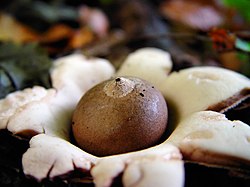
Geastrum triplex
Scientific classification Edit this classification
Kingdom: Fungi
Division: Basidiomycota
Class: Agaricomycetes
Subclass: Phallomycetidae
Order: Geastrales
K.Hosaka & Castellano (2007)[2]
Family: Geastraceae
Corda (1842)[1]
Type genus
Geastrum
Pers. (1801)
Genera

Boninogaster
Geasteroides
Geastrum
Myriostoma
Schenella
Sclerogaster
Sphaerobolus
Terrostella

The Geastrales are an order of gasterocarpic basidiomycetes (fungi) that are related to the Gomphales. The order contains the families Geastraceae—which include the "earthstars" formerly placed in Lycoperdales or Phallales,[4][5]—and also Schenellaceae, Sclerogastraceae and Sphaerobolaceae.

About 160 species are classified in this order, divided among seven or eight genera, including Geastrum, Myriostoma and Sphaerobolus. Sphaerobolus species are known as "shotgun fungus" or "cannonball fungus". They colonize wood-based mulches and may throw black, sticky, spore-containing globs onto nearby surfaces.[6][7]

In Geastrum, once mature, the exoperidium splits into a variable number of rays, which give them their visible star shape. The exoperidial rays are there to protect the endoperidial body and orchestrate spore dispersal.[8] The fruiting bodies of several earthstars are hygrometric: in dry weather the rays will dry and curl up around the soft spore sac, protecting it. In this state, often the whole fungus becomes detached from the ground and may roll around like a tumbleweed. In wetter weather, the rays moisten and uncurl; some even curl backward lifting the spore sac up. This allows rain or animals to hit the spore sac, emitting spores when enough moisture is present for them to germinate and establish.

References

[edit]
[edit]
Revisions and contributorsEdit on WikipediaRead on Wikipedia
from Grokipedia
Geastrales is an order of gasterocarpic basidiomycete fungi in the class , characterized by fruiting bodies (gasterocarps) that develop spores internally within an enclosed structure, rather than on exposed surfaces like gills or pores. The order includes four families: Geastraceae, Sclerogastraceae, Schenellaceae, and Sphaerobolaceae, with species that are primarily saprotrophic, decomposing in terrestrial environments such as humus, grasslands, and occasionally on decaying . Distributed worldwide except , Geastrales fungi exhibit diverse morphologies adapted for spore dispersal, often in arid or shaded habitats under trees. The family Geastraceae, the largest of the four, contains genera such as and Myriostoma, commonly known as earthstars due to their distinctive fruiting bodies. These gasterocarps initially form as spherical or pear-shaped structures embedded in the substrate; upon maturation, the outer layer (exoperidium) splits radially into 5–12 star-like rays, elevating the inner sac (endoperidium) above the ground to facilitate wind dispersal of powdery s. With over 100 described in alone, many exhibit hygroscopic properties where the rays open or close in response to , and they are often found in nutrient-poor soils, contributing to and nutrient cycling in ecosystems. Recent studies have continued to describe new , with four additions to reported in 2025. Some , like those in section Myceliostroma, have a pseudomycelial base that anchors the fruiting body firmly to the soil. In contrast, the family Sphaerobolaceae is represented by the single genus Sphaerobolus, known as the artillery or shotgun fungus for its explosive discharge mechanism. Fruiting bodies consist of cup-like peridioles that mature into stellate structures, forcibly ejecting black, sticky balls (gleba) up to several meters toward light sources, aiding dispersal onto potential substrates like wood or foliage. Sphaerobolus species, such as S. stellatus, are cosmopolitan saprotrophs frequently associated with bark and decaying , where they can cause aesthetic issues by staining surfaces but play a role in lignocellulose breakdown. Molecular studies, including mitochondrial genome analyses, highlight unique rearrangements and dynamics in this family, underscoring its evolutionary distinctiveness within Geastrales.

Taxonomy and classification

Etymology and history

The order Geastrales derives its name from the genus Geastrum, established by Christiaan Hendrik Persoon in 1801, with the generic epithet combining the Greek roots geo- (earth) and astron (star) to describe the star-like rays produced by the splitting exoperidium of mature fruiting bodies. The genus Geastrum was first formally described by Persoon in his Synopsis Methodica Fungorum (1801), where he outlined its key features among gasteroid fungi, marking the initial taxonomic recognition of these earthstars. Early 19th-century mycologists, including Elias Magnus Fries, incorporated Geastrum species into the class Gasteromycetes—a broad assemblage of basidiomycetes characterized by enclosed spore production—within Fries's Systema Mycologicum (1829), reflecting the prevailing morphological emphasis on gasterocarpic development. Throughout the 19th and early 20th centuries, and related genera were frequently misclassified under orders such as Lycoperdales or Phallales, owing to superficial resemblances with in Lycoperdaceae, particularly their gasteroid habit of internal maturation. These placements overlooked distinguishing traits like the stellate exoperidium, which elevates the spore sac for dispersal, leading to polyphyletic groupings in earlier systems (e.g., Zeller 1948). By the mid-20th century, some revisions tentatively aligned gasteroid fungi, including geastralean taxa, with based on broader basidiomycete affinities, though inconsistencies persisted without molecular evidence. The modern taxonomic framework for Geastrales emerged in 2006 through phylogenetic analyses by Hosaka et al., who erected the order based on a multi-gene incorporating nuclear rDNA (18S, 28S, 5.8S, and ITS regions) alongside protein-coding genes (RPB1, RPB2), revealing a monophyletic distinct from Lycoperdales and Nidulariales. These molecular data positioned Geastrales within the newly defined subclass Phallomycetidae, demonstrating close evolutionary ties to the gomphoid-phalloid fungi and basal affinities within , including proximity to Cantharellales in broader rDNA-based trees.

Current phylogenetic position

Geastrales is currently classified in the kingdom Fungi, phylum , class , as an order of gasteroid fungi characterized by enclosed fruiting bodies. This placement reflects a revision from earlier assignments to the polyphyletic group Lycoperdales or broader Gasteromycetes, driven by molecular analyses of large subunit (LSU rDNA) and (ITS) sequences that integrate Geastrales into the monophyletic Agaricomycetes. Prior to 2006, genera like were often grouped with in Lycoperdales based on superficial morphological similarities, but phylogenetic evidence demonstrated their distinct evolutionary lineage. Molecular studies position Geastrales as the sister group to Cantharellales within Agaricomycetes, forming a basal gasteroid clade distinct from other sequestrate orders like Lycoperdales. Hosaka et al. (2006) established Geastrales as a new order in the subclass Phallomycetidae using multi-gene analyses, including nuclear LSU rDNA, confirming its separation from Phallales and Gomphales while highlighting affinities with cantharelloid lineages. Subsequent work by Binder et al. (2010) reinforced this by analyzing early-diverging Agaricomycetidae clades, showing Geastrales nested among resupinate and gasteroid forms, with strong support for its autonomy from Lycoperdales based on combined rDNA datasets. Key evidence supporting this position includes sequence analyses of the 18S small subunit and 28S LSU rRNA genes, which support a close phylogenetic relationship as sister groups to Cantharellales, indicating a shared ancestry. These molecular markers, combined with morphological synapomorphies such as gasterocarps featuring an evanescent gleba that deliquesces to release powdery spores, distinguish Geastrales as a specialized lineage adapted for wind dispersal in terrestrial ecosystems.

Families and genera

The order Geastrales comprises two families: Geastraceae, established by Corda in , and Sphaerobolaceae. Geastraceae is the larger family, encompassing genera such as and Myriostoma. Sphaerobolaceae accommodates the genus Sphaerobolus due to its distinctive explosive spore discharge, though some molecular studies suggest close relations within Geastrales. Geastraceae encompasses 7 genera, with an estimated total of over 150 worldwide as of 2023. The most species-rich genus is Geastrum, which includes approximately 90–130 and is distinguished by its exoperidium that dehiscing into a stellate structure with 6–16 rays, elevating the endoperidium for dispersal. Myriostoma, containing a single (M. coliforme), features an endoperidium with numerous pores resembling a saltshaker, facilitating passive release. Radiigera is characterized by radiating, hyphal rays on the exoperidium, though molecular data indicate it may be nested within Geastrum. Schenella, comprising 2 species, exhibits a geopore-like dehiscence on the endoperidium, with a small pore for escape. Nidulariopsis mimics bird's nest fungi through its cup-shaped peridium with nested peridioles, though it lacks true nidularioid structure. The remaining genera, Geasteroides and Phialastrum, are minor, with Geasteroides (1 species) showing reduced stellate features and Phialastrum (1–2 species) distinguished by phialide-like structures. Sphaerobolaceae contains the single Sphaerobolus, with 3–5 as of 2023, notable for its cannon-like that forcibly ejects a sticky gleba up to 2 meters away, a trait adapted for targeted dispersal onto animal fur or .

Morphology and characteristics

Fruiting body structure

The fruiting bodies of Geastrales are gasterocarps, characterized by enclosed production within a protective structure. These basidiomata vary significantly between families, typically measuring from less than 1 mm to 10 cm in diameter and developing epigeously (above ground), though some initiate hypogeously. They begin as small, pyriform to ellipsoidal structures embedded in the substrate, with a leathery outer covering that protects the developing spore mass. In the family Geastraceae, the exoperidium—the outermost layer—is thick and papery to leathery, splitting radially at maturity into 4–16 hygroscopic rays that curve outward and downward, forming a stellate base reminiscent of an earthstar; this expansion elevates and exposes the inner spore sac. Ray counts and hygroscopicity vary by , with structures often 1–10 cm in diameter. Beneath it lies the endoperidium, a delicate, papery 0.6–2.1 cm across, often smooth or silky with colors from pale grey to dark brown, and typically featuring a beak-like apophysis (a short stalk) or a (ridged mouth) at the apex for release. Internally, the gleba—the fertile mass—fills the endoperidium as a powdery tissue in Geastraceae, initially and maturing to olive-brown or black, supported by a central in many . Developmentally, the immature fruiting body emerges from soil enclosed in a volva-like pseudostipe or ; as moisture levels rise, the exoperidial rays absorb water and unfurl, lifting the endoperidium above the substrate for enhanced dispersal, a process that can take days to weeks depending on environmental conditions. In contrast, the family Sphaerobolaceae, represented by Sphaerobolus, has diminutive fruiting bodies (1–2 mm diameter), spherical and cup-like, lacking rays. Instead, the gelatinous gleba is packaged into separate, lens-shaped peridioles ( balls) within the basidiome, which are forcibly ejected up to several meters toward light sources for dispersal.

Microscopic features

The microscopic features of Geastrales fungi are essential for taxonomic identification, revealing distinct cellular structures in spores, hyphae, and reproductive tissues. Basidiospores in this order vary by family but are generally 3–10 µm in size, ranging from to yellowish-brown or brownish in color. In genera like (Geastraceae), they are often globose to subglobose, ornamented with low , short spines (echinulate), or irregular pedicels up to 1.6 µm high, measuring 3–8 µm in diameter. In Sphaerobolus (Sphaerobolaceae), the spores are smooth, broadly ellipsoid to ovoid, , 7–8 µm long by 4–5 µm wide. Hyphal structures exhibit a three-layered peridium in most Geastrales, particularly in Geastraceae: the exoperidium comprises a mycelial layer of thin-walled generative hyphae (1–3 µm wide) with clamp connections, a fibrous layer of interwoven hyphae (2–6 µm wide), and a pseudoparenchymatous layer; the mesoperidium includes generative hyphae and ; and the endoperidium consists of thick-walled, intertwined hyphae (1.5–7 µm wide) that are yellowish-brown and aseptate. Clamp connections are present in the generative hyphae of the peridium and rhizomorphs, facilitating dikaryotic growth. In Sphaerobolaceae, the peridium is simpler, with a multi-layered of interwoven hyphae lacking distinct crystal encrustations. Glebal tissues feature basidia that are narrowly to clavate, 12–26 µm long by 4.5–7.5 µm wide, each bearing 2–4 (rarely up to 8) sterigmata and producing four spores apiece. The capillitium consists of thick-walled (1.5–4.5 µm), aseptate threads 3.5–15 µm wide, often unbranched or sparingly branched, with acute to rounded tips and a narrow lumen; these threads are typically olivaceous or brownish and lack reactions. Diagnostic traits include a fibrillose or indistinct formed by projecting hyphae (2.5–7.5 µm wide), and the general absence of cystidia across most genera, distinguishing Geastrales from related gasteroid orders.

Habitat and ecology

Distribution and habitats

Geastrales, an order of gasteroid Basidiomycota fungi, exhibit a cosmopolitan distribution, with species recorded across all major continents including North and South America, Europe, Asia, Africa, and Australia. The order is most diverse in the temperate regions of the Northern Hemisphere, particularly in Europe, North America, and Asia, where numerous species thrive in broadleaf and mixed forests. Subtropical occurrences are noted in areas such as Australia and parts of South America, including semi-arid regions of Brazil, while representation in tropical zones remains rare, with only sporadic records in humid forests; recent taxonomic studies (as of 2025) have described new species in subtropical China and tropical Brazil, suggesting potentially underestimated diversity in these areas. For instance, Geastrum saccatum is widespread across grasslands and woodland edges in temperate and subtropical zones. Species of Geastrales predominantly inhabit floors, often under coniferous trees such as Pinus and Abies or hardwoods like Quercus and Fagus, where they decompose in layer. They favor sandy or loamy soils, including and humic types, and are frequently encountered in disturbed sites such as trailsides, parks, and areas around stumps. The altitudinal range spans from to montane elevations up to approximately 3000 m, with adaptations to varied biomes from coastal dunes to inland steppes. These fungi are hygrophilous, typically fruiting after rainfall in autumn, though some species appear from late summer through fall or even persist into winter in milder climates. While often associated with mycorrhizal host trees in their habitats, Geastrales species are primarily saprotrophic, deriving nutrients from decaying wood, leaf litter, and rather than forming mutualistic associations.

Ecological roles and interactions

Geastrales fungi primarily function as saprotrophs in terrestrial ecosystems, serving as key decomposers of woody debris, leaf litter, and layers in forests and grasslands. They break down complex organic compounds, including , through the production of extracellular enzymes such as manganese peroxidase (MnP), which facilitates the degradation of lignocellulosic materials and contributes to the release of carbon and into the , thereby supporting . This saprotrophic activity enhances and promotes the turnover of , particularly in temperate broadleaf and coniferous forests where species like are commonly found on decaying branches and mossy substrates. Within the order, Sphaerobolus species demonstrate a coprophilous lifestyle, growing on animal dung and contributing to the of fecal matter, which accelerates nutrient recycling in grasslands and pastures. Ecological interactions of Geastrales include predation by ; fruiting bodies are consumed by slugs and , which can influence fungal and viability. dispersal is primarily abiotic, facilitated by and , though animal-mediated via to fur or feet may occur incidentally. Beyond ecological roles, Geastrales have limited direct applications, valued ornamentally for their star-shaped fruiting bodies in gardens, while traditional Asian attributes anti-inflammatory properties to species like Geastrum triplex, used to reduce swelling and treat respiratory issues, supported by modern studies identifying β-glucan-rich extracts with potent and antioxidant effects.

Reproduction and life cycle

Spore production and dispersal

In Geastrales, are produced internally within the gleba, the fertile tissue enclosed by the endoperidium of the fruiting body. Basidia embedded in the gleba serve as the sites of , where compatible nuclei fuse to form a diploid nucleus, followed by that yields four haploid nuclei; each nucleus migrates to a sterigma, developing into a . As maturation progresses, the gleba transforms from a firm, tissue into a powdery mass of interwoven with capillitium threads, which aid in spore support and release. A single mature gleba can contain millions of , ensuring high reproductive potential despite passive dispersal strategies. Spore dispersal in Geastrales is predominantly passive, facilitated by the fruiting body's morphology, which elevates the endoperidium above the substrate via expanding exoperidial rays for optimal exposure to air currents. In genera like , wind gently dislodges s from the apical pore, while rain splash provides a more active trigger: impacting droplets create a bellows-like pressure that expels puffs of spore powder through the . This , a conical or fibrillose structure atop the endoperidium, regulates release by acting as a narrow that minimizes loss during calm conditions and directs spores efficiently during disturbances. Additionally, hygroscopic properties in the rays of certain species, such as Geastrum floriforme, allow them to unfurl in moist environments to heighten the spore sac and refold in aridity, protecting the gleba and timing dispersal with favorable wind. Exceptional dispersal occurs in Sphaerobolus, where the gelatinous gleba forms a tense, spherical that undergoes snap-through upon maturation, explosively ejecting the sticky mass up to 7 meters via stored in the surrounding cup-like peridium. This mechanism propels the , containing millions of basidiospores, toward or potential substrates. Animal-mediated dispersal supplements these abiotic methods; the gleba of Sphaerobolus clings to , feathers, or exoskeletons, while in Geastrum entomophilum, beetles inhabiting the fruiting body carry spores externally, enhancing short-distance propagation.

Development stages

The development of Geastrales fungi commences in the mycelial phase, characterized by persistent rhizomorphic that colonizes substrates as a network of aggregated hyphae. These rhizomorphs, often white to pale brown in color, connect the fruiting body to the underlying and facilitate absorption in the saprobic typical of the order. Following between compatible haploid hyphae, the enters a dikaryotic state, maintaining this binucleate condition until occurs later in the reproductive phase. Primordia formation initiates underground as a small, button-like structure, typically measuring 1-2 mm in diameter, composed of radially oriented, septate hyphae that differentiate into the exoperidium. The expands through hyphal inflation, forming a bulbous, hypogeous aggregate of undifferentiated plectenchyma that grows to several millimeters before further internal differentiation, such as the emergence of central cavities via hyphal separation and autolysis. occurs within basidia during gleba maturation, followed by and spore production. Maturation proceeds with continued hypogeous growth until the gleba ripens, after which the exoperidium dehisces into characteristic star-like rays, a process often triggered by drying that exposes the endoperidium and enables dispersal. Hyphae in the peridium and capillitium sclerify during this phase, providing . The overall lifecycle from mycelial to mature fruiting body typically spans several weeks to months, influenced by environmental conditions such as moisture and temperature, with basidiospores germinating via germ tubes to initiate new mycelial growth upon landing in suitable substrates.

Diversity and species

Number of species and genera

The order Geastrales encompasses approximately 150–160 accepted distributed across 8 genera, with recent taxonomic revisions and molecular studies indicating potential for higher totals due to ongoing discoveries. The genus Geastrum is the most species-rich, accounting for the majority with around 140 valid , many of which have been described or confirmed through integrative approaches combining morphology and in recent years. Other genera contribute fewer , reflecting a pattern of dominance by Geastrum within the primary family Geastraceae, while the family Sphaerobolaceae adds a smaller but distinct component. Species distribution varies markedly among genera, with Myriostoma comprising about 5–6 species, often distinguished by their multi-peridiate structure and revealed through phylogenetic analyses of traditionally monotypic groups. Sphaerobolus includes 4 recognized species, noted for their explosive spore discharge mechanism, while the remaining genera—such as Radiigera, Trichaster, and Schenella—are largely monotypic or contain 1–2 species each, highlighting a biodiversity skew toward larger, more variable clades. Endemism is particularly pronounced in regions like and the , where habitat-specific adaptations have led to numerous regional endemics, including several species restricted to subtropical forests or arid zones. Conservation assessments for Geastrales remain limited, with the majority unevaluated due to challenges in fungal monitoring and the group's saprobic in undisturbed habitats. However, habitat loss from and poses threats to some taxa in coastal dunes and sandy grasslands. Molecular surveys have further uncovered cryptic diversity via , suggesting that undescribed lineages—potentially doubling estimates in certain Geastrum sections—could elevate conservation priorities for overlooked variants in fragmented ecosystems.

Notable species and recent discoveries

Geastrum triplex, commonly known as the collared earthstar, is one of the most widespread and recognizable species in the order, featuring a fruiting body that expands to 5-10 cm in diameter with thick, fissured rays that form a distinct collar around the sac. This saprobic is frequently encountered in and mixed forests across , , and , often emerging from leaf litter or soil near trees. Geastrum saccatum, or the pouched earthstar, is another prominent noted for its pouch-like exoperidium and smaller size, typically reaching 2-4 cm when mature, with a spore sac elevated on a short pseudostipe. It commonly occurs in temperate regions worldwide, particularly in grassy areas, lawns, and disturbed soils under hardwoods or , where it decomposes . Sphaerobolus stellatus, the cannonball fungus, stands out for its unique explosive spore dispersal mechanism, propelling glebal masses up to several meters at speeds of up to 12 m/s (averaging around 9 m/s) through rapid eversion of its fruiting body. This small, 1-2 cm species is cosmopolitan, thriving on decaying wood in , forests, and urban landscapes, and is infamous for staining surfaces with persistent black s. Myriostoma coliforme, referred to as the pepperpot earthstar, is distinguished by its multi-pored spore sac, which develops up to 30 irregular openings for release, contrasting with the single ostiole in most Geastrum species. This rare , with a fruiting body up to 6 cm across, inhabits arid grasslands and sandy soils in regions like and , where it plays a role in nutrient cycling. In 2023, taxonomic studies identified seven new species from , including G. litchi, characterized by reddish tones in its exoperidium and distinct pseudostipe morphology, expanding the known diversity within sections like Exareolata and Corollina. These discoveries were based on morphological analyses and molecular data from ITS and LSU regions, highlighting cryptic variation in East Asian populations. By early 2025, four additional species were described from Chinese subtropical forests: G. sinense, G. trachelium, G. artocarpicola, and G. fibulatum, differentiated through multigene (ITS, LSU, SSU, RPB1, RPB2, TEF) and micromorphological traits such as spore ornamentation and peridial layers. Later in 2025, further discoveries from included G. argentum (July) and three species in section Corollina: G. iguassuense, G. nodimyceliale, and G. unisaccatum (October). These findings, combined with prior additions, underscore the underestimated in tropical and subtropical regions, potentially exceeding 160 species in the order as of late 2025. Geastrum elegans is valued for its elegant, star-shaped form with buff-colored rays and a finely grooved on the spore sac, making it a sought-after subject in mycological collections due to its aesthetic appeal and rarity in habitats like sandy dunes. Meanwhile, research on Sphaerobolus species, including S. stellatus, has revealed their potential in , as they produce lignocellulolytic enzymes like and capable of degrading pollutants in contaminated soils and wood-based wastes.

References

Add your contribution
Related Hubs
User Avatar
No comments yet.