Hubbry Logo
Ned LuddNed LuddMain
Open search
Ned Ludd
Community hub
Ned Ludd
logo
8 pages, 0 posts
0 subscribers
Be the first to start a discussion here.
Ned Ludd
Ned Ludd
from Wikipedia

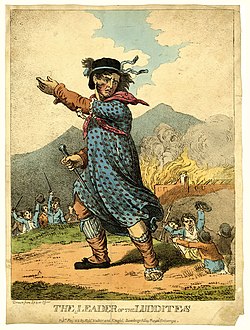
Engraving of Ned Ludd, Leader of the Luddites, 1812

Ned Ludd (/nɛd lʌd/)[1] is the legendary person to whom the Luddites attributed the name of their movement.[2]

In 1779, Ludd is supposed to have broken two stocking frames in a fit of rage. When the "Luddites" emerged in the 1810s, his identity was appropriated to become the folkloric character of Captain Ludd, also known as King Lud or General Ludd, the Luddites' alleged leader and founder.

History

[edit]

According to the legend, Ludd was a weaver from Anstey, near Leicester, England. In 1779, after either being whipped for idleness[3] or taunted by local youths,[4] he smashed two knitting frames in what was described as a "fit of passion".[5][6] This story can be traced to an article in The Nottingham Review on 20 December 1811, but there is no independent evidence of its veracity. John Blackner's book History of Nottingham, also published in 1811, provides a variant tale, of a lad called "Ludlam" who was told by his father, a framework-knitter, to "square his needles". Ludlam took a hammer and "beat them into a heap".[7] News of the incident spread, and whenever frames were sabotaged, people would jokingly say "Ned Ludd did it".[5][6]

By 1812, organised frame-breakers became known as Luddites, using the name King Ludd or Captain Ludd for their mythical leader. Letters and proclamations were signed by "Ned Ludd".[5]

[edit]

Music

[edit]
  • Ned Ludd was a Nottingham based blues rock band circa 1974/77 featuring Ian Belton (Guitar/Vocals), Chris Syson (Bass), Paul “Beano” Summers (Keyboards) Vince Noonan (Drums) later Billy Hammond (Drums).[8]
  • The character of Ned Ludd is commemorated in the folk ballad "The Triumph of General Ludd". Chumbawamba recorded a version of this song on their 2003 album, English Rebel Songs 1381–1984.
  • The Fall's song "Ludd Gang" (the B-side to "The Man Whose Head Expanded") is about Ned Ludd.
  • Robert Calvert wrote and recorded another song "Ned Ludd", which appeared on his 1985 album Freq; which includes the lyrics:

    They said Ned Ludd was an idiot boy
    That all he could do was wreck and destroy, and
    He turned to his workmates and said: Death to Machines
    They tread on our future and they stamp on our dreams.

  • Steeleye Span's 2006 album Bloody Men has a five-part section on the subject of Ned Ludd.
  • The Heaven Shall Burn song "The Final March" has a direct reference to Captain Ludd.
  • Alt-country band the Gourds affectionately refer to Ned Ludd as "Uncle Ned" in the song "Luddite Juice" from their 2009 album, Haymaker!.[9]
  • The Scottish folk musician Alasdair Roberts sings of Ned Ludd in his song "Ned Ludd's Rant (For World Rebarbarised)" on his 2009 album, Spoils.
  • San Diego punk band the Night Marchers included a song called "Ned Lud" on their 2013 album Allez! Allez!.
  • Neil Hannon of the Divine Comedy references Ned Ludd in the song "You'll Never Work in This Town Again" on their 2019 album, Office Politics.
  • Italian Hardcore punk band based in Rome Ludd Rising![10]

Literature

[edit]
  • Edmund Cooper's alternative-history The Cloud Walker (1973) is set in a world where the Luddite ethos has given rise to a religious hierarchy which dominates English society and sets carefully prescribed limits on technology. A hammer—the tool supposedly used by Ned Ludd—is a religious symbol, and Ned Ludd is seen as a divine, messianic figure.
  • The Fall of the Gas-Lit Empire, a steam-punk trilogy by Rod Duncan, describes a hypothetical world nearly 200 years after a successful Luddite revolution. The powerful and corrupt International Patent Office controls and restricts technological progress and Ned Ludd is given a similar status to Henry Ford in Brave New World.
  • The novel The Monkey Wrench Gang (1975), by Edward Abbey, is dedicated to Ned Ludd.
  • Ecodefense: A Field Guide to Monkeywrenching (1985) was published by Ned Ludd Books. Much of the content came from the "Dear Ned Ludd" column in the newsletter of the group Earth First!.
  • In the 2013–14 comic book miniseries Superman Unchained, a terrorist group called Ascension opposing modern technology uses the image of Ludd in its broadcasts.[11]
  • The Luddites were the inspiration for the 1922 play The Machine Breakers (Die Maschinenstürmer) by the German playwright Ernst Toller.
  • Ned Ludd is a character in the 2011 novel The Twelfth Enchantment by David Liss.

Television

[edit]

Other

[edit]
  • Ned Ludd, a restaurant in Portland, Oregon
  • The Ned Ludd, a craft beer pub on Friar Lane, Nottingham, is named after Ned Ludd.[12]
  • The video game Starsector features a faction opposed to AI and advanced technology known as the "Luddic Church", with an extremist offshoot faction known as the "Luddic Path", which are opposed to high technology.

See also

[edit]

References

[edit]
Revisions and contributorsEdit on WikipediaRead on Wikipedia
from Grokipedia
Ned Ludd, also known as Captain Ludd or General Ludd, was the legendary figurehead adopted by early 19th-century English workers who formed the movement to the introduction of mechanized knitting frames and looms that displaced skilled labor and depressed wages. The name originated from an apocryphal tale of a apprentice, possibly from Anstey, who in 1779 destroyed two stocking frames in anger, though no definitive evidence confirms Ned Ludd as a historical individual. From November 1811, Luddites across , , and issued threats and conducted nighttime raids signed in Ludd's name, smashing machinery while demanding better pay and conditions amid economic distress following the . The British government responded harshly, deploying troops comparable to those fighting , imposing , and executing or transporting over a dozen participants after trials, effectively suppressing the uprising by 1816. Though often caricatured as anti-progress reactionaries, the Luddites targeted specific technologies that enabled unskilled labor to undercut skills, reflecting a defense of craft traditions against capitalist reorganization rather than technology itself.

Legendary Origins

The Apocryphal Incident

The legend of Ned Ludd originates from an apocryphal event purportedly occurring in 1779 in Anstey, , where a young apprentice stocking weaver named Edward—or Ned—Ludd, frustrated by his master's reprimand for knitting too loosely or producing faulty work, retaliated by smashing two mechanical stocking frames with a . This impulsive act of destruction, described in later accounts as a "fit of passion," lacks verification in contemporary records and is widely regarded by historians as mythical, with no evidence confirming Ludd's existence or the incident's . The story frames Ludd as the symbolic progenitor of organized frame-breaking, transforming a personal grievance into a cautionary for against labor-saving machinery. By the early , frame-breakers invoked this legend in anonymous letters and manifestos, signing as "Ned Ludd" or claiming actions taken under his purported authority, thereby mythologizing the figure to lend legitimacy to their destructive tactics. These attributions, emerging amid rising , elevated the 1779 tale from to a rallying pseudonym, though the absence of primary sources from the era underscores its fabricated nature.

Potential Real-Life Inspirations

The legend of Ned Ludd originated in the textile-working communities of and , where oral among frame-work knitters described a young apprentice who, in a fit of rage around , destroyed a belonging to his master. This story, lacking contemporary documentation and first appearing in written form decades later, likely served as a or symbolic act of defiance against mechanized frames that threatened skilled labor. Historians note that such regional anecdotes in hosiery districts amplified the figure's mythic status, providing a relatable for anonymous protesters seeking to mask collective grievances under a single, pseudonymous leader. One candidate for a real-life basis is Edward Ludlam (sometimes spelled Ludlam or Luddlam), a resident of Anstey in during the mid-18th century, whose surname aligned with local dialect pronunciations of "Ludd." Parish records indicate Ludlam's burial in Anstey on August 31, 1776, and local histories portray him as a lowly-born individual, possibly of limited intelligence or mental instability, who may have engaged in disruptive behavior fitting the legend's narrative of frame-breaking in temper. However, no primary sources from the corroborate a specific incident involving Ludlam or a "Ned Ludd" destroying machinery, suggesting the connection relies on retrospective rather than verifiable events. The absence of direct archival evidence—such as court records, witness accounts, or frame-owner complaints from the purported 1779 episode—points to Ned Ludd's apocryphal construction, deliberately vague to enable widespread adoption in threat letters and manifestos without implicating individuals. This mythic amplification drew from broader folklore traditions, where workers in villages like Anstey and nearby hamlets invoked pseudoleaders to symbolize resistance, akin to earlier fictionalized figures in English protest lore. While no single historical person definitively inspired the name, the convergence of variants and localized stories in hotspots provided fertile ground for the legend's emergence.

Role in the Luddite Movement

Adoption as Symbolic Leader

In November 1811, the name first appeared in anonymous threatening letters sent to owners in , marking the persona's adoption as a symbolic commander of organized frame-breaking actions. One of the earliest documented examples is a letter dated 8 November 1811, addressed from "Ned Lud's Office" in to a local employer, warning of consequences for employing wide frames that undercut skilled knitters' livelihoods. These missives, often semi-literate and circulated prior to raids, positioned Ludd as the authoritative signatory directing "frame-breaking" to enforce compliance among manufacturers. The figure was rapidly elevated to "General Ned Ludd" or "King Ludd," portrayed in subsequent correspondence as a mythical general leading an "Army of Redressers" against mechanized production that displaced traditional artisans. Letters invoked Ludd's orders to destroy specific machinery, framing the acts as disciplined operations under his banner rather than sporadic , thereby lending a veneer of legitimacy and unity to the disparate groups of aggrieved workers. This militaristic depiction, evident in threats issued from and spreading to by early 1812, emphasized protection of skilled labor standards over outright rejection of technology. Employing a fictional leader conferred practical on the movement's coordinators, insulating real individuals from immediate identification and prosecution amid heightened by local authorities. By attributing directives to an apocryphal rooted in , organizers could disseminate threats and coordinate attacks without exposing personal networks, a tactic that amplified the campaign's reach while complicating attribution to specific perpetrators. This strategic veil persisted through the initial phase of activity in 1811–1812, enabling the to function as a rallying symbol detached from any verifiable historical individual.

Use in Threats and Manifestos

Luddite communications from 1811 and 1812 frequently invoked Ned Ludd, often styled as "King Ludd," "General Ludd," or simply "Ned Ludd," in threatening letters and posted directed at frame-work owners and manufacturers. These documents warned that Ludd's "regiment" or "army" would destroy unauthorized machinery, such as wide stocking frames or shearing frames, if not dismantled voluntarily. For instance, a dated 23 December 1811, signed "By order of King Ludd," threatened frame destruction and positioned the action as enforcement of traditional practices against fraudulent production methods. Similarly, a notice from 16 December 1811 under "Ned Lud" alerted the to convene with hosiers over price drops, threatening assembly of 20,000 men otherwise. Rhetorical appeals in these writings emphasized custom, historical , and artisan entitlements to fair wages tied to traditional methods. A key dated 1 1812, issued "By order of King Ludd," declared framework knitters empowered to demolish frames producing articles "in a fraudulent and deceitful manner," citing a 1663 and prior wage agreements as legal basis against innovations devaluing skilled labor. Letters to specific owners, such as one from early 1812 warning a holder of "detestable Shearing Frames" to remove them or face destruction by Ludd's men, framed machinery as violations of trade customs established by law and precedent, not mere economic threats but assaults on constitutional artisan rights. This symbolic invocation cast Ned Ludd as a quasi-military defender rallying against "unconstitutional" that undercut established livelihoods, with language mimicking official edicts—e.g., "Given under my hand" from Ned Ludd's "office"—to lend authority and inevitability to demands. Yet, despite the centralized imagery of Ludd commanding organized forces, the underlying operations remained decentralized and leaderless, with no evidence of a real individual coordinating from a fixed ; the served primarily as a unifying in written to intimidate without revealing operational structures.

Economic and Social Context

Textile Mechanization Pressures

The modification of traditional stocking into wide-frame variants, which doubled the width of , emerged in during the late 18th and early 19th centuries, enabling the production of "cut-up" from broader sheets of lower-quality material. These adaptations, operable by hand but requiring less skill, facilitated cheaper processes that undercut the market for high-quality, seamed produced on narrow by trained artisans. The resulting influx of inexpensive goods depressed prices, as wide allowed for rapid output of standardized, often inferior unsuitable for fine markets but viable for mass consumption. Hosiers increasingly rented frames to unqualified operators, known as "bag stockingers," who lacked the expertise to maintain frame precision or quality, further eroding product standards and . Skilled framework , dependent on piece-rate tied to output , faced systematic wage reductions as employers prioritized over craftsmanship, driving earnings toward subsistence levels amid frame rents that could consume up to half of weekly income. This practice, compounded by the truck system—payment in from frame-owning merchants—intensified financial strain, leaving many unable to cover costs, repairs, or basic needs. In textile hubs such as , where framework knitting dominated, the proliferation of approximately 20,000 frames by the early 1800s coincided with declining demand during the (1803–1815), amplifying displacement as overproduction outpaced export markets. Similar pressures afflicted woollen districts and cotton regions, where mechanized adaptations and wartime disruptions led to widespread idleness of hand-operated equipment, with thousands of frames standing unused by and skilled workers reporting earnings insufficient for survival. These dynamics directly linked machinery modifications to labor displacement, as employers' cost-cutting strategies prioritized short-term gains over sustaining artisanal employment structures.

Worker Grievances and Violence

The outbreaks of 1811-1812 centered on organized attacks against stocking frames modified for producing "cut-up" , a cheaper variety made by wide sheets of fabric that were subsequently cut and seamed into irregular , which undercut traditional full-fashioned methods and depressed product . These raids selectively spared frames adhering to established standards and norms, targeting instead those operated by non-apprenticed workers or used for substandard output. Worker grievances stemmed primarily from sharp wage reductions, with framework knitters experiencing drops of approximately one-third from 1800 levels by 1811, exacerbated by manufacturers' use of wide frames to produce low-value goods amid market saturation and . Threats issued in the name of Ned Ludd demanded restoration of traditional pay scales and enforcement of rules, reflecting tensions over employers' evasion of customary labor practices. Raids exhibited military-like discipline, conducted at night by groups of dozens to hundreds who assembled swiftly, dismantled targeted with precision—often removing jack-wires to render them inoperable—and dispersed without broader or personal violence. In alone, over 200 frames were destroyed in a three-week period in March 1811, contributing to a regional total exceeding 1,000 by early 1812.

Suppression and Historical Outcomes

Government and Military Response

In February 1812, the British Parliament passed the Frame-Breaking Act (52 George III c. 16), which declared the destruction or injury of stocking frames, lace frames, or other mechanized textile equipment a capital felony punishable by death, distinguishing it from ordinary property crimes by imposing the severest penalties to deter organized machine-breaking attributed to "Ned Ludd" and his followers. To enforce this legislation and safeguard industrial sites from raids—often proclaimed in letters signed by the fictitious "General Ned Ludd"—the government mobilized substantial military resources, deploying approximately 12,000 troops across the and northern counties by mid-1812, a force larger than that initially sent to the against and focused on garrisoning factories and patrolling vulnerable areas. Under commanders like General Thomas Maitland, these troops conducted night watches, raided suspected assembly points, and collaborated with local magistrates to suppress gatherings, while intelligence operations funded by county committees—such as Nottingham's allocation of £2,000 for informants—revealed the decentralized nature of cells, with no evidence of a singular historical Ned Ludd directing operations from hiding, but rather networks of local captains issuing threats in his name.

Trials, Executions, and Decline

The Luddite movement faced decisive legal suppression following high-profile raids, such as the April 11, 1812, assault on William Cartwright's Rawfolds Mill near , where armed workers failed to destroy machinery despite a force of approximately 100 men, resulting in two Luddite deaths and heightened government resolve. Authorities leveraged informants and spies to facilitate arrests, including in where raids like the April 1812 Westhoughton attack led to captures of suspects through betrayals by undercover agents posing as participants. The York Special Commission, convened from January 2 to 12, 1813, tried over 60 imprisoned men for Luddite-related crimes, including frame-breaking and murders tied to events like the Rawfolds raid and the killing of mill owner William Horsfall. Of those convicted, 17 were executed by hanging—a record for the assizes—while 6 received seven-year transportation sentences, and several others were acquitted or received lesser penalties, with the executions serving as public deterrents that left around 57 children fatherless. These trials, combined with military deployments and economic stabilization after the concluded in 1815, accelerated the movement's decline; sporadic violence resurfaced briefly in 1816 amid postwar depression but was quelled by continued repression, leading Luddites to pivot toward legal trade unionism by 1817 as business recovery reduced pressures.

Interpretations and Controversies

Justifications for Luddism Examined

Luddites and their sympathizers argued that , particularly wide knitting frames and power looms, deskilled artisans by replacing intricate handwork with simpler operations that employed lower-paid, less qualified labor, thereby eroding traditional structures tied to craftsmanship. This resistance was framed as a defense of workers' against employers who lowered piece rates to exploit cheaper machine output, preserving short-term in regions like and where jobs constituted a primary livelihood. Proponents, including some labor historians, liken these actions to proto-union efforts against unilateral technological imposition, emphasizing grievances over falling real earnings amid wartime inflation from 1811 to 1816. Counterarguments highlight that Luddite machine-breaking violated property rights, constituting criminal rather than legitimate protest, as machinery represented capital investments essential for scaling production beyond artisanal limits. Empirically, textile mechanization from the onward boosted by factors of tenfold in spinning and weaving, enabling of affordable goods that reduced costs and freed household budgets for , contributing to Britain's surge from 10.5 million in 1801 to 21 million by 1851 through improved caloric intake and health. While real wages stagnated or declined slightly during the Luddite peak (1811–1816) due to and rapid , they accelerated post-1819, rising steadily as gains outpaced pressures, with aggregate blue-collar earnings increasing amid falling prices for consumer staples. Romanticized narratives portraying Luddism as a pure class struggle between exploited workers and capitalists overlook causal realities: destruction neither halted nor significantly delayed adoption, as suppressed by 1817, yet mechanized output exploded, fueling export-led growth that comprised 40% of British production by value in the . Such views, prevalent in mid-20th-century leftist , underweight evidence that innovation's net effects—higher output per worker equaling twice real wage growth by mid-century—elevated living standards, as cheaper textiles and downstream efficiencies mitigated initial dislocations without reverting to pre-mechanized .

Debunking Romanticized Narratives

Romanticized narratives, particularly in modern left-leaning scholarship and media, portray Ned Ludd and the Luddites as heroic precursors to labor movements, valiantly resisting capitalist exploitation through targeted of dehumanizing machinery. In reality, their actions constituted deliberate property destruction equivalent to under contemporary legal frameworks, as frame-breaking directly violated owners' to capital investments essential for production. The British Parliament responded with the Frame-Breaking Act of 1812 (52 Geo. 3 c. 16), classifying the destruction of or frames—and by extension other mechanized tools—as a capital offense punishable by death, underscoring the state's view of such acts as felonious rather than justifiable protest. While Luddites selectively targeted wide-frame knitting machines and gig mills that undercut skilled labor by enabling cheaper, lower-quality output or unskilled operation, this precision did not mitigate the criminality or tactics employed against non-combatants. Their extended beyond factory owners to coerce fellow workers, issuing death threats and assaults on those who continued operating machinery or refused to join riots, as seen in the intimidation campaigns during the 1811-1812 uprisings in and . Such fractured communities, suppressing individual choice and enforcing through fear, which romantic accounts often gloss over in favor of a unified "class struggle" framing unsupported by the coercive dynamics on record. From a causal perspective, mechanization's short-term disruptions—wage compression and job displacement in textiles—were transitory phases in a broader surge that elevated Britain's global economic position. Resisting adoption through organized destruction deterred capital and technological diffusion, thereby extending periods of low-output agrarian rather than accelerating adaptation to higher-efficiency systems. By 1850, Britain's early industrialization had driven sustained growth, with beginning a marked rise after initial stagnation, correlating with its dominance that outpaced non-industrializing peers like and the Habsburg Empire in living standard improvements. Government suppression of Luddism, far from mere class repression, safeguarded property rights and , foundational to the secure environment that fueled this progress and prevented broader .

Legacy and Modern References

Evolution of the Term "Luddite"

Following the suppression of the Luddite uprisings in 1816, the term "Luddite" initially retained its association with the specific acts of frame-breaking in England's regions, as documented in contemporary government reports and trial records. By the 1830s, however, it had broadened into a label for broader resistance to , applied in parliamentary debates and periodicals to critics of steam-powered factories and agricultural implements, reflecting growing industrial expansion beyond textiles. This shift marked a detachment from the original movement's localized grievances, transforming "Luddite" into a generic slur for any opposition to labor-saving devices, often invoked by proponents of free-market industrialization to dismiss economic concerns as irrational backwardness. In the , the term experienced revival amid anxieties over automation's impact on employment, particularly during the and post-World War II era, when labor unions and economists debated machinery's role in persistent . By the , as and assembly-line emerged, "neo-Luddism" gained traction in intellectual circles, framing as a driver of dehumanizing rather than productivity gains, though empirical studies of the time showed net job creation through sectoral shifts. This usage solidified "Luddite" as a catch-all epithet for technoskepticism, detached from historical context and applied to figures questioning cybernetic systems or nuclear energy, prioritizing symbolic resistance over causal analysis of innovation's wage effects. Recent attempts to rehabilitate the term, such as Brian Merchant's 2023 book Blood in the Machine, recast Luddites as proto-labor activists against exploitative deployment of rather than machine-breaking per se, drawing parallels to contemporary gig economies and AI. Yet this narrative overlooks verifiable long-term outcomes: technological adoption, including ICT diffusion from onward, correlated with reductions in over 40 developing nations via enhanced agricultural yields and , halving rates globally from 36% in to under 10% by 2019. Such data underscore that while short-term disruptions occurred, machinery's causal role in elevating living standards—through compounded productivity—contradicts portrayals of Luddism as prescient foresight, rendering modern invocations more rhetorical than evidence-based.

Depictions in Culture and Media

Early 19th-century pamphlets and broadsides frequently invoked Ned Ludd as their purported leader, with documents signed in his name to proclaim threats against frame-breaking and machinery owners, portraying him as an authoritative organizer directing operations from secrecy. These writings, dated between and , presented Ludd as a mythical issuing formal declarations, consistent with the movement's attribution of machine destruction to his orders, though historical records indicate no verified individual by that name led the actions. Contemporary visual depictions in English cartoons illustrated Ned Ludd as an 18th-century workman, often armed or in , amid the riots, emphasizing his role as a symbolic saboteur rather than a goblin-like figure, with engravings showing him leading or inciting crowds in line with reported raids. In literature, modern novels such as Bobby Morris's 2012 Ned Ludd: He-Goose from Hell reconstruct Ludd's life as a fictional drawing on sparse evidence, depicting him as a central in the machine-breaking events, which embellishes the legendary aspects beyond verified 1779 incidents of frame-smashing attributed to a Leicestershire youth. Folk music traditions include ballads like "The Triumph of General Ludd," a traditional song referencing Ludd as a heroic resistor against mechanization, originating from the and preserved in oral histories, though it romanticizes the violence of organized attacks on factories documented in 1811-1812. Television portrayals feature Ned Ludd in the 2018 Big Hero 6: The Series episode "Muirahara Woods," where the character is reimagined as a reclusive developer, diverging significantly from historical textile worker associations by placing him in a contemporary sci-fi context unrelated to industrial unrest. The 2024 stage production The Legend of Ned Ludd at Liverpool's Everyman Theatre depicts Ludd amid worker protests against machinery through episodic scenes of strife, aligning loosely with 1811-1812 events but prioritizing dramatic snapshots over precise chronological fidelity to the Nottinghamshire and Yorkshire outbreaks.

References

Add your contribution
Related Hubs
User Avatar
No comments yet.