Hubbry Logo
Earth First!Earth First!Main
Open search
Earth First!
Community hub
Earth First!
logo
8 pages, 0 posts
0 subscribers
Be the first to start a discussion here.
Earth First!
Earth First!
from Wikipedia

Key Information

Earth First! is a radical environmental advocacy group[1] that originated in the Southwestern United States. It was founded in 1980 by Dave Foreman, Mike Roselle, Howie Wolke, Bart Koehler, and Ron Kezar.[2][3][4]

Inspired by several environmental writings, including Rachel Carson's Silent Spring, Aldo Leopold's land ethic, and Edward Abbey's The Monkey Wrench Gang, a small group of environmental activists composed of Dave Foreman, ex-Yippie Mike Roselle, Wyoming Wilderness Society representatives Bart Koehler and Howie Wolke, and Bureau of Land Management employee Ron Kezar, united to form Earth First. While traveling in Foreman's VW bus from the El Pinacate y Gran Desierto de Altar Biosphere Reserve in northern Mexico to Albuquerque, New Mexico, the group pledged, "No compromise in defense of Mother Earth!".

The co-founders of the group were called to action during the second "Roadless Area Review and Evaluation" (RARE II) by the U.S. Forest Service, which they considered a sell-out by mainstream environmental advocates. The activists envisioned a revolutionary movement, with the goal to set aside multi-million-acre ecological preserves all across the United States. Their ideas drew upon the concepts of conservation biology, which had been developing for over twenty years by notable scientists like E. O. Wilson; however, mainstream environmental groups were slow to embrace the new science. These events and ideologies coalesced after a grueling hike, as the men were headed toward Albuquerque. After "Foreman called out 'Earth First!', Roselle drew a clenched fist logo, passed it up to the front of the van, and there was Earth First!".[5]

Early years, from 1980–1989

[edit]

Earth First was founded on April 4, 1980,[3] by Dave Foreman, Mike Roselle, Howie Wolke, Bart Koehler, and Ron Kezar.[2]

During the group's early years (1980–1986), Earth First mixed publicity stunts (such as rolling a plastic "crack" down Glen Canyon Dam) with far-reaching wilderness proposals that reportedly surpassed the actions that mainstream environmental groups were willing to take (relying on conservation biology research from a biocentric perspective). The group's proposals were published in a periodical, Earth First! The Radical Environmental Journal, informally known as the Earth First! Journal. Edward Abbey often spoke at early gatherings, and his inspirational writings led him to be revered by the early movement.[citation needed] An annual gathering of the group was known as the Round River Rendezvous, with the name taken from an Ojibwa myth about a continuous river of life flowing into and out of itself and sustaining all relations.[citation needed] The rendezvous is a celebration with art and music, as well as an activist conference with workshops and recounts of past actions. Musicians such as Dana Lyons, Judi Bari, Daryl Cherney, Joanne Rand, Bart Koehler, Casey Neill and others performed regularly on Earth First! promotional roadshows as well as at gatherings, protests and blockades.[6] Another project led by the organization at this time was the creation of Earth First! Foundation, a tax-deductible fund which was established to provide financial support for research, advocacy and education by Earth First activists. The fund was later renamed the Fund for Wild Nature in 1991.[7]

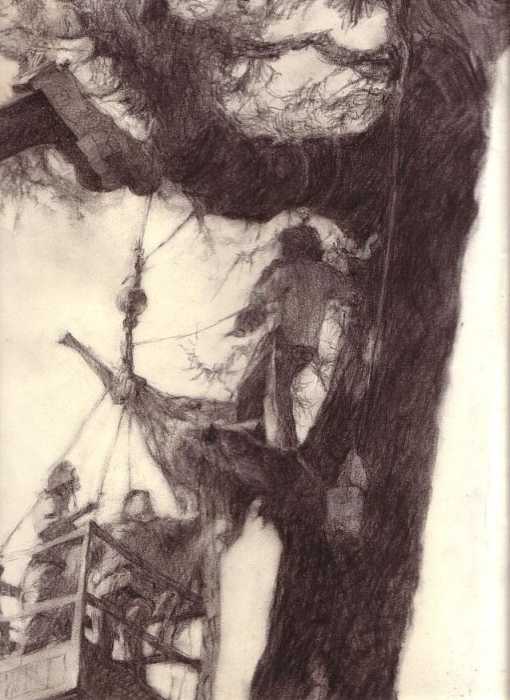
In the spring of 1985, a nationwide call to action against the logging company Willamette Industries, published in the Earth First! Journal, brought Earth First members from around the United States to the Willamette National Forest of Western Oregon.[8] After finding road blockades (carried out by Corvallis-based Cathedral Forest Action Group) were not an efficient form of protection against logging, Marylander Ron Huber and Washingtonian Mike Jakubal devised tree sitting as a more effective civil disobedience alternative.[9][10]

On May 23, 1985, Mike Jakubal led the first Earth First tree sit.[11] When U.S. Forest Service law enforcement official Steve Slagowski arrived, Mike Roselle, Ron Huber, and others were arrested for sitting at the base of the tree in support. The first "tree-sitting" lasted less than a day—Jakubal came down in the evening to look over the remains of the forest that had been cut down around him, and was arrested by a hidden Forest Service officer—but the tree-sitting concept was deemed sound by Earth First! members. Huber, Jakubal, and Roselle demonstrated the concept at the June 14 Washington EF Rendezvous;[12] on June 23, a convoy of activists arrived at Willamette National Forest and set up tree platforms[13] in "Squaw/Three timbersale",[14] a location the group thought was threatened with imminent destruction. While at one point, up to a dozen trees were occupied, on July 10 a clash[15] took down all the trees with platforms except for Ron Huber's after the other sitters had left for an overnight meeting elsewhere. Huber remained at his tree, dubbed Yggdrasil, until July 20 when two Linn County sheriff's deputies were lifted in a crane box[16] and wrestled him from the tree.

Direct action

[edit]

After 1987, Earth First became primarily associated with direct action to prevent logging, building of dams, and other forms of development which may cause severe destruction of wildlife habitats or the despoliation of wild places. The change in direction attracted many new members to Earth First, some of whom came from a leftist or anarchist political background or were involved in the counterculture.[citation needed] Dave Foreman has suggested that this led to the introduction of activities such as a "puke-in" at a shopping mall, a flag burning, the heckling of Edward Abbey at the 1987 Earth First rendezvous, and back-and-forth debates in the Earth First! Journal on topics such as anarchism, with which Foreman and other Earth First members did not wish to be associated. Most of the group's older members, including Dave Foreman, Howie Wolke, Bart Koehler, Christopher Manes, George Wuerthner, and Earth First! Journal editor John Davis, became increasingly uncomfortable with this new direction. This tension reportedly led several of the founders to sever their ties to Earth First in 1990. Many of them went on to launch the magazine, Wild Earth, as well as the environmental group, the Wildlands Project. On the other hand, Roselle, along with activists such as Judi Bari, welcomed the new direct-action tactics and leftist direction of Earth First.

Starting in the mid-1980s, Earth First increasingly promoted and identified with "deep ecology", a philosophy put forth by Arne Næss, Bill Devall, and George Sessions, which holds that all forms of life on Earth have equal value in and of themselves, without regard for their utility to human beings.

From 1990–present

[edit]

Since 1990, action within the Earth First movement has become increasingly influenced by anarchist political philosophy. This change brought a rotation of the primary media organ in differing regions,[clarification needed],[17][18] an aversion to organized leadership or administrative structure, and a new trend of identifying Earth First as a mainstream movement rather than an organization. In 1992, Earth First's push toward the mainstream movement led to the creation of an offshoot group called Earth Liberation Front.[19] The Earth Liberation Front was formally introduced during the 1992 "Earth First! Round River Rendezvous", where young activists debated the effectiveness of civil disobedience activism tactics in light of the ever-increasing destruction of the planet by human activity. Elders of the Earth First movement gave their blessing to this newly formed strike team known as ELF.[20] ELF became the extremists of the environmental movement, just as the Earth First movement itself had been when it was created a decade earlier.

Earth First protests commonly involved occupations of forested timber sale areas and other threatened natural areas. In these protests, dozens of people physically locked their bodies to trees, bulldozers, and desks using specially created lock boxes (metal tubes reinforced with rebar) through which protesters threaded their arms,[21][22] or using bicycle U-locks in order to lock their necks to other objects.

HeadWaters

[edit]

The HeadWaters campaign in Northern California aimed to protect the last old-growth redwood forests, Headwaters Grove (now known as Headwaters Forest Reserve) 3,000 acres (1,200 ha) of forest from logging by the Pacific Lumber Company.[23] Charles Hurwitz and his company Maxxam, Inc. purchased Pacific Lumber Company in 1985, and planned to liquidate its assets including these old-growth forests.[24][25][26]

In May 1987, sawmill worker George Alexander lost several teeth and fractured his jaw when the saw he was operating struck an 11-inch spike and fragmented, sending shrapnel into his face. This incident, which occurred at the Cloverdale Louisiana-Pacific mill in northern California, is alleged to have been caused by tree-spiking by Earth First members, but no conclusive evidence has been found to prove this.[27]

In 1997, as part of the ongoing HeadWaters Redwoods protests, activists locked themselves to a redwood stump which was carried into California Congressman Frank Riggs' office in Eureka.[28] HeadWaters was an ongoing protest lasting over a decade, and ending in 2009.[29]

The 1990s lawsuit, Headwaters Forest Defense vs. Humboldt County, charged that police officers were using excessive force, including chemical weapons.[30]

The first acknowledged death of an Earth First activist occurred on September 18, 1998, in Northern California's Redwood forests. Earth First activist David Nathan "Gypsy" Chain attempted to protect the forest by trespassing inside an active logging site. During the logging operations, a large redwood was cut down by a Pacific Lumber logger and fell upon Chain, who died instantly.[31]

Cove-Mallard Timber

[edit]

Between 1992 and 1998 took place the largest timber sale in United States Forest Service history, the Cove-Mallard timber sale of 6,000 acres in Idaho near the Nez Perce National Forest.[32] The group of EarthFirst activists focused on this area were called the "Cove-Mallard Coalition".[32]

With the aid of a nearby landowner, a former land developer turned activist, Earth First occupied the forest. As a result, Earth First succeeded in saving most of the threatened wilderness area. Over 350 people from 12 countries were arrested and the project was reduced from its initial plan of 200 clear-cuts and the construction of seven new roads, to 37 clear-cuts and two new roads. In June 1993, Earth First halted the construction of the Noble Road by erecting elaborate multi-layered barricades, which included U.S. Forest Service vehicles. These barricades were constructed in one night, during which activists traveled 17 miles through the mountains dodging law enforcement patrols who had been informed of the planned demonstration. The first tripod lockdowns occurred at this incident, which involved three 30 foot logs, tied together and placed upright, with an activist tied to a platform between them 20 feet in the air.[33] The tripod was placed over trenches in which four activists were buried in quick-drying cement. Two additional activists used U-locks to lock their necks to the front axles of responding vehicles. U.S. Forest Service shot at activists and raided the land with a SWAT team armed with M-16s.[34] 27 activists were arrested.

William "Avalon" Rodgers, a member of the Earth Liberation Front, who alongside the rest of his ELF group was also arrested and were serving life sentences in federal prison for crimes that involved property damage.[35][36] Rodgers was a long term Earth First activist, and one of the occupation activists of Free Cascadia/Warner Creek Oregon and the Cove/Mallard Idaho protests for years and one of four who constantly camped out in snow-caves monitoring the only logging of Noble Road in the winter of January to March 1995 in 12-foot deep snow and sub-zero temps.[37]

Free Cascadia

[edit]

During Free Cascadia, a mass occupation organized by Earth First at the Warner Creek timber sale in Oregon, 50-plus activists continuously occupied the burnt forested mountains of Oregon for a year in 1994-1995. They endured bad weather and law enforcement raids. Their barricades which were dug in reinforced trenches, forts with watchtowers, and tree-sits enabled a constant occupation of the land while lawsuits and political actions locally and in Washington D.C., ultimately saved the land.[38][39] Warner Creek is often seen an example of how the Earth First movement was successful, though most Earth First occupations of timber sales failed.

In the summer of 1995, environmental activists attempted to occupy the old-growth timber sale area of Sugarloaf Mountain in Southern Oregon. The Sugarloaf Mountain had been in legal battles for over a decade when the "Rider from Hell" was added in committee to the congressional Crime Bill of 1994, which mandated the logging of thousands of acres of old-growth forest.[40] The United States Forest Service declared an exclusionary zone of 30 square miles in southern Oregon and arrested anyone in the area, including a local woman walking her dog.[41] Over 100 federal agents, supported by helicopters and the elite US Army Ranger-trained law enforcement squad known as "Camo-Feddies," arrested hundreds of activists. The environmental activists engaged at all levels of protest with numerous public and illegal demonstrations by Earth First, protests at government offices locally and in Washington D.C., tree-sits in active logging zones, and even an attempted helicopter pad lock-down to immobilize logging helicopters. One tree from Sugarloaf timber sale, which was a four day long tree-sit by a local father and son Earth First team, required 9 log trucks to carry it out in sections.[42] This tree was estimated to be over 400 years old and took twenty-seven minutes to cut down using a 7-foot chainsaw.

Earth First responded by immediately occupying the nearby timber sale known as China Left in early October 1995 to defend the old-growth forest and the last wild salmon spawning grounds in Oregon. EF activists used dragon lock-boxes on both ends of the valley's only road to protect the area[43][clarification needed].[22][44][45] A female Earth First activist known as "Ocean" held the road for a day as police attempted to remove this human-and-cement blockade, allowing Earth First to dig in farther down the valley. This was the start of two-year-long occupation protest, during which a pickup truck was turned into a lock box to block the only bridge to the valley.[46]

Judi Bari car bombing

[edit]

In 1990, a bomb exploded in the car of Earth First activist Judi Bari, injuring Bari and fellow activist Darryl Cherney. Bari and Cherney were arrested due to suspicions by the police and Federal Bureau of Investigation that they had been transporting a bomb that had accidentally exploded.[47] Bari contended that extremists opposed to her pro-environmental actions had placed the bomb in her car in order to kill her. The case against them was eventually dropped due to lack of evidence.[48]

Bari died of cancer in 1997, but her federal lawsuit against the FBI and Oakland, California police resulted in a 2002 jury verdict awarding her estate and Darryl Cherney a total of $4.4 million.[49][50]

A documentary movie about the court case, entitled The Forest for the Trees, was released in 2006. It was directed by Bernadine Mellis, whose father is one of the lawyers featured in the documentary. The documentary Who Bombed Judi Bari?, directed by Mary Liz Thomson, was released in 2012. The filmmakers are offering a $50,000 reward for information leading the arrest of the bomber.[51][52]

On March 21, 2011, a U.S. federal judge in California ordered the FBI to preserve evidence related to the car bombing. The FBI was planning to destroy all evidence in the case.[53] The bombing remains unsolved.[49]

Protest and ecodefense

[edit]

Most activists of Earth First have previously participated in more moderate forms of environmental and political activism, including protest marches and writing letters to politicians. 'Fawn", an Earth Firster in the United States, grew up as a Republican, in a middle-class family.[54] Most members of Earth First identify as decentralized, locally informed activists whose ideas stem from communitarian ethics.[citation needed] One of the early critics of Earth First's change in tactics later accused the FBI of deliberately introducing the concept of Non-Violence to the group.[55]

In various parts of the United States, individual citizens and small groups form the base for grassroots political actions.[citation needed] These may take the form of legal actions, including protests, timber sale appeals, and educational campaigns or civil disobedience, including tree sitting, road blockades, and sabotage (also called "ecotage" by some Earth First members, who claim it is a form of ecodefense). Often, disruptive direct action is used primarily as a stalling tactic in an attempt to prevent possible environmental destruction while Earth First lawsuits try to secure long-term victories.[citation needed] Reported tactics include road blockades, activists locking themselves to heavy equipment, tree-sitting, and sabotage of machinery.[33][56][57][58]

Earth First was known for providing information in the Earth First! Journal on the practice of tree-spiking and monkeywrenching (or ecotage), although there is no evidence that Earth First was involved in related activity.[59] In 1990, Judi Bari convinced Earth First in the Northern California and Southern Oregon region to renounce the practice of tree-spiking, calling them counterproductive to an effort to form a coalition with workers and small logging businesses to defeat large-scale corporate logging in Northern California.[citation needed]

Police used non-lethal weapons and tactics against Earth First protesters including pepper spray, pain compliance holds, police dogs, and the threat of guns in attempts to coerce the protesters to abandon their lock downs.[30]

United Kingdom

[edit]
An arrest at the Liverpool docks (1992), with protestors occupying cranes in the background

The movement in the United Kingdom started in 1990, when a group in Hastings, Sussex organised an action at Dungeness nuclear power station in Kent. It grew rapidly, and many groups formed, with or without the EF name, over the next years.

The first major Earth First action happened in December 1991 at Port of Tilbury and focused around the importation of tropical hardwood. The second major action, the Merseyside Dock Action, attracted between 200–600 people who occupied Liverpool docks for two days. This action coincided with the Earth First roadshow, in which a group of UK & US Earth Firsters toured the country. Other early campaigns also focused on timber-yards, most notably the Timbmet yard in Oxford.[60]

There are now various regional Earth First groups, the "EF! Action Update" has been joined by the "EF! Action Reports website"[61] and a yearly Earth First national gathering.[62] At the first gathering in Sussex the debate focused on the use of criminal damage as a protest technique. Earth First decided to neither 'condemn nor condone' criminal damage, instead it focused more on non-violent direct action techniques. Some people at the gathering coined the term Earth Liberation Front (ELF), which became a separate movement and spread back to the US. Actions involving criminal damage often happened under cover of night, typically done under an ELF banner and attributed to elves and pixies, or the Earth Liberation Faeries, giving a distinctly British feel to the movement.

Major growth in the direct action movement started with a concurrent focus on roads, and a protest camp at Twyford Down was started, against the M3 in Hampshire. Whilst Earth First groups still played an essential part, other groups such as the Dongas tribe soon formed. Alongside SchNEWS, such publications as the "Earth First! Action Update",[63] and Do or Die[64] were means of communication between the groups. The movement grew to other road protest camps including the Newbury bypass, the A30 and the M11 link road protest in London, where whole streets were squatted in order to slow down the construction work. Later the focus widened to other campaigns including Reclaim the Streets, anti-genetics campaigns,[65] and Rising Tide. More recently, there have been groups such as Peat Alert![66] and Plane Stupid.[67]

The UK Earth First groups differed considerably from the U.S. groups as reported in a ten-year retrospective of the Earth First by two of the founders Jake Bowers and Jason Torrance:

We knew EF US's original hardline 'rednecks for wilderness' attitude wouldn't appeal here, so we set out to build a group that combined radical action and social justice to protect Britain's few remaining natural places.[60]

Seeing ecological and social justice as one and the same, in addition to organizing along anarchist lines and bringing in other radical and militant struggles, mixed with audacious actions and real radicalism spread the EF ideal to other countries and helped morph the US movement.

Sabotage

[edit]

Fairfield Snowbowl Ski Resort

[edit]

Earth First member Mark Davis was sentenced in Federal court to six years in prison for malicious destruction of property at the Fairfield Snowbowl Ski Resort near Flagstaff, Arizona, in concert with David Foreman, Ilse Asplund, Margaret Millett, and Mark Baker.[68] Davis had been charged with "using a torch to cut around the base of the top pylon of the main chair lift at Snowbowl on October 25, 1988."[69]

The resort attack, sabotage at Energy Fuels' Canyon uranium mine (6 miles southeast of Tusayan, Arizona), and attempting to cut down power-line towers leading to the Central Arizona Project aqueduct, were characterized as dress rehearsals for attacks on nuclear plants.[68]

Telluride Ski Resort

[edit]

On August 10, 1991, vandals identifying themselves as members of Earth First forced the closing of the Telluride Ski Resort in Mountain Village, Colorado using a chemical to write messages on 11 greens, such as "Earth First!", "Hayduke lives" and "Ron you pig".[70] In relation to the incident, the Telluride Times Journal received a letter signed "Earth First" stating that the ski lift had been sabotaged with a welding gas applied to the lift cable that weakens the metal.[70]

Aspen Pipeline Sabotage

[edit]

A gas pipeline in Aspen Colorado was sabotaged turning off heat to 3,500 people on December 29, 2020. The perpetrators wrote "Earth First!" on the pipeline.[71]

Filmography

[edit]

Documentary films

[edit]
Year Title Notes
1999 Pickaxe, the Cascadia Free State Story The film is based on the 1990s Earth First-led "Cascadia Free State"
2005 Testify! Eco-Defense and the Politics of Violence [72]
2009 Green With A Vengeance EF, along with the ELF, were the subject of this documentary film.[73]
2011 If a Tree Falls: A Story of the Earth Liberation Front EF, along with the ELF, were the subject of this documentary film.[74]

See also

[edit]

References

[edit]

Further reading

[edit]
[edit]
Revisions and contributorsEdit on WikipediaRead on Wikipedia
from Grokipedia
Earth First! is a radical environmental advocacy group founded on April 4, 1980, by Dave Foreman, Mike Roselle, Howie Wolke, Bart Koehler, and Ron Kezar in the , emphasizing biocentrism—the principle that all living organisms possess equal intrinsic value—and rejecting compromise in preservation. The organization's core tenets include recognizing 's right to exist independently of human utility, prioritizing Earth's ecosystems over anthropocentric interests, and employing tactics such as and "monkeywrenching"— of machinery to disrupt , , and road-building operations—under the slogan "No Compromise in Defense of Mother Earth." Early campaigns focused on blocking dam constructions, road developments in national forests, and timber harvests, with actions like tree-sitting and equipment tampering drawing media attention to ecological threats in the 1980s and 1990s. While these efforts delayed specific projects and heightened public awareness of habitat loss, empirical assessments indicate limited long-term wilderness preservation, as monkeywrenching often provoked legal crackdowns and industry countermeasures without addressing underlying policy drivers. Controversies arose from tactics like , which risked injuring loggers and prompted federal investigations into , with the FBI classifying such activities as threats involving , , and property destruction despite claims of non-violence by participants. Internal schisms, including Foreman's expulsion amid debates over human population critiques and Judi Bari's push for labor alliances, fragmented the group, underscoring tensions between purism and broader social activism.

History

Founding and Early Development (1980–1985)

Earth First! was founded on April 4, 1980, by five conservationists—Dave Foreman, Mike Roselle, Howie Wolke, Bart Koehler, and Ron Kezar—who sought to counter what they viewed as the insufficient militancy of established environmental organizations such as the and Wilderness Society. Disillusioned with compromise-driven lobbying, the founders emphasized uncompromising defense of wilderness areas, drawing inspiration from Edward Abbey's novel and principles of that prioritize the intrinsic value of non-human life. The group's inception occurred during a gathering in the desert, where participants formalized their commitment to radical tactics amid concerns over escalating threats to southwestern wildlands from logging, mining, and development. In its initial phase, Earth First! focused on building a network through informal rendezvous, such as the inaugural Round River Rendezvous held in , in late 1980, which served as a platform for strategy discussions and cultural bonding among activists. The organization eschewed hierarchical structure, operating as a loose without formal membership dues or bureaucracy to maintain ideological purity and agility. Early efforts centered on symbolic publicity to raise awareness, culminating in the group's first major public action on March 21, 1981, at in , where activists unfurled a 300-foot black plastic banner simulating a structural crack to dramatize the dam's environmental impacts and symbolize potential collapse. This event, attended by , marked Earth First!'s debut in media consciousness and established a pattern of theatrical to bypass mainstream channels. By 1983, Earth First! had expanded outreach via its bimonthly Earth First! Journal, launched to disseminate news, tactics, and calls for wilderness protection, while initiating low-level interventions like road blockades in national forests to disrupt logging operations. The period saw growing emphasis on biocentric advocacy, rejecting anthropocentric reforms in favor of halting industrial expansion outright, though internal debates over sabotage tactics—termed "monkeywrenching"—remained nascent and not yet systematized. A pivotal development occurred in 1985 with the introduction of tree-sitting in Oregon's Willamette National Forest, where activists occupied platforms in old-growth trees to physically impede timber harvests, pioneering a tactic that combined non-violent with heightened visibility. These actions, numbering fewer than a dozen major events annually in the early , reflected a deliberate shift from mere to on-the-ground defense, amassing a small but dedicated cadre of supporters primarily in the American Southwest.

Growth and Key Actions in the 1980s

Following its founding in April 1980 by Dave Foreman and four associates in the , Earth First! experienced rapid organizational growth through the dissemination of its quarterly journal, regional rendezvous gatherings, and the establishment of autonomous chapters. By 1984, membership had swelled into the thousands, with Foreman transitioning to full-time management of the group, enabling coordinated campaigns beyond initial symbolic protests. Expansion initially concentrated in western states like , , , and , but after 1984, it extended eastward via road trips and outreach, fostering over 1,100 reported actions by decade's end, including marches, office occupations, and confrontations with firms. Key early actions emphasized dramatic symbolism to draw media attention, such as the March 21, 1981, "Crack the Dam" protest at in , where activists unfurled a 300-foot black plastic sheet simulating a fissure to protest water infrastructure's ecological impacts. By 1983, tactics shifted toward high-stakes direct interventions against logging, incorporating road blockades, tree-sitting, and equipment sabotage under the rubric of "monkeywrenching"—non-lethal disruptions like spiking trees or disabling machinery to delay timber harvests. These methods proliferated in old-growth forests, exemplified by the 1987 California redwoods action where six members ascended ancient trees, established elevated camps with banners, and suspended logging operations for one week without arrests. The group's no-compromise stance amplified its visibility but invited scrutiny, culminating in federal investigations; on May 29-30, 1989, Foreman and four others faced arrest as the "Arizona Five" for allegedly plotting to power lines near a nuclear plant, charges later reduced but highlighting tensions between Earth First!'s biocentric advocacy and perceptions of . The journal served as a critical tool for strategizing these actions, debating tactics like blockades versus , though internal divisions over violence and began surfacing by mid-decade. Overall, the 1980s marked Earth First!'s from fringe provocation to a decentralized network influencing broader , albeit with actions that prioritized preservation over legal norms.

Shifts and Campaigns in the 1990s

In 1990, Earth First! underwent a significant internal shift when co-founder Dave Foreman resigned amid ideological conflicts, marking a fracture between wilderness biocentrists and activists emphasizing broader social critiques. Foreman and his wife Nancy Morton publicly split from the group, arguing it had veered toward excessive anti-human rhetoric and away from core wilderness defense priorities. This departure, following FBI infiltration and prosecutions in the late 1980s, prompted a leadership transition and tactical reorientation toward intensified civil disobedience, tree-sits, and legal challenges over outright sabotage, influenced by mounting legal risks and debates on non-violence. The group's journal and rendezvous reflected these tensions, with Foreman launching Wild Earth to pursue rewilding without Earth First!'s evolving anarchistic elements. A pivotal campaign was Redwood Summer in 1990, a three-month mobilization co-organized with the (IWW) to halt old-growth redwood logging by Corporation in . Modeled on the 1964 Mississippi , it trained over 1,000 activists in non-violent tactics, including blockades and rallies, but faced violent backlash, including the May 24 car bombing of organizers and Darryl Cherney, which injured Bari severely and was never conclusively solved despite FBI accusations against the victims. The effort disrupted operations temporarily but failed to stop logging outright, highlighting Earth First!'s media-savvy direct actions amid escalating Timber Wars. Headwaters Forest campaigns dominated the early-to-mid 1990s, with Earth First! activists conducting tree-sits, protests, and mapping expeditions against MAXXAM Corporation's clear-cutting of the 3,000-acre ancient grove since its 1985 identification by the group. These actions, including high-profile occupations, pressured federal intervention, culminating in the U.S. government's $480 million purchase of 7,500 acres in 1999 for preservation, though smaller adjacent parcels remained threatened. Tragically, in September 1998, activist David "Gypsy" Chain was killed by a falling tree during a confrontation with Pacific Lumber loggers, underscoring the campaign's hazards. Later in the decade, the Warner Creek blockade in Oregon's Willamette National Forest exemplified sustained resistance to post-fire "salvage" . From August 1995 to February 1996, Earth First!-aligned activists, including Cascadia Forest Defenders, maintained a year-long road occupation with trenches, platforms, and communal camps, defying over 500 arrests and halting the U.S. Forest Service's timber sale of 3,000 acres. This success, one of the longest U.S. environmental blockades, prevented in the watershed and influenced policy shifts against controversial salvage practices.

Post-2000 Activities and Decline

In the early , Earth First! collectives maintained campaigns focused on forest defense and anti-logging efforts, exemplified by the McKay Tract tree-sit in , where activists occupied trees starting in August 2008 to protest Green Diamond Resource Company's timber harvest plans, ultimately contributing to the suspension of certain operations by 2012. Groups also supported animal liberation actions, such as the 2011 cutting of nets in that released approximately 40,000 fish from a holding pen, claimed as one of the largest such liberations in U.S. history. Annual events, initiated in 2004 to support imprisoned eco-activists like Jeff Luers, expanded to dozens of cities by the 2010s, fostering solidarity with those convicted in cases. By the mid-2000s, intensified federal scrutiny under post-9/11 counterterrorism measures labeled radical environmental actions as "," culminating in Operation Backfire, which from 2004 to 2006 led to over a dozen arrests and lengthy sentences for individuals linked to arsons dating back to 1995, many of whom had ties to Earth First! networks. This repression extended to and infiltration; for instance, U.S. and deployed undercover officers in activist circles from the late 1990s through 2010, including cases like PC Mark Kennedy, who posed as an Earth First!-style activist for seven years, compromising operations and eroding internal trust. Such tactics, revealed through court documents and leaks, resulted in fewer high-profile monkeywrenching incidents and a shift toward decentralized, lower-risk . The group's influence waned as mainstream environmental organizations absorbed broader public attention on issues, reducing the perceived necessity for no-compromise tactics, while legal risks deterred participation; underground actions by affiliated cells sharply declined after 2006 convictions, with the Earth First! Journal noting a pivot to reporting on protests against pipelines and mining rather than leading mass blockades. Recent efforts, such as opposition to lithium mining in Nevada's Thacker Pass since 2020, have faced ongoing FBI and private security , as documented in 2025 , further constraining mobilization. Despite quarterly Journal publications into the , membership and media coverage have not matched 1980s-1990s peaks, reflecting a broader contraction in radical ecological amid institutional co-optation and prosecutorial pressure.

Ideology and Principles

Deep Ecology Foundations

Deep ecology, a philosophical framework articulated by Norwegian philosopher in 1972, posits that all living beings possess intrinsic value independent of their utility to humans, rejecting anthropocentric views that prioritize human interests above ecological integrity. This approach contrasts with "shallow ecology," which focuses on environmental reforms to sustain human welfare, by advocating a profound reorientation of human attitudes toward the , including recognition of the equality of species in principle and the need for substantial reductions in human population and consumption to preserve . Næss and collaborator George Sessions formalized eight platform principles in the , emphasizing the richness of life forms, limits on human interference to vital needs only, long-term ecological consequences of and depletion, critique of affluent , and personal obligations to implement these changes through policy and shifts. Earth First!, founded in 1980 by Dave Foreman and associates including Bart Kohler, Mike Roselle, and Howie Wolke, explicitly grounded its ideology in as a rejection of mainstream environmentalism's compromise-oriented tactics. Foreman, drawing from Næss's ideas encountered through readings and discussions, positioned the group to defend and not as resources for human benefit but as ends in themselves, embodying "biospherical egalitarianism" where non-human life holds equal moral standing. This foundation manifested in Earth First!'s core slogan, "No Compromise in Defense of Mother Earth," which echoed 's call for radical action against industrial development threatening ecosystems, such as and , without concessions to economic or human-centered justifications. The adoption of distinguished Earth First! from reformist groups like the , fostering a biocentric that viewed human expansion as a primary driver of planetary degradation, necessitating defensive measures to restore ecological balance. Foreman's writings, including contributions to the group's journal and books like Ecodefense (1985), reinforced this by arguing that demanded active resistance to "war on the wild," prioritizing the health of intact ecosystems over human or technological fixes. While 's emphasis on through identification with nature influenced Earth First!'s activist ethos, it also drew internal debates, as some members later critiqued its potential for undervaluing human needs in favor of absolute wilderness preservation.

Biocentrism and Anti-Anthropocentrism

Earth First! adopts biocentrism as a core tenet, asserting that all forms of life possess intrinsic value equivalent to that of humans, independent of their instrumental benefits to people. This perspective frames humans as one species among millions, without hierarchical superiority, and prioritizes the preservation of and ecosystems over human economic or recreational interests. The group's philosophy holds that "life exists for its own sake," rejecting utilitarian arguments that justify for human advancement. Central to this biocentric outlook is a profound anti-anthropocentrism, which explicitly denounces human-centered worldviews that treat as a mere for exploitation or "nature for people's sake." Earth First!ers view industrial civilization's expansion—driven by , extraction, and development—as a direct assault on the biosphere's integrity, equating it with an "anti-Earth" ethos that subordinates non-human life to desires. This stance demands the defense of areas in their unaltered state, advocating for the restoration of habitats and the reintroduction of extirpated to maintain ecological balance, rather than mere mitigation of human impacts. The 1981 Earth First! Introductory Guide codifies this ideology, defining an "Earth First!er" through adherence to biocentrism—or —and the uncompromising practice of placing planetary needs above human ones. Founder Dave Foreman reinforced this by promoting "visionary wilderness proposals" that challenge anthropocentric conservation efforts, such as those of mainstream groups, which often compromise for human-compatible uses like timber harvesting or recreation. By 1980, at the movement's inception during a , gathering, participants adopted the slogan "No Compromise in Defense of Mother Earth," encapsulating the commitment to biocentric action against perceived ecocidal policies.

No-Compromise Philosophy

The no-compromise philosophy of Earth First! is encapsulated in its foundational motto, "No Compromise in Defense of Mother Earth!", coined by co-founder Dave Foreman during the group's inception in April 1980 while on a through the American Southwest with fellow environmentalists disillusioned by mainstream conservation efforts. This slogan rejected any form of or concession with industrial developers, agencies, or even moderate environmental organizations that accepted partial protections or land trades, which Foreman and others viewed as enabling ongoing ecological destruction. The philosophy positioned Earth First! as a radical alternative, insisting on the absolute preservation of areas without dilution for human economic interests, such as , , or expansion. Central to this stance was a critique of established environmental groups like the Sierra Club and Wilderness Society, which Earth First! founders accused of bureaucratic inertia and willingness to barter irreplaceable wild lands for incremental legislative gains, such as during the U.S. Forest Service's Roadless Area Review and Evaluation (RARE II) process in the late 1970s. Foreman argued that such compromises perpetuated a cycle of habitat loss, as partial victories often led to further encroachments rather than halting exploitation outright. By adopting an uncompromising posture, Earth First! aimed to shift the Overton window of environmental discourse toward biocentric absolutism, where ecosystems held intrinsic value warranting total defense, unmediated by anthropocentric priorities like jobs or development. This approach drew inspiration from deep ecology's emphasis on the equality of all species but operationalized it through a militant rejection of reformism, asserting that only unyielding resistance could counter the causal drivers of biodiversity decline, including unchecked population growth and resource extraction. In practice, the no-compromise philosophy informed Earth First!'s advocacy for immediate, non-negotiable actions to protect specific sites, such as roadless areas totaling over 192 million acres identified in RARE II, refusing any designation short of full status. It also justified the group's tolerance for high-risk tactics, viewing legal channels and political lobbying as inherently flawed due to their susceptibility to co-optation by powerful interests. While this stance galvanized early activism—contributing to heightened public awareness and some policy shifts, like expanded designations in the 1980s—it drew criticism from within the broader for alienating potential allies and prioritizing ideological purity over pragmatic gains. Foreman's writings, including in the Earth First! Journal, reinforced this by framing compromise as moral capitulation, urging supporters to defend the planet with the same fervor historical conservationists like applied to unspoiled nature.

Tactics and Methods

Civil Disobedience and Blockades

Earth First! employed as a core tactic to impede environmentally destructive projects, emphasizing non-violent direct actions like tree-sitting and road blockades that physically halted operations while generating public awareness. These methods drew inspiration from civil rights-era protests, positioning activists' bodies as barriers against machinery and crews in remote wilderness areas. Tree-sitting emerged as a hallmark technique, with activists erecting platforms high in old-growth trees to prevent access and . The group introduced this tactic in in 1985, where protesters occupied canopies for days to block timber harvests. In California redwoods, examples included a 1987 action where six members scaled large trees, established branch camps with supplies and banners, and suspended for one week without arrests. Another instance occurred on April 13, 1988, when Greg King and Jane Cope occupied trees at 250 feet along near Honeydew, displaying anti- banners and prompting equipment removal costs billed to activists. Road and equipment blockades involved chaining or locking bodies to gates, bulldozers, and trucks, directly obstructing access in forested sites. In the redwoods during the , such interventions slowed timber extraction and accrued trespassing charges, with over 150 actions recorded by 1989—one roughly every two weeks. These efforts often resulted in confrontations with , yielding arrests but minimal long-term deterrence without broader legal or media pressure. The Redwood Summer campaign of 1990 exemplified scaled-up blockades and sit-ins in Humboldt County, mobilizing around 3,000 participants for mass non-violent protests modeled on Mississippi Freedom Summer. Initial rallies drew 500 people, culminating in 44 arrests on from road occupations and tree defenses, though a subsequent bombing disrupted momentum. Across the group's first decade, civil disobedience accounted for over 1,100 events concentrated in western states like , , and , frequently leading to temporary halts in development but straining relations with authorities.

Monkeywrenching and Sabotage Techniques

Monkeywrenching, a term popularized by Earth First! co-founder Dave Foreman, refers to direct sabotage actions intended to delay or prevent environmentally destructive industrial projects, such as and road-building, by targeting equipment and . These tactics, outlined in the 1985 publication Ecodefense: A Field Guide to Monkeywrenching edited by Foreman and others, emphasize nonviolent methods that avoid harm to humans while increasing economic costs for developers to protect wilderness areas. The guide, compiled from contributions to the Earth First! Journal, frames monkeywrenching as strategic of ecosystems, advocating small, anonymous teams for security and selection of high-impact vulnerabilities like heavy machinery. Tree spiking emerged as one of the most prominent techniques, involving the insertion of metal rods, ceramic pins, or quartz spikes into tree trunks to damage chainsaws or mill blades during logging attempts. Practitioners hammered 3- to 6-inch spikes, often coated in silicon caulk for concealment, into the base or upper trunk of targeted trees, with the goal of deterring harvest without direct confrontation. Though predating Earth First! by decades, the group amplified its use in the 1980s against old-growth timber operations, such as in Pacific Northwest forests, where spikes like 1/2-inch rebar or 60-penny nails were recommended for durability. Equipment sabotage targeted construction and logging machinery, including bulldozers, trucks, and excavators, through methods like pouring abrasives such as sand or into fuel tanks, oil reservoirs, or hydraulic systems to cause mechanical failure. Other approaches included cutting hydraulic hoses with bolt cutters, slashing tire sidewalls, or introducing water into fuel lines, all designed to impose repair delays and costs exceeding thousands of dollars per incident. The Ecodefense manual stressed timing these acts at night or during low-activity periods, using disposable tools to evade detection. Road and access disruption techniques encompassed road spiking with protruding rebar stakes or caltrops to puncture vehicle tires, and culvert plugging using , expanding , inner tubes, or debris to flood or erode logging roads. Culverts, critical for drainage, were filled to capacity—such as with sandbags for larger 16-inch pipes—often synchronized with impending storms to amplify and repair expenses. Survey stake removal, a simpler method, involved uprooting marked stakes from development sites to halt and , delaying projects by weeks or months with minimal tools. Additional methods included billboard alteration or destruction—sawing remote structures or defacing them with paint-thinner mixtures—and lock jamming with superglue or toothpicks to impede access to gates and vehicles. cutting targeted ranching , snipping wires near high-value sections to release or grazing impacts, while trap line used wire cutters to dismantle snares protecting . Earth First! maintained that these acts constituted ethical ecodefense, not , as they spared life and focused on industrial overreach, though federal laws like the 1988 Anti-Drug Abuse Act classified as a punishable by up to a year in .

Media and Symbolic Actions

Earth First! utilized the Earth First! Journal, established in , as a central communication tool to connect dispersed activists, share tactical insights, and propagate its biocentric ideology through articles on campaigns, critiques of industrial development, and calls for . The bimonthly publication, initially mimeographed and later professionally printed, reached thousands of subscribers by the mid-1980s, fostering a network that coordinated nationwide efforts while bypassing mainstream media filters. The group strategically leveraged dramatic, visually compelling actions to secure media coverage and frame environmental degradation as a moral crisis, drawing from influences like Greenpeace's media-savvy protests but emphasizing confrontation over spectacle. Early efforts from 1980 to 1983 focused on symbolic outreach, including rallies and cultural events infused with wilderness mythology, such as renditions of "rhythm of the wild" chants to evoke primal resistance against anthropocentric policies. These were intended to build public sympathy and pressure institutions, though Earth First! increasingly critiqued purely theatrical gestures as inadequate, arguing that symbolic refusal to compromise itself symbolized unyielding defense of ecosystems. Specific symbolic tactics included costumed protests, such as activists dressing as spotted owls in the late to highlight logging threats to old-growth forests and subvert U.S. Forest Service icons like , thereby contesting official narratives through counter-discourse. In broader campaigns, like the 1990 Redwood Summer initiative, symbolic elements—banners decrying corporate , mock funerals for felled trees, and human chains blocking roads—were paired with nonviolent blockades to generate widespread press attention, resulting in coverage across national outlets and amplifying calls to protect 3,000-year-old redwoods from Louisiana-Pacific's operations. Earth First!'s agitative , featuring slogans like "No Compromise in Defense of Mother Earth!" and confrontational appeals to biocentric , was calibrated to provoke ethical debates in media, positioning the group as agitators against industrial "rape" of while inviting scrutiny of their methods. This approach yielded both supportive reporting in alternative press and adversarial framing in mainstream sources, which often labeled actions as to underscore the group's intent to disrupt complacency.

Major Campaigns

Headwaters Forest Defense

The Headwaters Forest Defense campaign, initiated by Earth First! activists, targeted the preservation of approximately 7,500 acres of old-growth redwood forest in , threatened by operations conducted by the (PL) following its 1985 by Maxxam Corporation. North Coast Earth First! members discovered and mapped the area in 1987, identifying it as the Headwaters Forest Complex due to its role as the source of several salmon-bearing streams, and publicized its ecological significance through trespass expeditions and photography of ancient groves averaging 2,000 years old. The campaign emerged in response to Maxxam's accelerated logging to service $750 million in debt, which environmental groups argued undermined PL's prior sustainable practices. Earth First! launched initial actions in October 1986 with a demonstration at PL's San Francisco office, co-led by founders Dave Foreman and Mike Roselle, announcing a boycott of redwood products and allying with figures like David Brower of the Sierra Club. In May 1987, approximately 150 protesters blockaded logging trucks at the Fisher Gate entrance to PL property, resulting in multiple arrests and marking the first major direct action. That year, Earth First! pioneered redwood tree-sits, with an initial attempt in May thwarted by company crews, followed by successful occupations in August and September by activists Greg King and Marybeth Nearing to halt timber harvest in contested groves. These nonviolent tactics escalated through the late 1980s and 1990s, including alliances with the Environmental Protection Information Center (EPIC) and locked-out steelworkers opposing Maxxam's financial maneuvers. The 1990 Redwood Summer initiative, organized by Earth First! and drawing thousands of volunteers, intensified defenses through widespread tree-sits, road lock-ons, and protests against across timberlands, including Headwaters; the campaign was disrupted on May 24 when Earth First! organizer was bombed during a in Oakland. Subsequent years featured sustained tree-sits, base camps, and symbolic actions, such as the 1993 Week of Outrage with a logger-occupied tree-sit to highlight worker-activist tensions. Peak mobilization occurred in September 1996, when 6,000 rallied and 1,033 engaged in at Fisher Gate, the largest such arrest event in U.S. at the time. In September 1997, 8,000 attended a rally amid ongoing blockades. Tragically, on September 17, 1998, Earth First! activist David Nathan "Gypsy" Chain, 24, was fatally struck by a falling tree during a confrontation with a PL logger near a tree-sit, prompting further blockades and investigations that found no criminal charges against the company. Earth First!'s persistent direct actions, combined with legal challenges from allied groups and economic pressure via boycotts, contributed to negotiations culminating in the March 1, 1999, Headwaters Agreement, under which federal and state governments acquired 7,472 acres for $480 million, establishing the Headwaters Forest Reserve with restrictions on adjacent . The deal also mandated plans for 11 additional old-growth sites and restoration, though critics noted it allowed some continued harvesting on surrounding PL lands until bankruptcy in transferred operations to Mendocino Redwood Company under stricter regulations. Post-purchase monitoring by Earth First! and partners ensured compliance, with the reserve opening to limited public access by 2001.

Cove-Mallard Timber Conflicts

The Cove-Mallard timber conflicts arose from opposition by Earth First! and allied groups to U.S. Forest Service timber sales in the Cove-Mallard area of the Nez Perce National Forest, located approximately 80 miles southeast of . Protests began in 1992, targeting planned logging in roadless old-growth stands critical for wildlife habitat, including elk migration corridors, amid broader debates over forest management post-Northern listings. Activists argued the sales would fragment ecosystems and exacerbate road networks detrimental to biodiversity, while the Forest Service maintained the harvesting complied with multiple-use mandates and economic needs for local timber-dependent communities. Earth First! coordinated annual summer direct actions starting in 1992, emphasizing through road blockades, tree-sitting, and equipment interference to halt road-building and logging operations. These efforts generated over 200 arrests by 1996, with protesters physically occupying sites to delay crews, often leading to confrontations with and timber workers. Tactics escalated with allegations of —driving metal rods into trees to damage chainsaws—and , such as damaging logging roads and equipment in June 1996, actions condemned by both environmentalists and industry for endangering workers. A 1995 anonymous letter claimed spiking in the area, prompting joint denials from activists and loggers while heightening tensions. Legal repercussions were severe, reflecting judicial impatience with repeated violations. In 1995, U.S. District Judge Mikel Williams sentenced 10 protesters to seven days in jail for entering closed areas during blockades. A 1998 Idaho jury awarded $1.15 million in against 12 Earth First! members for , one of the largest civil penalties against environmental activists at the time, covering repairs and lost . Courts issued injunctions against further disruptions, though temporary stays were granted; appeals to overturn convictions for spiking and related acts failed by 1999. Forest Service personnel reported operational slowdowns but affirmed that Cove-Mallard sales represented only about 8% of the district's harvestable land, with much already previously logged. The campaign highlighted Earth First!'s no-compromise stance but drew criticism for economic impacts on rural jobs and for tactics verging on sabotage, which risked alienating moderate environmental support. Protests persisted into the late , influencing broader roadless area protections under the 2001 Roadless Rule, though Cove-Mallard logging proceeded in phases, underscoring the limits of against federal timber programs. Industry groups countered with organized responses, including labor alliances like Teamsters, framing the conflicts as external agitation against local livelihoods.

Judi Bari Bombing and Aftermath

On May 24, 1990, a concealed beneath the driver's seat detonated in the car driven by Earth First! organizer in , as she traveled with fellow activist Darryl Cherney to a rally planning event. The explosion severely injured Bari, fracturing her pelvis, lacerating her spleen, and embedding nails from the device into her body, while Cherney sustained shrapnel wounds and hearing damage; both survived but Bari faced lifelong health complications. Despite forensic evidence placing the three pipe bombs—two of which were motion-activated and packed with nails—under the seat without prior knowledge by the occupants, the FBI and arrested Bari and Cherney within hours, charging them with possession and transportation of explosives. The arrests drew immediate criticism from Earth First! members and advocates, who viewed them as an attempt to discredit the group's nonviolent timber industry campaigns in ; charges were dropped two days later after search warrants yielded no incriminating evidence in 's home. In 1991, and Cherney filed a federal lawsuit against the FBI and Oakland PD, alleging , , and First Amendment retaliation amid broader suspicions of federal infiltration into environmental movements reminiscent of tactics against prior activists. The case proceeded to in 2002, after 's , where a found the defendants liable for violating the plaintiffs' to free speech and assembly, awarding $4.4 million in damages—$2.9 million to 's estate and $1.5 million to Cherney—with 80% attributed to constitutional violations. No perpetrator was ever identified or prosecuted for the bombing, though a letter postmarked from Fresno claimed responsibility on behalf of "the Lord's Avenger," detailing the device's construction and motive tied to opposition against perceived ; investigations stalled without leads. , a key figure in shifting Earth First! toward labor-allied, nonviolent strategies against corporate , continued from a until her death from on March 2, 1997, at age 47, which some supporters speculated was exacerbated by bomb-related injuries though medically attributed solely to the malignancy. The incident amplified internal Earth First! debates on security and tactics, reinforcing Bari's critiques of sabotage-prone "monkeywrenching" as counterproductive and heightening distrust of federal agencies; the lawsuit victory bolstered claims of institutional bias against the group, influencing subsequent defenses against infiltration allegations while Bari's writings and alliances with timber workers endured as a factional legacy within the movement.

Ski Resort and Pipeline Sabotages

Earth First! activists have targeted infrastructure through monkeywrenching tactics, such as damaging lifts and equipment, to disrupt expansions into ecologically sensitive areas like sacred sites or wildlife habitats. In November 1987, sabotage occurred at near Flagstaff, where perpetrators cut lift cables and inflicted other damage, forcing temporary closure; federal investigations linked the act to radical environmentalists within or allied to Earth First!, including placement of key figures like Peg Millett at the scene. This incident prompted FBI Operation THERMCON, which scrutinized Earth First! networks for broader ecotage plots, though no direct convictions tied the group leadership solely to the Snowbowl event. A similar action took place on August 10, 1991, at in , where individuals identifying as Earth First! members applied J-5 acid to etch messages into components, rendering lifts inoperable and shutting down operations for repairs. The tactic aimed to highlight opposition to resort growth impacting local watersheds and forests, consistent with the group's advocacy for non-violent property disruption in its Ecodefense manual. Such incidents reflect Earth First!'s strategy of low-level to impose economic costs on developers, though attribution relies on self-identification and investigative associations rather than court-proven ties. Regarding pipelines, Earth First!-inspired monkeywrenching has included techniques like valve tampering or discharge plugging to halt transport, as outlined in group publications promoting interference with energy infrastructure. A prominent example unfolded on December 26, 2020, near , where unknown actors cut control wires and opened valves on three Black Hills Energy lines, releasing pressure and disrupting service to approximately 3,500 residents during winter cold, with "Earth First!" graffiti left at one site. The FBI classified it as potential , investigating links to environmental radicals, but no arrests followed despite extensive probes, underscoring the decentralized nature of such actions. This event caused no injuries but highlighted risks to public utilities, with damages estimated in the low millions for repairs and lost service.

Controversies

FBI Infiltration and Internal Divisions

In 1988, the FBI launched an undercover operation targeting Earth First! in , deploying Michael Fain, operating under the alias Mike Tait, to infiltrate local activists. Fain befriended members such as Peg Millet, attended meetings, and used wiretaps and body wires to record discussions on potential sabotage actions against facilities like the . This effort, part of Operation THERMCON, cost approximately $2 million over three years and involved Fain encouraging plans for damaging power lines and other , though recordings later revealed activists' reluctance to escalate to explosives. The infiltration culminated in May 1989 arrests of four Earth First! members, including co-founder Dave Foreman, Marc Davis, Peg Millet, and , on federal conspiracy charges for plotting to sabotage nuclear and forest service equipment using fictitious plans discussed with Fain. Foreman was not prosecuted after defense review of tapes showed Fain's proactive role in proposing targets, while the others faced trials with defenses; convictions followed for some, but the case drew criticism for FBI overreach resembling historical tactics. FBI documents later indicated private acknowledgment that Earth First! posed no genuine violent threat, despite public portrayals as eco-terrorists. These events exacerbated preexisting tensions within Earth First!, contributing to Foreman's resignation in and a broader organizational . Foreman, advocating biocentric and strategic monkeywrenching, clashed with emerging factions influenced by social ecology, , and stricter non-violence principles, viewing the latter as diluting focus on wilderness preservation in favor of human-centered issues. The infiltration bred and , accelerating the where Foreman departed to found the Wildlands Project, while remaining Earth First! groups shifted toward decentralized, direct actions emphasizing over sabotage. This realignment reflected both ideological rifts—biocentrism versus —and fallout from federal scrutiny, reducing overt advocacy for property destruction in official platforms. Critics, including the FBI and timber industry representatives, have alleged that Earth First! tactics such as and other forms of monkeywrenching constituted violence by endangering human lives, despite the group's stated policy against harming people. , which involves hammering metal or spikes into trees to damage logging and milling equipment, carried the risk of severe to chainsaw operators if spikes were not detected. In May 1987, logger George Alexander suffered a near-fatal when a spike shattered his blade, embedding fragments in his jaw and nearly severing an artery; while Earth First! publicly advocated spiking, no direct evidence linked the group to this specific incident, prompting chapters to renounce the tactic shortly thereafter. Legal prosecutions of Earth First! members primarily targeted property damage from sabotage rather than interpersonal violence. In 1989, four activists—Mark Davis, Marc Baker, Jeff Foss, and Charles O'Loughlin—were arrested in for monkeywrenching activities, including damaging survey equipment and billboards intended for a mining road; they faced federal felony charges under the Endangered Species Act for allegedly harming , though convictions were limited to vandalism with sentences of and fines. The FBI's operations against the group, including surveillance and infiltration reminiscent of tactics, framed such actions as part of a broader "eco-terrorism" threat, leading to heightened scrutiny but few successful prosecutions for violent crimes. Earth First! has consistently denied engaging in or endorsing against individuals, emphasizing that monkeywrenching targets machinery and infrastructure to minimize human risk, though critics argue the inherent dangers of undetected undermine this claim. No Earth First! members have been convicted of or in connection with their activities, with most legal outcomes involving charges like trespassing or minor property crimes; however, the 1987 spiking injury fueled legislative pushes, such as Oregon's 1988 law increasing penalties for endangering loggers via spiking. These cases highlight tensions between the group's non-violent rhetoric and the perceived recklessness of their methods, as assessed by law enforcement and industry sources.

Ideological Splits Over Human Priorities

Earth First! experienced significant internal ideological divisions in the late and early , particularly concerning the weighting of human economic and social needs against uncompromising ecosystem preservation. Co-founder Dave Foreman and his allies adhered to a biocentric philosophy rooted in , which posits that all living organisms possess intrinsic value independent of human utility, thereby subordinating expansive human development and to the flourishing of nonhuman life. Foreman argued that unchecked human priorities, such as industrial expansion and resource extraction, constituted an existential threat to , advocating tactics like to halt such activities without regard for resultant job losses in affected industries. Opposing this stance, and the "" faction promoted a "revolutionary ecology" framework that critiqued deep ecology's potential for overlooking class dynamics and corporate power structures. Bari contended that multinational timber corporations exploited both ancient forests and working-class loggers through unsustainable clear-cutting practices, which depleted resources and eroded community livelihoods, emphasizing alliances between environmentalists and laborers to pursue selective, sustainable harvesting over blanket absolutism. She viewed strict biocentrism as insufficiently attentive to how hierarchical human societies drive ecological degradation, prioritizing reforms in and anti-corporate resistance as prerequisites for genuine . These divergences reflected a broader contest between biocentrism—treating humans as one species among equals, with minimal accommodation for anthropocentric imperatives—and social ecology-influenced approaches that integrate human equity as causal to resolving ecological crises. Foreman's faction saw advocacy as diluting Earth First!'s core mission of "no compromise in defense of Mother Earth," potentially elevating human welfare above planetary integrity. Bari's perspective, conversely, held that ignoring workers' economic priorities alienated potential allies and failed to address root causes like capitalism's incentives for , as evidenced by her organization of Redwood Summer in 1990 to bridge logger-environmentalist divides. The rift intensified after FBI raids in 1989 targeting Foreman and others on conspiracy charges, which Bari's supporters attributed partly to internal leaks amid ideological fractures. By 1990, Foreman publicly , decrying the group's evolution into an "overtly leftist" entity fixated on human-centered issues like and anti-poverty efforts at the expense of biocentric rigor, subsequently founding the Wild Earth journal to refocus on defense. This fragmented Earth First! regionally, with the national journal shifting under Bari's influence toward eco-labor coalitions, though it persisted in against perceived threats to both human communities and ecosystems.

Criticisms and Counterarguments

Ineffectiveness and Economic Costs

Critics of Earth First! contend that its monkeywrenching and tactics proved largely ineffective in halting or broader , as U.S. timber harvests continued to rise overall from the 1950s through the late 20th century despite localized disruptions. Federal timber sales declined sharply in the during the 1990s—dropping 87 percent between 1988 and 1996—primarily due to policy shifts like the Northwest Forest Plan stemming from lawsuits over species protections, rather than sabotage alone, which offered only temporary delays repairable by industry. In campaigns like Cove-Mallard, protests and spiking delayed but did not permanently prevent , with injunctions eventually lifted and partial sales completed, illustrating how such actions shifted extraction elsewhere without systemic change. Economic costs imposed by Earth First!-inspired sabotage were substantial for targeted industries, including direct property damage exceeding hundreds of thousands of dollars per incident; for instance, attacks on logging equipment in Washington state caused $187,000 in losses to Skyline Logging Co. and $240,000 to another operation. These tactics aimed to inflate operational expenses and deter development, yet companies often absorbed costs through insurance or relocation, passing burdens to consumers via higher timber prices without proportionally reducing national harvest volumes. Taxpayer-funded resolutions, such as the $480 million federal-state buyout of Headwaters Forest in 1999 to end disputes, exemplified indirect fiscal impacts, where public funds preserved acreage but enabled Pacific Lumber's subsequent bankruptcy and shifted logging pressures to other private lands. Broader economic repercussions included job displacements in timber-dependent communities, with estimates of 15.8 direct industry jobs per 1,000 board feet harvested underscoring losses from delayed sales in contested areas like Cove-Mallard. While proponents viewed these costs as necessary to internalize environmental externalities, detractors from industry and policy analyses argued they exacerbated regional unemployment without verifiable long-term ecological gains, as and sustained aggregate U.S. timber output. Such outcomes fueled criticisms that Earth First!'s confrontational approach alienated potential allies and provoked countermeasures, like enhanced security, ultimately undermining broader environmental advocacy effectiveness.

Misanthropy and Anti-Human Bias

Earth First!'s deep ecological underpinnings have elicited criticisms of inherent , manifesting as a prioritization of non-human over human populations and needs. Co-founder Dave Foreman articulated this bias starkly, describing humanity as "a cancer on " and proposing goals to reduce the global human population to about 100 million, dismantle industrial infrastructure, and vastly expand areas. These positions frame human expansion as an invasive , equating it with ecological degradation and advocating remedies that devalue large-scale human existence in favor of biotic equilibrium. This anti-human orientation extended to Foreman's dismissal of humanitarian interventions during crises, such as the 1984-1985 Ethiopian famine, which he portrayed as "nature's way" of enforcing population limits rather than a call for aid. Earth First! publications reinforced such , depicting as a "cancer on the life of the Earth" and urging uncompromising defense of ecosystems irrespective of socioeconomic costs to humans. Critics contend this fosters a form of biocentrism that subordinates individual human lives and development to planetary self-regulation, potentially endorsing natural catastrophes as corrective mechanisms. The movement's motto, "No compromise in defense of Mother Earth," encapsulates this ethos, signaling absolute precedence for wild nature over anthropocentric concerns like poverty alleviation or . Internal pushback emerged, notably from , who in a 1991 Earth First! Journal piece rejected as incompatible with , arguing it alienated potential allies by abstracting human struggles from environmental defense. Despite such fissures, Foreman's views shaped early Earth First! ideology, contributing to perceptions of the group as endorsing human deprioritization for ecological purity.

Public and Industry Backlash

The 1987 tree-spiking incident at a lumber mill, which severely injured 23-year-old mill worker George , generated intense public condemnation of Earth First!'s sabotage tactics. Alexander sustained facial injuries from shrapnel when his saw blade struck a metal spike embedded in a log, marking the first documented human injury linked to the practice. Alexander himself described the act as "," highlighting risks to workers and fueling broader outrage over tactics that endangered human lives while targeting industrial operations. The event prompted federal investigations into environmental radicals, including Earth First! affiliates, and eroded sympathy for the group's methods among the general public, who increasingly viewed them as prioritizing wilderness over worker safety. Timber industry representatives lambasted Earth First! for economic disruptions caused by protests, equipment sabotage, and blockades, which halted logging operations and inflated costs during the 1980s "timber wars" in regions like Northern California and Idaho. Companies such as Pacific Lumber faced repeated interruptions from Earth First!-organized actions, including tree-sits and road occupations, leading to direct confrontations where operators resisted by advancing machinery toward protesters. Highland Enterprises filed a civil lawsuit against the group in the mid-1980s, accusing Earth First! of racketeering through coordinated sabotage that damaged heavy equipment and deterred timber harvesting. Industry leaders argued these tactics not only threatened jobs— with U.S. Forest Service data showing timber employment declines amid heightened activism—but also undermined legal forestry by fostering a climate of fear and litigation delays. Public opinion polls and media coverage from the era reflected widespread disapproval of Earth First!'s confrontational strategies, with mainstream outlets portraying the group as extremists whose "guerrilla theater" alienated potential allies and provoked counter-mobilization. Even some environmental organizations distanced themselves, condemning spiking and as counterproductive to building broad coalitions for conservation. Rural communities dependent on , particularly in the , rallied against the group, viewing actions like those in the redwoods as assaults on livelihoods rather than legitimate protest, which intensified local opposition and support for industry counterclaims. This backlash contributed to a framing Earth First! as a fringe element, limiting its influence beyond activist circles despite occasional media amplification of its causes.

Organization and Reach

Decentralized Structure and Journal

Earth First! operates as a movement rather than a , characterized by a non-hierarchical structure that emphasizes among regional groups. This decentralized model, established at its founding in 1980, avoids centralized leadership, professional staff, or membership rolls, allowing local affinity groups to initiate direct actions independently while adhering to the movement's core principles of biocentrism and no compromise in defense. The absence of formal oversight enables rapid, mobilization but has contributed to variability in tactics and internal ideological tensions over time. The structure promotes bioregional organization, where groups operate within specific ecosystems or locales, fostering localized decision-making over top-down directives. This approach draws from communitarian ethics, positioning participants as self-directed activists who coordinate loosely through shared rhetoric and events like annual rendezvous, without binding authority. Consequently, Earth First! lacks a unified of command, which supporters argue enhances resilience against infiltration or co-optation, though critics contend it facilitates unaccountable . Central to this decentralization is the Earth First! Journal, an independent, collectively managed publication that serves as the movement's primary communication organ since its inception alongside the group in 1980. Originally printed as a newsletter to disseminate news, strategy, and calls to action, the journal functions as a subscription mechanism—purchasing it constitutes de facto affiliation, bypassing formal membership. It features reports on ecodefense tactics, critiques of industrial development, and theoretical essays, maintaining editorial autonomy from any central body to reflect diverse regional perspectives. Published irregularly but typically quarterly or bimonthly, the journal has evolved into a digital and print hybrid, with its rotating editors drawn from the movement's volunteers to ensure ideological consistency without . By , it continues to prioritize , funding operations through subscriptions and donations while avoiding corporate influences that the founders decried in mainstream groups. This publication not only sustains visibility and recruitment but also embodies the decentralized ethos by amplifying voices from autonomous cells worldwide.

International Extensions and Gatherings

Earth First! developed autonomous extensions outside the , with groups forming in countries including the , , , and . These international branches adopted the core philosophy of biocentrism and but adapted tactics to local environmental threats, operating independently without formal hierarchy or centralized control from the U.S. founding collective. In the , Earth First! mobilized in 1991 as a radical network inspired by the American model, serving as a catalyst for broader direct-action . UK activists emphasized opposition to road-building projects and importation of tropical hardwoods, employing tactics like occupations, lock-ons, and to disrupt development. This extension influenced the convergence of environmental and campaigns, including anti-globalization efforts, while maintaining a focus on defense. Australian Earth First! adherents applied similar strategies in rainforest blockades and anti-logging campaigns during the 1980s and 1990s, aligning with broader nonviolent direct-action traditions against in areas like the Daintree and Terania Creek. In and , smaller groups pursued localized actions against industrial expansion and resource extraction, though documentation of sustained chapters remains limited compared to Anglo-American branches. International gatherings, modeled on the U.S. Round River Rendezvous tradition of skill-sharing, networking, and strategy sessions, occur annually in extended regions. The hosts Earth First! Summer Gatherings, which bring together activists for workshops on , ecological resistance planning, and campaign coordination; the 2025 event is set for August 6–11 in , . These events emphasize non-hierarchical participation, inviting campaign-specific groups, newcomers, and local communities to foster decentralized solidarity without cross-border formal alliances.

Impact and Evaluation

Influence on Broader Environmentalism

Earth First! played a pivotal role in popularizing within the U.S. , adopting Norwegian philosopher Arne Næss's framework that asserts the intrinsic value of nonhuman life forms independent of human utility. Founded in 1980, the group integrated this biocentric ethic into its platform, contrasting with the anthropocentric priorities of established organizations like the , and thereby shifting broader discourse toward ecosystem-centered preservation over recreational or resource-based conservation. This philosophical infusion encouraged activists across the spectrum to prioritize biological diversity and integrity, influencing texts and campaigns that emphasized "no compromise" in defending natural systems. The organization's tactical innovations, particularly nonviolent direct actions, extended into mainstream practices. Earth First! conducted one of the earliest documented tree-sits in May 1985 at Oregon's Willamette National Forest's Mill Creek to obstruct operations, a method that subsequently proliferated in campaigns against old-growth . These interventions amplified media coverage and public awareness of ecological threats, as seen in the Northwest Ancient Forest Campaign from 1987 to 1994, where radical blockades and occupations pressured policymakers and complemented mainstream litigation, contributing to outcomes such as the 1994 Northwest Forest Plan that protected millions of acres. Environmental leaders interviewed in studies have noted that such extreme tactics often rendered moderate proposals more palatable to stakeholders, enhancing leverage without mainstream groups endorsing the methods directly. While Earth First!'s for confrontational "monkeywrenching"—ecological like equipment tampering—primarily galvanized radical subsets, including the formed in 1992, it indirectly compelled broader to refine its strategies amid backlash. The group's actions heightened scrutiny of industrial development but also fueled perceptions of , prompting mainstream entities to emphasize legal and coalition-building to sustain credibility. Empirical assessments of campaigns reveal mixed results: heightened visibility advanced awareness in cases like ancient , yet alienated publics in others, such as Maine's woods disputes, where tactics undermined unified fronts against timber interests. This duality underscored Earth First!'s legacy in injecting urgency and ethical absolutism into , though at the cost of internal schisms over human versus nonhuman priorities.

Long-Term Outcomes and Empirical Assessments

Over four decades since its founding in 1980, Earth First!'s campaigns have achieved temporary halts in specific operations through tactics such as tree-sitting and road blockades, delaying timber harvests by weeks to months in cases like California's redwood forests during the 1980s and 1990s. However, these interventions rarely prevented long-term resource extraction, as affected companies often relocated operations or awaited legal resolutions, with no verifiable data linking Earth First! actions to permanent acreage preservation beyond what mainstream litigation accomplished. Empirical assessments of broader environmental impacts remain sparse and inconclusive, with global deforestation rates persisting at approximately 10 million hectares annually through the and , unaffected by radical tactics in targeted U.S. regions. Case studies from the Pacific Northwest's ancient forest conflicts indicate that Earth First!'s high-profile protests contributed to public awareness and indirectly supported policy shifts, such as the 1994 Northwest Forest Plan, which reduced federal logging by 80% from peak levels; yet causal attribution favors scientific assessments of species decline (e.g., ) and court victories by established groups like the over sabotage or blockades. Self-reported successes by Earth First! activists, such as preserving elements of Headwaters Forest, overlook confounding factors like federal buyouts and ignore instances where ecotage escalated enforcement, leading to FBI sting operations and convictions that fragmented the movement. Long-term organizational outcomes reflect diminished efficacy, with internal schisms—exemplified by the 1990 bombing of activist and the spin-off of the more arson-prone —eroding cohesion and public support by the mid-1990s. Post-2000, Earth First!'s decentralized structure sustained sporadic actions via its journal, but membership and media presence declined amid of toward litigation and market-based incentives, yielding no measurable reversal in habitat loss trends attributable to the group. Critics, including former insiders, argue that the emphasis on misanthropic and property destruction alienated potential allies and provoked industry resilience, as evidenced by sustained U.S. timber output post-campaigns, underscoring a pattern where symbolic disruption failed to alter underlying economic drivers of extraction.

References

Add your contribution
Related Hubs
User Avatar
No comments yet.