


Community hub
Recent from talks
Contribute something
Nothing was collected or created yet.
Geoffrey Marcy
View on Wikipedia
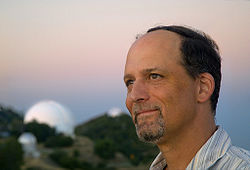
Geoffrey William Marcy (born September 29, 1954) is an American astronomer. He was an early influence in the field of exoplanet detection, discovery, and characterization. Marcy was a professor of astronomy at the University of California, Berkeley, and an adjunct professor of physics and astronomy at San Francisco State University. Marcy and his research teams discovered many extrasolar planets, including 70 out of the first 100 known exoplanets[4] and also the first planetary system around a Sun-like star, Upsilon Andromedae.[5][6] Marcy was a co-investigator on the NASA Kepler space telescope mission.[7] His collaborators have included R. Paul Butler, Debra Fischer and Steven S. Vogt, Jason Wright, Andrew Howard, Katie Peek, John Johnson, Erik Petigura, Lauren Weiss, Lea Hirsch and the Kepler Science Team.[3][8][7] Following an investigation for sexual harassment in 2015, Marcy resigned his position at the University of California, Berkeley.[9][10]
Key Information


Early life and education
[edit]Marcy graduated from Granada Hills High School in Granada Hills, California, in 1972.[1] He graduated with a Bachelor of Arts summa cum laude with a double major in physics and astronomy from the University of California, Los Angeles, in 1976.[11] He then completed a doctorate in astronomy in 1982 at the University of California, Santa Cruz,[12] with much of his work done at Lick Observatory.
Academic career
[edit]Marcy has held teaching and research positions, first at the Carnegie Institution of Washington (then the Mt. Wilson and Las Campanas Observatories) as a Carnegie fellow from 1982 to 1984.[1] He then worked as an associate professor of physics and astronomy from 1984 to 1996 and then as a distinguished university professor from 1997 to 1999 at the San Francisco State University.[13]
Marcy was a professor of astronomy and the Watson and Marilyn Alberts Chair for SETI[3][14] at the University of California, Berkeley, from 1999 through 2015. From 2000 to 2012, he was the director of UC Berkeley's Center for Integrative Planetary Science. Marcy was also one of the project leaders of the Breakthrough Initiatives that will search for intelligent life in the universe, using large radio and optical telescopes.[15][16]
Marcy and his team confirmed Michel Mayor and Didier Queloz's discovery of the first extrasolar planet orbiting a Sun-like star—51 Pegasi b.[17] Two months later, Marcy and his team announced the discovery of two additional planets around 47 Ursae Majoris[18] and 70 Virginis.[19] Other achievements include discovering the first multiple planet system around a star similar to our own (Upsilon Andromedae),[5][6] the first transiting planet around another star, simultaneously with David Charbonneau and Timothy Brown (HD 209458 b), the first extrasolar planet orbiting beyond five AU (55 Cancri d),[20] and the first Neptune-sized planets (Gliese 436b and 55 Cancri e).[21] Marcy was a co-investigator of the NASA Kepler mission[7] that discovered over 4000 exoplanets, most being smaller than four times the size of Earth. His team, led by Erik Petigura and Andrew Howard, showed that approximately 20% of Sun-like stars have a planet of one to two times the size of Earth and receive incident stellar light within a factor of four of the light the Earth receives from the Sun, making them warm planets, many of which accommodate liquid water.[22]
Later career
[edit]In May 2017, Marcy co-authored studies related to laser light emissions from stars, as a way of detecting technology-related signals from an alien civilization. The study included Tabby's Star (KIC 8462852), an oddly dimming star whose unusual light fluctuations may be the result of interference by an artificial megastructure, such as a Dyson swarm, made by such a civilization. No evidence was found for technology-related signals from Tabby's Star in the studies.[23][24]
In 2021, Marcy's membership in the National Academy of Sciences was rescinded.[25]
Sexual harassment
[edit]A six-month investigation by the University of California, Berkeley, Title IX office concluded in 2015 with the finding that Marcy had violated the university's sexual harassment policy[26] between 2001 and 2010.[27][28][29] Four complaints were filed with the university's Title IX office, one of which Marcy denied.[30] As a consequence, the university "imposed real consequences on Professor Geoff Marcy by establishing a zero tolerance policy regarding future behavior and by stripping him of the procedural protections that all other faculty members enjoy".[31]
At least three additional allegations had been made against Marcy as early as 1995 while he was at San Francisco State University, as corroborated by Penny Nixon, then SFSU's sexual harassment officer.[32] A former graduate student of Marcy, now faculty member at Harvard, called Marcy's harassing behavior an "open secret" in the astronomy community.[28] Marcy's alleged actions included unwanted massages, kisses, and groping.[28]
On October 7, 2015, Marcy posted an "Open Letter to the Astronomy Community" stating "While I do not agree with each complaint that was made, it is clear that my behavior was unwelcomed by some women. I take full responsibility and hold myself completely accountable for my actions and the impact they had. For that and to the women affected, I sincerely apologize."[33]
On October 12, 2015, the UC Berkeley Astronomy Department met and released a statement asserting that Marcy was "inadequately disciplined"[31] by the university, and "we believe that Geoff Marcy cannot perform the functions of a faculty member."[34][35]
On the same day, Marcy resigned as principal investigator of the Breakthrough Listen project.[36] Two days later, on October 14, 2015, he indicated his intention to step down from his professorship at UC Berkeley.[9][10] Marcy retained the title of emeritus despite his resignation.[37]
In 2023, a paper co-authored by Marcy with the American Astronomical Society drew criticism from graduate students who had collected data for the project but were not offered co-authorship. As harassment, including sexual harassment, is not classified as research misconduct by the group, Marcy's name was not disincluded from the paper.[38] One of Marcy's junior collaborators in Sweden published an essay stating that she is subjected to harassment, bullying, and discrimination from the astronomy community for her decision to work with Marcy.[39]
Personal
[edit]Marcy lives with his wife, Susan Kegley,[40] in California.[3]
In the media
[edit]Earlier, and as a pioneer in the study of extrasolar planets, Marcy has been featured prominently in the media, including Time magazine,[41][42] The New York Times,[3][43] Astronomy magazine[44] and as a participant in various PBS Nova episodes: "Hunt for Alien Worlds" (1997), "Finding Life Beyond Earth" (2012), "Alien Planets Revealed" (2014);[45] a BBC Horizon episode: "The Planet Hunters" (1996) and History Channel programs: The Universe (2007). Marcy was also featured on ABC News Nightline (October 20, 1995),[46] The MacNeil-Lehrer News Hour (January 18, 1996), The David Letterman Show (April 12, 2001), a Planetary Radio interview (2007)[47] and a National Academy of Sciences interview (2014).[48]
Honors
[edit]- ABC News: "Person of the Week"' (January 26, 1996)[49]
- California Scientist of the Year (2000)
- Henry Draper Medal of the National Academy of Sciences with R. Paul Butler (2001)[50]
- Elected member of the National Academy of Sciences (2002)[51]
- Beatrice M. Tinsley Prize from the American Astronomical Society (2002)
- NASA Medal for Exceptional Scientific Achievement (2003)
- Discover magazine: Space Scientist of the Year (2003)
- Shaw Prize with Michel Mayor (2005)[52]
- On October 28, 2006, he received an honorary doctorate in science from the University of Delaware.[53]
- Carl Sagan Prize for Science Popularization from Wonderfest (2009)[54]
- Fellow of the American Academy of Arts and Sciences (2010)[55]
- PNAS Cozzarelli Prize recipient, with Erik Petigura and Andrew Howard (2013)[56]
- On June 9, 2012, he received an honorary doctorate in science from the University of Chicago.
- Named the 2015 Miller Senior Fellow of the Miller Institute at the University of California Berkeley.[57]
See also
[edit]References
[edit]- ^ a b c "Autobiography of Geoffrey Marcy". The Shaw Prize. Shaw Prize Foundation. Archived from the original on December 2, 2016. Retrieved August 22, 2015.
- ^ Tim Stephens (September 4, 2007). "Major gift supports crucial piece of Automated Planet Finder". University of California, Santa Cruz. Archived from the original on October 18, 2020. Retrieved October 6, 2010.
- ^ a b c d e Overbye, Dennis (May 12, 2013). "Finder of New Worlds". The New York Times. Archived from the original on May 17, 2014. Retrieved May 13, 2014.
- ^ Marcy, G.W. (2014). "Technology Enabling the First 100 Exoplanets". AAS Meeting Abstracts. 223: 91.03. Bibcode:2014AAS...223.9103M.
- ^ a b "A Family of Giants: First System of Multiple Planets Found around a Sun-like Star". NASA Science News. NASA. Archived from the original on August 21, 2010. Retrieved August 16, 2015.
- ^ a b "SFSU Public Affairs Press Release: First system of multiple planets found around a Sun-like star". San Francisco State University. Public Affairs Office at San Francisco State University. Archived from the original on August 18, 2015. Retrieved August 16, 2015.
- ^ a b c "Kepler Team". Kepler: A Search For Habitable Planets. Ames Research Center. April 10, 2015. Archived from the original on May 28, 2010. Retrieved August 18, 2015.
- ^ Lemonick, Michael (December 16, 2009). "Super-Earth: Astronomers Find a Watery New Planet". Time. Archived from the original on December 18, 2009. Retrieved December 17, 2009.
- ^ a b Nanette Asimov (October 14, 2015). "Embattled astronomer resigns from UC Berkeley post amid sex harassment scandal". San Francisco Chronicle. Archived from the original on July 2, 2016. Retrieved October 14, 2015.
- ^ a b Overbye, Dennis (October 14, 2015). "Geoffrey Marcy to Resign From Berkeley Astronomy Department". The New York Times. Archived from the original on October 15, 2015. Retrieved October 15, 2015.
- ^ "UCLA Spotlight". Spotlight.ucla.com. UCLA Marketing and Communications. Archived from the original on August 20, 2015. Retrieved August 17, 2015.
- ^ "Alumni Achievement Award". University of California Santa Cruz Alumni. Regents of the University of California. Archived from the original on August 31, 2015. Retrieved August 17, 2015.
- ^ "Multiple planets discovered around Upsilon Andromeda". Harvard-Smithsonain Center for Astrophysics. Retrieved August 24, 2015.
- ^ Dvorsky, George (June 8, 2012). "Meet SETI's new boss: Geoff Marcy, the planet hunter". Archived from the original on June 10, 2012. Retrieved June 14, 2012.
- ^ "Leaders". Breakthrough Initiatives. Breakthrough Prize Foundation. Archived from the original on August 27, 2015. Retrieved August 24, 2015.
- ^ "Yuri Milner and Stephen Hawking Announce $100 Million Breakthrough Initiative to Dramatically Accelerate Search for Intelligent Life in the Universe". Breakthrough Initiatives. Archived from the original on March 6, 2020. Retrieved August 17, 2015.
- ^ Marcy, G.W.; Butler, R.P.; Williams, E. (1997). "The Planet around 51 Pegasi". Astrophys. J. 481 (926): 926–935. Bibcode:1997ApJ...481..926M. doi:10.1086/304088.
- ^ Butler, Paul; Marcy, Geoffrey (1996). "A Planet Orbiting 47 Uma". Astrophysical Journal. 464 (2): L153. Bibcode:1996ApJ...464L.153B. doi:10.1086/310102.
- ^ Marcy, Geoffrey; Butler, Paul (1996). "A Planetary Companion to 70 Virginis". Astrophysical Journal Letters. 464 (2): L147. Bibcode:1996ApJ...464L.147M. doi:10.1086/310096. S2CID 9528214.
- ^ Marcy, G.W.; Butler, R.P.; Fischer, D. A. (2002). "A Planet at 5 AU around 55 Cancri". Astrophysical Journal. 581 (1375): 1375–1388. arXiv:astro-ph/0207294. Bibcode:2002ApJ...581.1375M. doi:10.1086/344298. S2CID 16170184.
- ^ Britt, Robert Roy (August 31, 2004). "Two Neptune-Mass Planets Found, Earth-Size Worlds Next". Space.com. Retrieved August 17, 2015.
- ^ Petigura, E.A.; Howard, A.W.; Marcy, G.W. (2013). "Prevalence of Earth-size planets Orbiting Sun-like stars". Proceedings of the National Academy of Sciences. 110 (19273): 19273–19278. arXiv:1311.6806. Bibcode:2013PNAS..11019273P. doi:10.1073/pnas.1319909110. PMC 3845182. PMID 24191033.
- ^ Koren, Marina (April 17, 2017). "Searching the Skies for Alien Laser Beams - A new study scanned 5,600 stars for tiny emissions of light, which may be the best way for an extraterrestrial civilization to signal its existence". The Atlantic. Archived from the original on June 15, 2017. Retrieved June 3, 2017.
- ^ Tellis, Nathaniel K.; Marcy, Geoffrey W. (May 12, 2017). "A Search for Laser Emission with Megawatt Thresholds from 5600 FGKM Stars". The Astronomical Journal. 153 (6): 251. arXiv:1704.02535. Bibcode:2017AJ....153..251T. doi:10.3847/1538-3881/aa6d12. S2CID 119088358.
- ^ "Geoffrey W. Marcy". National Academy of Sciences. Archived from the original on November 29, 2018. Retrieved May 26, 2021.
- ^ "UC Berkeley Sexual Harassment Policy". University of California. June 17, 2015. Archived from the original on October 13, 2015. Retrieved October 27, 2015.
- ^ Overbye, Dennis (October 10, 2015). "Geoffrey Marcy, Astronomer at Berkeley, Apologizes for Behavior". The New York Times. Archived from the original on February 6, 2018. Retrieved October 11, 2015.
- ^ a b c Andersen, Ross (October 10, 2015). "The Consequences of Sexual Harassment in Astronomy". The Atlantic. Archived from the original on October 11, 2015. Retrieved October 10, 2015.
- ^ Mervis, Jeffrey (October 9, 2015). "Berkeley astronomer found guilty of sexual harassment". Science Insider. Archived from the original on March 3, 2022. Retrieved October 10, 2015.
- ^ Kleinfeld, Zoe, Abbott, Katy (October 14, 2015). "Campus astronomer Geoffrey Marcy to resign amid sexual harassment allegations". The Daily Californian. Archived from the original on October 18, 2015. Retrieved October 28, 2015.
{{cite news}}: CS1 maint: multiple names: authors list (link) - ^ a b Leff, Lisa (October 12, 2015). "UC Berkeley says astronomer was appropriately disciplined". AP News. Archived from the original on November 19, 2015. Retrieved October 12, 2015.
- ^ Ghorayshi, Azeen (October 23, 2015). "Famous Astronomer Accused Of Sexual Harassment At His Previous Job, Too". BuzzFeed. Archived from the original on November 4, 2015. Retrieved November 5, 2015.
- ^ Marcy, Geoff (October 7, 2015). "An Open Letter to the Astronomy Community" (PDF). Archived from the original (PDF) on March 10, 2016. Retrieved October 12, 2015.
- ^ Overbye, Dennis (October 13, 2015). "Geoffrey Marcy's Berkeley Astronomy Colleagues Call for His Dismissal". The New York Times. Archived from the original on November 8, 2020. Retrieved February 16, 2017.
- ^ "Letter from UC Berkeley Astronomy faculty to Geoff Marcy" (PDF). October 12, 2015. Archived (PDF) from the original on November 19, 2015. Retrieved October 14, 2015.
- ^ "Breakthrough Initiatives". Archived from the original on March 17, 2017. Retrieved October 13, 2015.
- ^ Ghorayshi, Azeen (January 22, 2016). "Alleged Harasser Gets Honorific Title At UC Berkeley". Retrieved May 27, 2021.
- ^ "After outcry, disgraced sexual harasser removed from astronomy manuscript". www.science.org. Archived from the original on May 28, 2023. Retrieved May 28, 2023.
- ^ "Sommarkrönika av Beatriz Villarroel: cancelkultur och trakasserier inom astronomin - fallet Geoff Marcy". academicrightswatch.se. Archived from the original on July 22, 2023. Retrieved July 22, 2023.
- ^ "Susan Kegley, PhD". Pesticide Research Institute. May 9, 2012. Archived from the original on March 3, 2016. Retrieved August 17, 2015.
- ^ Lemonick, Michael D. (February 5, 1996). "Searching for Other Worlds". Time. Archived from the original on August 21, 2015. Retrieved August 18, 2015.
- ^ Dorminey, Bruce (2002). Distant Wanderers: The Search for Planets Beyond the Solar System. New York: Copernicus Books. pp. 51. ISBN 978-0-387-95074-7.
- ^ Noble Wilford, John (February 9, 1997). "In a Golden Age of Discovery, Faraway Worlds Beckon". The New York Times. Archived from the original on August 21, 2015. Retrieved August 18, 2015.
- ^ Marcy, Geoff; Butler, Paul (March 2000). "Hunting Planets Beyond". Astronomy. 28 (3): 42. Bibcode:2000Ast....28...42M. Retrieved November 12, 2015.
- ^ "NOVA - Alien Planets Revealed". pbs.org. January 8, 2014. Retrieved August 17, 2015.
- ^ Dorminey, Bruce (2002). Distant Wanderers: The Search for Planets Beyond the Solar System. New York: Copernicus Books. pp. 52. ISBN 978-0-387-95074-7.
- ^ Marcy, Geoff (November 26, 2007). "Planetary Radio 5th Anniversary Show: Astronomer Geoff Marcy on Discovery of Fifth Planet in Star System (28:52)". Planetary Society. Retrieved November 12, 2015.
- ^ "InterViews". National Academy of Sciences. Archived from the original on August 11, 2015. Retrieved August 17, 2015.
- ^ Goldsmith, Donald (1997). Worlds Unnumbered: The Search for ExtraSolar Planets. Sausalito, CA: University Science Books. p. 1. ISBN 978-0-935702-97-2.
- ^ "Henry Draper Medal". National Academy of Sciences. Archived from the original on January 26, 2013. Retrieved February 24, 2011.
- ^ "Member Directory". National Academy of Sciences. Archived from the original on November 29, 2018. Retrieved August 12, 2015.
- ^ "2005 Announcement and Citation". The Shaw Prize. Archived from the original on May 26, 2024. Retrieved August 10, 2015.
- ^ "Honorary Degree Recipients from 1997 to present". University of Delaware. Archived from the original on July 16, 2011. Retrieved August 10, 2015.
- ^ "Sagan Prize Recipients". wonderfest.org. 2011. Archived from the original on August 12, 2011. Retrieved September 10, 2011.
- ^ "Book of Members, 1780–2010: Chapter A" (PDF). American Academy of Arts and Sciences. Archived (PDF) from the original on March 4, 2016. Retrieved April 13, 2011.
- ^ "PNAS Announces Six 2013 Cozzareli Prize Recipients". National Academy of Sciences. Archived from the original on May 14, 2014. Retrieved March 6, 2014.
- ^ "Miller Professors". Miller Institute for Basic Research in Science. University of California, Berkeley. Archived from the original on August 22, 2015. Retrieved August 29, 2015.
External links
[edit]- Marcy's personal homepage
- Autobiography Archived September 12, 2006, at the Wayback Machine
- Talk by Dr. Geoff Marcy on Extrasolar Planets (2008) on YouTube
- Interview with Geoff Marcy (March 11, 2009)
- Interview with Geoff Marcy (February 1, 2011)[dead link]
| International | |
|---|---|
| National | |
| Academics | |

Geoffrey Marcy
View on GrokipediaEarly life and education
Childhood and family background
Geoffrey Marcy was born on September 29, 1954, in St. Clair Shores, Michigan.[9] His father was Robert D. Marcy, and he has two sisters, Susie and Renee.[9][10] The family soon relocated to the suburbs of Los Angeles in the San Fernando Valley, where Marcy grew up during the 1960s.[2] His upbringing emphasized education, music, and sports, reflecting values instilled by his family.[2] Marcy has described his early years as unremarkable, akin to a "plain vanilla" childhood.[11]Undergraduate and graduate studies
Marcy earned a Bachelor of Arts degree with a double major in physics and astronomy from the University of California, Los Angeles (UCLA) in 1976, graduating summa cum laude and as a member of Phi Beta Kappa.[1] At UCLA, he was influenced by professors including Ray Orbach, George Abell, and Mike Jura, whose courses in physics and astronomy sparked his interest in stellar spectroscopy and observational techniques.[2] He pursued graduate studies at the University of California, Santa Cruz (UCSC), where he conducted research in observational astrophysics at Lick Observatory, focusing on Doppler shift measurements and high-resolution spectrometry.[2] Marcy completed his Ph.D. in astronomy and astrophysics in 1982, with a dissertation titled "Observations of magnetic fields on late-type stars," which examined the Zeeman effect in Sun-like stars under the supervision of George Herbig.[12][2] During this period, he collaborated with Steven Vogt on developing spectrometers aimed at detecting planetary signatures through radial velocity variations.[2]Academic career
Early academic positions
Following his PhD in astronomy and astrophysics from the University of California, Santa Cruz in 1982, Geoffrey Marcy held a Research Associate position at the Institute for Astronomy, University of Hawaii, from 1982 to 1984.[13] In this role, he conducted postdoctoral research, aligning with his dissertation work on stellar magnetic fields via the Zeeman effect.[2] Marcy then transitioned to a faculty position at San Francisco State University (SF State) in 1984 as an Assistant Professor in the Department of Physics and Astronomy, serving in escalating capacities until 1999.[13] He advanced through the ranks, achieving full Professor status by 1996 and Distinguished University Professor from 1997 to 1999, while maintaining an affiliation with SF State even after joining UC Berkeley.[13] These positions at a primarily undergraduate institution allowed Marcy to mentor students, including Paul Butler, and access nearby observatories like Lick for observational astronomy.[2]Tenure at University of California, Berkeley
Geoffrey Marcy joined the University of California, Berkeley, as Professor of Astronomy in 1999.[14] In this role, he also served as head of the Center for Integrative Planetary Science, which was founded in 2001.[14] He maintained an adjunct position at San Francisco State University during his Berkeley tenure.[14] Marcy held the position until 2015, during which time he was recognized for leadership in exoplanet research, though his administrative and mentoring roles drew scrutiny in later investigations. In 2014, complaints from female graduate students prompted an investigation by Berkeley's Office for the Prevention of Harassment and Discrimination (OPHD), which concluded in June 2015 that Marcy had violated the university's sexual harassment policy through unwelcome physical advances, including grabbing and touching, on at least four women between 2001 and 2010.[15] Despite these findings, the university did not recommend termination, instead imposing a monitoring agreement with strict behavioral standards, citing procedural limitations under faculty tenure protections that required a formal hearing, higher evidentiary standards, and adherence to a three-year statute of limitations for most claims.[6] Public disclosure of the investigation's details in a BuzzFeed News article on October 7, 2015, led to widespread condemnation within the astronomy community and pressure from colleagues, prompting Marcy to resign on October 14, 2015.[6][15] Berkeley Chancellor Nicholas Dirks and Executive Vice Chancellor Claude Steele accepted the resignation immediately, describing Marcy's conduct as "contemptible and inexcusable" and committing to reforms in handling faculty misconduct cases.[6] The episode underscored challenges in enforcing accountability for tenured professors, as the university lacked unilateral authority to dismiss faculty without due process.[6]Resignation and post-academic activities
In October 2015, following a Title IX investigation completed in June of that year, which substantiated violations of University of California policies on sexual harassment involving incidents with female students between 2001 and 2010, Geoffrey Marcy resigned his tenured professorship in the Department of Astronomy at the University of California, Berkeley.[16] [6] The university accepted his resignation immediately, stating it was appropriate given the findings, though no formal sanctions had been imposed prior to public disclosure via a BuzzFeed News report.[17] [18] On the same day, October 12, 2015, Marcy resigned as principal investigator of the Breakthrough Listen initiative, a $100 million project funded by Yuri Milner to search for extraterrestrial intelligence using radio telescopes.[19] [16] Post-resignation, Marcy withdrew from institutional academic roles and public scientific leadership, including stepping down from the organizing committee of a December 2015 astronomy conference marking 20 years of exoplanet discoveries.[18] In May 2021, the National Academy of Sciences terminated his elected membership, citing the Berkeley investigation's conclusions on his repeated sexual harassment of students over a decade.[20] His involvement in research has been minimal and contentious; in May 2023, he was initially listed as a co-author on an arXiv preprint analyzing exoplanet data, but the lead author withdrew the paper after online objections, removed Marcy from the authorship, and secured his agreement not to co-author future papers with the group, highlighting ongoing professional ostracism in the astronomy community.[21] No evidence indicates affiliation with universities or major observatories since 2015, with his activities limited to private life and sporadic, unsuccessful attempts at collaboration.[21]Scientific contributions
Radial velocity technique and exoplanet detection
The radial velocity technique, also termed Doppler spectroscopy, infers the existence of exoplanets by detecting periodic shifts in a host star's spectral lines, which arise from the star's reflex motion due to the gravitational pull of an orbiting planetary companion; the amplitude of this velocity variation scales with the planet's mass and orbital proximity, modulated by the sine of the orbital inclination.[22] Geoffrey Marcy, in partnership with R. Paul Butler, advanced the precision of this method during the early 1990s through the integration of an iodine absorption cell into spectrographs, which imprints a well-characterized molecular iodine spectrum onto the incoming stellar light to serve as a simultaneous wavelength calibrator and instrumental profile modeler. This innovation, detailed in their 1992 publication, achieved radial velocity accuracies of about 5 meters per second initially, later refined to 3 meters per second or better via upgrades at facilities like Lick Observatory's 3-meter Shane Telescope and the Keck Observatory's HIRES spectrometer.[23][24][25] These enhancements enabled Marcy and Butler to confirm the 1995 detection of 51 Pegasi b—the first exoplanet identified around a sun-like (G-type) star—through independent radial velocity observations spanning late 1995 to early 1996, revealing a 4.23-day orbital period and minimum mass of 0.47 Jupiter masses, thus validating the unexpected class of close-in giant planets known as hot Jupiters.[26][22] Their subsequent long-term monitoring campaigns, targeting hundreds of nearby sun-like stars, yielded the majority of early exoplanet confirmations via radial velocity, including the first Jupiter-mass planet in a potentially habitable zone around 16 Cygni B (1996, period 798 days, minimum mass 1.7 Jupiter masses) and multi-planet systems such as that around 47 Ursae Majoris (two planets detected by 1996 and 2001, with periods of 1,090 and 2,590 days). By January 2001, Marcy, Butler, and collaborators had announced 38 of the 53 known exoplanets at that time, predominantly via this technique, establishing empirical evidence for diverse planetary architectures incompatible with slow migration models dominant in pre-1995 theory.[25][27]Major discoveries and collaborations
Marcy collaborated extensively with Paul Butler, forming the core of the California and Carnegie Planet Search team, which utilized high-precision radial velocity measurements from instruments like the Hamilton Echelle Spectrograph at Lick Observatory and HIRES at Keck Observatory to detect exoplanets.[2] This partnership, spanning over two decades, yielded the majority of early radial velocity exoplanet detections around main-sequence stars.[3] In late 1995, Marcy and Butler confirmed the discovery of 51 Pegasi b, the first exoplanet detected orbiting a sun-like star, originally announced by Michel Mayor and Didier Queloz using similar Doppler spectroscopy techniques.[2] Their independent verification, achieving radial velocity precision of approximately 5 meters per second, established the technique's reliability for detecting Jovian-mass planets in short-period orbits, often termed hot Jupiters.[2] By January 1996, the team announced two additional planets: one around 70 Virginis (a Jupiter-mass world with an orbital period of 116.6 days) and another around 47 Ursae Majoris (a 2.4 Jupiter-mass planet with a 3.0-year orbit), expanding the known exoplanet population to include longer-period giants.[28] The team's efforts revealed the first confirmed multi-planet systems around main-sequence stars, including Upsilon Andromedae (with planets b, c, and d detected between 1996 and 1999) and 55 Cancri (multiple planets identified progressively from 1996 onward), demonstrating that planetary systems could host several worlds akin to, but distinct from, the Solar System.[3] In 2005, they reported Gliese 876 d, a Neptune-mass planet (approximately 7 Earth masses) in a 1:2 orbital resonance with Gliese 876 c, representing one of the smallest exoplanets detected by radial velocity at the time and highlighting compact, resonant architectures.[29] By mid-2005, Marcy's team had discovered over 110 exoplanets, comprising a significant portion—often cited as around 70%—of the first 100 confirmed extrasolar planets.[3]Involvement in NASA missions and broader research
Marcy served as a co-investigator on NASA's Kepler mission, launched on March 7, 2009, to survey a field of approximately 150,000 stars for transiting exoplanets, with a focus on Earth-sized planets in habitable zones.[30] In this capacity, his team provided ground-based radial velocity follow-up observations to validate Kepler candidates, measuring stellar wobbles to derive planetary masses and distinguish true planets from false positives such as eclipsing binaries.[31] This integration of transit and radial velocity data enabled precise characterizations, contributing to Kepler's confirmation of over 2,600 exoplanets by mission end in 2018.[32] Leveraging Kepler's photometric dataset, Marcy collaborated with Erik Petigura and Andrew Howard to quantify the frequency of small planets around Sun-like stars. Their analysis, published in 2013, determined that about 22% of stars with temperatures between 4,100 and 6,200 K host at least one planet with a radius of 1-1.4 Earth radii receiving 0.25-4 times Earth's insolation, estimating over 40 billion such planets in the Milky Way and at least 10 billion in the habitable zone.[33] This eta-Earth (η⊕) metric provided empirical constraints on planet formation models and informed the design of subsequent missions like TESS and JWST.[1] Beyond core detection efforts, Marcy's NASA-supported research encompassed statistical analyses of exoplanet populations, including multi-planet system dynamics and the architectural stability of resonant chains observed in Kepler data.[1] These studies, drawing on long-term radial velocity monitoring, revealed patterns in planetary spacing and eccentricities, challenging pure disk instability models and supporting core accretion with migration. His contributions extended to astrobiological implications, estimating the prevalence of worlds conducive to liquid water based on integrated datasets from Kepler and ground observatories.[31]Recent independent research (post-2015)
Following his resignation from the University of California, Berkeley in 2015, Geoffrey Marcy pursued independent research primarily in the search for extraterrestrial intelligence (SETI) and technosignatures, operating through the nonprofit Space Laser Awareness in Santa Rosa, California.[1] This work emphasized optical searches for laser emissions from advanced civilizations, building on earlier Doppler spectroscopy expertise but shifting toward anomalous transients and potential artificial signals. Marcy collaborated on projects analyzing archival astronomical data for unexplained phenomena, such as brief optical flashes or vanishing sources that might indicate non-natural origins.[34] A key focus was partnership with the Vanishing and Appearing Sources during a Century of Observations (VASCO) project, led by Beatriz Villarroel, which scans historical sky surveys spanning decades for rare transients potentially linked to extraterrestrial technology or unidentified anomalous phenomena.[35] Marcy contributed to VASCO efforts identifying clusters of simultaneous transients, such as nine events observed on April 12, 1950, in Palomar Observatory plates, which defied conventional astrophysical explanations like gravitational lensing or variable stars.[36] These analyses, published in peer-reviewed journals, highlighted candidates for follow-up spectroscopy to detect artificial markers, with VASCO's citizen science component enlisting volunteers to classify anomalies across 70+ years of data.[37] Marcy's independent SETI research extended to targeted laser hunts using high-resolution spectrographs like Keck HIRES, scanning nearby stars for narrowband emissions indicative of intentional signaling. In a 2017 study, he and Nathaniel Tellis examined spectra from over 100,000 stars, setting upper limits on laser fluxes below 30 photons per square meter but finding no detections, which constrained models of interstellar communication. Later integrations with VASCO led to the EXOPROBE initiative, proposing cost-effective orbital searches for artificial probes or megastructures in the solar system via transient monitoring.[38] He also maintained ties to Breakthrough Listen, leveraging Green Bank and Parkes telescopes for radio and optical SETI, though primarily in advisory or data-analysis roles post-2015.[1] These efforts yielded co-authored papers amid ongoing field debates over collaboration ethics, including 2023 preprints on exoplanet occurrence rates from which Marcy withdrew authorship following criticism.[21] Despite limited institutional support, his work emphasized empirical null results and methodological rigor, contributing statistical bounds on technosignature prevalence without claiming detections.Awards and recognition
Key honors and prizes
Marcy shared the Henry Draper Medal from the National Academy of Sciences in 2001 with R. Paul Butler for their pioneering investigations of exoplanets using high-precision radial velocity measurements.[40][25] In 2002, he received the Beatrice M. Tinsley Prize from the American Astronomical Society, recognizing an outstanding and innovative research contribution to astronomy.[13][41] The following year, NASA awarded him the Exceptional Scientific Achievement Medal for significant contributions to exoplanet detection and characterization.[13][41] In 2005, Marcy was jointly awarded the Shaw Prize in Astronomy with Michel Mayor, receiving $500,000 for discovering and characterizing the first transiting exoplanets and determining their masses and orbits.[3][42] He later received the Carl Sagan Prize for Science Popularization in 2009 from Wonderfest for effectively communicating astronomical discoveries to the public.[1][41]Critiques of award processes
Marcy's prolonged retention as a member of the National Academy of Sciences (NAS), elected in 2002, faced criticism for exposing flaws in the academy's pre-2019 processes, which lacked authority to expel members for ethical violations like sexual harassment despite public knowledge of his misconduct since 2015. Critics contended that the bylaws confined sanctions to scientific misconduct such as plagiarism or falsification, allowing censures but not revocations for personal conduct issues, thereby failing to hold honorees accountable and signaling tolerance for behaviors undermining scientific integrity.[43] A 2018 public petition urged NAS to amend its rules and remove known harassers, arguing that retaining such members contradicted the academy's standards and perpetuated harm in the community.[44] The adoption of a revised NAS code of conduct in 2019, enabling expulsion for violations including sexual harassment, directly addressed these shortcomings, with Marcy becoming the first member removed under the new framework on May 27, 2021.[8] This case exemplified broader astronomy community concerns that award and honor processes emphasize empirical contributions while inadequately vetting or responding to character-related risks, potentially discouraging reporting of misconduct by associating it with threats to prestigious recognitions.[20] No formal calls emerged to revoke Marcy's earlier prizes, such as the 2005 Shaw Prize in Astronomy, as these predated the substantiated allegations spanning 2001–2010.Sexual misconduct allegations
Nature of the accusations
The sexual misconduct accusations against Geoffrey Marcy, a professor of astronomy at the University of California, Berkeley, primarily involved repeated instances of unwanted physical contact and advances toward female graduate students and postdoctoral researchers between 2001 and 2010.[15] A university investigation concluded that Marcy violated institutional policies through behaviors including massaging women's shoulders without consent, grabbing them by the waist from behind, attempting to kiss them on the mouth, and groping their buttocks or thighs.[45][46] These acts occurred in professional settings such as his office, departmental events, and off-campus gatherings, often following conversations about research or career advice.[5] At least four complainants provided detailed accounts substantiating a pattern of conduct, with Marcy admitting during the investigation to some physical interactions while disputing others as mutual or misinterpreted.[19][5] One specific allegation involved a January 2010 incident at an off-campus astronomy conference, where Marcy helped an intoxicated undergraduate student return to her hotel room and allegedly continued unwanted advances there.[5] Additional claims included inappropriate discussions of his own sexual activities and propositions for dates or intimate encounters, which complainants described as creating a hostile environment leveraging his authority as a senior faculty member and exoplanet research leader.[5][46] The investigation, initiated in 2014 after formal complaints, relied on complainant testimonies, witness corroboration, and Marcy's responses but did not involve criminal proceedings or external legal findings.[19] Marcy publicly apologized in October 2015 for actions that made colleagues uncomfortable, acknowledging boundary-crossing without admitting to all specifics.[45] No evidence emerged of coercion tied to academic evaluations, though accusers cited power imbalances in the close-knit astronomy department as amplifying the impact.[46]University investigation and outcomes
In 2014, the University of California, Berkeley's Title IX office initiated a formal investigation into complaints of sexual harassment against Geoffrey Marcy, prompted by reports from female graduate students dating back to 2001.[5] The six-month probe, concluded on June 22, 2015, examined incidents spanning 2001 to 2010 involving four complainants who alleged repeated unwanted physical advances, including unwanted kissing, groping, and attempts to remove clothing during professional interactions.[5] [46] The investigation report, delivered to Marcy on June 29, 2015, determined that he had violated the university's faculty code of conduct on sexual harassment, describing his actions as creating an intimidating and hostile environment.[5] [15] Despite the findings, UC Berkeley imposed no formal sanctions on Marcy, such as suspension, demotion, or termination, citing procedural constraints including a three-year statute of limitations for most disciplinary actions and the need for due process hearings with higher evidentiary standards.[6] The university instead issued a directive for Marcy to cease such behavior and established ad hoc behavioral standards exceeding policy requirements to monitor compliance, with Chancellor Nicholas Dirks deeming the resolution "appropriate" internally at the time.[46] [6] This outcome drew immediate criticism from astronomers and advocates for prioritizing Marcy's scientific stature—given his role in exoplanet discoveries—over accountability, highlighting systemic issues in handling high-profile faculty misconduct.[15] [47] Details of the investigation remained confidential until October 9, 2015, when BuzzFeed News published excerpts from the report, sparking widespread outrage in the scientific community and beyond.[48] Under pressure from petitions, media scrutiny, and statements from organizations like the American Astronomical Society condemning the university's leniency, Marcy resigned his tenured position effective October 14, 2015.[19] [6] UC Berkeley accepted the resignation, acknowledging the violation as "contemptible and inexcusable" while noting limitations in retroactively imposing penalties due to expired timelines and prior closure of the case.[6] The episode prompted UC system-wide reviews of Title IX processes, with President Janet Napolitano calling for reforms to expedite handling of sexual misconduct allegations.[49]Resignation and immediate aftermath
On October 14, 2015, Geoffrey Marcy resigned his tenured position as a professor of astronomy at the University of California, Berkeley, following a campus investigation that substantiated multiple complaints of sexual harassment against female graduate students dating back to 2001.[6][16] The investigation, concluded in 2014 but kept confidential until publicized, found credible evidence of unwanted physical advances, including grabbing, kissing, and rubbing against complainants without consent, though it did not recommend termination due to procedural timelines and lack of formal university sanctions at the time.[17][18] Berkeley Chancellor Nicholas Dirks issued a statement describing Marcy's actions as "contemptible and inexcusable," emphasizing that the university accepted the resignation immediately and viewed it as an appropriate outcome given the findings.[6] Colleagues in the astronomy department had reportedly urged Marcy to step down after the investigation's results became known internally, amid concerns over the university's initial decision not to dismiss him, which drew criticism for protecting a prominent researcher.[17][19] The resignation followed a BuzzFeed News article on October 13, 2015, detailing the allegations and investigation, which sparked widespread media coverage and public outcry within the scientific community, highlighting systemic issues in handling harassment by high-profile academics.[18][46] In response, UC Berkeley President Janet Napolitano called for a system-wide review of sexual misconduct policies, noting the case as indicative of broader challenges in academia.[49] Marcy also withdrew from the organizing committee of the American Astronomical Society's December 2015 meeting marking 20 years of exoplanet discoveries.[18]Long-term professional and field impacts
Following his resignation from the University of California, Berkeley, on October 14, 2015, Geoffrey Marcy transitioned to independent research, maintaining an output of peer-reviewed publications co-authored with collaborators into at least 2024, as documented on his professional website with a cumulative total exceeding 740 papers and over 83,000 citations.[50] However, institutional affiliations and leadership roles eluded him; he received salary and benefits through mid-2016 but ceased formal university ties thereafter.[51] Marcy's professional trajectory encountered sustained barriers, including expulsion from the National Academy of Sciences in May 2021—the academy's inaugural use of its 2019 policy terminating members for sexual misconduct findings.[20] In May 2023, he was excised as a co-author from a preprint on arXiv after astronomers protested his inclusion, citing unresolved ethical concerns from the 2015 allegations despite no direct involvement in the disputed work.[21] These events reflected a field-wide enforcement of ostracism, with collaborators like Jason Wright explicitly barring advisees from co-authoring with Marcy post-2015 to prioritize workplace safety.[52] The scandal catalyzed procedural reforms in astronomy, amplifying pre-existing efforts to combat harassment. A 2018 survey by the American Astronomical Society, informed by the Marcy case's publicity, documented that 41% of female respondents experienced gender harassment and 16% sexual harassment, prompting mandatory reporting protocols, bystander training, and ethics guidelines across institutions.[53] Professional bodies, including the AAS, adopted zero-tolerance stances, with the incident underscoring vulnerabilities in high-profile labs where scientific prestige had previously insulated misconduct.[17] Exoplanet science, Marcy's core domain, progressed without evident disruption, yielding thousands of new detections via missions like Kepler and TESS by 2025, affirming the field's resilience through distributed expertise rather than individual reliance.[19] Yet, the episode eroded trust in unchecked authority figures, fostering a cultural shift toward accountability that some observers credit with reducing tolerance for interpersonal abuses, though empirical data on incidence rates remains sparse beyond self-reported surveys.[54]Personal life
Family and relationships
Marcy has been married to Susan Kegley, an environmental chemist and pesticide researcher, since 1994.[55][1] The couple resides in California, where Marcy, now retired, assists with Kegley's beekeeping and agricultural initiatives.[56] During the 2015 investigation into professional misconduct allegations against Marcy at UC Berkeley, Kegley publicly supported her husband, stating that he had fully cooperated with the probe and that his interactions with students may have been misinterpreted as overly friendly rather than inappropriate.[55][57] Marcy has a sister named Renee, with whom he maintains family ties, including interactions with her son Adam and other nephews such as Wesley.[10] No public records indicate that Marcy and Kegley have children.Interests and public engagements
Marcy has delivered numerous public lectures and talks focused on exoplanet discoveries and the search for extraterrestrial life, often aimed at broad audiences including high school students and the general public. Notable engagements include the Irons Lecture in Physics and Astronomy at Rutgers University on April 3, 2011, discussing planetary systems; a SETI Institute talk on September 18, 2011, titled "Kepler, Exoplanets and SETI"; and a presentation at the Smithsonian National Air and Space Museum on December 11, 2007, addressing conditions for habitable planets.[58][59][60] These outreach efforts highlighted his research on Doppler spectroscopy techniques for detecting extrasolar planets, drawing invitations from scientific societies and museums worldwide.[61] Following his 2015 resignation from UC Berkeley, Marcy's public engagements diminished significantly amid professional repercussions, with no major lectures documented after that period in available records. In retirement, he has shifted focus to personal interests in environmental stewardship, residing with his wife and assisting in the development of a pollinator-friendly organic farm and butterfly habitat on their property.[1] This pursuit reflects a post-career emphasis on biodiversity conservation, though details remain limited to self-reported information.[1]References
- https://www.[researchgate](/page/ResearchGate).net/publication/275055376_A_search_for_optical_laser_emission_using_keck_HIRES