Hubbry Logo
George CablesGeorge CablesMain
Open search
George Cables
Community hub
George Cables
logo
8 pages, 0 posts
0 subscribers
Be the first to start a discussion here.
George Cables
George Cables
from Wikipedia

Key Information

George Andrew Cables (born November 14, 1944)[1] is an American jazz pianist and composer.

Early life

[edit]

Cables was born in New York City, United States.[1] He was initially taught piano by his mother.[1] He then studied at the High School of Performing Arts and later at Mannes College (1963–65).[1] He formed the Jazz Samaritans at the age of 18, a band that included Billy Cobham, Steve Grossman, and Clint Houston.[1] Cables' early influences on piano were Thelonious Monk and Herbie Hancock.[1]

Later life and career

[edit]

Cables has played with Art Blakey, Sonny Rollins, Dexter Gordon, Art Pepper, Joe Henderson, Frank Morgan and other well-established jazz musicians.[2]

His own records include the 1980 Cables' Vision with Freddie Hubbard among others.[3] From 1983, Cables worked in the project Bebop & Beyond. He left later in the 1980s, but returned for guest appearances on two early 1990s albums, before rejoining in 1998.[1]

Cables is a charter member of The Cookers band, founded in 2010, which includes leading jazz composers and players like Billy Harper, Eddie Henderson, David Weiss, Donald Harrison, Cecil McBee, Billy Hart and others.

Discography

[edit]
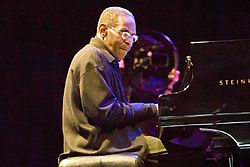
George Cables in 1984

As leader/co-leader

[edit]
Year recorded Title Label Notes
1975 Why Not Whynot Trio, with Tony Dumas (bass), Carl Burnett (drums)
1979 Circle Contemporary With Joe Farrell (flute), Ernie Watts (alto sax), Rufus Reid (bass), Eddie Gladden (drums)
1979 Cables' Vision Contemporary With Freddie Hubbard (flugelhorn), Bobby Hutcherson (vibraphone), Tony Dumas (bass, electric bass), Peter Erskine (drums); some tracks with Ernie Watts (tenor sax, flute), Vince Charles (percussion) added
1980 Morning Song HighNote Quartet, with Eddie Henderson (trumpet), John Heard (bass), Sherman Ferguson (drums); in concert
1980? Some of My Favorite Things Atlas Trio, with Tony Dumas (bass), Billy Higgins (drums)
1981 Whisper Not Atlas Trio, with Tony Dumas (bass), Peter Erskine (drums)
1982? Old Wine, New Bottle Atlas Trio, with David Williams (bass), Carl Burnett (drums)
1982? Wonderful L.A. Atlas Trio, with David Williams (bass), Carl Burnett (drums)
1982 Goin' Home Galaxy Duo, with Art Pepper (alto sax, clarinet)
1982 Tête-à-Tête Galaxy Duo, with Art Pepper (alto sax)
1983? Sleeping Bee Atlas Trio, with Tony Dumas (bass), Ralph Penland (drums)
1984 The Big Jazz Trio Eastworld Trio, with Stanley Clarke (bass), Peter Erskine (drums)
1985 Phantom of the City Contemporary Trio, with John Heard (bass), Tony Williams (drums)
1986 Double Image Contemporary Duo, with Frank Morgan (alto sax)
1987 By George Contemporary Some tracks solo piano; most tracks trio, with John Heard (bass), Ralph Penland (drums)
1991 Cables Fables SteepleChase Trio, with Peter Washington (bass), Kenny Washington (drums)
1991 Night and Day DIW Trio, with Cecil McBee (bass), Billy Hart (drums)
1991 Beyond Forever SteepleChase With Joe Locke (vibraphone), Santi Debriano (bass), Victor Lewis (drums)
1993 I Mean You SteepleChase Trio, with Jay Anderson (bass), Adam Nussbaum (drums)
1994 Quiet Fire SteepleChase Trio, with Ron McClure (bass), Billy Hart (drums)
1994 George Cables at Maybeck Concord Solo piano; in concert
1995 Person to Person SteepleChase Solo piano
1995 Alone Together Groove Jazz Trio, with Philippe Soirat, Carlos Barretto
1995 Skylark SteepleChase Trio, with Jay Anderson (bass), Albert Heath (drums)
1996 Dark Side, Light Side SteepleChase Trio, with Jay Anderson (bass), Billy Hart (drums)
1997 Bluesology SteepleChase Trio, with Jay Anderson (bass), Billy Drummond (drums)
2000 One for My Baby SteepleChase Trio, with Jay Anderson (bass), Yoron Israel (drums)
2001 Senorita de Aranjuez Meldac Trio, with George Mraz (bass), Victor Lewis (drums)
2001 New York Concerto Meldac Trio, with George Mraz (bass), Victor Lewis (drums)
2001 Shared Secrets MuseFX With Bennie Maupin (bass clarinet), Gary Bartz (alto sax), Alphonso Johnson and Abraham Laboriel (bass; separately); Vinny Colaiuta and Peter Erskine (drums; separately)
2003 Looking for the Light MuseFX One track solo piano; one track trio, with Peter Washington (bass), Victor Lewis (drums); most tracks quartet, with Gary Bartz (alto sax, soprano sax) added
2004 A Letter to Dexter Kind of Blue Trio, with Rufus Reid (bass), Victor Lewis (drums)
2007 You Don't Know Me Kind of Blue Solo piano
2012 My Muse HighNote Trio, with Essiet Essiet (bass), Victor Lewis (drums)
2013 Icons & Influences HighNote Trio, with Dezron Douglas (bass), Victor Lewis (drums)
2015 In Good Company HighNote Trio, with Essiet Essiet (bass), Victor Lewis (drums)
2016 The George Cables Songbook HighNote Some tracks trio, with Essiet Essiet (bass), Victor Lewis (drums); some tracks quartet, with Sarah Elizabeth Charles (vocals) added); one track quintet, with Craig Handy (tenor sax, flute) added; some tracks sextet, with Steven Kroon (percussion) added
2019 I'm All Smiles HighNote Trio, with Essiet Essiet (bass), Victor Lewis (drums)
2020 Too Close for Comfort HighNote Trio, with Essiet Essiet (bass), Victor Lewis (drums)

As sideman

[edit]

With The Cookers

With Roy Haynes

With Eddie Henderson

With Joe Henderson

With Freddie Hubbard

With Bobby Hutcherson

With Greg Marvin

  • Taking Off! (Planet X, 1991)
  • Special Edition (Planet X, 2001)

With Frank Morgan

With Art Pepper

With Max Roach

With Bud Shank

With Woody Shaw

With others

References

[edit]
[edit]
Revisions and contributorsEdit on WikipediaRead on Wikipedia
from Grokipedia
George Cables is an American jazz pianist and composer renowned for his lyrical style and extensive contributions to modern jazz, spanning over six decades as both a and . Born on November 14, 1944, in , Cables received classical training from a young age and attended the , where he initially focused on before discovering jazz's expressive freedom. He later studied at the Mannes College of Music for two years, honing his technical skills amid the vibrant sounds of New York. Cables launched his professional career in the mid-1960s, joining the group Jazz Samaritans in 1964 alongside drummer and guitarist . By 1969, he had recorded with saxophonist Paul Jeffrey, contributed to Max Roach's album , and briefly joined Art Blakey's , while also touring with that year. Relocating to the West Coast in 1971, he immersed himself in the and jazz scenes, collaborating with luminaries such as , Freddie Hubbard, , , and . His pivotal partnership with tenor saxophonist from 1977 to 1979 revitalized his focus on acoustic piano and traditions, followed by a profound association with in the late 1970s and early 1980s, including their duet album Goin' Home, Pepper's final recording. As a leader, Cables has released numerous albums since the mid-1970s, showcasing his compositional talents and interpretive depth on standards and originals. Notable works include his 2024 release I Hear Echoes on HighNote Records, issued on his 80th birthday and featuring tracks like "Echo of a Scream" and "Peace." His discography as a encompasses hundreds of recordings with icons including , Tony Williams, and , establishing him as a cornerstone of and . In recent years, Cables continues to perform actively, leading his trio at events such as the 2025 TD James Moody Jazz Festival at Bethany Baptist Church in Newark, New Jersey, where he shared insights on his enduring career, and receiving the Jazz Legacies Fellowship from the Jazz Foundation of America in June 2025. He also serves as a clinician in college jazz programs and composes arrangements for his ensembles and others, maintaining his reputation as a melodic force in contemporary jazz.

Early life and education

Upbringing and family influences

George Cables was born on November 14, 1944, at Brooklyn Hospital in , specifically in , to a family of modest means living in the working-class neighborhoods that characterized much of the city's diverse urban landscape. His first seven years were spent in the Bedford-Stuyvesant section of at 244 Gates Avenue, before the family moved to Chauncey Street between Ralph and Howard Avenues in the Brownsville section, and then relocated to St. Albans in around age nine, a move that placed them in a community rich with musical undercurrents. Cables' initial exposure to music stemmed directly from his mother, an elementary who played in their home and organ for the church, fostering an environment where music was a daily presence. From a young age, he would observe and mimic her playing, which sparked his interest; she provided his first informal lessons, focusing on classical techniques and basic theory before he advanced to structured instruction at a local nursery school and later at the Little School near the . This maternal guidance emphasized disciplined classical training, laying the groundwork for his technical proficiency on starting around age five or six. Growing up in New York's culturally vibrant boroughs immersed Cables in a tapestry of sounds and influences, with the St. Albans neighborhood particularly alive with jazz luminaries like Count Basie and residing nearby, subtly shaping his auditory world through community interactions. His early listening experiences included jazz records encountered via family collections and neighborhood sharing, introducing him to pivotal figures such as and , whose harmonic innovations and improvisational styles left a lasting impression during his formative years. This foundational period of family-driven musical nurturing transitioned into more structured formal education when Cables enrolled at the .

Formal training and early musical development

George Cables began his formal musical training in childhood with piano lessons provided by his family, laying the groundwork for his classical foundation. He further developed these skills at the in , where he focused on classical piano techniques during his high school years. This rigorous environment honed his technical proficiency and introduced him to structured musical education, emphasizing precision and repertoire mastery. Following graduation, Cables took a year off before enrolling at Mannes College of Music in 1963, where he studied as a piano major for two years until 1965. There, he immersed himself in classical repertoire, including works by composers such as Beethoven and Chopin, which strengthened his interpretive abilities and harmonic understanding. However, his exposure to during this period began to draw him away from strictly classical pursuits, prompting a gradual shift in focus. At age 18, around 1963–1964, Cables co-formed the Jazz Samaritans, a seminal ensemble that marked his transition to . The band featured notable young talents including drummer , saxophonist Steve Grossman, bassist Clint Houston, and later drummer , allowing Cables to experiment with collective improvisation in a supportive group setting. This experience was pivotal, as it bridged his classical background with jazz's expressive demands, fostering his ability to blend technical control with spontaneous creativity. The Jazz Samaritans' performances in New York venues such as the Village Vanguard, Top of the Gate, and Slugs provided Cables with essential early gigs that solidified his bebop foundation. These local appearances exposed him to the city's vibrant scene, where he absorbed influences from recordings and live performances by artists such as and , refining his rhythmic phrasing and improvisational vocabulary in real-time interactions. Through these opportunities, Cables built a practical command of elements, preparing him for broader professional engagements.

Professional career

1960s and 1970s breakthroughs

Cables entered the professional scene in the mid-, joining the group Jazz Samaritans in 1964 alongside drummer and guitarist . In 1969, he recorded with saxophonist Paul Jeffrey and contributed to Max Roach's album , marking his breakthrough with high-profile associations that showcased his emerging talent as a . That same year, he joined Art Blakey's for a brief but impactful tenure, contributing to the band's hard-driving sound during a period of transition for the ensemble. He also toured with tenor saxophonist , a collaboration that exposed him to diverse audiences and introduced him to the environment for the first time. These experiences solidified his reputation among jazz luminaries and paved the way for his relocation westward. By 1971, Cables had permanently moved to Los Angeles, initially as part of Joe Henderson's band, and soon integrated deeply into the vibrant scenes of both and . This relocation allowed him to immerse himself in a more relaxed yet innovative musical landscape, distinct from the intensity of New York, where he had honed his skills earlier. His presence on the West Coast facilitated frequent performances and recordings with leading figures, enhancing his versatility across and styles. Throughout the 1970s, Cables built his profile through key recordings and live performances with trumpeters Freddie Hubbard and , as well as tenor saxophonist , whose groups emphasized intricate interplay and exploration. With Hubbard, he contributed to sessions that blended with funkier elements, while his work with Shaw highlighted lyrical trumpet-piano dialogues on albums featuring original material. Henderson's ensembles, in particular, provided Cables opportunities to navigate complex harmonies and rhythmic innovations, as heard in live recordings from the era. These associations not only expanded his musical palette but also established him as a sought-after capable of elevating ensemble dynamics. Cables made his debut as a leader with the album Why Not in 1975 on Why Not Records, a milestone that highlighted his compositional voice amid the decade's evolving landscape. Recorded in , the album featured original pieces such as "Ebony Moonbeams," a reflective that demonstrated his melodic sensitivity and harmonic sophistication, alongside more uptempo tracks showcasing his rhythmic drive. This release marked a turning point, allowing Cables to transition from to while drawing on influences from his recent collaborations.

1980s to 2000s collaborations and projects

In the late 1970s, George Cables joined the Quartet, serving as pianist from 1977 to 1979 and contributing to live performances and recordings that highlighted his return to acoustic piano in contexts. This tenure emphasized Cables' adeptness at supporting Gordon's expansive lines with fluid, harmonically rich accompaniment, as heard on albums like Night Ballads: Montreal 1977 and Live in Iowa 1979. His work during this period bridged his earlier electric keyboard explorations with a renewed focus on traditional dynamics, aligning with the revival's acoustic ethos. Cables' collaborations in the early 1980s included significant duet recordings with alto saxophonist , with Goin' Home captured on May 11-12, 1982, and Tête-à-Tête primarily on April 14, 1982 (with additional tracks on April 13 and May 11), both at in . These intimate pairings showcased Cables' empathetic interplay, providing melodic and rhythmic support that allowed Pepper's lyrical intensity to shine in his final studio efforts before his death later that year. Concurrently, Cables released his leader Cables' Vision in 1979 on Contemporary Records, featuring trumpeter Freddie Hubbard on several tracks and demonstrating his compositional voice through originals like "I Told You So," alongside standards arranged for a setting. Throughout the 1980s and into the 2000s, Cables co-founded and participated in the Bebop & Beyond ensemble, led by saxophonist Mel Martin, which began in 1983 and focused on tributing bebop icons through recordings and performances. He contributed piano to their debut album Bebop & Beyond (1984) and remained involved through the 1990s, rejoining in 1998 for projects including tributes to Dizzy Gillespie, such as Plays Dizzy Gillespie. This work underscored Cables' role in preserving bebop traditions while incorporating modern sensibilities. He also collaborated with vibraphonist Bobby Hutcherson on the 1983 album Four Seasons, a standards program recorded in the Netherlands that highlighted their long-standing rhythmic synergy. In 1985, Cables recorded the trio album Phantom of the City with drummer Tony Williams and bassist John Heard, blending his originals with bebop-inflected improvisation. Additional partnerships included accompaniments for vocalist Sarah Vaughan in the 1980s, where his piano supported her interpretive phrasing in live and recorded settings, and engagements with Dizzy Gillespie's groups in the 2000s, extending his bebop roots into ensemble tributes.

2010s to present activities

In 2010, George Cables joined the supergroup The Cookers, alongside tenor saxophonist , trumpeters Eddie Henderson and David Weiss, alto saxophonist Craig Handy, bassist Cecil McBee, and drummer , with their debut album Warriors marking the ensemble's formation. The group has since toured extensively and released multiple albums, showcasing Cables' contributions in a collective rooted in and traditions. Cables continued his focus on intimate trio settings with the 2021 release of , recorded in September 2020 with bassist Essiet Essiet and drummer Victor Lewis, featuring a mix of standards and originals that highlight his lyrical phrasing and harmonic depth. The album, issued by HighNote Records, earned praise for its emotional intimacy amid the pandemic era. In 2024, Cables released I Hear Echoes on HighNote Records, a trio recording with Essiet Essiet and Jerome Jennings that blends standards by composers like and with original pieces, emphasizing themes of personal reflection and mentorship toward emerging artists. The album underscores his role in bridging generational influences through melodic . That same year, Cables performed at the TD James Moody Jazz Festival on November 8, leading a trio with Claffy and Jennings in a concert at Bethany Baptist Church in . He also appeared at the DC JazzFest from August 27 to 31, participating in the Generations Series at and a supergroup led by bassist Corcoran Holt featuring trombonist , trumpeter Sean Jones, Harper, and drummer Jeff "Tain" Watts. Throughout the and into the present, Cables has served as a clinician in college programs across the and , conducting workshops on , composition, and to mentor young musicians.

Musical style and compositions

Key influences and stylistic evolution

George Cables' piano style was profoundly shaped by several iconic figures, particularly Thelonious 's angular phrasing, Herbie Hancock's harmonic sophistication, and ' lyrical touch. Early exposure to came through high school encounters with recordings and live performances at venues like the Five Spot, where Cables absorbed the pianist's unconventional rhythms and melodic fragmentation. Hancock's influence emerged via albums such as and , where Cables admired the vibrant voicings, soulful grooves, and economical use of notes that added color and depth to ensemble playing. Evans, in turn, inspired through solo interpretations like "," emphasizing a horizontal, flowing lyricism that contrasted with more vertical approaches but complemented Cables' emerging sensitivity. Cables' stylistic evolution began with classical roots, honed at the and Mannes College of Music, before transitioning to around age 18 through jam sessions and groups like the Jazz Samaritans. This foundation in formal technique evolved into mastery during the late 1960s and 1970s, as he immersed himself in the genre's intricate improvisational demands while playing with ensembles led by and . By the 1970s, particularly in and scenes, Cables incorporated modal and elements, drawing from chord structures like those in ' "So What" to expand harmonic possibilities in collaborations with and Freddie Hubbard. Unlike some contemporaries who delved deeply into fusion's electric textures, Cables maintained a strong emphasis on the acoustic piano's natural , especially after his tenure with Dexter Gordon's quartet from 1977 to 1979 reignited his passion for the instrument's unamplified warmth. This choice reflected a deliberate avoidance of heavy fusion experimentation, prioritizing bebop's acoustic heritage over synthesized sounds. Over time, Cables developed a warm, melodic approach ideally suited to interpretations and supportive ensemble roles, as evident in his sensitive accompaniments that enhanced lyrical solos, such as those by .

Notable compositions and arrangements

George Cables has composed several original works that reflect his melodic lyricism and harmonic sophistication, often drawing from personal experiences and jazz traditions. One of his most enduring pieces is the multi-part Suite for Sweet Rita, a tender tribute to his wife composed in the 1990s and featured on albums such as Person to Person (1995) and Dark Side, Light Side (1996). The suite's flowing structure incorporates ballad-like introspection with subtle rhythmic variations, showcasing Cables' ability to blend emotional depth with post-bop elegance. Similarly, "Dark Side, Light Side," the title track from his 1996 trio album, explores contrasting moods through a contemplative piano-led melody that evolves into a more introspective dialogue with bass and drums, evoking the dualities in jazz expression. Cables' arranging talents have significantly shaped collaborative projects, providing rich harmonic frameworks that enhance ensemble dynamics. During his tenure with Dexter Gordon's quartet from 1977 to 1979, Cables contributed arrangements that infused Gordon's tenor lines with lush, modern voicings. His work with in the late 1970s and early 1980s, including duo sessions and quartet dates for labels like Contemporary and , featured Cables' arrangements of standards that highlighted Pepper's lyrical , notably on Goin' Home (1982), blending intimate balladry with subtle rhythmic propulsion. These efforts underscore Cables' role in bridging roots with contemporary sensitivity. In later group settings, Cables' compositions and arrangements have continued to blend originals with reinterpreted standards, reflecting jazz history while incorporating personal themes reminiscent of Thelonious Monk's angular wit. As a founding member of The Cookers since 2010, he has provided key originals like "Ebony Moonbeams," arranged for the septet's horn-forward sound, which merges spiritual jazz elements with post-bop swing on albums such as Believe (2012). With the ensemble Bebop & Beyond, starting in 1983, Cables contributed arrangements that fused bebop standards with his originals, creating tributes to figures like Dizzy Gillespie and Thelonious Monk, as on Bebop & Beyond Plays Dizzy (1990), where his charts emphasized rhythmic vitality and harmonic interplay. These works highlight Cables' evolution toward thematic depth, often echoing Monk's influence in their quirky phrasing and structural innovation. In recent years, Cables' compositional output remains active, as seen on his 2024 album I Hear Echoes, which includes originals such as "Echo of a Scream" and "Peace," demonstrating his continued lyrical and style.

Discography

As leader or co-leader

George Cables has recorded more than 30 albums as a leader or co-leader, spanning over five decades and illustrating his progression from foundations to a more , lyrical expression. His first outing as a leader, the trio Why Not (1975, Whynot), paired Cables with bassist Tony Dumas and drummer Carl Burnett to deliver originals such as "Ebony Moonbeams" and "Rita," blending energy with melodic phrasing. This debut established Cables' compositional voice amid the era's emphasis on acoustic . By 1980, Cables' Vision (Contemporary) expanded to a co-led sextet featuring trumpeter Freddie Hubbard, saxophonist , vibraphonist , bassist Tony Dumas, drummer , and percussionist Vince Charles, showcasing Cables' arrangements of standards and originals in a vibrant, ensemble-driven context. The highlighted thematic unity through interconnected motifs, reflecting Cables' growing interest in collective . In the mid-1980s, Cables explored duo intimacy on Goin' Home (1982, ), co-led with alto saxophonist and clarinetist , where the pair interpreted tunes like "In a Mellow Tone" and "" with tender, conversational lyricism over two days of sessions. This collaboration marked a pivot toward emotional depth, prioritizing dialogue over dense arrangements. The following year brought (1985, Contemporary; recorded 1979), where Cables led a flexible ensemble including flutist , saxophonist , bassists Tony Dumas and , and drummers Eddie Gladden and , weaving standards like "I Remember Clifford" with originals such as "" and "The Phantom" to emphasize cyclic harmonies and textural variety via and . The recording underscored Cables' experimental side while grounding it in melodic accessibility. Cables' recent leadership reflects a matured trio focus, as on Too Close for Comfort (2021, HighNote), with bassist Essiet Essiet and drummer Victor Lewis delivering swinging takes on standards like the title track and "Circle of Love," alongside originals that highlight Cables' polished, narrative-driven lines. This album exemplifies his shift to concise, heartfelt expression in longstanding rhythm partnerships. Most recently, I Hear Echoes (2024, HighNote) reunites Cables with Essiet on bass and introduces drummer Jerome Jennings for a program of reinterpreted classics by , , and , plus originals like "Echoes of a Scream," fostering reflective trio dynamics that echo history while prioritizing lyrical introspection. Across these works, Cables' discography traces an arc from bebop-infused vitality to elegant, melodic maturity, often through evolving personnel like Dumas, Essiet, and Lewis.

As sideman

George Cables began his career in the late , joining Art Blakey's for a pivotal stint that showcased his emerging style amid the band's hard-driving rhythm section. In 1969, he contributed to live recordings such as the performance, where his fluid accompaniment supported trumpeter and tenor saxophonist on extended improvisations like "," highlighting Cables' ability to blend harmonic sophistication with the group's energetic swing. That same year, Cables toured extensively with , providing rhythmic and harmonic foundation for the saxophonist's exploratory tenor work during a West Coast swing that influenced his relocation to . His role emphasized supportive interplay, allowing Rollins' thematic inventions to shine while adding subtle chromatic tensions in ballads and up-tempo pieces. In the 1970s and early 1980s, Cables collaborated with tenor saxophonist on the big-band album Sophisticated Giant (1977), where his piano anchored arrangements by , contributing lyrical solos on tracks like "Fried Bananas" that underscored Gordon's robust tone and the ensemble's sophisticated swing. Cables' work with trumpeter in the 1970s, including albums like Blackstone's Legacy (1970), (1972), and Woody III (1979), featured his piano in modal explorations and ballads, providing textural depth to Shaw's innovative voicings and fostering a telepathic rapport in settings. Throughout the 1980s and 1990s, he frequently partnered with vibraphonist on sessions such as Four Seasons (1985) and Highway One (1978), where his elegant chord voicings and solos on standards like "Autumn Leaves" complemented Hutcherson's precision, creating intimate dialogues rooted in traditions. Into the 2010s and beyond, Cables became a core member of the all-star octet The Cookers, contributing to their debut Warriors (2010) and follow-up Cast the First Stone (2011), where his bridged generational gaps with veterans like and Eddie Henderson, offering harmonic richness on originals such as "Peacemaker" that evoked collective memory in anthems. More recently, on Eddie Henderson's Witness to History (2023), Cables' Fender Rhodes and acoustic infused reflective tracks like "Why Not?" with warm, introspective textures, supporting Henderson's in a celebration of five decades of evolution.

Awards and legacy

Major awards and honors

Throughout his career, Cables has earned multiple nominations and wins in the Critics Poll, particularly in the for his acclaimed accompanying work with leading artists. In 2025, he was selected as one of the inaugural Jazz Legacies Fellows by the Jazz Foundation of America and the Mellon Foundation, receiving a lifetime achievement award and a $100,000 unrestricted grant to support his artistic endeavors. In 2003, Cables received the ASCAP Jazz Living Legend Award.

Influence on jazz and recognition

George Cables has significantly influenced younger generations of jazz pianists through his extensive involvement in educational clinics and workshops at institutions across the . In January 2025, he co-led a masterclass at the with saxophonist Steve Wilson, mentoring students from the university's ensemble by emphasizing the rhythm section's vital role in driving the music forward and encouraging confident, energetic performances during joint improvisations. As a faculty member at the Stanford Jazz Workshop, Cables has shared his expertise in ensemble dynamics and harmonic manipulation, while directing the Ensemble at since 2011, where he guides students in interpreting complex repertoires. His participation in The Cookers, a supergroup featuring younger musicians like trumpeter David Weiss and saxophonist , allows Cables to demonstrate masterful support that provides harmonic ballast and melodic lift, shaping the band's cohesive sound and inspiring bandmates through his subtle yet profound contributions. Cables has played a key role in preserving and traditions through dedicated projects that honor foundational figures. From the 1980s onward, he contributed to the Bebop & Beyond ensemble, led by saxophonist , which recorded tribute albums to icons like and , blending classic structures with contemporary interpretations to keep these styles vibrant for new audiences. His ongoing work with The Cookers further upholds these traditions, drawing from the mid-1960s era of innovation while adapting it for modern ensembles, ensuring the enduring relevance of 's rhythmic and harmonic complexities. Recognition from fellow jazz luminaries underscores Cables' stature as a pivotal figure in the genre. Bassist has praised him, stating, “I’ve played with a lot of piano players—, , —and George is right there,” highlighting his technical and expressive parity with jazz's elite. Drummer echoed this, noting, “I thought George was the closest thing I’d get to playing with ,” in reference to Cables' Hancock-inspired fluidity and innovation during collaborations. These tributes reflect his reputation for elevating group performances, a quality that has earned him acclaim as one of the most reliable and lyrical sidemen in jazz history. Cables' enduring legacy as a major voice in modern is affirmed by his official and sustained activity well into his eighties. At age 81 in 2025, he continues to perform and record actively, with scheduled appearances including a duo with saxophonist at the Taos Jazz Festival and trio dates in Albuquerque, demonstrating his commitment to evolving traditions. This vitality cements his impact as a bridge between 's past and future.

References

Add your contribution
Related Hubs
User Avatar
No comments yet.