Hubbry Logo
Georges PicquartGeorges PicquartMain
Open search
Georges Picquart
Community hub
Georges Picquart
logo
8 pages, 0 posts
0 subscribers
Be the first to start a discussion here.
Georges Picquart
Georges Picquart
from Wikipedia

Key Information

Marie-Georges Picquart (6 September 1854 – 19 January 1914) was a French Army officer and Minister of War. He is best known for his role in the Dreyfus affair, in which he played a key role in uncovering the real culprit.

Early career

[edit]

Picquart was born in Strasbourg. He began his military career in 1872, graduating from the École spéciale militaire de Saint-Cyr as fifth in his year. Picquart served as an infantry officer in France before undertaking staff duties in Indochina. He saw service with the 4th Zouaves in Algeria as well as with several regiments of line infantry and chasseurs à pied (light infantry) in Metropolitan France. He subsequently studied at the General Staff Academy (École d'état-major) where he was second in his class, after which he became a lecturer at the War Academy (École supérieure de guerre). One of his students at the latter institute was Alfred Dreyfus.[1]

Picquart and the Dreyfus affair

[edit]

Picquart was then appointed to the General Staff in Paris. As a staff officer he acted as reporter of the debates in the first Dreyfus court-martial for the then Minister of War, Auguste Mercier, and the Chief of the Army General Staff, Raoul Le Mouton de Boisdeffre. Picquart was subsequently promoted to the rank of lieutenant-colonel on 6 April 1896.

He was appointed chief of the army's intelligence section (Deuxième Bureau, service de renseignement militaire) in 1895. The following year Picquart discovered that the memorandum ("bordereau") used to convict Captain Alfred Dreyfus had actually been the work of Major Ferdinand Walsin Esterhazy. Several high-ranking generals warned Picquart to conceal his discovery, but Picquart continued his investigation. In this he was hindered and sabotaged by subordinate officers, notably Major Hubert-Joseph Henry. As a consequence, Picquart was relieved of his appointment with the Deuxième Bureau, returning in December 1896 to regimental duty in Africa, commanding the 4th Tunisian Tirailleurs Regiment (native infantry) based at Sousse in French Tunisia.[2]

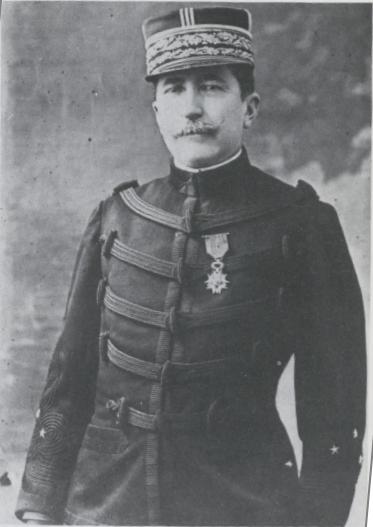
Lieutenant Colonel Georges Picquart as commander of the 4th Tunisian Tirailleurs

After the trial of Émile Zola for publishing his 1898 open letter J'Accuse…!, Picquart was himself accused of forging the note that had convinced him of Esterhazy's guilt. He was then arrested for forgery and was waiting for a court-martial, while the French Court of Cassation was reviewing the Dreyfus case. After the second court-martial, held as a consequence of the conclusions of the court, Picquart resigned from the army. However, the exoneration of Dreyfus in 1906 also absolved Picquart, who was, by an act of the French Chamber of Deputies, promoted to brigadier general. That was the rank that an officer of his seniority and experience could normally have expected to reach, if his career had not been interrupted by his involvement in the Dreyfus affair.[3]

Subsequent career

[edit]

In 1906, Picquart entered Georges Clemenceau's first cabinet as Minister of War. He held that position for the entire duration of the Clemenceau Cabinet, from 25 October 1906 to 24 July 1909. Picquart then returned to military service as an Army Corps commander.[4]

Private life

[edit]

A keen amateur pianist, Picquart was a regular visitor to the Chaigneau family, whose daughters formed the Trio Chaigneau. He later helped arrange concerts for them.[5][page needed]

Picquart was raised in an ardent Catholic family,[6] but later left religion and became an agnostic.[7]

Death

[edit]

While still a serving army officer, Picquart died on 19 January 1914 in Amiens from injuries sustained in a fall from a horse while he was riding in Picardy. He was 59.[8]

[edit]

Richard Dreyfuss portrayed Picquart in the 1991 made-for-cable drama Prisoner of Honor, directed by Ken Russell which chronicled the Dreyfus Affair. The 2013 novel An Officer and a Spy and the 2019 film adapted from it tell the story of the Dreyfus affair from Picquart's perspective.

See also

[edit]

References

[edit]
[edit]
Revisions and contributorsEdit on WikipediaRead on Wikipedia
from Grokipedia
Marie-Georges Picquart (6 September 1854 – 19 January 1914) was a officer of Alsatian origin who rose to prominence for his role in exposing flaws in the 1894 conviction of Captain for treason. Appointed head of the army's Intelligence Section in late 1895, Picquart examined the original bordereau—a torn letter offering French military secrets to —and concluded through handwriting analysis that it matched the script of Major , not Dreyfus, whose conviction had relied on forged evidence and procedural irregularities. Picquart's findings threatened the military hierarchy's , prompting superiors to suppress his reports, transfer him to remote postings in and , and ultimately him on fabricated charges of violating secrecy oaths. Despite these reprisals, his evidence contributed to the reopening of the Dreyfus case in 1898, Esterhazy's acquittal notwithstanding, and culminated in Dreyfus's full exoneration by the in 1906. Reinstated with promotions, Picquart briefly commanded a before being appointed Minister of War in Georges Clemenceau's cabinet from 1906 to 1909, where he oversaw reforms amid ongoing political fallout from the affair. The highlighted Picquart's commitment to evidentiary truth over institutional loyalty, as he initially shared prevailing suspicions about Dreyfus but shifted upon confronting discrepant facts, including intercepted correspondence linking Esterhazy to German agent Max von Schwartzkoppen. His perseverance amid personal risk—enduring imprisonment and career —marked him as a pivotal figure in rectifying a rooted in antisemitic prejudices and bureaucratic self-preservation within the French General Staff. Picquart's mysterious death in 1914, officially ruled a by fall from a window, has fueled speculation of foul play given his prior antagonisms with military figures.

Early Life and Formation

Birth and Family Origins

Marie-Georges Picquart was born on September 6, 1854, in , then part of the department in , . His parents were Marie Charles François Hubert Picquart (1814–1865), a civil servant serving as a for direct contributions, and Louise Henriette Mélanie Debenesse (1817–1896). Picquart's family originated from the Alsace-Lorraine border region, reflecting a blend of Alsatian and Lorrainian heritage typical of many French families in the area prior to the . In 1856, shortly after his birth, the family—comprising his parents, an older sister, and two brothers—relocated to Geudertheim, a village near , where his father had been appointed to a position. They resided there until autumn 1862. The Picquart lineage included traditions of , with relatives in administrative and roles, though his immediate family emphasized magistracy and fiscal administration over martial pursuits. Following the 1871 annexation of by after the , the family opted to remain French, relocating to the French interior and affirming their loyalty to the .

Education at Saint-Cyr and Early Influences

Picquart entered the , France's elite , in 1872 at age 18, following a preparatory path influenced by his family's longstanding involvement in the and armed forces. Born in in 1854 to parents steeped in these traditions, he pursued formal military education amid a national context of recovery from the 1870-1871 defeat, which had resulted in the annexation of his birthplace region to , potentially reinforcing familial emphases on service and national resilience. The Saint-Cyr curriculum emphasized rigorous physical training, tactical instruction, and leadership development, preparing cadets for or other branches through a competitive two-year program at the time. Picquart distinguished himself academically and militarily, graduating fifth out of 304 in his class in 1874. This high ranking secured his commission as a sous-lieutenant in the 20th , marking the start of his active service. Early influences from his family's military heritage likely instilled a commitment to discipline and honor, values central to Saint-Cyr's ethos, while the academy's environment—drawing from Napoleonic traditions of merit-based advancement—further honed his analytical skills and sense of institutional loyalty, traits evident in his later career. Transitioning to the École d'Application d'Infanterie shortly after initial graduation, he specialized in , building foundational expertise amid France's post-war army reforms.

Pre-Dreyfus Military Service

Initial Commissions and Assignments

Picquart entered the in 1872, graduating fifth in his class as a sous-lieutenant in the arm. His family background, rooted in Alsatian magistrates and soldiers displaced after the , oriented him toward a military path emphasizing technical proficiency and republican discipline. Early assignments placed him in artillery units in metropolitan France, where he gained operational experience in gunnery and amid the post-1870 army reforms. By the mid-1880s, Picquart deployed to colonial campaigns, serving in for pacification operations and then in (northern Vietnam) from 1885 to 1888 during the Sino-French War's aftermath, contributing to French consolidation against local resistance and Chinese forces. These postings honed his skills in , earning recognition for analytical rigor in terrain assessment and supply management. Upon returning to France in 1888, Picquart was promoted to major for his , which counted double toward advancement under army regulations. He transitioned to staff roles, joining the General Staff and serving as a of at the École supérieure de guerre, where he instructed officers on cartographic and strategic mapping essential for modern conflicts. In 1893, he was assigned as sous-chef de bureau on General Gaston de Galliffet's staff at Versailles, handling administrative and operational coordination for cavalry divisions. These positions underscored his rising expertise in staff work, positioning him for higher duties.

Promotions and Operational Experience

Picquart entered the in November 1872 and graduated fifth in his class in 1874, earning a commission as sous-lieutenant in the . He advanced to the following year in 1875. By 1880, at age 26, he reached the rank of capitaine. His promotion to chef de bataillon occurred in 1888, after which he served initially with the 144e régiment d'infanterie de ligne before transferring to the 9e régiment d'infanterie. Early in his career, Picquart performed duties as an officer in . He later gained operational experience overseas, including staff assignments in (northern Indochina) during French colonial campaigns there. He also served with the 4e régiment de zouaves in , contributing to efforts in the region. Following these postings, Picquart attended the École d'état-major, where he honed his expertise in and , preparing him for higher staff roles. By July 1895, he had been promoted to lieutenant-colonel, reflecting his rapid ascent among France's officer corps.

Central Role in the Dreyfus Affair

Leadership of the Intelligence Bureau

Marie-Georges Picquart assumed leadership of the French Army's , the service also known as the Statistical Section, on July 1, 1895, succeeding Colonel Jean Sandherr, who resigned due to paralysis from . At 40 years old, Picquart was among the youngest officers to hold the rank of and brought a reputation for intellectual rigor, hard work, and Alsatian origins that attuned him to border security concerns against . His appointment came amid ongoing French efforts to counter foreign following the 1894 conviction of Captain for treason based on a torn memorandum (bordereau) intercepted by the bureau. Under Picquart's direction, the intensified surveillance of potential spies, emphasizing empirical analysis of documents and handwriting expertise to identify threats from German intelligence. He reorganized workflows to enhance efficiency, delegating tasks to subordinates like Captains Henry and Du Paty de Clam while maintaining personal oversight of key files. This period marked a shift toward more of archival materials, including unresolved cases, as Picquart sought to verify the bureau's prior conclusions amid persistent leaks of French military secrets. His leadership prioritized causal links between intercepted communications and actual betrayals, diverging from the more speculative methods under Sandherr. Picquart's tenure, lasting until November 1896, exposed internal tensions within the General Staff, where loyalty to institutional verdicts often superseded new . Despite initial acceptance of Dreyfus's guilt—rooted in the army's reliance on secret dossier he had observed at the 1894 closed-door —Picquart's commitment to factual verification began eroding confidence in the as handwriting discrepancies emerged in routine file audits. This approach, grounded in direct examination rather than deference to , positioned the bureau to confront potential miscarriages, though it invited resistance from superiors protective of the army's honor.

Uncovering Evidence Against Esterhazy

Upon assuming leadership of the French Army's Statistical Section (counter-intelligence) on July 1, 1895, Picquart began reviewing archived files related to ongoing concerns, including the bordereau—a memorandum attributed to that had prompted his 1894 conviction for . In early 1896, while examining intercepted correspondence, Picquart identified a torn-up message known as the petit bleu, recovered from the German Embassy's wastebasket in March 1896, which appeared to originate from a French officer offering military secrets to the German military attaché, . The partial address on the petit bleu pointed to Major , prompting Picquart to obtain samples of Esterhazy's handwriting for comparison. Picquart's analysis revealed striking similarities between Esterhazy's and that of the bordereau, convincing him that Esterhazy, not Dreyfus, was the of the incriminating . Further investigation into Esterhazy's background uncovered a profile consistent with : chronic indebtedness from and dissipation, a history of financial improprieties, and documented contacts with foreign agents, including requests for funds masked as loans. Under Picquart's orders, of Esterhazy confirmed irregular behavior, such as evasive movements and associations with suspicious figures, while additional handwriting exemplars—procured discreetly from Esterhazy's correspondence—reinforced the match to both the bordereau and petit bleu. By mid-1896, Picquart had amassed sufficient evidence to conclude Esterhazy's guilt, including the petit bleu's implication of ongoing treasonous activity post-Dreyfus's , which suggested Dreyfus's innocence was a judicial . He documented these findings internally but faced immediate pressure from superiors to suppress them, as reopening the case risked institutional embarrassment. Despite this, Picquart's independent verification, drawing on direct file analysis rather than contested expert opinions like those later provided by , prioritized empirical handwriting congruence and contextual indicators over prevailing narratives.

Institutional Resistance and Picquart's Dilemmas

Upon identifying Major Ferdinand Walsin Esterhazy's handwriting as matching the bordereau in late August 1896, Lieutenant-Colonel Picquart reported his findings to his superiors in the French General Staff, including General Raoul Le Mouton de Boisdeffre and General Arthur Gonse, urging a discreet investigation to avoid public scandal. However, these officers, prioritizing the preservation of the army's and the finality of Dreyfus's 1894 conviction, suppressed the evidence and instructed Picquart to cease his inquiries, with Gonse explicitly warning him: "Dreyfus is guilty; consider your own career" and questioning why Picquart cared if "that Jew rots" on . This resistance reflected a broader institutional commitment to maintaining the narrative of Dreyfus's guilt, even amid emerging contradictions, as reopening the case risked exposing procedural flaws and potential forgeries used in the original . Picquart faced acute personal dilemmas, torn between his initial acceptance of Dreyfus's guilt—rooted in his attendance at the 1894 trial and prevailing anti-Semitic sentiments within the officer corps—and his duty as an intelligence officer to pursue empirical evidence rigorously. Despite lacking personal sympathy for Dreyfus, whom he viewed as a Jew unfit for high command, Picquart prioritized institutional honor and rational inquiry over blind loyalty, recognizing that allowing Esterhazy to remain in service while Dreyfus suffered unjustly dishonored the army's integrity. His persistence led to retaliation: in November 1896, he was abruptly transferred to a perilous posting in Sousse, Tunisia, amid local unrest, effectively isolating him from Paris and demoting his influence without formal charges. The General Staff's efforts intensified after Picquart confided details to Louis Leblois in 1897, who leaked them to senators, prompting Esterhazy's January 1898 —where suppressed ensured his in just two days. Picquart's refusal to recant, even as superiors fabricated the "faux Henry" document in August 1898 to fabricate new proof against Dreyfus, culminated in his on November 13, 1898, and beginning November 18, 1898, on charges of violating professional secrecy and forgery. Convicted on August 9, 1899, and sentenced to five years' fortress imprisonment, he served only ten months before release, embodying the conflict between individual conscience and institutional self-preservation that defined his role in exposing the affair's injustices.

Prosecution, Exile, and Defense of Truth

In retaliation for his investigations implicating Major as the true author of the bordereau, Picquart faced systematic institutional pressure from French military authorities intent on preserving the original conviction of . On November 25, 1897, he was abruptly transferred from his intelligence role to command a of native troops in , —a remote and hazardous posting designed to isolate him from and silence further inquiries, effectively amounting to administrative . This move followed his confidential disclosures to civilian allies like Louis Leblois, a who relayed details to Senator Auguste Scheurer-Kestner, prompting public scrutiny of the affair. Picquart's exile proved temporary amid escalating revelations, including the exposure of forgeries by Major in August 1898. Arrested on June 13, 1898, by order of War Minister Godefroy Cavaignac, he was imprisoned in the Mont-Valérien fortress on charges of breaching military secrecy by sharing case documents with unauthorized civilians, including purported leaks to a so-called "Jewish syndicate" substantiated by fabricated telegrams. Despite Henry's confession and suicide, which undermined the charges, Picquart remained detained for over a year, enduring that tested his resolve but did not extract recantations of his evidence against Esterhazy. His commitment to truth manifested most directly during Dreyfus's retrial at the court-martial from August 7 to September 9, 1899, where Picquart, released temporarily for testimony, delivered unflinching accounts of the petit bleu evidence, Esterhazy's handwriting match, and the General Staff's cover-up, declaring under that Dreyfus's guilt was incompatible with the facts he had uncovered. This appearance, defying orders to remain silent, reinforced demands for revision despite the tribunal's guilty verdict with extenuating circumstances on September 9. Immediately following, on November 14–19, 1899, Picquart faced his own in for the Leblois disclosures, resulting in conviction under military penal code provisions for divulging secrets; he received a 60-day sentence but was dishonorably discharged and placed on , prolonging his professional marginalization until full vindication in 1906. Through these ordeals, Picquart's refusal to fabricate alibis for the army—evident in his drafted but unpublished letter outlining the conspiracy—prioritized empirical evidence over institutional loyalty, catalyzing broader exposure of the .

Rehabilitation and Later Military Career

Service in Tunisia and Professional Setbacks

In late 1897, following his disclosures in the Dreyfus Affair, Lieutenant Colonel Marie-Georges Picquart was transferred by order of General Charles-Arthur Gonse to a remote and hazardous posting in , ostensibly to suppress his further involvement in the case. This assignment to amid rising unrest against French colonial rule was widely perceived as punitive, with superiors hoping Picquart might perish in combat or fade into obscurity. Upon arrival in on January 16, 1898, he assumed command of the 4th Regiment of Tunisian Tirailleurs, stationed in , where he led infantry operations against local insurgents. Picquart's tenure involved grueling patrols in the Tunisian desert, including a reconnaissance mission framed as North African fortifications—a pretextual task designed to isolate him from metropolitan influence. During one such expedition, he narrowly escaped death when subordinates, possibly acting on implicit orders from , led him into an that resembled a ; Picquart's survival was attributed to his own vigilance and intervention by a sympathetic local officer. Despite these perils, he maintained in his , suppressing rebel activities effectively, though the posting exposed him to harsh environmental conditions and constant threat from tribal warfare. This exile inflicted significant professional setbacks on Picquart, halting his advancement while contemporaries ascended ranks; as a , he was passed over for colonelcy promotions due to lingering institutional resentment over his Dreyfus stance. The General Staff's machinations, including fabricated charges of , further marginalized him, confining his expertise in and to peripheral colonial duties rather than core French command structures. By , after years of stagnation, Picquart's insistence on truth had cost him seniority and influence, underscoring the French Army's prioritization of loyalty to the Affair's cover-up over merit.

Return to France and Reinstatement

Following the quashing of Alfred Dreyfus's conviction by France's on July 12, 1906, Marie-Georges Picquart, who had been reassigned to a remote and hazardous posting in amid institutional backlash for his investigations into the , was cleared of all related disciplinary actions and criminal charges. This judicial reversal directly facilitated his recall from colonial service, marking his effective return to and the higher echelons of military command. On July 13, 1906, the enacted a special law promoting Picquart to —a rank reflecting the advancement he would have received had his career not been obstructed by superiors' efforts to suppress evidence of Esterhazy's guilt and protect the Army's initial verdict against Dreyfus. This legislative reinstatement, parallel to Dreyfus's own restoration as a major, compensated for years of professional isolation and demotion, positioning Picquart for subsequent command roles in the . The promotion underscored parliamentary recognition of Picquart's adherence to evidentiary rigor over institutional loyalty, though it bypassed standard merit-based procedures due to the exceptional circumstances of the .

World War I Contributions and Command Roles

Marie-Georges Picquart held the rank of général de division at the time of his death on January 19, 1914, following a fall from his horse near , which resulted in fatal injuries. This event occurred approximately six months before the outbreak of on July 28, 1914, precluding any contributions or command roles by Picquart in the conflict. Despite his extensive prior experience in , counter-espionage, and high-level —including service as Minister of War from 1906 to 1907—Picquart's untimely demise meant he could not be mobilized or assigned to frontline commands, staff positions, or advisory roles during the mobilization and early battles of the war. Historical records confirm no posthumous attributions or indirect influences tied to his pre-war career were applied to French command structures in 1914–1918.

Political Engagement

Appointment as Minister of War

Following the full exoneration of on July 12, 1906, and Picquart's own reinstatement to the with promotion to brigadier general, appointed him Minister of War on October 25, 1906, as part of his first cabinet formation. This selection reflected Clemenceau's intent to integrate protagonists into government to signal military reform and accountability, leveraging Picquart's reputation for exposing institutional cover-ups within the General Staff. Picquart, previously sidelined and persecuted for his investigations, entered the role amid ongoing tensions between republican civilians and the conservative military elite. Picquart's appointment occurred against a backdrop of Clemenceau's broader cabinet strategy, which emphasized radical oversight of the to prevent future miscarriages of like the Dreyfus conviction. As an Alsatian officer with firsthand experience in operations, Picquart was positioned to address lingering Dreyfus-related resentments and push for procedural changes, though his tenure would later reveal limits to such reforms due to entrenched military autonomy. The cabinet, lasting until July 24, 1909, marked Picquart's sole foray into high civilian office, during which he retained his military rank and focused on stabilizing morale post-scandal.

Policy Decisions and Criticisms

Picquart, appointed Minister of War on October 25, 1906, by Prime Minister , prioritized the modernization of the amid lingering divisions from the . His efforts focused on integrating republican loyalists into key positions, reducing the influence of conservative officers associated with the Affair's miscarriages of justice, and advancing technical and organizational updates to enhance military readiness. These included streamlining administrative structures and promoting officers committed to civilian oversight, actions that aligned with 's broader agenda of subordinating the military to republican authority. A notable policy decision involved personnel reforms, where Picquart facilitated the rehabilitation and advancement of Dreyfus supporters within the officer corps while maintaining limits on full career restoration for himself. He upheld his predecessor Eugène Étienne's ruling, refusing to credit Dreyfus's years in penal servitude (1895–1899) toward seniority for promotions or pensions, arguing it would disrupt established hierarchies. This stance reflected Picquart's emphasis on institutional stability over individual redress, even as he ensured Dreyfus's formal exoneration and return to active duty as a major in July 1906. Criticisms of Picquart's tenure emanated primarily from conservatives and anti-Dreyfusard factions, who viewed his appointment as a partisan affront and accused him of politicizing promotions by favoring Dreyfusards at the expense of career officers loyal to traditional hierarchies. Right-wing press and monarchist outlets decried his reforms as vengeful purges, eroding merit-based advancement and inviting republican interference in command structures. Dreyfus himself expressed disappointment over the incomplete career restitution, prompting considerations of in 1907, though Picquart rebuffed further concessions, prioritizing cohesion. These critiques persisted despite Picquart's brief but steady service until the Clemenceau cabinet's dissolution in July 1909, underscoring tensions between his truth-driven legacy and entrenched resistance.

Personal Character and Private Life

Marriage, Family, and Daily Life

Picquart remained unmarried throughout his life and fathered no children, leading a bachelor existence marked by financial constraints and multiple extramarital affairs with married women. One notable relationship was with Pauline Monnier, the wife of a fellow officer, which drew scrutiny during the Dreyfus Affair proceedings. Lacking a family unit, he relied on personal networks and intellectual circles rather than domestic ties for support. In his daily routine, Picquart cultivated refined habits reflective of his Alsatian upbringing and military education, including fluency in five European languages with particular proficiency in German. , music, and art formed central elements of his private interests, providing respite from professional duties and contributing to his analytical mindset. Despite periodic financial hardships, he maintained a disciplined aligned with officer standards, though his independent streak often isolated him socially.

Ideological Views, Including Antisemitism and Conservatism

Picquart, a devout Catholic raised in a conservative milieu, adhered to traditional values emphasizing military discipline, national honor, and institutional loyalty, which aligned him with broader principles in . His reflected the era's aristocratic officer class, prioritizing the army's and 's republican stability over radical reforms, though he occasionally collaborated with leftist governments in pursuit of professional duties. Regarding , Picquart harbored personal prejudices typical of many French officers, viewing with suspicion amid widespread social that permeated and Catholic circles by the . However, upon assuming of army intelligence in November 1896, he methodically analyzed forensic evidence—the bordereau handwriting and petit bleu—concluding as the true traitor, not Dreyfus, despite Esterhazy's non-Jewish background disproving an antisemitic motive for the frame-up. This empirical approach led him to override initial biases, reporting the to superiors on November 1896 and persisting through his 1899 imprisonment for insubordination, actions that exposed forgeries by Major on August 30, 1898. Historians note this transcendence of prejudice as pivotal, transforming him from a potential anti-Dreyfusard into a key defender of judicial truth, without adopting broader Dreyfusard . Picquart's conservatism persisted post-Dreyfus, evident in his 1906-1909 tenure as Minister of War under Georges Clemenceau's radical cabinet, where he resisted politicizing the while implementing modernization, such as three-year in 1905, balancing efficiency with traditional command structures. He critiqued extremist but upheld Catholic-influenced moral frameworks, avoiding the secular zealotry of allies like , whose J'Accuse...! on January 13, 1898, amplified the affair but diverged from Picquart's evidence-based restraint. This blend—conservative foundations yielding to rational scrutiny—distinguished him amid France's polarized ideologies, where fueled anti-republican fervor among figures like .

Death, Honors, and Historical Evaluation

Fatal Accident and Surrounding Circumstances

On January 19, , Marie-Georges Picquart, then commanding the Second Army Corps in , suffered a fall from his horse while riding in the Picardy countryside. The incident resulted in severe injuries, including complications such as , to which he succumbed later that day at age 59. Contemporary reports attributed the death unequivocally to accidental causes, with no indications of external factors or beyond the inherent risks of equestrian activity for a military officer. Picquart's passing occurred amid his continued high-level service, mere months before the outbreak of , during which his corps would play a role in early French defenses. Official accounts emphasized the suddenness of the event, noting that he had been in robust health and actively engaged in command duties prior to the ride. A with full military honors followed, reflecting recognition of his career contributions, including his pivotal role in exposing miscarriages of justice during the two decades earlier. No inquiries or public speculations suggested foul play at the time, distinguishing Picquart's demise from contemporaneous suspicions surrounding other Dreyfus Affair figures, such as Émile Zola's 1902 death by . Archival and historical reviews have consistently upheld the accident's veracity, citing the absence of motive or evidence for alternative narratives amid Picquart's post-Dreyfus reinstatement and promotions.

Posthumous Recognition and Military Honors

Following his death on January 19, 1914, from injuries sustained in a horseback riding accident in , Picquart was granted a funeral procession in that included standard military honors for a general and former corps commander, such as an escort accompanying the hearse. The ceremony, held despite his expressed preference for modest rites limited to regulatory protocol for a unit leader, drew prominent attendees including General , the army's chief of staff, and various political figures, reflecting institutional acknowledgment of his pre-war service, ministerial tenure, and pivotal role in exposing miscarriages of justice during the Dreyfus Affair. Picquart was initially interred in Paris's Père-Lachaise Cemetery, a site reserved for notable figures, underscoring the esteem in which he was held by the Third Republic's leadership. In a subsequent act of regional homage, his remains were exhumed and reinterred in , his birthplace in , on July 23, 1919, symbolizing enduring French claims to the territory lost in 1871 and recovered in 1918; the transfer involved ceremonial honors coordinated by local and national authorities. No formal posthumous promotions or additional decorations, such as elevation beyond his pre-death rank of commandeur in the Légion d'honneur (awarded July 11, 1912), were recorded in official military annals immediately following his passing, consistent with French protocol limiting such gestures absent wartime exigencies or legislative intervention. The honors thus centered on funerary rites and burial arrangements, which collectively affirmed his legacy as an officer of unyielding duty amid institutional pressures, though contemporary accounts noted restraint to align with his personal directives against ostentation.

Scholarly Debates on Motivations and Impact

Scholars have debated whether Picquart's pursuit of evidence exonerating Dreyfus stemmed from personal anti-Semitism, institutional , or an unwavering commitment to factual accuracy. While Picquart exhibited anti-Semitic traits common among French officers of the , such as initial toward Dreyfus due to his Jewish background, his investigations prioritized handwriting analysis and documentary discrepancies over . For instance, upon reviewing the petit bleu in March 1896, Picquart identified Major as the bordereau's author through comparative , not sympathy for the convicted officer, whom he held no personal regard for. This evidence-driven approach conflicted with his superiors' efforts to suppress findings, leading to his transfer to in November 1896 and subsequent in 1899 for violating secrecy oaths, actions that underscore a motivation rooted in professional integrity rather than or ideological bias. Critics, including some military historians, argue Picquart's delays in escalating his discoveries—confiding initially only to superiors like General Georges Gonse—reflected ambivalence or a desire to shield the from , potentially prolonging Dreyfus's . However, primary accounts from Picquart's 1898-1899 testimonies reveal his intent was to correct an internal error discreetly, adhering to military hierarchy until falsified documents like the Henry forgery surfaced in 1898, compelling broader disclosure. Counterarguments emphasize that his persistence, despite demotion to in 1898 and , aligns with causal realism: the evidentiary mismatch between the bordereau and Dreyfus's script, confirmed by independent experts by 1897, logically demanded rectification to preserve efficacy against genuine threats. Regarding impact, Picquart's role is credited in with catalyzing the Dreyfus Affair's second phase, transforming a closed into a national crisis that exposed systemic flaws in French . His leaked findings to figures like Bernard Lazare in 1896 prompted Mathieu Dreyfus's complaint against Esterhazy, culminating in the 1898 Zola and 1899 retrial, where Picquart's testimony under oath affirmed Esterhazy's guilt on January 16, 1900. This contributed to Dreyfus's partial in 1899 and full rehabilitation by the Cour de Cassation on July 12, 1906, alongside Picquart's own promotion to that year. Debates persist on whether his actions exacerbated societal divisions—fueling anti-Republican backlash and anti-Semitic violence, as seen in the 1898 Fashoda crisis context—or mitigated long-term damage by affirming republican legalism over clerical-military authoritarianism. Empirical data from post-Affair reforms, including the 1905 , suggest his evidentiary insistence bolstered institutional trust, though some scholars caution against overattributing causality to one officer amid broader journalistic and intellectual pressures.

References

Add your contribution
Related Hubs
User Avatar
No comments yet.