Hubbry Logo
GeppettoGeppettoMain
Open search
Geppetto
Community hub
Geppetto
logo
8 pages, 0 posts
0 subscribers
Be the first to start a discussion here.
Geppetto
Geppetto
from Wikipedia
Geppetto
The Adventures of Pinocchio character
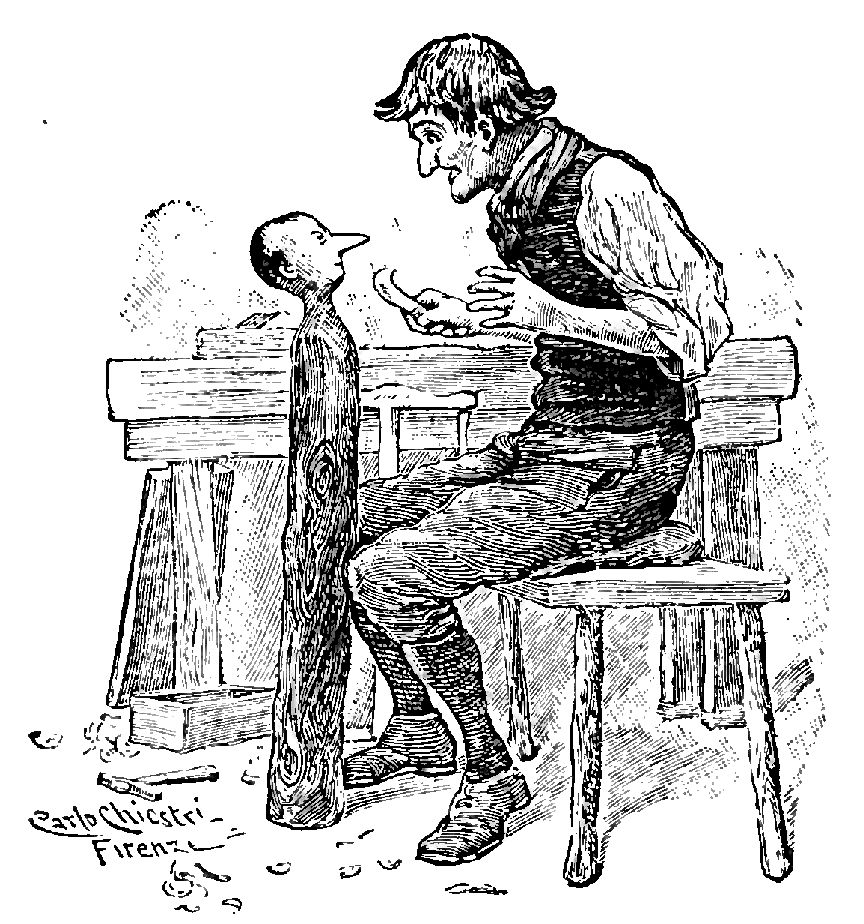
Geppetto carving Pinocchio.
First appearanceThe Adventures of Pinocchio (1883)
Created byCarlo Collodi
In-universe information
SpeciesHuman
GenderMale
OccupationCarpenter
FamilyPinocchio (son)
NationalityItalian

Geppetto (/əˈpɛt/ jə-PET-oh; Italian: [dʒepˈpetto])[1] is a fictional character in the 1883 Italian novel The Adventures of Pinocchio by Carlo Collodi. Geppetto is an elderly, impoverished woodcarver and the creator (and thus 'father') of Pinocchio. He wears a yellow wig resembling cornmeal mush (called polendina), and consequently his neighbors call him "Polendina" to annoy him. The name Geppetto is a Tuscan diminutive of the name Giuseppe (Italian for Joseph).

Role

[edit]
The next morning, Geppetto is released from jail.

Geppetto is introduced when carpenter Mister Antonio finds a talking block of pinewood that he was about to carve into a leg for his table. When Geppetto drops by looking for a piece of wood to build a marionette, Antonio gives the block to Geppetto.

Geppetto, being extremely poor and thinking of making a living as a puppeteer, carves the block into a boy and names him "Pinocchio." Before he is even built, Pinocchio already has a mischievous attitude; no sooner is Geppetto finished carving Pinocchio's feet than the puppet proceeds to kick him. Once the puppet has been finished and Geppetto teaches him to walk, Pinocchio runs out the door and away into the town. He is caught by the carabiniere. When people say that Geppetto dislikes children, the carabiniere assumes that Pinocchio has been treated poorly and imprisons Geppetto.

Geppetto is seen healthy again and resuming woodcarving.

The next morning, Geppetto is released from jail and finds that Pinocchio's feet have burnt off. Geppetto replaces them with new feet. When Geppetto feeds him three pears, Pinocchio promises to go to school. Because Geppetto has no money to buy school books, he sells his only coat.

Geppetto is next seen when Pinocchio believes that the Fairy with Turquoise Hair has died and a pigeon carries him to the seashore, where Geppetto is building a boat to search for Pinocchio (depending on the version of the story he sails in search for Pinocchio on near islands or following Mangiafuoco and his puppet theatre headed to the Nuovo Mondo). Pinocchio tries to swim to Geppetto but is washed underwater while Geppetto is swallowed by the Terrible Dogfish.

Geppetto is not seen again until Pinocchio is himself swallowed. Pinocchio and Geppetto escape the Dogfish and are thence conveyed to shore by a tuna.

After several months of hard work supporting the ailing Geppetto at a farmer's house, Pinocchio goes to buy himself a new suit, and Geppetto and Pinocchio are not reunited until the puppet has become a boy. Geppetto is seen healthy again and resuming woodcarving.

Adaptations

[edit]
Nino Manfredi as Geppetto in the TV series The Adventures of Pinocchio (1972)
Geppetto as portrayed in Guillermo del Toro's Pinocchio (2022)
Actor Version
Christian Rub Pinocchio (1940 film)
Walter Slezak Pinocchio (1957 TV musical)
Stan Francis The New Adventures of Pinocchio
Burl Ives Pinocchio (1968 film)
Roberto Bertea
Dallas McKennon (English dub)
The Adventures of Pinocchio (1972 film)
Nino Manfredi The Adventures of Pinocchio (1972 miniseries)
Minoru Yada
Walter Massey (English)
Pinocchio: The Series
Carl Reiner Faerie Tale Theatre
Jim Cummings Pinocchio (1992 film)
Charles S. Dutton Happily Ever After: Fairy Tales for Every Child
Junji Chiba Piccolino no Bōken
George S. Irving Pinocchio's Christmas
Tom Bosley Pinocchio and the Emperor of the Night
Orson Bean Tiny Toon Adventures
Martin Landau The Adventures of Pinocchio
Martin Landau The New Adventures of Pinocchio
Drew Carey Geppetto (TV musical)
Chris Miller Shrek
Keith Scott Fairy Tale Police Department[2]
Carlo Giuffrè
David Suchet (English voice)
Pinocchio (2002 film)
Howard Ryshpan Pinocchio 3000
Jonathan Summers The Adventures of Pinocchio (opera)
Bob Hoskins Pinocchio (miniseries)
Tony Amendola Once Upon a Time
Mino Caprio
Michael Rudder (English)
Pinocchio (2012 film)
Roberto Benigni
Antonio Palumbo [it] (English voice)
Pinocchio (2019 film)
Tom Hanks Pinocchio (2022 live-action film)
David Bradley Pinocchio (2022 animated film)
Brian Bowles Ravenswatch (2023 videogame)
Anthony Howell Lies of P (2023 videogame)
Richard Brake Pinocchio: Unstrung

Disney version

[edit]
Geppetto, as seen in the 1940 Disney film.

In the 1940 Disney animated film, Geppetto is introduced as a shopkeeper finishing Pinocchio. Before falling asleep, Geppetto wishes upon on a star for Pinocchio to become a real boy. During the night, the Blue Fairy grants Geppetto's wish. The next day, he sends Pinocchio on his first day of school. On his way, Pinocchio meets Honest John and Gideon, who convince him to join Stromboli's puppet show instead, and then to go to Pleasure Island. When Pinocchio returns home, he finds the shop empty and full of dust and cobwebs, and learns from a letter by the Blue Fairy that Geppetto, venturing out to sea to rescue Pinocchio from Pleasure Island, had been swallowed by Monstro (a whale-like variation of The Terrible Dogfish). Determined to rescue his father, Pinocchio reunites with Geppetto and his pets inside Monstro, where Pinocchio burns spare furniture to choke their captor into releasing them. This done, Monstro pursues them to the coast, where Pinocchio pulls Geppetto to safety, but himself falls senseless. While Geppetto mourns Pinocchio at home, the Blue Fairy revives Pinocchio, and makes him human.

Geppetto appeared the following year in the short All Together (1942), made for the Canadian government.[3]

Disney's version of Geppetto has also made appearances in House of Mouse as well as in the Kingdom Hearts series of video games in the "Monstro" world. The character also made a cameo appearance alongside Pinocchio in the episode "Wonders of the Deep" of the Mickey Mouse TV show.

Tom Hanks plays Geppetto in the 2022 live-action/CGI adaptation of the film.[4] This version was shown to have a son who died.

Russian version

[edit]

In the 1936 Soviet book adaptation The Golden Key, or the Adventures of Buratino by Aleksey Nikolayevich Tolstoy, the character based on Geppetto is named Papa Carlo. He is an elderly organ grinder who lives in a tiny closet under a staircase, containing nothing but a painted fireplace on a piece of canvas. His barrel organ had long been broken, forcing him to survive on odd jobs. His only friend is Giuseppe the Blue Nose, an aging and perpetually drunk carpenter (based on Mastro Antonio), who gives Carlo a sentient log that he later carves into Buratino. Tolstoy likely used Carlo and Giuseppe as a satirical depiction of Russian theater practitioners Konstantin Stanislavski and Vladimir Nemirovich-Danchenko, respectively.

In the 1959 animated adaptation of the book, Papa Carlo was voiced by Yevgeny Vesnik, while in the 1975 live-action adaptation, he was portrayed by Nikolai Grinko.

Television musical

[edit]

Geppetto is the title character in the 2000 made-for-television musical, portrayed by Drew Carey. He dearly wishes to become a father until one night, the Blue Fairy appears in his workshop and brings Pinocchio to life. At first, Geppetto is happy that his wish came true, but runs into problems with Pinocchio asking persistent questions when trying to get to sleep, wandering off and getting into mischief when introducing him to the townspeople of Villagio, lying, and not interested in being a toymaker. The next day, Geppetto sends Pinocchio off to school, telling him to just act like all of the other children and he'll be alright. However, Pinocchio gets sent home from school after he gets into a fight for imitating all the other children, disappointing Geppetto. On their way home, they meet Stromboli the puppeteer who is fascinated by Pinocchio and thinks he would be worth a fortune to him as the main attraction in his puppet show.

After a brief confrontation with the Blue Fairy doesn't go well, Geppetto returns home, only to find out that Pinocchio ran away to live with Stromboli, who keeps him under a contract he had him sign. When Geppetto arrives after the show, Stromboli says Pinocchio left, claiming that he wanted to see the world, only to find Pinocchio running off to Pleasure Island and they both set out to find him. Along the way, Geppetto meets a magician named Lezarno and visits the town of Idylia where Professor Buonragazzo and his son make perfectly obedient children for any family that wants one. He then arrives at Pleasure Island and discovers the terrible curse it harnesses. After riding the roller coaster, the boys all "make jackasses of themselves" by turning into donkeys. He arrives at the roller coaster to rescue Pinocchio, but he refuses, saying he was a big disappointment to him, gets on the ride, and is shipped off to the salt mines after having been turned into a donkey. Geppetto, keeping up with the ship using a tiny fishing boat, suddenly gets swallowed by a monstrous whale where Pinocchio tells him that after he jumped in the water to save him, the donkey curse washed away and he became human again. After making up their misunderstanding, Pinocchio tells as many lies as he can, causing his nose to grow, which tickles the whale's uvula, causing it to throw them up. They then return home to Villagio, only to find Stromboli waiting to take Pinocchio back, still keeping him under the contract he signed earlier. Geppetto offers his entire shop in exchange, only for Stromboli to kidnap Pinocchio and Geppetto pleads and begs to the Blue Fairy, who can no longer help him, to grant him one last wish. The fairy then turns Pinocchio into a real boy, shoos Stromboli away with her magic, and transformed the words on the workshop sign to "Geppetto & Son," thus resulting in Pinocchio and Geppetto living happily ever after.

Fables

[edit]

Geppetto is a major villain in the Fables comic series written by Bill Willingham and published by DC Comics. His actions are responsible for the entire premise of the comic book, in that he is the being known as "The Adversary" who masterminded the conquest of the Fable homelands, forcing the Fables to flee into the mundane world.[5]

Video games

[edit]

Geppetto serves as one of two main antagonists, alongside Simon Manus, in the 2023 soulslike Lies of P developed by Neowiz Games and Round8 Studio and published by Neowiz. His actions are responsible for the puppet uprising that desolates the fictional city of Krat. He entrusts his creation P to enter the chaos to gather strength and retrieve an artifact in Simon's possession to enact a sinister resurrection plot for his deceased son, Carlo.

References

[edit]
[edit]
Revisions and contributorsEdit on WikipediaRead on Wikipedia
from Grokipedia
Geppetto is a fictional character in Carlo Collodi's 1883 Italian children's novel , portrayed as a poor, elderly woodcarver who lives alone in a modest and crafts a living named from a piece of enchanted wood that comes to life, becoming its devoted adoptive father. In the story, Geppetto demonstrates unwavering parental love and sacrifice, selling his only coat to buy Pinocchio an alphabet book for school and enduring hardship, including arrest by authorities after Pinocchio runs away and a grueling two-year survival inside the belly of a giant shark while searching for his "son" across the ocean. His patient, forgiving nature contrasts with Pinocchio's initial disobedience and impulsiveness, underscoring the novel's themes of redemption, moral growth, and the transformative power of familial bonds. Geppetto's character has been widely adapted in literature, film, and theater, most notably in Walt Disney's 1940 animated feature , where he is depicted as a gentle, lonely toymaker accompanied by his cat Figaro and goldfish Cleo, wishing upon a for Pinocchio to become a real boy. This portrayal emphasizes his warmth and vulnerability, influencing subsequent versions such as Roberto Benigni's 2002 live-action film and the 2022 Disney+ remake starring as Geppetto, which explore similar motifs of loss and longing.

Origins and Literary Background

In Carlo Collodi's Novel

In Carlo Collodi's 1883 novel (originally titled Le avventure di Pinocchio: Storia di un burattino), Geppetto is depicted as a poor, elderly woodcarver residing in a modest Tuscan village. He earns a meager living as a carpenter, crafting wooden items in a cramped, one-room dwelling furnished with only a rickety table, a , a simple bed, and a rusty , reflecting the widespread among artisans in late 19th-century . Nicknamed "Polendina" by local children—meaning "cornmeal mush"—due to his yellow resembling the color of , Geppetto is quick to anger when taunted, underscoring his irritable yet solitary disposition amid economic hardship. The narrative introduces Geppetto's pivotal role through his encounter with a piece of enchanted . Visiting his neighbor Mastro , known as Master Cherry, Geppetto requests a scrap of wood to fashion a , as Antonio had intended to use it for a table leg. When Antonio strikes the wood to shape it, the piece cries out in pain, revealing its magical properties by speaking and laughing; startled, the two men scuffle, and Geppetto seizes the wood and flees home with it. As he begins carving, the wood continues to exhibit lively traits—its nose stretches, its mouth forms a grin, and it even kicks him—yet Geppetto persists, driven by profound and a yearning for familial companionship in his childless old age. Geppetto's decision to create a son named stems from both practical necessity and emotional void; he envisions the performing dances and somersaults worldwide to provide for them both, naming it after the Italian word for in hopes of good fortune. This act symbolizes his desire for a surrogate family amid isolation. The novel itself was serialized in the Italian children's newspaper Giornale per i bambini from July 1881 to January 1883, initially as a before public demand prompted its continuation as a , embedding themes of poverty's harsh realities and for wayward youth in the context of Italy's post-unification social challenges.

Name Etymology and Inspirations

The name Geppetto originates as a diminutive form of Giuseppe, the Italian variant of Joseph, commonly used in 19th-century Tuscany to denote an everyday, humble individual. This linguistic choice underscores the character's portrayal as a poor, unassuming woodcarver, evoking the simplicity of rural Italian folk life during Carlo Collodi's era. The etymology draws inspiration from the biblical Saint Joseph, the carpenter and guardian of Jesus, mirroring Geppetto's woodworking trade and his longing for a son in the narrative. Scholars note that Collodi intentionally evoked this parallel to infuse the character with themes of paternal devotion and craftsmanship rooted in Judeo-Christian tradition, a motif resonant in Italian literature of the period. Collodi's depiction of Geppetto was influenced by his firsthand encounters with impoverished Tuscan artisans amid the social upheavals of the Risorgimento, when economic hardship plagued Florence's . In particular, the tense relationship between Geppetto and the carpenter Master Cherry reflects a real-life contentious friendship between woodworkers in Florence's Castello neighborhood that Collodi observed during his journalistic career. In translations of Collodi's , the name has undergone adaptations to linguistic conventions; for example, it becomes "Gepetto" in many French editions to align with phonetic norms, while in Russian versions, particularly Aleksey Tolstoy's influential 1936 retelling The Golden Key, or the Adventures of , Geppetto is rendered as "Papa Carlo" to evoke a folksy, paternal figure familiar to Soviet readers.

Character and Role in the Original Story

Physical Description and Personality

In Carlo Collodi's , Geppetto is portrayed as an elderly woodcarver, described as a "dapper little old man" with a yellow wig resembling mush, which earns him the mocking nickname "Polendina" from local children. His build is thin and frail, evident from his slender frame and thin legs, compounded by the physical toll of that leaves him shivering in shirt sleeves after selling his patched coat on a cold day. Later in the story, after enduring prolonged hardships, he appears as a "little old man, white as the snow," underscoring his advanced age and vulnerability. Geppetto's personality blends deep and with a quick temper, making him a multifaceted figure of paternal devotion amid hardship. He exhibits profound , such as sharing his meager breakfast of pears with the newly animated despite his own hunger, and selling his only coat to purchase an for its education. His hot-tempered side emerges sharply when teased, as he becomes "wild as a beast" in response to mockery, yet this impulsiveness is tempered by and unwavering love. Psychologically, Geppetto's as a solitary, impoverished drives his emotional investment in creating a companion from , treating the unfinished as a son from the moment he carves it, even scolding it affectionately for seeming to laugh or stare. This resilience and moral steadfastness position Geppetto as a humble, hardworking counterpoint to the story's more deceitful or indolent characters, embodying themes of redemption through and . His quirks, such as conversing with the wood as if it were alive—exclaiming at its "ugly wooden eyes" or chiding it for impudence—reveal an innate tenderness that transforms a simple project into a profound familial bond.

Key Events and Relationships

In Carlo Collodi's , Geppetto carves a puppet from a piece of enchanted wood given to him by his neighbor, the carpenter Master Cherry, and names the figure in hopes of bringing good fortune to his impoverished life. Upon coming to life, Pinocchio immediately displays mischief by laughing at Geppetto's yellow wig and kicking him, which escalates when the puppet runs outside and incites neighbors to complain, leading to Geppetto's arrest by the police for alleged mistreatment. After Geppetto's arrest, Pinocchio returns home alone, but their father-son bond forms despite the early chaos when Geppetto is later released. Geppetto demonstrates profound sacrifices for Pinocchio's education and well-being, such as selling his only winter coat to purchase an so the puppet can attend , leaving himself shivering in shirtsleeves during cold weather. When runs away after selling the book for theater tickets, Geppetto embarks on a desperate four-month search across land and sea, constructing a small to pursue leads on his whereabouts, only to face peril when the vessel is wrecked in a storm. Swallowed by (also called the ) during this quest, Geppetto endures near-starvation and isolation inside the creature's belly for two years, surviving on scraps from a sunken ship while lamenting his loss. The reunion occurs when Pinocchio, guided by a pigeon and driven by guilt, dives into the Dogfish's mouth and discovers Geppetto weakened but alive; together, they sneak out through the Dogfish's open mouth while it sleeps, with Pinocchio carrying the weakened Geppetto on his back, then escaping to shore with the aid of a friendly tunny fish. Back home, Pinocchio supports the frail Geppetto by working as a porter to buy and , repaying his father's devotion through diligence. This culminates in Pinocchio's transformation into a real boy by , who rewards his maturity, allowing Geppetto to finally enjoy a stable family life free from poverty. Geppetto's interactions with others underscore his as a poor woodcarver; his brief exchange with Master Cherry involves a minor scuffle over the wood but resolves into gratitude for the gift that creates . , while primarily Pinocchio's guardian, indirectly benefits Geppetto by facilitating the family's reunion and prosperity, highlighting his reliance on his son's adventures for salvation. Throughout these events, Geppetto serves as a steadfast anchor for Pinocchio's turbulent journey, embodying themes of unconditional and personal growth through their shared trials.

Adaptations Across Media

Film and Animation

In the 1940 Disney animated film Pinocchio, Geppetto is portrayed as a whimsical and loving father figure, voiced by Christian Rub, who carves the puppet from wood and wishes upon a star for him to become a real boy, emphasizing themes of hope and paternal affection. This adaptation highlights Geppetto's gentle nature through scenes where he dotes on his pets Figaro and Cleo, creating a cozy, toy-filled workshop that contrasts with the original novel's harsher realities. A key sequence shows Geppetto swallowed by the whale Monstro, where he ingeniously builds a small fire and makeshift home inside the beast's belly while awaiting rescue, underscoring his resourcefulness and bond with Pinocchio. In Roberto Benigni's 2002 live-action film Pinocchio, Carlo Giuffrè portrays Geppetto as a humble and devoted woodcarver in 19th-century , faithfully adapting the novel's depiction of poverty and sacrifice, including selling his coat for Pinocchio's schoolbook and searching for him at sea. Benigni's direction emphasizes Geppetto's emotional depth and forgiveness, with Giuffrè's performance conveying weariness and unconditional love amid the puppet's misadventures. The 1972 Italian miniseries Le avventure di Pinocchio, directed by Luigi Comencini, presents a grittier Geppetto played by , depicting him as an impoverished woodcarver enduring economic hardships in a Risorgimento-era setting that reflects Italy's historical struggles for unification and social upheaval. Manfredi's performance captures Geppetto's toil and sacrifices, such as trading his coat for Pinocchio's education, portraying him as a resilient yet weary figure in a rundown environment far removed from the sentimentality of later versions. This adaptation retains the novel's emphasis on and labor, showing Geppetto's creation of Pinocchio as an act born of loneliness and necessity rather than pure whimsy. In Matteo Garrone's 2019 live-action film Pinocchio, Roberto Benigni plays Geppetto as a poor, elderly artisan driven by profound loneliness to carve the living puppet from enchanted wood, highlighting his raw vulnerability and paternal longing in a stark, realistic 19th-century Tuscan landscape. Benigni's portrayal underscores themes of redemption and hardship, including Geppetto's ocean search and time inside the sea monster, aligning closely with Collodi's original while adding emotional intensity through Benigni's expressive performance. In Steve Barron's 1996 live-action film The Adventures of Pinocchio, Martin Landau portrays Geppetto as a remorseful man who once loved Leona (played by Geneviève Bujold), who married his late brother, carving the puppet from a magical log he found in the forest as an act born of loneliness and unrequited affection. This version adds emotional depth to Geppetto's motivation, framing Pinocchio's animation as a poignant attempt to reclaim familial joy, with Landau's dignified performance grounding the fantastical elements in human vulnerability. Key scenes depict Geppetto raising the lively puppet amid challenges like Pinocchio's escapades on the Island of Lost Boys, altering the dynamic to highlight redemption and paternal guidance. Guillermo del Toro's 2022 stop-motion adaptation reimagines Geppetto, voiced by David Bradley, as a grieving and war-traumatized woodcarver in during the , beginning during , whose son Carlo dies in a church bombing, prompting him to craft the puppet from a pine cone in a drunken rage as a flawed replacement. Bradley's portrayal conveys Geppetto's raw pain and initial rejection of Pinocchio's imperfections, adding historical depth through the era's political turmoil and emphasizing themes of loss over idealization. Unlike the original, this Geppetto evolves to accept Pinocchio as an individual, not a surrogate, in a narrative that integrates the Monstro sequence with darker tones of survival and reconciliation. The 2022 Disney+ live-action remake, directed by Robert Zemeckis, features Tom Hanks as Geppetto, expanded with a backstory of losing his real son and wife, which fuels his longing for family as he carves Pinocchio from enchanted wood in his clock shop filled with mementos of the deceased. Hanks' warm, heartfelt performance amplifies Geppetto's role as a devoted father who teaches Pinocchio about bravery and truth, including a climactic rescue from Monstro where emotional bonds triumph. This version heightens sentimentality by focusing on Geppetto's internal growth and reunion with Pinocchio, transforming him into a heroic savior figure. An upcoming 2026 horror reimagining, Pinocchio: Unstrung, directed by as part of the Twisted Childhood Universe, casts as Geppetto, portraying him as a grandfather introducing his grandson to a sinister wooden named in a dark tale blurring reality and fantasy, with production ongoing as of 2025. Across these adaptations, Geppetto's character often undergoes alterations that increase sentimentality, such as portraying him as an endearing, pipe-smoking rather than the novel's hot-tempered poor man reliant on the for support in old age. Many omit the original's emphasis on and economic desperation, instead highlighting whimsical family dynamics and rescue scenes like the Monstro encounter to evoke wonder and paternal heroism. These shifts prioritize emotional resonance and visual spectacle in cinematic formats, evolving Geppetto from a marginalized to a symbol of unconditional love.

Television, Theater, and Musicals

Geppetto's portrayal in television adaptations of Pinocchio often emphasizes his role as a devoted but flawed , adapting the character's emotional depth to episodic formats suitable for broadcast audiences. In the 1957 live musical special Pinocchio, directed by , depicted Geppetto as a whimsical woodcarver whose longing for companionship drives the narrative, with the production incorporating songs that highlight his isolation and paternal instincts through physical comedy and heartfelt monologues. Similarly, the 1960–1961 Canadian puppet-animated series The New Adventures of Pinocchio, comprising 130 episodes, featured Geppetto as a narrator and recurring character portrayed through , presenting him as an endearing, bumbling elder who imparts moral lessons amid Pinocchio's escapades, underscoring themes of guidance and forgiveness in a family-oriented serial structure. These early TV versions leaned on live-action and elements to amplify Geppetto's physical expressiveness, softening his original story's gruffness for younger viewers while exploring dynamics, such as his interactions with village neighbors as surrogate kin. Later television productions modernized Geppetto's character to blend tradition with contemporary humor and drama. The 2000 ABC Geppetto, starring in the title role, reimagined him as a comedic toy shop owner in a small Italian town, grappling with 's sudden fame and rebellious antics after the comes to life, which forces Geppetto to confront his own regrets about isolation and unfulfilled dreams through upbeat songs and sequences. Carey's performance emphasized Geppetto's affable, everyman charm, with the story inverting perspectives to focus on his journey as a parent navigating mischief and media attention. In contrast, the 2008 Italian-British miniseries Pinocchio, directed by Alberto Sironi, cast as a more traditional Geppetto—a weathered, suffering enduring and loss—faithful to Collodi's in its two-episode format, where his quiet resilience and emotional turmoil anchor the adaptation's darker tones. Hoskins's portrayal highlighted Geppetto's stoic endurance, portraying him as a paternal anchor amid Pinocchio's trials, with minimal comedic relief to preserve the source material's . Theater and musical adaptations of Pinocchio have showcased Geppetto through live performance, often integrating and song to convey his inner conflicts and craftsmanship legacy. Early efforts in the included regional theater productions and experimental Broadway workshops that experimented with puppet-infused stagings, where Geppetto was enacted as a poignant figure delivering emotional arias about personal loss and the artistry of creation, drawing from the era's interest in folk tales for family audiences. These performances, though not achieving long runs, influenced later works by emphasizing Geppetto's vulnerability on . More recent touring musicals, such as Disney's My Son Pinocchio: Geppetto's Musical Tale (premiering in 2006 and continuing in regional and touring productions through the present), recast Geppetto as a folk hero-like toymaker reflecting on regret and fatherhood, featuring songs like "" (adapted) that explore his craftsmanship and longing for connection, with the narrative told from his viewpoint to highlight themes of redemption. The 2017 Royal National Theatre production of Pinocchio, directed by , further advanced this with innovative , portraying Geppetto (voiced and operated by Mark Hadfield) in a visually dynamic spectacle that incorporated audience interaction through immersive staging, softening his temper into a relatable, grief-stricken while amplifying performative elements like ensemble numbers on loss and ingenuity. Across these stage versions, Geppetto's character benefits from direct performer-audience engagement, fostering through live emotional delivery and often expanding his relationships to include communal ties for broader .

Comics, Literature, and Video Games

In the comic series Fables (2002–2015), created by and published by Vertigo (an imprint of DC Comics), Geppetto is reimagined as a central known as "The Adversary," a tyrannical emperor who rules over the Homelands and exiles the Fables to Earth, enforcing a rigid empire through magical enchantments and wooden soldiers he crafts. His backstory reveals dark secrets about Pinocchio's creation, portraying Geppetto as an immortal woodcarver who used forbidden magic to build an army of enchanted puppets, leading to his isolation and eventual downfall within Fabletown society after his identity is exposed. Expanded literature has explored Geppetto through fictional retellings that delve into his psyche as a creator. In Edward Carey's The Swallowed Man (2021), presented as Geppetto's memoirs written while trapped inside a giant whale, he grapples with the ethics of animating life from wood, reflecting on his loneliness, paternal regrets, and the monstrous implications of playing god with Pinocchio's existence. Video games have depicted Geppetto in varied roles, often emphasizing his inventive prowess or manipulative tendencies. In Lies of P (2023), developed by Neowiz and Round8 Studio, Geppetto serves as a puppet-maker in the plague-ridden, Bloodborne-inspired city of Krat, where he orchestrates a puppet rebellion to revive his deceased son Carlo; player choices reveal his tragic yet ruthless motivations, culminating in confrontations that highlight his god-like control over artificial life. In contrast, the Kingdom Hearts series (2002–present), developed by Square Enix, casts Geppetto as a supportive inventor and father figure aboard his ship in Traverse Town and other worlds, aiding protagonists like Sora in their quest while worrying over Pinocchio's safety from Heartless threats. Elements of Geppetto's workshop and creations appear in twisted forms within the forgotten realm of Wasteland in Epic Mickey (2010), developed by Junction Point Studios, integrating his Pinocchio-inspired designs into the dilapidated Disney cartoon landscape corrupted by the Shadow Blot. These portrayals mark a trend in modern , , and video games toward morally ambiguous depictions of Geppetto, shifting from his original benevolent fatherly role to explore creator-god complexes, where his act of animation raises themes of control, loss, and ethical in interactive and serialized narratives.

Legacy and Interpretations

Literary and Psychological Analysis

In , Geppetto is often interpreted as a , a creator figure akin to the Platonic craftsman who shapes imperfect life from inert matter, with embodying the golem-like artificial being striving for humanity. This role underscores themes of and technological ambition, as Geppetto crafts the to combat his profound , highlighting tensions between creator and creation in an era of rapid industrialization. Parallels to biblical figures further enrich this symbolism; Geppetto mirrors as a devoted father whose son (, akin to ) undergoes trials of betrayal, imprisonment, and eventual redemption, saving his from peril in a manner reminiscent of Joseph's provision during famine. Psychological readings emphasize the Oedipal dynamics in Geppetto's relationship with , portraying the woodcarver as an inadequate or absent paternal authority whose intense bonding fosters the puppet's pre-Oedipal fixations and rebellious impulses. Critics like analyze Geppetto's arc as emblematic of redemption through moral socialization, evolving from a , impoverished figure to a who guides toward ethical maturity amid societal pressures. These interpretations frame the father-son bond as a lens for exploring Italian literary tropes of paternal and filial in 19th-century narratives. From a Marxist perspective, Geppetto represents proletarian resilience against the dehumanizing forces of industrialization, as a lowly whose craftsmanship symbolizes resistance to and class exploitation in Collodi's . His and sacrifices underscore the tale's of economic disparity, with Pinocchio's journey reflecting the lower classes' aspiration for upward mobility through labor and discipline. In and studies, Geppetto's absence of a accentuates the vulnerabilities of single parenthood in 19th-century , blending paternal with maternal nurturing—such as his sacrificial deceptions to provide for —while exposing emotional fragility in a patriarchal context. Post-1950 critiques, including those in annotated editions and essays like Zipes's, trace Geppetto's shift from mere to a multifaceted , illuminating broader themes of creation, loss, and familial redemption in modern literary analysis.

Cultural Impact and Modern Relevance

Geppetto serves as an enduring archetype of the loving inventor-father in Western media, representing the devoted creator who imparts moral guidance and seeks familial connection through his craft. This image parallels portrayals of paternal figures in literature and film, such as Victor Frankenstein in Mary Shelley's 1818 novel Frankenstein, where the scientist's animation of a creature resembles Geppetto's carving of a living puppet, both exploring the burdens of creation and abandonment. In animation, echoes appear in Pixar's Toy Story franchise, where toys animated by imagination yearn for recognition from their child-owner, mirroring the emotional bond between Geppetto and Pinocchio. The character's narrative is widely integrated into curricula to foster and perseverance, with Geppetto's role highlighting themes of and steadfast support amid adversity. Educators use the story to illustrate how a father's patience can guide personal growth, encouraging students to reflect on and resilience in relationships. In , Geppetto embodies the nation's of artisanal craftsmanship, particularly Tuscan woodcarving traditions, symbolizing the value of manual skill and creative labor passed down through generations. Post-2020, Geppetto's tale has gained renewed relevance in discussions on AI and creation , drawing parallels to where inventors grapple with endowing machines with and "humanity." Commentators invoke the puppet-master dynamic to debate moral responsibilities in forms, akin to Geppetto's wish for a son, amid rising concerns over AI sentience and creator accountability. In surrogacy contexts, the narrative informs conversations on non-biological parenthood, emphasizing bonds forged through intent rather than . The 2023 video game Lies of P reimagines Geppetto as a flawed behind a mechanical uprising, prompting reflections on the perils of paternal ambition in automated societies. Global adaptations reveal variations in Geppetto's portrayal, adapting the to cultural contexts. In Japanese anime like Piccolino no Bouken (), he appears as a harmonious family anchor, emphasizing collective balance and gentle mentorship over individual rebellion. Feminist retellings, such as those analyzing Collodi's original through lenses, critique Geppetto's authority as emblematic of patriarchal control, reinterpreting his guidance as restrictive and advocating for autonomous agency in creator-child dynamics. Geppetto features prominently in merchandise and cultural events, reinforcing his nostalgic appeal. At Disney parks, shops like La Bottega di Geppetto in Disneyland Paris sell Pinocchio-themed toys and apparel, evoking the woodcarver's workshop. In Collodi, Italy, the annual Pinocchio Street Festival celebrates the character with crafts, performances, and exhibits, positioning Geppetto as a symbol of local heritage and storytelling tradition.

References

Add your contribution
Related Hubs
User Avatar
No comments yet.