


Community hub
Recent from talks
Contribute something
Nothing was collected or created yet.
Halva
View on Wikipedia
_Samarkand,_Siyab.jpg) | |
| Type | Confectionery, dessert |
|---|---|
| Place of origin | Iran (Persia)[1][2] |
| Region or state | Middle East, South Asia, Central Asia, Eastern Europe, Balkans, South Caucasus, North Africa, Horn of Africa |
| Serving temperature | Cold |


Halva (also halvah, halwa, halua[3]) is a type of confectionery that is spread throughout the Middle East and North Africa, East Africa, Eastern Europe, and the Balkans, Central Asia, and South Asia. The name refers to a broad variety of recipes, generally a thick paste made from flour, butter, oil, saffron, rosewater, milk, turmeric powder, and sugar.[4][5][6][7]
Etymology
[edit]
The word halva entered the English language between 1840 and 1850 from Romanian, which came from Ottoman Turkish: حلوى, romanized: helva, itself ultimately derived from Arabic: حلوى, romanized: ḥalwā, a sweet confection.[8][9] The root in Arabic: ح ل و, romanized: ḥ-l-w, means "sweet".[10] The Persian name for the confection is Persian: روغن خورديگ, romanized: rōɣæn xordīg, meaning "oil food".[1]
History
[edit]Halva originated in Persia (modern day Iran).[1][11] By the 9th century, the term was applied to numerous kinds of sweets, including the now-familiar sweetened cooked semolina or flour paste.[4][8]
The first recipes of halva were documented in the 13th century Arabic cookbook Kitab al-Tabikh (The Book of Dishes), as well as an anonymous cookbook from 13th-century Al-Andalus. Halva was adopted by the Ottoman Turks, including a sesame-based version, and spread throughout their empire.[8]
Types
[edit]Most types of halva are relatively dense confections sweetened with sugar or honey.[12] Their textures, however, vary. For example, semolina-based halva's texture can be like a very buttery, moist clumpy couscous[13] to something gelatinous and translucent, while sesame-based halva is drier and more crumbly.[14]
Grain-based halva
[edit]
Grain-based halva is made by toasting flour or cornstarch in oil, mixing it into a roux, and then cooking it with a sugary syrup. Corn is rarely used.
Dishes made from wheat semolina include Suji ka Halva in India, Pakistan, Shujir Halua in Bangladesh and irmik helvası in Turkey. In both dishes, semolina is toasted in fat, either oil or butter, and then mixed with water or milk and sugar to achieve the desired flavor and consistency.[15] Wheat-based sohan halwa in northern India and Pakistan is a renowned delicacy made by combining wheat flour with milk, sugar, clarified butter, cardamom, saffron, and nuts such as almonds and pistachios. The mixture is slow-cooked, allowing the sugar to caramelize, which gives Sōhan halvā its unique firm and brittle texture.

Dairy-based rice flour halva, known as Pathein halawa, is considered a Burmese delicacy native to the city of Pathein.
Sesame
[edit]Sesame halva is popular in the Balkans, Poland, the Middle East, and other areas surrounding the Mediterranean Sea.
The primary ingredients in this confection are sesame butter or paste (tahini), and sugar, glucose or honey.[4] Soapwort[16][17] (called ‘erq al halaweh in Arabic; çöven in Turkish), or egg white are added in some recipes to stabilize the oils in the mixture or create a distinctive texture for the resulting confection. Other ingredients and flavorings, such as pistachio nuts, cocoa powder, orange juice, vanilla, or chocolate are often added to the basic tahini and sugar base.[4][18]
Sunflower
[edit]
Sunflower halva is popular in the countries of the former Soviet Union as well as in Bulgaria and Romania.[19] It is made of roasted ground sunflower seeds instead of sesame. It may include other ingredients, such as nuts, cocoa powder, or vanilla.[20][21] In 1996 around 4–5 thousand tonnes of sunflower halva were being produced by Ukraine annually.[22]
 | This article needs to be updated. (January 2025) |
Peanuts
[edit]In Argentina, Greek immigrants at the beginning of the 20th century created a kind of halva called mantecol from peanut butter, currently marketed under the name of Mantecol and also Nucrem. Such a product is widely consumed in the country.
Carrots
[edit]Gajar ka halwa, or gajorer halua, is a popular halva in India, Pakistan and Bangladesh. It is made by slow-cooking grated carrots with milk, sugar, and ghee (clarified butter), often flavored with cardamom and garnished with nuts such as almonds, pistachios, or cashews. Sometimes, khoya (reduced milk solids) or condensed milk is added to enhance its richness and flavor.
Other
[edit]Floss halva
[edit]Pişmaniye (Turkish) or floss halva is a traditional sweet, prepared in Kocaeli, Turkey, made by flossing thin strands of halva into a light confection. Made primarily of wheat flour and sugar, the strands are continuously wrapped into a ball shape and then compressed. The result is a halva with a light consistency, similar to cotton candy. Floss halva can be found in regular and pistachio flavors, and there are brands with halal or kosher certifications.
In Chinese cuisine, a floss-like candy similar to pişmaniye or pashmak halva, known as dragon beard candy, is eaten as a snack or dessert.
A raw version of halva also has become popular among proponents of raw food diets. In this version, a mixture of raw sesame tahini, raw almonds, raw agave nectar and salt are blended together and frozen to firm.[23]
Cultural and national variations
[edit]Azerbaijan
[edit]
One regional variant is from Sheki where Şəki halvası halva refers to a layered bakhlava style pastry filled with spiced-nut mix and topped by crisscrossed patterns of a red syrup made from saffron, dried carrot and beetroot.[24][25]
Greece
[edit]Halva is a traditional fasting food among Greek Orthodox who traditionally have food restrictions, especially from meat, on Wednesdays and Fridays throughout the year, for all of Great Lent and other fasting periods.[26]
Italy
[edit]In the early 2020s, halva production also began in Italy. In 2023, the artisanal confectionery laboratory The Halva Lab was established in Sassuolo, producing halva inspired by Mediterranean and Middle Eastern traditions but made without added sugars.[27][28]
India
[edit]
India has many types of halva, some unique to particular regions of the country. It is one of the popular sweets of India usually made from semolina.[29]
The town of Bhatkal in Coastal Karnataka is famous for its unique banana halwa which is infused with either whole cashews, pistachio or almonds. This type of authentic halwa is a specialty of the Muslims of this town. The Udupi cuisine has halwa made from banana, wheat, ashgourd, and jackfuit.[30][31]
It is speculated that halva (or halwa) is associated with Indian traditions and culture. Written records of sweets from Mānasollāsa mention a sweet called shali-anna, a type of semolina halwa which is today known as kesari in South India.[32]
Tirunelveli in Tamil Nadu is known for its wheat halwa. Its preparation is a laborious process that "is slowly seeing this sweet disappear." Unlike other sweets, the extra ghee is not drained out but forms an outer layer. This increases the shelf life of the halwa. Locals attribute the unique taste of the halwa to the water of the Thamirabarani.[33]
The history of Kozhikode Halwa in Kerala could trace back to Zamorin era. Zamorin invited chefs from Gujarat to prepare halwa for their royal feast.[34] They were also granted places to stay beside royal kitchen. This settlement later evolved as sweet sellers street, nowadays known as SM (Sweet Meat) Street or Mittayitheruvu.[35] Kozhikode halwa is made of pure coconut oil, not from ghee. Kozhikode halwa also builds religious harmony; Ayyappa devotees from neighboring states Karnataka and Andhra Pradesh buy halwa and chips like prasadam (sacred food). They distribute them among their neighbors and friends, who consume them with a religious zeal.[36]
-
 Sooji halwa made from semolina or sooji
 -
 Black halwa from Kerala
.JPG)

Iran
[edit]
In Iran, halva (Persian: حلوا) usually refers to a related confection made from wheat flour and butter and flavored with saffron and rose water.[37][38] The final product has a yellow, brown, or dark brown color. The halva is spread thin on a plate and left until it dries into a paste. Halva usually is served at wedding celebrations, religious ceremonies and funerals.
Halva ardeh is the Iranian term for tahini-based halva, and may or may not include whole pistachios. Ardeh is processed sesame in the form of paste, usually sweetened with syrup.[39][40]
Israel
[edit]Tahini halvah (Hebrew: חלווה) is very popular in Israel and among Jews in the diaspora.[41][42] Israeli halvah is made from sesame tahini and sugar. It is generally sold in slabs, with or without nuts. Vanilla, or vanilla with chocolate swirls are perhaps the most common, but there are many different varieties. Halvah is parve. It is often served as a breakfast component at Israeli hotels.
It is also used in specialty ice cream, which is made of sesame halva, tahini, eggs, cream, and sugar, and usually topped with pistachios and Silan (date syrup).[43][44]
-
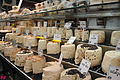 Israeli halva displays at the Mahane Yehuda Market in Jerusalem
 -
 Halva ice cream
.jpg)

Myanmar (Burma)
[edit]In Myanmar (Burma), halawa (ဟလဝါ) generally refers to Pathein halawa (ပုသိမ်ဟလဝါ), a Burmese confection or mont made with glutinous rice flour, rice flour, milk, and coconut shavings originating in the Irrawaddy delta town of Pathein. Another popular semolina-based confection, which is known as sooji halawa in India, is called sanwin makin in Myanmar.
Turkey
[edit]In Turkey halva is served for special occasions such as births, circumcisions, weddings and religious gatherings. The tradition is for semolina halva to be served at funerals, when someone leaves or returns from Hajj, and during Ramadan.[45]
For this reason, flour (un) halva is also called in Turkish ölü helvası, meaning "halva of the dead". The expression "roasting halva for someone" suggests that the person referred to has died.
United States
[edit]Halva can be found in ethnic Indian, Jewish,[8] Arab, Persian, Greek, Balkan community stores and delicatessens as well as natural food stores. Besides being imported, it is manufactured in the United States, with the largest producer being Brooklyn-originated Joyva.[46][3]
Somalia
[edit]In Somalia, halva is known as xalwo (also spelled halwo or xalwa). It is a popular sweet made from sugar, oil, and cornstarch, flavored with spices such as cardamom, nutmeg, or cloves, and sometimes enriched with peanuts. Xalwo is traditionally served at weddings, Eid celebrations, and other festive occasions, and is often offered to guests alongside Somali tea or coffee as a symbol of hospitality.[47]
See also
[edit]
References
[edit]- ^ a b c Foundation, Encyclopaedia Iranica. "Welcome to Encyclopaedia Iranica". iranicaonline.org. Retrieved April 23, 2021.
The origin of ḥalwā in Persia dates from the pre-Islamic period. References are found in the Middle Persian text of Xōsrōv ud rēdak (ed. Monchi-zadeh, secs. 38-40) to two kinds of sweetmeats (rōγn xwardīg): (1) summer sweetmeats, such as lōzēnag (made with almond), gōzēnag (made with walnut), and čarb-angušt (made from the fat of bustard or gazelle and fried in walnut oil); and (2) winter sweetmeats, such as wafrēnagītabarzad flavored with coriander (gišnīz ačārag). Many references are found to ḥalwā in classical Persian texts, but rarely do they provide details concerning ingredients.
- ^ Marks, Gil (November 17, 2010). Encyclopedia of Jewish Food. HMH. ISBN 978-0-544-18631-6.
Halva is a dense confection. The original type is grain based, typically made from semolina, and another kind is seed based, notably made from sesame seeds. Origin: Persia
- ^ a b Clark, Melissa (March 24, 2004). "For Halvah, Use 1/2 Cup Nostalgia". The New York Times. Retrieved November 15, 2020.
- ^ a b c d Davidson, Alan (1999). The Oxford Companion to Food. Oxford: Oxford University press. p. 378. ISBN 0-19-211579-0.
- ^ Sharar, Abdul Halim (1994). Lucknow: the last phase of an oriental culture. Oxford University Press. p. 165. ISBN 9780195633757.
- ^ Hosking, R. (2010). Food and Language: Proceedings of the Oxford Symposium on Food and Cooking 2009. Proceedings of the Oxford Symposium on Food and Cookery Series. Prospect Books. p. 202. ISBN 978-1-903018-79-8. Retrieved April 11, 2022.
- ^ Szokovski, Miriam. "How to Make Halva at Home".
- ^ a b c d Marks, Gil (2010). "Halva". Encyclopedia of Jewish Food. HMH. ISBN 9780544186316.
- ^ Halvah Archived March 6, 2016, at the Wayback Machine, Random House Dictionary, 2009
- ^ "American Heritage Dictionary". Retrieved February 21, 2019.
- ^ Marks, Gil (November 17, 2010). Encyclopedia of Jewish Food. HMH. ISBN 978-0-544-18631-6.
Halva is a dense confection. The original type is grain based, typically made from semolina, and another kind is seed based, notably made from sesame seeds. Origin: Persia
- ^ Kobren, Gerri (August 17, 1983). "What's this stuff called halvah?". The Herald News (Passaic, New Jersey). Independent Press Service. p. C-4. Retrieved August 17, 2022 – via Newspapers.com.
- ^ "Suji ka Halwa | Sheera Recipe". July 3, 2021.
- ^ Shah, Khushbu (June 8, 2017). "Halwa vs. Halvah: An Investigation". Taste. Retrieved March 8, 2019.
- ^ Segnit, Niki (2019). Lateral Cooking. Bloomsbury. p. 83. ISBN 9781635574418.
- ^ Arndt, Alice (1999). Seasoning Savvy: How to Cook with Herbs, Spices, and Other Flavorings. Taylor & Francis. p. 215. ISBN 978-1-56022-031-2.
- ^ "Halva Ethnological Museum of Thrace". Archived from the original on July 3, 2007.
- ^ "HALWA+WITH+PISTACHIO" "Halwa with pistachio". FAO Food and Nutrition Paper. 25–28. Food and Agriculture Organization of the United Nations. 1982.
- ^ Nistor, E.; Hoha, G.; Usturoi, M.; Alley, M. S. (2014). "Comparison of three sunflower halva assortments from Romanian market" (PDF). Analele Universității din Oradea, Fascicula: Ecotoxicologie, Zootehnie și Tehnologii de Industrie Alimentară. 14 (B): 329–336. S2CID 54789320.
- ^ "Халва. Общие технические условия", Гост 6502-2014, Межгосударственный совет по стандартизации, метрологии и сертификации, 2014 ["Halva. General specifications", Interstate Standard GOST 6502-2014 (in Russian), Euro-Asian Council for Standardization, Metrology and Certification, 2014]
- ^ "Халва". ГОССТАНДАРТ. "Halva" (in Russian). GOSSTANDART. Archived from the original on January 13, 2021. Retrieved May 1, 2019.
- ^ Volodymyrovych, Dmytro (1996). Ukraine 5 years of Independence. Politische Geschichte. ISBN 9789667127008.
- ^ Amsden, Matt (2006). RAWvolution: Gourmet Living Cuisine. HarperCollins. ISBN 978-0-06-084318-2.
- ^ "Visions of Azerbaijan Magazine ::: SHEKI'S MYSTERIES – STAINED GLASS AND THE SWEETEST HALVA". Visions of Azerbaijan Magazine.
- ^ "Mətbəx sirləri: Şəki halvası - VİDEO". Milli.Az. March 20, 2013.
- ^ Moskin, Julia (April 11, 2016). "Sesame Extends Its Sweet Reach Beyond the Middle East". The New York Times.
- ^ "Che cos'è l'halva, il dolce antico che in Italia viene prodotto solo da un laboratorio artigianale". Gambero Rosso (in Italian). July 5, 2025. Retrieved October 22, 2025.
- ^ "Halva Lab, la dolce impresa di Rossana e Marco". Il Resto del Carlino (in Italian). May 16, 2023. Retrieved October 22, 2025.
- ^ Bahadur, Om Lata (1996). The book of Hindu festivals and ceremonies (3rd ed.). New Delhi: UBS Publishers Distributors ltd. p. 172. ISBN 81-86112-23-5.
- ^ "ash gourd halwa recipe kashi halwa kushmanda halwa dumroot halwa". Hebbar's Kitchen. February 12, 2019. Retrieved March 22, 2024.
- ^ "jackfruit halwa recipe seasonal dessert". Udupi recipes. June 3, 2017. Retrieved March 22, 2024.
- ^ "Full text of "Indian Food Tradition A Historical Companion Achaya K. T."". archive.org. Retrieved January 30, 2019.
- ^ Rajagopalan, Ashwin (May 10, 2018). "Tirunelveli Halwa: Tamil Nadu's Legendary Red Wheat Halwa You Need to Try". NDTV Food. Retrieved August 20, 2019.
- ^ "kozhikode-calicut-halwa-food-history". www.onmanorama.com.
- ^ Basheer, K. p m. (December 22, 2017). "a-sweet-place-in-their-hearts". The Hindu.
- ^ Naha, Abdul Latheef (December 13, 2015). "kozhikodan-halwas-religious-flavour". The Hindu.
- ^ Fair, Chris (August 3, 2008). Cuisines of the Axis of Evil and Other Irritating States. Rowman & Littlefield. ISBN 978-1-59921-634-8. Retrieved November 1, 2020.
- ^ "Recipe". Archived from the original on February 19, 2009. Retrieved December 5, 2008.
- ^ Floor, Willem M. (2003). Traditional Crafts in Qajar Iran (1800-1925). Mazda Publishers. ISBN 9781568591476.
- ^ Ying, Chris; Redzepi, René (2018). You and I Eat the Same: On the Countless Ways Food and Cooking Connect Us to One Another (MAD Dispatches). Vol. 1. Artisan Books. ISBN 9781579658564.
- ^ Marks, Gil (1996). The World of Jewish Cooking. Simon & Schuster. p. 210. ISBN 978-0-684-82491-8.
- ^ "Four stops for halvah". Haaretz.
- ^ "The ice man cometh". Haaretz.
- ^ Anders, Anders (October 31, 2016). "Halva ice cream". Icecreamnation.org. Retrieved October 31, 2016.
- ^ Tremblay, Pinar (May 18, 2015). "Semolina halva unites Turks in times of joy, sorrow". Al Monitor (Turkey). Retrieved August 20, 2019.
In Anatolia, the peninsula of land that today constitutes the Asian part of Turkey, halva has a social mission: it is shared with family and friends at joyous events such as weddings, births, circumcision ceremonies and religious celebrations. Traditionally, it is also served during Lent, at funerals and when someone leaves for hajj and is welcomed back home.
- ^ DeLafuentenov, Charles (November 8, 2004). "A Longtime Brooklyn Company That's Known for Its Sesame Sweet". The New York Times.
- ^ Xirsi, Geedi (March 25, 2023). "Homemade Xalwa: A Traditional Somali Dessert". Somalista Newspaper. Somalista. Retrieved September 25, 2025.


| International | |
|---|---|
| National | |

Halva
View on GrokipediaEtymology and Terminology
Etymology
The word "halva" derives from the Arabic ḥalwā (حلوى), meaning "sweet confection" or "sweetmeat," rooted in the Semitic triliteral ḥ-l-w, which conveys the concept of sweetness across related languages.[6][2] This etymological base reflects the confection's ancient association with sweetened preparations, with early textual references appearing in 7th-century Arabic sources describing a pudding-like mixture of dates, milk, and toasted flour.[3][7] The term's evolution involved significant Persian influence during the Islamic era, where it was adapted as halvâ (حلوا) to denote various dense sweets, building on pre-Islamic Middle Persian mentions of similar confections in texts like Xōsrōv ud rēdak.[7] From Persia, the word spread through trade and conquest, entering Ottoman Turkish as helva (حلوا) by the medieval period, a form that emphasized semisolid, oil-based desserts and facilitated its dissemination across the empire.[8] This Ottoman variant, in turn, influenced European borrowings, such as Romanian halvă, which entered English around 1846 as "halvah."[6] Further linguistic shifts occurred in the Indian subcontinent, where Persian halvâ was adopted into Hindi and Urdu as halwa, retaining the connotation of a sweet paste or fudge-like treat introduced via Mughal culinary exchanges. In Semitic traditions, the Hebrew ḥalvah (חלווה) represents a modern borrowing from Arabic or Ottoman sources, though it echoes ancient Aramaic adjectives like ḥalā (חלא) and ḥalyā (חלי), both meaning "sweet" and linked to early confectionery descriptors in rabbinic literature.[9] These adaptations highlight halva's role as a transcultural term for sweetness, evolving without altering its core Semitic foundation.Regional Names
The term "halva" exhibits numerous transliterations and regional variations across languages and cultures, all deriving from the Arabic ḥalwā, meaning "sweet."[10] In Arabic dialects, it is commonly rendered as halawa or halwa, reflecting phonetic adaptations in countries like Egypt and the broader Middle East.[2] Similarly, in Urdu and Hindi spoken in Indian subcontinent, the confection is referred to as halwa, a direct borrowing that emphasizes its dense, sweet nature.[11] In European and Mediterranean contexts, the name shifts slightly to accommodate local phonetics: Greek speakers use halvas or helva, while in Hebrew, it appears as halva or halvah.[12] Turkish variants employ helva, and Albanian forms include halve, highlighting the word's migration along trade routes.[12] These linguistic adaptations maintain the core meaning while aligning with regional pronunciation norms. Naming conventions often incorporate local ingredients to specify types, enhancing cultural specificity. In Israel, the sesame paste-based version is distinctly called tahini halva, underscoring its primary component.[13] In India, chickpea flour preparations are known as besan halwa, distinguishing them from other regional sweets like those made with semolina.[14] In modern English-speaking contexts, branding has standardized transliterations such as "halva" or "halvah," driven by commercial producers exporting from the Middle East and Eastern Europe to global markets.[10] This uniformity facilitates international trade while preserving the confection's multicultural heritage.[12]History
Origins and Early Development
Halva's roots lie in ancient sweetmeats from Mesopotamia and Egypt, where early confections served as precursors to the modern treat. In ancient Egypt, similar preparations combined sesame oil, honey, and flour to create dense, flavored pastes enjoyed as delicacies. Some scholars have suggested it originated near Byzantium, now Istanbul, some time before the 12th century.[2][15][16][17] The confection known as halva emerged more distinctly in the 7th century in Persia and Arabia, where the Arabic term ḥalwā, meaning "sweetness," first described a simple paste of dates kneaded with milk. This early form represented a bridge between ancient precursors and more sophisticated recipes, reflecting the region's agricultural abundance of dates and dairy. By the 9th century, references indicate halva had begun to incorporate refined sugars and fats, marking its transition toward a denser, more durable candy.[18][19][1] During the Abbasid Caliphate (750–1258 CE), halva developed further in the opulent courts of Baghdad, where sesame paste—known as tahini—and sugar syrup became key components, elevating it to a status symbol among the elite. The earliest known Arabic cookbook, the 10th-century Kitab al-Tabikh by Ibn Sayyar al-Warraq, includes recipes for sweets resembling halva. Culinary innovations in this era, fueled by trade along the Silk Road, introduced these ingredients, transforming halva into a luxurious treat flavored with rosewater and nuts. The earliest surviving written recipes from the 13th century appear in Arabic texts influenced by Persian traditions, notably the Kitab al-Tabikh (The Book of Dishes) by Muhammad ibn al-Hasan ibn al-Karim, which details seven variations primarily based on flour, oil, and boiled sugar syrup. These formulations laid the foundational techniques for halva's texture and preservation.[2][10][20] Although sesame paste appeared in halva recipes as early as the Abbasid period, the distinctive crumbly tahini-based halva (known as tahin helvası in Turkish), which dominates modern production in Turkey, Israel, Greece, Lebanon, Palestine, and other regions, was refined and popularized during the Ottoman Empire in the 16th century. Under Sultan Suleiman the Magnificent (r. 1520–1566), the imperial palace in Istanbul established a dedicated kitchen called the Helvahane (House of Halva), where specialist chefs produced approximately 30 varieties daily. This included perfecting the sesame-tahini version by combining tahini with sugar syrup, often incorporating soapwort extract to achieve the signature light, fibrous texture through stabilization and aeration. This Ottoman innovation spread widely across the empire and influenced regional cuisines, establishing the standardized, melt-in-your-mouth confection widely recognized today. While the base ingredients (sesame paste and sweeteners) have older Levantine and Arab origins, the Ottomans transformed it into the iconic form now prevalent across the Mediterranean, Balkans, and Middle East.[2][3]Spread and Regional Evolution
The Ottoman Empire played a pivotal role in disseminating halva across the Balkans and Eastern Europe starting in the 15th century, integrating it into military rations and imperial cuisine as a portable, nutrient-dense confection. Scholars suggest that sesame-based halva, known as tahin helvası in Turkey, may have originated near Istanbul (formerly Byzantium) as early as the 12th century or earlier, with roots in pre-Ottoman influences.[2] By the reign of Suleiman the Magnificent (1520–1566), dedicated halvahane kitchens in Istanbul produced over 30 varieties, including tahin helvası, which evolved into a staple of Turkish gastronomy and was supplied to the imperial palace, facilitating its adoption in conquered territories like Romania and influencing local sweet-making traditions through trade and administrative networks.[2][21][22] This expansion transformed halva from a Middle Eastern staple into a shared culinary element in Balkan societies, where it blended with regional ingredients while retaining its sesame or flour base. In the 16th century, the Mughal Empire introduced halva to Indian subcontinent, drawing from Persian and Central Asian prototypes to create flour-based versions suited to local tastes and resources. During Akbar's rule (1556–1605), imperial kitchens innovated halvas using wheat derivatives abundant in the subcontinent, such as those made with ghee, sugar, and nuts, embedding the confection in festive and royal contexts as documented in texts like the Ain-i-Akbari.[23] Waves of immigration in the 19th and 20th centuries carried halva to the Americas, particularly through Eastern European and Middle Eastern Jewish communities fleeing pogroms and economic hardship. By the early 1900s, Ashkenazi immigrants in New York City's Lower East Side began commercial production, with Nathan Radutzky founding Joyva in 1907 to mass-produce sesame halva using mechanized processes that scaled output from artisanal batches to factory levels.[2] Industrial adaptations, such as adding chocolate coatings in the 1950s, aligned the treat with American confectionery trends, boosting sales to millions annually while preserving its cultural significance in diaspora communities.Types
Sesame-based Halva
Sesame-based halva is a traditional confection originating from Middle Eastern culinary traditions, primarily made by emulsifying tahini—a paste derived from ground sesame seeds—with a hot sugar syrup cooked to the firm-ball stage and soapwort extract for aeration. This process creates a dense, fudge-like consistency that is both smooth and slightly sandy in texture, allowing it to melt lusciously in the mouth while providing a nutty, rich sesame flavor. The key to its distinctive structure lies in the careful balance of the emulsification, where the hot syrup (typically sucrose-based and heated to 245–250°F) is rapidly incorporated into room-temperature tahini to form a pliable mass that sets upon cooling. In Turkish variations, known as tahin helvası, production involves combining tahini with sugar syrup, and emulsifiers such as soapwort extract or egg whites to prevent oil separation and achieve a crumbly texture; flavorings like pistachios may be added, and it is generally vegan-friendly, offering nutritional benefits from sesame seeds including high calcium content for bone health, antioxidants, and essential minerals. A notable example is Bayramiç Tahin Helvası from the Bayramiç district of Çanakkale, Turkey, which received geographical indication status in 2021 for its traditional artisanal methods preserved since the 1870s.[24][25][26][27][28][29][30][31][32] In Levantine traditions, particularly in regions like Lebanon, Syria, Jordan, and Palestine, sesame-based halva features common subtypes distinguished by texture and appearance. These variations highlight the adaptability of the base recipe. The use of whole seeds in some versions not only enhances chewiness but also intensifies the earthy sesame notes, making it a staple in Levantine markets and home cooking.[33][24][2] Flavor profiles unique to sesame-based halva often include infusions that complement the nutty foundation, such as vanilla for a subtle aromatic lift, pistachio for a vibrant, green-flecked nuttiness, or chocolate for a modern, marbled depth that contrasts the traditional sesame base. These additions are typically stirred in during the mixing stage, allowing flavors to integrate evenly as the halva sets, resulting in versatile subtypes enjoyed across Middle Eastern and Mediterranean cuisines. For instance, pistachio-infused versions evoke Levantine heritage, while chocolate variants appeal to contemporary palates, all while preserving the core tahini-syrup emulsion.[24][33][26]Grain-based Halva
Grain-based halva refers to varieties where grains such as semolina, wheat flour, cornmeal, or rice flour serve as the primary base, creating a carbohydrate-rich confection distinct from seed or nut emulsions. The preparation typically involves roasting or frying the grain in ghee, butter, or oil to develop flavor, followed by incorporation of a hot sugar syrup, which absorbs into the mixture to form a cohesive sweet. This process yields a porous structure with a melt-in-the-mouth texture, achieved through careful stirring to prevent lumps and ensure even syrup absorption.[34][35] A prominent example is Indian sooji halwa, made by roasting semolina (sooji) in ghee until aromatic, then blending it with a boiling mixture of water, milk, and sugar, often flavored with cardamom. This results in a soft, fluffy consistency that is pudding-like and served warm during festivals or as a simple dessert. Similarly, Turkish irmik helvası involves toasting semolina with butter and pine nuts until golden, then pouring in a sugar-water syrup to simmer briefly, producing a tender yet slightly grainy texture ideal for portioning into molds.[34][36][35][37] Irmik helvası is distinct from other Turkish halva varieties, such as un helvası, a denser, flour-based type that is more laborious to prepare and often called "ölü helvası" due to its association with funerals, and tahin helvası, a crumbly, sesame paste-based confection that requires no cooking. In contrast, irmik helvası features a soft, pudding-like texture that is grainy yet fluffy. It holds profound cultural significance in Turkey, symbolizing comfort and remembrance, and is traditionally prepared for funerals as a gesture of solace, as well as for religious occasions like kandil nights and Ramadan iftars, births, weddings, housewarmings, and family gatherings. It is frequently served warm, often paired with ice cream in the popular dondurmalı variation or sprinkled with cinnamon. Regional variations include Kahta Bademli irmik helvası, which incorporates almonds for added nuttiness, and Konya styles that may feature local ingredients or specific preparation techniques.[38][39][40][37] Subtypes extend to other grains, such as cornmeal halva, where corn flour is fried in ghee and combined with a cardamom-infused sugar syrup for a smooth, cohesive result that mimics semolina's mouthfeel while offering a gluten-free alternative. Rice flour variants, like Iraqi halwat timman, toast the flour in butter before adding a sweetened water base with [rose water](/page/Rose water), yielding a light, delicate texture. The roasting imparts a distinct nutty flavor to all grain-based halvas, enhanced by garnishes such as slivered almonds, raisins, or pine nuts scattered on top for added crunch and sweetness.[41][42][34][35]Sunflower Seed Halva
Sunflower seed halva is a confectionery made primarily from ground sunflower seeds, serving as a nut-free alternative to traditional sesame varieties and widely enjoyed in Eastern Europe. It consists of sunflower seed paste, or tahini, combined with cooked sugar syrup and a foaming agent such as soapwort extract to achieve its characteristic light, flaky texture.[43][3] This preparation mirrors the basic techniques used for sesame-based halva, involving the blending of a seed paste with a sweetened syrup.[43] The flavor of sunflower seed halva is nutty and rich with a golden caramelized note, offering a milder profile than the more intense sesame version due to the subtler taste of sunflower seeds.[3] Common subtypes include chocolate-coated bars, where the halva is enrobed in a layer of cocoa butter or chocolate glaze, often flavored with vanilla or praline for added decadence.[43] These variations enhance its appeal as a portable snack or dessert. Sunflower seed halva gained prominence in Eastern Europe, particularly in Russia, Ukraine, Bulgaria, and Romania, where it is produced on a large scale reflecting local agricultural strengths. As of 2010, annual production in Romania was 1,500–2,000 tons, underscoring its status as a staple confection.[43] Mass production in former Soviet factories further solidified its role in everyday consumption, often sold in blocks or bars.[3]Other Seed and Nut Halvas
Peanut halva features roasted peanuts combined with molasses and sugar, creating a dense, crumbly confection that adapts traditional halva methods to the nut's bold flavor profile. In American contexts, this variant often incorporates peanut butter as the primary base, yielding a richer, chunkier texture compared to smoother seed-based versions, and has gained popularity through home recipes and commercial products since the mid-20th century. [44] In African adaptations, particularly in East African countries like Kenya, peanut halawa is produced and sold as a local sweet, blending roasted groundnuts with sweeteners for a hearty, nut-forward treat reflective of the region's peanut cultivation traditions. [45] In Indian culinary traditions, subtypes such as cashew halva and almond halva emphasize the integration of whole or chopped nuts into a creamy matrix for enhanced crunch and flavor depth. Cashew halva is typically made by soaking and grinding cashews into a paste, then simmering with milk, ghee, and sugar until it achieves a fudgy consistency, with additional roasted cashew pieces folded in to provide textural contrast against the soft base. Almond halva follows a similar process, using blanched almonds ground with milk solids and sweetened, often garnished or studded with slivered almonds to amplify the nutty crunch within the cohesive structure. These versions highlight tree nuts' ability to deliver a luxurious, multifaceted mouthfeel distinct from milder seed pastes. Allergenic considerations are paramount for these halvas, as peanuts and tree nuts like cashews and almonds are among the most common food allergens, affecting up to 2% of children in the United States and potentially triggering severe reactions including anaphylaxis. Texture variations arise significantly from nut size and roast level; larger nut pieces contribute noticeable crunch, while deeper roasting enhances flavor through Maillard browning and can result in firmer integration into the halva matrix due to reduced moisture and increased oil release. [46] General nut roasting techniques, involving dry heat to develop aroma compounds, further tailor these outcomes without altering core preparation principles. [47]Vegetable-based Halvas
Vegetable-based halvas represent a distinct category of these confections, utilizing root vegetables or gourds as the primary ingredient to create moist, pudding-like desserts with a balance of savory undertones and sweetness. These variants differ from seed or nut-based forms by leveraging the natural moisture and earthy flavors of vegetables, resulting in a softer, more yielding texture after cooking. In Indian cuisine, such halvas are often prepared during colder months, drawing on the seasonal abundance of vegetables like carrots to enhance both flavor and nutritional value.[48] Carrot halva, known as gajar halwa or gajrela, is an iconic example, made by grating fresh red carrots and slowly cooking them in full-fat milk, sugar, ghee, and spices like cardamom until the mixture thickens into a rich pudding. This North Indian dessert originated as a winter specialty, utilizing the sweet, in-season carrots available from November to February, which provide natural moisture that aids in achieving the desired creamy consistency without excessive added liquids. The process involves reducing the milk to concentrate flavors, often garnished with nuts for added crunch, making it a festive treat during holidays like Diwali.[49][48][50] Other vegetable-based halvas include beetroot halwa (chukandar ka halwa) and pumpkin halwa (kaddu ka halwa), which similarly employ grated or pureed vegetables simmered in milk and sweetened to highlight their vibrant colors and subtle earthy notes. Beetroot halwa features the deep red hue and mild sweetness of the root, cooked with cardamom and nuts for a nutrient-dense result, while pumpkin halwa uses the gourd's orange flesh for a golden, aromatic pudding enriched by saffron or fennel. These preparations capitalize on the high water content of the vegetables—around 88% in carrots and 92% in pumpkins—to create a luscious texture, and their seasonal availability in winter promotes nutritional benefits such as boosted immunity from beta-carotene and fiber, positioning them as wholesome indulgences in regional traditions.[51][52][50]Specialty Forms
Floss halva, also known as halva floss or çekme helva, is a distinctive variety featuring fine, pulled sugar threads coated in sesame paste to create a light, airy texture reminiscent of cotton candy but with a nutty sesame flavor. This form is particularly prominent in Turkish cuisine, where the hot mixture of tahini and sugar is repeatedly stretched and pulled by hand to form delicate strands, often incorporating pistachios or other nuts for added richness.[53] The process requires skill to achieve the floss-like consistency, resulting in a confection that melts in the mouth and is commonly enjoyed as a festive treat or topping for desserts.[54] In Sri Lankan and Indian sweets, floss halva draws from similar pulled sugar techniques rooted in Persian influences that spread via ancient trade routes, adapting sesame coatings for a regional twist on the confection. These versions emphasize the fibrous, thread-like structure, often prepared during festivals to symbolize sweetness and prosperity.[55] Molded or bar forms of halva represent another specialty variation, where the dense mixture is shaped into compact blocks or bars for easy portioning and storage. In Armenian cuisine, halva ardeh—made primarily from tahini and sugar— is typically molded into firm bars that offer a crumbly yet melt-in-the-mouth texture, providing a portable snack with a pronounced sesame profile.[56] Similarly, in Turkish cuisine, piped decorative halva involves using a piping bag to create intricate patterns or shapes from the softened mixture, often for ceremonial presentations such as weddings or religious events, enhancing its visual appeal while maintaining the traditional nutty sweetness.[57] Preservation techniques play a crucial role in maintaining the quality of these specialty halva forms, particularly for shelf-stable production. Vacuum-sealing removes oxygen to inhibit microbial growth and oxidation, extending shelf life significantly compared to traditional open packaging; for instance, vacuum-packed halva can remain fresh for months at room temperature by preventing moisture ingress and flavor degradation.[58] This method is especially useful for molded bars and floss varieties, ensuring they retain their texture and taste during transport and storage without refrigeration.[59]Preparation
Core Ingredients
Halva's core ingredients revolve around sweeteners, binders, and additives that contribute to its distinctive texture and flavor profile across traditional recipes. Sweeteners form the foundational element, typically consisting of sugar syrup cooked to the firm-ball stage, honey, or jaggery, which provide the necessary sweetness and structural matrix.[28] In many formulations, glucose syrup is incorporated alongside sucrose to inhibit excessive crystallization, ensuring a smooth, fudgy consistency rather than a grainy one by interfering with sugar crystal formation during cooling.[60] Jaggery, a traditional unrefined sugar in South Asian variants, offers a molasses-like depth while similarly requiring careful temperature control to manage its caramelization and prevent over-crystallization.[61] Binders serve to integrate the sweeteners with the base components, influencing the final texture from crumbly to dense. In seed-based halvas, such as those made from sesame or sunflower seeds, tahini or seed pastes act as the primary binder, with their high oil and protein content emulsifying the hot sugar syrup to create a matrix that sets into a fibrous or tahini-rich structure. Aerating agents like soapwort root extract are used in traditional sesame halva to create foam for the fibrous texture.[27][4] For grain-based versions, ghee, clarified butter, or vegetable oils function as binders, coating semolina, wheat flour, or other grains to facilitate even distribution of sweetness and yield a softer, pudding-like texture upon absorption and cooling.[61] Milk or condensed milk derivatives may also be used in some recipes as binders, contributing moisture and creaminess while aiding in fat crystallization for stability.[62] Additives enhance palatability and longevity without altering the core composition. Traditional flavorings like rose water, cardamom, and saffron are infused into the syrup or base to impart aromatic notes, with rose water providing a floral essence common in Middle Eastern preparations.[63] In commercial productions, preservatives such as emulsifiers (e.g., lecithin or E471) and citric acid are added to prevent oil separation and microbial growth, extending shelf life while maintaining texture integrity.[64]Traditional Techniques
Traditional halva preparation in home and artisanal settings often begins with roasting seeds or grains to develop their nutty flavors. Sesame seeds for tahini-based halva are typically roasted in a dry pan over medium heat until golden brown, a process that takes about 5–10 minutes with constant stirring to prevent burning.[65] In some Mediterranean traditions, such as Greek halva making, the ground sesame paste (tahini) is then placed in a specialized copper vessel known as a pashimi for further mixing, where the metal's conductivity aids in even heating and flavor enhancement.[66] For grain-based varieties like semolina halva, the grains are similarly toasted in a heavy-bottomed pan with ghee or butter until fragrant and lightly browned.[67] Once roasted, the base is combined with a sugar syrup cooked to the firm-ball stage, around 245–250°F (118–121°C), to achieve the right consistency for setting without becoming too hard.[24] This syrup, made from sugar, water, and sometimes flavorings like saffron or rosewater, is poured hot into the tahini or roasted grains while both are warm, ensuring proper emulsification. In Middle Eastern sesame halva methods, the mixture is then kneaded or pulled by hand like taffy to incorporate air and create the signature flaky, fibrous texture; this aeration process aligns the sugar crystals and proteins into delicate strands, requiring skilled manipulation to avoid crystallization.[3] In certain Indian subcontinental variants, such as Tirunelveli wheat halwa, the preparation incorporates a resting or mild fermentation step during milk extraction, where soaked wheat flour is allowed to settle overnight, allowing natural lactic bacteria to develop subtle tangy flavors that enhance the final sweetness.[68] After cooking, many Indian subcontinental halwas, including Pakistani and Indian semolina versions, undergo a post-cooking rest period of 20–30 minutes covered, permitting residual heat to evaporate moisture and deepen the caramelized notes without additional intervention.[69] These manual techniques emphasize precision in temperature and timing to preserve halva's authentic, labor-intensive character. In Turkish cuisine, a specialized preparation known as Balıkçı Helvası (fisherman's halva) transforms pre-made tahini halva by crumbling it, mixing with milk and lemon juice, topping with butter, and baking in an oven until golden and puffed. This results in a hot, creamy, soufflé-like texture that is richer and softer than the traditional cold, plain tahini halva. It is particularly associated with Turkish fish restaurants (balık lokantaları), where it serves as an indispensable closing dessert after seafood meals.[70][71][57]Modern Production Methods
Modern halva production has shifted toward industrialized processes to enable large-scale manufacturing, particularly in Israel and the United States, where factories began adopting mechanized equipment in the mid-20th century. In Israel, companies like Achva, founded in 1929 and starting halva production in 1946 before expanding production lines by the 1950s, utilize continuous processing systems involving automated mixers and cooling tunnels to blend tahini with sugar syrup efficiently, reducing preparation time from traditional hours-long methods to minutes. Similarly, U.S. manufacturers employ high-capacity mixers and extruders in confectionery lines to aerate and shape halva, facilitating mass output for commercial distribution while maintaining the product's crumbly texture through controlled temperature and agitation. These advancements, dating back to post-World War II industrial growth, allow for consistent quality across batches in facilities producing thousands of kilograms daily.[72][73] To enhance shelf life and address issues like oil separation in sesame-based halva, modern producers incorporate emulsifiers such as soy lecithin, typically at concentrations of 0.25% to 2.25%, which helps stabilize the tahini-sugar emulsion during storage. Soy lecithin shows limited effectiveness, resulting in oil retention of 73–78% with a decrease of about 5% after 30 days at 45°C, though it remains popular for its vegan compatibility and natural sourcing from soybeans despite being less effective than alternatives like monoglycerides. This addition not only extends product viability for global markets but also supports adaptations for plant-based diets without altering the traditional flavor profile.[4] Quality control in contemporary halva manufacturing adheres to international standards like HACCP, implemented across production lines to mitigate biological, chemical, and physical hazards, especially for export-oriented operations. Critical control points include roasting sesame seeds at temperatures exceeding 85°C for at least 20 minutes to eliminate pathogens, along with continuous monitoring of mixing temperatures above 90°C and final packaging inspections to prevent contamination. Facilities in regions like the Middle East and Europe follow GMP guidelines, incorporating stainless steel equipment (e.g., Type 304 mixers) and routine microbiological testing for Salmonella and aflatoxins, ensuring hygienic conditions and compliance with global food safety regulations.[74][75]Regional Variations
Middle Eastern Variations
In Iran, tar halva is a cherished traditional confection made primarily from wheat flour, sugar, oil, and water, infused with aromatic saffron and rosewater for a distinctive floral and golden hue. This dense, fudge-like treat is customarily prepared in households during special gatherings and shared as a gesture of solace during mourning rituals, reflecting its role in comforting communities in times of grief.[76] In Turkey, un helvası represents a flour-based variant of halva, though semolina-based irmik helvası (also known historically as Sultan Helva in Ottoman traditions, often prepared for royal or special commemorative events) is more commonly associated with funerary customs, where it is offered to visitors following a death to symbolize sweetness amid sorrow. It is also prepared for religious occasions such as kandil nights and Ramadan iftars, as well as births, weddings, housewarmings, and family gatherings, symbolizing comfort and good fortune. In everyday Turkish conversation, "helva" often refers specifically to irmik helvası. Prepared by toasting semolina in butter until golden, then combining it with a sugar syrup often scented with pine nuts, this helva embodies communal mourning practices rooted in Ottoman traditions.[77][78][79][80][81][82] In Turkey, tahin helvası, a sesame-based halva made from tahini, holds significant cultural importance, served during pivotal life events such as births, weddings, funerals, and religious holidays like Ramadan, symbolizing community, solace, and the transience of life. With roots in Ottoman traditions, where it was sent to the imperial palace and integrated into Turkish gastronomic history, tahin helvası has spread beyond Turkey to regions including the Balkans, the broader Middle East, and Mediterranean areas, where it is cherished in Jewish communities as a parve treat, often served at breakfasts or as an ice cream topping in Israel.[81][83][84] In Turkey, Balıkçı Helvası, or Fisher's Halva, is a distinct preparation of tahini halva specifically associated with fish restaurants (balık lokantaları), where it serves as a classic closing dessert after seafood dinners. This unique context has earned it the name "Balıkçı Helvası," reflecting its ties to seafood culture and tradition. It is often described as the indispensable dessert for seafront meals, distinguishing it from plain tahini halva consumed in other settings.[70][71][57][85] Israeli tahini halva, derived from sesame paste, frequently incorporates chocolate swirls for a marbled effect, blending the nutty richness of tahini with the bittersweet depth of melted chocolate to create a modern twist on the classic Middle Eastern sweet. This variation, popular in Jewish baking traditions, is often enjoyed as a standalone treat or integrated into pastries, highlighting tahini's versatility in contemporary Israeli cuisine.[24][86] In Azerbaijan, sesame halva stands as a staple sweet, crafted from ground sesame seeds mixed with sugar syrup to form a crumbly yet cohesive texture, and it is typically prepared in communal settings during festivals or family events to foster shared culinary heritage. This version underscores the region's emphasis on collective food preparation, though it remains distinct from the more liquid tahini-based forms found elsewhere in the Middle East.[87]Variations in the Indian Subcontinent and Myanmar
In the Indian Subcontinent, halva, known locally as halwa, often incorporates dairy elements like milk or reduced milk solids, distinguishing it from oil-based versions elsewhere, and is tied to Hindu and Buddhist festivals celebrating prosperity and community. One prominent example is gajar halwa, a beloved North Indian winter dessert prepared by slow-cooking grated carrots with full-fat milk, sugar, ghee, and cardamom, sometimes enriched with condensed milk for creaminess or khoya for added thickness. This treat leverages seasonal red carrots available in cooler months, providing warmth and nourishment during festivities like Diwali, where it symbolizes abundance.[88][89] Another cherished Indian variant is moong dal halwa, a rich, granular pudding made from soaked and ground yellow moong lentils roasted in ghee until golden, then simmered with milk, sugar, and nuts like almonds and pistachios, often flavored with cardamom and saffron. Popular in northern states such as Rajasthan and Uttar Pradesh, it is a staple for Diwali and weddings, embodying indulgence and auspiciousness in Hindu traditions.[90] In Myanmar, influenced by Indian migrant communities, sanwin makin (also called shwegyi sanwin makin) represents a semolina-based halwa adaptation, blending toasted semolina with coconut milk, sugar, eggs or butter, and sesame seeds for a custardy texture baked into a cake-like form. This dessert reflects Indian culinary techniques, such as roasting grains, and is commonly enjoyed at celebrations, highlighting cross-cultural exchanges in Burmese sweets.[91] Pakistani khoya halwa features evaporated milk solids (khoya) as its core, combined with semolina or flour, ghee, sugar, and nuts, yielding a dense, fudge-like consistency. Regional variations incorporate distinct spices—such as saffron and cardamom in Punjabi styles for floral notes, or rose water in Sindhi preparations—tailoring the sweetness to local tastes and often served during Eid or winter gatherings.[92]European Variations
In Greece, halva (known as halvas) is a traditional semolina-based pudding prepared without dairy or eggs, making it suitable for the Orthodox Christian fasting period. It is typically made by toasting coarse and fine semolina in olive oil until golden, then incorporating a hot syrup of sugar, water, cinnamon, and citrus peels, often garnished with toasted almonds and raisins for added texture and flavor.[93] This version follows the classic "1:2:3:4" ratio—one part oil, two parts semolina, three parts sugar, and four parts water—and is commonly served during Clean Monday (Kathari Deutera), the first day of Great Lent, as a vegan dessert alongside lagana bread and taramasalata.[94][95] In the Balkans, particularly Bulgaria and Romania, halva takes the form of compact bars made from roasted ground sunflower seeds mixed with sugar syrup, reflecting the region's agricultural abundance of sunflowers and adaptation from sesame-based originals.[96] These sunflower halva bars became widely available through state-supported mass production during the communist era, when industrial food manufacturing emphasized accessible confections using local crops like sunflower seeds, which were plentiful and cost-effective under planned economies.[97] The result is a dense, mildly nutty treat often sold in wrappers, evoking nostalgia for the standardized sweets of that period. In Poland, chałwa (halva) draws from Middle Eastern roots but was popularized and integrated into local cuisine by Jewish immigrants over centuries, becoming a staple in confectionery shops.[98] A distinctive variant incorporates cocoa for a chocolate-infused flavor, combining the traditional sesame paste base with sugar, glucose, and cocoa to create a richer, more indulgent bar that blends Eastern European Jewish traditions with Poland's growing chocolate heritage.[99] This cocoa chałwa reflects the influence of Jewish confectioners who adapted global ingredients to fit kosher and regional tastes.[98]North American Variations
In North America, particularly in the United States and Canada, halva has been largely commercialized and adapted to local tastes, with a focus on packaged products available in delis, supermarkets, and specialty stores. One of the pioneering brands is Joyva, established in 1907 by Ukrainian Jewish immigrant Nathan Radutzky in Brooklyn, New York, which introduced chocolate-covered sesame halva bars that quickly became popular in Jewish communities.[2] Joyva's halvah, made from sesame tahini, sugar, and soy lecithin, remains the largest producer in the country and is a staple in kosher delis and markets, often sold in individually wrapped bars for convenience.[100][101] Following the growth of plant-based diets in the 2010s, vegan and gluten-free halva versions have proliferated in health food markets, often using seed butters to cater to dietary restrictions. These products emphasize natural ingredients without dairy or gluten, appealing to consumers seeking allergen-friendly sweets; for instance, imported sunflower seed-based halva, which is inherently vegan and gluten-free, has seen increased availability in U.S. retailers like Amazon and specialty grocers since the mid-2010s.[102] The U.S. vegan food market grew by 20% in 2018, reaching $3.3 billion in sales.[103] Craft confectioneries have introduced fusion flavors, blending traditional halva with American favorites like peanut butter to attract broader audiences. Hebel & Co, a Los Angeles-based artisan producer founded in the late 2010s, offers Peanut Butter Chocolate Crisp Halva, incorporating organic peanut butter, dark chocolate, and puffed quinoa for a textured, modern twist that remains vegan and gluten-free.[104] Similarly, New York-based Seed + Mill produces Peanut Butter & Jelly Halva, combining sesame tahini with peanut butter and fruit preserves, highlighting innovative flavor pairings in small-batch production.[105] These adaptations reflect halva's integration into North American snacking culture, often packaged in eco-friendly formats for health-focused consumers.Other Global Adaptations
In regions with significant Indian diaspora populations, such as South Africa, traditional halwa recipes have been localized by incorporating local ingredients like nuts and dried fruits, reflecting a fusion of Indian subcontinental confectionery techniques with African pantry staples. These adaptations are prepared by toasting semolina or ground nuts in ghee before simmering with sugar syrup infused with cardamom, creating a dense, pudding-like treat served during festivals and family gatherings. This blending stems from the historical arrival of Indian indentured laborers in the 19th century, whose culinary traditions evolved alongside local produce, resulting in sweets that honor both heritages while using affordable, regional ingredients.[106][107][108] Similarly, in Latin America, particularly Brazil, Middle Eastern immigrant communities—especially Syrian and Lebanese arrivals since the late 19th century—have innovated halva by substituting or adding local nuts like Brazil nuts, which provide a creamy texture and earthy flavor to the classic tahini-based confection. These versions maintain the core method of crystallizing sugar syrup with sesame paste but incorporate the Amazon-sourced Brazil nut for regional appeal, often enjoyed as a homemade treat in diaspora households or sold in ethnic bakeries in cities like São Paulo and Rio de Janeiro. This adaptation highlights how immigrant groups sustain cultural foods by leveraging abundant local resources, turning halva into a bridge between Levantine origins and Brazilian palates.[109] Contemporary global trends have further expanded halva's reach through health-conscious and innovative fusions, notably keto-friendly versions that replace sugar with erythritol to create a low-carb alternative suitable for diabetic or ketogenic diets. These modern recipes typically combine tahini with powdered erythritol, a sugar alcohol derived from fermented fruits, along with flavors like vanilla or pistachios, yielding a fudgy texture without the glycemic impact of traditional sugar; such adaptations gained popularity in the early 2020s amid rising demand for sugar-free sweets. Additionally, since the 2020s, halva has inspired ice cream flavors in artisanal shops and home recipes worldwide, blending crumbled halva pieces into bases like tahini or vanilla, often topped with chocolate sauce or pistachios for a textural contrast that evokes Middle Eastern desserts in frozen form. These innovations, driven by wellness movements and creative culinary experimentation, have positioned halva as a versatile ingredient in global dessert trends.[110][111][112][113]References
- https://en.wiktionary.org/wiki/halva