Hubbry Logo
search
logo
876494

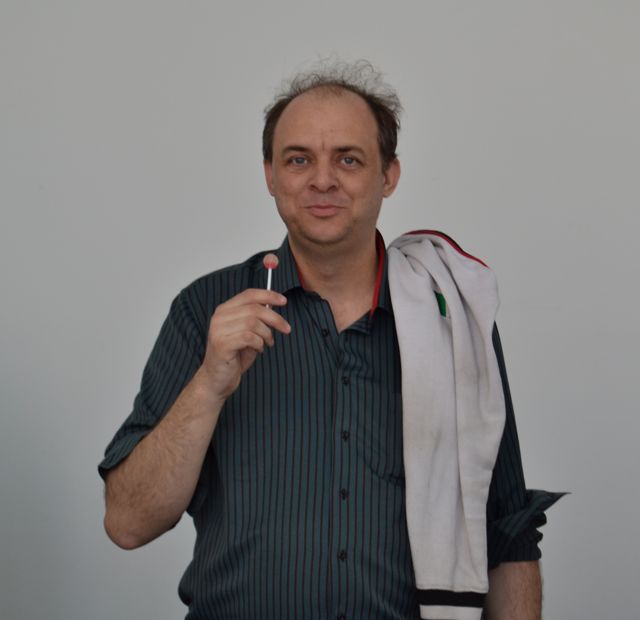
Graham Harman

logo
Community Hub0 Subscribers
Read side by side
from Wikipedia

Graham Harman (born May 9, 1968) is an American philosopher. He is Distinguished Professor of Philosophy at the Southern California Institute of Architecture in Los Angeles.[2] His work on the metaphysics of objects led to the development of object-oriented ontology. He is a central figure in the speculative realism trend in contemporary philosophy.[3]

Biography

[edit]

Harman was born in Iowa City and raised in Mount Vernon, Iowa. His maternal grandparents were of Luxembourgian and Czech descent.[4][5][6] He received a B.A. from St. John's College in Annapolis, Maryland in 1990 and went on to graduate school at Penn State University to earn a master's degree, studying under philosopher Alphonso Lingis, in 1991. While pursuing a Ph.D. at DePaul University, Harman worked as an online sports reporter, an experience which he credits for developing his writing style and productivity. After finishing his degree in 1999 he joined the Department of Philosophy at the American University in Cairo, where he taught from 2000-2016, leaving at the rank of Distinguished University Professor.[7][8] He has also been a visiting faculty member at the University of Amsterdam, University of Innsbruck, University of Turin, and Yale University. Since 2013 he has been a faculty member at the European Graduate School.[9]

Philosophical work

[edit]

Harman starts the development of his work with Martin Heidegger's concept of "tool-analysis" from Being and Time. To Harman, tool-analysis was a key discovery which establishes the groundwork for taking seriously the autonomous existence of objects and, in doing so, highlights deficiencies in phenomenology due to its subordination of objects to their use by or relationship with humans.

Harman is considered part of the speculative realism trend, a nebulous grouping of philosophers united by two perspectives: a rejection of anthropocentric "philosophies of access" which privilege the perspective of humans in relation to objects, and a support of metaphysical realism via rejection of "correlationism", an assumption in Post-Kantian philosophy that fellow speculative realist Quentin Meillassoux defines as "the idea according to which we only ever have access to the correlation between thinking and being, and never to either term considered apart from the other."[10] Harman's object-oriented approach considers the life of objects to be fertile ground for a metaphysics that works to overcome anthropocentrism and correlationism.

According to Harman, everything is an object, whether it be a mailbox, a shadow, spacetime, a fictional character, or the Commonwealth of Nations. However, drawing on phenomenology, he does distinguish between two categories of objects: real objects and sensual objects (or intentional objects), which sets his philosophy apart from the flat ontology of Bruno Latour.[11]

Harman defines real objects as inaccessible and infinitely withdrawn from all relations and then puzzles over how such objects can be accessed or enter into relations: "by definition, there is no direct access to real objects. Real objects are incommensurable with our knowledge, untranslatable into any relational access of any sort, cognitive or otherwise. Objects can only be known indirectly. And this is not just the fate of humans — it’s the fate of everything."[12]

Central to Harman's philosophy is the idea that real objects are inexhaustible: "A police officer eating a banana reduces this fruit to a present-at-hand profile of its elusive depth, as do a monkey eating the same banana, a parasite infecting it, or a gust of wind blowing it from a tree. Banana-being is a genuine reality in the world, a reality never exhausted by any relation to it by humans or other entities." (Harman 2005: 74). Because of this inexhaustibility, claims Harman, there is a metaphysical problem regarding how two objects can ever interact. His solution is to introduce the notion of "vicarious causation", according to which objects can only ever interact on the inside of an "intention" (which is also an object).[13]

Cutting across the phenomenological tradition, and especially its linguistic turn, Harman deploys a brand of metaphysical realism that attempts to extricate objects from their human captivity and metaphorically allude to a strange subterranean world of "vacuum-sealed" objects-in-themselves: "The comet itself, the monkey itself, Coca-Cola itself, resonate in cellars of being where no relation reaches."[14]

Strongly sympathetic to panpsychism, Harman proposes a new philosophical discipline called "speculative psychology" dedicated to investigating the "cosmic layers of psyche" and "ferreting out the specific psychic reality of earthworms, dust, armies, chalk, and stone."[15] Harman does not, however, unreservedly endorse an all-encompassing panpsychism and instead proposes a sort of 'polypsychism' that nonetheless must "balloon beyond all previous limits, but without quite extending to all entities".[16] He continues by stating that "perceiving" and "non-perceiving" are not different kinds of objects, but can be found in the same entity at different times: "The important point is that objects do not perceive insofar as they exist, as panpsychism proclaims. Instead they perceive insofar as they relate."[16]

Harman rejects scientism on account of its anthropocentrism: "For them, raindrops know nothing and lizards know very little, and some humans are more knowledgeable than others."[17]

Bibliography

[edit]

See also

[edit]

References

[edit]
[edit]
Revisions and contributorsEdit on WikipediaRead on Wikipedia
from Grokipedia
Graham Harman (born May 9, 1968) is an American philosopher best known as a founder of the speculative realism movement and the originator of object-oriented ontology (OOO), a metaphysical approach that asserts the independent existence of all objects—human and nonhuman—beyond their relations to human thought or perception.[1][2] Harman earned a BA from St. John's College in 1990, an MA from Penn State University in 1991, and a PhD from DePaul University in 2002, where his dissertation, Tool-Being: Heidegger and the Metaphysics of Objects, laid the groundwork for his philosophy by interpreting Martin Heidegger's tool-analysis to argue for the irreducibility of objects.[3][2] His early career included teaching at the American University in Cairo starting in 2000, where he received the 2009 Excellence in Research Award, before becoming Distinguished Professor of Philosophy and Liberal Arts Program Coordinator at the Southern California Institute of Architecture (SCI-Arc) in Los Angeles.[4][3] He also holds a professorship in philosophy at the European Graduate School in Switzerland.[2] Central to Harman's OOO is the concept of objects' "withdrawal," meaning that no object fully exhausts itself in its interactions or qualities, challenging correlationist philosophies that tie reality to human access and rejecting both materialism's reduction of objects to components and phenomenology's focus on human experience.[5][4] Influenced by thinkers like Heidegger, Bruno Latour, and medieval Islamic philosophers such as the Ash'arites, Harman advocates a "flat ontology" where all entities—from quarks to ideas—are equally real and autonomous, with aesthetics playing a key role in indirectly approaching the real through indirect causation and tension.[5][4] Harman's prolific output includes over twenty-five books, such as Guerrilla Metaphysics: Phenomenology and the Limits of the Critique of Metaphysics (2005), The Quadruple Object (2011), Weird Realism: Lovecraft and Philosophy (2012), Art and Objects (2019), and Waves and Stones: On the Ultimate Nature of Reality (2025), which extend OOO into aesthetics, literature, and architecture.[6][3][7] As editor of the Speculative Realism series for Edinburgh University Press and co-editor of the New Metaphysics series for Open Humanities Press, he has shaped contemporary metaphysics, earning recognition as one of the 50 most influential living philosophers in 2016 and ranking #75 on ArtReview's 2015 list of key figures in the art world.[3][6] His ideas have influenced fields beyond philosophy, including art, architecture, and environmental theory, by emphasizing nonhuman agency and the limits of relational thinking.[4][5]

Biography

Early Life

Graham Harman was born on May 9, 1968, in Iowa City, Iowa, and raised in the nearby town of Mount Vernon.[2][3] He grew up amidst the rolling cornfields of the Midwestern landscape, which shaped his early perceptions of the world.[8] Harman's family provided a supportive environment for intellectual curiosity, particularly through his mother's influence. Despite having little formal education herself, his mother was a brilliant and perceptive individual who recognized his philosophical bent early on; she acquired encyclopedias for the household and enrolled him in introductory philosophy classes during his early teens.[5] He has two younger brothers, both of whom pursued careers in computer-related fields.[8] Harman's formative experiences foreshadowed his lifelong engagement with philosophy. At around age 13 or 14, prompted by his mother, he took a class on Plato's dialogues, including the Apology, Crito, and Phaedo, though he initially found the material unengaging.[5] By age 15, he attended a high school night class on the philosophy of law, where discussions of ethical case studies like the lifeboat dilemma sparked further interest.[5] His passion for metaphysics solidified at age 16 after reading the "Philosophy" entry in a home encyclopedia, marking a pivotal shift in his intellectual development.[5]

Education

Graham Harman earned his Bachelor of Arts degree in liberal arts from St. John's College in Annapolis, Maryland, in 1990.[2] The college's great books curriculum provided him with an early, intensive engagement with foundational philosophical texts, including works by phenomenologists such as Edmund Husserl and Martin Heidegger, fostering his initial interests in existential and phenomenological thought.[9] This classical education, centered on seminar-based discussions of primary sources from ancient to modern philosophy, contrasted with his rural Iowa upbringing and introduced him to metaphysical questions that would shape his later work.[3] He pursued graduate studies at Pennsylvania State University, where he completed a Master of Arts in philosophy in 1991 under the supervision of Alphonso Lingis.[2] Lingis, a prominent phenomenologist known for his interpretations of Heidegger and Maurice Merleau-Ponty, guided Harman's early explorations of phenomenological methods and their implications for understanding human experience and objects.[9] During this period, Harman deepened his focus on Heideggerian themes, particularly the interplay between perception and reality, through coursework and seminars that emphasized continental philosophy's critique of traditional metaphysics. Harman received his Doctor of Philosophy from DePaul University in 1999, with a dissertation titled "Tool-Being: Elements in a Theory of Objects," advised by William McNeill.[10] The work expanded Heidegger's tool-analysis from Being and Time, examining how equipment withdraws from explicit awareness in everyday use to argue for an ontology where objects possess withdrawn, real qualities beyond human access. This thesis, later published as Tool-Being: Heidegger and the Metaphysics of Objects in 2002, marked a pivotal intellectual encounter with Heidegger's ideas on readiness-to-hand and presence-at-hand, influenced by McNeill's expertise in phenomenology and hermeneutics.[2]

Academic Career

Positions in Egypt

In 2000, Graham Harman joined the Department of Philosophy at the American University in Cairo (AUC) as an assistant professor, marking the beginning of his 16-year tenure in Egypt.[2] He advanced to associate professor in 2006 and full professor in 2011, eventually becoming Distinguished University Professor.[11] During this period, Harman also served as Associate Provost for Research Administration, contributing to the institution's academic development.[12] At AUC, Harman taught philosophy courses focused on metaphysics, aesthetics, and speculative realism, tailoring his object-oriented ontology to a non-Western academic environment where students from diverse cultural backgrounds engaged with Western philosophical traditions.[4] For instance, in his Contemporary Philosophy course, he emphasized how entities possess essences beyond their relations, influencing students to reconsider identity in relational terms.[13] These classes often featured discussions that challenged Harman to refine his ideas through interactions with students unfamiliar with speculative realism, enriching his approach to objects in multicultural contexts.[14] The Egyptian cultural and political landscape profoundly shaped Harman's intellectual output, particularly amid the 2011 Arab Spring uprisings, which he witnessed firsthand and described as a "political awakening" that jolted him from complacency toward deeper reflections on societal change and imaginative failure.[15] This turbulent environment, including events like the ouster of President Mubarak and subsequent violence, informed his philosophical engagement with politics, viewing the protests as a Badiouian "event" that disrupted relational ontologies.[14] Cairo's dynamic setting boosted Harman's writing productivity; after a phase of procrastination as a graduate student, he transformed into a highly prolific scholar at AUC, producing major works such as Guerrilla Metaphysics (2005), Prince of Networks (2009), and The Quadruple Object (2011). He attributed this surge to the supportive academic atmosphere, including generous research grants that enabled extended writing retreats, such as month-long stays in Paris, allowing him to complete books amid Egypt's inspiring vibrancy. Harman delivered frequent lectures at AUC, including public talks on object-oriented philosophy, and collaborated with departmental colleagues on seminars that integrated local perspectives into global philosophical debates.[4] Student inquiries during these sessions often prompted him to explore how withdrawn objects apply to non-European cultural artifacts, subtly influencing the evolution of his speculative realism.[13]

Later Career and Current Role

In 2016, Harman departed from his position as Distinguished University Professor at the American University in Cairo, marking the end of his long tenure in Egypt and a shift toward more global and interdisciplinary engagements.[12] Following this, he continued his affiliation as a faculty member at the European Graduate School in Switzerland, where he had been appointed in 2013 and delivered lectures on object-oriented ontology and related themes.[2] That same year, Harman joined the Southern California Institute of Architecture (SCI-Arc) as Distinguished Professor of Philosophy, a role that integrated his philosophical work with architectural theory in an innovative academic setting.[3] In 2019, he was appointed Liberal Arts Program Coordinator for SCI-Arc's B.Arch program, overseeing curriculum that bridges philosophy, design, and critical theory.[9] His teaching at SCI-Arc emphasizes the philosophy of architecture, object-oriented approaches to design, and the interplay of objects in interdisciplinary contexts, fostering collaborations between philosophy and creative practice.[3] As of 2025, Harman remains active in this role at SCI-Arc, while extending his influence through public lectures and conferences. His recent book, Waves and Stones: On the Ultimate Nature of Reality (2025), has prompted discussions on metaphysics and aesthetics, including a dedicated talk at the Journal of Posthumanities event in November 2025.[7] Earlier that year, he delivered a keynote at the Architecture & Philosophy conference in March 2025, exploring object-oriented themes in architectural discourse.[16] Additional engagements include an intensive seminar on "The Rift in Objects" in May 2025 at the Estonian Doctoral School of Earth Sciences and Ecology, and a plenary lecture at the V International City and Philosophy Congress in November 2025 in Guadalajara, Mexico.[17][18]

Philosophical Influences

Heidegger and Phenomenology

Graham Harman's philosophical engagement with Martin Heidegger begins with a reinterpretation of the distinction between "ready-to-hand" (Zuhandenheit) and "present-at-hand" (Vorhandenheit) as outlined in Being and Time. The ready-to-hand refers to the withdrawn, subterranean reality of objects that function invisibly within a total referential system or world, where they recede from explicit awareness and operate as part of a concealed essence beyond mere utility.[19] In contrast, the present-at-hand emerges when this withdrawal is disrupted—such as through breakdown or theoretical observation—reducing objects to observable, surface-level properties or profiles that misrepresent their deeper ontological structure.[19] Harman emphasizes that this duality is not confined to human perception but reveals a fundamental oscillation in the being of all entities, from hammers to natural phenomena like rocks or clouds.[19] In his 1999 dissertation, later published as Tool-Being: Heidegger and the Metaphysics of Objects in 2002, Harman extends Heidegger's tool-analysis beyond human equipment to encompass all objects, positing "tool-being" as a universal mode of existence.[19] Here, every entity—whether artificial like screwdrivers or natural like dirt and solar tremors—possesses an autonomous reality that withdraws into a global equipmental totality, independent of relational encounters or human purposes.[19] This extension transforms Heidegger's practical analysis of equipment into a metaphysical framework, where objects execute their essence prior to any manifestation, creating an ontological fissure that challenges traditional views of being as merely present or relational.[19] Harman critiques phenomenology, including Heidegger's own approach, for its anthropocentric limitations, arguing that it overemphasizes human consciousness and the present-at-hand, thereby reducing objects to representations or intentional targets while neglecting their concealed tool-being.[19] This human-centered focus, Harman contends, dissolves individual entities into a holistic "world" accessible only through Dasein, failing to grasp the independent reality of objects beyond perceptual or hermeneutic access.[19] Such limitations prompted Harman's shift toward speculative realism, a movement rejecting correlationist philosophies that tie being to human thought.[20] In later work, Harman adapts Heidegger's concept of the fourfold (Geviert)—the interplay of earth, sky, mortals, and divinities—as an intersection of two dualisms: veiling versus unveiling, and the thing's specific character versus its existential totality.[21] He critiques Heidegger's static formulation for lacking dynamism and extends it by incorporating levels of infinite regress in objects and indirect causation, applying the structure universally to all entities rather than human dwelling alone.[21] This adaptation underscores tensions between concealment and revelation, informing Harman's broader metaphysics of withdrawn objects.[21]

Latour and Actor-Network Theory

In his 2009 book Prince of Networks: Bruno Latour and Metaphysics, Graham Harman presents the first comprehensive philosophical treatment of Bruno Latour, framing him as a profound thinker of relations rather than merely a sociologist of science.[22] Harman argues that Latour's actor-network theory (ANT) constitutes a metaphysics centered on how entities gain reality through their alliances and translations, as seen in Latour's analyses of scientific practices where microbes, laboratories, and researchers form interdependent networks.[23] This relational ontology, Harman contends, elevates Latour to the status of a major philosopher by revealing how stability emerges not from isolated essences but from ongoing processes of association and negotiation. Harman enthusiastically adopts key elements of Latour's flat ontology, which posits that humans and non-humans possess equal ontological status as actors within networks, dismantling traditional hierarchies that privilege human subjects over objects.[24] In ANT, all entities—whether people, technologies, or natural forces—exert agency through their roles in collective assemblages, as exemplified by Latour's depiction of scientific facts as robust "black boxes" stabilized by trials of strength among actors.[23] This egalitarian view influences Harman's own object-oriented philosophy by underscoring the irreducibility of non-human entities to mere human perceptions or tools, promoting a democracy of objects where no actor dominates ontologically. However, Harman critiques Latour's relational emphasis for underplaying the autonomy of objects, which he sees as existing independently of their network positions and possessing an inaccessible core beyond relational effects.[23] While Latour's occasionalism treats entities as fully articulated through mediators and alliances, Harman modifies this by insisting on a "withdrawn" dimension of objects that resists total translation into relations, ensuring their enduring reality apart from any specific network. This adjustment preserves Latour's insights into non-human agency while guarding against the risk of reducing objects to ephemeral events.[23] Latour's framework significantly shapes Harman's anti-correlationism, the rejection of philosophies that confine reality to human-world correlations, by demonstrating how networks bypass anthropocentric divides and affirm the independent efficacy of all actors.[23] Harman explicitly positions Latour as escaping correlationism, akin to his own speculative realist stance, through ANT's insistence that reality precedes and exceeds human access, as in the symmetric treatment of scientific controversies where facts and fictions alike emerge from actor interactions. This shared commitment reinforces Harman's broader metaphysical project, emphasizing a world of autonomous entities engaged in indirect relations.[23]

Islamic Philosophy

Harman draws significant inspiration from medieval Islamic philosophers, particularly the Ash'arite school of theology, whose occasionalist views resonate with his emphasis on the autonomy of objects and indirect causation. Ash'arite thinkers, such as al-Ash'ari (d. 936), posited that all causal relations are sustained moment by moment through divine intervention, denying inherent powers in created entities and viewing them as discrete, non-relational beings.[25] Harman incorporates this into his object-oriented ontology by analogizing the withdrawn essence of objects to Ash'arite atoms, which exist independently and only indirectly interact, challenging direct realism and relational reductionism. This influence is evident in his development of "vicarious causation," where objects influence one another without fully translating their inner realities, echoing the Ash'arite rejection of necessary connections in nature.[26] By integrating these ideas, Harman bridges Eastern and Western metaphysics, using Islamic occasionalism to support his flat ontology where all entities maintain irreducible sovereignty.[4]

Development of Object-Oriented Ontology

Origins in Speculative Realism

The origins of Graham Harman's philosophy are closely tied to the emergence of the Speculative Realism movement, which began with a pivotal one-day workshop held on April 27, 2007, at Goldsmiths, University of London, organized under the auspices of the Centre for the Study of Invention in the Centre for Research in Modern European Philosophy.[27] Harman participated alongside Quentin Meillassoux, Iain Hamilton Grant, and Ray Brassier, where the group presented ideas challenging the dominant trends in continental philosophy, particularly its anthropocentric focus on human experience and critique.[28] This event marked the informal launch of Speculative Realism as a loose collective effort to revive metaphysical speculation beyond the linguistic and phenomenological turns of post-Kantian thought.[29] A key articulation of the movement's principles came in the 2011 edited volume The Speculative Turn: Continental Materialism and Realism, co-edited by Harman, Levi R. Bryant, and Nick Srnicek, which served as a manifesto-like rejection of correlationism—the philosophical stance, most prominently critiqued by Meillassoux, that knowledge is limited to the correlation between human thought and the world, denying direct access to reality-in-itself.[30] The volume's essays collectively advocated for a speculative realism that posits the independent reality of entities beyond human perception or relation, breaking from the human-world dependency central to much twentieth-century continental philosophy. Within this framework, Harman's distinctive contribution was the development of object-oriented ontology (OOO), a realist metaphysics that grants equal ontological status to all entities—human, nonhuman, abstract, or concrete—treating them as withdrawn from full relational access.[31] Harman's early efforts to establish OOO as a broader philosophical movement involved close collaboration with Levi Bryant, beginning around 2009 when Bryant adopted and expanded the term "object-oriented ontology" from Harman's earlier "object-oriented philosophy."[5] Their joint editorship of The Speculative Turn helped solidify OOO's place within Speculative Realism, positioning it as a key strand that emphasizes the autonomy and irreducibility of objects over relational or processual ontologies favored by other participants like Grant or Brassier.[30] This partnership laid the groundwork for OOO's dissemination through subsequent publications and discussions, distinguishing it as a speculative yet rigorously metaphysical approach.[32]

Evolution of Key Ideas

Harman's object-oriented ontology (OOO) began to take shape in Guerrilla Metaphysics: Phenomenology and the Carpentry of Things (2005), where he advanced an object-oriented philosophy rooted in phenomenological critique, challenging analytic and continental traditions by prioritizing the metaphysical autonomy of objects over relational or human-centered approaches.[33] This work built on his earlier Heideggerian interpretations, emphasizing "carpentry" as a metaphor for how objects withdraw from direct access while enabling indirect philosophical construction.[34] By The Quadruple Object (2011), Harman formalized the structural core of OOO, introducing a fourfold ontology of real objects, sensual objects, real qualities, and sensual qualities, complete with diagrams to illustrate object permutations and their independence from human perception.[35] This marked a shift from the phenomenological focus of his earlier writings toward a more systematic metaphysics, termed "ontography," which critiques both materialism and idealism for reducing objects to their effects or appearances.[35] In the mid-period, Weird Realism: Lovecraft and Philosophy (2012) extended OOO into aesthetics, using H.P. Lovecraft's fiction to exemplify how objects resist full linguistic or sensory capture, thereby yielding a "weird" realism that liberates continental philosophy from anthropocentric constraints.[36] Harman analyzed Lovecraft's entities, such as Cthulhu, to demonstrate OOO's application beyond abstract theory, highlighting aesthetic encounters as indirect glimpses of withdrawn realities.[36] Later developments include Object-Oriented Ontology: A New Theory of Everything (2018), which serves as an accessible introduction synthesizing OOO's history, core ideas, and interdisciplinary impacts across art, politics, and science.[37] In Waves and Stones: On the Ultimate Nature of Reality (2025), Harman probes the ontology's implications for ultimate reality, exploring the tension between discontinuous "jumps" and continuous gradients through lenses like wave-particle duality and ancient philosophy.[38] Throughout these iterations, Harman refined OOO in response to relationist critiques—such as those from actor-network theory—by emphasizing object autonomy, while venturing into speculative psychology to address the psyche's role in object encounters without reducing it to relational processes.[39]

Core Philosophical Concepts

The Withdrawn Object

In Graham Harman's object-oriented ontology, the withdrawn object refers to the inherent retreat of all entities from direct access, existing in a subterranean reality that exceeds any relations or perceptions in which they participate. This concept posits that objects—whether physical, abstract, or conceptual—possess an autonomous essence that remains forever inaccessible, not merely to human cognition but to all interactions whatsoever. Harman describes this withdrawal as a "dark subterranean reality," where the true being of an object operates invisibly, independent of its observable qualities or effects.[40] This notion sharply contrasts with naive realism, which assumes direct, unmediated access to the full reality of objects through perception or experience, and with relationism, which reduces entities to mere bundles of their relational properties or encounters. For Harman, neither approach captures the object's irreducible surplus: naive realism overlooks the hidden depth beyond sensory or practical engagement, while relationism fails to account for how objects persist beyond the sum of their interactions, maintaining an inner unity that defies reduction. Instead, withdrawal underscores a metaphysics where objects are not exhausted by their appearances or uses but harbor an untouchable core.[40][2] The implications of the withdrawn object extend to a flat ontology, granting equal metaphysical status to all entities—humans, rocks, ideas, or raindrops—each equally secluded from full relational disclosure. This democratic view revives substantial forms in metaphysics, emphasizing that no entity is privileged by scale or type; a rock withdraws just as profoundly as a human mind. For instance, consider a hammer: in practical use, its essence remains hidden behind its function as a tool, ready-to-hand and executing reality without explicit presence; only when broken does it become present-at-hand, revealing mere qualities that still fail to exhaust its deeper being. This example illustrates how withdrawal preserves the object's autonomy even amid everyday utility.[40][40]

Vicarious Causation

In his 2005 book Guerrilla Metaphysics: Phenomenology and the Carpentry of Things, Graham Harman introduces the concept of vicarious causation to explain how objects interact despite their inherent withdrawal from direct access. Harman posits that causation is always indirect, occurring through proxies such as sensuous objects—perceived qualities—or real qualities inherent to objects, rather than through their inaccessible essence. This buffered process ensures that objects never fully encounter one another, maintaining a gap that prevents total fusion or reduction.[41][26] Harman models vicarious causation on the literary device of allusion, particularly metaphor, which evokes an object indirectly without capturing its full reality. For instance, in the metaphor "my heart is a furnace," the sensuous qualities of heat and intensity allude to the real object's depth, separating it from its power without exhausting or dominating it. This mechanism of allure—wherein qualities hint at but do not encompass the withdrawn object—underpins all relations, allowing causation to occur asymmetrically and without violating object autonomy.[26][41] By rejecting models of causation as direct fusion or reductive assimilation, vicarious causation preserves the independence of objects in every interaction. The withdrawn nature of objects necessitates these vicarious gaps, ensuring that no relation compromises their irreducible reality. This framework extends to implications in ethics and politics, where interactions resist total domination, as no entity can fully subsume or control another.[26][41]

The Quadruple Object

In his 2011 book The Quadruple Object, Graham Harman delineates a metaphysical framework centered on the quadruple object, a fourfold structure comprising the real object, real qualities, the sensual object, and sensual qualities.[42] The real object represents the withdrawn, autonomous entity that exists independently of any relation or perception, inaccessible in its full reality.[43] Real qualities denote the inherent powers or properties of this real object that enable it to interact without being exhausted by those interactions.[43] In contrast, the sensual object emerges within the experience of another entity, serving as the perceived or intentional version of the object, while sensual qualities are the specific traits or notes apprehended in that experience.[43] This fourfold model establishes a tension between the real pole (real object and real qualities) and the sensual pole (sensual object and sensual qualities), ensuring that objects cannot be reduced to either their hidden essence or their observable manifestations.[42] There is no direct access or translation between the real and sensual aspects, as the real object withdraws from all relations, and sensual experiences remain confined to the interior of perceiving entities.[43] Harman argues that this separation upholds the irreducibility of objects, critiquing philosophical approaches that undermine objects by dissecting them into smaller components or overmine them by subordinating them to larger systems or effects.[44] Harman further addresses erroneous reductions through the concepts of duomining and duominality. Duomining occurs when a philosophy simultaneously undermines and overmines an object, attempting to exhaust its reality through both internal decomposition and external relations, thus collapsing the object's autonomy.[44] Duominality, by contrast, preserves the fourfold structure as a duality of dualities—real versus sensual, and object versus qualities—resisting such mining by maintaining the tensions inherent to each pole and between them.[44] The quadruple object's implications extend to resolving longstanding paradoxes in metaphysics. The tension between the sensual object and its sensual qualities generates time, allowing objects to endure change without dissolving into flux.[43] Similarly, the tension between the real object and real qualities constitutes space as an internal constraint on the object's powers, preventing infinite regress in spatial relations.[43] For causation, the tension between the real object and sensual qualities enables vicarious causation, where objects indirectly influence one another without direct contact, addressing paradoxes of relational access.[43] The remaining tension, between the sensual object and real qualities, pertains to eidos, underscoring the object's unified essence beyond mere appearance.[43]

Applications and Extensions

In Aesthetics and Art

Graham Harman's application of object-oriented ontology (OOO) to aesthetics emphasizes the autonomy of artworks as objects that resist full human comprehension, capturing indirect glimpses of their withdrawn real qualities. In his 2019 book Art and Object, Harman argues that art functions not merely as a representation of human experience but as a medium that indirectly accesses the hidden essence of objects, allowing them to exert a subtle influence on observers without being fully exhausted by interpretation. This perspective positions artworks as sensuous entities that harbor deeper, inaccessible layers, challenging traditional aesthetic theories that prioritize either strict formalism or subjective interpretation. Building on this, Harman's 2012 work Weird Realism: Lovecraft and Philosophy explores how literature, particularly H.P. Lovecraft's horror fiction, exemplifies the strangeness of objects by revealing their inherent otherness beyond human categories. Harman contends that Lovecraft's narratives depict objects—such as ancient entities or cosmic voids—not as metaphors for human fears but as autonomous beings that withdraw from full grasp, producing an aesthetic effect through their eerie, indirect presence. For instance, in stories like "The Call of Cthulhu," the titular entity's dormancy and eventual awakening illustrate how objects maintain a tension between their sensuous appearance and their real, ungraspable qualities, evoking a sense of cosmic indifference that disrupts anthropocentric views of art. Harman's critique of formalism and interpretation in aesthetics posits that artworks are neither reducible to their surface forms (as in pure formalism) nor fully unlocked by critical exegesis (as in hermeneutic approaches), but instead exist as sensuous objects with irreducible depths that demand a non-exhaustive engagement. This framework draws briefly on the quadruple object, where artworks navigate the relations between real and sensuous qualities, enabling vicarious encounters that respect their independence. By treating art objects as equals to natural or technological ones, Harman rejects anthropocentric aesthetics that subordinate art to human utility or emotion, advocating instead for an ontology where aesthetic experience emerges from the indirect interplay between human and non-human entities. Harman's ideas have influenced contemporary art theory by promoting a speculative aesthetics that decenters the human viewer, encouraging artists and theorists to explore object-oriented themes in installations, literature, and performance. This shift is evident in discussions within speculative realism circles, where Harman's work inspires explorations of art's capacity to manifest the withdrawn weirdness of reality, fostering a broader rejection of relational or correlationist models in favor of object autonomy.

In Architecture and Design

Graham Harman's object-oriented ontology (OOO) has significantly influenced architectural theory and practice, particularly through his engagements with leading architects and his dedicated writings on the subject. In a 2017 discussion with Philippe Chiambaretta, founder of the Paris-based firm PCA-STREAM, Harman explored the application of OOO to contemporary design, emphasizing how objects in architecture maintain autonomy amid the Anthropocene's environmental challenges.[45] This collaboration highlighted OOO's potential to reframe the interplay between form and function, critiquing overly relational models while advocating for designs that respect the independent reality of built elements. Harman's essays, notably in his 2022 book Architecture and Objects, further elaborate on these ideas, positioning architecture as a domain where philosophical ontology intersects with spatial practice to challenge anthropocentric biases in design.[46] Central to Harman's architectural philosophy is the concept of buildings as withdrawn objects, entities that exist in excess of their relations to human users or constituent materials. Drawing on OOO, he argues that structures possess an intrinsic reality that cannot be fully captured by perception, utility, or composition, thereby withdrawing from direct access while engaging in indirect, vicarious interactions.[46] For instance, a building's relation to its inhabitants or environmental materials occurs through mediated translations rather than immediate fusion, preserving the object's irreducible core and encouraging designs that accommodate this hidden depth. This perspective shifts architectural focus from purely functional or parametric optimization to an aesthetic appreciation of objects' autonomous tensions, as seen in analyses of works by architects like Rem Koolhaas and Zaha Hadid.[46] Harman has also critiqued parametricism, a dominant architectural paradigm associated with Patrik Schumacher, for reducing objects to fluid, relational fields that undermine their substantial independence. In a 2013 lecture, he positioned OOO as a counter to parametricism's emphasis on continuous differentiation, arguing that it overlooks the discrete, withdrawn nature of architectural objects.[47] Schumacher responded in 2017, defending parametricism's relational ontology while acknowledging OOO's influence on experimental designs at institutions like SCI-Arc, where Harman serves as Distinguished Professor, though he ultimately critiqued it for potentially leading to fragmented, non-communicative forms.[48] In 2025, Harman's lectures have increasingly integrated OOO with sustainable design principles, foregrounding non-human agency to address ecological concerns in architecture. For example, in his March presentation for the Architecture & Philosophy series, he discussed how withdrawn objects and vicarious causation can inform designs that empower non-human actors, such as materials and ecosystems, in pursuit of more resilient built environments.[49] These talks build on OOO's flat ontology to advocate for architecture that avoids human-centered exploitation, promoting instead symbiotic relations that enhance long-term sustainability without collapsing distinctions between entities.[49]

Reception and Criticisms

Positive Impacts

Graham Harman's contributions to speculative realism, which emerged from a 2007 workshop he co-organized in London, played a pivotal role in reviving speculative metaphysics by challenging correlationist philosophies and emphasizing the independent reality of objects beyond human perception.[50] This movement, as detailed in Harman's 2018 introductory text Speculative Realism: An Introduction, has fostered a renewed focus on metaphysics in continental philosophy, moving away from linguistic and phenomenological dominance toward a realism that posits objects as withdrawn from all relations.[28] Harman's object-oriented ontology (OOO) has inspired variants within this framework, notably Levi R. Bryant's onticology, which extends OOO's flat ontology to emphasize objects as dynamic actors capable of translation and power.[51] In The Democracy of Objects (2011), Bryant explicitly credits Harman's work as foundational, stating that it permeates his entire approach to ontology, thereby broadening OOO's application to social and political theory. OOO's non-anthropocentric stance has found adoption in ecology, where it supports ethics centered on non-human entities by treating all objects—living or inert—as equally real and withdrawn, thus challenging human exceptionalism in environmental thought.[52] For instance, Harman's framework informs ecological discussions on the Anthropocene, enabling analyses that grant agency to natural systems without reducing them to human narratives.[53] In technology studies, OOO intersects with actor-network theory to explore how tools and artifacts exert influence independently, as seen in applications to organizational dynamics where objects like software or machines are viewed as autonomous participants in socio-technical assemblages.[54][55] Harman's accessible book Object-Oriented Ontology: A New Theory of Everything (2018) has popularized these ideas, garnering over 200 citations by the early 2020s and fueling debates in philosophy, art, and science on the status of objects.[56] This work synthesizes OOO's core tenets for a broad audience, highlighting its implications for understanding reality beyond human access and inspiring interdisciplinary engagement.[57] The global reach of Harman's philosophy is evident in translations of his books into 23 languages, including Arabic, Chinese, and Spanish, which have facilitated its integration into non-Western philosophical discourses.[12] His lectures and professorship at the American University in Cairo have further extended OOO's influence in the Middle East and beyond, prompting discussions on metaphysics in diverse cultural contexts.[4]

Major Critiques

One prominent ethical critique of Graham Harman's object-oriented ontology (OOO) centers on its perceived creation of an "ethical void" due to the withdrawn nature of objects, which undermines notions of agency and moral responsibility. By positing that all objects, including human agents, withdraw from direct relations and access, OOO flattens ontological hierarchies in a way that erases distinctions necessary for attributing ethical accountability, such as power dynamics between humans and non-humans.[58] Critics argue this nonrelational framework forecloses engagement with moral and political problems, as it renders ethical decisions indeterminate without a basis for prioritizing human exceptionalism or relational impacts.[59] For instance, while OOO extends ethical consideration to all entities like animals or artifacts, it struggles to justify why such extension should guide action, risking a post-humanist stance that remains tethered to unacknowledged anthropocentric assumptions.[59] Epistemologically, Harman's OOO has been faulted for speculative excess, advancing unverifiable claims about a realm of withdrawn real objects that lack empirical grounding or demarcation from sensual appearances. The theory's core assertion—that real objects exist independently and inaccessibly, beyond scientific or sensory verification—relies on philosophical speculation rather than testable criteria, positioning OOO as an epistemology disguised as ontology.[60] This leads to critiques that Harman's distinction between real and sensual objects is faith-based and arbitrary, as no method exists to confirm the reality of withdrawn entities over mere illusions or fictions.[61] Such unverifiability demotes empirical knowledge to simulacra while privileging abstract intellection, resulting in a relativistic system unable to account for change or practical epistemology.[60] Ontologically, a key challenge to OOO is its "ontological nihilism," where the equalization of all objects—real, sensual, fictional, or abstract—risks rendering the theory trivial by blurring distinctions between existence and nonexistence. Harman's liberal ontology treats entities like a hurricane and a fictional unicorn as equally real in their withdrawal, but this egalitarianism invites the counter-possibility that no objects exist at all, with appearances persisting as mere phenomena without substantial essence.[62] Critics contend this flat ontology collapses into nihilism, as it fails to exclude trivial or nonexistent objects, undermining any coherent metaphysical hierarchy or substantive reality.[63] In architectural and materialist contexts, OOO faces criticism for overemphasizing object withdrawal at the expense of material flows and relational processes, leading to designs that isolate entities rather than engage dynamic networks. Patrik Schumacher argues that Harman's focus on withdrawn objects promotes hermetic, discrete forms in architecture, ignoring the embedded relational complexity essential to material and social functionality.[48] This chthonic or process-oriented objection highlights how OOO's vacuum-sealed ontology neglects the earthly, flowing interconnections of matter, favoring static surplus over transformative interactions.[58]

Bibliography

Authored Books

Harman's first major work, Tool-Being: Heidegger and the Metaphysics of Objects (Open Court, 2002, ISBN 9780812694444), adapts Martin Heidegger's early analysis of tools to argue for a metaphysics in which objects withdraw from all relations, serving as his doctoral dissertation revised for publication.[40] In Guerrilla Metaphysics: Phenomenology and the Carpentry of Things (Open Court, 2005, ISBN 9780812694567), Harman introduces the "carpentry" metaphor for philosophy as a practice of indirect access to reality through constructed models, extending his critique of relationism.[41] Heidegger Explained: From Phenomenon to Thing (Open Court, 2007, ISBN 9780812696172) offers an accessible overview of Heidegger's philosophy, emphasizing the shift from phenomena to withdrawn things and bridging it to contemporary metaphysics. Prince of Networks: Bruno Latour and Metaphysics (re.press, 2009, ISBN 9780980544060) interprets Bruno Latour's actor-network theory as compatible with object-oriented ontology, portraying networks as alliances of irreducible objects rather than reducible relations. Towards Speculative Realism: Essays and Lectures (Zero Books, 2010, ISBN 9781846943942) compiles Harman's early essays and lectures from 1997 to 2009, tracing the origins of his object-oriented philosophy and the emergence of the speculative realism movement.[64] Circus Philosophicus (Zero Books, 2010, ISBN 9781846944000) presents Harman's ideas in a philosophical novella format through Socratic dialogues set in a circus, exploring the allure and withdrawal of objects beyond human access.[65] The Quadruple Object (Zero Books, 2011, ISBN 9781846947001) formalizes Harman's ontology through a quadruple structure of real objects, real qualities, sensual objects, and sensual qualities, distinguishing between withdrawn reality and accessible appearances. Quentin Meillassoux: Philosophy in the Making (Edinburgh University Press, 2011, ISBN 9780748640805) offers an in-depth study of Quentin Meillassoux's speculative philosophy, situating it within the broader speculative realism movement and Harman's own metaphysical framework.[66] Weird Realism: Lovecraft and Philosophy (Zero Books, 2012, ISBN 9781780992525) applies object-oriented aesthetics to H.P. Lovecraft's fiction, arguing that literature achieves realism by evoking the indirect allure of withdrawn objects. Bells and Whistles: More Speculative Realism (Zero Books, 2013, ISBN 9781782790389) gathers essays, interviews, and lectures from 2010 to 2013 that expand on speculative realism, addressing critiques and applications of object-oriented ontology.[67] Immaterialism: Objects and Social Theory (Polity, 2016, ISBN 9781509500970) deploys object-oriented principles to rethink social theory, using examples from art, politics, and economics to show how human and nonhuman objects interact without reduction. Dante's Broken Hammer: The Ethics of Objects (Repeater Books, 2016, ISBN 9781910924303) draws on Dante's Divine Comedy to explore ethical encounters with objects, critiquing anthropocentric views and proposing an ethics of indirect relations.[68] Speculative Realism: An Introduction (Polity, 2018, ISBN 9781509519996) surveys the speculative realism movement, positioning object-oriented ontology as its most developed branch while contrasting it with other strands like correlationism critiques. Object-Oriented Ontology: A New Theory of Everything (Pelican Books, 2018, ISBN 9780241269152) serves as an introductory text to OOO, synthesizing Harman's ideas into a comprehensive framework for understanding reality beyond human-centered perspectives.[69] Art and Objects (Polity, 2019, ISBN 9781509512683) advances a theory of aesthetics where artworks function as tension-filled spaces between real and sensual objects, elevating art as central to philosophy. Architecture and Objects (University of Minnesota Press, 2022, ISBN 9781517908539) examines architecture through OOO, treating buildings as autonomous objects that resist full human comprehension or environmental fusion.[46] Harman's most recent book, Waves and Stones: On the Ultimate Nature of Reality (Penguin Books, 2025, ISBN 9780241392874), investigates the interplay between continuous processes (waves) and discrete entities (stones) to resolve paradoxes in metaphysics.[70] These works illustrate the thematic evolution of Harman's thought from Heideggerian phenomenology toward a fully realized object-oriented ontology applicable across disciplines.

Edited Volumes and Other Works

Harman has co-edited several volumes that highlight collaborative explorations in speculative philosophy and related fields. One prominent example is The Speculative Turn: Continental Materialism and Realism (2011), co-edited with Levi Bryant and Nick Srnicek, which compiles essays from key figures in the speculative realism movement, including Quentin Meillassoux, and marks a pivotal collective statement on moving beyond correlationism in continental philosophy.[30] Another edited work is Intimately Unrelated = Intimement Sans Rapport (2011), co-edited with Declan Long, featuring contributions from artist Isabel Nolan and texts on modern art's relational dynamics, published in conjunction with an exhibition at The Model/Musée d'Art Moderne.[2] In the 2020s, Harman has engaged in collaborative symposia through editorial roles in special issues of Open Philosophy, focusing on critiques of object-oriented ontology (OOO). He served as editor for the topical issue "Object-Oriented Ontology and Its Critics" (2019), introducing debates with contributors addressing OOO's metaphysical implications.[71] This continued with "Object-Oriented Ontology and Its Critics II" (2020) and "Object-Oriented Ontology and Its Critics III" (2021), where Harman's editorials frame responses to philosophical objections, fostering dialogue among OOO proponents and detractors.[72][73] Harman's shorter collaborative works include forewords and interviews that extend OOO's reach. He contributed the foreword to Maurizio Ferraris's Manifesto of New Realism (2014), endorsing its critique of postmodern relativism while aligning it with realist ontologies.[74] Recent interviews, such as the 2024 RSam Podcast discussion on "Objects Untimely, the Subject, Freedom, and Is Kant the Enemy of Metaphysics?", explore OOO's intersections with subjectivity and metaphysics in conversation with host Rahul Samaranayake.[75] Journal articles up to 2025 include his 2024 response "Matter and Society" in Open Philosophy, engaging Martin Orensanz's critique of OOO's handling of materiality.[76] Non-book outputs encompass contributions to interdisciplinary projects, notably in architecture and philosophy. A key example is the 2022 dialogue "Object-Oriented Ontology in the Design Studio," co-authored with Simon Weir in InterStices, which applies OOO to architectural pedagogy and design processes.[77] These efforts underscore Harman's role in bridging philosophy with practical fields through collective inquiry.

References

User Avatar
No comments yet.