Hubbry Logo
Guard gooseGuard gooseMain
Open search
Guard goose
Community hub
Guard goose
logo
8 pages, 0 posts
0 subscribers
Be the first to start a discussion here.
Guard goose
Guard goose
from Wikipedia

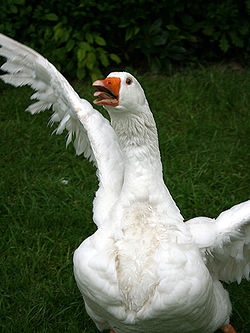
An Emden goose displaying aggression

The guard goose is a domestic goose that is used as a guard animal both on farms and in other situations.

Goose behavior

[edit]

Geese are considered to have excellent eyesight[1] and to be "watchful and inquisitive",[2] with strong territorial instincts. Goose attacks on humans are commonly reported. One case in 2001 set a legal precedent, resulting in a workers' compensation payout of over $17,000 for an injured delivery person, the first Illinois workers' compensation claim due to wildlife.[3] In another case, several geese protecting their goslings knocked a man off his bicycle, resulting in hospitalization.[4] One Buffalo, New York resident claimed over $2 million in damages for a goose attack while on a neighbor's property. At times, park rangers have killed entire flocks of aggressive geese.[5] Canada geese in Cincinnati parks have been responsible for knocking people down and breaking their bones, and called "spitting, hissing, biting attack missiles".[6]

The same aggressive, territorial behavior can be utilized in the guard capacity. Geese are intelligent enough to discern unusual people or sounds from usual stimuli.[7][8] Their loud honking will alert humans when the geese are alarmed.[1]

History of use

[edit]
The geese of the Capitol by Henri-Paul Motte, 1889

Guard geese have been used throughout history, and in modern times. In ancient Rome, geese are credited by the historian Livy for giving the alarm when Gauls invaded (see Battle of the Allia).[9][10][11] Geese were subsequently revered in the supplicia canum annual sacrifice, and the Romans later founded a temple to Juno, to whom the geese were considered sacred.

On modern farms, geese are said to be good deterrents to predators of other domestic fowl,[1][12] and against snakes. A 2006 handbook on industrial security recommends them for protecting warehouses and other isolated physical assets.[13] They are reported to have been used to guard United States Air Defense Command installations in Germany;[14] as the Scotch Watch at Ballantine's Distillery in Dumbarton, Scotland;[15][16] and to protect a police station in Xinjiang, China.[7][17][18]

Due to their tendency to make noise when approached by strangers, about 500 geese were used to supplement dogs, drones, and humans to patrol the 533 km (331 mi) boundary between Chongzuo and Vietnam during the COVID-19 pandemic. An official commented that the birds, one of the most common livestock in the region, are sensitive to sounds and can sometimes be more aggressive than dogs.[19]

Guard geese are utilized to monitor the fence at prisons in Brazil for incursions because of their low cost, and the fact that they don't respond to food bribes like dogs.[20]

Breeds

[edit]

A publication by the United States Department of Agriculture lists the African goose, Roman goose (Tufted Roman), Pomeranian goose (Saddleback Pomeranian), and Chinese goose as the best breeds for guard duty.[8][13] Chinese geese are said to be loud, and African geese both loud and large.[21][2]

See also

[edit]

References

[edit]
Revisions and contributorsEdit on WikipediaRead on Wikipedia
from Grokipedia
A guard goose is a domestic goose utilized as a vigilant sentinel to protect farms, homesteads, livestock, and poultry from predators and intruders, relying on its acute senses, territorial aggression, and piercing honks to alert owners. These birds have been employed in this role for millennia due to their natural watchfulness, 360-degree vision, ability to detect ultraviolet light, and low-maintenance requirements, often outperforming dogs in certain environments by foraging independently and requiring no specialized training. Breeds commonly selected for guarding include the Tufted Roman, Saddleback Pomeranian, White Chinese, Brown Chinese, African, and Toulouse geese, prized for their large size, loud vocalizations, and bold demeanor that enable them to charge threats with wings flapping and bills snapping. The historical use of geese as guards dates back to in 390 BCE, when sacred geese at the Temple of Juno on the honked loudly to warn Roman defenders of a nocturnal Gallic invasion during the , preventing the capture of the citadel and earning the birds divine honors thereafter. This event, chronicled by the Roman historian , established geese's reputation as effective alarms in military and civilian contexts, a tradition that persisted through centuries in , , and the for safeguarding crops, warehouses, and settlements. In modern applications, guard geese have been deployed in diverse settings, including the U.S. military's 1986 initiative during the , where approximately 900 geese patrolled air defense sites in , such as those under the 32nd Air Defense Command in , due to their superior sensory detection and cost-effectiveness over canine units. Other notable uses include protecting distilleries like from 1959 to 2012, Brazilian prisons such as São Pedro de Alcântara, Chinese police stations since 2013 and border checkpoints and facilities during the (2020–2022), and South Korean farms as of 2025, where their territorial instincts deter foxes, coyotes, raccoons, and human trespassers while complementing other security measures. As of 2025, their use has expanded to farms and vineyards in , complementing traditional applications. Despite their efficacy against smaller threats, guard geese are most successful in groups and may require integration with or dogs for defense against larger predators like coyotes or bobcats.

Natural Behavior and Suitability

Alertness and Vocalization

Geese exhibit superior hearing, which enables them to localize subtle sounds associated with approaching threats, such as footsteps or rustling. Their laterally positioned eyes provide a nearly panoramic approaching 340 degrees, allowing them to monitor their surroundings continuously while foraging or resting. This , which includes the ability to detect ultraviolet light, permits geese to discern objects in fine detail 2.5 to 3 times farther than humans can, enhancing their ability to spot movement or anomalies from afar. Hearing serves as their second most critical , facilitating the localization of subtle sounds associated with approaching threats, such as footsteps or rustling. The primary means of signaling danger is through loud, persistent honking, which functions as a potent to rally the flock. These vocalizations, described as resonant honks, barks, or cackles, vary in intensity but are designed to carry over distances, ensuring rapid group awareness without physical confrontation. This hyper-vigilance stems from the evolutionary adaptations of geese as prey animals in wild flocks, where early detection and alerting to predators like foxes or hawks significantly improves survival rates for the group. By selecting open habitats that offer unobstructed views and employing shared vigilance behaviors in flocks—where individuals scan for threats while —geese minimize predation risk through collective monitoring. Vocalization patterns adapt to the of the ; daytime alarms often consist of short, sharp bursts to signal immediate but visible dangers, while nighttime responses feature prolonged, repetitive calls to compensate for reduced visibility and ensure the flock remains coordinated in darkness.

Territorial and Protective Instincts

Domestic geese display strong territorial instincts, often responding to perceived threats by charging intruders with wings spread wide and emitting loud hisses, leveraging their substantial body weight in large breeds—up to 10-13 kg for females and 12-15 kg for males—to physically knock down or intimidate adversaries. This aggressive defense is particularly evident when protecting nesting sites or foraging areas, where individuals will pursue and confront smaller predators or unfamiliar entities, distinguishing them from more passive sentinel animals. In flock settings, geese operate as cohesive units, with dominant individuals leading protective responses to safeguard vulnerable members, such as goslings. This behavior ensures the safety of the young and weaker flock members, who are guided to safer zones during confrontations. Gender plays a key role in these protective responses, with ganders (males) exhibiting heightened territorial aggression, especially during the spring breeding season when hormone levels peak, leading them to vigorously defend mates, offspring, and territory. Females, while capable of fierce defense near their nests, generally show less proactive aggression outside immediate threats to eggs or goslings. These instincts trace back to their wild ancestors, the (Anser anser) in Europe and the (Anser cygnoides) in , whose similar defensive behaviors have been preserved and adapted through over 3,000 years of for farm protection. Vocalizations frequently serve as an initial warning before escalating to physical action.

Historical Use

Ancient and Early Civilizations

The of geese began around 7000 years ago in , with archaeological evidence from a Neolithic rice cultivation village in the Lower River region indicating early human management of these birds for agricultural integration. In , occurred approximately 3000 BCE, where geese were raised in yards and enclosures, contributing to farm economies through their roles in pest deterrence around grain stores and fields. A pivotal example of geese's protective role emerged in the during the Gallic invasion of 390 BCE. As Gaulish forces attempted a nocturnal assault on the , the sacred geese dedicated to Juno in the temple awoke with loud honking, alerting the Roman guards under Marcus Manlius and enabling a successful defense that preserved the citadel and ultimately the city. This event, recorded by ancient historians like , underscored geese's vigilance and led to their ceremonial honoring in , while highlighting a broader Roman appreciation for their utility on farms. Roman agricultural texts further document geese's practical use in property protection. In his first-century CE treatise De Re Rustica, Lucius Junius Moderatus Columella detailed the rearing of geese on estates, emphasizing their low-cost maintenance and value to rural households. This integration reflected geese's dual role in food production and security during the empire's agrarian expansion. In medieval Europe, geese became staples on farms and noble estates for safeguarding property. Archaeological analyses of bird remains from sites across and the continent confirm widespread husbandry practices from the 11th to 15th centuries, where flocks were managed collectively by communities to enhance both economic output and defensive capabilities. Ancient Chinese traditions similarly incorporated geese into elite and agricultural contexts, as evidenced by the 46 bronze geese unearthed from a pit in the mausoleum of the First Emperor Qin Shi Huang (r. 221–210 BCE), symbolizing patrolling figures in a recreated imperial garden for the afterlife.

19th Century to Modern Applications

During the 19th century, as American pioneers expanded westward under the Homestead Act of 1862, geese became integral to farmsteads, kept alongside other poultry for their utility in providing feathers, meat, and eggs while leveraging their innate alertness for basic property protection. In the , the role of guard geese diminished due to advancements in , alongside the increasing use of dogs and perimeter fencing for security. This decline was particularly evident in industrialized farming, where mechanical and chemical alternatives supplanted traditional livestock-based methods. A resurgence began in the and , coinciding with the growth of in the United States, where geese were reintroduced for their cost-effective guarding capabilities and ecological benefits in sustainable systems. This revival emphasized geese's low-maintenance vigilance, making them suitable for small-scale operations seeking alternatives to chemical inputs. For example, in 1986, the U.S. military deployed approximately 900 geese to patrol air defense sites in during the . Additionally, from 1959 to 2012, geese guarded distilleries such as against intruders. In modern homesteads, guard geese are commonly employed to safeguard flocks from predators like coyotes, foxes, and hawks, relying on their loud vocalizations and aggressive defense to deter threats without specialized training. For instance, breeds such as African and Chinese geese are integrated with chickens to patrol open areas, alerting owners to intruders through persistent honking. A unique deployment occurred in 2022 in rural province, , where authorities enlisted approximately 500 geese to patrol border perimeters with , enhancing human checkpoints by honking at and nipping potential illegal crossers amid strict measures. This approach capitalized on the birds' territorial instincts in expansive rural terrains, proving effective in low-resource settings. Since the 2010s, guard geese have gained traction in designs on small-scale U.S. farms, fulfilling dual functions of weeding orchards and gardens through foraging while providing auditory alerts to disturbances. Case studies, such as those at Redbyrd Orchard in New York, demonstrate how flocks of geese integrated into systems since 2010 reduce manual labor and enhance by controlling pests and unwanted vegetation without herbicides.

Breeds and Selection

Several goose breeds have proven particularly effective as guard animals due to their size, vocal nature, and territorial behaviors, with selections often based on historical use and adaptability to various environments. The Embden goose, originating in and standardized in by the mid-19th century, features striking white and stands as one of the largest domestic breeds, with mature ganders reaching up to 12 kg in weight. Known for their bold aggression toward intruders while remaining protective of their flock, Embden geese have been popular for farm security. The , descended from the wild (Anser cygnoides), exhibits an upright posture and a notably noisy temperament that makes it ideal for alerting to potential threats. This breed's agility and persistent vocalizations excel in deterring predators across open areas, positioning it as a reliable choice for homestead protection. African geese, benefiting from hybrid vigor through crosses between Chinese and Toulouse lines, demonstrate hardiness in warmer climates and a robust build suited to vigilant patrolling. Their loud honking and territorial instincts have made them a favored option for farm security in the . The Tufted Roman goose, a breed with a distinctive crest, is highly vocal and aggressive, making it an excellent guard due to its alertness and willingness to confront threats. The Saddleback Pomeranian goose features a saddle-like marking and is known for its bold, noisy behavior, ideal for territorial defense on farms and homesteads. Toulouse geese, particularly the production strains, are large and vocal, providing effective protection through their size and while being adaptable to various environments. Developed during by poultry Oscar Grow, the Pilgrim goose is distinguished by its auto-sexing trait, where males display white plumage and females show gray, facilitating easy identification from hatching. This breed maintains a calm and docile demeanor, making it suitable for integration into mixed flocks, though its quieter nature limits its effectiveness as a primary guard compared to more vocal breeds. For sourcing guard geese, reputable hatcheries such as Murray McMurray Hatchery and Metzer Farms provide day-old goslings of these breeds, ensuring genetic quality and health certifications. It is advisable to start with a small group of 2-4 birds to promote natural flock dynamics and enhance their collective guarding effectiveness, as geese thrive socially and perform better in pairs or trios.

Key Traits for Effective Guarding

When selecting geese for guard duties, prioritize larger individuals from heavy breeds weighing between 8 and 15 kg, as their substantial size enhances intimidation value and enables them to physically confront potential threats like small predators. This weight range, typical of breeds such as the Embden, allows geese to assert dominance through presence alone without excessive energy expenditure on movement. Temperament is crucial, with ideal guard geese exhibiting high alertness and moderate aggression toward unfamiliar humans or animals while remaining manageable around familiar handlers. To avoid overly docile lines that may fail to respond to intruders, observe the behavior of parent birds during selection, favoring those that display vocal warnings and territorial posturing without unprovoked attacks on people. Noisy vocalization, in particular, serves as an effective early alarm system, amplifying their protective role. Adaptability to local conditions ensures sustained performance in guarding tasks, so choose geese tolerant of the prevailing —such as cold-hardy varieties for northern regions—and terrain features like open pastures or areas with access for and mobility. Geese generally thrive in varied environments but perform best when selected for resilience to temperature extremes and landscape demands, reducing stress that could impair vigilance. Flock dynamics play a key role in maintaining effective guarding, requiring a minimum group size of 3-5 geese to mitigate , which can lead to behavioral issues like reduced activity or excessive wandering. An ideal sex ratio of one gander to 3-4 geese promotes harmony, minimizing intra-flock aggression while supporting collective territorial defense. Health indicators should guide selection to ensure long-term reliability, focusing on vigorous individuals with robust growth and minimal veterinary history, as they sustain guarding duties without frequent interruptions from illness.

Implementation and Management

Acclimation and Basic Training

The acclimation process for guard geese begins with a gradual introduction to the protected area, such as a barnyard or , to allow them to familiarize themselves with the environment and bond with resident like chickens or . Ideally, goslings should be raised alongside the flock from a young age to facilitate imprinting, where the geese recognize the other animals as part of their group and view them as flockmates to protect. For adult geese, a period of at least two weeks is recommended, followed by placement in an adjacent fenced where they can see and hear the existing flock without physical contact, typically lasting 1-2 weeks to minimize stress and . Basic techniques leverage the geese's natural instincts with minimal intervention, focusing on positive reinforcement rather than structured commands. Food rewards, such as scattering grain or treats near the fence line, can encourage the geese to associate owners and the property with safety and provision, fostering trust without turning them into pets. To discourage unwanted aggression, particularly toward humans or smaller during breeding seasons, temporary separation in a secure is effective, allowing time for the geese to calm while monitoring interactions. Unlike guard dogs, geese require no formal programs; their territorial vigilance and vocal alerts emerge from routine exposure to the area, with protective instincts providing the primary effectiveness. Full integration typically occurs within 4-6 weeks, during which owners should monitor the establishment of the flock's pecking order to ensure harmonious dynamics. This timeline allows the geese to claim the property as their , enhancing their alerting behavior toward intruders while integrating seamlessly with the they are meant to guard.

Housing, Care, and Integration

Guard geese require secure enclosures to ensure their safety and effectiveness as protectors. For free-ranging or patrolled areas, a minimum of 1,000 square feet of outdoor space per bird (equivalent to 20–40 geese per acre on ) is recommended to allow sufficient room for movement, , and territorial patrolling while preventing . Enclosures should feature predator-proof fencing at least 6 feet high, with the base buried 12 to 18 inches underground to deter digging predators such as foxes or raccoons. Access to a shallow , such as a kiddie pool or , is essential for and , which helps reduce stress and supports feather maintenance by enabling . Daily care involves providing a balanced diet primarily consisting of fresh grass or hay (about 80% of intake) supplemented with grains like oats, , or corn (20%), along with grit for and occasional minerals if is limited. Routine checks are crucial, focusing on signs of parasites such as (Syngamus trachea), which can cause respiratory distress; fecal testing every 3-6 months and as needed help maintain flock . Clean in shelters, changed weekly, prevents bacterial buildup and foot issues like bumblefoot. Integration with other animals requires gradual introduction to minimize , starting with supervised short sessions in shared spaces to allow . Guard geese can coexist with chickens if raised together from young or slowly acclimated, though separate nighttime housing may be necessary to avoid pecking injuries. In gardens, geese effectively control weeds through , with one to two birds capable of maintaining 1-2 acres seasonally by consuming grasses and broadleaf without damaging crops if managed rotationally. Seasonal adjustments include providing draft-free winter shelter with thick bedding like or wood shavings to insulate against cold, ensuring ventilation at the roofline to avoid moisture buildup while blocking wind. During breeding season (typically spring), manage pairs by allocating private nesting areas to direct territorial toward rather than intra-flock conflicts, potentially increasing their vigilance against intruders. Acclimation to the , as a prerequisite, ensures geese bond with the area before full integration.

Advantages and Limitations

Primary Benefits

Guard geese offer significant economic advantages compared to dogs or electronic systems, with low initial setup costs for a group of four birds, including purchase and basic housing, and no recurring expenses for specialized . Their self-sustaining nature through can reduce supplemental feed requirements by up to 50%, as observed in pasture-raised flocks where natural grazing meets most nutritional needs. Beyond protection, guard geese provide multi-functionality by controlling grassy weeds in crops like and strawberries while largely avoiding broadleaf , thereby minimizing use in sustainable farming. Their droppings serve as a natural , enriching without chemical inputs and supporting ecological management. Guard geese demonstrate high reliability through constant 24/7 vigilance, driven by their acute eyesight and territorial instincts, which enable them to detect and alert against small predators such as raccoons or hawks—threats that dogs may overlook due to selective attention. Unlike fatigue-prone animals or power-dependent , they maintain alertness without rest, providing consistent deterrence. These birds embody eco-friendliness with their non-lethal approach to intruder deterrence, relying on loud alarms rather than aggression, and their hardiness allows them to thrive in diverse climates on unsuitable for other . This adaptability promotes low-impact and in agricultural settings.

Common Drawbacks and Solutions

While guard geese offer effective deterrence through vigilance and vocalization, their territorial instincts can lead to toward humans, particularly unfamiliar individuals or even owners if not properly managed. This behavior stems from their innate protectiveness, which may intensify during breeding seasons when females guard nests or goslings. To mitigate this, early through imprinting goslings on handlers from a young age helps them distinguish family members from threats, fostering calmer interactions. Maintaining sex-balanced flocks, with a of one gander to several geese, distributes protective duties and reduces overall by promoting stable within the group. In areas near neighbors, installing visual barriers such as fences or shrubs can prevent unnecessary confrontations while allowing geese to patrol their territory. Another common issue is noise from persistent honking, which serves as an alarm but can disturb nearby residents, especially in semi-rural or suburban settings. Breeds like White Chinese or African geese are particularly vocal, amplifying this concern. Selecting sites distant from residences minimizes complaints, as geese thrive in open rural spaces where their calls are less intrusive. In urban areas, local noise ordinances often regulate domestic , limiting excessive disturbances during quiet hours, though enforcement varies by jurisdiction. Guard geese are vulnerable to large predators such as bears, coyotes, or foxes, as their role is primarily to alert rather than physically confront threats, making them unsuitable as sole protectors in high-risk regions. Providing secure nighttime housing, such as predator-proof coops with hardware cloth reinforcements and no gaps larger than a quarter-inch, confines them safely after dusk and reduces exposure. In bear-heavy areas, supplementing with livestock guardian dogs enhances defense, combining geese's early warning with canine deterrence. Effective flock management is essential, as solitary geese often exhibit signs of depression or heightened stress due to their highly social nature, leading to reduced guarding efficacy or health issues. Keeping at least two geese ensures companionship and normal behavior, with larger groups to support social welfare. To control , annual egg collection is recommended, as each mature goose typically produces 20–40 eggs per season, preventing unchecked breeding while providing a resource for incubation or sale.

References

Add your contribution
Related Hubs
User Avatar
No comments yet.