Hubbry Logo
Guy FortGuy FortMain
Open search
Guy Fort
Community hub
Guy Fort
logo
8 pages, 0 posts
0 subscribers
Be the first to start a discussion here.
Guy Fort
Guy Fort
from Wikipedia

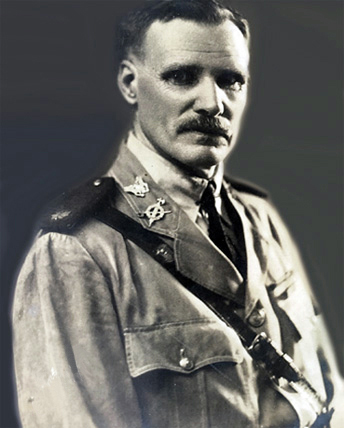
Guy O. Fort (January 1, 1879 – November 11, 1942) was a brigadier general in the Philippine Army under the control of the United States Army Forces in the Far East. Fort led the 81st Division (Philippines) during the initial Battle of the Philippines and the Japanese invasion of Malabang. After fighting a last-ditch stand, Fort was ordered by his higher command to surrender and be taken prisoner by Japanese forces.[1] His captors demanded Fort help persuade his former soldiers engaged in guerrilla warfare to stop resisting the occupation. Fort refused and was executed by firing squad. Fort is the only American-born general officer to be executed by enemy forces.[2][3][4]

Key Information

Life

[edit]

Guy Osborne Fort was born in 1879 to Jacob Marvin Fort and Lena Fulkerson in Kellerville, Michigan, in an area now known as Traverse City. The family later moved to Gloversville, New York,[5] where Fort enlisted in the U.S. Army in 1899.[2]

Fort settled in the Philippines with his first wife, Marguerite Eugine Fort, who died in 1927 shortly after giving birth to their second son. He later married again, with his second wife Mary Angeles Adams[6] dying at the start of World War II.[5] His great-granddaughter was Filipina child actress, singer and model Julie Vega.

Fort regularly wrote home to family in Gloversville, and during the 1930s said he considered retiring and returning to the United States. However, he lacked a copy of his birth certificate and was unsure if he'd be allowed back, or if he could find a job during the Great Depression. His last letter home was in April 1939.[5]

Military and constabulary career

[edit]

Fort served for three years in the 4th U.S. Cavalry in the Philippines before being discharged in 1902.[2] Two years later he was commissioned as a 3rd Lieutenant in the Philippine Constabulary, a gendarmerie-style police force under American control. As a member of the constabulary, he helped suppress the Moro Rebellion.[5]

Aside from a stint as a plantation manager from 1917 to 1922, Fort remained with the constabulary until World War II, advancing to the rank of Colonel. Stationed mainly in Mindanao, Fort was noted for both studying and observing the rituals and customs of the people he served among and for convincing outlaw bands to lay down their arms.[2] In particular, Fort was known among the Americans as an expert on the Moro people.[7] While in the constabulary, he also served briefly as the interim governor of the province of Agusan.[8]

World War II

[edit]

In November 1941, facing the pending Japanese invasion of the Philippines, the constabulary became part of the Philippine Army under the control of the United States Army Forces in the Far East. That month Fort was sent to Bohol to take command of the 81st Division (Philippines). On December 20, 1941, Fort was promoted to brigadier general.[2]

Fort took his division to Lanao province in Mindanao where he organized and outfitted several battalions of Moro soldiers[9] and planned a defense in depth for his sector.[10] Foreseeing defeat,[11] he also prepared his division to wage guerrilla warfare against the Japanese.[12][13]

Fort's 81st Division began fighting on April 29, 1942, against the better organized and equipped Japanese army.[2] For the next few weeks Fort's Lanao force engaged in continual fighting,[14] resulting in heavy Japanese casualties.[15] However, the Japanese also continually pushed the defenders back.[15]

The division fought longer than other army groups before surrendering and made use of demolitions to close one of the main roads through the island.[16]

Surrender and execution

[edit]

After making a last-ditch stand against the Japanese on Mindanao, Fort received orders to surrender from his higher command.[1] While Fort protested these orders, he ultimately obeyed them and surrendered his forces on May 27, 1942.[13][2] Fort's surrender was fiercely opposed by the Maranao and other Moro people in Mindanao.[17] However, despite surrendering Fort let the Maranaos claim the U.S. Army's rifles and equipment,[18] which they would then use in guerrilla warfare.[19][11]

Along with Fort, 46 Americans and some 300 Filipinos under his command also surrendered, with the Americans ordered by their overall commander William F. Sharp not to flee into the hills or face court martial.[13] After Fort's surrender he was shipped north on the small freighter Maru San alongside other captive generals, including his direct commander Sharp plus Joseph P. Vachon and Manuel Roxas. After the war Roxas would become the first president of the Philippines.[20] Fort was then escorted by the Kempeitai to Manila,[21] where he remained for several months. In November 1942 the Japanese sought Fort's help in talking to the Moro people, who had started a new rebellion against the occupying forces. Specifically, Fort was supposed to tell the Moro that since the U.S. Army had surrendered they must also surrender.[1] Fort was brought from Manila back to Marawi (then known as Dansalan) on Mindanao[21] to tell the Moro to surrender. However, Fort refused to cooperate.[2][1]

Fort was then paraded through the city of Dansalan and executed by a firing squad[1][2] under the order of Lt. Colonel Yoshinari Tanaka.[21] Reportedly, Fort's last words were "You may get me but you will never get the United States of America."[22] An Allied war crimes tribunal later sentenced Tanaka to death by hanging for the executions of Fort and three other Americans, and he was executed at Sugamo Prison on April 9, 1949.[23] After Fort's execution Moro guerrilla groups staged revenge attacks against Japanese forces.[24][21]

Fort is the only American-born general officer to be executed by enemy forces.[2][3][4] However, he is not the only American general officer to die at enemy hands.

There is controversy over what happened to Fort's body. According to the U.S. government, Fort's body was never recovered, resulting in his name being engraved on the tablets of the missing at the Manila American Cemetery.[25][11] However, a former prisoner of war and later provincial governor[26] named Ignacio S. Cruz said he located Fort's remains and turned them over to the American Graves Registration Service.[22] In 2017 Fort's granddaughter[27] and six other families of missing soldiers filed a lawsuit against the U.S. government's Defense POW/MIA Accounting Agency. The families are seeking an order to exhume the bodies of Fort and others and do DNA tests to identify the remains.[11]

Military awards

[edit]

References

[edit]
[edit]
Revisions and contributorsEdit on WikipediaRead on Wikipedia
from Grokipedia

Guy Oscar Fort (January 1, 1879 – c. November 13, 1942) was a in the United States Army who commanded the 81st Philippine Infantry Division () during . Born in , Fort enlisted in the U.S. Army as a teenager and served extensively in the beginning in 1900 with the 4th Cavalry, later joining the where he rose through the ranks over decades of operations against Moro rebels.
Following the Japanese invasion of the in , Fort led his division in defensive actions until the general surrender in April 1942, after which he evaded capture and organized Moro guerrilla forces on to harass Japanese occupiers through ambushes and intelligence operations. Captured in October 1942, he endured torture but refused demands to betray his guerrilla allies, resulting in his execution by Japanese firing squad near Dansalan; investigations failed to recover his remains, and the responsible officer was later tried for war crimes. Fort received the Army Distinguished Service Medal posthumously for his leadership in sustaining resistance, along with and , marking him as the only American-born executed by enemy forces in the conflict.

Early Life and Personal Background

Family Origins and Childhood

Guy Osborne Fort was born in January 1879 in Keeler, , to Jacob Marvin Fort and Lena Fulkerson Fort. The family resided in the rural Kellerville area, which later became part of Traverse City, reflecting modest Midwestern origins typical of late-19th-century American farming communities. He had at least one , a sister named Ethel Fort. Details of Fort's childhood remain limited, with records indicating a conventional upbringing in before he left formal education early. Fort dropped out of high school as a teenager to enlist in the U.S. Army, marking an early shift toward military service over civilian pursuits. This decision aligned with the era's opportunities for young men from small towns seeking structure and adventure, amid the U.S. expansion into overseas territories following the Spanish-American War.

Marriage and Adaptation to Philippine Life

Fort married Marguerite E. Fort, with whom he established a household in the following his early military postings there after enlisting in the U.S. Army on March 24, 1899. The couple resided primarily on Island, where they raised a family, including a son born around 1925. Marguerite died in 1927 shortly after giving birth to their second son. Fort's adaptation to Philippine life was marked by his prolonged residence in the , spanning over four decades from his arrival as a young enlistee in the 4th U.S. Cavalry during the Philippine-American War. He integrated into local military and administrative roles, including service in the and provincial governance, which required familiarity with regional customs, terrain, and populations such as the on . This extended tenure, coupled with family life in a private home on , reflected a commitment to the territory beyond transient duty, as he retired there after interwar assignments. Following Marguerite's death, Fort remarried, though details on his second wife remain limited in available records; she reportedly passed away at the onset of . His deep roots in the facilitated effective leadership in local forces during the Japanese invasion, underscoring practical acclimation to the islands' diverse ethnic and geographic challenges.

Pre-World War II Military Career

Enlistment and Philippine-American War Service

Guy O. Fort enlisted in the United States Army on March 24, 1899, at , shortly after the outbreak of the Philippine-American War. At the time of enlistment, he was recorded as having blue eyes, light brown hair, a fair complexion, and a height of 5 feet 7½ inches. Fort was subsequently deployed to the , where he served through the duration of the conflict, which spanned from 1899 to mid-1902. His assignments included Company D of the 4th and Company A of the 15th , units engaged in operations against Filipino forces on various islands, including . He remained in the post-armistice, completing his term of service, and received an honorable discharge on November 26, 1902, at , , with his character of service rated as excellent based on army records. This initial enlistment marked the beginning of Fort's extended military involvement in the , where U.S. regiments like the 4th and 15th conducted patrols, skirmishes, and pacification efforts amid ongoing resistance.

Philippine Constabulary Roles and Counterinsurgency Efforts

Fort enlisted in the newly established as a third shortly after his discharge from the on November 26, 1902, at , . The , formed in August 1901 under the and initially commanded by officers, was designed to assume responsibility for internal security from regular army units, focusing on suppressing , organized bandit groups known as ladrones, and religious-inspired insurgencies such as the (red pants) rebels in the and remaining Moro resistance in . During his early years in the , Fort participated in pacification operations across the islands, leveraging the force's mobile, gendarmerie-style structure that emphasized rapid response to guerrilla threats through a network of district commands and native recruits supplemented by American officers. The 's efforts contributed to the decline of widespread disorder by the mid-1910s, with operations involving patrols, intelligence gathering, and targeted engagements that separated insurgents from civilian populations, though challenges persisted in remote Moro territories where datu-led juramentados and fortified cotta strongholds required tactics. Fort's assignments placed him in regions prone to such unrest, building his expertise in amid the archipelago's diverse ethnic and cultural landscapes. Advancing steadily, Fort attained the rank of on November 22, 1927, and was appointed assistant chief of the , a senior oversight role involving policy formulation, training standardization, and coordination of anti-insurgency measures against sporadic threats like Aglipayan schismatic violence and agrarian unrest in . Under his tenure, the maintained its efficacy, emphasizing local recruitment—including Moro units in the south—to foster legitimacy and intelligence advantages, which proved instrumental in preempting escalations into full rebellions. By the eve of , Fort's leadership helped transition the force toward integration with the , while upholding its foundational mandate of causal deterrence through persistent presence and enforcement.

Interwar Assignments, Promotions, and Retirement

Following , Fort remained in the , where he advanced in rank and took on significant operational responsibilities in the southern . In 1926, serving as a major, he directed successful campaigns against outlaw bands in the Mindanao-Sulu region, earning commendation through General Order No. 11, Headquarters , dated March 6, 1926, for his effective leadership in suppressing these threats. On November 22, 1927, Fort received promotion to in the and was appointed Assistant Chief, a senior administrative and operational role overseeing departmental activities across the . He held this position amid ongoing efforts to maintain order in Moro-dominated areas, leveraging his extensive experience and fluency in local dialects including Tagalog, Visayan, and Moro languages. As the longest-serving American officer in the Constabulary, Fort's tenure emphasized practical tactics tailored to the 's diverse terrains and populations. Fort continued in senior Constabulary roles through , contributing to provincial and security operations, such as interim administration in areas like Agusan province during leadership transitions. By the late 1930s, as the Constabulary underwent Filipinization and reorganization under the Philippine , he retired from active service and settled as a civilian in , Cotabato, on , where he resided with his family. This retirement allowed him to maintain deep ties to the region, informed by over three decades of immersion, until his recall to duty in 1941 amid escalating Pacific tensions.

World War II Command and Resistance

Mobilization and Leadership of Philippine Forces

Brigadier General Guy O. Fort commanded the 81st Infantry Division (Philippine Army), a reserve formation primarily composed of Filipino troops under the United States Army Forces in the Far East (USAFFE), tasked with defending Mindanao following the Japanese attack on Pearl Harbor on December 7, 1941. In the immediate aftermath, Fort oversaw the division's mobilization as part of the broader activation of Philippine Army units, integrating them into the island's defensive structure amid limited resources and incomplete training. The 81st, alongside the 51st and 101st Divisions, formed the core of the Philippine contingents in the south, with Fort directing organizational efforts to position forces for conventional defense while anticipating potential guerrilla operations. By early January 1942, reinforcements from the bolstered the Force under Major General , establishing five sectors including Lanao, where Fort's 81st Division played a key role in fortifying routes such as to against anticipated amphibious assaults. Leadership under Fort emphasized rapid deployment of units, often reorganized —such as converting into roles—and basic training drills, though ammunition shortages precluded live-fire exercises, limiting effectiveness to positional defenses and demolitions planning. His command integrated elements and provisional battalions, totaling thousands across the sectors, to create a layered resistance capable of delaying Japanese advances despite numerical and material disadvantages. As Japanese landings commenced on April 29, 1942, at in the Lanao Sector, Fort issued orders to hold positions at all costs, coordinating the 81st's engagements until the division's strength dwindled amid relentless enemy pressure. This phase highlighted Fort's focus on sustaining Filipino soldiers' and operational cohesion, refusing premature withdrawal to buy time for broader USAFFE strategies, though the sector's defenses ultimately proved insufficient against superior Japanese forces by early May.

Defense of Mindanao Against Japanese Invasion

Guy O. Fort commanded the 81st Division of the , an understrength unit primarily composed of local Moro recruits, as part of F. Sharp's Visayan- Force responsible for defending . The division's mission focused on protecting key routes and coastal areas in the island's western sector, including preparations to contest enemy landings and block advances toward interior strongholds like . The Japanese initiated their conquest of with an unopposed landing of approximately 3,000 troops from the Sakaguchi Detachment at Davao on December 20, 1941, quickly securing the eastern gulf region despite limited local resistance from scattered elements. Fort's forces, lacking adequate equipment, training, and air or naval support, conducted initial delaying actions but could not prevent the Japanese from establishing airfields and consolidating control over eastern by early 1942. To complete the island's subjugation, Japanese forces under Lieutenant General Moritake Tanabe executed amphibious assaults on the western coast, landing about 7,000 troops at on April 29, 1942, and additional elements at . Fort positioned the 81st Division to defend Route 1 from northward to , employing Moro bolomen—irregular fighters armed with native blades and rifles—in ambushes and to exploit terrain familiarity and harass advancing columns. The 81st provided limited with 75mm guns, offering some initial deterrence during the Malabang landings, but Japanese naval bombardment, air superiority, and rapid infantry maneuvers overwhelmed the defenders. By mid-May 1942, despite Fort's efforts to organize Moro guerrilla elements for sustained resistance, the division's conventional defenses collapsed under superior enemy firepower and numbers, forcing a withdrawal into the hinterlands and contributing to the broader surrender of organized forces on May 27.

Capture, Imprisonment, and Execution

Surrender Circumstances

Following the Japanese landings at on May 2, 1942, Guy O. Fort, commanding the Lanao sector forces including elements of the Philippine Army's 81st Division, organized defenses along Route 1 from to to counter the invasion. His troops, numbering around 5,000 Filipinos with limited American support, engaged Japanese paratroopers and naval but were quickly outmatched by the enemy's superior , air support, and reinforcements exceeding 10,000 troops. Despite initial resistance, including skirmishes that delayed Japanese advances, Fort's command faced and ammunition shortages by early May. On May 10, 1942, Major General , overall commander of Visayas-Mindanao Force, issued surrender orders to all subordinate units in response to the capitulation of on May 6, aiming to prevent further futile losses amid the broader Philippine campaign collapse. Fort received these directives while his forces remained in contact with the enemy, having prepared contingency plans for guerrilla operations dispersed in Mindanao's terrain; however, he protested the timing but ultimately obeyed to avoid isolated annihilation. Local Moro and Maranao fighters under Fort's nominal oversight strongly opposed compliance, viewing continued resistance as obligatory against , yet Fort prioritized chain-of-command adherence. Fort formally surrendered his command on May 27, 1942, marching surviving troops to Dansalan (present-day ) for internment, marking one of the last organized capitulations in the southern . This action spared immediate combat deaths but led to the consolidation of prisoners, who later endured forced marches and camps under Japanese control. The surrender reflected the overarching strategic defeat, with Fort's forces having inflicted only minor delays on Japanese consolidation of .

Imprisonment and Refusal to Collaborate

Following the Japanese capture of Fort's forces in the area of on May 28, 1942, he was detained as a at Camp Keithley near (then Dansalan), along with approximately 300 Filipino troops and 46 other Americans. Conditions for POWs under Japanese control in included forced labor, malnutrition, and exposure to tropical diseases, though specific details on Fort's treatment during the initial months remain limited in declassified records. In an effort to quell ongoing Moro guerrilla resistance, Japanese occupation authorities transferred Fort to before returning him to later in 1942, intending to leverage his long-standing relationships with local Moro leaders—forged during decades of service in the region—to urge their surrender and cooperation. Fort, however, categorically refused to collaborate, rejecting demands to broadcast appeals or otherwise assist in suppressing the holdouts who continued armed opposition from the mountains. This defiance, rooted in his loyalty to Allied forces and prior commitments to Philippine defense, marked him as uncooperative amid broader Japanese efforts to co-opt captured officers for propaganda and pacification. Fort's refusal extended to all overtures from his captors, including Lieutenant Colonel Tsuji Masanobu's unit, which sought his endorsement to dismantle resistance networks; he maintained silence or direct opposition, prioritizing fidelity to his oath over personal survival. As the highest-ranking American officer executed by Axis forces in World War II, his stance exemplified resistance among senior POWs, though it isolated him from potential leniency offered to those who complied. Japanese records later cited this non-cooperation as the basis for his fate, with executing officer Tanaka convicted postwar for war crimes including Fort's case.

Execution and Immediate Aftermath

Following his refusal to collaborate with Japanese occupation forces, Guy O. Fort was paraded through the streets of Dansalan (present-day Marawi City) before being executed by firing squad on November 9, 1942, under direct orders from Yoshinari , commander of the Japanese garrison in the area. The execution was intended to deter Moro guerrilla resistance on by demonstrating the consequences of defiance, but it failed to suppress ongoing insurgent activities among local Meranaw fighters, who continued operations against Japanese forces in the immediate weeks following. Fort's body was buried in an , and its location remains unknown, preventing formal recovery or identification postwar. , held responsible for the , was tried by U.S. military authorities in the Class B war crimes tribunal, convicted of atrocities including Fort's execution, and hanged at on March 11, 1949. Fort's death established him as the highest-ranking U.S. military officer executed by enemy action during .

Legacy, Awards, and Historical Assessment

Military Decorations and Honors

Fort was posthumously awarded the Army Distinguished Service Medal for his "exceptionally meritorious service" as commanding general of the 81st Division, , during the defense against the Japanese invasion of in 1941–1942, where he organized and led guerrilla resistance efforts despite overwhelming odds. This decoration, the U.S. Army's second-highest honor for non-combat leadership, recognized his strategic direction in delaying enemy advances and maintaining organized opposition post-surrender. He received the Purple Heart for wounds or fatal injuries sustained as a , specifically in connection with his execution by Japanese forces on February 1, 1942, following refusal to collaborate. The Prisoner of War Medal, authorized retroactively in 1986, was also conferred for his captivity from January 1942 until his death, during which he endured interrogation and resisted providing intelligence to the enemy. Fort's earlier and campaign service earned him the Philippine Campaign Medal for participation in operations circa 1900–1913 as a young officer in the . Additional II-era ribbons included the (with one bronze service star for pre-Pearl Harbor mobilization duties), Asiatic-Pacific Campaign Medal (with campaign stars for defense), , and Philippine Defense Medal (with one bronze star for at least four months of combat against Japanese forces).
AwardRibbon/DeviceService Period/Context
Army Distinguished Service MedalN/APosthumous; leadership in 1941–1942 Philippine defense
N/ACaptivity and execution, 1942
N/AJapanese captivity, January–February 1942
Bronze starPre-1941 mobilization
Asiatic-Pacific Campaign MedalBronze stars (number unspecified)Mindanao operations, 1941–1942
N/AOverall WWII participation

Postwar Recognition and Ongoing Recovery Efforts


Following , Guy O. Fort received posthumous recognition for his leadership in the defense of and resistance to Japanese occupation, including the Army Distinguished Service Medal awarded for "exceptionally meritorious and distinguished services" in command of Philippine forces against superior enemy numbers. His sacrifice was further honored through for wounds sustained in action and the , acknowledging his captivity and execution by Japanese forces on November 11, 1942. Fort's name is inscribed on the Tablets of the Missing at the and Memorial, reflecting his unrecovered status among the fallen in the Pacific theater.
Historians and military analysts have assessed Fort as the highest-ranking U.S. officer executed by enemy action during , highlighting his refusal to collaborate or surrender unconditionally, which exemplified defiance amid the of organized resistance in the . This legacy underscores the brutal treatment of high-level prisoners and the broader pattern of against Allied commanders, as documented in tribunals and veteran accounts. Ongoing recovery efforts focus on locating Fort's remains and those of executed subordinates near on , where a local eyewitness recalled the 1942 executions ordered by Japanese Goro Tanaka. The Defense POW/MIA Accounting Agency maintains an active profile on Fort, coordinating with Philippine authorities and recovery teams; a 2025 expedition, prompted by survivor testimonies of bayoneting and shooting at the site of a now-removed , aims to excavate potential locations despite challenges from erosion, development, and prior unverified searches. These initiatives build on postwar grave registration attempts, which failed to identify Fort's hasty interment, emphasizing forensic and oral histories to resolve MIA cases from the Japanese occupation.

Evaluations of Leadership and Sacrifice

Fort's leadership in mobilizing and commanding the 81st Philippine Infantry Division during the Japanese invasion of in April 1942 has been assessed as adaptive and effective given limited resources, particularly in organizing Moro tribesmen into combat battalions such as the Bolo Battalion to defend key positions around and routes to . His prior decades of service in the , including with the , enabled him to leverage local knowledge and customs to integrate irregular fighters, delaying Japanese advances despite numerical inferiority. records note that under his command, forces held out until surrendering on May 27, 1942, one of the last major units in the Visayas-Mindanao sector to do so. Following capture and imprisonment at Camp Keithley, Fort refused Japanese demands to collaborate by using his influence to pacify Moro guerrillas, instead maintaining silence on resistance networks. This defiance culminated in his on or about , 1942, marking him as the highest-ranking U.S. officer killed by enemy execution during . His sacrifice is viewed by postwar accounts as a of unyielding resistance, inspiring continued guerrilla operations on that controlled 85% of the island by 1945. The refusal to betray allies underscored a commitment to duty, contributing to the moral framework of Allied defiance in the Pacific theater.

References

Add your contribution
Related Hubs
User Avatar
No comments yet.