



Community hub
Recent from talks
Contribute something
Nothing was collected or created yet.
Hacknet
View on Wikipedia
| Hacknet | |
|---|---|
 | |
| Developer | Team Fractal Alligator |
| Publisher | Fellow Traveller |
| Engine | |
| Platforms | Microsoft Windows, macOS, Linux |
| Release | Microsoft Windows
|
| Genre | Simulation |
| Mode | Single-player |
Hacknet is a 2015 video game developed by Matt Trobbiani that allows the player to perform simulated computer hacking.
Gameplay
[edit]The game simulates a Unix-like operating system, with every main element of the game's interface having its own window. Windows are tiled in a fashion highly reminiscent of the i3 window manager. The windows have multiple tiling configurations with their own wallpapers and color schemes, which can be found as files as the game progresses. The main gameplay is done through two large interfaces, a graphical display, and a Unix terminal. Both interfaces are essential for gameplay, though the player can use either as their main interface.
Along with the terminal, the computers in the game simulate a Unix-like file system, through which the player can explore the computer, and even destroy them by deleting critical system files. The core of the gameplay is to connect to other computers and run dedicated programs to break the security and acquire superuser privileges on the computer. The general procedure is to first run a scan to see what protections the computer has and then run programs matching what the scan revealed. Each program takes up a certain amount of memory, which the player has to manage, as there is only a limited amount of memory to share.
The game notably averts the common trope of bouncing a connection between several intermediary computers before reaching the target computer. Instead, a simplified system of a variable speed countdown is used to force the player to act quickly. If this countdown reaches zero, the player is given one last chance to avoid a game over by hacking their ISP and changing their IP address.
Once superuser privileges have been obtained, the file system of the computer is investigated. The exact task on each computer varies for each mission, but can, in general, be performed by running a specific command to access one or more files on the system.
A few systems have specialized interfaces, such as email systems and databases.
Most computer systems contain text files that can be read. A large majority of the files are quotes from the website bash.org.[1]
Story
[edit]Bit
[edit]The game begins with the player being automatically contacted by a user by the username "Bit". The automated message tells the player that it was sent in the event of Bit's death and asks that the player investigate his death.
Bit then starts to teach you the game mechanics by way of simple missions. Bit will then inform the player to join the hacktivist group Entropy, as they are currently recruiting members. By locating their proxy server and hacking into it, the player is congratulated by Entropy for being the first person to pass the test. Afterwards, the player proves themselves by shutting down a tabloid server that has taken a negative stance towards Entropy.
After shutting down the server, Entropy accepts the player into their ranks and provides them with several contracts to fulfill, ranging from changing someone's score in a clicker game to deleting stolen files.
Naix
[edit]After completing a few of Entropy's missions, the player is eventually assigned to investigate a hacker by the alias of Naix. Naix recently stole a large amount of data from a company, damaging the hacking community's reputation in the process. After deleting Naix's stolen data, he takes offense to being investigated and attacks the player's system, deleting their interface. This attack can be defended against, albeit requires strict timing by using a trap program. If the attack is successful, it will result in the game interface disappearing and the computer rebooting, leaving the player with a minimal console interface. Once the player has recovered their system from the attack by downloading Naix's system, the player can choose to either take revenge on Naix by counter-deleting his system, or follow the guidance of their mission control and make a statement that such behavior is not acceptable, resulting in the resumption of the player's missions with Entropy.
Naix's Tests
[edit]If the player counter-hacked Naix, he relents, making a truce with the player, and gives them a test by defacing a bloatware antivirus company's homepage. Once successful, the player completes another test by hacking directly into the antivirus company's mainframe. After completing his tests, Naix apologizes, admitting the player's skill and invites them to join a community named /el.
/el Message Board
[edit]The player is whitelisted by Naix, granting access to an Internet forum. While other members of the forum are stumped by a series of trials set up by a group named the Polar Star, the player completes the tests and is rewarded with a new hacking program. After that, a member of /el challenges the community to hack into a "secure" hard drive connected to the internet to be used as a server. If the community cannot crack it, the member will consider them failures and begin to use the hard drive. Undeterred, the player hacks into the server and deletes a file set up by the member, passing the test.
CSEC
[edit]If the player didn't hack Naix and only reported back to Entropy, they are invited to another organization called CSEC, going through an automated test. If the player hacked Naix, proved their skill, and completed /el's missions, Naix directly recommends them to a CSEC admin named Vap0r, skipping the automated trials altogether. Either way, the player is assigned to break into a fried chicken chain's servers and steal the recipe. After uploading the recipe to a drop server, the player is given an account to CSEC's contract hub, allowing them to accept and fulfill various contracts. While downloading several program's from CSEC's assets server, the player downloads a seemingly useless program named Sequencer.
Project Junebug
[edit]One late-game contract in the game is called "Project Junebug". While the player can see it right after joining CSEC, the mission will remain locked until all other CSEC missions have been taken care of. The mission is a request to provide euthanasia for someone terminally ill by hacking their pacemaker and shutting it off.
Finale
[edit]As the final story arc of the game, the player is contacted directly by Vap0r revealing herself to be an old friend of Bit. Vap0r works with the player to break into the computers of a computer security software company named EnTech. As the pair do so, they are faced with a security system that makes computers invulnerable to the tools currently at the disposal of the player. While the player manages to find alternative ways into the protected systems, they discover that Bit was involved in a project for the company; specifically, the creation of a highly advanced operating system specialized in computer hacking named HackNet. It is revealed that the plan for the project is to unleash the new operating system to the world in order to cause consumer demand for the protection system.
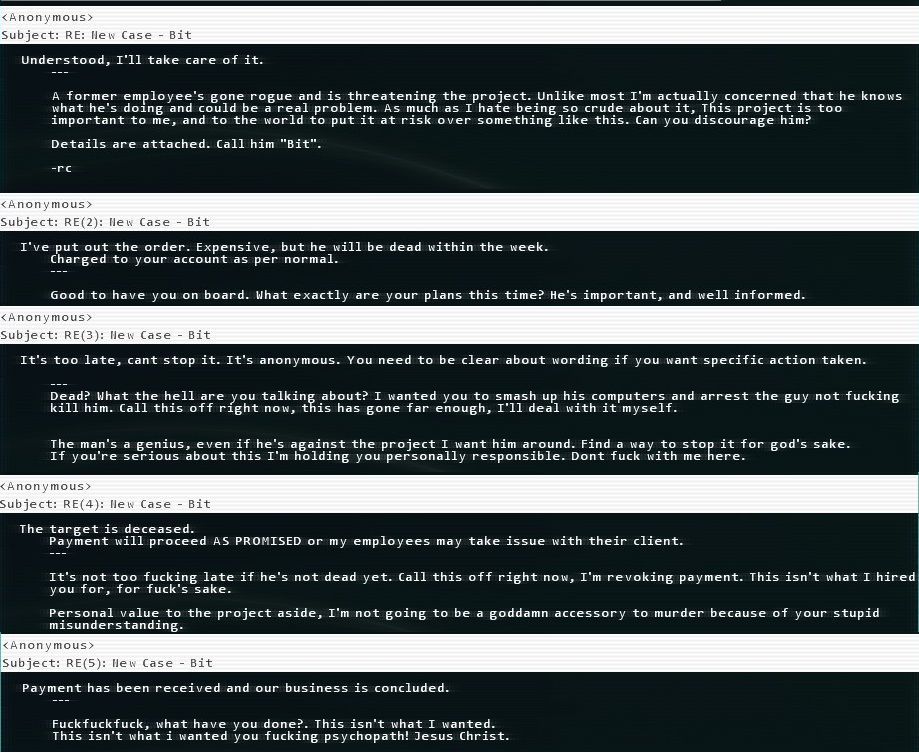
Bit in particular was a major contributor. As the project was nearing its completion, Bit began to question the morality of the project and wanted to delete it. The EnTech CEO requested a hitman to "discourage him", but due to miscommunication, this led to Bit being assassinated. Although the CEO only wanted to intimidate Bit into silence and destroy his computers, he is killed before the CEO can call off the hitman.[2]
Once all the facts of the story have been revealed to the player, they are contacted by Vap0r, who has been preparing to launch an attack on EnTech and requires the player's assistance. The player activates Sequencer, which turns out to be a modified music sequencer program. By activating it, the program signals Vap0r to connect the player to EnTech's backup archive by forcing it to run an online update check, performing a simultaneous takedown of the production server and the backup server with the player's help and proceeding to eradicate all copies of the HackNet project.
Additionally, by command of Bit himself, they bring down the server at the heart of Porthack, the tool that Bit made. Once this final mission is completed, Bit delivers some final voice-acted words, explaining that the player now has the only remaining copy of HackNet before the game credits roll.
Labyrinths
[edit] | This article duplicates the scope of other articles, specifically #DLC. |
Labyrinths is a DLC expansion for Hacknet. A mysterious individual named Kaguya begins recruiting several individuals, including the player. After passing Kaguya's trials, the player has their Hacknet UI wiped, joins a hub server named Bibliotheque, and is introduced to two other skilled hackers, Coel and D3f4ult. Kaguya explains to the team that they have recruited them for a mysterious job, but first assigns them to steal several programs in preparation for the task. While the player, Coel, and D3f4ult break into several servers and steal programs, Kaguya works on securing software, intel, and contacts for the upcoming job.
After stealing several programs, the player and D3f4ult break into an MMO to change a user's points as a test, as Kaguya needs to prove the team is good enough for them to get some intel. While the two break into the MMO, Kaguya and Coel work on a confidential mission mentioning "Nisei MK III", something that has been discussed between the two since the beginning of the DLC.
Kaguya assigns all team members to gain access to the booking mainframe of an airline company named PacificAir, utilizing all the tools and programs they stole. The team eventually manages to hack into the mainframe and each member is given a final task. The player, having gained access to the mainframe server first, is instructed to install a backdoor as a "backup plan". D3f4ult works with Kaguya to analyze the security protocols and find a way through for the team, and Coel's mission is sparse of details, only telling her "you know the stakes."
After all members complete their respective tasks, Kaguya explains their plan. With Coel, the two have been sabotaging a chemical weapon research — Nisei MK III — and they have deleted all digital backups. However, a hardcopy of the data exists in a PacificAir plane, PA_0022, which Kaguya wants crashed to prevent the weaponization of the data. PA_0018, a second flight, contains the research's reports.
While Kaguya and Coel argue about the morality of the situation, D3f4ult suddenly accepts the mission, catching everyone off-guard, and attempts to crash the first plane by deleting the plane's firmware. However, Coel goes rogue, activating a backdoor program which bans Kaguya and D3f4ult from Bibliotheque. She asks the player to save the plane while she holds D3f4ult and Kaguya off to stop them from reconnecting. At this point, the player can decide whether to crash the plane Kaguya asked them to, crash both planes, or save them.
Save Ending
[edit]By downloading the second plane's firmware, reinstalling it in the first plane, and rebooting the controls, the player is able to save PA_0022 and its passengers. Coel thanks the player for their help, and the two hackers wipe Kaguya and D3f4ult's computers to stop them from attacking the planes again. Coel instructs them to lay low, directing them to a server which will remove Kaguya's trackers and return them to the Hacknet UI — the base game.
Crash Ending
[edit]By doing nothing and waiting for the first plane to crash, Kaguya and D3f4ult are able to rejoin Bibliotheque's group chat as Coel escapes. D3f4ult expresses concern as the second plane with the reports continues flying, but Kaguya reluctantly allows the plane to keep flying, as they believe the research does not outweigh the loss of life. Kaguya thanks the two and disbands the group, promising to contact D3f4ult and the player after things have cooled down.
Double Crash Ending
[edit]If the player chooses to crash both planes by deleting the second plane's firmware, Kaguya and D3f4ult rejoin. D3f4ult notices the second plane has also gone down while Kaguya tries to reassure themselves and the group that it was the safest option, disbanding the team.
Subvert Psylance Investigation
[edit]If the player has completed the DLC before the end of the main game, the player receives a CSEC contract called Subvert Psylance Investigation, in which they're asked to help the posters' friend, who is being framed for an attack she did not commit. The attack is mentioned as the PA_0022 incident, with the poster asking the player to "COVER TRACKS WELL" and signing off as -K.
During the mission, the player hacks into Psylance Internal Services — the cybersecurity company working for PacificAir — to replace the incident report with the one from CSEC, that references the Nisei MK III project Coel was tracking for Kaguya. This could suggest that the chemical weapon threat was, to an extent, true.
Additionally, by running a decryption program on the file provided by CSEC, the player can see that it was encrypted on Kaguya's computer, making Kaguya or Coel the only people that could have given the mission. Based on the other clues, it is heavily implied the poster is Kaguya.
Development
[edit]Hacknet was developed by Matt Trobbiani, the sole developer of Team Fractal Alligator, based in Australia.[3][4][5]
Reception
[edit]| Aggregator | Score |
|---|---|
| Metacritic | 82/100[6] |
| Publication | Score |
|---|---|
| GameSpot | 8/10[7] |
Hacknet received generally positive reviews from critics.[6]
GameSpot gave the game an 8/10, praising the game for its unique presentation puzzle design.[7]
DLC
[edit] | This article duplicates the scope of other articles, specifically #Labyrinths. |
A DLC expansion for "Hacknet", titled "Hacknet Labyrinths" was announced on August 30, 2016.[8] The expansion was set to come out December 2016; however, development issues delayed release to March 31, 2017.[9][10]
The expansion features new hacking tools and security systems, as well as a 3- to 4-hour chapter to the game, where the player is recruited by a hacker that goes by the alias "Kaguya" into a small elite hacking team. It includes more secrets, more UI themes and a full new soundtrack, from artists such as synthwave artist OGRE and Rémi Gallego, creator of metal/electronic act "The Algorithm".
Extensions
[edit]In May 2017, official mod support for Hacknet titled Hacknet Extensions was released worldwide, in which players can create their own custom stories and campaigns for the game. These extensions can be shared and downloaded from the Steam Workshop. Extensions are separate from the main game, and are accessed from a separate menu from the title screen.[11][12]
Hacknet Extensions also features extension-exclusive tools and the ability to implement custom music and themes.[11]
Notes
[edit]- ^ The game also supports the FNA Game Engine, and is the default on platforms other than Windows
References
[edit]- ^ Barrett, Ben (August 14, 2015). "Hacknet Released, Is A Game About Being A Hacker". Rock, Paper, Shotgun. Retrieved April 10, 2016.
- ^ "Bit Accidental Assassination Emails". Thunderfox.nl. September 16, 2016. Retrieved September 16, 2016.
- ^ Prescott, Shaun (July 17, 2015). "Hacknet is a hacking game with "real hacking"". PC Gamer. Future. Retrieved April 10, 2016.
- ^ "Matthew Trobbiani on developing games". abc.net. April 6, 2017. Retrieved July 15, 2017.
- ^ Patrick Stafford, Glixel, (3 June 2016), Solo Indie Game Development – Not for Faint of Heart, Rolling Stone Archived November 26, 2017, at the Wayback Machine. Retrieved July 24, 2017
- ^ a b "Hacknet for PC Reviews". Metacritic. CBS Interactive. Retrieved April 10, 2016.
- ^ a b "Hacknet - Labyrinths Review". GameSpot. Retrieved April 22, 2017.
- ^ Caldwell, Brendan (August 30, 2016). "Hacknet Gets 3-4 Hour Expansion In December". Rock, Paper, Shotgun. Retrieved February 15, 2017.
- ^ "Hacknet Labyrinths Development Update". Steam. August 30, 2016. Retrieved February 15, 2017.
- ^ "Hacknet: Labyrinths Release Date & Trailer". Steam. March 21, 2017. Retrieved March 21, 2017.
- ^ a b Prescott, Shaun (May 26, 2017). "Hacknet now has modding tools, so you can create your own campaigns". PC Gamer. Retrieved June 2, 2018.
- ^ Reema (May 26, 2017). "Hacknet has become great again - Added Mod Tools Helps Create custom Campaigns | TheTech52". TheTech52. Retrieved June 2, 2018.
External links
[edit]Hacknet
View on GrokipediaGameplay
Core Mechanics
Hacknet employs a terminal-based interface that simulates command-line operations on a UNIX-like system, requiring players to type text commands to navigate and manipulate a virtual network.[1] This core loop centers on reconnaissance, intrusion, data extraction, and evasion, with players starting missions by scanning for accessible nodes using thescan command, which reveals IP addresses and open ports on nearby systems.[9] Connection to a target node occurs via the connect [IP] command, after which players probe for vulnerabilities by running tools like probe [port number] to assess exploit potential.[10]
To breach defenses, players deploy specialized executables such as porthack.exe, which simulates a port-scanning attack to gain shell access by cracking sequential ports, often requiring multiple attempts or upgraded versions for higher success rates against fortified targets.[9] Once inside, standard file system commands like ls to list directories, cd to change paths, cat to view files, and rm to delete traces enable data retrieval or alteration, with critical emphasis on clearing logs via rm /var/log/* or similar to avoid detection by system administrators.[11] The game's Netmap provides a graphical overlay for visualizing network topology, allowing players to trace routes and identify clusters of interconnected nodes for deeper infiltration.[12]
Progression integrates resource management, as successful hacks yield currency for purchasing node upgrades like enhanced proxies to mask origins or advanced hacks such as brutessl.exe for encrypted connections, directly influencing mechanical efficiency without altering the terminal paradigm.[9] This design enforces deliberate, text-driven decision-making, blending real-world inspired syntax with abstracted exploits to evoke authentic penetration testing while abstracting complexities like actual code compilation.[10]
Commands and Tools
Hacknet utilizes a text-based terminal interface modeled after Unix-like command-line environments, requiring players to type commands to explore file systems, scan networks, probe targets, connect to remote nodes, transfer files, and execute hacks. Core navigation and utility commands mirror real-world counterparts, such asls for listing directory contents, cd [directory] for changing directories, cat [filename] for viewing file contents, pwd for displaying the current path, and rm [filename] for deleting files, the latter often used to erase logs and minimize detection risk.[13][14] Network interaction relies on commands like scan to identify nearby nodes and their IP addresses, probe [IP] to analyze a target's open ports, system type, and security features, connect [IP] to establish a session, and dc or exit to disconnect safely.[13][14] File acquisition employs scp [filename] [IP] to download executables or data from remote systems, enabling progression by securing new capabilities.[13][15]
Specialized tools, obtained as downloadable .exe files via scp during missions or from contacts, extend basic functionality and are invoked by typing their filename in the terminal. Early tools include Proxy.exe, which masks the player's trace level and aids in evading initial defenses; BruteSSH.exe for forcing SSH connections on secured ports; and Decrypt.exe for accessing encrypted files or communications.[16] Advanced tools acquired later encompass sqlmap.exe for automated SQL injection exploits, MKProxy.exe for enhanced proxy chaining to reduce detection, and DDoS.exe for overwhelming targets with traffic, each calibrated to counter escalating security protocols like ICE (Intrusion Countermeasure Electronics) or multi-layered firewalls.[16][17] These tools integrate with core commands, such as running Proxy.exe before probing high-security nodes to lower breach difficulty, fostering strategic depth in mission execution.[13]
The help command provides in-game documentation, paginated with help [page_number] to reference syntax and usage, while ps lists running processes for monitoring active tools or exploits.[14] Trace management remains critical, as failed connections or incomplete log deletions via rm log/* in the /log directory increase the risk of traceback events, potentially alerting authorities like CSEC.[16] This command-tool ecosystem simulates realistic hacking workflows, emphasizing preparation, reconnaissance, and cleanup over simplistic point-and-click interfaces.[1]
Networks and Progression
In Hacknet, the virtual environment is simulated as a series of interconnected networks populated by nodes, each representing individual computers or servers with unique IP addresses, security levels, and accessible ports. Players access the Netmap interface to visualize these networks, where nodes are color-coded: green for the player's home system, blue for undiscovered connections, white for probed or connected nodes, red for actively targeted systems, and yellow for those with an open shell session. Scanning a network reveals hidden nodes and their basic properties, while probing provides detailed reconnaissance, including open ports, operating systems, and potential vulnerabilities, enabling targeted attacks without immediate connection.[18] Networks vary in theme and difficulty, ranging from residential subnets to corporate infrastructures and secured government arrays, with connections forming traceable paths that simulate real-world internet topology.[1] Player progression occurs primarily through a mission-driven structure, where tasks assigned by the contact "Bit" guide advancement, requiring infiltration of specific nodes via terminal commands to execute objectives such as file exfiltration, backdoor installation, or data alteration. Successful completions reward players with new executables—specialized hacking tools like SSHCrack for brute-forcing secure shell ports or SQLBufferOverflow for exploiting database vulnerabilities—which consume system RAM during use and expand capabilities against increasingly fortified targets.[18] [17] These tools are acquired either directly from missions or purchased using currency earned from contracts and optional hacks, allowing iterative improvement in breaching higher-security nodes protected by proxies, intrusion detection, or tracing mechanisms that can trigger system crashes if unresolved.[17] Traces introduce risk-reward dynamics, as evading them via IP changes or disconnections preserves progress, while failure results in temporary setbacks but no permanent data loss, encouraging strategic depth over the game's approximately 10-15 hour campaign.[18] Side activities, such as scanning unassigned networks for lootable files or fulfilling faction contracts, supplement core advancement by providing additional resources and unlocking hidden commands like forkbomb for node disruption.[17]Plot
Initial Setup and Bit's Role
The plot of Hacknet opens with the player character, depicted as a novice hacker operating from a personal terminal, receiving an unexpected incoming connection and encrypted message from "Bit," a prominent figure in underground hacking circles who is announced to have died in a car crash shortly before the events unfold.[19] Bit's communication denies the accident narrative, claiming instead that his demise resulted from deeper entanglements in illicit digital operations, and urgently recruits the player to assume control of his vacated systems and continue probing into obscured network anomalies.[20] This setup establishes the player's initial hacking environment on a standard Linux-like terminal interface, requiring execution of foundational commands such asconnect to link to Bit's residual servers and scan to map nearby nodes for reconnaissance.[17]
Bit's role manifests exclusively through posthumous, automated transmissions—comprising text logs, pre-scripted directives, and uploaded tools—positioning him as an absent mentor who orchestrates the player's early progression without direct interaction.[20] These messages direct the acquisition of essential probes and utilities, such as the probe command for vulnerability assessment, while embedding clues about Bit's prior activities, including affiliations with groups like EntropyMonkey and skirmishes against entities like CSEC.[16] By delegating operational continuity to the player, Bit's digital remnants drive the narrative's causal chain, transforming the protagonist's solitary setup into a vector for escalating intrusions into secured infrastructures.[21]
This foundational dynamic underscores the game's emphasis on simulated terminal authenticity, where Bit's instructions compel iterative command-line experimentation to breach initial barriers, such as deleting archival files from compromised servers to erase traces.[22] The absence of Bit's live presence heightens the intrigue, as his logs reveal fragmented insights into his fatal pursuits, priming the player for subsequent arcs involving broader conspiracies without resolving his own endpoint.[20]
Naix Arc
In the Naix Arc, the player, acting on directives from the Entropy collective, executes a mission to delete a protected directory from a corporate target, triggering retaliation from Naix, a self-proclaimed elite hacker who had previously infiltrated the same network to exfiltrate sensitive Microsoft internal data. Naix responds via email expressing fury over the interference, followed by a direct intrusion into the player's home system, where he deletes the critical x-server.sys file—disabling the graphical user interface and forcing reliance on command-line operations—and deploys a forkbomb to overwhelm system resources, simulating a denial-of-service attack.[23][24] To counter, the player examines connection logs on their home machine to identify Naix's originating IP address, typically routed through a proxy node such as Proxy_Node-X22, then systematically breaches intermediary proxies using tools like SSH cracking, port hacking, and overload exploits to reach Naix's root gateway.[16] Upon accessing the gateway, the player discovers a backup copy of the deleted x-server.sys file, restores functionality to their system, and can deploy countermeasures such as executing a web server worm or crashing Naix's setup, culminating in Naix conceding with a "gg wp" message acknowledging the player's superior retaliation.[23][25] This sequence introduces core defensive mechanics, including log analysis, proxy navigation, and trap deployment (e.g., shell traps to repel incoming hacks), while narratively positioning Naix as a volatile rival in the hacker ecosystem rather than a central conspirator. Completing the arc unlocks optional paths, such as aligning with Naix to access the /el message board for additional Entropy-adjacent missions, though the primary storyline proceeds independently toward CSEC investigations.[16][26] The encounter underscores the game's emphasis on reciprocal hacking risks, with failure states like unrecovered GUI leading to temporary progression blocks resolvable via manual file restoration or restarts.[27]CSEC and Project Junebug
Following the events of the Naix arc, in which the player thwarts an aggressive hacking entity targeting their systems, an email invitation arrives offering membership in CSEC, described as an invite-only collective of elite hackers and security specialists providing resources and high-value contracts to exceptional operatives.[16] Acceptance involves affirming commitment via a response to CSEC's hub server, granting access to a database of missions ranging from medical record investigations to decryption software development and fabricated evidence removal.[16] These contracts reward cryptocurrency and unlock advanced tools, such as port scanners, while escalating in complexity and ethical ambiguity.[28] Project Junebug emerges as a late-stage CSEC contract, initiated by connecting to the organization's assets server and selecting the assignment from the queue.[16] The briefing email outlines a sensitive operation: hacking into the pacemaker of Elliot Whit, a patient hospitalized in severe pain whose request for euthanasia has been refused by medical authorities, effectively enabling a remote shutdown to grant "denied death."[24] Execution requires infiltrating Universal Medical's network, querying records for Whit's details—revealing a history of prolonged suffering dating back decades—and then targeting the implanted device's node to issue a fatal command sequence.[16] The mission presents a binary choice: affirm participation by completing the hack and reporting success, yielding substantial payment and continued CSEC favor, or reply with "deny" to reject it, potentially straining relations with the group but averting direct involvement in the act.[29] Accepting aligns with CSEC's pragmatic ethos of fulfilling client demands, including morally fraught ones framed as mercy interventions, while denial prompts alternative asset access and may influence subsequent investigations into the protagonist's mentor, Bit, by highlighting CSEC's boundaries.[30] This contract underscores the game's exploration of hacking's real-world ramifications, where technical prowess intersects with life-ending decisions, as corroborated across player analyses of its branching outcomes.[24]Finale and Labyrinths
In the main game's finale, following the controversial Project Junebug operation—which involves compromising an airliner's systems—the player receives directives to infiltrate EnTech, the corporation behind the Hacknet software's distribution, and systematically delete all instances of the program across targeted networks.[31] This sequence reveals through accessed files and communications that Bit, the deceased hacker who initiated contact with the player, developed Hacknet as a self-propagating backdoor tool intended to undermine EnTech's control, but its deployment inadvertently escalated into broader systemic risks, including unintended real-world consequences from simulated actions bleeding into actual network intrusions.[32] A final transmission guides the player to "PortHack's heart," prompting termination of the core node, which underscores the player's role as an unwitting vector in Bit's posthumous vendetta against corporate overreach, driven by EnTech's accidental authorization of a hit on Bit after misinterpreting his activities as a threat.[31] The Labyrinths expansion extends this narrative into a parallel storyline, positioning the player within an elite hacker collective recruited for intricate data heists commissioned by the shadowy figure Kaguya, who operates an underground forum facilitating advanced operations.[6] Missions involve navigating factional tensions between groups like Entropy and CSEC, uncovering ties to prior events such as the Pacific Airline 0022 (PA_0022) incident referenced in Project Junebug, where players manipulate records to shift blame between entities like Coel and Kaguya.[33] The DLC's finale centers on a high-tension assault on the Bibliotheque network, culminating in a directive to induce a crash of PA_0022, forcing choices that determine outcomes: standard paths lead to destructive resolutions aligning with hacker autonomy, while an alternate "save" ending requires deploying specialized tools to avert catastrophe, preserving lives at the potential cost of exposing the collective's operations.[34] These branching conclusions integrate deeper lore on the interconnected hacker ecosystem, emphasizing causal chains from individual hacks to global repercussions without resolving all ambiguities from the base game.[35]Multiple Endings
In the Labyrinths expansion, the finale presents players with critical choices regarding two passenger aircraft flight computers, PA_0018 and PA_0022, which Kaguya intends to crash as part of a broader scheme.[36] Players can hack PA_0018 to retrieve the 747FlightOps.dll file from its /FlightSystems directory and upload it to PA_0022 before reloading the firmware on both, averting the crashes and aligning with Coel's directives to subsequently destroy Kaguya's systems.[36] This "save" outcome grants access to Kaguya_Projects and emphasizes restoration of stability, with Coel providing further guidance.[36] Alternatively, inaction on PA_0022 results in its crash, leading to a narrative path where Kaguya rewards the player with Kaguya_Projects access despite the loss of life, framing the event as a necessary escalation.[36] [37] Players may also sabotage PA_0018 by removing its 747FlightOps.dll before transferring files, causing both planes to crash and amplifying the destructive consequences while still unlocking subsequent content.[36] These variants—save, single crash, and double crash—differ primarily in immediate human cost and faction alignment, with Coel or Kaguya influencing post-finale progression, though all paths converge on exploring Kaguya's projects.[36] [37] The base game's conclusion remains singular, centered on terminating the Hacknet distribution via EnTech's servers, but optional missions such as hacking a pacemaker to kill an executive add personal stakes, reframing the finale as retribution against those wielding unchecked technological power over life.[38] This choice, initially bugged as mandatory but later optional, influences player interpretation without altering core events.[38]Development
Origins and Inspirations
Hacknet originated as a prototype created by solo developer Matt Trobbiani during a 48-hour game jam centered on the theme of "UIs and Interfaces," which he later described as the most productive period in his development career.[39][40] Trobbiani, a computer science graduate from the University of Adelaide, built the initial version using a custom interface system to simulate terminal-based hacking, drawing from his long-standing hobby in coding and game design that dated back over a decade.[41] An unfinished iteration was uploaded to IndieDB in 2012, generating significant early interest and feedback that informed further iteration over the subsequent three years of part-time development.[40] The game's core concept was inspired by a desire to evoke the authentic experience of hacking, contrasting with portrayals in media by emphasizing command-line realism over graphical interfaces.[39] Trobbiani cited the 2001 hacking simulation Uplink as a primary influence, praising its fresh approach but seeking to expand on immersion through real-world-inspired mechanics like UNIX-like commands and network probing.[39] Broader influences on his design philosophy included strategy games such as StarCraft and Warcraft III custom maps, which fostered his interest in complex systems, as well as indie developers like Chris Delay of Introversion Software and Jonathan Blow, whose emphasis on player agency shaped Hacknet's progression and puzzle-like challenges.[39] Trobbiani's background in game jams and university clubs reinforced a focus on educational and immersive simulation, with early prototypes prioritizing feedback from conventions to refine usability without compromising technical authenticity.[41] Under the studio Team Fractal Alligator, the project evolved from these roots into a full release, published by Surprise Attack Games, reflecting Trobbiani's solo commitment to blending procedural depth with narrative-driven hacking scenarios.[39]Production and Solo Development
Hacknet's production was undertaken entirely by Matt Trobbiani as a solo developer under his one-person studio, Team Fractal Alligator, based in Adelaide, Australia.[42] The project began during a 48-hour game jam centered on the theme of "UIs and Interfaces," where Trobbiani prototyped the core terminal-based hacking simulation; he then expanded it part-time over approximately three years as a hobby alongside other commitments.[41][39] Trobbiani managed all primary programming tasks independently, implementing an immediate-mode interface to replicate authentic command-line interactions and drawing on research into real-world hacking methods using somewhat outdated tools for ethical simulation purposes.[39][41] While he outsourced select assets to independent contributors for music and art, the game's design, coding, and iterative refinements—often involving hundreds of rapid compilations to tweak effects and mechanics—remained his sole responsibility.[41][39] Funding came from Trobbiani's personal resources, leading to substantial debt accumulation to complete the title without external investment.[43] Key challenges encompassed frequent coding roadblocks necessitating full redesigns, balancing player freedom with guided progression to preserve immersion, and staying abreast of cybersecurity concepts without delving into current exploits.[41][39] Surprise Attack Games provided publishing support for marketing and distribution upon nearing completion, but did not influence the solo creative or technical production phases.[39]Technical Implementation
Hacknet was developed using the C# programming language and the XNA framework, a Microsoft-provided toolkit for 2D and 3D game development.[44] [45] This choice enabled cross-platform compatibility after porting from the deprecated XNA to its open-source successor, MonoGame, for Linux and macOS releases.[44] Rendering relies on OpenGL for displaying the terminal interface and visual effects, such as animated text and node maps, without dependence on a full commercial game engine like Unity.[46] The game's core simulation models a virtual network of interconnected nodes, each assigned simulated IP addresses, open ports, and running services represented as daemons with scripted behaviors.[47] Player actions via terminal commands—drawing from real Unix-like syntax such asscan, connect, and probe—trigger deterministic outcomes based on node states, security levels, and equipped tools like port crackers or brute-forcers, rather than executing actual system code.[15] This architecture ensures an internally consistent hacking experience, where network traversal and intrusion mechanics are governed by procedural checks and event-driven logic, avoiding real-time multiplayer or external dependencies.[47]
Modding support, introduced post-release, leverages decompiled C# assemblies from the original binaries, allowing community extensions to add custom nodes, executables, and missions without altering core engine code.[45] The solo development process emphasized lightweight implementation, with audio and visual assets integrated directly into the XNA pipeline for minimal overhead in simulating ASCII-style terminals and probe visualizations.[48]
Release and Expansions
Initial Release
Hacknet was initially released on August 12, 2015, for Microsoft Windows via Valve's Steam platform.[1] The game was developed solo by Matt Trobbiani, an independent creator based in Adelaide, Australia, under the studio Team Fractal Alligator, with publishing handled by Surprise Attack Games.[2] This launch followed several years of behind-the-scenes development, during which Trobbiani reportedly borrowed AUD $10,000 to complete production.[10] The initial version featured a core narrative-driven campaign centered on terminal-based hacking simulations, including commands mimicking real Unix-like systems for tasks such as probing networks, exploiting vulnerabilities, and decrypting data.[1] Priced at approximately $10 USD at launch, it emphasized immersion through a black-screen interface with green text, avoiding graphical elements to replicate authentic command-line experiences.[49] macOS and Linux ports followed later in 2015, adapted by developer Ethan Lee to expand accessibility beyond the Windows-exclusive debut.[2] Early post-launch metrics indicated strong uptake, with over 100,000 units sold in the immediate aftermath, reflecting demand for its niche genre blending puzzle-solving and role-playing elements.[10] No physical editions or console ports accompanied the digital PC rollout, positioning Hacknet squarely within the indie digital distribution ecosystem.[5]Updates and Patches
Hacknet received several post-launch patches to resolve bugs, enhance stability, and introduce minor features supporting gameplay and modding compatibility. An early update on October 4, 2015, addressed critical issues including save file corruption, progression blocks in the Junebug mission arc, and other launch-day problems reported by players. In April 2016, version 4.034 was released, incorporating quality-of-life improvements such as an option to disable the music visualizer for better performance on lower-end hardware, account deletion functionality, enhanced tab completion for commands, and fixes to themv command along with CSEC mission progression errors like rank tracking and server loading failures.[50]
Version 5.069, deployed on June 26, 2017, primarily supported the then-upcoming Extensions modding framework by refining tools like reducing FTPBounce.exe execution time by 2 seconds, adding a -s flag to HexClock.exe to prevent UI theme overrides, and improving the PositionNear tag for node placement; it also fixed scripting errors in HackerScripts (e.g., incorrect target reporting, alert notifications, and invalid character handling), daemon wildcard support, upload targeting, and ESequencer.exe spin-up delays.[51][19]
Subsequent beta-branch patches, such as v4.026 tested in March 2019, focused on residual stability fixes including additional bug resolutions and save management options, reflecting ongoing maintenance amid community modding activity rather than major content additions.[52]
Labyrinths DLC
Hacknet Labyrinths is a major expansion for the terminal-based hacking simulator Hacknet, released on March 31, 2017, for Microsoft Windows via Steam and other digital platforms.[6][53] Developed by Team Fractal Alligator, it priced at $4.99 at launch, with a standard retail of $6.99, and integrates a self-contained 3-4 hour chapter into the base game's storyline without requiring a separate playthrough.[54][55] The content emphasizes collaborative hacking operations, where players join a small team of elite operatives executing intricate data heists coordinated by a enigmatic recruiter named Kaguya.[6][56] Access to Labyrinths occurs post-tutorial in an ongoing campaign, triggered by accepting the "Kaguya Trials" contract from the CSEC hub after completing any active assignment, or via Entropy channels in a fresh game.[57] The expansion introduces specialized missions involving reconnaissance, infiltration, and disruption tasks, such as targeting ricer networks, DDoS operations on critical infrastructure, memory forensics, and archival extractions from secured nodes.[36] New command-line tools expand the hacking toolkit, enabling advanced techniques like team coordination via IRC channels for real-time ally input and procedural challenges that simulate escalating security labyrinths.[6][35] These elements build on the base game's mechanics, incorporating roguelike variability in node defenses and mission outcomes to heighten replayability and tension.[56] The DLC culminates in high-stakes finales tied to the broader Hacknet narrative, revealing interconnections with entities like Coelus and Bibliotheque through evidence manipulation and systemic breaches.[36] An accompanying soundtrack features eight original tracks composed by Rémi Gallego, OGRE Cinematrik, Tonspender, and HOME, enhancing the atmospheric terminal sessions.[55] Labyrinths maintains the core game's commitment to realistic terminal emulation while amplifying multiplayer-like team dynamics in a single-player context, without altering prior save data or base campaign progress.[58][6]Extensions and Modding
Hacknet Extensions, released on May 23, 2017, introduced official modding support enabling players to create and share custom content such as full campaigns, stories, computers, missions, themes, programs, and networks.[59] These extensions leverage the game's existing assets and optionally incorporate elements from the Labyrinths DLC, with creation involving the editing of XML files to define elements like computer security levels (ranging from 0 to 5), ports, daemons (e.g., mail servers), mission goals (e.g., file deletion or gaining admin access), and event triggers (e.g., adding missions to hub servers).[60] Developers provided an interactive "IntroExtension" tutorial and verification tools within the game to test for errors, emphasizing strict XML syntax adherence to ensure compatibility.[60] Extensions integrate directly with Steam Workshop, allowing users to browse, download, subscribe, and launch custom content seamlessly from the game's menu, which facilitated rapid community adoption following the update.[59] To create an extension, users access the game's local files via Steam properties, copy a blank template folder (e.g., BlankExtension), rename it, and modify the ExtensionInfo.xml file before placing it in the designated extensions directory; the Labyrinths DLC is required for advanced features like certain themes or assets.[60] Shortly after launch, a HackerJAM modding competition ran from May 26 to June 9, 2017, offering Steam credits as prizes to encourage high-quality submissions, which boosted early extension development.[59] Beyond official tools, community efforts have expanded modding capabilities; for instance, Hacknet-Pathfinder, a C# modloader and API released post-2017, enables programmable extensions with features like custom plugins via .NET Framework 4.0, compatibility across Windows and Linux, and integration with frameworks such as BepInEx for enhanced management, surpassing XML-based limitations for complex modifications.[61] This tool includes installation options via executables, Python scripts, or manual ZIP extraction, along with documentation and mod templates to support deeper alterations like new mechanics or behaviors not feasible in base extensions.[61] Community hubs, including a dedicated Discord server established around the release, have fostered ongoing collaboration, resulting in dozens of extensions shared via Workshop collections and third-party sites, though official support remains centered on XML-driven content to maintain stability.[59][60]Reception and Legacy
Critical Response
Hacknet garnered generally favorable critical reception upon its release, with an aggregate Metacritic score of 82 out of 100 based on seven critic reviews, six of which were positive and one mixed.[62] Reviewers frequently lauded the game's terminal-based interface for delivering an authentic and immersive hacking simulation, incorporating real Unix-like commands such as ls, cd, and scp to evoke the feel of command-line operations without requiring prior expertise.[62] This approach was credited with making players feel like actual hackers, blending education on basic networking concepts with engaging puzzle-solving.[63][11] The narrative structure drew particular acclaim for its mystery-driven plot, following a deceased hacker's instructions through escalating intrusions and revelations, which integrated seamlessly with the mechanics to create tension and replayability.[62] Elements like the synth soundtrack and gradual tutorial progression were highlighted as enhancing the atmospheric tension and accessibility, mitigating an otherwise steep learning curve for newcomers to terminal emulation.[62] Publications such as GameGrin described the experience as "genuinely thrilling," emphasizing its edge over mainstream action titles in evoking cyber intrigue.[9] Criticisms centered on limitations in gameplay depth and realism; one review noted insufficient freedom in hacking approaches relative to puzzle games like TIS-100, potentially constraining exploration for advanced players.[62] Others observed a "Hollywoodized" flair in its fast-paced intrusions and combat-like node defenses, diverging from real-world hacking's emphasis on prolonged reconnaissance and social engineering rather than direct terminal assaults.[11][12] Despite these points, the consensus positioned Hacknet as a standout in the niche hacking simulation genre, innovative for its solo development and focus on procedural authenticity over graphical spectacle.[64]Commercial Performance
Hacknet achieved notable commercial success for an indie title developed by a solo creator. Within four months of its August 2015 launch, the game sold approximately 100,000 copies, demonstrating strong initial demand driven by positive early reviews and word-of-mouth among terminal-based simulation enthusiasts.[40] By the end of its first year, sales exceeded 200,000 units, reflecting sustained interest and effective distribution primarily through platforms like Steam.[65] By April 2017, cumulative sales reached around 400,000 copies, generating seven-figure revenue for developer Matthew Trobbiani and publisher Fellow Traveller.[66] This performance was bolstered by the game's $9.99 pricing and lack of significant marketing budget, relying instead on organic community engagement and critical acclaim. A 2018 Steam giveaway temporarily inflated ownership metrics to over 877,000 accounts per leaked Valve data, though this included non-paying users and did not directly contribute to revenue.[67] The Labyrinths DLC, released in 2018 for $6.99, contributed additional income but specific figures remain undisclosed; overall, Hacknet's sales trajectory underscores its viability as a low-budget success, with no public data indicating further significant growth post-2017 amid a maturing hacking simulation niche.[68]Community and Modding Impact
The introduction of Hacknet Extensions in a free update on May 25, 2017, enabled players to create custom campaigns, system networks, nodes, themes, music tracks, and story missions using the game's assets, significantly extending its replayability beyond the base content and Labyrinths DLC.[69] This official modding framework, detailed in a Steam community guide released the same year, provided tools for scripting new narratives and mechanics, fostering a dedicated creator base.[60] Community-driven extensions proliferated on platforms like Steam Workshop, Nexus Mods, and GitHub repositories, with examples including full campaigns such as "hellSec" and "Stuxnet," which incorporate advanced elements like real programming challenges, binary decoding, and ethical pentesting simulations.[70] Nexus Mods hosts specialized Hacknet sections with mods for UI enhancements, quality-of-life improvements, and high-difficulty content, including Vortex mod manager integration for easier installation as of May 20, 2020. These user-generated additions addressed post-story content gaps, allowing players to build and share bespoke hacking scenarios that mimic real-world cybersecurity concepts without altering core files.[71] The modding scene contributed to Hacknet's sustained engagement, evidenced by its all-time peak of 127,640 concurrent Steam players on July 12, 2018—aligned with Labyrinths launch but bolstered by extension hype—and over 25,000 reviews averaging 92% positive as of recent data.[72] Steam discussions and Reddit threads from 2015 onward highlight active modding queries and recommendations, indicating a niche but persistent community that values the game's terminal-based authenticity for educational and creative hacking simulations.[73] While not driving massive commercial growth, extensions preserved the title's legacy by enabling indefinite expansion, with creators leveraging open-source tools like GitHub's Stuxnet mod for developer utilities.[74] This grassroots ecosystem underscores Hacknet's influence on indie hacking sims, prioritizing depth over breadth in player-driven evolution.Realism and Criticisms
Hacknet's depiction of hacking draws on authentic terminal-based interfaces and commands, such asls, cd, nmap, and ssh, which mirror those found in Unix-like systems, providing players with a familiarity that evokes real command-line operations.[64] However, the game's mechanics substantially simplify actual cybersecurity practices; real hacking often involves prolonged reconnaissance, social engineering, vulnerability research, and legal-ethical constraints, rather than the puzzle-like, immediate node-probing sequences in Hacknet, which prioritize narrative progression over operational fidelity.[75] Developers implemented these elements to create an accessible simulation, but experts note that while introductory concepts like port scanning are represented, advanced exploits, evasion techniques, and the probabilistic nature of intrusions—such as zero-day vulnerabilities or network defenses—are abstracted or omitted for gameplay purposes.[76]
Critics and players have pointed to this simplification as a core limitation, arguing that Hacknet adopts a "Hollywoodized" approach by condensing complex, iterative processes into rapid, deterministic actions, which can mislead novices about the tedium and expertise required in genuine penetration testing.[11] For instance, real-world intrusions rarely unfold in real-time via isolated terminals without tools like Metasploit or Wireshark integrations, and the game's lack of consequences for failed attempts—such as detection by intrusion detection systems—diverges from causal realities where errors trigger alerts or legal repercussions.[75] Community discussions highlight that while Hacknet excels as an educational primer for basic syntax, it falls short as a training tool for practical skills, with some cybersecurity professionals viewing it more as entertainment than instruction due to its omission of passive, knowledge-intensive phases like OSINT gathering.[76]
Beyond accuracy, gameplay criticisms include repetitive node traversal and a campaign length of approximately 6-8 hours, which some reviewers found insufficient for the price despite expansions like Labyrinths adding procedural challenges.[12] Technical issues, such as occasional command parsing bugs in early versions, were addressed via patches, but the absence of multiplayer or deeper customization has led to calls for modernization, with players relying on mods for extended replayability.[77] Despite these points, the game's restraint from glamorizing illegal activities—framing hacks within a fictional narrative—avoids promoting real misuse, aligning with developer intent for immersive fiction over endorsement.[78]