Hubbry Logo
SadehSadehMain
Open search
Sadeh
Community hub
Sadeh
logo
8 pages, 0 posts
0 subscribers
Be the first to start a discussion here.
Sadeh
Sadeh
from Wikipedia
Sadeh
جشن سده
Sadeh in Iran
Also calledJashn-e Sadeh (Persian: جشن سده)
Observed by Iran
Tajikistan
Canada Canada (by Iranian Canadians)
United States United States (by Iranian Americans)
Date10 Bahman (January 29, 30, or 31)
Frequencyannual
Related toNowruz, Tirgan, Mehregan, Yalda
Sadeh/Sada celebration
CountryIran and Tajikistan
Reference01713
RegionAsia and the Pacific
Inscription history
Inscription2023 (18th session)
ListRepresentative

Sadeh (Persian: سده also transliterated as Sade), is an Iranian festival that dates back to the Achaemenid Empire.[1] Sadeh is celebrated 50 days before Nowruz. Sadeh in Persian means "hundred" and refers to the one hundred days and nights remaining to the beginning of spring. Sadeh is a mid-winter festival that was celebrated with grandeur and magnificence in ancient Persia.[2] It was a festivity to honor fire and to defeat the forces of darkness, frost, and cold.

History

[edit]
Persian miniature of "The Feast of Sada" from Shahname of Shah Tahmasp

Legends have it that King Hushang, the 2nd king of the mythological Pishdadian dynasty (Pishdad means to give the Law), established the Sadeh tradition. It is said that Hushang was once climbing a mountain when he saw a snake. When he threw a stone to hit the snake, it hit another stone and since they were both flint stones, fire broke out and the snake escaped. This way he discovered how to light a fire.[3] Hushang cheered up and praised God who revealed to him the secret of lighting a fire. Then he announced: "This is a light from God. So we must admire it."

According to religious beliefs, Jashn-e Sadeh recalls the importance of light, fire and energy; light which comes from God is found in the hearts of his creatures.

During ancient times, Jashn-e Sadeh was celebrated by lighting fire.[4] For Zoroastrians the chief preparation for Sadeh was and still in some parts is the gathering of wood the day before the festival. Teenage boys accompanied by a few adult males would go to local mountains to gather camel thorns, a common desert shrub in Iran. For most, this is the first time they are away from their families. The occasion resembles a ritual of passage to adulthood, a notable step for the boys enroute to manhood. The boys would take the camel thorns to the temples in their cities. If it was their first time doing this, on their return, a celebration was held at home with the presence of friends and families.

During ancient times, the fires were always set near water and the temples (see also: Fire temple). The fire originally meant to assist the revival of sun and bring back the warmth and light of summer. It was also meant to drive off the demons of frost and cold, which turned water to ice, and thus could kill the roots of plants.

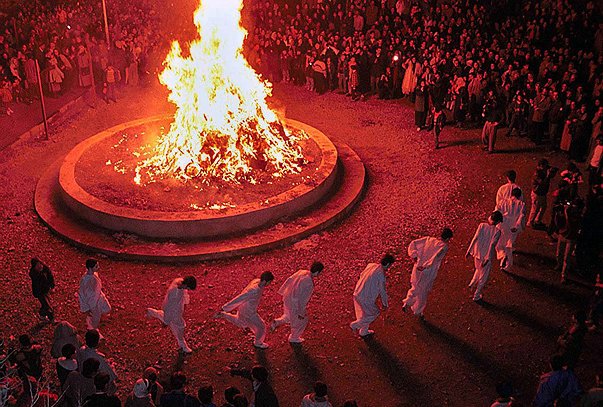
Sadeh in Varjavand Kushk, 2003

The fire was kept burning all night. The day after, women would go to the fire in the morning, each taking a small portion of the fire back to their homes to make new glowing fire from the "blessed fire" of the temple. This is to spread the blessing of the Sadeh fire to every household in the neighborhood. Whatever is left from the fire would be taken back to the shrine to be placed in one container and kept at the temple until the next year. This way the fire is kept burning all year round. The "eternal fire" also symbolizes the love of homeland which is always alive like a fervent fire in the people's hearts.

The festivities would normally continue for three days. The evenings are spent eating and giving out foods as donations, food that is prepared from slaughtered lambs and is distributed among the poor.

The most elaborate report of the celebration of Sadeh after the Muslim conquest of Persia in 7th century AD comes from the 10th century AD during the reign of Mardavij of Ziyarid dynasty, the ruler of Isfahan. The Ziyarid dynasty did their best to maintain Persian traditions. Bonfires were set up on both sides of the Zayandeh River to remember the Sadeh custom. The fires were kept in specially built metal holders. Hundreds of birds were released while the fireworks were lighting the sky. There were fireworks, dancing and music with lavish feasts of roasted lamb, beef, chicken and other delicacies.

Today the ceremony is celebrated somewhat like the ancient times in some Iranian cities such as Kerman and Yazd. Jashn e Sadeh is also celebrated every year in the Kushke Varjavand gardens in Karaj with the presence of Iranian Zoroastrians and others interested in traditional Persian ceremonies. Sometimes the fires are not lit outside and all activities take place inside the Zoroastrian temples. The activities of camel thorn gathering have almost been stopped though there are efforts to preserve the tradition. However, the bulk of Iranians are becoming more familiar with the occasion and there are gatherings and celebrations even outside the country on 30 January[clarification needed] each year. People will gather and pray, and then they will hold each other's hands, form a circle, and dance around the fire.

Sadeh in Tehranpars Markar, 2011

Every year, on 30 January[clarification needed], thousands of Zoroastrians in Iran and other countries celebrate the religious feast of Jashn-e Sadeh by burning firewood in an open space to signify the coming of spring and as a symbolic token of the eternal fight with mischief.

There is a cave in a mountain near Yazd, called Chak-Chak Fire Temple. Every year special ceremonies are held there during the Sadeh Feast. It is believed that the last Zoroastrian princess took shelter there in 640 AD when the Muslims expanded their power to the east.

Although for the majority of Iranians Sadeh has no religious significance and no specific rituals are involved other than lighting fires at sunset and having a cheerful time, Iranians of all faiths make a collective effort at this day to keep up with their ancient traditions and to celebrate the preciousness of creation.

Sadeh has a complex history and two different days were observed for the festival's veneration. In addition to 50 days (100 days and nights) before the beginning of the new year (or hundredth day after the gahambar of Ayathrima), already noted, the other celebration marked the hundred day before the religious new year (religious new year is not necessarily the same as spring new year). It is not clear why there are two Sadeh Festivals and why different regions have had different dates. Many of Zoroastrian holy days were and are celebrated twice; this is most likely caused by the calendar reform in the 3rd century AD.

Since 2017 Sadeh is officially recognized and celebrated by the Government of Tajikistan.[5]

On January 30, 2023, people in multiple different cities of Iran, celebrated Sadeh.[6] In the wake of the Mahsa Amini protests, Sadeh was celebrated by a great number of people, and they prepared fire as a symbol of Sadeh feast all across the Iran.[6] Among the cities that celebrated Sadeh, were Tehran, Tabriz, Izeh, Ahvaz, Shiraz, Kerman, Sanandaj, Isfahan, Zanjan, Kermanshah, Yazd, Malayer, Mashhad, and some cities of Hormozgan.[6][7] In Tehran, the districts of Amanieh, Shahr-Ara, Andisheh, Shahriyar, Haft-howz, Ekbatan, Beheshti, and Sohrevardi were some of the neighborhoods in which Sadeh was celebrated by preparing fire.[6][7] Some people also gathered in mountains of northern Tehran, and made fire to celebrate Sadeh.[7]

See also

[edit]

References

[edit]
[edit]
Revisions and contributorsEdit on WikipediaRead on Wikipedia
from Grokipedia
Sadeh, also known as Jashn-e Sadeh or Sada, is an ancient mid-winter festival originating in Persia and celebrated annually on , marking the end of the coldest days of winter and the preparation for spring through the of that symbolize warmth, , and the defeat of darkness. The festival predates but became deeply associated with it, revering fire as a purifying and life-sustaining element, with rituals including communal gathering of firewood, recitation of prayers by priests, singing, dancing around the flames, and sharing traditional foods and fruits. According to legend, it commemorates the discovery of fire by the mythical king , who struck flint stones, sparking the first flames and establishing humanity's mastery over cold and shadow. In addition to religious observance, Sadeh involves agricultural practices such as fertilizing fields and trees, reflecting its in pre-spring renewal, and it fosters community across ethnic and religious lines. Recognized by in 2023 as an shared by and , the festival continues in Zoroastrian communities worldwide, though public celebrations in have faced restrictions under the .

Etymology and Terminology

Meaning and Linguistic Origins

The term Sadeh originates from the Persian word sad (صد), denoting "one hundred," a derivation commonly attributed by historical sources to its association with the passage of one hundred days from the onset of winter or, more precisely, fifty days and fifty nights preceding , the Persian New Year. This numerical significance reflects ancient calendrical computations in Iranian tradition, where the festival aligns with the midpoint of winter. In the , Sadeh falls on the tenth day of , the eleventh month, corresponding to approximately January 30 in the , a fixed date that underscores its role as a seasonal marker independent of solar variations in folk observance. Linguistically, Sadeh traces to sad, itself from sata, both signifying the numeral one hundred, embedding it within Zoroastrian Indo-Iranian linguistic frameworks tied to ritual timing and cosmic order. Although some scholarly analyses note uncertainty in the precise —beyond the prevalent Islamic-era linkage to ṣad (hundred)—the term's Zoroastrian specificity differentiates it from homophonous variants like Sada in regional Persian dialects, which lack the festival's doctrinal context.

Historical Development

Ancient Pre-Zoroastrian and Zoroastrian Foundations

The observance of Sadeh traces its conceptual foundations to pre-Zoroastrian Indo-Iranian traditions of veneration, emerging in agrarian societies between approximately 1500 and 1000 BCE, where symbolized essential protection against winter's harshness and facilitated survival through warmth, cooking, and . These practices paralleled Vedic fire cults in neighboring Indo-Aryan contexts, emphasizing 's practical and spiritual role in combating cold and darkness during the mid-winter period, as evidenced by shared linguistic roots for (*ātar/*agni) and rituals across proto-Indo-Iranian cultures. Archaeological indicators include early installations in Central Asian and sites, predating formalized Zoroastrian temples, which underscore 's utility in seasonal agrarian cycles rather than purely mythical constructs. Within , Sadeh integrated these antecedents, formalized in Pahlavi texts like the , which attribute the festival to the legendary discovery of fire by the Pishdadian king around the dawn of human civilization. According to this account, Hushang accidentally generated a spark by striking a flint-axe against a rock while pursuing a serpent, thereby illuminating the path to fire's controlled use and instituting Sadeh to commemorate this event as a triumph of human ingenuity over primordial chaos. While hymns such as the extol fire () as a divine agent of (cosmic order), direct references to Sadeh as a named festival appear absent, suggesting its crystallization in later Zoroastrian that synthesized pre-Zoroastrian elements into a mid-winter rite marking renewal fifty days before . This mythological framing aligns with Zoroastrian cosmology's emphasis on fire's purifying essence, yet rests on textual traditions compiled between the 3rd and 9th centuries CE, reflecting oral precedents rather than contemporaneous records. Empirical support for these foundations derives from ancient Iranian fire altars, such as those documented in Achaemenid-era structures (circa 550-330 BCE), which served as focal points for and practical combustion, mirroring Sadeh's core motif of as a bulwark against winter's . Excavations reveal these altars—often simple depressions or elevated platforms for containing flames—integrated into settlements and temples, indicating 's indispensable role in pre-Islamic Iranian for both ritual and sustenance, without evidence of Sadeh-specific iconography but consistent with its thematic emphasis on 's mastery. Such artifacts affirm a causal continuum from prehistoric utility to Zoroastrian sacralization, prioritizing observable functionality over unsubstantiated supernatural attributions.

Celebrations in Achaemenid and Sassanian Eras

In the (c. 550–330 BCE), fire reverence formed a central aspect of Zoroastrian royal ideology, as evidenced by glyptic imagery from depicting fire altars in ritual contexts, which implies state patronage of fire-based ceremonies potentially encompassing early forms of Sadeh observances. These representations, including supported altars on pillars, align with broader Achaemenid endorsements of Zoroastrian practices, though direct epigraphic or textual references to Sadeh itself remain unattested in surviving contemporary records. The Sassanian Empire (224–651 CE) marked the zenith of Sadeh as a prominent national festival, characterized by large-scale bonfires, communal feasts involving wine and offerings, and royal endowments to fire temples, as preserved in Pahlavi literature and epic traditions reflective of Sassanian customs. The Dēnkard, a key Sassanian-era compilation, links the festival to the legendary king Hushang's discovery of fire, portraying it as a structured observance with societal significance under royal auspices. Archaeological remnants of Sassanian fire temples, such as those featuring eternal flames and ritual enclosures, corroborate the institutional grandeur of these events, with kings like depicted in reliefs honoring fire altars. Feasts emphasized abundance, with distributions of food and gifts, underscoring state orchestration to reinforce imperial unity and Zoroastrian orthodoxy. Following the Arab conquest in 651 CE, Sadeh practices waned amid political upheavals, yet Pahlavi texts such as the Dēnkard and Bundahišn ensured textual preservation of Sassanian-era rituals, maintaining continuity in Zoroastrian scholarly traditions.

Rituals and Practices

Core Ceremonies Involving Fire

The central ritual of Sadeh centers on the ignition of large bonfires at sunset on the 10th of Bahman in the Zoroastrian calendar, typically around January 30 in the Gregorian calendar. Communities prepare substantial piles of firewood, often gathered collectively in advance, to ensure the fires burn brightly and sustain through the evening. This act mechanistically counters the mid-winter chill by generating heat and illumination, facilitating communal gatherings in otherwise harsh conditions. Zoroastrian priests, known as mobeds, clad in white robes, lead the ignition process with recitations from the , the sacred texts, including the Atash Niyayesh, a dedicated to . The ceremony may also incorporate an Afrinagan-e Do Dahman, a blessing ritual for the community, performed prior to lighting to invoke collective well-being through structured . These recitations, drawn from liturgical traditions akin to the , emphasize 's role without invoking unverified supernatural efficacy, instead aligning with observable properties of combustion for warmth and visibility. Once ignited, participants circle the bonfires, engaging in dances and songs that promote social cohesion around the shared heat source. The fires' practical effects—radiating to mitigate cold, emitting to extend , and serving as a focal point for interaction—underpin the ritual's persistence, as they directly address environmental challenges of the season through causal means of fire management.

Communal and Agricultural Customs

Communal preparations for Sadeh involve collective efforts such as gathering from households, often led by youths, to foster and readiness for the . Participants also engage in maintaining communal , including cleaning water streams and pools, as well as repairing bridges, activities that unite villagers outdoors and reflect shared responsibility for the environment. Agriculturally, Sadeh signifies the initiation of preparations for the spring planting season, with farmers traditionally sprinkling on farmlands to enrich the soil. Gardeners prune trees and bushes on this day to promote growth and vitality in the coming cycle, aligning the with practical agrarian renewal after winter's dormancy. Following the main observances, communities partake in feasts featuring shared traditional dishes, including dry and fresh fruits offered as symbols of abundance and blessing. These gatherings emphasize merriment, with and wine distributed communally to express and strengthen social bonds.

Symbolism and Philosophical Underpinnings

Fire as Agent of Purification and Victory Over Darkness

In Zoroastrian doctrine, , personified as the , serves as the visible manifestation of Ahura Mazda's order and purity, acting as an intermediary that consumes impurities through its inherent transformative properties. Ancient rituals meticulously purified fires over 1,000 times annually to maintain this state, reflecting fire's observed capacity to incinerate organic contaminants and pathogens via , a process empirically evident in its sterilization of materials by breaking down molecular structures at high temperatures. This aligns with broader ancient understandings of as a physical agent that converts polluting substances into ash, thereby restoring cleanliness and enabling sanctity, as seen in its role alongside water as a core element of purity. Fire's triumph over darkness in Zoroastrian cosmology extends this empirical foundation, where its emission of light—through thermal radiation and photon dispersal—physically illuminates spaces, countering the literal obscurity associated with Angra Mainyu's domain of chaos, , and deceit. Angra Mainyu's counter-creation of against Ahura Mazda's underscores fire's causal role in dispelling shadows via wavefront propagation, providing not only visibility but also psychological reassurance against the perils of unlit environments, independent of purely metaphysical dualism. This physical efficacy reinforced fire's symbolic victory, as its sustained heat generation combated winter's physiological threats like , embodying a practical mastery over environmental adversities. The veneration of in Zoroastrianism clashed with Islamic theology post-conquest, where such practices were deemed idolatrous shirk, prohibiting the deification or ritual elevation of created elements like , which viewed as subordinate to rather than a divine agent. While Zoroastrians maintained as a non-worshipped of divine , Islamic jurists classified these rites as polytheistic deviations, leading to restrictions on fire temples and underscoring a fundamental doctrinal incompatibility between elemental reverence grounded in observed causal powers and monotheistic . This tension highlighted how Zoroastrian emphasis on 's tangible purifying mechanics diverged from Islamic aversion to any perceived anthropomorphization of natural forces.

Ties to Seasonal and Cosmic Cycles

Sadeh's timing, fixed at the tenth day of in the Iranian —typically falling between January 30 and 1—positions it roughly 40 to 50 days after the on December 21, a period when solar insolation begins to increase measurably in the . This alignment empirically corresponds to the phase where, following the solstice's of daylight (approximately 9-10 hours at latitudes around 35°N on the ), days lengthen by over 1 minute daily, accumulating to about 40-50 additional minutes of light by early , signaling the cosmic shift toward vernal renewal. In the climatic context of the , characterized by continental winters with average temperatures dipping to -5°C to 5°C in central regions and snowfall in highlands, Sadeh marks the observed waning of peak cold, often the onset of thaw in lower elevations by late winter. This mid-winter juncture, 50 days antecedent to on the 20-21 , facilitated agricultural foresight in pre-modern societies reliant on for ; historical accounts indicate ancient viewed it as the earth's preparatory warming for spring planting, with rites symbolically accelerating this natural progression amid arid, semi-arid conditions where winter frosts constrain growth until equinoctial stability. Cross-cultural comparisons reveal parallels in Indo-European traditions, where mid-winter fire festivals similarly anchor to post-solstice solar increments; for instance, the Celtic around February 1 invoked fire to invoke in ewes and dispel wintry stasis, mirroring Sadeh's emphasis on light's triumph over prolonged through shared motifs of purification and seasonal pivot, likely rooted in proto-Indo-European observances of equinoctial . Such convergences underscore a causal realism in ancient calendars: empirical tracking of and to mitigate winter's existential threats via communal anticipation of cosmic rhythms.

Fate Under Islamic Conquest and Revival

Suppression from 7th Century Onward

The Arab Muslim conquest of Sassanid Persia, completed by 651 CE with the death of , subjected Zoroastrians to status under Islamic rule, imposing the on able-bodied non-Muslim males as a financial penalty for retaining their faith. This economic pressure, combined with social inferiorities such as restrictions on public worship and testimony in courts, prompted widespread conversions over centuries, reducing Zoroastrian numbers from a to a marginalized minority by the CE. Zoroastrian rituals central to Sadeh, including the kindling and veneration of large bonfires symbolizing purity and triumph over winter's darkness, faced condemnation as shirk—associating partners with God—under Islamic doctrine emphasizing tawhid, or divine unity. Fire temples (atashkadeh), essential for such ceremonies, were frequently destroyed or converted into mosques during the Umayyad (661–750 CE) and Abbasid (750–1258 CE) periods, with jurists prohibiting practices perceived as idolatrous to prevent emulation by Muslims. Public festivals were curtailed to avoid scandalizing the ummah, driving Sadeh observances into clandestine or household settings to evade enforcement. Despite these constraints, Sadeh persisted among remnant Zoroastrian communities in remote desert oases like and , where geographic isolation shielded traditions from urban oversight. Medieval Iranian dynasties with Zoroastrian sympathies, such as the Ziyarids, occasionally permitted limited revivals, as in the 934 CE celebration recorded under Prince Mardavij, but orthodox caliphal authority generally prevailed, ensuring underground continuity evidenced by the survival of ritual knowledge into later eras.

20th-Century Resurgence and Modern Adaptations

During the (1925–1979), Sadeh experienced a notable resurgence as part of broader state efforts to revive pre-Islamic Iranian heritage and foster national identity. Pahlavi's policies emphasized ancient Persian traditions to counterbalance Islamic influences and promote secular nationalism, leading to the festival's adoption as a major communal event among Zoroastrians and gradually broader Iranian society. Public celebrations, including bonfires and rituals, were held in urban centers like , aligning with the era's modernization drive that integrated traditional practices into contemporary civic life. Following the 1979 Islamic Revolution, which prioritized Islamization and marginalized non-Islamic elements of Iranian culture, Sadeh persisted primarily within Zoroastrian communities despite ideological pressures. Zoroastrians, recognized as a protected minority under the , maintained observances through organized associations, ensuring continuity amid the revolutionary upheaval. This endurance reflected the festival's deep-rooted cultural significance, with events continuing in key Zoroastrian hubs such as and , even as public scale varied. In response to and demographic shifts, modern adaptations of Sadeh have included simplified rituals suited to city environments, such as contained bonfires in parks or association halls rather than expansive rural fires. The Zoroastrian Association of has played a central role in coordinating these events, incorporating traditional elements like fire-kindling, prayers, and feasting while adhering to contemporary safety and logistical constraints. These changes have preserved the core symbolism of fire's triumph over winter darkness without diluting its philosophical essence.

Contemporary Observance

Celebrations Within Iran

Sadeh is observed annually on January 30 by Iran's Zoroastrian community, centered at fire temples in Yazd and other locations such as the outskirts of Tehran, where participants light large bonfires, recite prayers from the Avesta, and engage in communal feasts symbolizing the triumph over winter's cold. The Zoroastrian population in Iran, officially recorded at approximately 25,000 in recent censuses, limits the scale of these gatherings to hundreds rather than thousands, with events confined primarily to the minority's designated spaces amid regulatory oversight. In 2024, celebrations proceeded with torch-bearing processions and lightings despite periodic prohibitions on open flames and public assemblies, as reported by international observers noting the resilience of these rites in defying seasonal and administrative chill. By January 2025, authorities explicitly banned non-Zoroastrian public involvement in the festivals, restricting participation to verified community members at sites like Yazd's temple, where the underscores the continuity of tradition under constrained conditions. While some accounts suggest wider Iranian ethnic participation in cultural echoes of Sadeh, empirical evidence points to observance remaining a niche preserve of the Zoroastrian minority, with broader claims often unsubstantiated by attendance data or official permissions.

Practices in Zoroastrian Diaspora Communities

In Parsi communities in , Sadeh observances omit the traditional lighting central to Iranian practices, focusing instead on liturgical prayers, communal feasts featuring seasonal foods like nuts and fruits, and recitations from Zoroastrian texts such as the . This adaptation reflects historical divergences in ritual customs between Iranian Zoroastrians and their Parsi descendants, who fled Persia in the 8th-10th centuries CE to escape conquests, prioritizing inner liturgical rites like over outdoor ceremonies. Parsi associations, such as those in and , host jashns (celebratory gatherings) on the date aligned with the Kadmi or Fasli calendars, often in agiaries ( temples) where a consecrated is already maintained, emphasizing symbolic reverence for as divine rather than ritual ignition. In n diaspora centers, particularly among Iranian Zoroastrian emigrants post-1979 Islamic Revolution, Sadeh events adapt to urban regulations by employing indoor fireplaces, altars, or electric/solar lamps to symbolize the purifying flame, avoiding open bonfires that require permits or constant tending. The Federation of Zoroastrian Associations of (FEZANA), established in to unite over 20 local associations, coordinates annual Sadeh jashns on or near , integrating prayers, traditional music, and feasts with lectures on Zoroastrian ethics to foster community identity amid a growing population estimated at 15,000-20,000 adherents. These gatherings, held in dar-e-mehrs (places of light) or community halls in cities like , , and , often align with the for accessibility, blending ancient Indo-Iranian elements like fire veneration with modern youth performances and interfaith dialogues. Similar adaptations occur in the , where the Zoroastrian Trust Funds of Europe and smaller associations in and organize indoor Sadeh commemorations, using symbolic lamps or temple fires due to stringent public fire laws, with emphasis on gahambars (seasonal feasts) and educational programs for second-generation youth. Across these settings, post-1979 influxes from —numbering thousands fleeing persecution—have revitalized observance, with community records showing a surge in participation from sporadic private rituals to organized public events by the , sustaining cultural continuity through hybrid practices that prioritize spiritual symbolism over literal replication of ancient Persian rites.

Political and Cultural Controversies

Regime Restrictions and Bans in the

Following the 1979 Islamic Revolution, the 's authorities viewed Sadeh as emblematic of pre-Islamic "fire worship" and , incompatible with Shia doctrine, leading to bans on large public bonfires and widespread participation by the Muslim majority. These measures, often rationalized through citations of risks, environmental damage, or public order, effectively confined observances to Zoroastrian enclaves while discouraging national revival of the festival's ancient Persian roots. Zoroastrian representatives, operating under regime oversight, have periodically enforced such limits, transforming once-public events into restricted, invitation-only affairs to comply with ideological constraints. Restrictions intensified in the post-Khatami era, with public programs curtailed and celebrations shifted to private venues or online formats amid internet disruptions and official blockades. In 2024, for example, events in were initially canceled following bombings that killed nearly 100 people, then relegated to virtual streams, illustrating how security pretexts compound ideological suppression. By 2025, prohibitions explicitly targeted non-Zoroastrian involvement. On January 30, officials in , , and barred public access to rituals like lighting, with Zoroastrian organizers invoking "limited space" and "health considerations" as stated reasons—widely interpreted as proxies for state directives to prevent cultural cross-pollination and potential unrest. packages for Sadeh to these sites were abruptly canceled, further isolating the despite its recognition as in December 2023. Reports from outlets like , which document regime actions from an opposition perspective, highlight how these policies sustain suppression of non-Islamic heritage, even as Sadeh's popularity surges among Iranians drawn to ancestral traditions.

Role in Anti-Government Protests and Identity Assertion

During the ongoing "" uprising sparked by the in September 2022, the Sadeh festival on January 30, 2023, served as a focal point for anti-government protests across . In cities including , protesters lit large bonfires—echoing the festival's traditional fires—and chanted slogans denouncing the mandatory and clerical rule, framing the event as an extension of the broader resistance against enforced Islamic norms. Demonstrations in neighborhoods like Tehran's highlighted the fires as symbols of collective anger, with participants explicitly tying the ritual to demands for personal freedoms suppressed under the . The politicization of Sadeh drew on the festival's ancient Zoroastrian symbolism of fire as a purifying force and emblem of light triumphing over darkness, repurposed by dissidents to critique the regime's ideological opacity and repression. Iranian opposition media reported that bonfires during these gatherings represented enlightenment and truth against the "darkness" of authoritarian control, with chants invoking pre-Islamic heritage as a counter-narrative to state-enforced . This interpretation resonated amid the protests' emphasis on reclaiming indigenous cultural practices, positioning Sadeh as a for asserting Persian identity distinct from the Arab-Islamic synthesis imposed post-7th century conquest. Such uses provoked regime countermeasures, including heightened security and sporadic bans on public gatherings, which authorities justified as preventing deviations from orthodox Islamic observance, though dissident analyses contend these reflect efforts to suppress ethnic and . Pro-regime outlets dismissed the protests as foreign-influenced disruptions of "national" traditions, but evidence from independent monitors underscores the events' organic ties to widespread discontent over cultural erasure. By integrating Sadeh into repertoires, participants advanced a of cultural revival as inseparable from political liberation, prioritizing empirical continuity of Iranian traditions over imported doctrinal overlays.

Global Recognition and Lasting Impact

UNESCO Inscription and International Awareness (2023)

On December 6, 2023, during the 18th session of the UNESCO Intergovernmental Committee for the Safeguarding of the Intangible Cultural Heritage in Botswana, the Sadeh/Sada celebration was inscribed on the Representative List of the Intangible Cultural Heritage of Humanity through a joint nomination by Iran and Tajikistan. This listing recognizes the festival's role in commemorating the mythical discovery of fire by the legendary king Hushang and marking the preparation of farmlands for spring sowing, observed annually around January 30 in the Gregorian calendar. The inscription highlights Sadeh's ancient Zoroastrian roots, involving communal bonfires symbolizing light, warmth, and renewal, accompanied by rituals such as poetry recitation, feasting, and traditional music. By elevating the practice to international status, aims to safeguard it from cultural erosion and promote its transmission across generations, particularly in communities where it persists despite historical suppressions. The joint recognition between and underscores shared Central Asian and Iranian cultural elements, including linguistic ties in the term "Sada" used in Tajik observance. This designation has amplified global awareness of Sadeh, drawing attention to Zoroastrian heritage beyond and , with media coverage and cultural exchanges fostering appreciation in communities and academic circles. It positions the as a bridge to pre-Islamic traditions, encouraging and revival efforts internationally while emphasizing community involvement in its perpetuation.

Contributions to Iranian Cultural Heritage Preservation

The Sadeh festival sustains key elements of pre-Islamic Iranian heritage by preserving Indo-Iranian fire veneration practices that originated before and persisted despite historical marginalization. Rooted in myths such as Hushang's discovery of fire through striking flintstones, Sadeh embodies symbolic rituals honoring light, warmth, and agricultural renewal, traditions that were viewed as idolatrous under early Islamic rule and thus suppressed as part of broader efforts to enforce Abrahamic against perceived polytheistic elements. This continuity counters assertions of seamless cultural assimilation following the 7th-century Arab conquests, as Sadeh's survival in Zoroastrian enclaves and its revival by Persian dynasties like the Ziyarids under (r. 935–943 CE) demonstrated deliberate efforts to reaffirm ethnic Iranian identity distinct from Arab-Islamic dominance. By maintaining these practices through , epics, and communal observances, the bolsters a secular Iranianism grounded in shared pre-Islamic lore, evidenced by its celebration across religious communities and its role in fostering against assimilation pressures. While some interpretations romanticize Sadeh exclusively as Zoroastrian doctrine, its pre-Zoroastrian pagan foundations—likely pragmatic responses to exigencies in agrarian societies—highlight empirical resilience over doctrinal purity, as the festival's and endurance reflect indigenous customs' adaptability rather than uninterrupted religious . This preservation of lore, lost or altered in other Abrahamic-influenced regions, underscores Sadeh's function in empirically documenting cultural persistence amid and conversion.

References

Add your contribution
Related Hubs
User Avatar
No comments yet.