Hubbry Logo
search
logo

Hat notation

logo
Community Hub0 Subscribers
Read side by side
from Wikipedia

A "hat" (circumflex (ˆ)), placed over a symbol is a mathematical notation with various uses.

Estimated value

[edit]

In statistics, a circumflex (ˆ), nicknamed a "hat", is used to denote an estimator or an estimated value.[1] For example, in the context of errors and residuals, the "hat" over the letter indicates an observable estimate (the residuals) of an unobservable quantity called (the statistical errors).

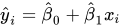
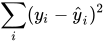
Another example of the hat denoting an estimator occurs in simple linear regression. Assuming a model of , with observations of independent variable data and dependent variable data , the estimated model is of the form where is commonly minimized via least squares by finding optimal values of and for the observed data.

Hat matrix

[edit]

In statistics, the hat matrix H projects the observed values y of response variable to the predicted values ŷ:

Cross product

[edit]

In screw theory, one use of the hat operator is to represent the cross product operation. Since the cross product is a linear transformation, it can be represented as a matrix. The hat operator takes a vector and transforms it into its equivalent matrix.

For example, in three dimensions,

Unit vector

[edit]

In mathematics, a unit vector in a normed vector space is a vector (often a spatial vector) of length 1. A unit vector is often denoted by a lowercase letter with a circumflex, or "hat", as in (pronounced "v-hat").[2][1] This is especially common in physics context.

Fourier transform

[edit]

The Fourier transform of a function is traditionally denoted by .

Operator

[edit]

In quantum mechanics, operators are denoted with hat notation. For instance, see the time-independent Schrödinger equation, where the Hamiltonian operator is denoted .

See also

[edit]

References

[edit]
Revisions and contributorsEdit on WikipediaRead on Wikipedia
from Grokipedia
Hat notation, also known as circumflex notation, is a conventional mathematical symbol consisting of a caret-shaped diacritic (ˆ) placed over a variable or symbol to convey specialized meanings in various fields of mathematics and related disciplines.[1] Commonly, it denotes a unit vector (e.g., $ \hat{\mathbf{v}} $), where the vector is normalized to have magnitude 1, a practice prevalent in vector calculus and physics.[1] It also represents an estimated parameter in statistics (e.g., $ \hat{\theta} $), distinguishing sample-based approximations from true population values.[2] Additionally, the hat serves as an operator for concepts like the cross product in three-dimensional space, transforming a vector into a skew-symmetric matrix that facilitates vector multiplication.[3] These uses highlight its versatility in denoting normalization, approximation, and transformation without altering the base symbol's identity. In vector analysis, hat notation is particularly prominent for indicating direction without magnitude. For instance, the unit vector in the direction of $ \mathbf{v} $ is written as $ \hat{\mathbf{v}} = \frac{\mathbf{v}}{||\mathbf{v}||} $, a standard in multivariable calculus and engineering. This notation aids in decomposing vectors into orthogonal components and is foundational for computations in physics.[1] In statistical modeling, the hat accent is a hallmark of inference, marking estimators derived from data. For example, in linear regression, the fitted values are $ \hat{\mathbf{y}} = \mathbf{H} \mathbf{y} $, where $ \mathbf{H} = \mathbf{X} (\mathbf{X}^T \mathbf{X})^{-1} \mathbf{X}^T $ is the hat matrix, a projection operator that "puts the hat" on observed responses to yield predictions.[4] Similarly, sample proportions like $ \hat{p} $ estimate population probabilities, enabling hypothesis testing and confidence intervals.[2] Beyond these, hat notation appears in advanced contexts, such as the hat operator in vector algebra, where $ \hat{\mathbf{a}} $ denotes the 3×3 skew-symmetric matrix corresponding to vector $ \mathbf{a} $, satisfying $ \hat{\mathbf{a}} \mathbf{b} = \mathbf{a} \times \mathbf{b} $ for the cross product.[3] This matrix representation, $ \hat{\mathbf{a}} = \begin{pmatrix} 0 & -a_z & a_y \ a_z & 0 & -a_x \ -a_y & a_x & 0 \end{pmatrix} $, is essential in rigid body dynamics, computer graphics, and Lie group theory for rotations.[3] Other niche applications include growth rates in logarithmic differentiation (hat calculus, where $ \hat{x} = \frac{dx}{x} $), underscoring its role as a compact modifier for derived or transformed quantities.[1]

In Estimation and Prediction

Statistical Estimators

In statistical modeling, the hat symbol (^) denotes an estimator of an unknown parameter, distinguishing the sample-based approximation from the true population value. For instance, in linear regression, the vector of coefficients β\beta is estimated as β^\hat{\beta}, which provides the best linear unbiased estimate under standard assumptions. This notation facilitates clear communication in inference, where β^\hat{\beta} is used to test hypotheses about the underlying relationships in the data.[5] A representative application appears in simple linear regression, where the model posits yi=β0+β1xi+ϵiy_i = \beta_0 + \beta_1 x_i + \epsilon_i for observations i=1,,ni = 1, \dots, n, and the fitted values are computed as y^i=β^0+β^1xi\hat{y}_i = \hat{\beta}_0 + \hat{\beta}_1 x_i, with β^0\hat{\beta}_0 and β^1\hat{\beta}_1 as the ordinary least squares (OLS) estimates minimizing the sum of squared deviations. The residuals, denoted e^i=yiy^i\hat{e}_i = y_i - \hat{y}_i, quantify the model's prediction errors and form the basis for variance estimation and diagnostic tests.[5] In the multiple regression setting, the OLS estimator generalizes to the matrix form
β^=(XX)1Xy, \hat{\beta} = (X^\top X)^{-1} X^\top y,
where XX is the n×kn \times k design matrix of regressors (including a column of ones for the intercept), and yy is the n×1n \times 1 vector of observations; this formula yields the coefficients that project the data onto the regressor space.[5]

Dynamic System Estimators

In dynamic system estimation, particularly within control theory and filtering algorithms, the hat notation denotes the estimated state vector in state-space models, where x^(t)\hat{x}(t) represents the best estimate of the true state x(t)x(t) based on available measurements and prior knowledge. This notation is standard in recursive estimation methods for time-varying systems subject to process and measurement noise, allowing engineers to track evolving system dynamics in real-time applications such as navigation and robotics.[6] Unlike static statistical estimators that focus on batch processing of fixed datasets, dynamic system estimators using hat notation emphasize recursive, online updates to handle noisy, sequential data streams, enabling predictive corrections as new observations arrive. This approach is crucial for systems where states evolve over time according to differential or difference equations, prioritizing computational efficiency and adaptability over one-time optimization.[7] A seminal example is the Kalman filter, which recursively estimates the state via prediction and update steps; the update equation is given by
x^kk=x^kk1+Kk(zkHx^kk1), \hat{x}_{k|k} = \hat{x}_{k|k-1} + K_k (z_k - H \hat{x}_{k|k-1}),
where x^kk\hat{x}_{k|k} is the updated state estimate at time kk, x^kk1\hat{x}_{k|k-1} is the prior prediction, KkK_k is the Kalman gain matrix, zkz_k is the measurement, and HH is the observation matrix. This formulation minimizes the mean-squared estimation error for linear Gaussian systems.[8] Within the Kalman filter, the innovation—or prediction error—captures the discrepancy between observed and predicted measurements, often notated as νk=zkHx^kk1\nu_k = z_k - H \hat{x}_{k|k-1}, which informs the gain computation and reflects new information injected into the estimate. This term ensures the filter adapts to unanticipated deviations, enhancing robustness in noisy environments.

In Linear Algebra

The Hat Matrix

In linear regression, the hat matrix $ H $, also known as the projection matrix, is defined as
H=X(XTX)1XT, H = X (X^T X)^{-1} X^T,
where $ X $ is the $ n \times p $ design matrix containing the regressors (including a column of ones for the intercept). This matrix satisfies $ \hat{y} = H y $, where $ y $ is the vector of observed responses and $ \hat{y} $ is the vector of fitted values, effectively projecting $ y $ onto the column space of $ X $.[9] The hat matrix possesses several key properties that stem from its role as an orthogonal projection operator. It is symmetric, meaning $ H^T = H $, and idempotent, satisfying $ H^2 = H $. Additionally, the trace of $ H $ equals the number of predictors $ p $ (including the intercept), so $ \trace(H) = p $. These properties ensure that applying $ H $ multiple times yields the same projection and that the matrix aligns with the geometry of least squares estimation.[10][11] Geometrically, the hat matrix represents the orthogonal projection of the response vector onto the $ p $-dimensional subspace spanned by the columns of the design matrix $ X $. This projection minimizes the Euclidean distance between $ y $ and the fitted values in that subspace, embodying the least squares solution. The diagonal elements $ h_{ii} $ of $ H $, referred to as leverage values, quantify the relative influence of each observation $ y_i $ on its own fitted value $ \hat{y}_i $; these values range between 0 and 1, with higher leverages indicating observations that are more distant from the bulk of the data in the predictor space and thus potentially more influential on the regression fit. Typically, leverages exceeding $ 2p/n $ are considered large, signaling high-leverage points that warrant diagnostic attention.[9][9] For the simple case of linear regression with one predictor (and intercept, so $ p = 2 $), the leverage $ h_{ii} $ simplifies to
hii=1n+(xixˉ)2k=1n(xkxˉ)2, h_{ii} = \frac{1}{n} + \frac{(x_i - \bar{x})^2}{\sum_{k=1}^n (x_k - \bar{x})^2},
where $ \bar{x} $ is the mean of the predictor values. This formula highlights how the constant term $ 1/n $ provides a baseline leverage, while the second term increases for points farther from $ \bar{x} $. Consider a small dataset with $ n=3 $ observations and predictor values $ x = [1, 2, 3]^T $: here, $ \bar{x} = 2 $ and $ \sum (x_k - \bar{x})^2 = 2 $. The leverages are then $ h_{11} = \frac{1}{3} + \frac{1}{2} = 0.833 $, $ h_{22} = \frac{1}{3} + 0 = 0.333 $, and $ h_{33} = 0.833 $, confirming that the endpoint observations have higher influence and that $ \trace(H) = 2 $. To compute the full hat matrix, first form $ X = \begin{bmatrix} 1 & 1 \ 1 & 2 \ 1 & 3 \end{bmatrix} $, then $ X^T X = \begin{bmatrix} 3 & 6 \ 6 & 14 \end{bmatrix} $ with inverse $ (X^T X)^{-1} = \frac{1}{6} \begin{bmatrix} 14 & -6 \ -6 & 3 \end{bmatrix} $, yielding $ H = X (X^T X)^{-1} X^T = \begin{bmatrix} 5/6 & 1/3 & -1/6 \ 1/3 & 1/3 & 1/3 \ -1/6 & 1/3 & 5/6 \end{bmatrix} $, whose diagonals match the leverages above.[9][9][12]

The Cross Product Hat Operator

In three-dimensional Euclidean space, the cross product hat operator, denoted as a^\hat{a} for a vector a=(ax,ay,az)R3\mathbf{a} = (a_x, a_y, a_z)^\top \in \mathbb{R}^3, is defined as the unique 3×33 \times 3 skew-symmetric matrix that encodes the linear transformation corresponding to the cross product operation with a\mathbf{a}. Explicitly,
a^=(0azayaz0axayax0), \hat{a} = \begin{pmatrix} 0 & -a_z & a_y \\ a_z & 0 & -a_x \\ -a_y & a_x & 0 \end{pmatrix},
such that a×b=a^b\mathbf{a} \times \mathbf{b} = \hat{a} \mathbf{b} for any bR3\mathbf{b} \in \mathbb{R}^3.[13] This matrix representation transforms the bilinear cross product into a matrix-vector multiplication, facilitating computations in linear algebra and enabling the cross product to be treated as an element of the Lie algebra so(3)\mathfrak{so}(3).[13] The hat operator exhibits key properties stemming from the geometry of the cross product. It is skew-symmetric, satisfying a^=a^\hat{a}^\top = -\hat{a}, which reflects the antisymmetry of the cross product: a×b=(b×a)\mathbf{a} \times \mathbf{b} = -(\mathbf{b} \times \mathbf{a}).[13] Additionally, the Frobenius norm of a^\hat{a} relates directly to the Euclidean norm of a\mathbf{a}, with a^F=2a2\|\hat{a}\|_F = \sqrt{2} \|\mathbf{a}\|_2, as the squared norm is trace(a^a^)=2(ax2+ay2+az2)\operatorname{trace}(\hat{a}^\top \hat{a}) = 2(a_x^2 + a_y^2 + a_z^2).[14] These attributes make a^\hat{a} an infinitesimal generator of rotations in SO(3)\mathrm{SO}(3), with the exponential map exp(θ^u)=R\exp(\hat{\theta} \mathbf{u}) = \mathbf{R} yielding a rotation matrix for unit vector u\mathbf{u} and angle θ\theta.[15] The conceptual foundations of the cross product, underlying the hat operator, trace back to the 19th century, with William Rowan Hamilton's introduction of quaternions in 1843, where the vector part corresponds to the modern cross product.[16] This was formalized as a standalone vector operation by J. Willard Gibbs in the 1880s, who coined the term "cross product" and adopted the ×\times notation.[16] The matrix form emerged in the context of line geometry through Julius Plücker's 1865 development of Plücker coordinates, which parametrize directed lines in space using moment and direction vectors, paving the way for screw theory.[17] In screw theory, a cornerstone of robotics and mechanics, the hat operator plays a central role in representing twists and wrenches as six-dimensional screws in the Lie algebra se(3)\mathfrak{se}(3). A twist ξ=(ω,v)\xi = (\boldsymbol{\omega}, \mathbf{v})^\top is encoded as the 4×44 \times 4 matrix ξ^=(ω^v00)\hat{\xi} = \begin{pmatrix} \hat{\boldsymbol{\omega}} & \mathbf{v} \\ \mathbf{0}^\top & 0 \end{pmatrix}, where ω^\hat{\boldsymbol{\omega}} captures the angular velocity component via cross products, and similarly for wrenches (f,τ)(\mathbf{f}, \boldsymbol{\tau})^\top with f^\hat{\mathbf{f}}.[13] This formulation simplifies kinematic and dynamic analyses of rigid bodies, such as computing joint velocities in manipulators or force propagation in mechanisms, by leveraging the algebra of screws for composition and reciprocity conditions.[18] A practical example arises in rigid body dynamics, where torque τ\boldsymbol{\tau} about a point is computed as τ=r×F=r^F\boldsymbol{\tau} = \mathbf{r} \times \mathbf{F} = \hat{\mathbf{r}} \mathbf{F} for position vector r\mathbf{r} and applied force F\mathbf{F}. This matrix form aids numerical stability in simulations, avoiding explicit determinant computations for the cross product.[13]

In Vector Geometry

General Unit Vectors

In mathematical and physical contexts, the hat notation denotes a unit vector, which is a vector normalized to have a magnitude of 1, thereby representing direction without magnitude. For a nonzero vector v\mathbf{v}, the unit vector v^\hat{\mathbf{v}} is defined as v^=vv\hat{\mathbf{v}} = \frac{\mathbf{v}}{\|\mathbf{v}\|}, where v\|\mathbf{v}\| is the Euclidean norm (or length) of v\mathbf{v}. This ensures that v^=1\|\hat{\mathbf{v}}\| = 1.[19][20] Key properties of unit vectors include the self-dot product equaling 1, as v^v^=1\hat{\mathbf{v}} \cdot \hat{\mathbf{v}} = 1, reflecting their unit length. Additionally, normalization preserves orthogonality: if two vectors u\mathbf{u} and v\mathbf{v} are orthogonal (i.e., uv=0\mathbf{u} \cdot \mathbf{v} = 0), then their unit vectors satisfy u^v^=0\hat{\mathbf{u}} \cdot \hat{\mathbf{v}} = 0, since the dot product of unit vectors is uvuv=0\frac{\mathbf{u} \cdot \mathbf{v}}{\|\mathbf{u}\| \|\mathbf{v}\|} = 0. These properties make unit vectors essential for constructing orthonormal bases in vector spaces.[21] In physics, hat notation for unit vectors is commonly applied to specify directions of forces or fields independent of their strengths. For instance, in the gravitational field, the force on a mass mm due to another mass MM at distance rr is expressed as F=GMmr2r^\vec{F} = -G \frac{Mm}{r^2} \hat{\mathbf{r}}, where r^\hat{\mathbf{r}} is the unit vector pointing from MM to mm, isolating the directional component. This usage facilitates vector decompositions in mechanics and electromagnetism.[22] Unit vectors often arise in relation to the cross product when determining normal directions to surfaces or planes. Specifically, for two vectors a\mathbf{a} and b\mathbf{b}, the unit normal n^\hat{\mathbf{n}} is given by n^=a×ba×b\hat{\mathbf{n}} = \frac{\mathbf{a} \times \mathbf{b}}{\|\mathbf{a} \times \mathbf{b}\|}, providing a normalized direction perpendicular to both a\mathbf{a} and b\mathbf{b}. This is widely used in geometry and physics for defining orientations, such as in surface normals for flux calculations.[23] A prominent example of hat notation in curvilinear coordinates is the orthonormal basis in spherical coordinates, consisting of r^\hat{\mathbf{r}}, θ^\hat{\theta}, and ϕ^\hat{\phi}. Here, r^\hat{\mathbf{r}} points radially outward from the origin, θ^\hat{\theta} is in the direction of increasing polar angle θ\theta (tangential to the meridian), and ϕ^\hat{\phi} follows increasing azimuthal angle ϕ\phi (along the parallel). These unit vectors form a right-handed, orthogonal set at every point, enabling efficient expression of position, velocity, and force vectors in spherical symmetry problems like planetary motion or quantum orbitals.[24]

Cartesian Basis Unit Vectors

In three-dimensional Euclidean space, the Cartesian basis unit vectors are conventionally denoted by ı^\hat{\imath}, ȷ^\hat{\jmath}, and k^\hat{k}, representing the orthonormal directions along the positive x-, y-, and z-axes, respectively. These unit vectors are explicitly defined in component form as ı^=(1,0,0)\hat{\imath} = (1, 0, 0), ȷ^=(0,1,0)\hat{\jmath} = (0, 1, 0), and k^=(0,0,1)\hat{k} = (0, 0, 1), each having a magnitude of unity and being mutually perpendicular.[25] This notation traces its origins to William Rowan Hamilton's invention of quaternions in 1843, where i, j, and k functioned as imaginary unit vectors forming the basis for a four-dimensional algebra, with the real unit 1 completing the set; Hamilton described them as "directed segments" of unit length along perpendicular axes.[26] The symbols were later adapted and popularized in vector calculus by Josiah Willard Gibbs and Oliver Heaviside during the late 19th century, who decoupled the vector components from the scalar in quaternions to develop a more streamlined system for physical computations, such as in electromagnetism. A key application of this notation lies in the decomposition of position vectors in Cartesian coordinates, where any vector r\mathbf{r} is expressed as r=xı^+yȷ^+zk^\mathbf{r} = x \hat{\imath} + y \hat{\jmath} + z \hat{k}, with xx, yy, and zz denoting the scalar components along each axis; this linear combination facilitates calculations in vector addition, projections, and derivatives. In electromagnetism, the notation is routinely employed to resolve field vectors, for instance, the electric field E\mathbf{E} is written as E=Exı^+Eyȷ^+Ezk^\mathbf{E} = E_x \hat{\imath} + E_y \hat{\jmath} + E_z \hat{k}, where ExE_x, EyE_y, and EzE_z are the components, enabling straightforward analysis of field behavior in rectangular cavities or wave propagation.[27] The circumflex or hat symbol explicitly signifies unit length, setting these basis vectors apart from general vector notation, where boldface lettering (e.g., i\mathbf{i}) may denote vectors of arbitrary magnitude without emphasizing normalization; this distinction is particularly useful in physics textbooks to avoid ambiguity when scaling components.[25]

In Functional Analysis

Fourier Transform Notation

In the context of functional analysis, the hat symbol $ \hat{} $ serves as the standard notation for the Fourier transform of a function, transforming it from the time or spatial domain to the frequency domain. The continuous Fourier transform of a function $ f(t) $ is denoted $ \hat{f}(\omega) $ and defined by the integral
f^(ω)=f(t)eiωtdt, \hat{f}(\omega) = \int_{-\infty}^{\infty} f(t) e^{-i \omega t} \, dt,
where $ \omega $ represents the angular frequency. This formulation decomposes $ f(t) $ into its constituent frequency components using complex exponentials, enabling analysis of oscillatory behavior in signals or functions.[28] Several conventions exist for the Fourier transform, primarily differing in the placement of scaling factors such as $ 2\pi $. For instance, an alternative form incorporates the $ 2\pi $ directly in the exponent:
f^(s)=f(t)e2πistdt, \hat{f}(s) = \int_{-\infty}^{\infty} f(t) e^{-2\pi i s t} \, dt,
with the inverse then lacking the $ 1/(2\pi) $ factor. Symmetric normalizations, common in physics and mathematics, distribute the scaling as $ 1/\sqrt{2\pi} $ in both the forward and inverse transforms to preserve the $ L^2 $-norm. One-sided variants, prevalent in engineering, restrict the integral to positive times or frequencies for causal signals, adjusting the formula accordingly to focus on spectra for $ t \geq 0 $ or $ \omega \geq 0 $. These variations arise from disciplinary preferences but maintain the core principle of frequency decomposition.[28][29] The inverse Fourier transform recovers the original function via
f(t)=12πf^(ω)eiωtdω, f(t) = \frac{1}{2\pi} \int_{-\infty}^{\infty} \hat{f}(\omega) e^{i \omega t} \, d\omega,
establishing a duality that ensures perfect reconstruction under suitable conditions, such as $ f $ being in the Schwartz class of rapidly decaying functions. In applications, particularly signal processing, the hat notation facilitates spectrum analysis by representing the frequency content of waves, such as decomposing audio signals into harmonics for filtering or compression. This is essential for tasks like identifying dominant frequencies in non-periodic signals, enabling efficient manipulation in domains like communications and imaging.[28] Named after Joseph Fourier, who introduced foundational ideas in 1807 for heat propagation, the transform's hat notation was standardized in the 20th century amid growing mathematical rigor, with key refinements by figures like Norbert Wiener in the 1930s solidifying its modern form.[29]

Operator Notation in Quantum Mechanics

In quantum mechanics, the hat symbol (^) is a standard convention for denoting linear operators that represent physical observables, thereby distinguishing them from classical scalar quantities or c-numbers. This notation emphasizes the abstract, operator nature of quantities like position and momentum in the Hilbert space framework. For example, the position operator x^\hat{x} acts on wave functions in the position representation, while the momentum operator is given by p^=iddx\hat{p} = -i \hbar \frac{d}{dx}.[30][31] A key application of this notation appears in the time-independent Schrödinger equation, which governs the stationary states of quantum systems:
H^ψ=Eψ, \hat{H} \psi = E \psi,
where H^\hat{H} is the Hamiltonian operator, typically H^=p^22m+V(x^)\hat{H} = \frac{\hat{p}^2}{2m} + V(\hat{x}) for a particle in a potential VV, ψ\psi is the wave function, and EE is the energy eigenvalue.[32] This equation illustrates how operators encode the dynamics of quantum systems, with the hat underscoring that H^\hat{H} is not merely a numerical energy but an entity that acts on state vectors to yield eigenvalues corresponding to measurable outcomes.[33] Operators in this notation exhibit fundamental properties such as non-commutativity, which underpins quantum uncertainty. The canonical commutation relation between position and momentum operators is [x^,p^]=i[\hat{x}, \hat{p}] = i \hbar, meaning x^p^p^x^=i\hat{x} \hat{p} - \hat{p} \hat{x} = i \hbar.[34] This relation, derived from the algebraic structure of quantum mechanics, prevents simultaneous precise measurements of conjugate variables and highlights the non-classical behavior captured by the hat notation.[35] The hat notation emerged within Paul Dirac's bra-ket formalism, developed in the 1930s to provide a coordinate-free description of quantum states and transformations.[33] In this framework, states are represented as kets ψ|\psi\rangle and bras ψ\langle\psi|, with operators A^\hat{A} acting as A^ψ=ϕ\hat{A} |\psi\rangle = |\phi\rangle. A practical consequence is the computation of expectation values for observables, given by A^=ψA^ψ\langle \hat{A} \rangle = \langle \psi | \hat{A} | \psi \rangle, which yields the average measurement outcome for state ψ|\psi\rangle under operator A^\hat{A}.[30] This bilinear form integrates seamlessly with the hat convention, facilitating calculations in abstract vector spaces without explicit wave function representations.[31]

References

User Avatar
No comments yet.