Hubbry Logo
Hawkins grenadeHawkins grenadeMain
Open search
Hawkins grenade
Community hub
Hawkins grenade
logo
8 pages, 0 posts
0 subscribers
Be the first to start a discussion here.
Hawkins grenade
Hawkins grenade
from Wikipedia
Battle patrol of the 1st East Surreys rest after returning from enemy territory in Italy, 16 December 1943. The soldier in the centre is holding a Hawkins grenade

Key Information

The Grenade, Hand, Anti-Tank, No. 75, also known as the "Hawkins grenade" was a British anti-tank hand grenade used during World War II. It was one of a number of grenades developed for use by the British Army and Home Guard in the aftermath of the Dunkirk evacuation. The grenade first appeared in 1942, and was designed to be more versatile than previous grenades, such as the No. 73 grenade and the sticky bomb.

It was rectangular, about 150 millimetres (5.9 in) in length and 75 millimetres (3.0 in) in width, containing approximately 0.45 kilograms (0.99 lb) of explosive. When a vehicle drove over the grenade, it cracked a chemical igniter and leaked acid onto a sensitive chemical, which detonated the explosive. Multiple grenades were often used to destroy tanks or disable their tracks, and the grenade could also be used as a demolition charge. It was used by the British Army and the United States Army, with the former using it until 1955 and the latter also creating their own variant, the M7 anti-tank mine.

Development

[edit]

With the end of the Battle of France and the evacuation of the British Expeditionary Force from the port of Dunkirk between 26 May and 4 June 1940, a German invasion of Great Britain seemed likely.[3] However, the British Army was not well-equipped to defend the country in such an event; in the weeks after the Dunkirk evacuation it could only field twenty-seven divisions.[4] The army was particularly short of anti-tank guns, 840 of which had been left behind in France and only 167 were available in Britain; ammunition was so scarce for the remaining guns that regulations forbade even a single round being used for training purposes.[4]

As a result of these shortcomings, a number of new anti-tank weapons had to be developed to equip the British Army and the Home Guard with the means to repel German armoured vehicles.[5] Many of these were anti-tank hand grenades, large numbers of which could be built in a very short space of time and for a low cost.[6] They included the No. 73 Grenade, which was little more than a Thermos-sized bottle filled with TNT, and the grenade, hand, anti-tank No. 74, also known as the "sticky bomb", which was coated with a strong adhesive and stuck to a vehicle.[7] A more versatile grenade appeared in 1942 in the form of the grenade, hand, anti-tank, No. 75, more commonly known as the "Hawkins grenade", which was designed so that it could be used in a number of roles.[8]

Design

[edit]

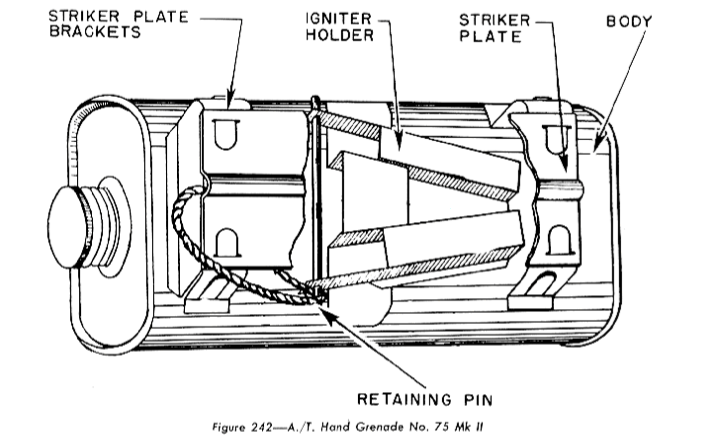
The grenade was rectangular in shape and approximately 150 millimetres (5.9 in) in length and 75 millimetres (3.0 in) in width,[9] and weighed about 1.02 kilograms (2.2 lb).[8] Its explosive content consisted of around 0.45 kilograms (0.99 lb) of blasting explosive,[9] which was usually either ammonal or TNT.[2] On the top of the grenade was a plate, under which the user would insert a chemical igniter, which would act as the weapon's fuse.[8][9] When a vehicle drove over the grenade, its weight crushed the plate, which in turn cracked the igniter; this then leaked acid onto a sensitive chemical which detonated the charge.[9] The grenade was designed so that it could either be thrown at a vehicle like an ordinary anti-tank grenade, or placed at a location when used as an anti-tank mine.[8] It was also fitted with areas where blasting caps or cordtex could be placed, so that it could be used as a demolition charge.[2] When the grenade was used, it was recommended that the user be within a short distance of their target, ideally concealed within a trench; if the target were an armoured vehicle, then the best areas to target were the sides and rear, where the engine compartment was located and armour was generally thinner.[10]

Operational history

[edit]
1st Lieutenant Wallace Strobel, speaking with SHAEF commander General Dwight D. Eisenhower, has a Hawkins grenade strapped to his leg

Introduced in 1942, the grenade saw service with the British Army until 1955. The United States Army also used the grenade, as well as developing their own variant, the M7 light anti-tank mine.[2] When used in an anti-tank role, a number of the grenades could be strung together in a "daisy chain" at intervals of around two feet before being placed across a road.[11] It was particularly effective at damaging the tracks of tanks.[12] When sufficient grenades were grouped together, they were capable of disabling a medium tank.[13] The Hawkins was also used in other roles, such as breaching walls,[1] and its small size enabled its placement into the "web" of a railway line to destroy a section of track.[9] The weapon received the nickname "Johnson's Wax tin" due to its appearance to a commercially produced floor treatment product. In the Battle of Ortona Canadian troops used them as demolition charges to "mousehole" between buildings.[14]

Users

[edit]

Users of the grenade included:

See also

[edit]

References

[edit]

Bibliography

[edit]
[edit]
Revisions and contributorsEdit on WikipediaRead on Wikipedia
from Grokipedia
The Hawkins grenade, officially designated the Grenade, Hand, Anti-Tank, No. 75, was a British anti-tank hand introduced during , designed primarily to disable armored vehicles through a versatile explosive device that could function as a thrown , a pressure-activated mine, or a demolition charge. It measured 150 mm in length and 75 mm in width, weighed 1.02 kg, and contained 0.45 kg of or TNT explosive filling, with a chemical igniter triggered by impact or structural deformation to mix components for detonation. Developed in response to the British Army's and Home Guard's urgent need for anti-tank weapons following the and equipment losses in , the entered production in June 1942 after evaluations showed it outperformed earlier 1940–1941 designs. It featured a rectangular sheet-metal body with variants including the Mk I, Mk II, and Mk III, the latter incorporating improvements for reliability, and was produced in large quantities until the mid-1940s. The Hawkins grenade saw extensive use by British, Canadian, and American forces across multiple theaters of WWII, notably during the 1944 where U.S. Airborne troops employed it against German armor, and it remained in British service until 1955. Its adaptability allowed placement under tracks for mine use, attachment via for sabotage, or direct throwing up to short ranges, though its blast effect was limited against heavier tanks, influencing later designs like the American M7 light .

History

Development

The development of the Hawkins grenade was spurred by the dire shortage of anti-tank weapons facing British forces and the following the in May-June 1940, where much heavy equipment was lost to German advances, leaving infantry vulnerable to armored threats during the anticipated invasion. This urgency prompted rapid innovation in improvised weaponry to equip civilian and regular units with simple, effective defenses against German tanks and vehicles. The grenade, officially designated Grenade, Hand, Anti-Tank, No. 75, was designed by Captain Hawkins of the , with initial concepts submitted around October 1940. Preliminary trials occurred on 23 October 1940, demonstrating the design's potential to damage tank tracks, followed by more extensive production trials in May-June 1941 that confirmed its viability. It was officially adopted and entered production in 1942, marking a key response to the evolving needs of defensive warfare. Intended as a low-cost, improvised anti-tank device for close-quarters use, the Hawkins grenade prioritized accessibility for by incorporating civilian materials such as commercial tin containers to house the explosive charge. Early testing emphasized operational simplicity, with trials validating the crush-igniter mechanism's reliability under vehicle pressure and its effectiveness in disrupting tracks without requiring advanced training. This focus on ease of manufacture using readily available resources ensured it could be quickly scaled to arm the and frontline troops confronting German armor.

Production

Adopted in following initial trials, the grenade enabled quick scaling of output to meet wartime demands. Production ramped up significantly during , with over 2 million units manufactured by various firms between and 1945 to equip defensive forces. The low-cost production process, leveraging basic stamping and filling techniques, supported mass issuance to units requiring improvised anti-tank capabilities. The remained in service until , after which it was phased out.

Design and Operation

Physical Characteristics

The Hawkins possesses a rectangular prism shape, measuring 165 mm in length, 92 mm in width, and 48 mm in height, designed to resemble a compact, flat tin can for ease of production and handling. This form factor allowed for simple stacking and transport in bulk. The device weighs 1.02 kg overall, including approximately 0.79 kg of filling, which contributes to its balanced portability despite the robust build. Constructed primarily from in the form of a tin-plate body with rounded corners and a screwed, cemented cap for watertightness, it incorporates a striker assembly housed in a cylindrical metal fitting soldered to the top. The explosive charge consists of , a nitrate-based of and aluminum powder, or alternatively TNT, selected for their ability to generate high suitable for penetrating armored vehicles through blast effects rather than mechanisms. This filling is cast as a solid block fitting the interior, sealed post-production to prevent moisture ingress. Its moderate weight enables hand-throwing at short ranges by trained personnel or direct placement as an , emphasizing versatility in field deployment. The overall prioritized simplicity in manufacturing, drawing from wartime needs for rapid, low-cost production of effective anti-armor tools.

Fuzing and Deployment

The fuzing mechanism of the Hawkins utilizes a chemical crush igniter, consisting of a tin-plate tube containing a filled with a of nitric and , along with an ignition composition. When sufficient pressure—approximately 300 pounds—is applied to the striker plate, it drives the striker into the , breaking it and allowing the acid to react with the ignition composition to produce an immediate flash that initiates the attached and main charge. This system operates effectively in any orientation, as the striker plate ensures regardless of how the rests. Safety features include malleable metal tabs on the grenade body that secure the igniter assemblies in their pockets during , preventing accidental displacement, and a red seal or plug that holds the striker pin in place on later marks to avoid premature crushing of the . Arming involves inserting the pre-assembled igniter (such as Grenade Igniter No. 75 Mk II for early models or Detonator No. 83 for later variants) into the two V-shaped pockets on the grenade's striker plate, then bending the tabs to lock them in position; a rubber tube or glue seal provides additional waterproofing at the joint. The is issued unfuzed to minimize risks during handling and storage. In hand-thrown deployment, the armed is hurled toward an approaching vehicle's path, typically within a short range of about 30 feet due to its weight, to function as an improvised mine upon being driven over; it does not detonate on impact from throwing, requiring precise placement for effectiveness. As a dedicated , it is laid flat on the ground or lightly buried with the striker plate upward, positioned under likely vehicle tracks to be crushed by the weight of passing armor. For enhanced effect, multiple grenades can be connected in a "daisy chain" configuration using cord or signal wire threaded through tabs on the support brackets, strung across roads or paths to create a wider hazard zone capable of damaging tracks or undercarriage components. The grenade also serves as a demolition charge by attaching armed units to walls, bridges, or other obstacles, where targeted pressure or impact triggers the to breach structures. Operational limitations stem from the immediate-action fuzing, which demands accurate positioning since the device lacks a self-ignition or impact fuze for direct throws against moving targets, making it less ideal for dynamic engagements beyond hasty defensive setups.

Combat Employment

World War II Usage

The Hawkins grenade saw extensive deployment by Allied forces across multiple theaters during World War II, particularly in North Africa, the Italian Campaign, and the Normandy invasion of 1944. In North Africa, it was issued to British units, where it served as a lightweight anti-vehicle option amid the fluid desert warfare against Axis armor. By the Italian Campaign, Canadian and British troops integrated it into close-quarters operations, leveraging its dual role as both a thrown grenade and a pressure-activated mine. During the Normandy landings on D-Day, June 6, 1944, it equipped airborne elements of the British, Canadian, and United States forces, including paratroopers from the 82nd and 101st Airborne Divisions who carried it strapped to their gear for rapid anti-tank response behind enemy lines. It was also used by British airborne forces during Operation Market Garden at Arnhem in September 1944. In key actions, the grenade proved adaptable to diverse combat scenarios. During the in December 1943, Canadian forces from the 1st Infantry Division improvised clusters of four to five Hawkins grenades taped to wooden sticks and rigged with primacord fuses to create powerful "mouseholing" charges, blasting through walls in the city's rubble-strewn streets to outflank German defenders in house-to-house fighting. In Normandy's country following D-Day, Allied troops placed the grenades on roads and in hedgerows for ambushes, targeting German convoys navigating the confined terrain; airborne units used them to disrupt thin-skinned vehicles and tracks during early chaos. While specific vehicle kills are sparsely documented, such tactics contributed to disabling lighter Axis armor in these engagements. Tactically, the Hawkins excelled at severing tank tracks or immobilizing half-tracks and early-war medium tanks like the when applied to vulnerable side armor, often in multiples to amplify blast effects against tracks or underbellies. It was less reliable against heavy tanks such as the without concentrated use, as its 0.45 kg explosive fill prioritized disruption over penetration. In urban settings like , troops repurposed it for anti-personnel roles by bundling units as improvised charges, enhancing mobility in fortified environments. Across campaigns, it contributed to vehicle disables, underscoring its value in infantry anti-armor doctrine despite limitations against late-war heavies.

Post-War Applications

Following , the Hawkins grenade remained in limited service with the , retained in stockpiles for potential use in static defenses and tasks until its in July 1955. Its versatility as a multi-role device—capable of functioning not only as an but also as a charge—saw it adapted for non-combat applications, such as breaching bunkers and obstacles during exercises. This extended utility stemmed from its simple design, which allowed multiple units to be bundled for greater effect in controlled demolitions, though its low individual yield limited it to supplementary roles. The grenade's phase-out was driven by the emergence of more advanced anti-tank systems, including shaped-charge launchers like the American and British PIAT, which offered superior penetration and reliability against armored vehicles compared to the Hawkins' blast effect. Additionally, inherent safety concerns with its acid-based fuzing mechanism—where a crushed released corrosive liquid to initiate —led to occasional unreliable performance and risks of premature explosion, further hastening its retirement. By the mid-1950s, these factors rendered the device obsolete in favor of mechanical or electrical fuzed alternatives. Surplus stocks of the Hawkins grenade were largely destroyed or demilitarized during the as part of broader inventory reductions, with many units repurposed for inert training aids or scrapped to prevent proliferation. Today, surviving examples are rare and highly valued among military collectors, typically deactivated and preserved as historical artifacts due to their association with improvisation.

Users and Variants

Primary Users

The Hawkins grenade was primarily adopted by the as a critical anti-tank following its official acceptance in June 1942, with widespread issuance to regular infantry units, the , and forces to address the urgent need for portable anti-vehicle capabilities after the . It became a standard component of defensive training for non-specialist troops, emphasizing basic techniques for throwing the underhand to a distance of about 30 yards or placing it as a pressure-activated mine on roads and tracks during anti-tank drills. These protocols focused on safe handling, arming the impact fuse only upon deployment, and coordinating with other improvised anti-tank measures to simulate real-world ambushes against armored vehicles. Canadian forces integrated the Hawkins grenade into their standard equipment kits during , particularly within the 1st Canadian Infantry Division, where it saw extensive use in the Italian Campaign, including the intense urban fighting at the in December 1943. Troops adapted it for close-quarters tactics by attaching multiple grenades to wooden poles for breaching fortified positions, while maintaining similar training regimens to British protocols for placement and daisy-chaining to enhance explosive effect against tanks and bunkers. Its adoption extended to operations in Northwest Europe, where Canadian units employed it alongside Commonwealth allies in and beyond. The military adopted the British-designed Hawkins grenade for airborne operations, issuing it to divisions such as the 82nd and 101st Airborne during the D-Day drops in in June 1944, where paratroopers often strapped it to their legs for rapid deployment. American training mirrored British methods, with emphasis on quick placement under fire and integration into anti-tank ambushes. This use highlighted its value for lightly equipped troops in high-mobility scenarios. It was also used by other Allied forces, including Polish troops during World War II.

Adaptations and Copies

The United States developed the M7 light anti-tank mine as a direct adaptation of the British No. 75 Hawkins grenade during World War II, entering production in 1944 and continuing into 1945. The M7 retained the Hawkins's crush-activated fuze mechanism but featured a steel body for enhanced durability, weighing approximately 2 kilograms when loaded, compared to the original's lighter tin construction in early models. This design allowed for similar deployment as either a thrown grenade or a laid mine, with the M7 using a mechanical M603 fuze requiring 60 to 110 kilograms of pressure to activate. The British No. 75 itself saw several variants to address manufacturing and operational issues. The Mark I used a rectangular tin-plate body for simplicity and low cost, filled via a screw cap with explosives like or Nobel's 704B. In contrast, the Mark II featured angled pockets for easier insertion of the chemical igniter, reducing assembly errors. The Mark III further refined this by eliminating the filling cap and using 0.8 kilograms of TNT plus booster pellets for more reliable . These changes, along with a variant designated No. 75A for alternative fillings, resulted in approximately five minor types overall, focusing on safety and efficacy without altering the core crush- principle. Late-war evolutions of the original, such as the Mark II's angled holders, aimed to minimize accidental during transport and deployment, addressing reports of unreliable ignition in field tests. Post-war, the Hawkins design influenced improvised and copied devices in various conflicts, though direct foreign replicas were limited. Today, inert replicas of the Hawkins grenade and its variants are produced for educational and recreational purposes. These non-explosive models, typically made from resin or stamped metal, replicate the original dimensions and markings for use in historical reenactments of battles, such as operations. Collectors and film productions also employ them as props to depict anti-tank tactics accurately, ensuring safe handling while preserving the device's historical appearance.

References

Add your contribution
Related Hubs
User Avatar
No comments yet.