Recent from talks
Be the first to start a discussion here.
Contribute something
Welcome to the community hub built to collect knowledge and have discussions related to Hawser.
Nothing was collected or created yet.
Hawser
View on Wikipediafrom Wikipedia


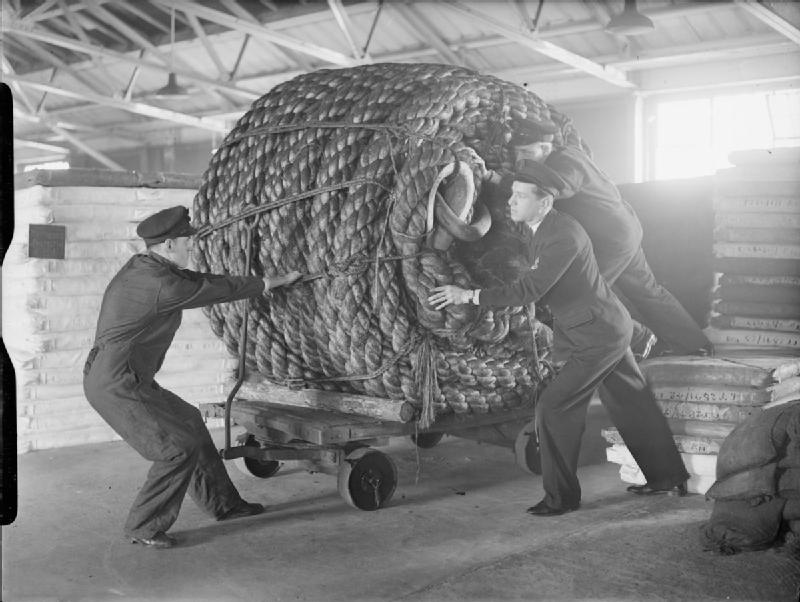
Hawser (/ˈhɔːzər/) is a nautical term for a thick rope used in mooring or towing a ship.[1] A hawser is not waterproof, as is a cable. A hawser is an anchor rope,[2] located on the hawse.[3]
References
[edit]- ^ The American Heritage Dictionary of the English Language, third edition, Houghton Mifflin Company, p. 830 "hawser". The American Heritage Dictionary of the English Language (5th ed.). HarperCollins.
- ^ "Cathole at dictionary.com".
- ^ The American Heritage Dictionary of the English Language, third edition, Houghton Mifflin Company, pp. 829–30, ISBN 0-395-44895-6
External links
[edit]
Media related to Hawser ropes at Wikimedia Commons
Hawser
View on Grokipediafrom Grokipedia
A hawser is a nautical term for a thick rope or cable used primarily for mooring, towing, or securing ships to docks or other vessels.[1][2]
The term originates from late 13th-century Middle English haucer, borrowed from Anglo-French haucier or Old French halcier, meaning "to hoist," which derives from Vulgar Latin altiare, an alteration of Late Latin altare ("to make high"), ultimately from Latin altus ("high").[3][2] This etymology reflects the rope's role in lifting or raising heavy loads in maritime operations, and by the 14th century, it had become a standard term in English naval terminology.[4]
Historically constructed from natural fibers like hemp or manila for strength and flexibility, hawsers were typically "hawser-laid," meaning they consisted of three right-handed strands twisted together to form a larger rope, providing durability against abrasion and tension at sea.[5][6] In modern usage, hawsers are often made from synthetic materials such as nylon, polyester, or polypropylene, offering improved resistance to weathering, UV exposure, and elongation under load; common constructions include double-braided, 8-strand plaited, or 12-strand designs for enhanced performance in towing and mooring applications.[7][8]
Hawsers play a critical role in maritime safety and operations, distinguishing them from thinner lines like sheets or halyards, and from waterproof cables used in anchoring; their thickness—typically exceeding 5 inches (13 cm) in circumference—ensures they can withstand immense forces, such as those from large vessels in rough conditions.[9][10]
