

Heavy cruiser
View on Wikipedia | This article needs additional citations for verification. (May 2012) |

A heavy cruiser was a type of cruiser, a naval warship designed for long range and high speed, armed generally with naval guns of roughly 203 mm (8 inches) in calibre, whose design parameters were dictated by the Washington Naval Treaty of 1922 and the London Naval Treaty of 1930. Heavy cruisers were generally larger, more heavily armed and more heavily armoured than light cruisers while being smaller, faster, and more lightly armed and armoured than battlecruisers and battleships. Heavy cruisers were not considered capital ships, unlike battlecruisers, battleships, and fleet carriers. Heavy cruisers were assigned a variety of roles ranging from commerce raiding to serving as 'cruiser-killers,' i.e. hunting and destroying similarly sized ships.
The heavy cruiser is part of a lineage of ship design from 1915 through the early 1950s, although the term "heavy cruiser" only came into formal use in 1930. The heavy cruiser's immediate precursors were the light cruiser designs of the 1900s and 1910s, rather than the armoured cruisers of the years before 1905. When the armoured cruiser was supplanted by the battlecruiser, an intermediate ship type between the battlecruiser and the light cruiser was found to be needed—one larger and more powerful than the light cruisers of a potential enemy but not as large and expensive as the battlecruiser so as to be built in sufficient numbers to protect merchant ships and serve in a number of combat theatres.
With their intended targets being other cruisers and smaller vessels, the role of the heavy cruiser differed fundamentally from that of the armoured cruiser. Also, the heavy cruiser was designed to take advantage of advances in naval technology and design. Typically powered by oil-fired steam turbines rather than the reciprocating steam engines of the armored cruiser, heavy cruisers were capable of far faster speeds and could cruise at high speed for much longer than could an armoured cruiser. They used uniform main guns, mounted in center-line superfiring turrets rather than casemates. Casemate guns and a mixed battery were eliminated to make room for above deck torpedoes, and ever-increasing and more effective anti-aircraft armaments. They also benefited from the superior fire control of the 1920s and continually upgraded through the 1950s. Late in the development cycle radar and electronic countermeasures would also appear and rapidly gain in importance.
History
[edit]Development
[edit].jpg)

At the end of the 19th century, cruisers were classified as first, second or third class depending on their capabilities. First-class cruisers were typically armoured cruisers, with belt side armour, while lighter, cheaper, and faster second- and third-class cruisers tended to have only an armoured deck and protective coal bunkers, rather than armoured hulls; they were hence known as protected cruisers. Their essential role had not changed since the age of sail—to serve on long-range missions, patrol for enemy warships and raid and defend commerce.[1] Armoured cruisers had proved less versatile than needed to do this adequately. In a race to outsize and outgun one another, they had grown to around 15,000 tons and up to 9.2 and 10 inches (230 and 250 mm) in main gun calibre—very close to the pre-dreadnought battleships of the day, although they were generally ascribed to be weaker than the battleship due to their lack of armour and not appreciably faster due to the limits of engine technology at the time. While Japanese armoured cruisers had distinguished themselves at the Battle of Tsushima in 1905, the armoured cruiser as it was then known had reached the pinnacle of its development.[2]
Tactics and technology were gearing towards naval encounters held over increasingly longer ranges, which demanded an armament of primarily large calibre guns. The demand for speed with which to outflank a potential enemy and fulfil its traditional role as scout for the fleet demanded a speed preferably 30 percent faster than battleships. Thirty percent was the ratio by which frigates had been faster than ships of the line in the days of sail. If a battleship sailed at 20 knots, this would mean that an armoured cruiser would have to steam at least 26 or 27 knots.[3]
Armoured cruisers could not fulfil these criteria without being built much larger and taking on a different form than they had in the past. The result was the battlecruiser. HMS Invincible and her two sister ships were designed specifically to fulfil these requirements. In a sense they were an extension of the armoured cruiser as a fast, heavily armed scout, commerce protector and cruiser-destroyer, reflected in the term originally ascribed to them, "large armoured cruiser". However, they were much larger, faster and better-armed than armoured cruisers, able to outpace them, stay out of range of their weapons and destroy them with relative impunity. Because they carried the heavy guns normally ascribed to battleships, they could also theoretically hold their place in a battle line more readily than armoured cruisers and serve as the "battleship-cruiser" for which William Hovgaard had argued after Tsushima. All these factors made battlecruisers attractive fighting units, although Britain, Germany and Japan would be the only powers to build them. They also meant that the armoured cruiser as it had been known was now outmoded. No more were built after 1910 and by the end of World War I, the majority of them had been taken out of active service.[4]
Although Lord Fisher, the man behind the building of Invincible, had hoped to replace practically all forms of cruisers with battlecruisers, they proved to be too costly to build in large numbers. At the same time, the third class cruiser (of about 3,000 tons) started to carry thin steel armour on the outside of its hull and became known as a light cruiser. This new type was then joined by 5,000-ton light cruisers, analogous to the older second-class cruisers. The wide gap between the massive battlecruiser of perhaps 20,000 tons and 305 mm (12-inch) guns and the small light cruiser of up to 5,000 tons and 100 mm (4-in) or 155 mm (6-inch) guns naturally left room for an intermediate type. The first such design was the British 'Atlantic cruiser' proposal of 1912, which proposed a long-range cruiser of about 8,000 tons displacement with 190 mm (7.5-inch) guns. This was a response to a rumour that Germany was building cruisers to attack merchant shipping in the Atlantic with 170mm guns. The German raiders proved to be fictional and the 'Atlantic cruisers' were never built. However, in 1915 the requirement for long-range trade-protection cruisers resurfaced and resulted in the Hawkins class. Essentially enlarged light cruisers, being referred to in contemporary reference works as an "improved Birmingham" type after the 6-inch gunned 5,000-ton second-class light cruisers then entering service, the Hawkins-class cruisers each carried seven 190 mm (7.5-inch) guns and had a displacement just under 10,000 tons.
The difference between these light cruisers and ones that would follow with the heavy cruiser were almost as pronounced as that between the armoured cruiser and the battlecruiser. One reason for this difference was the intended mission of these light/heavy cruisers which were not intended to serve as a junior battleship, as the armoured cruiser had been, and were not built or designed to serve in that capacity. Armored cruisers were often pressed into the main line of battle against battlecruisers and dreadnought battleships (Battle of the Falkland Islands, Battle of Dogger Bank (1915), Battle of Jutland). By contrast, heavy cruisers and light cruisers were not expected to be deployed as such, although there had been some notable engagements (Battle of the Denmark Strait, Battle of Cape Matapan, Naval Battle of Guadalcanal, Battle of Surigao Strait). The heavy cruiser's main armament of 203 mm (8-inch) guns was smaller than the typical 9.2-or-10-inch (230 or 250 mm) guns of the last armoured cruisers so their intended targets were other cruisers and smaller vessels. Further reasons for the difference were the advances in technology and naval design, both of which the heavy cruiser was able to take advantage. Heavy cruisers, like all contemporary ships, were typically powered by oil-fired steam turbine engines and were capable of far faster speeds than armoured cruisers had ever been (propelled by coal-fired reciprocating steam engines of their era). Nonetheless, heavy cruisers often had a larger number of main guns (some armoured cruisers had a mixed instead of uniform complement of main guns), discarded the mounting of main guns in casemates in favour of centre-line superfiring turrets (saving tonnage and enabling the ship to fire all guns on one broadside), and benefited from the introduction of fire control in the 1920s and 1930s, meaning that the heavy cruiser was considerably more powerful.
Washington Treaty
[edit]_leaving_Wellington,_New_Zealand,_on_22_July_1942_(80-G-13454-A).jpg)
The Washington Naval Treaty of 1922 imposed a moratorium on new battleship construction, with the exception of the two Nelson-class battleships by Great Britain, and set very strict limits on the tonnage and firepower of future battleships and battlecruisers. It also set the definition of a capital ship as a warship of more than 10,000 tons standard displacement or with armament of a calibre greater than 8 inches (203 mm). There was the concern that a subsequent race in building larger, more powerful cruisers might subvert the usefulness of the prohibition on capital ship construction and encourage navies to squander their now-limited permissible tonnage for capital ships on fast vessels designed specifically to hunt down large cruisers. To avert these challenges, representatives of the United States, Great Britain, Japan, France and Italy set limits on the tonnage and firepower of cruisers to 10,000 tons in standard displacement and 8 inches for maximum main gun caliber. These limits were in the interests of the U.S. and Britain especially. Planners in the U.S. Navy had spent two years prior to the start of negotiations designing 10,000 ton, 8-inch cruisers and were convinced that smaller vessels would not be worthwhile. Britain had just built its Hawkins-class cruisers and wanted to ensure they would not fall prey to a much larger type of super-cruiser.[5]
Despite these intentions and set limitations, a number of new, powerful cruiser classes emerged from these nations, which sparked off something of a cruiser arms-race. The Japanese navy had a doctrine of building more powerful ships in every class than its likely opponents, which led to the development of several very impressive heavy cruiser classes. British and American building was more influenced by the desire to be able to match the Japanese ships while keeping enough cruisers for their other global responsibilities. With battleships heavily regulated by the Washington Treaty, and aircraft carriers not yet mature, the cruiser question became the focus of naval affairs. The British, with a strained economy and global commitments, favoured unlimited cruiser tonnage but strict limits on the individual ships. The Americans favoured the opposite: strictly limited numbers of powerful cruisers. Disagreements between the British and Americans wrecked the 1927 conference on naval affairs.

_underway_at_sea_in_September_1935_(NH_97838).jpg)
Even during the 1920s, the 10,000-ton limit was not always strictly observed, although British, French and American designers generally worked to the limit with precision. The British built 13 of the County class with four twin 8-inch gun turrets but with very minimal armour. The ships had fine sea-keeping qualities and a long range, but were virtually unprotected, and were easily damaged in combat. The Japanese Myōkō class, however, grew during its construction as the naval general staff prevailed on the designers to increase the weapons load. As well as a breach of the Treaty, this was a poor decision from the design point of view and the ships had to be reconstructed in the 1930s to reduce weight. The German Deutschland class was classified as armoured coast defence ships under the terms of the Treaty of Versailles. They superficially resembled contemporary battleships due to their massive main gun turrets and unusually high conning tower/bridge. However, they were in effect a heavy cruiser being up gunned to 11-inch batteries at the cost of slower speed; their displacement was declared at 10,000 tons but was in practice considerably greater. The Italian Navy first built two Trento-class cruisers, which sacrificed protection for speed, and then four Zara class, a much more balanced and better-protected design, plus an improved replica of the Trentos (Bolzano); all of them, however, surpassed the displacement limit.
The Pensacola-class cruisers were the US Navy's first "treaty cruisers" designed in line with Washington Naval Treaty restrictions. Their main battery consisted of ten 8 in (200 mm) guns, in two twin turrets on the main deck, and two triple turrets two decks above, making it one of the two US Navy ship classes (besides the Nevada-class battleships) to have different-sized turrets for main armament (Subsequent US cruisers would mount nine 8" guns in three triple turrets 2 fore 1 aft). Their thin armour on the belt (varying from 2.5 to 4 inches (64 to 102 mm) in thickness) and deck 1.75 inches (44 mm) was no better than that on 6-inch-gunned cruisers and was inadequate to protect their vitals from enemy 8-inch shells. Also, their unusual main battery layout and heavy tripod fore-masts made these ships top-heavy and prone to excessive rolling. This combined with low freeboard forward made them inferior sea boats compared to later designs. Rework in the shipyards modified the hull and superstructure in the 1930s to eliminate the rolling. The two vessels in this class, Pensacola and Salt Lake City, were originally classified as light cruisers due to their minimal armour until re-designated in July 1931 as heavy cruisers in accord with international practice of designating all cruisers with guns larger than 6".[6]
London Treaty
[edit]In 1930 the Washington Naval Treaty was extended by the London Naval Treaty, which finally settled the arguments on cruisers which had raged in the 1920s. The treaty defined limits on both heavy cruisers – those with guns larger than 155 mm (6.1 inches) – and light cruisers – those with smaller-calibre guns. The limit of 10,000 tons displacement still applied to both. This was the point at which the split between "heavy" and "light" cruisers finally became official and widespread.
The Treaty satisfied Britain and America. However, it deeply offended Japan, as this severely limited the numbers of heavy cruisers that the Imperial Japanese Navy could have, as they considered heavy cruisers as key warships in a line of battle with their 8-inch guns and heavy torpedo armament. The IJN placed less priority on purpose-built light cruisers, most of their existing types dating back to the 1920s (the five World War I-era light cruisers that the IJN commissioned were less well-armed than light cruisers of the US and Royal Navies), which were largely relegated to leading destroyer squadrons. The solution the Japanese adopted was to build the Mogami class, which was declared as a 10,000 ton light cruiser with fifteen 6.1-inch guns. In practice, they displaced over 12,000 tons, had what was effectively a heavy cruiser hull design, and it was always intended to replace her turrets to give a final armament of ten 203 mm guns, making something of a nonsense of the light and heavy cruiser classifications. The waters were muddied further when the US Navy ceased laying down keels for new heavy cruisers in 1934 and used their new hull design for the Brooklyn class light cruiser. This type followed in the steps of Mogami by taking what was effectively a heavy cruiser hull and fitting light cruiser guns to it, and while the US Navy never fitted 8-inch guns to their "light" cruisers, the hull design was used as the basis for future heavy cruiser designs.
The German navy also paid lip-service to the treaty limitations, with the Admiral Hipper class displacing 16,170 tons.
In the mid-1930s, Britain, France and Italy ceased building heavy cruisers. It was felt [citation needed] that, in a likely cruiser engagement, a larger number of 155 mm (6-inch) guns would be preferable to a smaller number of 203 mm (8-inch). While the 8-inch gun would inflict more damage when it hit, more 6-inch guns could be carried, likely resulting in more shells on target, and a greater chance of scoring the first hit. This led to the construction of cruisers up to the 10,000-tons limit, with twelve to fifteen 155 mm guns.[citation needed]
The 1936 London Naval Treaty, principally negotiated between Britain and the United States but never ratified, would have abolished the heavy cruiser entirely by restricting new construction to 8,000 tons and 155 mm (6.1-inch) guns. This suited Britain's needs very well, but was largely a dead letter. The U.S. continued to build heavy cruisers, culminating in the New Orleans class and USS Wichita.
World War II
[edit]
Heavy cruisers were still being built, and they could be balanced designs when nations decided to skirt the restrictions imposed by the London Naval Treaty.
Heavy cruiser order of battle between Japan and the United States and its allies:
- United States (4 classes and 1 ship)
- 2 Pensacola, 10,000 t, 10 guns
- 6 Northampton, 2 Portland, 7 New Orleans, 10,000 t, 9 guns
- Wichita, 10,000 t, 9 guns
- British Commonwealth (5 classes)
- Japan (6 classes)
Japan was only allowed 12 heavy cruisers by treaty, but had intentionally built the Mogamis with the option to have their main battery changed. The two Tones were also originally planned as light cruisers, but launched after the treaty system broke down with 8-inch guns. At the start of hostilities there was thus a parity between the United States Navy and the Imperial Japanese Navy with respect to heavy cruisers.
The Germans built their Admiral Hipper-class heavy cruisers of 14,000 tons, although the Anglo-German Naval Agreement was supposed to limit their displacement to the 10,000 tons specified by the Washington Naval Treaty.
The US built the Baltimore class of heavy cruisers during the war. While earlier heavy cruisers were noted for their powerful torpedo armament (especially Japanese heavy cruisers), later ships built by the USN concentrated mainly on anti-aircraft armament, as their main role was escorting aircraft carriers and troop transports instead of engaging in surface actions. Most Japanese heavy cruisers were sunk by aircraft or submarines, rather than in surface engagements.[8]
-
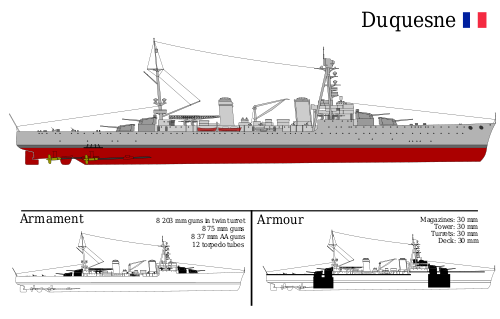 Example of heavy cruiser evolution during the Second World War: Duquesne in original anti-surface layout
 -
 Tourville after refit: reinforced anti-air armament, removal of sea plane, torpedo launchers and aft mast


_underway_c1963.jpg)

The US built the last heavy cruisers, which were finished shortly after the war. The Baltimore class consisted of seventeen ships, including three of the slightly different Oregon City class. The Des Moines class were the last heavy cruisers built: though based on the Baltimores, they were considerably heavier and longer due to their new rapid-firing 203 mm (8-inch) guns. Additionally, two aircraft carriers were built on a Baltimore-derived hull, the Saipan-class aircraft carrier.
The largest heavy cruisers were the Alaska-class large cruisers, which were designed as "cruiser killers". They resembled contemporary battlecruisers or battleships in general appearance, as well as having main armament and displacement equal or greater than that of capital ships of the First World War. However, the Alaskas were actually upscaled heavy cruisers, as their machinery layout and the possession of a single rudder was based on cruisers rather than that of battleships or battlecruisers. Furthermore the Alaskas lacked the sophisticated underwater protection system featured in battleships and battlecruisers, making them vulnerable to shells and torpedoes that hit under the waterline. The Alaskas also had proportionately less weight in armour at 28.4% of displacement, in contrast to the British battlecruiser HMS Hood of 30%, the German Scharnhorst and the U.S. Navy's North Carolina-class battleships of 40%.[9] Effectively, the Alaskas were ill-protected to stand up against the guns of true battleships and battlecruisers, and as carrier escorts they were much more expensive than the Baltimores while having only slightly better anti-aircraft capabilities. Given low priority by the USN, only two members of the Alaskas were completed and they saw little service as World War II ended not long after their commissioning.
Heavy cruisers fell out of use after the Second World War, with the Royal Navy decommissioning its last three (HMS London, HMS Cumberland, and HMS Devonshire) by the early 1950s. Some existing US heavy cruisers lasted well through the 1970s, with the last all-gun ship USS Newport News decommissioning in 1975. USS Chicago, USS Columbus and USS Albany, which had been converted to guided missile cruisers (US hull symbol CG), were laid up between 1975 and 1980.
Losses
[edit]- ESP Baleares, Battle of Cape Palos, 6 March 1938
- KM Admiral Graf Spee, Battle of the River Plate, 13 December 1939
- KM Blücher, Battle of Drøbak Sound, 9 April 1940
- RN York, Raid on Souda Bay, 26 March 1941
- RM Zara, Fiume, Pola, Battle of Cape Matapan, 29 March 1941
- USN Houston, gunfire and torpedoes, Battle of Sunda Strait, 1 March 1942
- RN Exeter, Second Battle of the Java Sea, 1 March 1942
- RN Cornwall, Dorsetshire, Indian Ocean Raid, 6 April 1942
- IJN Mikuma, airstrike, Battle of Midway, 6 June 1942
- RM Trento, 14 June 1942
- Guadalcanal campaign
- USN Astoria, Quincy, Vincennes, gunfire and torpedoes, Battle of Savo Island, 9 August 1942
- RAN Canberra, Battle of Savo Island, 9 August 1942
- IJN Kako, torpedoes, aftermath of the Battle of Savo Island, 10 August 1942
- IJN Furutaka, gunfire and torpedo, Battle of Cape Esperance, 12 October 1942
- IJN Kinugasa, airstrike, Naval Battle of Guadalcanal, 14 November 1942
- USN Northampton, torpedoes, Battle of Tassafaronga, 30 November 1942
- USN Chicago, airstrike, Battle of Rennell Island, 30 January 1943
- French Navy Algérie, Colbert, Foch, Dupleix, Scuttling of the French fleet at Toulon, 27 November 1942
- RM Trieste, airstrike, La Maddalena harbour, 10 April 1943
- Battle of Leyte Gulf
- IJN Atago, Maya, submarine attack in the Palawan Passage, 23 October 1944
- Mogami, surface action in the Battle of Surigao Strait and subsequent airstrike, 25 October 1944
- Chōkai, Suzuya, Chikuma, Battle off Samar, 25 October 1944
- IJN Nachi, airstrike, Manila Harbour, Philippines 4 November 1944
- IJN Kumano, airstrike, Santa Cruz Harbour, Philippines, 25 November 1944
- KM Admiral Scheer, airstrike Kiel, 9 April 1945
- KM Lutzow, airstrike in Swinemunde, 16 April 1945
- KM Admiral Hipper, scuttled in Kiel following airstrike, 3 May 1945
- IJN Haguro, destroyer torpedoes, Battle of the Malacca Strait, 16 May 1945
- IJN Ashigara, submarine, 8 June 1945
- IJN Aoba, Tone, airstrike, Bombing of Kure, 24 July 1945
- USN Indianapolis, submarine torpedoes, 30 July 1945
Surviving heavy cruisers
[edit]The last heavy cruiser in existence is the USS Salem, now a museum ship in Quincy, Massachusetts.
See also
[edit]
- BL 7.5 inch Mk VI naval gun prototype heavy cruiser main battery armament
- BL 8 inch Mk VIII naval gun British heavy cruiser armament
- 203mm/50 Modèle 1924 gun Early French heavy cruiser armament
- 203mm/55 Modèle 1931 gun Later French heavy cruiser armament
- 20.3 cm SK C/34 Naval gun German heavy cruiser armament
- 203 mm /50 Model 1924 Early Italian heavy cruiser armament
- 203 mm /53 Italian naval gun Later Italian heavy cruiser armament
- 20 cm/50 3rd Year Type naval gun Japanese heavy cruiser armament
- 180mm Pattern 1931-1933 Soviet heavy cruiser armament
- 8"/55 caliber gun United States heavy cruiser armament
- List of ships of the Second World War
- List of cruisers of the Second World War
- List of cruisers of World War I
- List of heavy cruisers of the Imperial Japanese Navy
- List of United States Navy cruisers § Heavy and light cruisers (CA, CL)
References
[edit]- ^ Rodger, N. A. M.: The Command of the Ocean, A Naval History of Britain 1649–1815. Allen Lane, London, 2004. ISBN 0-7139-9411-8
- ^ Marriot, Leo. Treaty Cruisers location 124. ISBN 9781783409761
- ^ Breyer 1973, p. 48.
- ^ Breyer, pp. 48–9
- ^ Friedman 1985, pp. 109–10.
- ^ Silverstone, Paul H (1965). US Warships of World War II. Annapolis, Maryland: Naval Institute Press. ISBN 0-87021-773-9.
- ^ A fourth Hawkins class heavy cruiser, the training ship HMS Vindictive (formerly HMS Cavendish), underwent a refit intended to restore her role as an armed heavy cruiser upon the outbreak of war. This refit was only partially completed however, and Vindictive was instead converted into a repair ship.
- ^ Junyokan! Stories and Battle Histories of the IJN's Cruiser Force
- ^ Friedman, Battleship Design and Development, 166–173
Works cited
[edit]- Breyer, Siegfried (1973). Battleships and Battlecruisers of the World, 1905–1970. London: Macdonald and Jane's. ISBN 0-356-04191-3.
- Friedman, Norman (1985). U.S. Battleships, An Illustrated Design History. Annapolis, Maryland: Naval Institute Press. ISBN 0-87021-715-1.
Heavy cruiser
View on GrokipediaDefinition and Classification
Origins and Treaty Definitions
The concept of the heavy cruiser emerged in the aftermath of World War I as part of broader international efforts to curb naval arms races by imposing limits on non-capital warships, preventing them from encroaching on battleship roles while allowing for versatile scouting and raiding vessels.[1] Following the war's devastation and economic strains, major powers sought to stabilize fleets through disarmament, focusing on tonnage and armament caps to avoid unchecked proliferation of large cruisers that could rival capital ships in firepower.[4] The Washington Naval Treaty of February 6, 1922, signed by the United States, United Kingdom, Japan, France, and Italy, established key parameters for cruisers without explicitly using the term "heavy cruiser," but implicitly defining the class through restrictions on surface combatants under 10,000 long tons standard displacement and armed with guns no larger than 8 inches (203 mm) in caliber.[1] Article XI of the treaty exempted cruisers from overall tonnage ratios applied to capital ships, permitting unlimited numbers as long as they adhered to the 10,000-ton limit and 8-inch gun maximum, which distinguished them from heavier battleships (limited to 35,000 tons and 16-inch guns) while enabling designs optimized for long-range operations.[4] This framework spurred a construction race among signatories for what became known as "treaty cruisers," maximizing displacement and armament within bounds to achieve superior scouting and commerce protection capabilities without violating capital ship prohibitions.[1] The London Naval Treaty of April 22, 1930, building on Washington, formalized the "heavy cruiser" designation by subdividing cruisers into Category A (heavy cruisers, equipped with guns exceeding 6.1 inches or 155 mm) and Category B (light cruisers, limited to 6.1 inches or smaller), while retaining the 10,000-ton displacement cap and imposing specific quotas: 18 heavy cruisers for the U.S., 15 for Britain, and 12 for Japan.[5][4] These treaties thus crystallized the heavy cruiser as a standardized warship type in interwar naval doctrine, balancing firepower for surface engagements with constraints to prevent escalation toward unrestricted battlecruiser-like designs.[1]Distinctions from Light Cruisers and Battlecruisers
Heavy cruisers were distinguished from light cruisers primarily by their main battery caliber, with heavy cruisers mounting guns larger than 6.1 inches (155 mm)—typically 8-inch (203 mm) weapons—as defined by Article 13 of the London Naval Treaty signed on April 22, 1930, while light cruisers were restricted to 6.1 inches or smaller.[6] This armament difference enabled heavy cruisers to deliver heavier projectiles with greater range and penetration in surface gunnery duels, approximately 30,000 yards effective range for 8-inch guns versus 20,000 yards for typical 6-inch mounts, though the larger shells resulted in slower rates of fire and higher per-unit costs estimated at 20-30% more than light cruiser equivalents.[1] Heavy cruisers also exhibited higher standard displacements, often 9,000-12,000 tons compared to 6,000-10,000 tons for light cruisers, supporting thicker armor belts (up to 6-9 inches versus 3-5 inches) to protect against peer threats while adhering to the 10,000-ton limit set by the Washington Naval Treaty of February 6, 1922.[5] These attributes positioned heavy cruisers for offensive roles against enemy cruisers or merchant shipping, whereas light cruisers emphasized defensive screening against destroyers and submarines due to their rapid-fire batteries. Relative to battlecruisers, heavy cruisers sacrificed armor thickness and gun size for operational flexibility, with deck and belt protection rarely exceeding 6 inches—insufficient against battleship-caliber fire—contrasting battlecruisers' 9-12 inch schemes designed to withstand 12-inch (305 mm) or larger shells in fleet actions.[1] Battlecruisers, as pre-treaty capital ships displacing 25,000-40,000 tons, carried main armaments of 11-15 inch guns for engaging battleships or enemy battlecruisers at decisive ranges, embodying a deliberate trade-off of armor for speed (27-32 knots) to fulfill scouting and pursuit roles within the battle fleet.[5] The heavy cruiser category emerged from treaty compromises to augment cruiser scouting capabilities with enhanced firepower without encroaching on capital ship quotas, limiting tonnage and armament to avert escalation in major fleet units; this reflected a causal prioritization of balanced naval presence over unrestricted power projection, as evidenced by the treaty's allocation of specific heavy cruiser numbers (18 for the U.S., 15 for Britain, 12 for Japan) separate from battlecruiser constraints under battleship categories.[6]Historical Development
Early 20th Century Precursors
![HMS Hawkins, lead ship of the Hawkins-class cruisers][float-right] The evolution of cruiser designs in the early 20th century transitioned from protected and armored cruisers toward larger vessels with uniform heavy-caliber batteries, driven by the need for effective long-range engagements observed in conflicts like the Russo-Japanese War (1904–1905). This shift emphasized firepower concentration for improved fire control and accuracy, replacing mixed armaments with consistent large guns to support roles in fleet scouting, commerce raiding, and protection. Armored cruisers, such as the German Scharnhorst class (laid down 1905–1906), displaced around 11,600 long tons and carried four 21 cm (8.3-inch) guns as their primary battery, balancing armor, speed of 22.5 knots, and endurance for extended operations.) These designs influenced subsequent heavy cruiser concepts by prioritizing offensive capability over lighter secondary batteries. The British Hawkins-class cruisers, ordered between November 1915 and March 1917, represented a direct precursor to formalized heavy cruisers, tailored for countering commerce raiders with global reach. Displacing 9,750 long tons standard, they featured seven 7.5-inch (190 mm) BL Mk VI guns in a predominantly uniform arrangement, supplemented by 12-pounder anti-aircraft guns and torpedoes, achieving speeds up to 31 knots powered by Parsons geared steam turbines. Intended for trade route patrols and raider hunts, their completion from 1919 onward highlighted pre-treaty experimentation with enlarged cruiser hulls exceeding 10,000 tons full load, foreshadowing armament-speed trade-offs in interwar limitations.[7] In other navies, similar trends emerged, though constrained by strategic priorities; Austro-Hungarian efforts focused on scout cruisers like the Helgoland class (commissioned 1912–1913), with lighter 10 cm guns on 3,500-ton displacements for Adriatic operations, underscoring regional variations in cruiser scaling before postwar restrictions curtailed larger builds. These early designs underscored causal drivers like vulnerability to long-range threats, propelling empirical refinements in gun elevation, director control, and propulsion for versatile fleet integration.Washington Naval Treaty (1922)
The Washington Naval Treaty, formally signed on February 6, 1922, by representatives of the United States, United Kingdom, Japan, France, and Italy, sought to curb post-World War I naval escalation by establishing quantitative and qualitative limits on major warships.[8] [9] While primarily targeting capital ships with a 5:5:3 tonnage ratio favoring the US and UK over Japan, the treaty's provisions for auxiliary vessels indirectly birthed the heavy cruiser category by capping individual cruiser displacement at 10,000 standard tons and main battery caliber at 8 inches (203 mm).[8] [9] Any non-capital surface combatant exceeding these thresholds—such as through larger hulls or heavier guns—would be reclassified as a capital ship, subjecting it to the treaty's more stringent overall limits and scrapping requirements.[1] This framework prevented the evolution of unregulated "super-cruisers" that could have mirrored pre-war battlecruiser inflation, instead channeling design efforts into balanced vessels optimized for scouting and raiding within fixed parameters. The signatories' acceptance of these ratios and caps compelled resource allocation toward compliant prototypes, as unchecked cruiser enlargement risked violating capital ship equivalency clauses and provoking countermeasures.[10] Naval powers like the US and UK, facing budgetary pressures from wartime debts, innovated hull geometries—such as widened beams for enhanced stability under heavy gun loads—to extract maximum utility from the 10,000-ton envelope without breaching displacement rules.[1] Empirical outcomes included the halt of oversized auxiliary projects; for example, prospective designs exceeding 10,000 tons were either redesigned or abandoned to align with the caliber-displacement linkage, fostering a standardized heavy cruiser archetype distinct from lighter, smaller-gun contemporaries.[11] By mandating the immediate scrapping of over 60 incomplete or excess capital ships across signatories—totaling millions of tons in foregone construction—and enforcing a 10-year holiday on new battleship lays—the treaty redirected fiscal priorities to auxiliary forces, including heavy cruisers.[12] US naval appropriations, for instance, pivoted from battlecruiser completions to funding 10,000-ton cruiser hulls, averting a projected tonnage spiral that could have doubled global fleets absent intervention.[13] This causal reorientation not only stabilized interwar naval equilibria but crystallized the heavy cruiser as a treaty-driven compromise between firepower needs and arms control imperatives, influencing doctrinal emphases on long-range gunnery within bounded scales.[4]London Naval Treaty (1930)
The London Naval Treaty, signed on April 22, 1930, by the United States, United Kingdom, France, Italy, and Japan, and entering into force on October 27, 1930, following ratification, refined the qualitative restrictions on cruisers from the 1922 Washington Naval Treaty by imposing quantitative limits on heavy cruisers—defined as those armed with guns exceeding 6.1 inches (155 mm) in caliber.[5][6] It retained the 10,000 long ton standard displacement limit and 8-inch (203 mm) maximum gun caliber for such vessels while capping their numbers: 18 for the United States, 15 for the British Commonwealth, and 12 for Japan.[6] These allocations, integrated into overall cruiser tonnage ceilings of 323,500 tons for the US, 339,000 tons for the UK, and 208,850 tons for Japan, aimed to prevent an unchecked buildup by formalizing a balanced distribution that preserved the heavy cruiser's role in fleet operations without enabling dominance by any single power.[5][14] The treaty's provisions prompted signatories to accelerate pre-existing construction programs to maximize allowances before potential escalator clauses or expirations, resulting in the completion of heavy cruiser classes like the US Navy's Pensacola and New Orleans types to reach the 18-unit quota, the Royal Navy's County class toward its 15, and Japan's Myōkō and Takao classes for 12.[14][15] It also permitted supplementary tonnage for light cruisers (6-inch guns or smaller)—up to 143,500 tons each for the US and UK, and 100,450 tons for Japan—encouraging minor shifts in emphasis toward these vessels for screening duties while sustaining heavy cruisers as the primary surface combatants within fiscal and strategic bounds.[5] Adherence to these limits persisted longer than anticipated due to the Great Depression's onset in 1929, which imposed severe budgetary restraints and deterred immediate large-scale naval expansions despite underlying tensions, such as Japan's dissatisfaction with its inferior ratios.[16][5] This economic reality delayed full denunciations—Japan notified withdrawal on December 29, 1934, effective December 31, 1936—allowing the treaty to temporarily stabilize heavy cruiser forces as versatile elements for scouting, raiding counteraction, and battle line support amid constrained resources.[17]Interwar Design Evolution
Following the Washington Naval Treaty of 1922, which capped heavy cruisers at 10,000 long tons standard displacement and restricted main batteries to 8-inch (203 mm) guns, naval architects focused on optimizing firepower within these constraints. The United States Navy's New Orleans-class cruisers, laid down between 1931 and 1934, incorporated three triple 8-inch/55 caliber gun turrets to mount nine guns, enhancing broadside weight compared to earlier twin-turret designs while adhering to tonnage limits.[18] This arrangement allowed for a main battery output of approximately 270 rounds per minute per side, prioritizing offensive capability over extensive armor, with belt protection limited to 5-6 inches.[19] Japan pursued treaty circumventions through modular designs, exemplified by the Mogami-class cruisers laid down in 1931 as light cruisers armed with five triple 155 mm (6.1-inch) dual-purpose guns to nominally comply with caliber restrictions on light cruisers. These vessels, displacing around 11,000 tons initially, were reconstructed between 1939 and 1940 by replacing the 155 mm turrets with five twin 203 mm (8-inch) mounts, effectively converting them to heavy cruisers without exceeding light cruiser construction quotas under the treaties.[20] Shipyard records from the Yokohama and Nagasaki yards confirm the feasibility of this refit, which involved hull strengthening to handle the heavier armament and improved stability through ballast adjustments.[21] Amid growing aerial threats in the 1930s, interwar heavy cruiser designs increasingly integrated dual-purpose secondary batteries and enhanced anti-aircraft suites, such as multiple 4-inch guns and early automatic cannons, to balance surface and air defense roles. British County-class cruisers, for instance, featured up to eight 4-inch high-angle guns alongside their eight 8-inch mains, reflecting doctrinal shifts toward fleet air defense screening.[22] Fire control advancements, including optical rangefinders and mechanical computers like the US Ford Rangekeeper, enabled more precise gunnery against both surface and low-flying aircraft targets, though radar integration remained nascent until the late 1930s. These adaptations maximized versatility within treaty bounds, foreshadowing wartime requirements without violating displacement or armament ceilings.Design Features
Primary Armament
Heavy cruisers were defined by their primary armament of 8-inch (203 mm) caliber guns, which exceeded the 6.1-inch (155 mm) limit for light cruisers under interwar naval treaties.[19] These guns, such as the U.S. Navy's 8"/55 Mark 12 and Mark 15, were mounted in twin or triple turrets, with configurations varying by class and nation; for instance, the U.S. Baltimore-class featured three triple turrets housing nine guns total.[19] The effective range for surface engagements reached 20 to 25 kilometers, allowing cruisers to engage targets at standoff distances while maintaining fleet screening roles.[19] Ammunition included armor-piercing (AP) shells for penetrating cruiser and destroyer armor, weighing up to 335 pounds (152 kg), and high-explosive (HE) shells for bombardment and anti-shipping against softer targets.[19] The rate of fire stood at 2 to 3 rounds per minute per gun under combat conditions, facilitating sustained barrages despite the slower reload compared to smaller calibers.[23] National variations emphasized gun-centric designs in the U.S., where later classes omitted torpedo tubes to maximize main battery firepower and reduce topside weight, contrasting with Japanese heavy cruisers that integrated Type 93 "Long Lance" torpedoes alongside similar 8-inch guns for enhanced close-range lethality.[24] The Japanese Type 93 offered ranges exceeding 30 kilometers at high speeds, though its oxygen-fueled propulsion posed handling risks absent in U.S. gun-focused armament philosophy.[25] British and other treaty-compliant designs adhered closely to 8-inch gun standards in twin turrets, prioritizing uniformity over torpedo augmentation.[19]Armor and Displacement Limits
The Washington Naval Treaty of 1922 limited cruisers to a standard displacement of 10,000 long tons and main guns no larger than 8 inches in caliber, creating the framework for heavy cruiser design by forcing trade-offs between armament, protection, and performance.[9] [1] The London Naval Treaty of 1930 reaffirmed these displacement and caliber restrictions while allocating tonnage quotas among signatories, but imposed no direct limits on armor thickness, leaving protection schemes constrained indirectly by the overall weight budget.[15] Designers prioritized schemes that could resist 8-inch shellfire from comparable vessels at engagement ranges of 10,000 to 15,000 yards, emphasizing inclined belt armor for effective thickness against flat-trajectory impacts and layered deck protection against plunging shells, though full immunity proved elusive within the tonnage cap.[1] Armor configurations typically featured main belts of 5 to 8 inches—thicker amidships over magazines and machinery for vital zone protection—and decks of 2 to 3 inches, with turret faces and barbettes similarly scaled to 5 to 9 inches to match the threat while preserving buoyancy through extensive subdivision into watertight compartments.[26] This distributed protection relied on causal factors like compartmentalization and internal bulkheads to limit flooding and maintain stability after hits, as thicker plating alone would exacerbate weight distribution issues and reduce freeboard. Empirical data from interwar gunnery and damage trials demonstrated that heavier armor allocations compromised speed by increasing hull resistance and draft, with treaty-limited vessels averaging 32 to 35 knots compared to lighter light cruisers exceeding 35 knots under similar power outputs.[1] Displacement creep emerged as navies optimized hull forms, steel alloys, and layouts to pack more capability into nominal limits, exemplified by the U.S. Baltimore-class heavy cruisers, which achieved standard displacements approaching 14,000 tons through efficient engineering despite treaty-era precedents.[27] Such advancements allowed marginally thicker armor or enhanced torpedo bulges without formal violations, but overloaded full-load figures often neared 17,000 tons, highlighting how buoyancy preservation via anti-flooding measures became critical for operational survivability amid the empirical reality of progressive flooding in combat.[27] These constraints underscored the causal tension: excess armor weight not only eroded speed margins essential for scouting roles but also amplified sinking risks if compartmentation failed under repeated 8-inch penetrations.[1]Propulsion, Speed, and Range
Heavy cruisers were propelled by geared steam turbine engines powered by oil-fired boilers, typically arranged on four shafts to distribute power and enhance reliability during high-speed operations.[28] This configuration allowed for efficient power transmission from multiple boilers—often eight or twelve—to achieve the high speeds required for fleet scouting and screening roles.[29] Power plants delivered between 80,000 and 132,000 shaft horsepower (shp), enabling maximum speeds of 32 to 35 knots, which permitted integration with faster battleships and aircraft carriers while outpacing merchant shipping for commerce raiding countermeasures.[30] The U.S. Pensacola-class, for example, produced 107,000 shp from eight boilers, attaining 32.5 knots on trials.[31] British County-class cruisers generated 80,000 shp for 32 knots, reflecting a design emphasis on balanced endurance over raw sprint capability.[32] Japanese Takao-class vessels reached 35.5 knots with 132,000 shp from twelve boilers, prioritizing tactical agility in Pacific operations.[28] Fuel efficiency stemmed from large oil bunkerage—up to 2,500 tons—yielding ranges of 8,000 to 10,000 nautical miles at 12 to 15 knots, ideal for transoceanic patrols without frequent refueling.[33] Pensacola-class ships achieved 10,000 nautical miles at 15 knots, supporting extended deployments across vast theaters.[34] County-class endurance reached 9,120 nautical miles at 12 knots, optimized for imperial trade route protection.[32] Such metrics underscored causal trade-offs in displacement limits, where added fuel reserves reduced space for armament or armor without exceeding treaty tonnage.[31] Propulsion designs occasionally incorporated taller funnels for improved boiler ventilation and reduced exhaust smoke, enhancing operational stealth but constraining deck space for anti-aircraft mounts amid evolving aerial threats.[32]National Design Variations
United States Navy heavy cruisers, such as the Baltimore class commissioned from 1943, emphasized a balance between surface gunnery and anti-aircraft defense, reflecting a doctrine prioritizing fleet integration and carrier task force protection in expansive Pacific operations. These ships displaced 14,472 tons standard, mounted nine 8-inch/55-caliber guns in three triple turrets, and achieved speeds of 33 knots, with extensive secondary batteries including twelve 5-inch/38-caliber dual-purpose guns for versatile anti-air roles.[35] This design deviated from strict treaty adherence post-1936 but built on earlier treaty cruisers like the Pensacola class by incorporating heavier armor—up to 6 inches on magazines—and improved fire control systems, enabling effective engagement against both surface threats and aircraft swarms.[27] British Royal Navy designs, exemplified by the County class laid down from 1924, focused on commerce protection and long-range raiding interception, aligning with imperial trade route vulnerabilities. Limited to 10,000 tons standard under treaty rules, these cruisers carried eight 8-inch guns in four twin turrets forward, a configuration chosen for concentrated firepower over triple mounts to simplify loading amid high seas, while attaining 29 knots and ranges exceeding 13,000 nautical miles at 12 knots.[32] High freeboard and robust hulls enhanced seaworthiness for Atlantic and Indian Ocean patrols, though lighter armor—typically 1-4.5 inches—reflected prioritization of endurance over heavy fleet duels, with torpedo tubes limited to eight 21-inch weapons for defensive use.[36] Japanese Imperial Navy heavy cruisers like the Takao class, entering service in 1932, integrated long-range Type 93 torpedoes as a core element, driven by a doctrine favoring night torpedo attacks in decisive battles akin to historical precedents like Tsushima. Displacing around 10,000 tons nominally but often exceeding in practice, they featured ten 8-inch guns in five twin turrets and four quadruple 24-inch torpedo mounts carrying the oxygen-fueled Type 93, capable of 5,000-yard runs at 44 knots.[29] Armor varied from 1.5 to 5 inches on belts, thicker over magazines, supporting aggressive maneuvers, though this armament-heavy approach strained stability and required later modifications for better anti-air capabilities.[37] The German Kriegsmarine's Admiral Hipper class, commissioned from 1939, stressed high speed for commerce raiding in the Atlantic, achieving 32 knots on 132,000 shaft horsepower while mounting eight 8-inch guns in four twin turrets. Designed near treaty limits at 14,000 tons standard, they included twelve 5.9-inch guns and twelve 21-inch torpedo tubes, but radar systems like the FuMO 21/24 were initially rudimentary, lacking the precision directors of Allied counterparts for surface gunnery in poor visibility.[38] Armor reached 3.1 inches on belts, adequate for cruiser engagements but vulnerable to battleship fire, with the emphasis on evasion over sustained fleet actions underscoring a strategy of hit-and-run operations.[39] Italian Regia Marina Zara-class cruisers, built from 1930, prioritized armor for Mediterranean fleet actions against superior French forces, featuring a 5.9-inch belt sloped at 10 degrees and up to 6 inches on turrets, among the thickest for treaty cruisers at effective thicknesses exceeding 150 mm in key areas. Eight 8-inch guns in four twin turrets provided firepower, but omission of torpedo armament—dropped to allocate weight to protection—limited versatility in close-quarters brawls, potentially constraining tactical flexibility in dynamic battles where torpedoes could exploit gun range gaps.[40] Speeds of 32 knots and displacements near 10,000 tons reflected a rigid gun-duel focus, with doctrine assuming daylight superiority through protected platforms rather than multifaceted threats.[41]| Nation/Class | Standard Displacement (tons) | Main Armament | Speed (knots) | Torpedo Tubes | Key Armor Features |
|---|---|---|---|---|---|
| US/Baltimore | 14,472 | 9 × 8-inch triples | 33 | None standard | 6-inch magazines, 5-inch decks |
| UK/County | 10,000 | 8 × 8-inch twins | 29 | 8 × 21-inch | 1-4.5-inch belts, high freeboard |
| Japan/Takao | ~10,000 | 10 × 8-inch twins | 35 | 16 × 24-inch | 1.5-5-inch belts, tapered magazines |
| Germany/Hipper | 14,000 | 8 × 8-inch twins | 32 | 12 × 21-inch | 3.1-inch belts, 1.6-inch decks |
| Italy/Zara | ~10,000 | 8 × 8-inch twins | 32 | None | 5.9-inch sloped belts, 6-inch turrets |