Hubbry Logo
search
logo
827382

Hedgehog slice

logo
Community Hub0 Subscribers

Wikipedia

from Wikipedia
Hedgehog slice
TypeSquare
Place of originGermany
Region or stateEurope
Main ingredientsCrushed biscuit, or rice puffs
  •   Media: Hedgehog slice

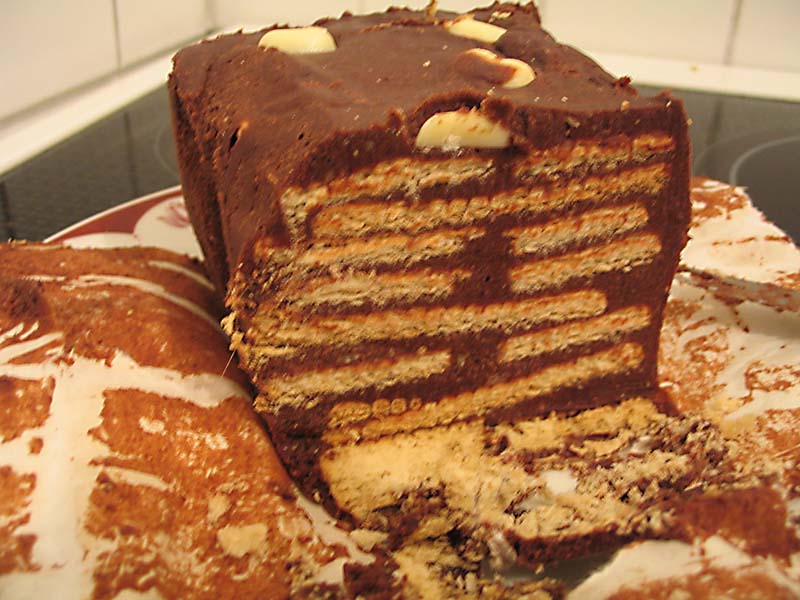
A hedgehog slice is an uncooked flat, square or bar-shaped chocolate snack/dessert, similar to rocky road but with alternating lighter and darker areas. The darker areas are chocolate flavoured. The lighter areas are originally complete biscuits, outside of Germany possibly alternatively crushed ones,[1] or even crushed rice puffs, or similar. Nuts may also be added.[1] It usually has a topping of chocolate icing, upon which may be sprinkled coconut, hundreds and thousands, or other kinds of sprinkles or raisins (e.g. chocolate or coffee flavoured, etc.).[2]

The dish goes by a variety of names. In German it is called Kalter Hund (cold dog), Kalte Schnauze (cold snout) or Kellerkuchen (cellar cake). In some languages it is named after its appearance, such as Swedish radiokaka (named for both its resemblance to old-time radios and its ability to be eaten soundlessly so as to not disturb radio broadcasts), Turkish Mozaik Pastası or Greek Mosaico. The Danish kiksekage and Serbo-Croatian keks torta simply mean biscuit cake. The Dutch name Arretjescake comes from a promotional recipe book published by Calvé and is named after its mascot character,[3] while the Norwegian Delfiakake refers to the Delfia deep-frying fat mentioned in this recipe.

The dish is derived from chocolate salami which was invented in the beginning of the twentieth century and which in turn traces its heritage to various kinds of fake sausage confectionery without chocolate from the start of the nineteenth century.

Many German histories refer to a 1920s recipe from baking firm Bahlsen that combined chocolate with packaged cookies.[4][5] The name "Kalter Hund" has been theorized to have passed into German through the Slovakian word hyntow (box-shaped trolley), which might have been a reference to the rectangular pans in which the dessert is often made.[4] In Germany, it is often described as a retro food that conjures nostalgic associations of the 1950s.[4] In 2019, inhabitants of Ronneburg made a 994.9 meter long cake, the longest to date in Germany.[6]

See also

[edit]

References

[edit]
[edit]

Grokipedia

from Grokipedia
Hedgehog slice is a classic no-bake dessert popular in Australia, prepared by combining crushed sweet biscuits with butter, sugar, cocoa powder, and desiccated coconut, then pressing the mixture into a tin and refrigerating it to set.[1] It is typically topped with a layer of melted chocolate or icing and cut into squares for serving, offering a simple, textured treat ideal for afternoon tea.[1] The dessert gained widespread popularity in Australian cookbooks and women's magazines during the 1970s.[1] It is derived from early 20th-century European confections, including the German Kalter Hund ("cold dog"), a layered no-bake chocolate and biscuit cake that is sometimes called hedgehog slice in English.[2][3] The Australian and New Zealand version is distinguished by its crushed biscuits, creating a spiky, hedgehog-like texture. In Australia and New Zealand, hedgehog slice remains a staple at bake sales, birthdays, and community events, valued for its ease of preparation and customizable additions like nuts or dried fruit.[1]

History and origins

European roots

The primary European precursor to hedgehog slice is the traditional German no-bake dessert Kalter Hund (meaning "cold dog"), which emerged in the early 20th century as a simple layered chocolate and biscuit cake.[4] The name likely derives from mining slang in industrial regions such as Saxony, where "Hund" referred to a worker's break-time treat or shift, evoking the dessert's quick preparation and rectangular form reminiscent of coal carts known as "Hunte."[5][6] First documented in German cookbooks during the 1920s, Kalter Hund was popularized by the Bahlsen company through recipes featuring their Leibniz butter biscuits, highlighting its accessibility for home cooks amid the economic challenges of the Weimar Republic.[4][7] Traditional preparations involve alternating layers of plain rectangular butter biscuits—such as Leibniz—with a rich mixture of melted milk and dark chocolate combined with coconut fat (like Palmin), poured into a loaf tin to set in the refrigerator without baking; the resulting slices reveal a distinctive marbled pattern from the contrasting chocolate shades.[8][9] In the early 20th century, similar no-bake chocolate-biscuit confections evolved across Europe, though distinct from the slice format; for instance, the UK's "hedgehog cake" traces back to 18th-century marzipan molds shaped like spiny animals using blanched almonds for quills, later incorporating cake bases in the 19th century but retaining a decorative, molded form rather than a layered bar.[10] These European traditions influenced Australian no-bake desserts.[3]

Adoption in Australia and New Zealand

The hedgehog slice, inspired by European no-bake chocolate biscuit cakes such as the German Kalter Hund, was adapted and embraced in Australia and New Zealand during the mid-20th century, with local versions incorporating accessible ingredients like Arnott's biscuits.[11][12] The first known recipe for a similar treat in Australia appeared in a newspaper in 1937.[3] It achieved widespread popularity from the 1970s onward, becoming a fixture in community cookbooks and women's magazines across both countries.[11][12] The treat's inclusion in school fete recipes and church fundraisers further solidified its status, evolving from a niche immigrant-influenced dessert to a cherished national staple in Australasian baking traditions.[12] In contrast to the loaf-shaped European precursors, the hedgehog slice was prepared as a flat bar, with its distinctive name arising from the spiky, textured surface formed by protruding biscuit crumbs and nuts, evoking the quills on a hedgehog's back.[13]

Description and ingredients

Traditional ingredients

The traditional hedgehog slice relies on a simple base of crushed plain sweet biscuits, such as Arnott's Marie (approximately 225g or ½ pound), which provide crunch and structure to the no-bake confection. These biscuits are broken into uneven chunks to create the characteristic textured, "hedgehog"-like appearance.[1] The binding mixture consists of 4 ounces (113g) butter for richness, ½ cup sugar for sweetness, 2 level tablespoons sifted cocoa powder for chocolate flavor, and 2 level tablespoons desiccated coconut for subtle texture. A single beaten egg is added to bind the ingredients, requiring gentle heating to cook it safely. This combination forms a fudgy paste that coats the biscuits, emphasizing the recipe's pantry-staple simplicity and refrigerator setting without flour.[1] Optional add-ins include ¾ cup crushed walnuts for added crunch and nuttiness, though they are not always present in classic recipes.[1] A layer of melted chocolate, typically dark or milk (around 200-250g), is poured over the chilled base to form a glossy topping that contrasts with the textured interior. The mixture is pressed into a lined tin (approximately 18cm x 28cm) and yields about 16-20 portions, suitable for sharing at gatherings.[1]

Preparation method

The preparation of traditional hedgehog slice follows a no-bake process involving mixing, brief heating, and chilling to create a firm base with visible biscuit chunks evoking a hedgehog's spines. It uses crushed plain sweet biscuits, optional walnuts, desiccated coconut, cocoa powder, sugar, butter, and egg, with gentle heating to bind without an oven.[1] Start by crushing the biscuits into a mix of small and larger chunks using a rolling pin in a sealed bag or food processor on pulse; aim for varied sizes about 1cm to preserve texture and avoid sogginess.[1] Melt the butter and sugar in a saucepan over low heat, stirring until dissolved. Add the cocoa powder, desiccated coconut, and beaten egg, then gently heat while stirring for 2-3 minutes until the mixture thickens slightly and the egg is cooked (reaching a safe temperature to avoid raw egg risks). Remove from heat and allow to cool for 5-10 minutes to prevent melting the biscuits. Fold in the crushed biscuits and optional chopped walnuts with a wooden spoon until evenly coated, taking care not to overmix.[1] Transfer to a lined slice tin (18cm x 28cm) and press firmly and evenly with a spoon or spatula to a thickness of about 2-3cm for uniform setting. Refrigerate for 1-2 hours until firm.[1] For the topping, melt 200-250g chocolate (with optional small amount of butter or oil for smoothness) in a heatproof bowl over simmering water or in microwave bursts, stirring until glossy. Pour over the set base, spread evenly, and chill for another 30 minutes until hardened. Remove from tin and cut into squares with a sharp, warmed knife for clean edges.[1] Use room-temperature ingredients to ensure even mixing; total active time is about 20 minutes, plus chilling. The brief heating step is crucial for binding and food safety with the egg.[1]

Variations

Regional differences

The standard Australian hedgehog slice features crushed Arnott's biscuits, such as Marie or Nice varieties, combined with walnuts and glace cherries, and is typically sweetened further through the use of additional condensed milk in the mixture.[14][15][16] In New Zealand, a common variation employs malt biscuits like Griffin's Super Wine instead of plain sweet biscuits.[17] Some recipes include digestive biscuits to create a denser texture.[18]

Modern adaptations

In recent years, hedgehog slice has seen adaptations to meet vegan dietary needs, replacing traditional condensed milk with coconut cream or plant-based alternatives and using dairy-free chocolate, while incorporating gluten-free biscuits for broader accessibility. These modifications maintain the slice's signature texture and chocolate base without animal products.[19] Flavor innovations have elevated the classic recipe, with additions like white chocolate swirls combined with dried cranberries for a tart contrast, or peppermint extract in choc-mint versions to evoke a refreshing twist suitable for adult palates. Espresso powder or mocha infusions provide a caffeinated depth, transforming the slice into a sophisticated treat often enjoyed with coffee.[20][21][22] Health-conscious updates include reduced-sugar formulations using dates or honey as natural binders instead of condensed milk, alongside nut-free options that swap nuts for seeds to avoid allergens. Low-carb variants substitute traditional biscuits with almond flour, appealing to ketogenic diets while preserving the no-bake simplicity.[23][24] The proliferation of social media platforms like Instagram since the 2010s has fueled a surge in creative hedgehog slice recipes, encouraging home bakers to experiment with visual and thematic enhancements that revive nostalgic treats with modern flair.[25]

Cultural significance

Nostalgic appeal

Hedgehog slice holds a profound nostalgic appeal in Australasian culture, primarily through its generational transmission within families. Popularized in Australia and New Zealand since the mid-20th century, the treat has been passed down as a simple family recipe, often evoking fond memories of childhood baking sessions and casual afternoon teas.[26][15] This emotional connection is reinforced through media representations that highlight its retro charm. In Australian television, such as episodes of The Cook Up with Adam Liaw, hedgehog slice is portrayed as a quintessential bakery staple from simpler times, symbolizing affordable childhood indulgences like pocket-money purchases at local shops.[27] Contemporary food websites and publications frequently feature it as a "retro classic," underscoring its role in evoking nostalgia amid fast-paced modern life.[28] The slice's no-fuss, no-bake preparation further enhances its psychological comfort, offering a straightforward antidote to the complexity of contemporary baking trends. This simplicity allows for quick assembly using pantry staples, providing a reassuring ritual that contrasts with elaborate, time-intensive desserts.[12] Its enduring popularity is evident in lists of iconic Australian sweet treats, such as Taste.com.au's ranking of the 50 best sweet slices.[29]

Serving occasions

Hedgehog slice is a popular choice for everyday treats, often enjoyed as an afternoon tea accompaniment with a hot cup of coffee or tea, where the beverage's bitterness balances the slice's sweetness.[22] It is also frequently packed into lunchboxes as a convenient, no-bake indulgence for schoolchildren or workers.[30] In social and celebratory contexts, hedgehog slice serves as a staple at birthday parties and bake sales across Australia and New Zealand, where its simple preparation and crowd-pleasing flavor make it ideal for sharing.[31] Community fundraisers, such as school events, commonly feature it cut into bite-sized pieces for easy sale and consumption.[28] Its nostalgic appeal further enhances its role in family gatherings and casual potlucks. For optimal enjoyment, hedgehog slice pairs best with hot beverages to offset its rich, sweet profile.[22] It stores well in an airtight container in the refrigerator for up to two weeks.[28] The slice is also freezer-friendly, lasting up to three months when wrapped properly and thawed in the refrigerator before serving.[32]

References

User Avatar
No comments yet.