Hubbry Logo
Princess cakePrincess cakeMain
Open search
Princess cake
Community hub
Princess cake
logo
8 pages, 0 posts
0 subscribers
Be the first to start a discussion here.
Contribute something
Princess cake
Princess cake
from Wikipedia
Princess cake
Swedish princess cake
Alternative namesPrinsesstårta, grön tårta, prinstårta, prinsessbakelse
TypeCake
Place of originSweden
Created byJenny Åkerström
Main ingredientsSponge cake, whipped cream, raspberries, pastry cream, marzipan, powdered sugar
  •   Media: Princess cake

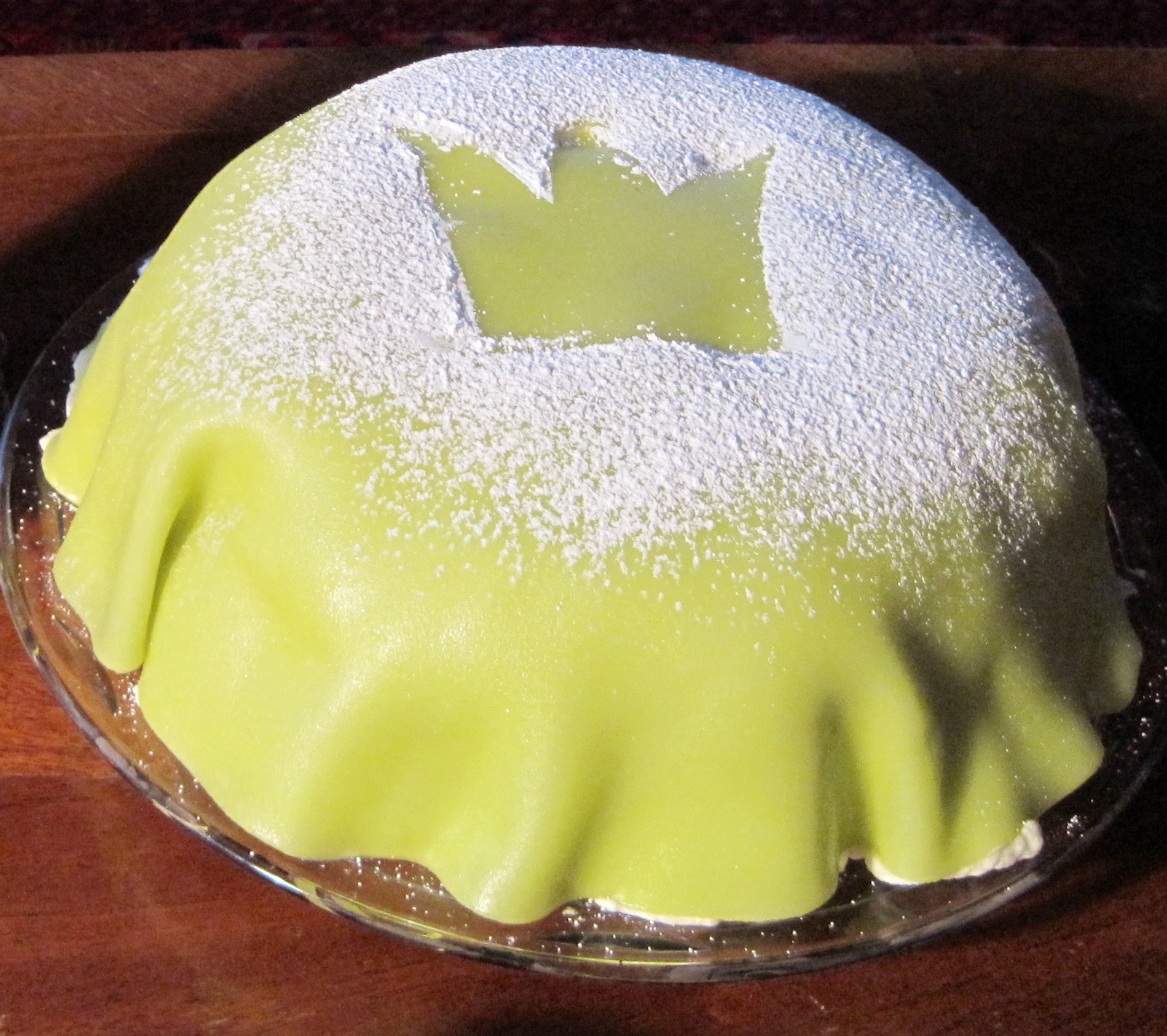
Princess cake or princess torte[1][2] (Swedish: prinsesstårta) is a traditional Swedish layer cake or torte consisting of alternating layers of airy sponge cake, pastry cream, and a thick-domed layer of whipped cream. The cake is covered by a layer of rolled marzipan, giving it a smooth, rounded top. The marzipan overlay is usually green, sprinkled with powdered sugar, and often decorated with a pink marzipan rose.[3][4] While the original recipe did not contain any fruit, modern versions usually include layers of jam[4] or fresh fruit, usually raspberries.

Origin and name

[edit]
Slice of a log-shaped cake, showing a thick layer of cream piled on top of the cake

The original recipe first appeared in the 1948 Prinsessornas kokbok cookbook, which was published by Jenny Åkerström (1867–1957), teacher of the three daughters of Prince Carl, Duke of Västergötland.[5]

The cake was originally called grön tårta (green cake), but was given the name prinsesstårta or "princess cake" because the Swedish princesses were said to have been especially fond of the cake. The princesses were Princess Margaretha (1899–1977; later Princess of Denmark), Princess Märtha (1901–1954; later Crown Princess of Norway), and Princess Astrid (1905–1935; later Queen of the Belgians).[6][7][8]

Variants

[edit]

Prinsesstårta has historically been called, or appeared in variants known as, green cake, regent cake, and opera cake.[9] Variants with other colours of marzipan are occasionally called prinstårta (prince cake) and sometimes Carl Gustaf cake when covered with yellow marzipan. Operatårta (opera cake) is a variant with red or pink marzipan.

A frog cake is a broadly similar Australian dessert that (aside from a bit of buttercream) is a smaller kind of prinsesstårta, decorated to resemble a frog’s face, with a cut in the marzipan forms the mouth.[4]

Variants with jam in the bottom layer are often called opera cake.[10]

Theme week

[edit]

Since 2004, there's been a "princess cake week" in Sweden held each September, with proceeds going to a royal charity.[11] Since 2004, the organization Sveriges bagare & konditorer (Sweden's Bakers & Confectioners) has promoted the last week of September as "Princess Cake Week".[12]

The first Thursday in March has become a well-known concept, primarily in Småland, where princess cake is eaten on this day. This is because the first Thursday in March is Småland's unofficial national day, and to honor the Småland dialect, it is called "fössta tossdan i mass" ('First Thursday in March').[13]

Storage

[edit]

Princess cake contains cream and can be stored in the refrigerator for several days, or frozen. The powdered sugar melts when it becomes moist. To prevent this, moisture-resistant powdered sugar can be used, or it can be dusted on just before delivery or serving.[14]

See also

[edit]

References

[edit]
Revisions and contributorsEdit on WikipediaRead on Wikipedia
from Grokipedia
The princess cake (Swedish: prinsesstårta) is a classic Scandinavian featuring alternating layers of light , raspberry jam, vanilla custard (or pastry cream), and , all assembled into a dome shape and coated in pale green , often adorned with a marzipan rose. Originating in during the 1920s, the cake was created by Jenny Åkerström, a prominent teacher and cookbook author who instructed the three daughters of —Princesses Margaretha, Märtha, and Astrid—in domestic arts. Initially known as gröntårta ("green cake") due to its distinctive exterior, the recipe was first documented in Åkerström's 1929 cookbook and later popularized in her 1948 publication, Prinsessornas kokbok ("The Princesses' Cookbook"), which she dedicated to her royal pupils. The princess cake gained widespread popularity in throughout the and is now considered a national favorite, celebrated annually on July 14 as Prinsesstårtans Dag ("Princess Cake Day"). While traditional versions emphasize the green dome for an elegant, regal appearance, modern adaptations may incorporate variations like different fruit jams or flavored creams, though the core structure remains a hallmark of Swedish baking heritage.

History and Origin

Creator and Development

The princess cake, known as prinsesstårta in Swedish, was created by Jenny Åkerström, a pioneering Swedish home economics teacher and cookbook author born in 1867. Åkerström operated a prestigious in during the early 20th century, where she emphasized practical domestic skills for young women, including those from elite families. Her work laid foundational contributions to modern Swedish culinary education, blending traditional recipes with innovative techniques suited to everyday households. In the and , Åkerström served as a private instructor to the three daughters of —Princesses Margaretha, Märtha, and —teaching them essential arts amid Sweden's evolving social norms for royalty. During these lessons, she developed as a sophisticated layered tailored for royal instruction, building on an earlier, simpler green-hued confection (grön tårta) from her 1929 that lacked and , to create a more elaborate structure with alternating layers of , , , and under a green dome. This evolution reflected Åkerström's pedagogical approach, using to demonstrate layering, flavor balancing, and presentation skills. The cake received its first formal documentation in the more elaborate form in the 1948 edition of Åkerström's influential series Prinsessornas Kokbok: Husmanskost och Helgdagsmat (The Princesses' : Everyday Food and Holiday Fare), where it appeared as grön tårta (green cake), named for its distinctive dome. This publication, originally launched in 1929 and revised through multiple editions until 1952, underscored Åkerström's enduring impact on Swedish baking traditions by codifying recipes that promoted accessible yet refined home cooking. The association with the princesses later inspired its renaming to prinsesstårta, tying it directly to her royal students.

Naming and Publication

The princess cake was initially known as gröntårta, or "green cake," a name derived from the distinctive green coating that forms its outer layer. This descriptor appeared in early recipes associated with the cake's development, reflecting its visual characteristic rather than any royal connotation. The cake was renamed prinsesstårta to honor the three Swedish princesses—Margaretha, Märtha, and —for whom it had become a favorite treat during their lessons with instructor Jenny Åkerström. The name change elevated the cake's status, associating it directly with royalty and contributing to its enduring appeal in Swedish baking tradition. The recipe, published as grön tårta, appeared in the 1948 edition of Åkerström's cookbook Prinsessornas nya kokbok, a comprehensive volume that included over 1,000 recipes tailored for home cooks. This publication marked a pivotal moment, as it disseminated the cake's precise formulation nationwide, transforming it from a private favorite into a widely adopted culinary icon.

Composition and Preparation

Key Ingredients

The traditional Princess cake, or prinsesstårta, is built upon a foundation of three delicate layers of sponge cake, which provides a light and airy base due to its whipped egg structure and minimal fat content. This is typically prepared by beating eggs and sugar until tripled in volume, then folding in sifted cake flour and a small amount of melted for subtle richness, resulting in a tender crumb that absorbs the fillings without becoming soggy. At its core, the cake features alternating layers of crème pâtissière—a thick made from , egg yolks, , cornstarch, and or pod—which adds creamy depth and stability to the structure. This , often chilled to set, contributes essential moisture and a subtle floral note that balances the sweetness. Complementing the is a generous layer of , whipped from and a touch of to stiff peaks, which introduces lightness and a fresh dairy flavor while helping to dome the cake's iconic shape. Between the sponge layers, raspberry jam or a preserve is spread thinly, providing a tart contrast that cuts through the richness and evokes the cake's fruity heritage. The exterior is defined by a smooth layer of or , traditionally dyed pale green with , which encases the cake like a protective shell and imparts a nutty, slightly sweet finish. This is rolled thin to avoid overpowering the inner components, allowing its subtle almond essence to harmonize with the and elements. A light dusting of mimics fresh , enhancing visual appeal, while an optional pink rose serves as a decorative crown, symbolizing elegance without altering the flavor profile. Emphasis is placed on using fresh, high-quality ingredients—such as real and pure jam—to ensure the cake's signature balance of moisture from the and against the dry and crisp .

Assembly Process

The assembly of a princess cake begins with preparing the sponge layers, which are baked in a round at approximately 350°F (175°C) until golden and springy, typically taking 25-30 minutes. The cake is then cooled completely in the pan before being removed and wrapped to prevent drying, allowing it to be made up to a day in advance for optimal texture. Once cooled, the sponge is horizontally sliced into three even layers using a serrated knife, with any domed tops or uneven edges trimmed flat to ensure stability during stacking. The bottom layer is placed on a serving plate or turntable, where raspberry jam is spread evenly, leaving a small border to contain subsequent fillings. The , or pastry cream, is then layered over the jam to provide a creamy, supportive base. The middle sponge layer is positioned atop the custard, followed by a generous mound of piled centrally to form the foundation of the cake's iconic dome. The top sponge layer is inverted and gently pressed down around the cream mound, compressing it slightly to create the initial conical shape. Additional is applied over the entire cake, sculpted into a smooth, rounded dome using an offset ; for stability, the cream is often stabilized with to hold its form without collapsing under the layer, and the partially assembled cake is chilled for 30 minutes to set. The chilled cake is then covered by rolling green-tinted into a thin, 1/4-inch disk on a surface dusted with to prevent sticking. The is draped over the dome, smoothed downward with clean, dry hands to eliminate creases and conform to the contours, ensuring a taut, even finish. Excess is trimmed at the base and tucked underneath for a neat edge, with any imperfections concealed by extra around the bottom if needed. Finally, decorations are added to enhance presentation: a pink marzipan rose, formed by shaping small flattened petals around a central core, is placed at the dome's peak, often flanked by green marzipan leaves secured with a dab of cream or corn syrup. The completed cake is lightly dusted with icing sugar and chilled for at least one hour to firm up, maintaining the dome's structure during serving.

Variants

Prince Cake

The prince cake, known as prinstårta in Swedish, was introduced alongside the princess cake in the 1948 edition of Prinsessornas kokbok by Jenny Åkerström. This variant serves as the primary gendered counterpart, adapted for male-oriented or neutral celebrations while sharing the base structure of layered , , jam, and . Key differences from the princess cake lie in the exterior covering and occasional internal adjustments. Instead of green marzipan, the prince cake typically features yellow marzipan, providing a counterpart aesthetic; for example, commercial versions incorporate sugar paste with emblems for decoration. The internal layers remain consistent. In practice, the prince cake retains the signature dome shape but employs masculine or simpler decorations, such as crowns, toppers, or minimal marzipan roses, distinguishing it for boys' birthdays or gender-neutral events.

Other Variations

In addition to the traditional green marzipan covering, variations of the princess cake incorporate pink or red , often associated with festive occasions or as a distinct style known as operatårta. Contemporary adaptations include vegan versions that substitute components with plant-based alternatives, such as coconut whipped cream and made from non-dairy milk thickened with cornstarch or , while maintaining the layered structure of , jam, and . Gluten-free options frequently replace wheat-based sponge with almond flour blends, combined with or for structure, allowing the cake to accommodate dietary restrictions without altering the dome-shaped aesthetic. In the United States, particularly in San Francisco-area bakeries, princess cakes are produced in larger formats, such as 11-inch versions serving up to 20 people, reflecting adapted portion sizes for American celebrations while preserving the classic composition. Modern innovations feature miniature individual portions, such as mini princess cakes assembled in tart form with scaled-down layers of , , , and fruit topping, ideal for parties or tastings.

Cultural Significance

In Swedish Culture

The princess cake, known as prinsesstårta in Swedish, holds a prominent place in the nation's culinary traditions, particularly as a staple during fika, the cherished break ritual that emphasizes social bonding and simple pleasures. Often enjoyed alongside in homes, workplaces, and cafés, it embodies the indulgent yet accessible of Swedish baked goods, with its layers of , , and offering a luxurious treat in everyday settings. Beyond daily fika, the cake features prominently in major Swedish celebrations, where its elegant dome-shaped form and vibrant green marzipan crown make it a symbol of festivity and achievement. It is a customary choice for birthdays, marking personal milestones with its royal-inspired grandeur, and for graduations, where it signifies completion and pride in educational accomplishments. Approximately 500,000 princess cakes are sold annually in , underscoring its enduring popularity and role as a cultural of and heritage. This substantial consumption highlights how the cake has evolved from a specialized —originally created in the for the young princesses Margaretha, Märtha, and —to a nationwide favorite that reinforces Swedish identity through tradition and craftsmanship. The cake maintains an ongoing connection to the Swedish monarchy, which bolsters national pride in its baking legacy. Bakers frequently highlight royal occasions to boost sales, such as the nationwide sell-out of princess cakes following the birth of Princess Estelle in 2012, keeping the dessert's regal associations alive in contemporary Swedish culture.

International Adoption

The princess cake gained significant traction in the United States through Swedish immigrant communities, particularly in San Francisco, where century-old bakeries like Schubert's (established 1911) and Victoria Pastry Company (founded 1914) have offered it since the early 20th century, with popularity surging via word-of-mouth sharing among Swedish expatriates and their American acquaintances in the mid-20th century. These establishments, rooted in Scandinavian baking traditions brought by immigrants, helped embed the cake in local culture, making it an iconic treat available at numerous city bakeries. Beyond the U.S., the cake spread to countries like the and via similar immigrant networks, appearing in specialized patisseries and Swedish-inspired bakeries. In the UK, venues such as Bageriet in 's and the Nordic Bakery feature the princess cake as a staple, reflecting the influence of Scandinavian diaspora communities that maintain traditional recipes in urban settings. In , it was popularized during the and amid waves of European immigration, including from , and now graces menus at retro-inspired cafes and bakeries as a nostalgic layered . In the 2020s, the princess cake experienced a global revival fueled by , with viral tutorials, posts, and simplified recipes from outlets like sparking widespread home baking and experimentation. This digital buzz has driven commercial availability, including frozen single-serve versions from and nationwide shipping of artisanal iterations from U.S. patisseries like Miette, extending its reach to international markets.

Traditions and Events

Princess Cake Week

Princess Cake Week, or Prinsesstårtans vecka in Swedish, is an annual charitable event dedicated to promoting the princess cake while supporting initiatives for vulnerable children. Initiated in 2004 by the Swedish Bakers' and Confectioners' Association (Sveriges bagare & konditorer), the event takes place during the last week of , transforming the period into a nationwide celebration of the cake's cultural heritage. Participating bakeries and confectioneries across commit to donating 10 SEK for each princess cake sold, with some also contributing 2.50 SEK per princess pastry, directly to Victoria's Fund. This fund, founded by Victoria in 1997, focuses on enabling children and young people with disabilities or chronic illnesses to lead active lives through targeted support projects. The donations help finance activities that promote inclusion, , and opportunities for these children, aligning the event's proceeds with the fund's mission. The event significantly boosts princess cake sales by encouraging special promotions, such as decorating cakes with gold crowns, which draws public attention and fosters community engagement. It raises awareness about the cake's traditional role in Swedish celebrations while highlighting the charitable cause, resulting in heightened visibility for both. Since its inception, Princess Cake Week has generated substantial charitable contributions; for example, sales in 2008 alone raised approximately 200,000 SEK for the fund, demonstrating its ongoing impact in supporting children's welfare initiatives.

Celebratory Uses

The princess cake, known as prinsesstårta in Swedish, holds a prominent place in Swedish celebrations, frequently appearing at birthdays, graduations, office parties, and family gatherings as a symbol of festivity and indulgence. This tradition underscores its status as Sweden's most popular celebration cake, often chosen for its elegant layers and vibrant green appearance that add a touch of royalty to the occasion. A playful custom accompanies its serving, where guests traditionally vie for the marzipan rose crowning the dome, heightening the communal joy of the event. In terms of presentation, whole princess cakes are commonly prepared for group settings at larger festivities, serving 8 to 12 people depending on size, while slices are portioned for more intimate fika moments or casual parties. For weddings and personalized events, bakers often customize the covering with additional motifs, such as floral designs or the couple's initials, to enhance its thematic appeal without altering the classic dome structure. Serving emphasizes preserving the cake's aesthetic ; it is presented chilled after for at least one hour to firm up the layers, and cut into even wedges with a heated, sharp knife to maintain the signature rounded form. Internationally, this cake has been embraced for analogous celebratory roles, such as birthday parties and seasonal gatherings and beyond, where its layered sophistication mirrors Swedish traditions.

Practical Aspects

Storage Guidelines

The princess cake, featuring perishable components such as and , requires to preserve its structure and prevent . It should be stored at approximately (39°F) in an airtight container or covered with or aluminum foil, where it remains fresh for up to 2-3 days. To safeguard the exterior from drying out or absorbing refrigerator odors, a cake dome or loose is recommended over direct contact. Freezing the assembled cake is discouraged, as the thawing process can cause the cream and custard to become soggy and separate, compromising texture. For best results, consume within 24 hours of assembly, and discard if signs of spoilage appear, such as weeping or separation in the cream layers, sour odors, or visible mold.

Serving Suggestions

Princess cake is traditionally served chilled to preserve its delicate layers of , , jam, and , ensuring the structure holds its iconic dome shape. However, allowing the cake to rest at for 15 to 30 minutes prior to slicing permits the flavors to mellow and integrate more fully. In line with Swedish fika customs, princess cake complements hot or , creating a balanced contrast between the cake's creamy sweetness and the beverage's bitterness; a single cake typically portions into 8 to 12 generous slices for communal enjoyment. For optimal aesthetics, lightly dust the dome with immediately before presenting to enhance its elegant, snowy appearance without overpowering the subtle green hue. To achieve neat, even slices that reveal the multicolored interior layers, employ a serrated with a gentle sawing motion, which minimizes compression and tearing of the soft fillings.

References

Add your contribution
Related Hubs
Contribute something
User Avatar
No comments yet.