
Recent from talks
Hellenistic Greece
Knowledge base stats:
Talk channels stats:
Members stats:
Hellenistic Greece
Hellenistic Greece is the historical period of Ancient Greece following Classical Greece and between the death of Alexander the Great in 323 BC and the annexation of the classical Greek Achaean League heartlands by the Roman Republic. This culminated at the Battle of Corinth in 146 BC, a crushing Roman victory in the Peloponnese that led to the destruction of Corinth and ushered in the period of Roman Greece. Hellenistic Greece's definitive end was with the Battle of Actium in 31 BC, when Octavian defeated Ptolemaic queen Cleopatra VII and Mark Antony, the next year taking over Alexandria, the last great center of Hellenistic Greece.
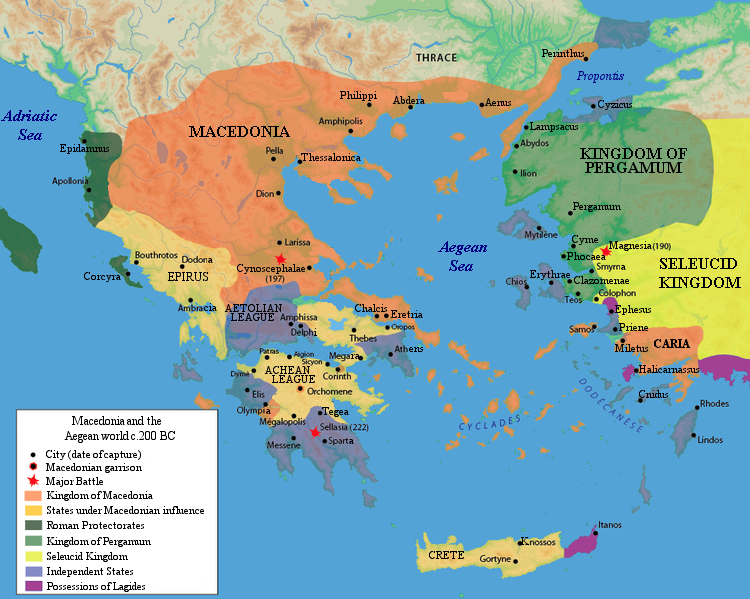
The Hellenistic period began with the wars of the Diadochi, armed contests among the former generals of Alexander the Great to carve up his empire in Europe, Asia, and North Africa. The wars lasted until 275 BC, witnessing the fall of both the Argead and Antipatrid dynasties of Macedonia in favor of the Antigonid dynasty. The era was also marked by successive wars between the Kingdom of Macedonia, the kingdom of Epirus, the Aetolian League, Achaean League, Sparta, Rhodes, kingdom of Pergamum as well as the Seleucid and Ptolemaic empires.
During the reign of Philip V of Macedon (r. 221–179 BC), the Macedonians not only lost the Cretan War (205–200 BC) to an alliance led by Rhodes, but their erstwhile alliance with Hannibal of Carthage also entangled them in the First and Second Macedonian War with ancient Rome. The perceived weakness of Macedonia in the aftermath of these conflicts encouraged Antiochus III the Great of the Seleucid Empire to invade mainland Greece, yet his defeat by the Romans at Thermopylae in 191 BC and Magnesia in 190 BC secured Rome's position as the leading military power in the region. Within roughly two decades after conquering Macedonia in 168 BC and Epirus in 167 BC, the Romans would eventually control the whole of Greece.
During the Hellenistic period the importance of Greece proper within the Greek-speaking world declined sharply. The great centers of Hellenistic culture were Alexandria and Antioch, capitals of Ptolemaic and Seleucid Kingdoms respectively. Cities such as Pergamon, Ephesus, Rhodes and Seleucia were also important, and increasing urbanisation of the Eastern Mediterranean was characteristic of the time.
The quests of Alexander had a number of consequences for the Greek city-states. It greatly widened the horizons of the Greeks, making the endless conflicts between the cities which had marked the 5th and 4th centuries BC seem petty and unimportant. It led to a steady emigration, particularly of the young and ambitious, to the new Greek empires in the east. Many Greeks migrated to Alexandria, Antioch and the many other new Hellenistic cities founded in Alexander's wake, as far away as what are now Afghanistan and Pakistan, where the Greco-Bactrian Kingdom and the Indo-Greek Kingdom survived until the end of the 1st century BC.
The defeat of the Greek city-states by Philip and Alexander also taught them that they could never again be powers in their own right, and that the hegemony of Macedon and its successor states could not be challenged unless the city states united, or at least federated. The Greeks valued their local independence too much to consider actual unification, but they made several attempts to form federations through which they could hope to reassert their independence.
Following Alexander's death a struggle for power broke out among his generals, which resulted in the break-up of his empire and the establishment of a number of new kingdoms. Macedon fell to Cassander, son of Alexander's leading general Antipater, who after several years of warfare made himself master of most of the rest of Greece. He founded a new Macedonian capital at Thessaloniki and was generally a constructive ruler.
Cassander's power was challenged by Antigonus, ruler of Anatolia, who promised the Greek cities that he would restore their freedom if they supported him. This led to successful revolts against Cassander's local rulers. In 307 BC, Antigonus's son Demetrius captured Athens and restored its democratic system, which had been suppressed by Alexander. But in 301 BC a coalition of Cassander and the other Hellenistic kings defeated Antigonus at the Battle of Ipsus, ending his challenge.
Hub AI
Hellenistic Greece AI simulator
(@Hellenistic Greece_simulator)
Hellenistic Greece
Hellenistic Greece is the historical period of Ancient Greece following Classical Greece and between the death of Alexander the Great in 323 BC and the annexation of the classical Greek Achaean League heartlands by the Roman Republic. This culminated at the Battle of Corinth in 146 BC, a crushing Roman victory in the Peloponnese that led to the destruction of Corinth and ushered in the period of Roman Greece. Hellenistic Greece's definitive end was with the Battle of Actium in 31 BC, when Octavian defeated Ptolemaic queen Cleopatra VII and Mark Antony, the next year taking over Alexandria, the last great center of Hellenistic Greece.
The Hellenistic period began with the wars of the Diadochi, armed contests among the former generals of Alexander the Great to carve up his empire in Europe, Asia, and North Africa. The wars lasted until 275 BC, witnessing the fall of both the Argead and Antipatrid dynasties of Macedonia in favor of the Antigonid dynasty. The era was also marked by successive wars between the Kingdom of Macedonia, the kingdom of Epirus, the Aetolian League, Achaean League, Sparta, Rhodes, kingdom of Pergamum as well as the Seleucid and Ptolemaic empires.
During the reign of Philip V of Macedon (r. 221–179 BC), the Macedonians not only lost the Cretan War (205–200 BC) to an alliance led by Rhodes, but their erstwhile alliance with Hannibal of Carthage also entangled them in the First and Second Macedonian War with ancient Rome. The perceived weakness of Macedonia in the aftermath of these conflicts encouraged Antiochus III the Great of the Seleucid Empire to invade mainland Greece, yet his defeat by the Romans at Thermopylae in 191 BC and Magnesia in 190 BC secured Rome's position as the leading military power in the region. Within roughly two decades after conquering Macedonia in 168 BC and Epirus in 167 BC, the Romans would eventually control the whole of Greece.
During the Hellenistic period the importance of Greece proper within the Greek-speaking world declined sharply. The great centers of Hellenistic culture were Alexandria and Antioch, capitals of Ptolemaic and Seleucid Kingdoms respectively. Cities such as Pergamon, Ephesus, Rhodes and Seleucia were also important, and increasing urbanisation of the Eastern Mediterranean was characteristic of the time.
The quests of Alexander had a number of consequences for the Greek city-states. It greatly widened the horizons of the Greeks, making the endless conflicts between the cities which had marked the 5th and 4th centuries BC seem petty and unimportant. It led to a steady emigration, particularly of the young and ambitious, to the new Greek empires in the east. Many Greeks migrated to Alexandria, Antioch and the many other new Hellenistic cities founded in Alexander's wake, as far away as what are now Afghanistan and Pakistan, where the Greco-Bactrian Kingdom and the Indo-Greek Kingdom survived until the end of the 1st century BC.
The defeat of the Greek city-states by Philip and Alexander also taught them that they could never again be powers in their own right, and that the hegemony of Macedon and its successor states could not be challenged unless the city states united, or at least federated. The Greeks valued their local independence too much to consider actual unification, but they made several attempts to form federations through which they could hope to reassert their independence.
Following Alexander's death a struggle for power broke out among his generals, which resulted in the break-up of his empire and the establishment of a number of new kingdoms. Macedon fell to Cassander, son of Alexander's leading general Antipater, who after several years of warfare made himself master of most of the rest of Greece. He founded a new Macedonian capital at Thessaloniki and was generally a constructive ruler.
Cassander's power was challenged by Antigonus, ruler of Anatolia, who promised the Greek cities that he would restore their freedom if they supported him. This led to successful revolts against Cassander's local rulers. In 307 BC, Antigonus's son Demetrius captured Athens and restored its democratic system, which had been suppressed by Alexander. But in 301 BC a coalition of Cassander and the other Hellenistic kings defeated Antigonus at the Battle of Ipsus, ending his challenge.
Recent media