Hubbry Logo
Henry ChalfantHenry ChalfantMain
Open search
Henry Chalfant
Community hub
Henry Chalfant
logo
8 pages, 0 posts
0 subscribers
Be the first to start a discussion here.
Henry Chalfant
Henry Chalfant
from Wikipedia

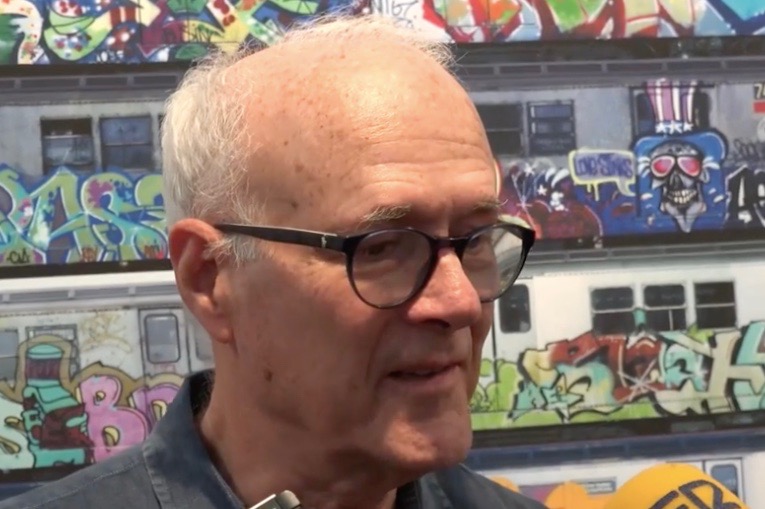
Henry Chalfant (born January 2, 1940) is an American photographer and videographer most notable for his work on graffiti, breakdance, and hip hop culture.

Key Information

One of Chalfant's prints is held in the collection of the Metropolitan Museum of Art in New York City.

Education and career

[edit]

Chalfant is a graduate of Stanford University, where he majored in classical Greek. Starting out as a sculptor in New York City in the 1970s, Chalfant turned to photography and film to do an in-depth study of hip-hop culture and graffiti art. One of the foremost authorities on New York subway art, and other aspects of urban youth culture, his photographs record hundreds of ephemeral, original art works that have long since vanished.[1]

His photographs have appeared in exhibitions of graffiti art from its early appearances in New York/New Wave at P.S.1 Contemporary Art Center to retrospectives such as Art in the Streets at the Museum of Contemporary Art, Los Angeles and City as Canvas: Graffiti Art From the Martin Wong Collection at the Museum of the City of New York, in addition to galleries and museums in the United States, Europe, and Asia.

In 1983, Chalfant co-produced the PBS documentary Style Wars, the seminal documentary about graffiti and hip hop culture.[2] Among Chalfant's other films are Flyin' Cut Sleeves, a documentary about Bronx street gang leaders in the 1970s and Visit Palestine: Ten Days on the West Bank, based on his visit to the occupied territories in 2000. His 2006 documentary From Mambo to Hip Hop: A South Bronx Tale chronicles two generations who grew up on the same blocks of the Bronx, NY, using rhythm as their form of rebellion—for the older generation of the 1950s it was the rhythms of Cuba; for their children of the 1970s it was the rhythms of rap.[3] The film was featured in the Latino Public Broadcasting series Voces in 2006-2007, and won an Alma Award for Best Documentary.

He has co-authored an account of New York graffiti art, Subway Art, and a sequel on the art form's worldwide diffusion, Spraycan Art.

Chalfant has stated his influences are varied:

"In college my mentor was Charles Rowan Beye, the Greek scholar. I really didn't have a mentor for my art work, but I was influenced by great sculptors I admired like David Smith and Eduardo Chillida. For visual anthropology, I was influenced by the ethnographic filmmaker, Jean Rouch."[4]

Chalfant continues to preserve and archive past work, make documentary films, and mentor other filmmakers' work through Public Art Films, a non-profit organization "dedicated to producing films and videos about grassroots cultural expressions."[5]

Henry Chalfant's Big Subway Archive

[edit]

On June 29, 2012, Chalfant released Henry Chalfant's Big Subway Archive as a 200-page book. Produced by Chalfant and Max Hergenrother, it is the first volume of a multi-volume archive comprising his entire collection of subway graffiti photographs. The archive series was renamed Henry Chalfant's Graffiti Archive: New York City's Subway Art and Artists in 2013.[6]

The e-books are published by Sleeping Dog Films, which primarily archives the photographer's over 800 photos of New York City Subway graffiti.[7]

Each book in the series concentrates on a particular group or groups of graffiti artists, with an introduction by Chalfant giving background on the time and place in which the artists worked. These passages also contain non-subway-car photos of the artists or their neighborhoods as well as video interviews with the featured artists. The pictures of the subway cars are actually multiple photos overlapped to show the entire length of the subway car at a direct ninety degree angle.

The first three volumes of the series have been released. Volume 1, CYA and TVS published June 29, 2012; CYA stands for "Crazy Young Artists" and TVS stands for "The Vamp Squad." Volume 2, Rolling Thunder Writers and Soul Artists, published December 7, 2012.[8] Volume 3, TC5 featuring Blade, published July 1, 2013; "TC5" stands for "The Crazy Five" or "The Cool Five."[9]

The series has received generally positive critical support and has generated mild controversy for some interview material, such as graffiti artist Lady Pink's assertion that "The graffiti movement has become a greater thing than the Renaissance."[10] The series also sheds new light on some historical graffiti feuds such as Seen TC5 versus Seen UA.[11]

Exhibitions

[edit]
  • A-Dieci Gallery (1970), Padua
  • 14 Sculptors Gallery (1973), New York
  • Sculptors Guild, Lever House (1974), New York
  • Three Rivers Arts Festival (1977), Pittsburgh
  • O.I.A. (1977) Battery Park, New York
  • 55 Mercer Gallery (1978), New York
  • New York/New Wave (1981) P.S.1 Contemporary Art Center, New York
  • Sculptors Guild (1981) Bronx Botanical Garden, New York
  • Elaine Benson Gallery (1981) Bridgehampton, New York
  • The Comic Art Show (1983) Whitney Downtown, New York
  • Content, a Contemporary Focus 1974-1984 (1984) Hirshhorn Museum, Washington, D.C.
  • Since the Harlem Renaissance: 50 Years of Afro-American Art (1985) Bucknell University, Lewisburg
  • Hip Hop: A Cultural Expression (1999) Rock and Roll Hall of Fame, Cleveland
  • Art of the American Century Part ll (1999) Whitney Museum of American Art, New York
  • Urban Mythologies (1999) Bronx Museum of the Arts, New York
  • Hip Hop (2000) Museum of Pop Culture, Seattle
  • Born in the Streets (2009) Fondation Cartier pour l'Art Contemporain, Paris
  • Art in the Streets (2011) Museum of Contemporary Art, Los Angeles
  • Moving Murals (2014) City Lore Gallery, New York
  • City as Canvas: Graffiti Art From the Martin Wong Collection (2014) Museum of the City of New York
  • 1980 (2016) Eric Firestone Loft, New York
  • Art Is Not A Crime 1977-1987 (2018) CEART Fuenlabrada, Madrid[12]
  • Henry Chalfant: Art vs. Transit, 1977-1987 (2019) Bronx Museum, New York [13]

Chalfant's solo exhibitions also include[14] Maharishi (2002), London; Prosper (2002), Tokyo; Galerie Speerstra (2003, 2006), Paris; Iguapop (2004), Barcelona; Montana Colors (2006), Barcelona; and Cox 18 (2006), Milano.

Personal life

[edit]

He married actress Kathleen Chalfant (née Bishop) in 1966. They have two children: David Chalfant, a record producer and bass player for the folk-rock band The Nields; and Andromache Chalfant, a set designer. The Chalfants live in Brooklyn Heights.[15]

Collections

[edit]

Chalfant's work is held in the following public collection:

References

[edit]
[edit]
Revisions and contributorsEdit on WikipediaRead on Wikipedia
from Grokipedia

Henry Chalfant (born January 2, 1940) is an American photographer, filmmaker, and sculptor renowned for his extensive documentation of New York City subway graffiti and the nascent hip-hop culture during the late 1970s and early 1980s. Originally trained as a sculptor after graduating from Stanford University, Chalfant relocated to New York in 1973 and shifted his focus to photography upon encountering the vibrant, illicit street art adorning subway cars. His work captured the ephemeral nature of this underground movement, preserving images of whole-train masterpieces by pioneering graffiti writers such as Dondi, Futura, and Lee Quiñones before they were buffed or painted over by transit authorities.
Chalfant's innovative technique involved taking sequential photographs from elevated platforms to composite full views of graffiti-covered trains, resulting in an archive exceeding 1,500 images that form a visual record of urban youth expression. He co-authored the seminal book Subway Art with Martha Cooper in 1984, which provided the first comprehensive photographic survey of the phenomenon and influenced its global spread. Additionally, as co-producer and of the 1983 PBS documentary , Chalfant offered an unflinching portrayal of graffiti artists, breakdancers, and DJs, earning the film the Grand Prize at the and cementing its status as a foundational hip-hop document. Beyond graffiti, Chalfant's oeuvre includes books like Spraycan Art (1987) and Training Days (2015), as well as films such as From Mambo to Hop (2006), which earned an for its exploration of cultural evolution. His photographs are held in prestigious collections, including the and the Carnegie Institute, and have been featured in major retrospectives, underscoring his role as a pivotal of street culture's raw, unfiltered vitality.

Early Life and Education

Childhood and Academic Background

Henry Chalfant was born on January 2, 1940, in , a suburb near known for its residential character during the mid-20th century. Raised in a conventional family setting without evident ties to artistic professions, his early years reflected the stability of post-Depression, pre-war American suburbia, with limited documented personal anecdotes from this phase. Chalfant's formative education occurred in local institutions, exposing him to structured academic routines absent indications of nonconformist behaviors or early urban engagements. This period laid groundwork for disciplined intellectual pursuits, aligning with the era's emphasis on formal learning over spontaneous creativity. He pursued higher education at , majoring in classical Greek and graduating with a degree around the early . His coursework emphasized ancient texts, languages, and cultural artifacts, cultivating an affinity for precise, enduring structural forms inherent in Greco-Roman traditions.

Initial Artistic Pursuits

Following his graduation from , where he majored in classical Greek, Chalfant turned to as his primary artistic medium, drawing on the enduring forms and principles of that he had studied extensively. This pursuit represented an extension of his academic focus on classical ideals of proportion, permanence, and material solidity into three-dimensional expression, with works often exploring abstract interpretations of these themes through and other durable media. Chalfant's sculptural production began in earnest around 1968 and continued through the early 1980s, yielding large-scale pieces crafted in dedicated studio spaces. He mounted solo exhibitions featuring these classical-inspired and abstract sculptures, including one at A-Dieci Gallery in , , in 1970, followed by shows at 14 Sculptors Gallery in New York in 1973 and 55 Mercer Gallery in New York in 1978. Despite this gallery exposure, his sculptural endeavors achieved only modest commercial traction in the competitive early scene, where market preferences increasingly favored ephemeral and conceptual works over traditional sculptural permanence, laying groundwork for experimentation with photography as a more accessible medium for capturing dynamic cultural phenomena.

Transition to New York and Sculptural Career

Move to New York City

In 1973, Henry Chalfant moved to from suburban to establish himself as a sculptor after earning a in classical Greek from . The city at the time faced acute economic pressures, including a looming fiscal crisis that nearly led to municipal by 1975, exacerbated by federal aid cuts, , and surging welfare costs that strained budgets and prompted widespread service reductions. This environment of featured rising crime rates—homicides doubled from 1965 to 1975—and crumbling infrastructure, such as abandoned properties and unreliable public transit, which underscored the challenges for newcomers seeking artistic footholds. Chalfant initially concentrated on studio-based , producing works that reflected his early interests in form and material, amid a competitive New York art ecosystem dominated by established galleries and minimalism's aftermath. Aspiring artists grappled with escalating rents in spaces—often illegally converted industrial buildings—and material expenses, compounded by the city's instability that limited institutional support and sales opportunities. Despite these hurdles, Chalfant integrated into emerging creative networks, exhibiting sporadically while honing techniques like , without yet venturing into urban subcultures or public interventions. The fiscal turmoil and social fragmentation indirectly shaped the artistic climate, fostering experimentation in response to institutional neglect, though Chalfant's early efforts remained rooted in traditional sculptural rather than reactive expressions. This period of laid groundwork for his persistence in a precarious market, where economic pressures weeded out many contemporaries but aligned with broader shifts toward accessible, site-responsive art forms.

Sculptural Work and Early Influences

Upon arriving in in 1973, Henry Chalfant established himself as a sculptor, creating works primarily from stone materials such as and . His output during this period, spanning 1968 to 1982, consisted of small-scale, multi-piece assemblages that emphasized precise form and the inherent durability of natural stone, often requiring careful fitting of components to achieve structural integrity. These pieces reflected a commitment to material permanence and sculptural fundamentals, drawing on the tactile and enduring qualities of the medium rather than ephemeral or conceptual experimentation. Chalfant's approach was shaped by his academic background in classical Greek at , where he studied under scholar Charles Rowan Beye, and subsequent travels in that exposed him to ancient Roman and Greek statuary. This led to sculptures incorporating classical motifs, such as balanced proportions and volumetric clarity, adapted into modern, abstracted forms executed in softer stones like for feasibility in studio fabrication. He exhibited solo at 14 Sculptors Gallery in New York in 1973, of which he was a founding member, and at 55 Mercer Gallery in 1978, alongside group shows including the annual Sculptors Guild exhibitions at from 1974 to 1983. Despite these presentations in New York galleries during the 1970s, Chalfant encountered professional challenges, including the solitary nature of studio-based and limited market traction amid a scene favoring conceptual and installation practices over traditional media. This stagnation prompted him to experiment with as a complementary and more immediate expressive outlet, leveraging its accessibility to capture and explore three-dimensional subjects without the physical demands of .

Discovery and Documentation of Graffiti

Initial Encounters with Subway Graffiti

Chalfant, having relocated to in 1973 as a practicing sculptor, first took notice of subway graffiti in earnest around amid the city's pervasive , including widespread abandonment and fiscal crisis that characterized the . While commuting via elevated tracks in uptown or scouting potential sites for his own installations, he encountered trains fully covered in elaborate paintings, an unplanned observation that piqued his interest in their monumental scale and transient quality, as the works vanished quickly due to routine cleaning by transit authorities. Approaching the phenomenon initially as a visual artist rather than a , Chalfant perceived the as uncommissioned, bold assertions of creativity in a blighted environment marked by economic hardship and social neglect, distinct from commissioned . The paintings' impermanence—often lasting only days before buffing—contrasted with traditional sculpture's durability, yet their mobility across the city amplified their visibility and challenge to authority. His earliest photographs documented entire train cars transformed by writers such as Seen, whose mechanical-style tags and pieces emerged prominently by the mid-1970s, and , known for sophisticated lettering on whole sides. These images, captured spontaneously with a 35mm camera from station platforms, lacked any systematic archival ambition at the outset, serving instead as personal records of striking urban visuals encountered serendipitously.

Photographic Methodology and Archive Development

Chalfant developed a methodical technique for photographing entire graffiti-covered subway cars, using a 35mm camera to take rapid successive exposures from multiple positions along station platforms, enabling the assembly of composite panoramas that captured full-train compositions. This empirical approach prioritized comprehensive documentation of the artwork's scale and context over isolated aesthetic framing, often involving quick movements alongside passing trains to seize fleeting opportunities before the vehicles departed. He focused on elevated tracks at uptown and stations for optimal vantage points, supplemented by occasional access to train yards and depots, including nocturnal expeditions to secure unobstructed views of stationary cars. Between 1977 and 1987, this yielded an archive exceeding 1,500 images of hundreds of whole cars, systematically recording pieces that the routinely buffed or overpainted, thereby countering the rapid ephemerality of the medium. Chalfant cultivated trust with graffiti writers through non-evaluative engagement, such as hosting them at his studio to review contact sheets, which facilitated informal tips on train locations without implying endorsement of illegal activities. This relational dynamic supported the expansion of his "Big Subway Archive" into a dedicated repository of unaltered visual data, emphasizing preservation of the raw, site-specific causality of 's production and erasure cycles over interpretive narrative.

Key Publications and Films

Subway Art (1984)

Subway Art, co-authored by Henry Chalfant and Martha Cooper, was published in 1984 as a photographic documentation of graffiti from the late 1970s and early 1980s. The book features over 150 images capturing the spectrum of graffiti forms, including simple tags, quick throw-ups, and elaborate whole-car masterpieces executed by writers using spray paint on train exteriors. These visuals illustrate the progression from rudimentary signatures to sophisticated murals incorporating lettering, three-dimensional effects, and thematic illustrations, often applied under cover of night to evade authorities. Interviews with prominent graffiti writers in the book reveal self-taught techniques honed through , such as layering colors for depth and using fat caps for broad coverage, without formal training or institutional support. Writers described iterating designs on paper before executing them on moving targets like subway cars, emphasizing speed and visibility in high-risk environments. This evolution occurred amid New York City's fiscal crisis and infrastructure decay, where abandoned buildings and underfunded public services created canvases for expression amid perceived urban neglect. While portraying graffiti as a creative outlet responding to socioeconomic conditions, the book acknowledges the practical burdens, including the Metropolitan Transportation Authority's annual multimillion-dollar expenditures on buffing and repainting defaced trains during the . From 1972 to 1989, such cleanup and prevention efforts totaled hundreds of millions of dollars, reflecting the tension between artistic innovation and the tangible costs of in a strained transit system.

Style Wars (1983) and Other Documentaries

Chalfant co-produced the 1983 PBS documentary Style Wars with Tony Silver, which documented the nascent hip-hop culture in New York City through raw footage of graffiti writing, breakdancing, and rapping. The film captured young artists, primarily Black and Latino teenagers from low-income neighborhoods, engaging in these activities amid the city's fiscal crisis and urban decay of the early 1980s. Filming occurred in the Bronx and Manhattan, including subway yards, uptown streets, playgrounds, and clubs, highlighting unscripted scenes of defiance against authority, such as police pursuits and transit authority crackdowns. A central figure in the graffiti segments was , a teenage writer whose relentless "bombing"—rapid, aggressive tagging of subway trains—exemplified the movement's confrontational edge, prioritizing volume and visibility over stylistic refinement. featured the Rock Steady Crew performing acrobatic routines in outdoor spaces, while rapping showcased groups like and the Furious Five freestyling over beats, all presented without narrative overlay or later commercialization. This approach preserved the subculture's pre-mainstream authenticity, avoiding romanticization and instead conveying the immediate risks and improvisational energy of the era. In subsequent short films, Chalfant explored hip-hop's foundational elements, such as All City (1983), which he directed as an extension of planned youth programming on graffiti and street culture, featuring writers demonstrating techniques at venues like the Bronx's Fashion Moda gallery alongside b-boying and rap performances. These works, like Style Wars, emphasized documentary immediacy over polished storytelling, focusing on the organic development of hip-hop practices before widespread media influence.

Exhibitions, Collections, and Later Career

Major Exhibitions

Chalfant's photographs from the Subway Art era first gained prominence in New York gallery shows during the mid-1980s, coinciding with the 1984 publication that helped legitimize as an art form, though these were often group s rather than solo s. A landmark solo , "Henry Chalfant: Art vs. Transit, 1977-1987," opened at the of the Arts on September 25, 2019, and ran through March 8, 2020, marking the first major U.S. of his work. The show featured large-scale prints and composites from his archive documenting ephemeral subway by artists such as , Seen, and Futura 2000, many of which were destroyed during the Metropolitan Transportation Authority's clean-up campaigns. It included elevated train car facsimiles and video footage to recreate the urban context, emphasizing the tension between and artistic expression. In 2023, Speerstra Gallery in hosted "Trainspotter: Selected Works 1980-2023," presenting curated selections from Chalfant's decades-spanning documentation of train evolution. Eric Firestone Gallery mounted "Henry Chalfant: 1980" in New York, displaying approximately 150 photographs of peak-era subway cars, including previously unpublished images that captured the density and style of whole-car bombings during New York City's fiscal crisis. More recently, "The Epic Story of " debuted at Birmingham's from May 30 to June 29, 2025, as part of hip-hop anniversary programming, showcasing Chalfant's subway train photographs alongside Style Wars screenings to trace graffiti's roots in 1970s culture. The free exhibition highlighted lost artifacts of street art's global influence, drawing crowds to view panels of tagged trains that symbolized rebellion amid .

Archival Collections and Recent Projects

Chalfant's photographic archive, comprising over 1,500 images of graffiti primarily from the late 1970s and early 1980s, has been institutionalized through acquisitions by major collections, including the Smithsonian Institution's Community Museum, which holds the "Henry Chalfant Subway Graffiti Series Photographs" series of chromogenic coupler prints documenting whole cars and sequences of tagged trains. These holdings, gifted via the trustees, preserve ephemeral works by artists such as SHY, KEL, CRASH, VANDAL, and FRITOS, emphasizing Chalfant's methodical "in sequence" capture technique developed during daily commutes. Additional portions reside in permanent collections at institutions like the Eric Firestone Gallery, which exclusively represents his graffiti archive. Public access to the archive is facilitated through Chalfant's official website, henrychalfant.com, which hosts digitized selections alongside contextual materials on evolution. A key preservation milestone occurred in with the release of Henry Chalfant's Big Subway Archive as interactive iBooks, digitally restoring and presenting nearly 1,000 full-train photographs in galleries organized by artist, line, or era, countering the physical decay of the original subway art. Post-2010 projects have emphasized digital expansion and hip-hop cultural . Chalfant contributed to collaborative efforts like the Hip Hop Museum's archival initiatives, providing imagery and expertise for exhibits tracing 's role in early hip-hop, as highlighted in 2025 discussions on platforms such as interviews revisiting . His ongoing videography adapts to post-vandalism shifts toward sanctioned , with recent outputs including footage for documentaries that document legal murals and global adaptations, though specific titles remain tied to broader hip-hop preservation rather than standalone releases.

Impact and Reception

Contributions to Hip-Hop and Graffiti Legitimization

Chalfant's extensive photographic documentation of New York City subway graffiti from 1977 to 1987 created a comprehensive visual archive that preserved thousands of ephemeral works erased by the Metropolitan Transportation Authority's (MTA) buffing campaigns, which repainted train cars white to eliminate tags and murals almost immediately after application. This record countered the MTA's narrative framing graffiti solely as vandalism by evidencing its scale, stylistic evolution, and cultural significance within hip-hop's broader ecosystem of breakdancing, DJing, and MCing. By capturing whole-train "pieces" and "burners" before their destruction, his images provided empirical proof of artistic innovation amid urban decay, enabling later verification of writers' outputs that would otherwise lack tangible remnants. The 1984 publication of Subway Art, co-authored with Martha Cooper and featuring Chalfant's photographs alongside Cooper's, disseminated this archive internationally, selling over 100,000 copies and inspiring graffiti's global proliferation from to by the mid-1980s. Often termed the "bible of graffiti," the book shifted perceptions by presenting subway art as a coherent aesthetic movement rooted in hip-hop subculture, facilitating its study in and rather than . Exports of the work via translations and reprints exposed non-New York audiences to verifiable examples, correlating with the rise of legal graffiti walls and international crews emulating styles like wildstyle lettering. Chalfant's documentation supplied for graffiti writers seeking gallery representation post-1984, as curators and collectors referenced his to authenticate and value pieces no longer extant on , aiding transitions to sanctioned exhibitions and commercial markets. In hip-hop legitimization, his co-production of the 1983 documentary —which integrated visuals with and breaking—provided early cinematic evidence of the culture's interconnected elements, influencing institutional recognition by preserving block-party scenes and train yards as sites of communal creativity over illicit disruption. This archival role empirically bridged subcultural practice to mainstream discourse, with his images cited in academic texts as foundational data for analyzing hip-hop's emergence from marginalized and communities.

Criticisms and Debates on Vandalism vs. Art

Chalfant's documentation of subway , particularly through his photographs and co-production of the 1983 documentary , fueled ongoing debates over whether such work constituted or , with officials viewing it as the latter. The classified as , expending an estimated $6 million annually by 1980 on removal efforts alone, a figure that contributed to broader citywide spending of hundreds of millions of dollars from 1972 to 1989 to eradicate it from public infrastructure. Transit authorities, including those under Mayor , expressed hostility toward portrayals that highlighted bombers and taggers evading cleanup crews, arguing that visibility incentivized further illegal activity rather than fostering neutral archival value. Critics contended that Chalfant's emphasis on the skill hierarchies—from rudimentary tags to complex "pieces"—romanticized what empirical data framed as a precursor to broader disorder, with internal NYCTA police studies indicating the graffiti subculture served as a training ground for future adult offenders. While proponents, including Chalfant himself, noted divided audience reactions—with roughly half embracing it as innovative expression and the other half rejecting it as defacement—detractors prioritized causal links to urban decay signals over cultural narratives of resistance. This perspective held that archiving ephemeral illegal acts, without equivalent emphasis on enforcement costs or property rights violations, indirectly enabled proliferation by elevating perpetrators' notoriety. Legal status reinforced the vandalism classification, as graffiti on public transit violated New York Penal Law provisions against criminal mischief, treating even elaborate works as non-consensual alterations rather than protected speech. Debates persist on whether such demystifies hierarchies of technique or glosses over externalities like taxpayer burdens and safety risks from obscured signage, with truth-seeking analyses favoring data on abatement economics over subjective aesthetic validations.

Personal Life

Family and Residence

Henry Chalfant has been a resident of since 1973, when he relocated there with his wife, actress , and their two young children to establish a sculpture studio while she pursued acting opportunities. The couple, married since 1966, have maintained a stable family life in the city without notable public disruptions or scandals. Their children include son David Chalfant, a and formerly with the folk-rock band The Nields, and daughter Andromache Chalfant, a set designer based in New York. Chalfant kept his personal affairs distinct from the high-risk urban youth culture he documented, prioritizing family stability over immersion in the graffiti and hip-hop scenes' associated dangers.

Ongoing Involvement in Urban Culture

In recent years, Chalfant has maintained active engagement with through interviews and public discussions, emphasizing the historical documentation of as a cultural phenomenon rather than an endorsement of contemporary illegal practices. In August 2025, he appeared on the Living Proof Radio podcast (Episode 216), where he reflected on the evolution of New York City's graffiti scene from the 1970s and 1980s, discussing its artistic innovation alongside the practical challenges it posed for public infrastructure. Similarly, in a May 2025 conversation with artist , Chalfant addressed the legacy of and subway art, underscoring the tension between graffiti's creative merit and its status as unauthorized activity that imposed cleanup costs on taxpayers, estimated in the millions annually for during the peak era. Chalfant's approach prioritizes archival preservation via and , capturing ephemeral works before their removal without advocating for renewed . He has noted that while was inherently illegal—"Sure, it was illegal"—its documentation helped legitimize it as through empirical records rather than through permissive policies. This stance aligns with his consistent focus on factual chronicling, as seen in his August 2025 interview with , where he discussed early hip-hop elements like and tagging without evidencing shifts toward politicized or idealized narratives of . Ongoing projects, including contributions to exhibitions like The Epic Story of in 2025, further demonstrate his commitment to sustaining access to these records for educational purposes.

References

Add your contribution
Related Hubs
User Avatar
No comments yet.