


Community hub
Recent from talks
Contribute something
Nothing was collected or created yet.
Hero of Israel
View on Wikipedia | This article needs additional citations for verification. (November 2020) |

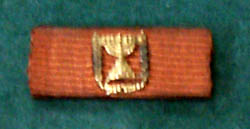
Hero of Israel (Hebrew: גיבור ישראל) is an Israeli military decoration that was awarded during the War of Independence.[1] When the IDF was first established in May 1948, a system of decorations had not yet been instituted, but many soldiers who had distinguished themselves in battle were recommended by their officers for awards. The army command installed a committee to decide on a system of decorations, and a contest was written out for the public to design medals. However, after more than a year, no decisions had been taken and in the summer of 1949 it was decided that, as a "temporary solution", 12 decorations would be awarded to a selection of soldiers who were representative for the different IDF units and who had distinguished themselves by the highest level of heroism.
The award ceremony was held on July 17, 1949. After a military parade, Israeli President Chaim Weizmann, Prime Minister David Ben-Gurion and IDF Chief of Staff Yaakov Dori awarded the decoration to the recipients or their dependents (four awards were given posthumously).
After this ceremony, the committee continued to work on a system of decorations, but it was never brought to a solution and so the Hero of Israel ribbon was never awarded again. Instead, in 1970 it was replaced with the Medal of Valor. All recipients of the Hero of Israel automatically received the Medal of Valor as well.
Design
[edit]The decoration is designed in the form of a red ribbon bar, charged with a clasp of the Israeli coat of arms made of gold.
Recipients
[edit]| Photo | Name | Rank | Conflict | Place of action | Date of action | Notes |
|---|---|---|---|---|---|---|
 |
Yair Racheli | Private | War of Independence | Near Shefa-'Amr | 19 Jan 1948 | Received the medal for destroying an enemy position |
 |
Emmanuel Landau | Private | War of Independence | Kiryat Motzkin | 17 Mar 1948 | Received the medal for capturing an enemy supply truck |
 |
Abraham Avigdorov | Private | War of Independence | Kiryat Motzkin | 17 Mar 1948 | Received the medal for destroying two enemy Bren machine gun positions |
 |
Zerubavel Horowitz | Second Lieutenant | War of Independence | Road to Jerusalem | 27 Mar 1948 | Received the medal for covering the retreat of his comrades from an enemy attack |
 |
Yizhar Armoni | Private | War of Independence | Nabi Yusha | 20 Apr 1948 | Received the medal for covering the retreat of his comrades and evacuation of wounded soldiers |
.jpg) |
Emil Brig | Sergeant | War of Independence | Kibbutz Gesher area | 14 May 1948 | Received the medal for blowing up a bridge and thus preventing the enemy from advancing |
 |
Zvi Zibel | Airman | War of Independence | Ben Shemen | 25 Jun 1948 | Received the medal for delivering supplies to the besieged Ben Shemen while under heavy enemy fire |
 |
Ben-Zion Leitner | Private First Class | War of Independence | Iraq Suwaydan | 19 Oct 1948 | Received the medal for destroying enemy bunkers during the Battles of the Separation Corridor |
 |
Ron Feller | Sergeant | War of Independence | Karatiyya | 19 Jul 1948 | Received the medal for destroying an enemy tank in the Battle of Karatiyya |
 |
Yohai Ben-Nun | Captain | War of Independence | Mediterranean Sea | 22 Oct 1948 | Received the medal for sinking the Egyptian Navy flagship |
 |
Siman-Tov Ganeh | Private | War of Independence | Iraq Suwaydan | 9 Nov 1948 | Received the medal for covering the retreat of his comrades |
 |
Arieh Atzmoni | Master Sergeant | War of Independence | Rafah | 4 Nov 1948 | Received the medal for rescuing a cannon from enemy hands |
References
[edit]- ^ "On the history of the Decoration "Hero of Israel"". www.israelidecorations.net. Archived from the original on March 14, 2012. Retrieved 9 November 2020.


Hero of Israel
View on GrokipediaThe Hero of Israel (Hebrew: Gibor Yisrael, גִּבּוֹר יִשְׂרָאֵל) was Israel's inaugural and highest military decoration, bestowed solely during the 1948 Arab–Israeli War to recognize unparalleled acts of valor exhibited by soldiers in direct confrontation with enemy forces, often under conditions of severe numerical and material disadvantage.[1][2]
Established amid the nascent Israel's struggle for survival against invading Arab armies, the award criteria demanded "supreme heroism in combat facing the enemy while risking one's life," as articulated in official commendations for recipients who single-handedly neutralized fortified positions, rescued comrades under fire, or turned the tide of engagements through individual initiative.[2][3]
On 17 July 1949, precisely twelve individuals—comprising both living and posthumous honorees—received the distinction from Prime Minister David Ben-Gurion and President Chaim Weizmann during a ceremonial parade marking the first anniversary of the Israel Defense Forces (IDF).[2][3]
Notable recipients included Avraham Avigdorov, who stormed and captured a heavily defended Arab outpost in Ramle despite sustaining multiple wounds, and Zerubavel Horowitz, who led a desperate breakout from an encircled convoy under intense enemy assault.[3][4]
In 1970, the Hero of Israel was formally superseded by the Medal of Valor (Itur HaGvura), which adopted equivalent standards but extended eligibility to subsequent conflicts, with prior awards retroactively aligned to the new nomenclature by 1973.[1][3]
Historical Context
Establishment During the War of Independence
The Hero of Israel award was established by David Ben-Gurion, Israel's first prime minister, as the highest military honor for acts of exceptional valor during the War of Independence, which spanned from late 1947 to early 1949.[5][6] This decoration emerged amid the Yishuv's desperate defense against irregular Arab forces and subsequent invasions by regular armies from Egypt, Jordan, Syria, Iraq, and Lebanon, aimed at thwarting the nascent state's survival following its declaration on May 14, 1948.[7] Ben-Gurion instituted the award to acknowledge unprecedented bravery in battles characterized by stark asymmetries: Jewish forces, initially numbering around 35,700 in the Haganah (including Palmach elite units), confronted Arab irregulars and invading armies that held local numerical edges—often 2:1 in manpower during key engagements—and exploited a British-enforced blockade that induced acute shortages of arms and supplies until clandestine acquisitions bolstered defenses.[8][7] The IDF recommended over 1,200 soldiers for recognition, but Ben-Gurion, emphasizing restraint to avoid diluting the honor's prestige, pared the list to just 12 recipients, all from pre-state militias like the Haganah and Palmach, underscoring the improvised, unified structure of Jewish defense prior to formal IDF formation on May 26, 1948.[5][9] These selections highlighted individual sacrifices in operations that defied overwhelming odds, such as isolated hilltop defenses and convoy breakthroughs essential to sustaining besieged settlements.[6] The awards were formally presented on July 17, 1949, marking the capstone of recognition for the war's foundational heroism.[6]Role in Pre-State and Early IDF Formations
The Hero of Israel award emerged amid the clandestine operations of pre-state Jewish defense organizations, including the Haganah, Irgun, and Lehi, which faced existential threats without sovereign backing or reliable arms supplies due to international embargoes imposed by powers like the United States and Britain.[10][8] These militias conducted irregular warfare, often defensive in nature against Arab attacks, where individual heroism compensated for disparities in manpower and equipment, as seen in early 1948 clashes like the defense of kibbutzim.[11] Following Israel's declaration of independence on May 14, 1948, and the unification of these groups into the Israel Defense Forces (IDF) on May 26, 1948, the award transitioned from informal recognition of underground valor to a statutory military honor, with David Ben-Gurion formalizing its criteria for acts that decisively influenced battle outcomes during the War of Independence.[12] Recipients, such as Yair Racheli for pre-IDF engagements, exemplified this bridge, as their exploits in militia units were retroactively validated under IDF auspices despite the irregular, resource-scarce context.[11][13] The award's application extended to pivotal early battles, including the April 1948 defense of Degania Alef against Syrian forces, where small Haganah detachments repelled superior armored assaults through improvised tactics, and the Jerusalem convoys and sieges, where isolated acts like Avraham Avigdorov's solo penetration of enemy lines on May 28, 1948, shifted tactical momentum amid blockade-induced shortages.[13] Its stringent threshold—limited to 12 initial living recipients awarded on July 17, 1949—reflected the war's framing as a desperate defense against coordinated Arab invasion aimed at annihilation, prioritizing only those whose beyond-duty actions averted catastrophe rather than routine combat valor.[12][6] Post-armistice in 1949, the Hero of Israel was not extended beyond the founding conflict, as the IDF evolved into a formalized peacetime institution with structured hierarchies and procurement channels, rendering the ad-hoc heroism emblematic of militia-era survival obsolete for subsequent operations; it was supplanted in 1970 by the Medal of Valor to accommodate ongoing threats without diluting the original's existential rarity.[11] This causal shift underscored how the award's design inherently tied recognition to the irregular necessities of state formation, distinct from later conventional warfare paradigms.[12]Design and Symbolism
Physical Characteristics
The Hero of Israel medal consists of a bronze disc with a diameter of 40 mm, suspended from a ribbon in blue and white stripes evocative of the Israeli flag.[1] The obverse depicts a central Magen David surrounded by a laurel wreath.[1] The reverse features the inscription "גיבור ישראל" in Hebrew lettering.[1] Weighing approximately 30 grams, the medal was engineered for practical field wear amid material shortages during its production era.[1] Minting occurred in limited quantities under the exigencies of wartime conditions in 1949.[1] Surviving specimens are housed in institutions such as Yad La-Shiryon, the Armored Corps Memorial and Museum at Latrun.Emblematic Elements and Meanings
The Magen David at the core of the Hero of Israel award embodies the Jewish heritage of self-defense, originating from biblical accounts of King David's victories over Philistine forces and extending to Zionist paramilitary organizations like the Haganah, which protected Jewish settlements during the British Mandate period against Arab riots and pogroms.[14] This symbol underscores a causal continuum of resilience, where armed defense was essential for communal survival prior to statehood, countering narratives that downplay martial necessity in Jewish historical agency. Encircling or accompanying elements, such as motifs evoking laurel wreaths in broader martial iconography, signify victory attained against overwhelming adversaries, as evidenced by Israel's repulsion of coordinated invasions by armies from Egypt, Jordan, Syria, Iraq, and Lebanon in the 1948 War of Independence, despite numerical and logistical disadvantages.[15][16] This triumph, achieved through individual acts of extraordinary valor, directly enabled the consolidation of sovereignty from fragmented mandate-era defenses to a defended nation-state.[17] The ribbon design, incorporating hues resonant with the Israeli flag's blue and white stripes, links the honor to national identity forged via sacrificial combat, affirming that state-building required not abstract diplomacy but empirical demonstration of defensive capability amid existential conflict. These elements collectively reject interpretations minimizing heroism's role, instead highlighting its foundational place in the causal chain from pre-state revolts—such as the 1936-1939 Arab Revolt countermeasures—to enduring independence.Award Criteria and Process
Eligibility and Standards of Valor
The Hero of Israel decoration recognized acts of exceptional personal valor during the 1948 Arab-Israeli War, limited to those demonstrating direct, measurable contributions to unit survival or battlefield success amid overwhelming odds. Qualifying actions typically involved individual initiatives, such as lone assaults on enemy positions outnumbering the actor by significant margins or extraction of wounded personnel under sustained hostile fire, where the outcome empirically prevented unit annihilation or enabled tactical reversals.[18] Such feats exceeded the thresholds for subordinate honors like citations for gallantry, demanding verifiable evidence of life-risking conduct that altered combat dynamics beyond routine bravery.[1] Awards necessitated corroboration via multiple eyewitness accounts and superior officer validations, prioritizing causal links between the act and preserved forces or neutralized threats over mere intent or exposure to danger. This empirical standard distinguished it from the later Medal for Operational Gallantry, which honors collective mission excellence rather than singular, high-mortality interventions in fluid engagements. Posthumous conferral predominated, with 10 of the 12 decorations issued to fallen soldiers, reflecting the disproportionate lethality of isolated heroics in Israel's resource-scarce, outnumbered defenses.[18][11][1] Selection adhered strictly to meritocratic evaluation, independent of affiliations with pre-state militias such as Haganah, Palmach, or others, ensuring distribution reflected operational impact across integrated forces rather than factional preferences. This apolitical framework countered narratives alleging preferential treatment for socialist-leaning groups, as validations drew from unified command assessments post-1948.[18]Selection and Presentation Procedures
Nominations for the Hero of Israel award originated from field commanders within the Haganah and early Israel Defense Forces (IDF), who submitted recommendations for acts of exceptional valor during combat operations in the War of Independence.[5] These were escalated through the chain of command for review by senior IDF officers, with final approval resting with Prime Minister and Defense Minister David Ben-Gurion, who imposed strict criteria limiting awards to deeds that directly secured battlefield victories.[5] Ben-Gurion personally reduced an initial list of proposed recipients from hundreds to just 12, prioritizing empirical impact over broader recognition to maintain focus amid ongoing resource constraints and operational demands.[5] The review process relied on ad-hoc evaluations by military panels under the nascent Ministry of Defense, emphasizing verifiable eyewitness accounts and tactical outcomes rather than posthumous or symbolic gestures, which facilitated rapid decisions in a wartime environment lacking formalized bureaucracy.[13] This expedited mechanism aimed to sustain troop morale by acknowledging proven contributions without delay, though no dedicated pension or financial benefits accompanied the initial awards. By the signing of the armistice agreements in 1949—beginning with Egypt on February 24 and concluding with Syria on July 20—only these 12 citations had been approved, reflecting the deliberate restraint in distribution.[5][6] Presentations occurred through formal ceremonies rather than impromptu field events, with the primary event held on July 17, 1949, in Tel Aviv following a military parade.[6] Prime Minister Ben-Gurion, alongside President Chaim Weizmann and IDF Chief of Staff Yaakov Dori, personally conferred the decorations to the recipients, eight of whom attended in person despite lingering hostilities and logistical challenges from the recent war.[9] This timing, just days before the final armistice, underscored the procedural efficiency in transitioning from combat validation to official recognition, without elaborate protocols that might have prolonged the process.Recipients
Complete List and Statistics
The Hero of Israel award was bestowed upon 12 individuals for acts of exceptional valor during the 1948 War of Independence, symbolizing the highest recognition of military heroism in Israel's formative conflict. These awards, later retroactively equivalent to the Medal of Valor, were limited to this number by decision of Prime Minister David Ben-Gurion to evoke the Twelve Tribes of Israel, emphasizing collective sacrifice over proliferation of honors. All recipients demonstrated initiative and self-sacrifice in direct combat against superior enemy forces, often turning the tide in critical engagements.[19][11] Statistical analysis reveals that 10 of the 12 awards (83%) were conferred posthumously, underscoring the lethal risks undertaken in asymmetric warfare where Israeli forces frequently faced numerically superior Arab armies. Recipients predominantly served in infantry roles within pre-state militias like the Palmach or early IDF brigades such as Givati, Golani, and Yiftach, reflecting the ground-centric nature of the conflict. Actions occurred across diverse fronts, from Galilee skirmishes against local militias to southern assaults on Egyptian columns in the Negev, illustrating broad geographic distribution amid multi-front invasions by Egypt, Jordan, Syria, and Iraq. As of 2023, Yair Racheli remains the sole surviving recipient.[19][11]| Name | Date and Location/Unit | Act Summary | Status |
|---|---|---|---|
| Avraham Avigdorov | 17 March 1948, Kiryat Motzkin/Givati Brigade | Single-handed grenade assault disabling Egyptian tank amid invading column | Posthumous |
| Yair Racheli | 19 January 1948, near Shefa-Amr/Palmach | Charged and silenced enemy machine-gun nest with grenade, enabling advance | Living |
| Emmanuel Landau | 17 March 1948, Kiryat Motzkin/Givati Brigade | Repelled attackers in close-quarters defense of outpost against Egyptian forces | Posthumous |
| Zerubavel Horowitz | April 1948, road to Jerusalem/Harel Brigade | Led ambush disrupting Jordanian supply lines in vital corridor battle | Posthumous |
| Yizhar Armoni | 20 April 1948, Nabi Yusha/Golani Brigade | Held position against Syrian assault, preventing flank penetration | Posthumous |
| Emil Brig | 14 May 1948, Kibbutz Gesher area/Palmach | Defended bridgehead under heavy fire from Iraqi troops crossing Jordan River | Posthumous |
| Simantov Ganeh | May 1948, Latrun/Yiftach Brigade | Cleared enemy strongpoints in armored clash, sustaining severe wounds | Posthumous |
| Yohai Ben-Nun | 1948, Galilee front/Palmach | Coordinated infantry counterattack repelling Syrian incursion | Posthumous |
| Zvi Siebel | 1948, central front/Golani Brigade | Disrupted enemy reinforcements in key defensive stand | Posthumous |
| Ron Feller | 1948, northern sector/Palmach | Neutralized threats in ambush operation against irregular forces | Posthumous |
| Arie Azmoni | 1948, southern front/Givati Brigade | Advanced under fire to secure position against Egyptian advance | Posthumous |
| Ben-Zion Leitner | 1948, Jerusalem area/Harel Brigade | Protected convoy route through hostile territory via bold maneuvers | Posthumous |
Profiles of Notable Recipients
Avraham Avigdorov, a private in the Palmach's 1st Battalion, earned the Hero of Israel on July 17, 1949, for his role in an ambush near Kiryat Motzkin on March 17, 1948, where he eliminated two Bren machine gun positions defending an enemy weapons convoy and damaged several vehicles, preventing their advance despite sustaining injuries.[20][13] This action disrupted Arab irregulars' reinforcement efforts in the Galilee during the civil war phase, bolstering Jewish defensive lines against coordinated attacks on settlements. Avigdorov's initiative under fire exemplified individual valor that compensated for numerical disadvantages, directly aiding the retention of strategic positions vital to early state consolidation. Yair Racheli, a private and Palmach veteran, was the first recipient of the Hero of Israel, awarded for silencing an enemy machine gun position near Shefa-'Amr on January 19, 1948, by hurling a hand grenade into it amid heavy fire during a pre-state operation.[11][21] His rapid engagement neutralized a key threat, allowing his unit to press forward and secure the area against local Arab forces' ambushes, which were part of broader efforts to isolate Jewish communities before the British withdrawal.[12] Racheli's persistence in such early skirmishes helped maintain open routes for supplies and mobilization, countering attrition tactics that could have undermined the nascent IDF's formation. Zerubavel Horowitz, a second lieutenant and Palmach commander, received the award posthumously for his actions on March 27, 1948, during the convoy to Kfar Etzion on the Jerusalem road, where his vehicle was isolated and set ablaze by Molotov cocktails; he held off attackers single-handedly, covering the retreat of wounded comrades until overwhelmed.[6][22] This sacrifice preserved personnel and morale in a critical supply mission amid the siege of Jerusalem, staving off total encirclement and enabling subsequent breakthroughs that secured the corridor for territorial viability.[23] Emil Brig, a sergeant from a non-Palmach unit, was honored for demolishing a bridge in the Kibbutz Gesher area on May 14, 1948, as invading forces advanced, thereby halting their momentum and buying time for defenders to reorganize against the Syrian incursion into the Jordan Valley.[24][9] Brig's engineering under combat pressure exemplified tactical denial that prevented deeper penetrations, safeguarding the eastern frontier and facilitating counteroffensives essential to retaining the Beisan Valley for the nascent state..jpg)Legacy and Impact
Influence on Israeli Military Decorations
The Hero of Israel decoration, instituted for exceptional acts of valor during the 1947–1948 War of Independence, ceased issuance after 1949 with the establishment of the Israel Defense Forces as a professional standing army, reflecting a doctrinal shift from existential, irregular warfare to structured, ongoing defense operations.[1] This transition necessitated a formalized system of military honors adaptable to recurrent conflicts rather than one-off recognitions of foundational survival struggles, as the original award's criteria—demanding unparalleled self-sacrifice amid threats to nascent statehood—proved ill-suited for peacetime training or lower-intensity engagements.[11] In 1970, the Knesset enacted legislation establishing the Medal of Valor (Itur HaGvura) as the IDF's highest decoration, explicitly supplanting the Hero of Israel to elevate the threshold for awards in non-existential scenarios while preserving the emphasis on life-risking heroism against enemy forces.[25] Prior recipients of the Hero of Israel were automatically granted the new medal, ensuring continuity of prestige and retroactive equivalence without diminishing the original's rarity—only 12 Heroes were posthumously or otherwise honored by 1949. The Medal of Valor's criteria, requiring "supreme heroism in combat at the risk of life," directly echoed the Hero's standards but adapted them causally for a conscript-professional force, enabling selective application in operations like the 1973 Yom Kippur War, where 10 medals were awarded for analogous feats amid armored breakthroughs and infantry assaults.[25][11] This evolutionary linkage underscored pragmatic military realism: the Hero of Israel's model informed subsequent tiers like the Medal of Courage (1970), which addressed slightly lesser but still extraordinary valor, fostering a graduated hierarchy that incentivized elite performance without proliferating honors that could erode motivational impact in prolonged service. By 1975, over 40 Medals of Valor had been conferred across conflicts, demonstrating the system's scalability while upholding the undiluted benchmark of existential-risk actions set by its predecessor.[9] The absence of post-Independence Hero awards thus represented not a retreat from heroism but an institutional refinement, prioritizing empirical effectiveness in sustaining combat readiness over symbolic inflation.[26]Cultural and National Significance
The Hero of Israel award embodies the core narrative of Israel's establishment through acts of extraordinary valor amid existential threats during the 1948 War of Independence, where outnumbered forces repelled invasions by multiple Arab armies. This decoration, conferred on only 12 individuals, symbolizes the "few against many" principle that underpins Israeli national resilience, as evidenced by recipient accounts of single-handedly neutralizing enemy positions despite severe odds.[12] Such stories affirm the causal role of individual heroism in securing territorial survival against revanchist adversaries, countering narratives that diminish the 1948 conflict's defensive imperatives.[13] In Israeli collective memory, the award's recipients are venerated during annual Independence Day observances, where their exploits are retold to instill intergenerational appreciation for military sacrifice as foundational to statehood.[11] Yair Racheli, the last surviving honoree as of 2023, exemplifies this enduring legacy through public recountings of his actions in capturing a strategic village, linking foundational bravery to contemporary security imperatives amid persistent hostilities.[12] These narratives, preserved in military histories and veteran testimonies, reinforce cultural norms prioritizing deterrence through demonstrated resolve rather than appeasement. The award's influence extends to broader societal morale, with heroic precedents from 1948 invoked in discussions of national defense ethos, though direct quantitative impacts on enlistment remain anecdotal amid Israel's universal conscription framework.[1] By highlighting empirically verifiable feats—like Avraham Avigdorov's solo assault on Egyptian positions—it sustains a paradigm of unyielding defense, essential for maintaining public cohesion in protracted conflicts.[13]
References
- https://commons.wikimedia.org/wiki/File:YAIR_RACHELI.jpeg