Hubbry Logo
HethelHethelMain
Open search
Hethel
Community hub
Hethel
logo
8 pages, 0 posts
0 subscribers
Be the first to start a discussion here.
Hethel
Hethel
from Wikipedia

Hethel is a small village in the civil parish of Bracon Ash, in the English county of Norfolk.

Key Information

Hethel is located five miles (8.0 km) south-east of the market town of Wymondham, and approximately ten miles (16 km) south of the city of Norwich.

History

[edit]

Hethel's name is of Anglo-Saxon origin and derives from the Old English for heather hill.[1]

In the Domesday Book, Hethel is listed as a settlement of 21 households in the hundred of Humbleyard. In 1086, the village was divided between the estates of Roger Bigod and Judicael the Priest.[2]

Hethel Hall was built in the Seventeenth Century and was demolished in the 1950s.[3]

On 1 April 1935 the parish was abolished and merged with Bracon Ash.[4]

Geography

[edit]

In 1931 the parish had a population of 118.[5]

Hethel is noted for containing the oldest known living hawthorn tree[6] in East Anglia and possibly in the United Kingdom (reputed to be more than 700 years old). Planted in the 13th century, "Hethel Old Thorn" (a specimen of Common Hawthorn, Crataegus monogyna)[1][2] is in the village churchyard, which is classified as the smallest reserve under the care of the British Wildlife Trusts partnership.[3][7]

All Saints' Church

[edit]

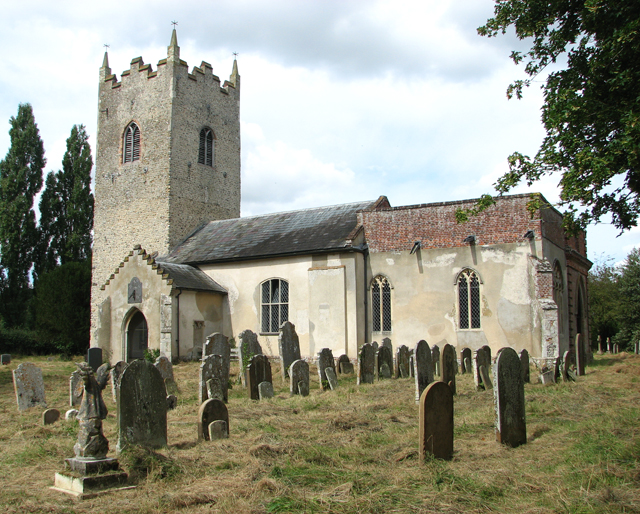
Hethel's church dates from the medieval period. All Saints' is located on Church Road and has been Grade I listed since 1959.[8] All Saints' is no longer open for Sunday service.[9]

All Saints' features an elaborate marble memorial to Miles Branthwaite and his wife, Mary.[10]

Hethel Airfield

[edit]
RAF Hethel in WW2

RAF Hethel was an airfield used by the US during the Second World War, and later by the RAF. Located 7 miles (11 km) south west of Norwich, it was constructed in 1942 for American use and assigned USAAF designation "Station 114". From 14 September 1943 through to 12 June 1945, Hethel served as headquarters for the 2nd Combat Bombardment Wing of the 2nd Bomb Division.

After the departure of the Americans, it was assigned to RAF Fighter Command. On 25 June Polish-manned North American Mustang RAF squadrons moved into the base. In mid-1947, Hethel became a Personnel Transit Centre but was transferred to RAF Technical Training Command. With the downsizing of the RAF, the field was closed in 1948. For many years the base was inactive and abandoned until it was finally sold by the Air Ministry in 1964.

For a number of years the old airfield Nissen huts were used to house families awaiting re-housing under the post-war building programme. Forehoe and Henstead RDC also used part of the area as a store depot. With the end of military control, Hethel became the manufacturing and testing site for Lotus Cars. The manufacture of vehicles, originally started in the old hangars and workshops, now takes place in several modern buildings. Lotus uses parts of the airfield perimeter track and lengths of the main runway as a testing track.

Lotus Cars

[edit]
Interior of the Lotus Cars factory at the former Hethel Airfield.

In 1966 Lotus Cars moved into a purpose built factory on the site of the airfield and developed portions of the runways and taxiways as a test track for their cars. The factory and engineering centres cover 55 acres (22 ha) of the former airfield and use 2.5 miles (4.0 km) of runway. Much of the remaining runways have been removed and returned to agricultural use. The layout can still be seen from aerial photos.

Lotus Europa at the Malaysian Motor Show 2010.

Lotus Cars designs and builds race and production automobiles of light weight and high handling characteristics. Colin Chapman, the founder of Lotus, died of a heart attack in 1982 at the age of 54, having begun life an innkeeper's son and become a multi-millionaire industrialist. The car maker built tens of thousands of successful racing and road cars and won the Formula One World Championship seven times. At the time of his death he was linked with the DeLorean Motor Company scandal over the use of government subsidies for the production of the Delorean for which Lotus had designed the chassis.

In 1986, the company was bought by General Motors. On 27 August 1993, GM sold the company, for £30 million, to A.C.B.N. Holdings S.A. of Luxembourg, a company controlled by Italian businessman Romano Artioli, who also owned Bugatti Automobili SpA. In 1996, a majority share in Lotus was sold to Perusahaan Otomobil Nasional Bhd (Proton), a Malaysian car company listed on the Kuala Lumpur Stock Exchange.

The company also acts as an engineering consultancy, providing engineering development—particularly of suspension—for other car manufacturers. The company's former racing arm, Team Lotus, and the Lotus Driving Academy were/are also based at Hethel.

Governance

[edit]

Hethel is part of the electoral ward of Bracon Ash & Hethel for local elections and is part of the district of South Norfolk.

The village's national constituency is South Norfolk which has been represented by the Labour's Ben Goldsborough MP since 2024.

War Memorial

[edit]

Hethel's war memorial is a wooden and brass plaque inside All Saints' Church which lists the following names for the First World War:[11]

Rank Name Unit Date of death Burial/Commemoration
Capt. Frederic G. Bird DSO Royal Navy 29 Dec. 1919 Chatham
Pte. Frederick W. Gooch 47th (British Columbia) Bn., CEF 18 Oct. 1918 Chapel Corner Cemetery
Pte. Hugh R. Fulcher 1st Bn., Coldstream Guards 29 Oct. 1914 Menin Gate
Pte. Alfred Gooch 5th Bn., Norfolk Regiment 19 Apr. 1917 Jerusalem Memorial

References

[edit]
[edit]
Revisions and contributorsEdit on WikipediaRead on Wikipedia
from Grokipedia
Hethel is a small village in the of Bracon Ash, , , situated approximately five miles southeast of and ten miles south of . It gained prominence as the headquarters and primary manufacturing site for , a British producer, which established its factory and test track there in 1966 on the grounds of the former RAF Hethel airfield, a bomber base used by the ' 389th Bombardment Group. The village features the medieval Church of All Saints, with its possibly Saxon origins and a unique 18th-century , alongside the Hethel Old Thorn, an ancient hawthorn tree dating to the 13th century that forms Norfolk's smallest . Lotus's presence has defined Hethel's modern identity, with the facility renowned for producing lightweight, high-performance vehicles like the series, though recent shifts toward electrification and ownership changes under Chinese conglomerate have prompted workforce reductions exceeding 500 jobs in 2025.

Geography and Demographics

Location and Physical Features

Hethel is a small village and former , now part of the parish of Bracon Ash and Hethel, in the district of , . It is situated approximately 5 miles (8 km) southeast of and 10 miles (16 km) south of , within the Wymondham Settled Plateau Farmland landscape character area, which lies above the 40-meter contour above (AOD) to the southwest of . The village's central coordinates are roughly 52.556° N, 1.184° E. The physical landscape of Hethel features gently undulating plateau terrain characteristic of central Norfolk's arable farmlands, with large open fields, limited hedgerows, and occasional tree lines defining the rural setting. Average elevation in the area reaches about 47 meters (154 feet) above sea level, supporting predominantly agricultural land use interspersed with woodlands such as Hethel Wood. The underlying geology contributes to free-draining soils suitable for crop cultivation, though specific soil profiles vary with local drift deposits typical of the region's glacial till-influenced lowlands. The population of Hethel parish, recorded separately until its administrative merger with Bracon Ash in 1935, showed modest fluctuations in the early 19th century before a steady decline through the late 19th and early 20th centuries, consistent with broader rural depopulation trends in Norfolk driven by agricultural mechanization and urban migration.
Census YearPopulation
1801175
1811173
1821209
1831184
1841211
1851210
1881149
1891149
1901153
1911156
1921145
1931118
Data from UK censuses, aggregated by the Great Britain Historical GIS Project. Following the 1935 merger into Bracon Ash and Hethel parish, population data reflect the combined area, which has remained small and exhibited gradual growth amid limited residential development and proximity to Norwich's commuter influence. The parish recorded 446 residents in the 2001 census, rising to 460 in 2011 and 477 in 2021, representing annual growth rates of approximately 0.3% and 0.4% over those respective decades. This stability contrasts with faster growth in surrounding (14.4% increase from 2011 to 2021), attributable to Hethel's rural character and industrial focus at the former airfield site rather than housing expansion.

Historical Overview

Early Settlement and Medieval Period

The name Hethel derives from hǣðhyll, meaning "heather hill," indicating settlement origins in the Anglo-Saxon period. The village is recorded in the of 1086 as a established settlement in the hundred of Humbleyard, , with 21.5 households equivalent to approximately 108 individuals. In 1086, Hethel's lands were divided between Roger Bigot, who held the larger portion including 13 villagers, 8 freemen, 11 smallholders, and 3 slaves, along with 4 lord's teams, 3.5 men's teams, 16 acres of , for 60 pigs, 2 mills, and 1 church; and Judicael the , who held a smaller estate with 2 villagers, 2 smallholders, 1 lord's team, 0.5 men's teams, 3 acres of , and for 4 pigs. Pre-Conquest, the settlement's annual value was £5 6s 5d, rising to £9 10s post-Conquest due to expanded resources under Bigot, including increased such as 5 cobs, 8 , 25 pigs, 80 sheep, and 3 wild mares. A church is explicitly noted in Bigot's holding, confirming ecclesiastical presence by the late . The Church of All Saints, central to medieval Hethel, features a tower with long-and-short suggestive of pre-Conquest construction, though the structure is primarily medieval. Designated a Grade I listed building, it includes a Saxon-origin tower and later medieval elements, such as windows added in the late medieval period, with the core fabric largely unaltered thereafter. Archaeological traces of a possible deserted medieval settlement, including hollow ways, indicate shifts in village layout during the period, though the core settlement persisted around the church. Hethel's manorial complexity, with up to seven manors some overlapping parishes, reflects fragmented feudal holdings typical of medieval .

19th-Century Events: The Rush Case

James Blomfield Rush, born in 1800 as the illegitimate son of Mary Blomfield and later adopting his stepfather's surname, became a in . In 1838, he acquired Potash Farm in Hethel at for £3,750, exceeding the £3,500 bidding limit set by his landlord Isaac Jermy; Rush financed the purchase through loans from Jermy, with repayment, including interest, due by 1848, under threat of repossession. Rush's financial overextension worsened when Jermy raised rents on Rush's Felmingham farm, leading to Rush's declaration in May 1848. On November 28, 1848, Rush, disguised in a dark coat, gaiters, and carrying pistols, approached Stanfield Hall near —Jermy's residence—and fatally shot Isaac Jermy on the porch before entering and killing Jermy's son, Isaac Jermy Jermy, in the hallway; he also wounded Jermy's daughter-in-law Sophie Jermy and servant Eliza Chastney. The motive stemmed from Rush's desperate debts to Jermy, compounded by Rush's scheme involving forged deeds purporting to transfer Stanfield Hall properties to him. Rush was arrested shortly thereafter at Potash Farm alongside his mistress Emily Sandford, who testified against him. Rush's trial commenced on March 29, 1849, at before Baron Rolfe; after presentation of ballistic evidence, witness accounts, and Sandford's testimony, the jury deliberated for just ten minutes before convicting him of willful . He was sentenced to death and hanged publicly on April 21, 1849, atop , before an estimated crowd of 20,000; his body was interred in an unmarked grave at the site. The case drew widespread media scrutiny, with special trains running to for the execution, and inspired literary works, including elements in novels by Dickens and Bulwer-Lytton. In Hethel, the notoriety prompted the renaming of Potash Farm to Hethel Wood Farm following the murders, distancing the property from Rush's legacy; the site later housed structures incorporated into the modern Lotus Cars headquarters. Charles Dickens visited Hethel on January 12, 1849, inspecting the farm amid the unfolding investigation, underscoring the case's draw on national figures. The events highlighted rural Norfolk's tensions over land tenancy and debt enforcement in the mid-19th century.

20th-Century Transformations

The early in Hethel was marked by continuity in its agricultural character, with the parish's clayey soils supporting a mix of arable crops including , beans, peas, and turnips, alongside elements such as on heavier lands. Farms like Church Farm emphasized dairy production, reflecting adaptations to local soil conditions that favored livestock over intensive cropping in some areas. Tenant farming persisted, as exemplified by operations at Potash Farm under figures like John Rowe, who had established there by the late and continued into the new era. World War I introduced temporary disruptions to this rural stability, primarily through labor shortages that drew men into military service and prompted local women to fill gaps in farm work. Residents from Hethel, such as Constance Steward of Hethel Rectory, contributed substantially, with Steward alone recording 1922 hours of agricultural labor from 1917 onward. These efforts aligned with broader national initiatives to maintain food production amid wartime demands. Postwar, a was erected around to honor Hethel's fallen from the conflict, underscoring the human cost to the small community. The interwar years saw Hethel weather the agricultural depression of the , characterized by low prices and consolidation trends common in Norfolk's arable-dominated , though specific local shifts toward or crop diversification remain undocumented in parish records. The village's heavy soils continued to limit rapid transformation, preserving a pastoral-arable balance into the late , with no major infrastructural or demographic upheavals noted prior to the demands of .

World War II and Immediate Postwar Period

Hethel Airfield, constructed on requisitioned farmland, saw initial groundwork in 1941 with completion by 1942, originally designated for but immediately reassigned to the as Station 114. The base served briefly as a staging and training facility for the 320th , equipped with B-26 Marauders, from to , prior to their redeployment to ; the 310th used it similarly in spring 1943. From June 1943 until war's end, it primarily housed the 389th ("Sky Scorpions"), which flew B-24 Liberator heavy bombers on 321 strategic daylight raids targeting industrial and military sites in , the , and . The group supported major Allied campaigns, including the Normandy invasion (June 1944), the offensive (July 1944), the (–January 1945), and across the (March 1945), expending 17,548 tons of ordnance while suffering 116 aircraft losses to enemy action and accidents. Hethel also functioned as headquarters for the 2nd Combat Bombardment Wing of the Eighth Air Force's 2nd Bombardment Division from 1943 onward. The 389th departed for the on 30 May 1945, with the 2nd Combat Bombardment Wing shifting to by 12 June, marking the end of major USAAF operations. In March 1946, repurposed the site, hosting Polish-manned squadrons (Nos. 302, 303, 308, 316, and 317) flying Spitfires and P-51 Mustangs until their disbandment in December 1946 amid postwar demobilization and geopolitical shifts in . From 1947, Hethel operated as a Personnel Transit Centre before transferring to RAF Technical Training Command, closing fully by 1948; surviving Nissen huts meanwhile sheltered around 900 Polish displaced persons through the late 1940s and into the .

Religious and Memorial Sites

All Saints' Church

All Saints' Church in Hethel, Norfolk, features a late 11th-century western tower and nave, characteristic of Norman architecture, with the tower dated to 1110 AD through dendrochronology, predating Norwich Cathedral. The tower is a rare square design without freestone, one of only six such examples in Norfolk, constructed using graded flintwork without buttresses. The north aisle and chancel date to the 14th or 15th century, while the chancel underwent restoration between 1737 and 1739. The church holds Grade I listed status, recognizing its architectural and historical significance, including a post-medieval bell stage with wooden Y-traceried openings, crow-stepped parapets, and finials. An 18th-century mausoleum adjoins the structure, and the tower's upper stage incorporates 14th-century elements with possible 18th-century pinnacles. Internally, notable features include a complex hammer-beam roof and a grand Branthwaite family memorial from circa 1620 on the north wall, among the most elaborate of its era in . The churchyard contains a war memorial dedicated to the United States Army Air Forces' 389th Bombardment Group, which operated from Hethel Airfield during World War II, conducting 321 missions. The site remains open daily for visitors, with a managed wildlife churchyard mown annually in August to support biodiversity.

War Memorials

The Bracon Ash and Hethel War Memorial is a Grade II listed granite obelisk erected circa 1920 on a square plinth, commemorating 16 local men who died in the First World War and one casualty from the Second World War. Located at the junction of The Street and Hawkes Lane in Bracon Ash, adjacent to Hethel parish, the memorial features leaded inscriptions and is enclosed by granite posts linked by metal bars; the Second World War addition honors Private Alfred Henry Spinks. In Hethel proper, All Saints Churchyard contains a grey granite memorial dedicated to the 389th (Heavy) and attached units of the Eighth , which operated B-24 Liberators from Hethel Airfield (Station 114) between 16 June 1943 and 28 May 1945. The inscription records the involvement of the 564th, 565th, 566th, and 567th Squadrons in 321 combat missions, the loss of 116 aircraft and 588 personnel killed or (plus 37 other operational losses), and the dropping of 17,548 tons of bombs, alongside the Distinguished Unit Citation awarded on 1 August 1943 for operations over ; temporary bases in , including No. 10 in and Massicault in , are also noted. A separate memorial headstone in the same churchyard specifically commemorates 17 members of the 389th Bomb Group killed in a between two B-24 Liberators over the on 21 November 1944 during a training exercise. Inside All Saints Church, a roll of honor and book of remembrance further document the group's personnel and losses. These sites reflect Hethel's significant role in operations, with the airfield hosting nearly 3,000 American airmen whose sacrifices are also preserved through the adjacent 389th Bomb Group Memorial Exhibition museum.

Military Infrastructure

Hethel Airfield Operations

Hethel Airfield, designated Station 114 by the US Army Air Forces (USAAF), was constructed on requisitioned farmland in beginning in , with completion in late 1942. Originally intended for (RAF) Bomber Command, the incomplete airfield was transferred to the USAAF in 1942 for heavy bomber operations. The site featured three concrete runways in a triangular layout, over fifty hardstands, and support facilities for B-24 Liberator operations, enabling strategic daylight bombing raids over occupied . The first USAAF unit at Hethel was the 320th (Medium), which arrived in late 1942 and used the base primarily as a staging and transit facility before redeploying to on 2 1942. Following brief use for B-24 by other Second Air Division groups, the 389th , nicknamed the "Sky Scorpions," took occupancy in June 1943 as part of the Eighth Air Force's 2nd Combat Bombardment Wing. The group comprised four squadrons—564th, 565th, 566th, and 567th—operating Consolidated B-24 Liberators, with tail markings featuring a "Circle-C." From Hethel, the 389th conducted over 300 combat missions, targeting German industrial sites, rail yards, and military installations to weaken Axis defenses ahead of Allied invasions, including preparations for . A notable detachment participated in , the low-level raid on oil refineries in on 1 August 1943, flying from and suffering heavy losses but contributing to the disruption of Nazi fuel supplies. Operations involved high-altitude , often under intense flak and fighter opposition, with the group achieving significant tonnage of bombs dropped—exceeding 15,000 tons by war's end. Casualties were substantial, with 141 aircraft lost and over 1,000 personnel killed or missing during the European campaign. The 389th flew its final combat missions in late April 1945, supporting ground forces in the final push against . The group returned to the in May 1945, with personnel demobilizing at Charleston Army Air Field, , by mid-1945. Postwar, the airfield saw limited RAF use before surplus in , marking the end of its active military aviation role.

Postwar Conversion and Current Use

Following the end of in 1945, Hethel Airfield was returned to the Royal Air Force after its use by the ' 389th Bombardment Group. It served and subsequently RAF Technical Training Command until its closure as a military facility in 1948. The site then remained largely abandoned for over a decade, with the British government declaring it surplus and eventually selling the property in the early 1960s. In 1966, established operations at Hethel by constructing a purpose-built on the former airfield grounds, repurposing existing hangars and from the wartime . Portions of the original runways and taxiways were adapted into a private for development and , leveraging the site's expansive, paved surfaces originally designed for heavy bombers. This conversion transformed the disused military base into a hub for , aligning with Lotus founder Colin Chapman's emphasis on , performance-oriented designs produced in the converted facilities. Today, Hethel remains the primary manufacturing and testing site for , owned by the company since the postwar acquisition. The factory focuses on artisanal assembly of sports cars and electric vehicles, utilizing the —which incorporates sections of the original —for high-speed testing and validation. As of 2025, Lotus continues normal production operations at Hethel with no announced plans for closure, producing models in facilities expanded from the original setup. The site's historical infrastructure supports ongoing innovation, including recent shifts toward electrification while maintaining annual output in the low thousands of vehicles.

Economic and Industrial Role

Lotus Cars Establishment

traces its origins to 1952, when engineer Anthony Colin Bruce Chapman established Lotus Engineering Ltd. in , , initially focusing on designing and building racing cars for enthusiasts. The company expanded rapidly through the 1950s and early 1960s, producing road-going sports cars like the and achieving success in , including Formula 1 entries under . By the mid-1960s, constrained by limited space at its facility, Lotus sought a larger site to accommodate growing production demands and testing needs. In 1966, Lotus relocated to Hethel, , converting a disused airfield into its primary manufacturing and development hub. The site, formerly RAF Hethel, provided expansive runways ideal for a private test track, enabling efficient vehicle prototyping and high-speed evaluations without reliance on public roads. Chapman oversaw the construction of a new on the premises, which began operations that year, marking the establishment of Hethel as Lotus's enduring headquarters. This move supported the production ramp-up of models such as the and Europa, with the facility emphasizing lightweight construction and performance engineering principles central to Chapman's philosophy. The Hethel factory's establishment solidified commitment to in-house , integrating , assembly, and testing under one roof to reduce development cycles and maintain competitive edges in and markets. Initial capacity focused on low-volume, high-performance , aligning with the company's niche as a specialist manufacturer rather than mass producer. By leveraging the airfield's infrastructure, Lotus achieved cost efficiencies and secrecy in testing, contributing to successes like the win with the turbine .

Key Innovations and Achievements

, headquartered at Hethel since , advanced through its emphasis on lightweight construction and performance optimization, encapsulated in founder Colin Chapman's philosophy of "simplify, then add lightness." This approach yielded innovations such as refined designs and aerodynamic efficiencies, initially honed in applications and later adapted for road vehicles, enabling superior power-to-weight ratios that set benchmarks for agility. A pivotal achievement was Team Lotus's dominance in , securing seven Constructors' Championships (1963, 1965, 1968, 1970, 1972, 1973, and 1978) from the Hethel base, where engineering teams developed championship-winning cars like the and 72, incorporating innovations in suspension geometry and tire management that influenced modern racing design. On the road car front, the , produced starting in 1966 at Hethel, introduced a compact mid-engine layout with a , achieving a of approximately 170 per ton and exemplifying efficient space utilization without compromising handling. Subsequent developments at Hethel included the application of advanced composites and aluminum extrusion technologies in models like the Elise (introduced 1996), which utilized a bonded aluminum chassis to reduce weight to under 900 kg while maintaining structural rigidity, earning acclaim for redefining lightweight sports car standards. Lotus Engineering's consultancy arm, operating from the site, extended these principles to broader applications, including control systems and dynamics simulations that supported innovations in platforms by the 2020s.

Recent Developments and Challenges

In 2025, , headquartered at Hethel, faced significant financial strain, recording operating losses of $263 million in the first half of the year amid a 43% decline in global sales. This downturn was exacerbated by a 64% collapse in sales of the Emira sports car model, leading to an overall £195 million loss for the company and prompting operational adjustments at the Hethel facility. Contributing factors included faltering progress on the Vision 80 strategy, which aimed for annual production of 80,000 vehicles by 2028 but struggled against weak demand for sports cars and broader market headwinds. To mitigate these pressures, Lotus announced in August 2025 the elimination of 550 jobs across its UK operations, primarily at Hethel, as part of cost-saving measures influenced by supply chain disruptions and anticipated U.S. tariffs under the incoming Trump administration. Production of the Emira was temporarily suspended in mid-May 2025 to manage excess inventory and address logistical issues, with the company committing to resume operations in September while emphasizing its ongoing dedication to the Norfolk site. These cuts represent nearly half of the UK workforce, highlighting challenges in transitioning to electrification and competing in a consolidating luxury sports car segment dominated by larger automakers. Earlier in June 2025, media reports surfaced alleging plans to cease assembly at Hethel and relocate it to the , potentially jeopardizing up to 1,300 positions, but Lotus issued a firm , stating it had "no plans to close the factory" and intended to maintain normal operations. Despite the reassurances, the episode underscored vulnerabilities tied to Lotus's ownership by China's Holding Group, including geopolitical tariff risks and the strategic pivot toward electric vehicles like the Evija hypercar, where production volumes remain limited. Local responses included support from Members of to assist affected workers in job transitions, reflecting broader concerns over the of Hethel's role as a hub for British automotive heritage amid global shifts.

Governance and Administration

Civil Parish Structure

Hethel is encompassed within the of Bracon Ash and Hethel, a single administrative unit serving both villages and governed by the Bracon Ash and Hethel Council. This structure reflects the merger of the former independent Hethel into Bracon Ash, consolidating local governance for a combined area of approximately 9.84 square kilometers. The council operates as the lowest tier of , handling responsibilities such as maintaining public rights of way, playgrounds, commons, and village halls; providing community grants; and consulting on applications and infrastructure proposals within the . It reports to and Broadland District Council for district-level services and for broader county matters, including highways and . The parish council consists of elected and co-opted members representing residents of Bracon Ash and Hethel, with current councillors including Zoë Claire Barr, David George Biddle, Neil Dyer, Mary Jayne Gray, Roy William Hayes, Steven James Horton, Anne Compton Howlett, and Nigel Legg. Administrative functions are led by Clerk Mrs. C. Jowett, reachable at 01603 812708 or [email protected], with correspondence addressed to 29 Churchfields, Hethersett, NR9 3AF. Council meetings occur periodically, often at the Bracon Ash and Hethel Village Hall, covering agendas like , protection, and local development; minutes and agendas are published online for transparency. As of the , the recorded a of 460 residents across 192 households, reflecting a rural community with limited residential density primarily in Bracon Ash, while Hethel remains more sparsely populated due to its industrial focus. By the 2021 census, this had risen modestly to 477, indicating stable but slow growth amid Norfolk's broader rural trends. The parish's small scale limits its council to volunteer-led operations without full-time staff beyond the , emphasizing community-driven decisions on amenities like the renovated Bracon Ash common and Hethel's historical sites.

Local Government Interactions

The Bracon Ash and Hethel Parish Council, responsible for local matters in Hethel, routinely interacts with District Council on consultations, , and development proposals as part of the statutory framework for tiered local governance in . For instance, the parish council has submitted formal responses to 's consultations on matters such as residential , scheduled to commence in May 2026 in compliance with impending national legislation, and broader like the Greater Norwich Local Plan, with presentations and feedback sessions held as early as January 2020. These engagements ensure parish-level input influences district-wide policies, though ultimate decision-making authority rests with the district . A notable point of contention arose in October 2023, when the Bracon Ash and Hethel Parish Council threatened to oppose an £8 million redevelopment application for the facility at Hethel, citing persistent noise disturbances from employees' vehicles during informal gatherings dubbed the "Lotus Rally." Residents reported being woken by engine revving late at night, prompting police monitoring of the disputes between villagers and workers starting in November 2023. The council's stance highlighted tensions between industrial operations and rural tranquility, potentially jeopardizing site expansions amid Lotus's operational challenges. Earlier interactions include a 2010 , R (Friends of Hethel Ltd) v District Council EWHC 2926 (Admin), where local objectors successfully challenged the district council's approval of three wind turbines near the Lotus factory, arguing procedural irregularities in overriding an area planning committee's 5-3 rejection vote. The case underscored the council's accountability in balancing ambitions against established industrial interests, with the permission ultimately quashed on appeal for inadequate reasoning. Such episodes reflect ongoing negotiations over in Hethel, where advocacy influences but does not override district-level determinations.

References

Add your contribution
Related Hubs
User Avatar
No comments yet.